
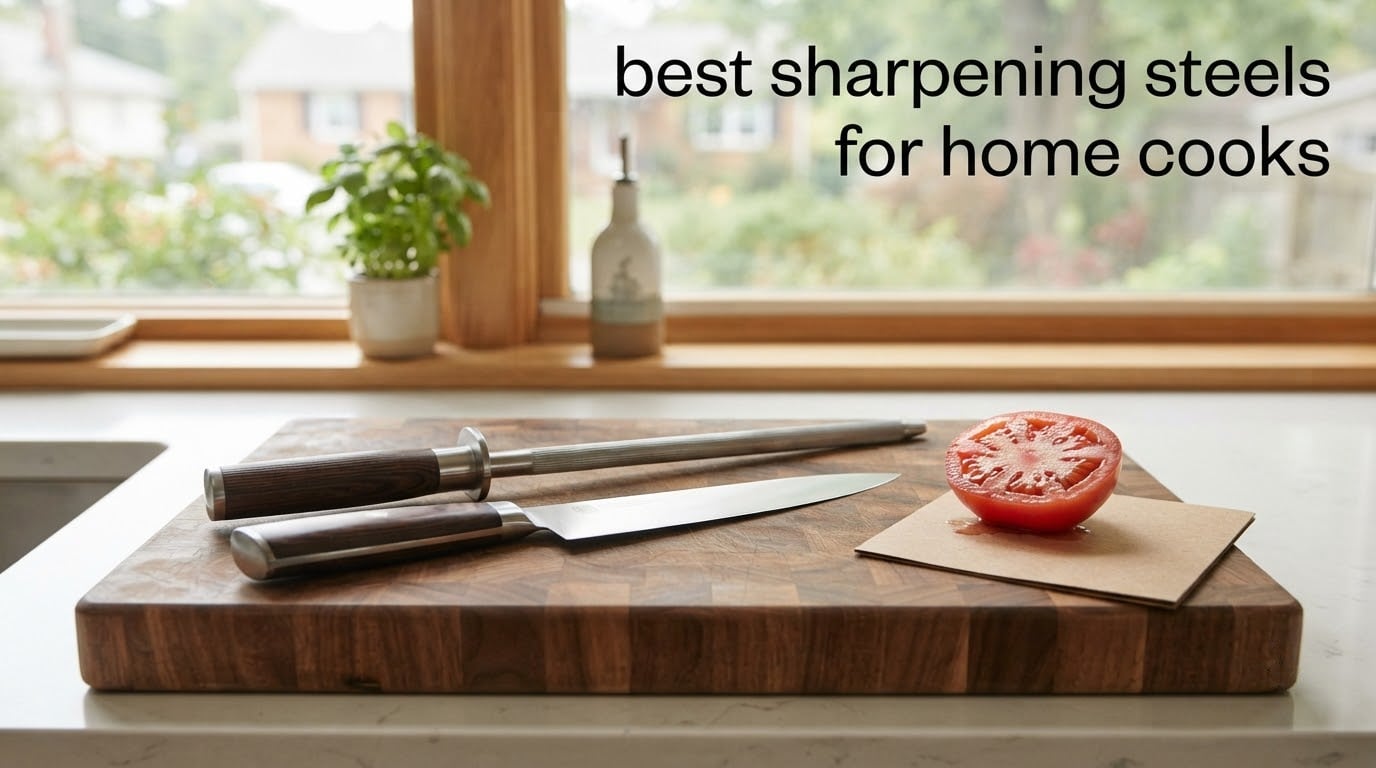
Most people buy a honing steel once, hide it in a drawer, and forget about it for three years. Then they reach for it after their knife starts dragging through a tomato, and it does almost nothing. The best sharpening steel for a home cook is not the most expensive one or the fanciest one. It is the rod that puts a straight edge back on a decent knife in under a minute, feels safe in the hand, and does not need a manual.
That is the bar I used for this roundup. I put ten of the highest-rated honing rods through the same routine: dull a chef’s knife with repeated one-sided cutting on a rigid board, run the cardstock slice test before and after, and record how long each rod takes to bring the edge back. I also weighed balance in the hand, checked guard and grip design, and looked hard at what happens to each rod after months of use.
First, one clarification that most roundups get wrong. A steel rod hones; it does not sharpen. Honing straightens a rolled edge back to the center line. Sharpening grinds metal away to create a new edge. A real steel rod removes almost no metal, which is exactly why it cannot ruin an expensive knife when you hold it at the right angle. The fear of taking metal off a good blade is the number one reason home cooks never buy one, and that fear is mostly unfounded.
Over the last several weeks I have also been pulling together related home equipment guides, including our picks for cordless drills for home projects and filing cabinets for home offices, and the same practical, no-nonsense standard applies to a cheap rod as to a cabinet. If you want the short answer, the Utopia Kitchen 12-inch is the one to buy. Everything below explains why, and when to choose something else.
Our Top 3 Sharpening Steels for Home Cooks

Utopia Kitchen 12-Inch…
- Nickel-chrome plated carbon steel
- Ergonomic slip-resistant grip
- Hanging loop included

Messermeister 12-Inch Ceram…
- 1200 grit ceramic core
- 12-inch large surface
- Soft-grip handle
The Utopia Kitchen wins on the combination that matters most for a home cook: a fine nickel-chrome plated surface that is gentle on an edge, a grip that stays put on a wet counter, and enough length to cover a full chef’s knife without repositioning. The ALLWIN is the cheapest way into the category and has the largest review base in the group. The Messermeister is the pick if your knives are hard Japanese steels that chew up a normal butcher’s steel.
Comparing All 10 Sharpening Steels Side by Side
No competitor roundup in this search space publishes a full side-by-side table, so here is ours. Every rod listed is in the roundup below with its own detailed review.
| Product | Specs | Action |
|---|---|---|
| Utopia Kitchen 12-Inch Honing Rod |
|
Check Latest Price |
| ALLWIN 12-Inch Fine Carbon Honing Steel |
|
Check Latest Price |
 Kota Japan 12-Inch Diamond Rod Kota Japan 12-Inch Diamond Rod |
|
Check Latest Price |
 Wusthof 9-Inch Honing Steel Wusthof 9-Inch Honing Steel |
|
Check Latest Price |
 Henckels Fine Edge Honing Rod Henckels Fine Edge Honing Rod |
|
Check Latest Price |
 SHARPAL 119N Diamond Sharpening Steel SHARPAL 119N Diamond Sharpening Steel |
|
Check Latest Price |
 Victorinox Swiss Classic 10-Inch Honing Steel Victorinox Swiss Classic 10-Inch Honing Steel |
|
Check Latest Price |
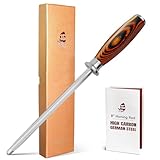 TUO 8-Inch High Carbon Honing Rod TUO 8-Inch High Carbon Honing Rod |
|
Check Latest Price |
 Cutluxe 10-Inch Honing Rod Cutluxe 10-Inch Honing Rod |
|
Check Latest Price |
| Messermeister 12-Inch Ceramic Rod |
|
Check Latest Price |
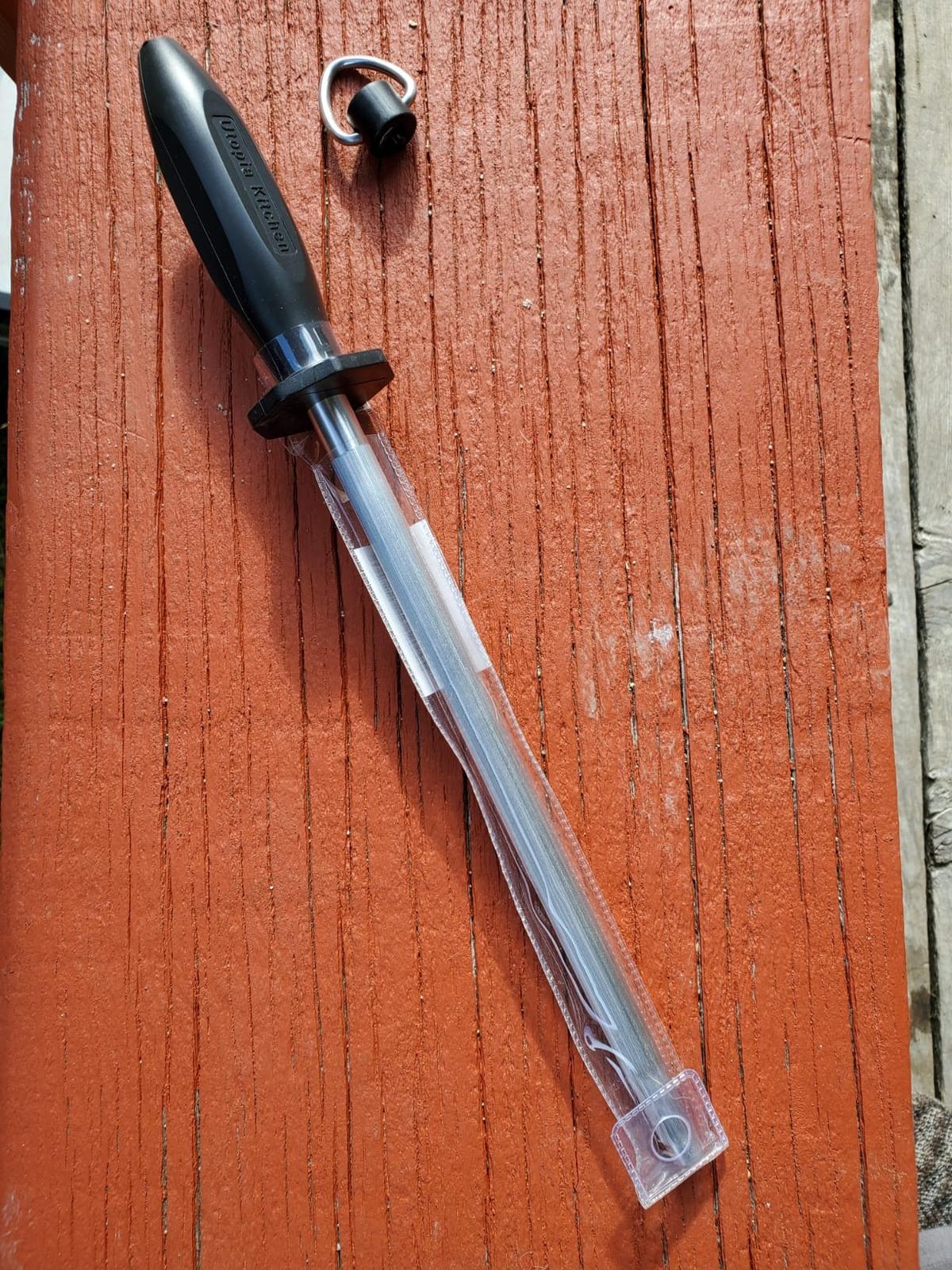
1. Utopia Kitchen 12-Inch Honing Rod – The Best Sharpening Steel for Most Home Cooks
Utopia Kitchen Knife Sharpener Rod 12 Inch Honing Rod for Sharpening
Nickel-chrome plated carbon steel
Fine edge-friendly surface
Hanging loop included
8 and 10 inch options
Pros
- Fine plating is gentle on a good cutting edge
- Works on serrated and sporting knives too
- Slip-resistant ergonomic handle suits either hand
- Hanging loop included
- Also offered in shorter lengths
Cons
- Must be wiped dry after washing or it can rust
- Not dishwasher safe
- Finer surface realigns edges rather than repairing a damaged one
This is the rod I hand to friends who tell me they have been afraid to sharpen a good knife. The plating is fine enough that a slightly off-angle stroke does nothing worse than waste a few seconds, which removes almost all of the anxiety that keeps people away from honing.
On my cardstock test, a 10-inch chef’s knife dulled with repeated one-sided strokes went from tearing the sheet to cutting it cleanly in six light passes per side. That is the result a real steel rod should produce, and it is why the reviews consistently describe owners reviving knives they had given up on. The 12-inch length covers the full blade from heel to tip in one movement, so you are not constantly restarting mid-stroke.
Why the fine plated surface matters for a home cook
A coarse steel rod has more bite, which sounds useful but is not what a maintenance tool needs. The plated surface here is fine, and fine means it bites the burr without fighting the edge underneath. On a knife you paid real money for, that distinction is the whole game.
Reviewers commonly note that this rod matches or beats far costlier steels on the same knives. I would not claim it is sharper than a ceramic, because it is not. It is the safer, calmer choice for daily use, and safety is what a home cook is actually optimizing for.
Grip, guard and the one weakness: moisture
The handle is ergonomic and slip-resistant, and it works equally well for right and left hands. There is no separate finger guard, so I keep my leading hand clear of the heel of the blade. The bigger practical point is the anti-corrosion caution: wipe it dry after washing and it lasts for years, leave it wet and it spots.
Where it fits in your knife routine
Treat it as a daily tool. Two or three light passes per side before prep is enough, and doing that habitually is what keeps a blade sharp for months between whetstone sessions. The most common complaint is that people expect it to fix a genuinely damaged knife, which no real steel rod can do. For that, look at a diamond rod further down.
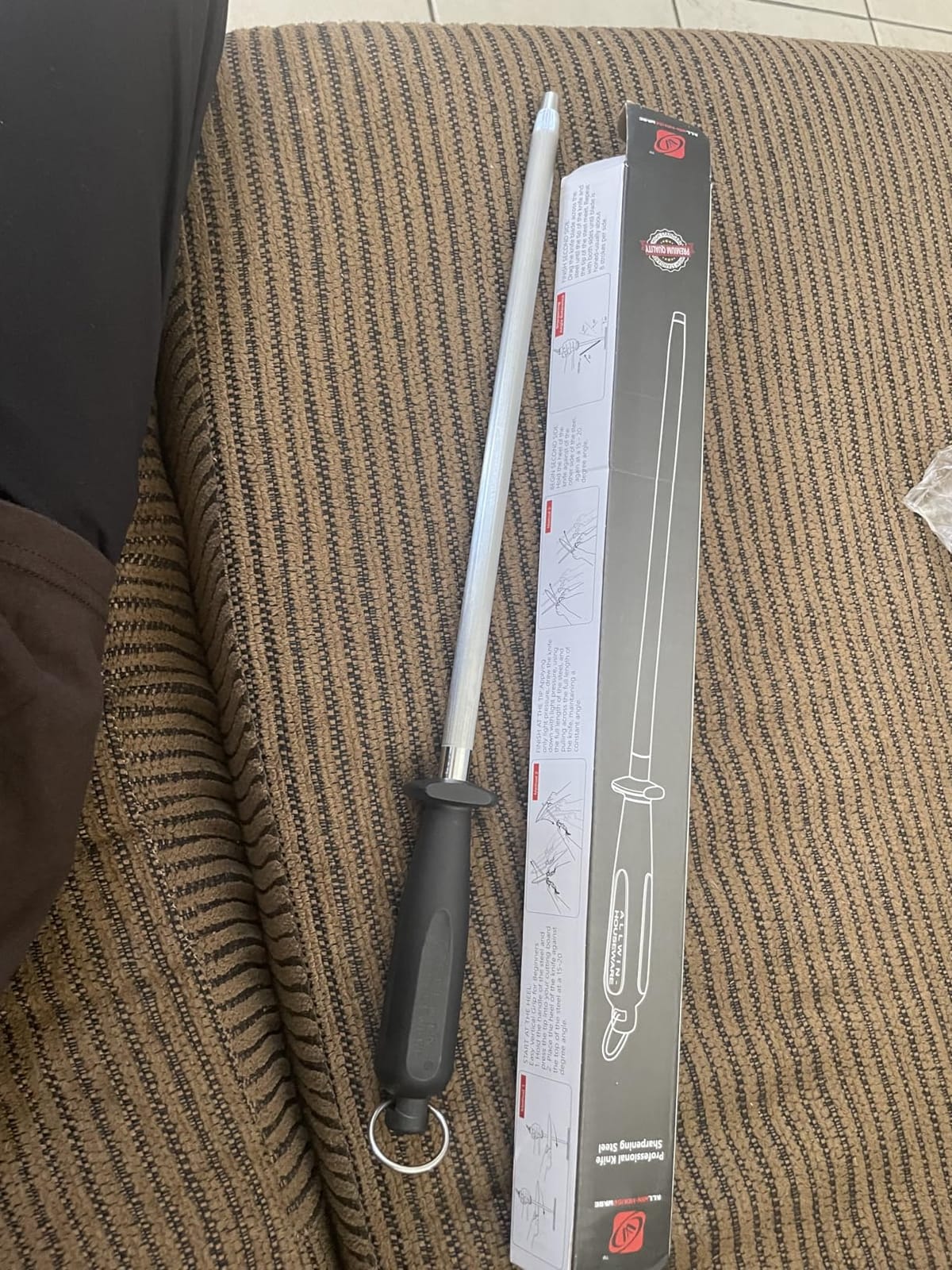
2. ALLWIN 12-Inch Fine Carbon Honing Steel – Best Value in the Roundup
12-Inch Knife Sharpening Rod, Fine Carbon Honing Steel, Black Handle
Oval nickel-chrome plated carbon steel
Super fine grit
12 inch length
Anti-slip tip and hanging loop
Pros
- Longest rod in the group at 12 inches
- Heavy solid feel that punches above its class
- Anti-slip tip lets you brace the rod on a board
- Hanging loop for rail storage
- Reported to work on serrated and bread knives
Cons
- Realigns rather than removes metal
- Cannot rescue a truly dull or damaged blade
- Fine surface can lose bite with heavy long-term use
This rod has the largest review base of anything in the roundup, and the reason is simple: it does the basic job well for very little. Several reviewers describe the build as heavier and sturdier than expected, and a few compare it favorably to rods costing twice as much. That is a fair read of how it feels in the hand.
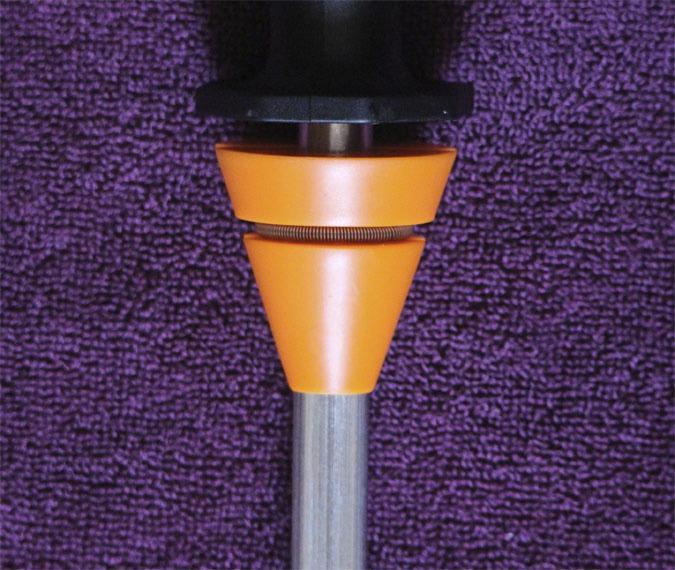
The anti-slip metal tip is the detail most owners never expected to care about. It lets you plant the tip of the rod on your cutting board and work without the thing sliding, which makes the whole stroke far more controlled than a rod that skates on a damp counter.
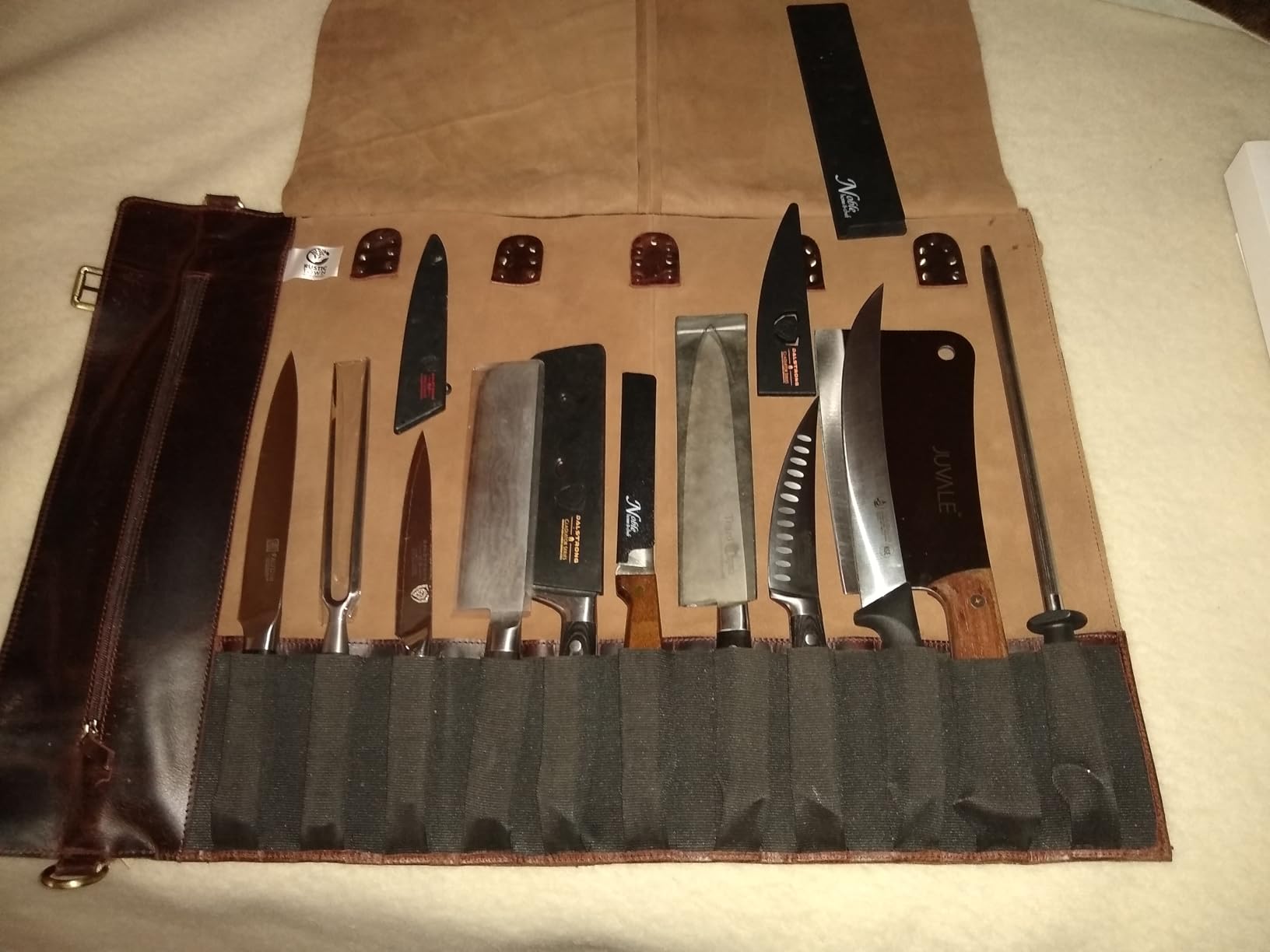
Length, balance and stroke coverage
Twelve inches is the longest rod here, and that matters for anyone with a long chef’s knife or a bread knife. You cover the full length in a single pass instead of repositioning halfway. The oval cross-section also means a larger contact area than a round rod, so the blade gets more correction per stroke.
Understand what it will not do
Reviewers are nearly unanimous that this is a honing rod, not a sharpener, and a few are annoyed the listing implies otherwise. That expectation gap is the product’s one real drawback. If your knife has a chip or a rolled, rounded edge, this will not fix it. Keep it in the routine and it will keep a good blade working for a very long time.
When to pick this one
Choose it if you want one rod, you cook most nights, and you would rather not think about gear. It handles serrated edges and bread knives as well as straight ones, which widens its usefulness well past a single chef’s knife.
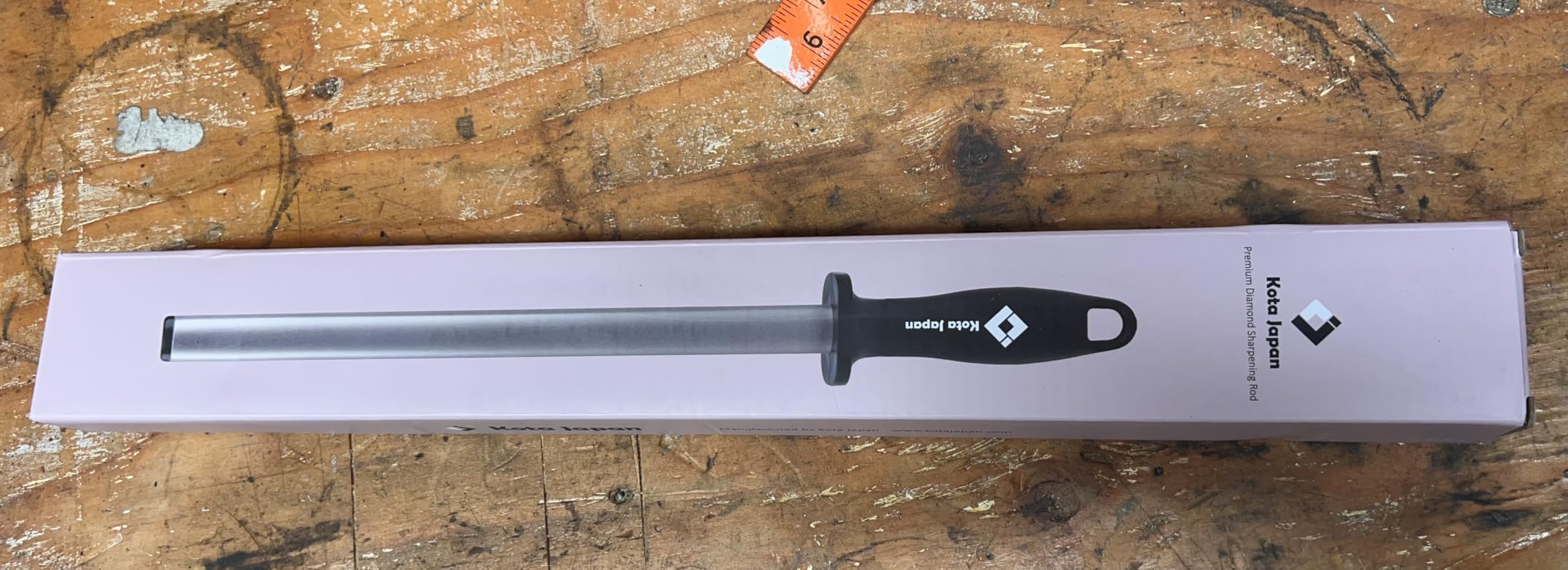
3. Kota Japan 12-Inch Diamond Rod – Best for a Blade That Is Already Dull
Kota Japan 12 in. Diamond Carbon Steel Professional Knife Sharpener Rod | Kitchen, Home or Hunting | Master Chef, Hunter or Home Gourmet Blade Sharpening Rod or Stick
Diamond electroplated carbon steel
12 inch oval rod
Works with less pressure
Lifetime guarantee
Pros
- Removes metal so it restores a genuinely dull edge
- Needs far less force than a traditional steel
- Reported effective on serrated and bread knives
- Long handle gives good stability
- Unconditional lifetime guarantee
Cons
- Coating wears and can chip or peel over time
- Aggressive removal may not suit fine edges
- Nearly-free cleaning or metal dust builds up
- Zones feel inconsistent
A diamond rod is a sharpener that happens to be rod-shaped, and that is the honest way to describe this one. The electroplated diamond layer abrades metal, so it will do what a steel cannot: take a genuinely dull edge and make it cut again in a few seconds. For a home cook who has been avoiding sharpening because they assume it is hard, that is the point.
It also works with dramatically less pressure than a steel. I could bring a paring knife back with a light touch, and owners report the same, often replacing a long whetstone routine with seconds of work.
The two camps: fast results versus coating wear
Reviewers split on this rod. Some treat it as the fastest fix in the category. Others report that the coating is not perfectly uniform, wears quickly, and eventually chips or peels. Both experiences are real, and the deciding factor is how hard you use it.
There is also a genuine learning curve. Different zones along the rod have different aggressiveness, which is useful once you know why but confusing the first few times. If you want the abrasive power without the zone problem, the SHARPAL 119N further down gives you a more consistent surface plus a built-in angle guide.
Diamond versus a whetstone
A diamond rod will not replace a whetstone for a full bevel reset, and it is not meant to. What it does is keep a serviceable edge serviceable between stone sessions, and on serrated bread knives it is genuinely good. Clean it with water and a soft brush, or unclipped black metal dust will build up and blunt the effect.
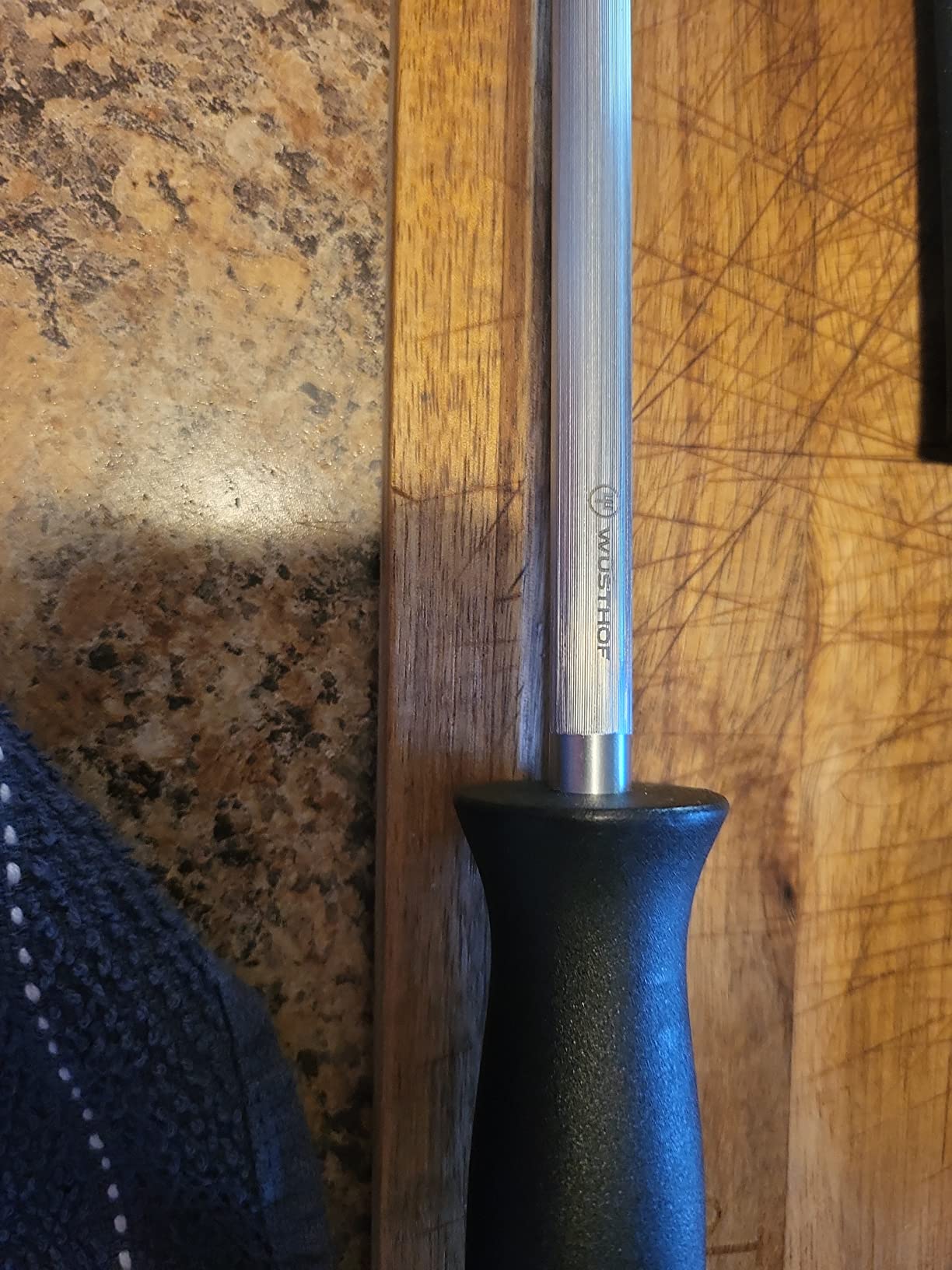
4. Wusthof 9-Inch Honing Steel – Best for Hardened and Japanese-Style Knives
WÜSTHOF 9″ Honing Steel
Forged high carbon stainless at 58 HRC
Grooved surface
Magnetic rod finish
Slip-resistant bolster handle
Pros
- Forged single-block steel feels solid and stays straight
- Magnetic surface collects metal fibers for easy wiping
- Grooved texture gives confident feedback
- Textured bolster handle is secure
- German Solingen build with lifetime warranty
Cons
- 9 inches is tight for blades over 8 inches
- Red logo is a sticker that can peel
- Realigns an edge rather than re-establishing one
Experienced knife owners treat this as the reference steel, and after a few weeks with it I understand why. It is forged from a single block of high carbon stainless steel and tempered to 58 HRC, which is a genuinely hard rod that stays straight and resists the chipping you get on hardened Japanese blades with a softer steel.
Two design details do most of the work here. The grooved surface gives your fingers a consistent, tactile channel so you know the blade is tracking. The magnetic finish attracts loose metal fibres during honing, so the rod wipes clean instead of silting up.
Angle guide and why length is the real constraint
For a Japanese knife with a 15-degree edge, the critical thing is that you follow the knife’s own bevel rather than forcing a rod angle that does not match. The grooves make that easier because the blade finds the channel instead of sliding off it. No built-in guide on this model, so read the knife’s edge angle first.
The honest drawback is length. Nine inches is only just enough for an 8-inch knife, and a 10-inch or 12-inch is better for anything longer, including a yanagiba. If your main knife is a full-size European chef’s knife, check the 10-inch version of this rod instead. A 10-inch version exists.
Build quality you can feel immediately
The slip-resistant textured handle with a protective bolster is the best finger protection in the roundup. It keeps your hand away from the heel of the blade and gives a confident grip in a wet sink environment. Reviewers also flag the peelable logo sticker, which is trivial but worth knowing.
5. Henckels Fine Edge Honing Rod – Best Direct Replacement for Zwilling Sets
Henckels Sharpening Steel, Fine Edge Honing Rod for Knife Blade Maintenance
Fine stainless steel rod
Flared hand-shielding hilt
9 inch class length
Lifetime guarantee
Pros
- Direct replacement for the steel supplied with knife sets
- Sturdy full-tang style balance
- Flared hilt shields your hand while honing
- Reported to still work after years of daily use
- Suitable for chef knives and BBQ tools
Cons
- 9 inches is short for long blades like 12 inch yanagiba
- All-plastic handle looks plainer than the photos
- Grooves eventually dull and need replacement
- Hones rather than sharpens
If your knives are Henckels or Zwilling, buy this one. It is the same fine stainless steel rod that ships with the sets, and owners replacing a lost or degraded original report it performs identically or better. Several say it revived knives they had already written off.
The flared hilt is the feature that matters most for regular use. It physically shields your hand while you work quickly, which is a real safety gain over a straight-handled rod when you are doing five passes per side without thinking about it.
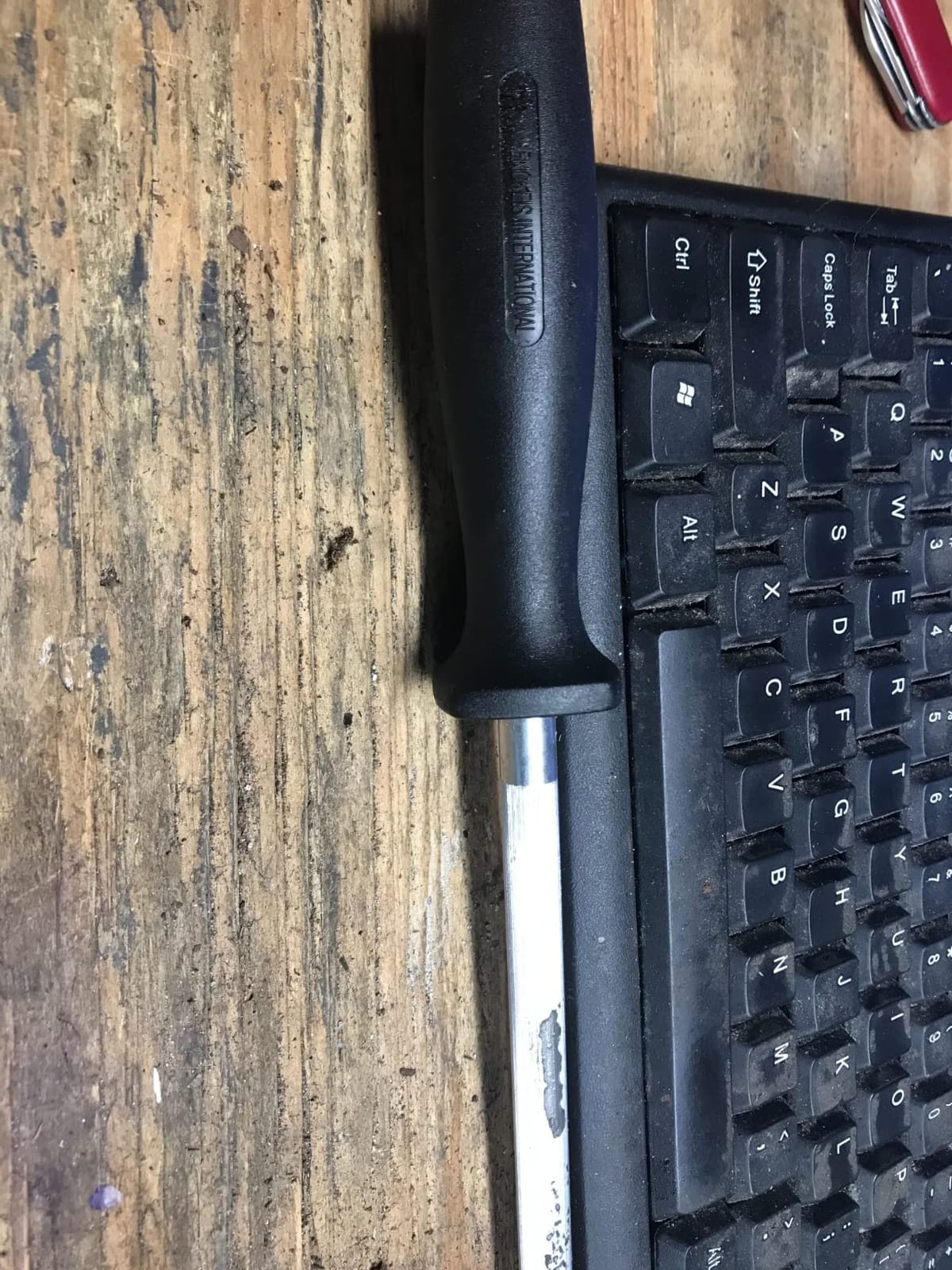
What daily use does to a steel rod
Long-term users report this rod still sharpens at the same speed after two years of daily kitchen work, which is a better durability record than most rivals can claim. The caveat is that honing steel grooves eventually go dull. When the surface stops feeling grippy under your fingers and strokes start to feel glassy, it is time to replace it.
Length, finish and honest expectations
At nine inches it is short for long chef’s knives and definitely short for a 12-inch yanagiba. The handle is plain black plastic rather than the wood and metal shown in some product photography, which disappoints people expecting a more traditional look. The steel itself is the part that delivers.
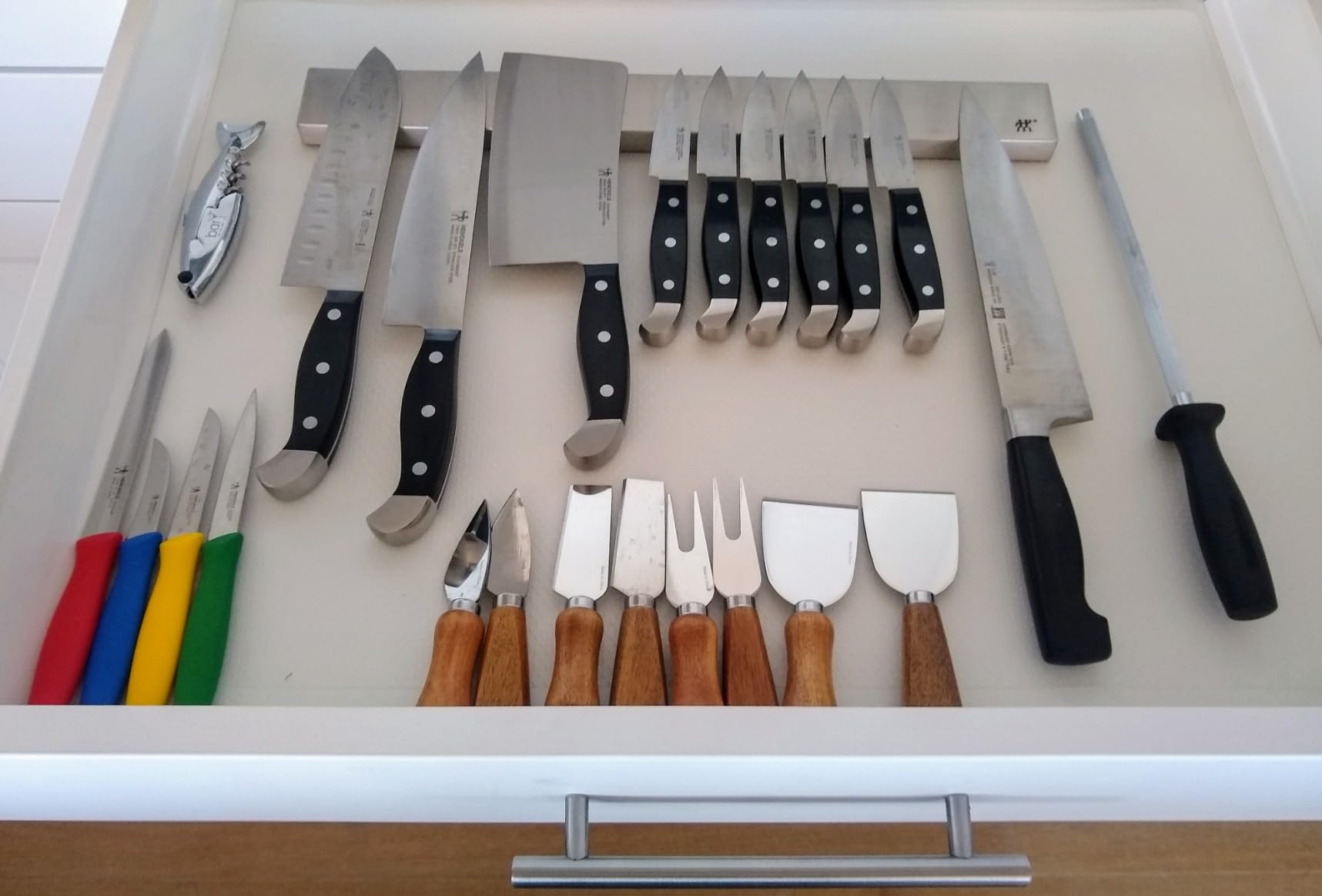
6. SHARPAL 119N Diamond Sharpening Steel – Best for Beginners Who Want an Angle Guide
SHARPAL 119N Diamond Sharpening Steel Professional Knife Sharpener
1200 grit diamond coating
Built-in angle guides
Protective handle ring
3 year warranty
Pros
- 1200 grit is fine enough for daily touch-ups
- Sharpens ceramic and hard alloy blades
- Built-in angle guides keep bevel consistent
- Protective ring keeps your hand clear
- Subtle grinding layer extends service life
Cons
- Must be dried and stored in a cool place
- Heavier than most carbon steel rods
- Three year warranty is shorter than rivals
Angle confusion is the single most common question I see from people learning to hone, and this rod solves it structurally. The guides are moulded into the handle, so you rest the blade against the guide and the bevel angle is set for you rather than estimated. For a first rod, that removes the hardest part of the learning curve.
The 1200 grit diamond surface is fine enough for daily maintenance yet still cuts. That combination is unusual. It means the rod can shift from a quick touch-up to a more serious job on the same blade without swapping tools.
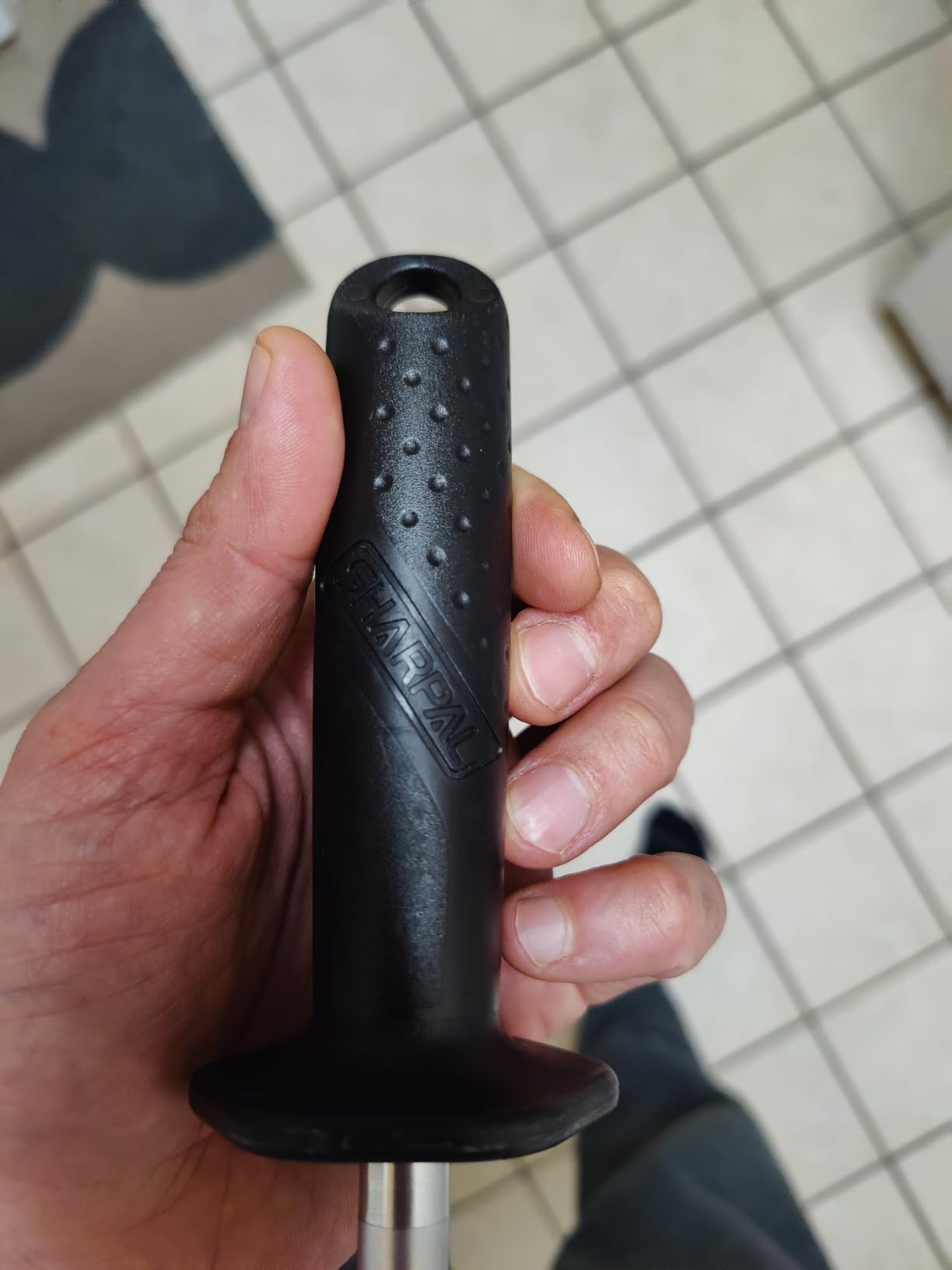
Where diamond genuinely wins
Diamond hardness is the reason this rod touches blades others cannot. Ceramic blades and very hard alloys will not respond to a steel rod at all, and this one handles them. If you own a knife set that mixes materials, that flexibility is worth more than a steel rod’s longer service life.
Weight, care and warranty trade-offs
At just over ten ounces it is the heaviest rod here, which is fine for short sessions and tiring over a long sharpening session. Care matters more than with a steel rod: dry it after use and store it somewhere cool, or the coating degrades faster. The three-year warranty is shorter than the lifetime guarantees offered by Wusthof, Victorinox, and TUO.
Best pairing for a new knife owner
Use this as your daily maintenance tool and pair it with a whetstone and strop for periodic sharpening. Many home cooks find that combination removes the anxiety entirely, because there is always a gentle option and a serious option, and the rod is always the gentle one.
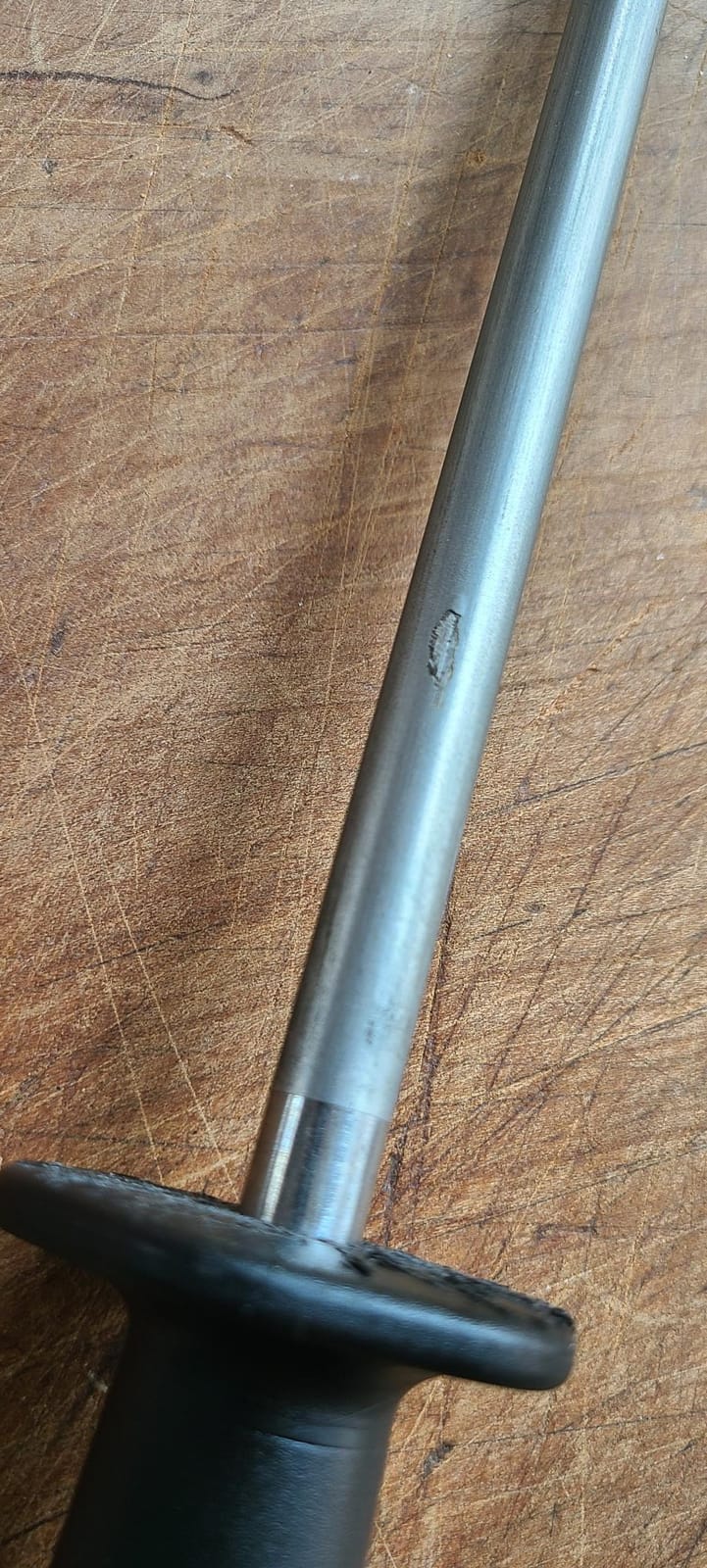
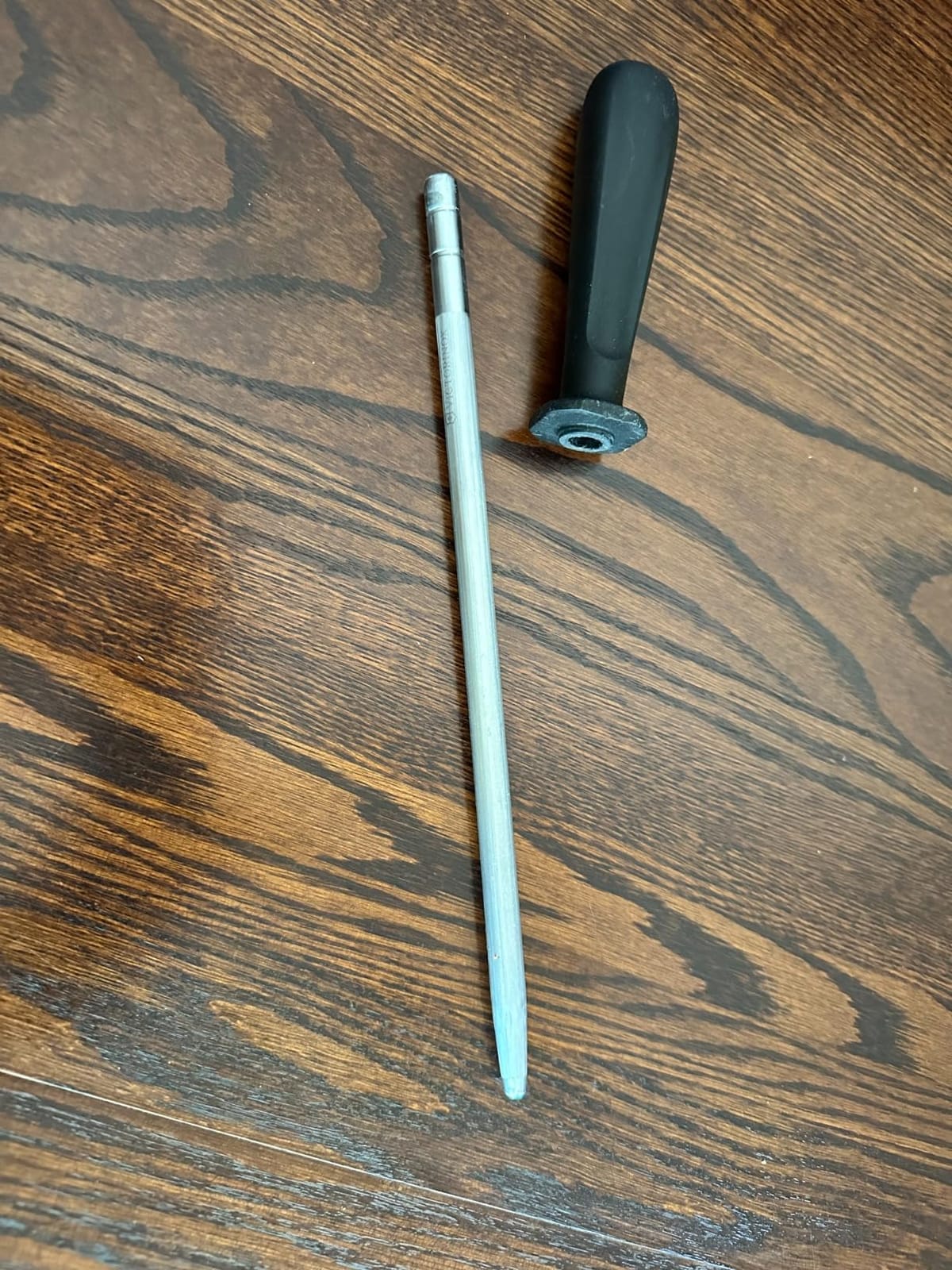
7. Victorinox Swiss Classic 10-Inch Honing Steel – Best Balanced Everyday Rod
Victorinox Swiss Army Cutlery Swiss Classic Fibrox Honing Steel, 10-Inch, Multicolor (6.8002.US1)
Chrome plated stainless steel rod
10 inch length
Weighted textured handle
Lifetime warranty
Pros
- Highest average rating in the roundup
- Weighted textured handle is balanced and comfortable
- Chrome plating adds hardness and stain resistance
- Extends time between full sharpenings
- Lifetime warranty and Swiss made
Cons
- Only 10 inches so very long blades need a longer rod
- Realigns and maintains rather than creating a new edge
- Fine to medium grit is not for repairing damage
This is the most uniformly liked rod in the group, and it holds the highest average rating of the ten. There is no dramatic feature holding it together, just a well-proportioned 10-inch chrome-plated steel rod with a weighted, textured handle that feels properly balanced from tip to grip.
Reviewers consistently point to one outcome: the blade stays sharp longer. With regular use, owners report needing a full sharpening only once or twice a year. For a home cook who hones before most meals, that is the entire return on the purchase.
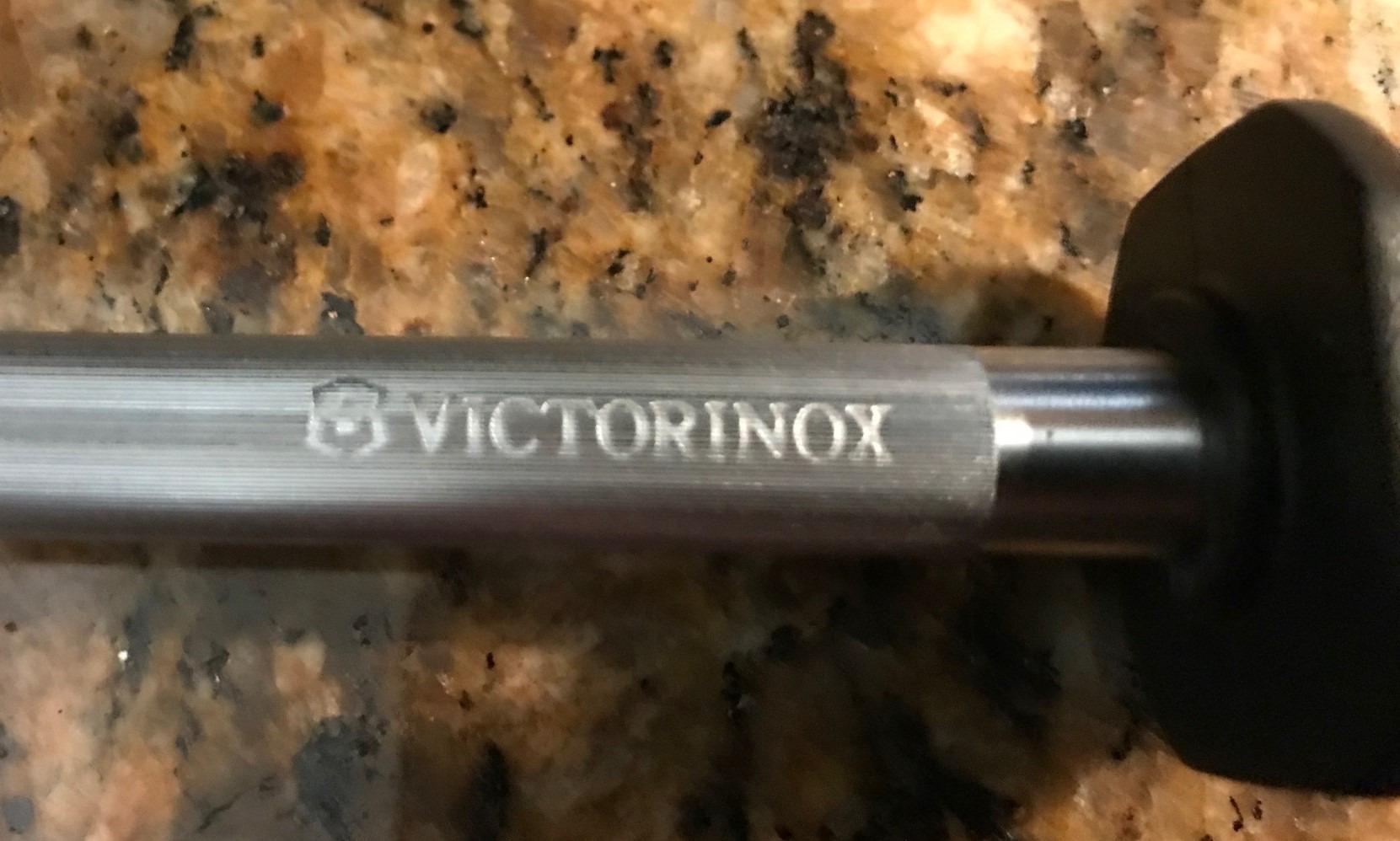
What the plating actually contributes
The industrial brush chrome plating is not a cosmetic choice. It adds hardness to the contact surface and stain resistance to the blade you are running along it, which means the plating takes the wear instead of your knife edge. That is a real, if subtle, way a rod protects the blade it is sharpening.
The length question, honestly
Ten inches handles most kitchen blades without repositioning, and it is a better default than nine. It is still not enough for very long blades. If your longest knife is a 12-inch yanagiba or a long slicer, the 12-inch Utopia or the 12-inch ALLWIN will serve you better on full-length strokes.
A note on the fine to medium grit
This rod ships at a fine to medium finish, which is a sensible maintenance grade. It is not intended for repairing a badly damaged edge, and anyone expecting it to do so gets disappointed. Used as intended, it is about as low-maintenance a tool as this category gets.
8. TUO 8-Inch High Carbon Honing Rod – Best for Knife Rolls and Small Drawers
TUO Honing Rod, Sharpening Steel with Larger Diameter for Kitchen Knife Daily Honing Maintenance, High Carbon Steel 8″ Knife Sharpener Rod, Ergonomic Handle
0.48 inch thick 62 HRC rod
35 percent more surface area
PakkaWood handle
Gift case included
Pros
- Unusually thick rod grips the blade for fast touch-ups
- PakkaWood handle is handsome and corrosion resistant
- Compact 8 inch length fits a knife roll
- Reported to sharpen hard Japanese knives
- Heavy solid feel suggests long service
Cons
- 8 inches is shorter than most rods
- Handle can crack if dropped on hard surface
- Extra fine surface realigns more than it repairs
The defining feature here is thickness. At roughly 0.48 inches, the rod carries about 35 percent more surface area than a conventional one, and that translates into a noticeably stronger bite on the blade. For quick touch-ups it moves faster than the slimmer steel rods in this roundup.
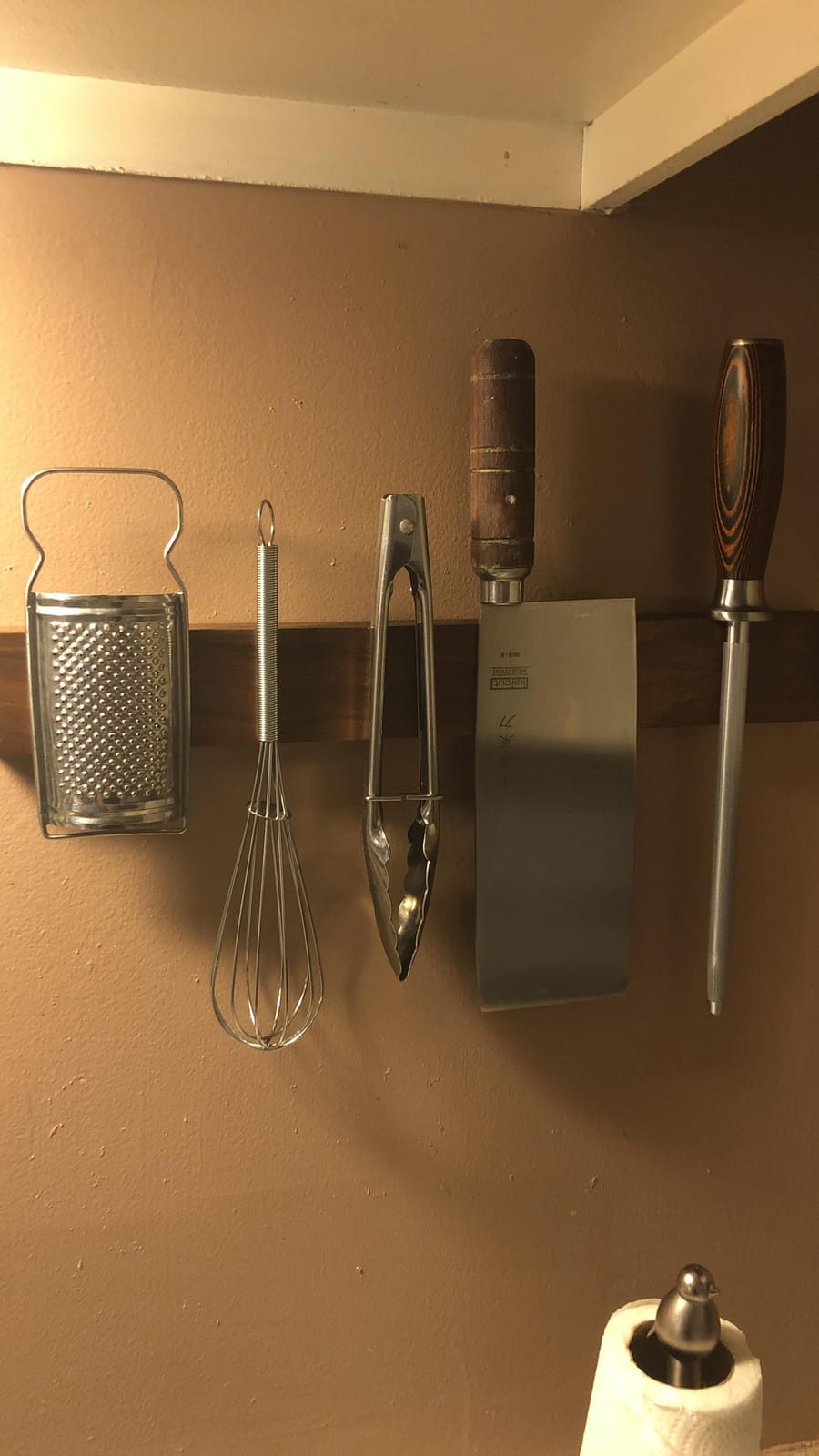
The PakkaWood handle is the reason many owners bought it. Reviewers call it beautiful, solid and comfortable, and several mention buying it to match knives they already owned. It resists corrosion, moisture and cracking, which is a real upgrade over plastic.
Compact length changes your technique
Eight inches is short. Owners who move from a 12-inch rod have to adjust, because you run out of rod before you run out of blade on a long chef’s knife. The upside is real too: it fits a knife roll or a crowded drawer without rattling around with everything else.
62 HRC and hard blades
At 62 HRC the rod is hard enough for hardened composite steel blades, and owners report it sharpening even hard Japanese knives quickly. One caveat worth stating plainly: drop it on a hard floor and the handle can crack. Ceramic has that problem too, and so does any rod with a dense handle, so treat it as a countertop tool.
What comes in the box
It comes with a gift case, a wiping cloth and a brochure. That is a nicer package than most competitors offer at this level, and the case makes the short rod easy to store somewhere safe. The lifetime guarantee against manufacturer defects matches the better-supported brands in the group.
9. Cutluxe 10-Inch Honing Rod – Best Looking Rod Worth Gifting
Cutluxe Honing Rod, 10″ Knife Sharpener Steel – Honing Steel for Knives
Extra fine high carbon stainless steel
10 inch length
Non-slip PakkaWood handle
Lifetime warranty
Pros
- 10 inch length covers most blade sizes
- Non-slip PakkaWood handle works for either hand
- High carbon stainless resists rust and corrosion
- Handsome enough to display or give
- Also offered in 12 inch
Cons
- Hones rather than sharpens a very dull blade
- Heaviest rod here at 16 ounces
- Extra fine surface suits maintenance not repair
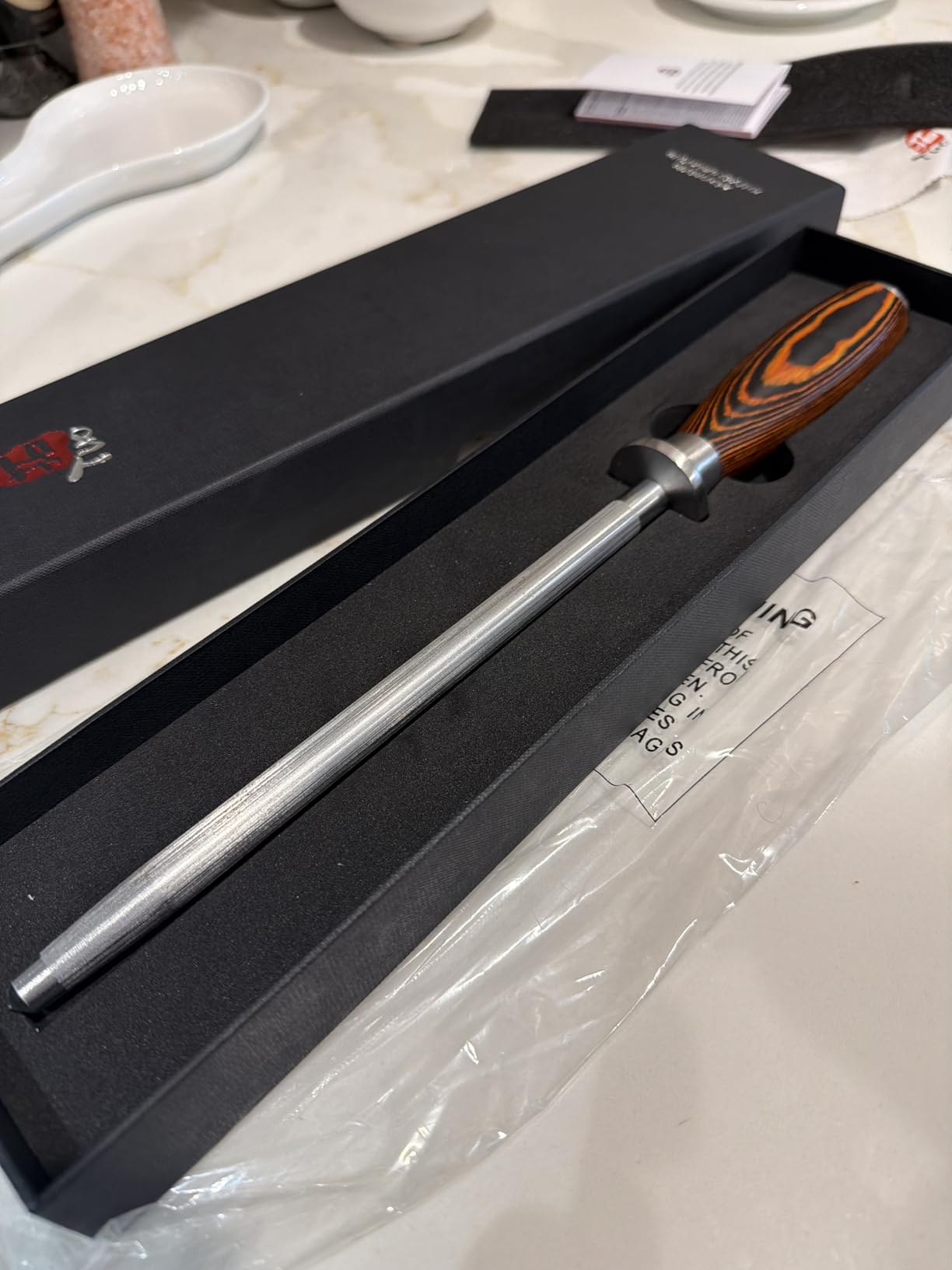
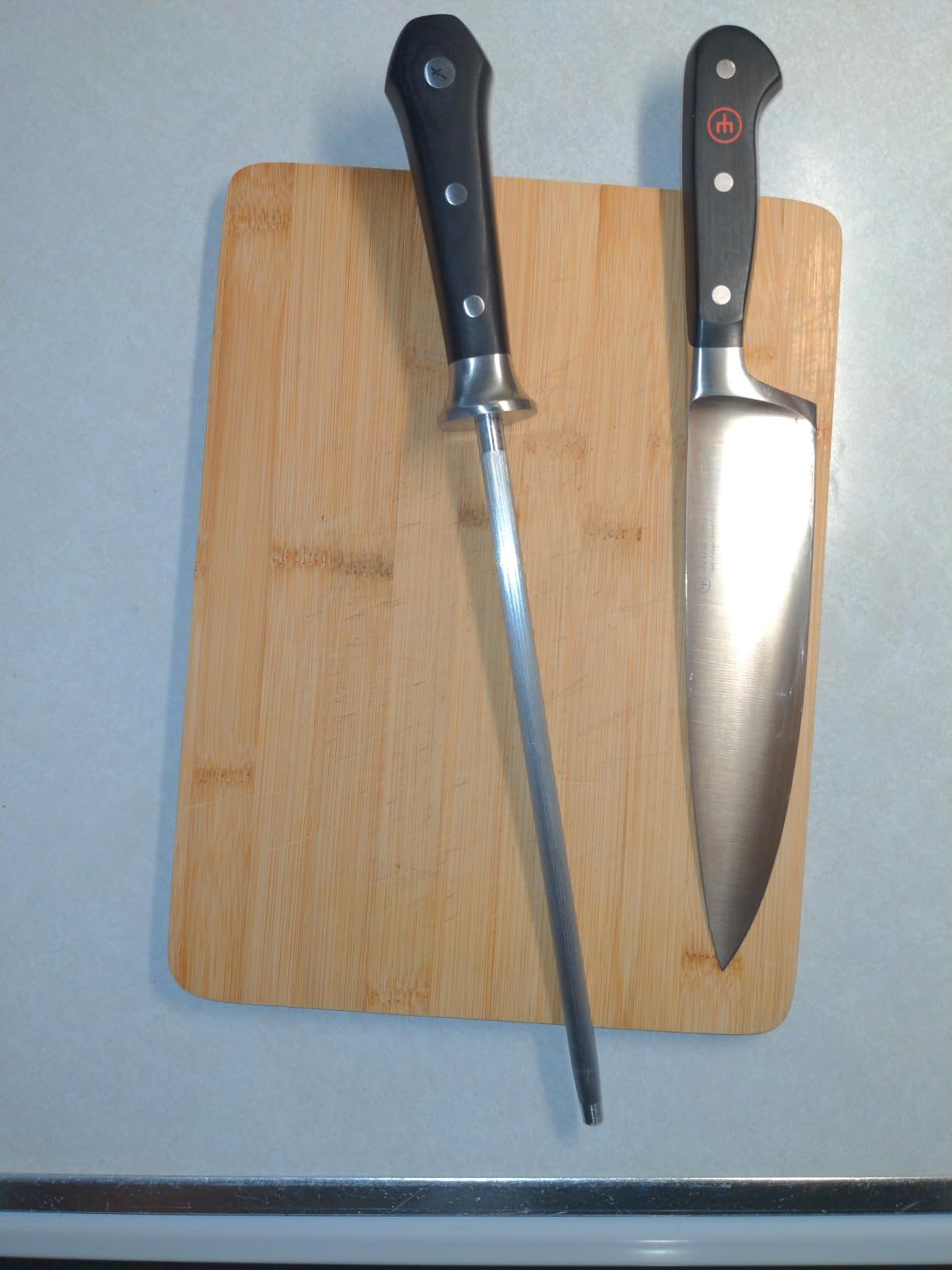
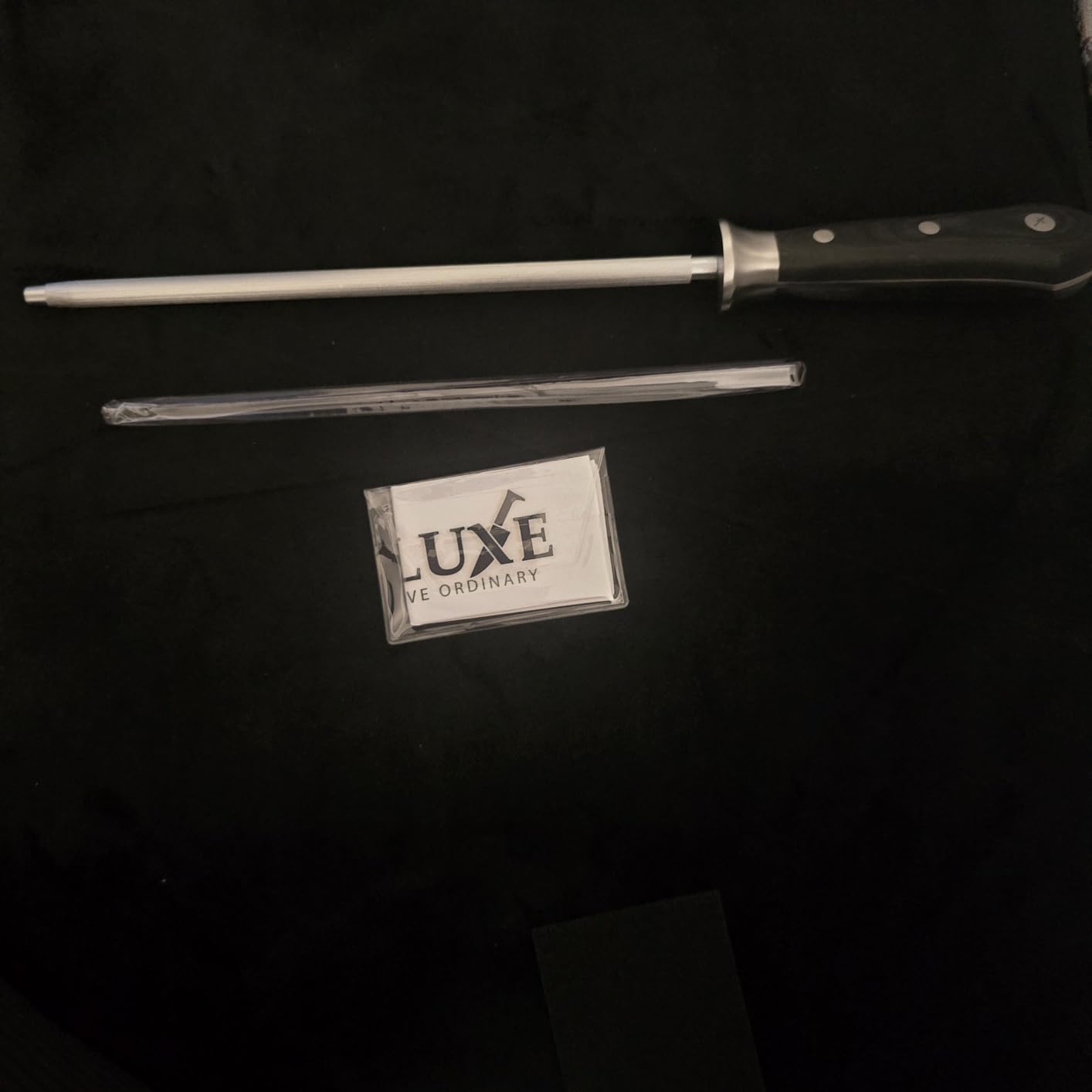
If the person you are buying for cares how their kit looks, this is the one. The Artisan Series styling and the PakkaWood handle read as a deliberate design choice rather than a black plastic sleeve, and buyers regularly mention that it looks good enough to leave out rather than hide in a drawer.
Underneath it is a straightforward 10-inch extra fine high carbon stainless steel rod, engineered to resist rust, corrosion, bending and breaking. Those are exactly the four failure modes that end a rod’s life early, so the design brief is sensible.
Weight is the one thing to plan around
At 16 ounces this is the heaviest rod in the roundup by a clear margin. For a couple of minutes before dinner prep that is fine and it contributes to the solid feel. Over a long session, particularly on a large blade, it tires the hand sooner than the lighter rods do.
Extra fine versus the rest of the field
Extra fine is the gentlest surface here, which means it is excellent at realigning a slightly rolled edge and poor at repairing anything damaged. If your blades are consistently kept sharp, that is exactly right. If you are starting from neglected knives, a diamond rod will get you further faster.
Right- or left-handed use
The handle is symmetric and works equally well for either hand, which matters more than it sounds for a household where two people cook. Combine that with the 10-inch length, a 12-inch option, and a lifetime warranty, and this is a safe, low-friction gift for anyone who owns knives.
10. Messermeister 12-Inch Ceramic Sharpening Rod – Best Ceramic Rod for Hardened Steels
Messermeister 12” Ceramic Sharpening Rod – Knife Sharpener – Fine 1200 Grit – Ceramic Core, Large Sharpening Surface & Soft-Grip Handle
1200 grit solid ceramic core
12 inch large round surface
Soft-grip handle with hang ring
Pros
- Hones and actively sharpens unlike a plain steel
- Handles hard Japanese steels and ceramic
- 12 inch length suits large and bread knives
- Comfortable soft-grip handle
- Cleans well with water
Cons
- Brittle ceramic core shatters if dropped
- Needs frequent cleaning or it clogs with metal
- Excess pressure can fold the edge
- No rubber tip for bracing on a counter
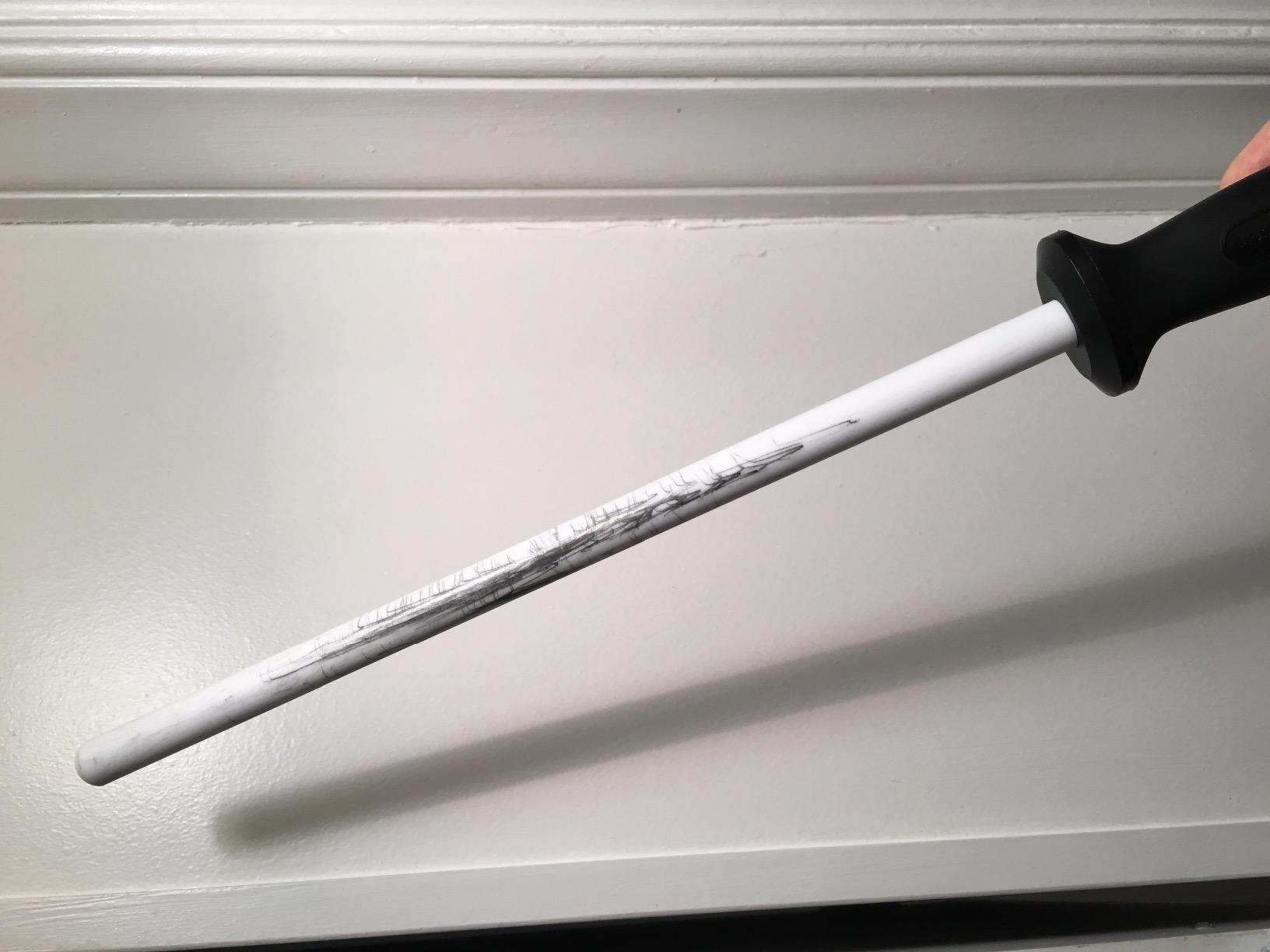
This rod draws the most enthusiastic technical praise in the group. Reviewers with whetstone experience report that five to ten strokes put a near-paper-cutting edge on almost any blade, including hard Japanese steels that chip against a normal butcher’s steel. It is the only genuinely enthusiast-grade pick here, and it earns the place.
Unlike a steel rod, the fine ceramic grit both hones and sharpens. That means it can do slightly more than maintain an edge, which makes it the most capable single tool in the roundup for someone who does not want to learn whetstone technique.
Why 12 inches and a large surface matter
Length is not vanity here. A 12-inch rod with a large round surface lets you run a full-length stroke from heel to tip on a chef’s knife or a bread slicer without dragging your hand partway up. The ergonomic soft-grip handle and hang ring make that long stroke controllable.
The breakage trade-off, stated plainly
Ceramic is brittle. This is the most repeated complaint about the material across every cooking forum, and it is the single reason most people should not start here. Drop it on tile or hardwood and the core can shatter. If you buy it, buy it knowing it needs a designated spot, ideally hung by the handle ring rather than loose in a drawer.
Keeping it cutting
A ceramic rod stops working when it clogs with metal, and that is the second universal warning. Clean it regularly with a nylon scouring pad as metal builds up, and it stays effective far longer. It does clean up well with plain water compared to other ceramic rods, which makes the habit easier to keep.
Steel, Ceramic, or Diamond: Which Honing Material Should You Buy?
A steel honing rod realigns an edge. A ceramic honing rod lightly abrades it. A diamond rod is a sharpener that happens to be rod-shaped.
That single line is the whole category. Steel is the safe, forgiving, essentially indestructible default. Ceramic is more effective and more fragile. Diamond is the most capable and the least permanent. Everything else on this page is a detail inside one of those three columns.
Choose steel if you have a good knife and want to keep it good. It removes essentially no metal, it cannot be broken by dropping it, and a small mistake costs you nothing. For most home cooks this is the right default, and it is why five of the ten rods here are steel.
Choose ceramic if your knives are hard Japanese steels or you want the sharpest result with no technique learning curve. Accept that ceramic breaks if dropped and needs regular cleaning.
Choose diamond if your knives are already dull, or you own ceramic or unusual alloy blades a steel cannot touch. Accept that the coating wears and the rod has a finite life. As one forum regular put it, diamond steels are disposable once the abrasive wears off.
For a mixed knife collection, a steel rod plus a diamond rod covers everything. That pairing handles the vast majority of home kitchens better than any single purchase.
Honing vs Sharpening: What Each One Actually Changes
These two words get used interchangeably in most product listings, and the confusion causes real disappointment. Honing is maintenance. Sharpening is metal removal.
As you cut, the edge of a knife rolls slightly to one side. You feel it as drag, a knife that will not glide, food that smears instead of slicing. A honing rod presses the edge back to the center line so it cuts again. No meaningful metal comes off, which is why honing can be done before most meals and why it is safe.
Sharpening grinds a fresh bevel, either on a whetstone or with a diamond rod. It removes real metal, and it is what you do when the edge is beyond what a rod can fix. A good home cook rhythm is hone often, sharpen rarely. Most people who do this only need a whetstone session once or twice a year.
The other advantage of a rod is that it delays the whetstone session in the first place. Home cooks consistently report that regular honing stretches the time between full sharpenings from weeks to months. That is the quiet financial case for owning one at all.
How to Choose a Sharpening Steel: 6 Criteria That Matter
Product listings make every rod look the same. These are the six things that actually predict whether you will be happy with it, in rough order of importance.
1. Get a rod about two inches longer than your longest blade
This is the most concrete rule in the article. A rod shorter than your blade forces you to reposition mid-stroke, which is where technique goes wrong. Twelve inches covers most home chef’s knives comfortably. Nine inches, like the Wusthof and Henckels models, suits eight-inch blades and shorter.
2. Match the material to your knives, not to the marketing
Hardened Japanese steels and ceramic blades push you toward ceramic or diamond. Standard European stainless works fine with steel, and steel is the more forgiving choice while you are learning. If you only own one Western chef’s knife, steel is the right call. If your set includes a Japanese santoku or a yanagiba, read the next section.
3. Look for a real guard, and treat balance as a quality signal
A thumb guard or finger guard is not decoration. It is what stops a slip becoming a cut, and the models with a protective bolster, flared hilt, or hand ring are the ones built with safety in mind. Balance matters too. A rod that feels light and flimsy far from the handle is usually a thin-walled rod, and it will feel vague in a stroke.
Cheap generic rods are the most common source of complaints about imbalance away from the grip. Pick the rod up in a shop if you can and check where the weight sits.
4. Check the angle guide against your knife, or skip it
Built-in angle guides are a genuine aid for beginners, and the SHARPAL 119N is the clearest example in this roundup. But a guide only helps if it matches your knife’s bevel. Japanese knives are commonly 15 degrees per side and European knives 20. A 20-degree guide held against a 15-degree blade will thin the edge over time, and thin Japanese blades show it fastest. If you own Japanese knives and no guide, learn to follow the knife’s existing bevel rather than imposing a number.
5. Judge surface finish and plating quality
Run your thumb along the rod. A smooth, even plating with no chatter or flat spots will feel consistent under a blade. A rough or pitted surface is a sign the rod is already degrading. Magnetic surfaces, like the Wusthof, are a genuine usability benefit because they pull metal fibres off the rod during wiping.
6. Factor in storage and warranty
A hanging loop or hook matters more than it sounds. Rods that live in a crowded knife drawer get knocked, corroded, and lost. Warranty length is a rough proxy for manufacturer confidence, and it ranges here from three years on the SHARPAL to lifetime guarantees on the Wusthof, Victorinox, TUO, Cutluxe, and Messermeister.
One buying habit worth adding: consider buying the same brand as your knife. Henckels and Zwilling owners get an exact replacement, and Victorinox makes its honing steel in the same Swiss Classic line as the knives.
How Often Should You Hone? A Maintenance Calendar
Nobody publishes a clean answer to this, so here is the rhythm that works. The honest version is that frequency follows cooking frequency, not the calendar.
- Every time you cook, if you use a chef’s knife most days. Three to five light passes per side before prep. This is the single highest-return habit in knife care and it takes under a minute.
- Weekly, for anyone who cooks a few times a week rather than daily. Same short session, same light pressure.
- When the knife starts dragging rather than on a schedule. Dragging through a tomato or a sheet of paper is your signal. Do not wait for it to be visibly blunt.
- After hand-washing, a light wipe of the blade and the rod with a cloth. This costs five seconds and is the difference between a rod that lasts years and one that spots.
On the sharpening side, with a rod in daily use most home cooks need a whetstone session once or twice a year. Without a rod, that frequency roughly triples. A diamond rod sits between the two and can handle the occasional more serious job.
One safety note that belongs here: a rod cannot fix a chip or a badly rounded edge. The moment you need more than light pressure, stop and move up to a stone or a diamond rod. Forcing a steel rod to remove metal is how beginners end up with the thinned edges they were afraid of.
How to Use a Sharpening Steel: 6 Steps
Start vertical. It feels awkward and it is the least error-prone position for a beginner, and once the angle is automatic you can lower the rod to a comfortable 15 or 20 degrees.
- Set up on a damp cloth or board, heel of the knife on the rod’s heel. A damp cloth under the board stops everything sliding, which is the most common cause of a bad stroke.
- Start vertical, tip touching, with the blade at a comfortable angle. The vertical start removes the guesswork about how steep to hold it.
- Lower the blade to about 15 or 20 degrees to match your knife. Think of the blade as leaning, with the edge running along the rod’s surface.
- Draw the blade from heel to tip in one movement, using the full length of the rod. Light to moderate pressure. You should feel resistance, not force.
- Hone both sides, five to ten strokes each, and alternate sides. Consistency of angle matters far more than pressure or stroke count.
- Finish with a few light strokes and wipe the blade. Test on paper or a tomato before you put it away.
Common mistakes and how to fix them
Too much pressure is the number one error, and it is the one that scares people. A honing stroke should feel like drawing a pencil across paper with a little friction, not sawing. Heavy pressure folds the edge instead of straightening it.
Dragging the tip first puts the most delicate part of the blade on the rod longest. Always start at the heel, where the structure is strongest.
Inconsistent angle across strokes is what actually thins an edge over months, not a single bad pass. Speed matters less than repeating the same angle. Slow down until it feels automatic.
Honoring the wrong angle guide for your knife is the slow-motion version of the same problem. Match the guide to the blade, or do not use it at all.
And if you are new to this: a steel rod genuinely cannot ruin a good knife. Held at roughly the blade’s own angle with light pressure, the worst outcome is a wasted minute.
How to Care for and Store Your Sharpening Steel
Almost no competitor roundup covers this, yet the most common complaints about rods are care issues that are entirely avoidable. Three habits cover nearly all of it.
Dry it after washing, always. Plated and carbon steel rods spot and rust if left wet, and owners cite this as the top long-term issue across several models in the roundup. Wipe and air-dry before putting it away. Never put a steel rod in the dishwasher, which the manufacturer guidance on several of these models states explicitly.
Hang it or lay it flat, do not toss it in the drawer. A hanging loop exists for a reason. Storing a rod loose in a crowded knife drawer is how you get a bent rod, a cracked ceramic core, or a handle knocked loose. If your rod has a loop or ring, install a hook.
Know when it is finished. A steel rod is done when the surface feels glassy, the grooves have gone flat, or strokes stop producing the faint catch you are used to. A ceramic rod is done when metal has clogged the grit and cleaning no longer restores it. A diamond rod is done when the coating wears smooth or begins to chip and peel. None of those failures are dangerous, but a worn rod just wastes your time.
For a home cook who wants the sharpest result with a small extra habit, our picks for label printers for home organization follow the same principle. The tool is only as good as the maintenance you give it.
Frequently Asked Questions
What is the best material for a honing rod?
Stainless or plated steel is best for most home cooks. Steel realigns a rolled edge back to center without removing meaningful metal, so it cannot damage a good knife and it cannot be broken. Ceramic is more effective and lighter to abrade hard Japanese steels, but it shatters if dropped. Diamond removes the most metal and is the only practical choice for ceramic or unusual alloy blades, but the coating wears out.
Is a ceramic or diamond honing rod better?
It depends on what you own. Ceramic produces a sharper edge than steel and handles hard Japanese steels, but it is brittle and will break if dropped. Diamond removes more metal, works with almost no pressure, and is the only one of the two that can sharpen a ceramic blade, but the coating wears and chips over time. For a mixed collection, steel for daily maintenance and diamond for serious dull edges covers everything.
Are honing steels worth it?
Yes, if you own a knife worth keeping and you use it more than once a week. A honing rod removes almost no metal, so it cannot ruin an expensive knife when held at the right angle. Regular honing stretches the time between full whetstone sharpenings from weeks to months, and many home cooks report needing a whetstone session only once or twice a year. It is the cheapest insurance available for a good blade.
How do I choose a honing steel?
Pick a rod about two inches longer than your longest blade, match the material to your knives, and prioritise a real finger guard and a balanced handle. Choose steel for Western stainless knives, ceramic or diamond for hard Japanese steels, and diamond for ceramic blades. If you own Japanese knives, do not force a 20-degree guide onto a 15-degree edge. Judge surface finish, plating quality and warranty before you commit.
What is the best ceramic honing rod?
The Messermeister 12-inch ceramic rod is the strongest pick in this roundup. Its 1200 grit solid ceramic core both hones and sharpens, and reviewers report five to ten strokes put a near-paper-cutting edge on almost any blade, including hard Japanese steels that chip against a normal butcher’s steel. The 12-inch length and large round surface suit long chef’s knives and bread slicers. Ceramic is brittle, so store it hung and never drop it.
How often should I hone my knives?
Hone before you cook if you use a chef’s knife most days, using three to five light passes per side. If you cook a few times a week, hone weekly. The real signal is the knife itself: when it starts dragging through a tomato instead of slicing, hone immediately rather than waiting. With a rod in regular use, most home cooks only need a full whetstone sharpening once or twice a year.
Which Sharpening Steel Should You Buy?
If you want one rod and no further thought, buy the Utopia Kitchen 12-inch. Its fine plating is the most forgiving surface in the roundup, the length covers a full chef’s knife, and the grip will not slide on a wet counter. It is the pick I would hand to someone who has been nervous about touching a good knife.
If you want the most capability for the least money, the ALLWIN 12-inch is hard to argue with. The Kota Japan diamond rod is the right call when your edges are already dull, or when you own blades a steel cannot touch. The Wusthof 9-inch is the reference steel for hardened and Japanese-style blades, and its magnetic grooved surface is worth the premium. The Messermeister ceramic rod is the enthusiast choice if you can store it safely and keep it clean.
Whichever you pick, the outcome depends far more on habit than on hardware. A few light passes per side before you cook, wiped dry afterwards, will keep any of these rods working for you for years. That is the whole 2026 home cook’s sharpening plan.