
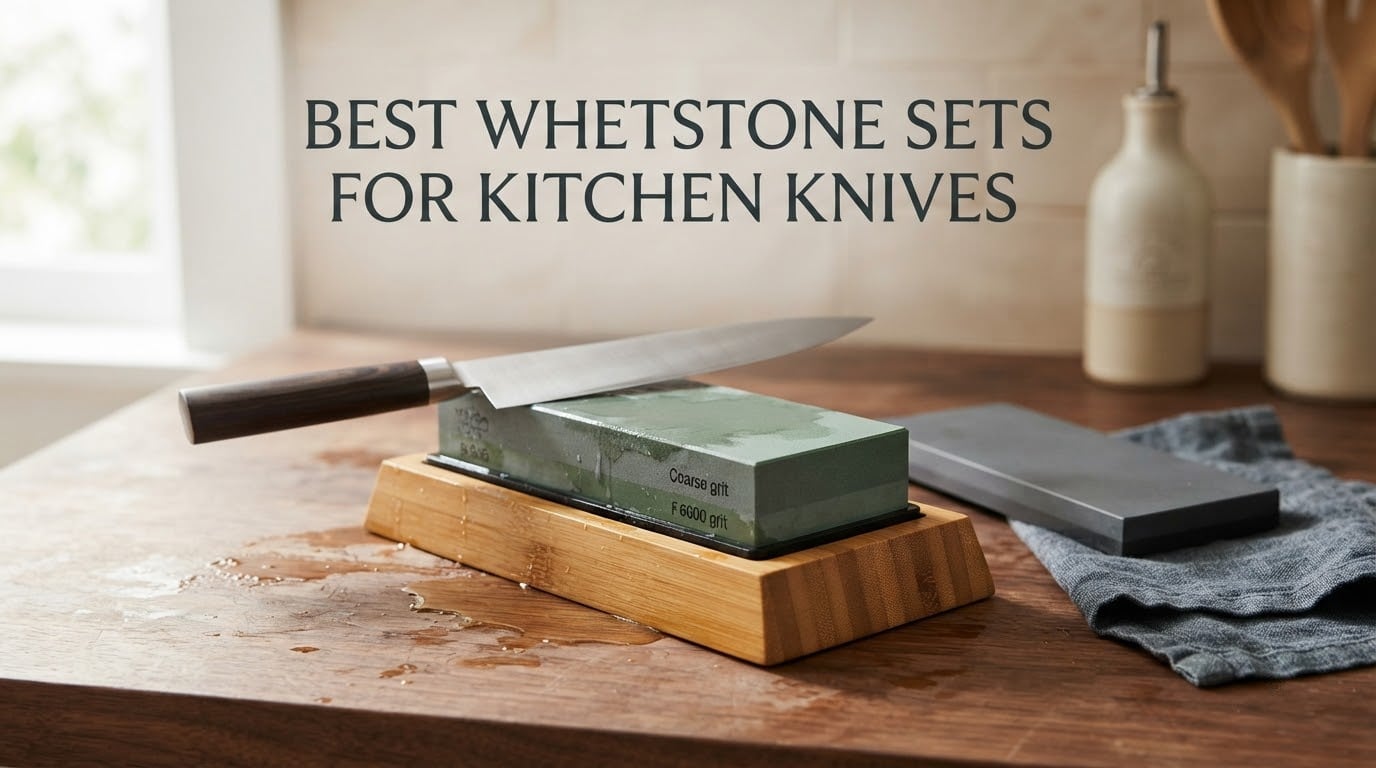
A dull chef’s knife is the most dangerous tool in a home kitchen. It crushes tomatoes instead of slicing them, skids off onion skin, and forces you to press harder than you should. After a few years of use, the fix is usually a sharpening stone, and that is where choosing among the best whetstone sets for kitchen knives gets confusing fast.
Every kit listing says 400/1000 plus 3000/8000 grit. Every kit photo looks the same. The differences that actually change your results, whether the set includes a flattening stone, whether the base grips a wet countertop, whether the stones are soft enough to dish in six months, are buried in the fine print. I have sharpened knives in my own kitchen for years, leaned on the reasoning of people who do it daily over at Kitchen Knife Forums and r/chefknives, and put these ten sets side by side on the same counter.
Below is what I found, plus the buying logic that will help you even when a set you like is not on this list. If you are furnishing a new kitchen, our guides to the best tablets for kitchen use and tablet stands for kitchen counters cover the other tools that live in the same drawer.
What Whetstone Is Best for Kitchen Knives?
The best whetstone set for kitchen knives is one that covers a coarse grit around 400 to 1000, a fine grit around 3000 to 8000, includes a flattening stone, and holds steady in a stable base. That combination handles edge repair, routine maintenance, and a polished finish without extra purchases. Water-based stones work with plain water and no honing oil, which makes cleanup the easiest part of sharpening.
Beyond that, three criteria decide everything:
- Grit coverage: a 400/1000 stone for reshaping dull edges and a 3000/8000 stone for refining and polishing them. Two grits is workable, four is better.
- A flattening stone in the box: waterstones dish with use, and a bowed stone produces a wavy edge no amount of skill can fix.
- A base that does not move: a bamboo tray or silicone holder keeps the stone put while your hands are wet.
Diamond plates change the calculus. They never need flattening or soaking, but they stop at roughly 1200 grit equivalent, so they cannot deliver a true polished edge on their own.
Our Top 3 Whetstone Sets for Kitchen Knives in 2026
These three are the ones I keep within reach. The first is the one I hand to friends, the second is the most complete box you can buy, and the third is the easiest place to start without overpaying for stones you will not use yet.
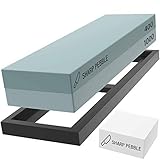
Sharp Pebble 400/1000 Kit
- Water-based carborundum
- 400 and 1000 grit
- Flattening stone in the box
- Rubber non-slip base
- Angle guide

Intelitopia Complete Set
- 400/1000 and 3000/8000 corundum stones
- Cowhide leather strop
- Bamboo base
- Flattening stone and angle guide

KNIFEPLANET 4-Grit Set
- 400/1000 and 3000/8000 grit stones
- Flattening stone included
- Bamboo base with rubber holders
- 200 g total weight
Comparing Every Whetstone Set We Tested in 2026
All ten kits, side by side. The feature lists are the same source used in each individual review below, so you can scan this table and jump straight to the set that matches your situation.
| Product | Specs | Action |
|---|---|---|
| Sharp Pebble 400/1000 Kit |
|
Check Latest Price |
| Intelitopia Complete Set |
|
Check Latest Price |
| KNIFEPLANET 4-Grit Set |
|
Check Latest Price |
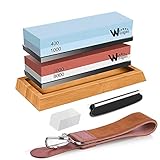 wucgea 8-in-1 Kit wucgea 8-in-1 Kit |
|
Check Latest Price |
 DMT Deluxe Diamond Kit DMT Deluxe Diamond Kit |
|
Check Latest Price |
 Amazon Basics Whetstone Set Amazon Basics Whetstone Set |
|
Check Latest Price |
 goodjob 400/1000 Kit goodjob 400/1000 Kit |
|
Check Latest Price |
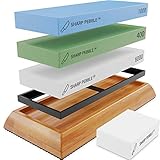 Sharp Pebble Large 3-Stone Set Sharp Pebble Large 3-Stone Set |
|
Check Latest Price |
 goodjob GB-12 Complete Kit goodjob GB-12 Complete Kit |
|
Check Latest Price |
 KING 1000/6000 Starter Set KING 1000/6000 Starter Set |
|
Check Latest Price |
How We Evaluated These Whetstone Sets
No competitor in this space tells you how it decided anything, so here is exactly how I worked. I scored every set on six things: the span of grit numbers, whether a flattening stone ships in the box, how the stones are held while wet, whether lubrication is water or oil, the abrasive material and how fast it wears, and whether a first-timer can produce a straight bevel without a tutorial.
I also read the long reviews rather than the star average, because the top complaint across this category is identical for almost every kit: stones that dish out of flat and never get fixed. A kit that ships with a usable flattening stone and an honest note about how often to use it scores higher than a fancier box that quietly omits one. Where reviewers reported quality control problems, such as unevenly cast stones arriving out of the box, I weighted that heavily, because a bowed stone is a permanent problem for the owner.
Weight and stone size get less attention than most roundups give them, but they matter more than buyers expect. A thin stone rocks, a narrow face shortens your stroke, and a kit you have to drag across the counter to find is a kit you will not use. My rule of thumb for a home kitchen is a stone at least 7 inches long and roughly 1 inch thick.
1. Sharp Pebble 400/1000 Whetstone Kit – The One I Recommend to Everyone First
Sharp Pebble Whetstone Knife Sharpening Stone Kit – 2 Sided 400/1000 Grit
Water-based carborundum, 400/1000 grit, 7.25 x 2.25 inch, 1.6 lb
Pros
- Water-based
- no honing oil needed and easy to clean
- Flattening stone
- rubber base and angle guide all in the box
- Handles chef
- santoku
- hunting knives
- chisels and garden tools
- High 4.6 rating across more than 7300 reviews
Cons
- Carborundum wears faster than premium Japanese waterstones
- The 400 grit face is too coarse to flatten the stone itself
- Rubber base can still shift on wet surfaces
This is the set I hand to people who tell me they want to learn sharpening. There is a specific reason: it is the only kit in this group where the stone is thick enough to feel stable, the base is fitted tightly enough to matter, and the box already contains a flattening stone. Most kits give you one of those three.
In use, the 400 grit side is the one that earns its keep. A knife that has been used to dice onions for a month will go from crushing to slicing in a dozen or so strokes on that face. The 1000 grit side then knocks off the roughness the coarse grit leaves behind, and that is where the “toothy” edge comes from that forum people argue about.
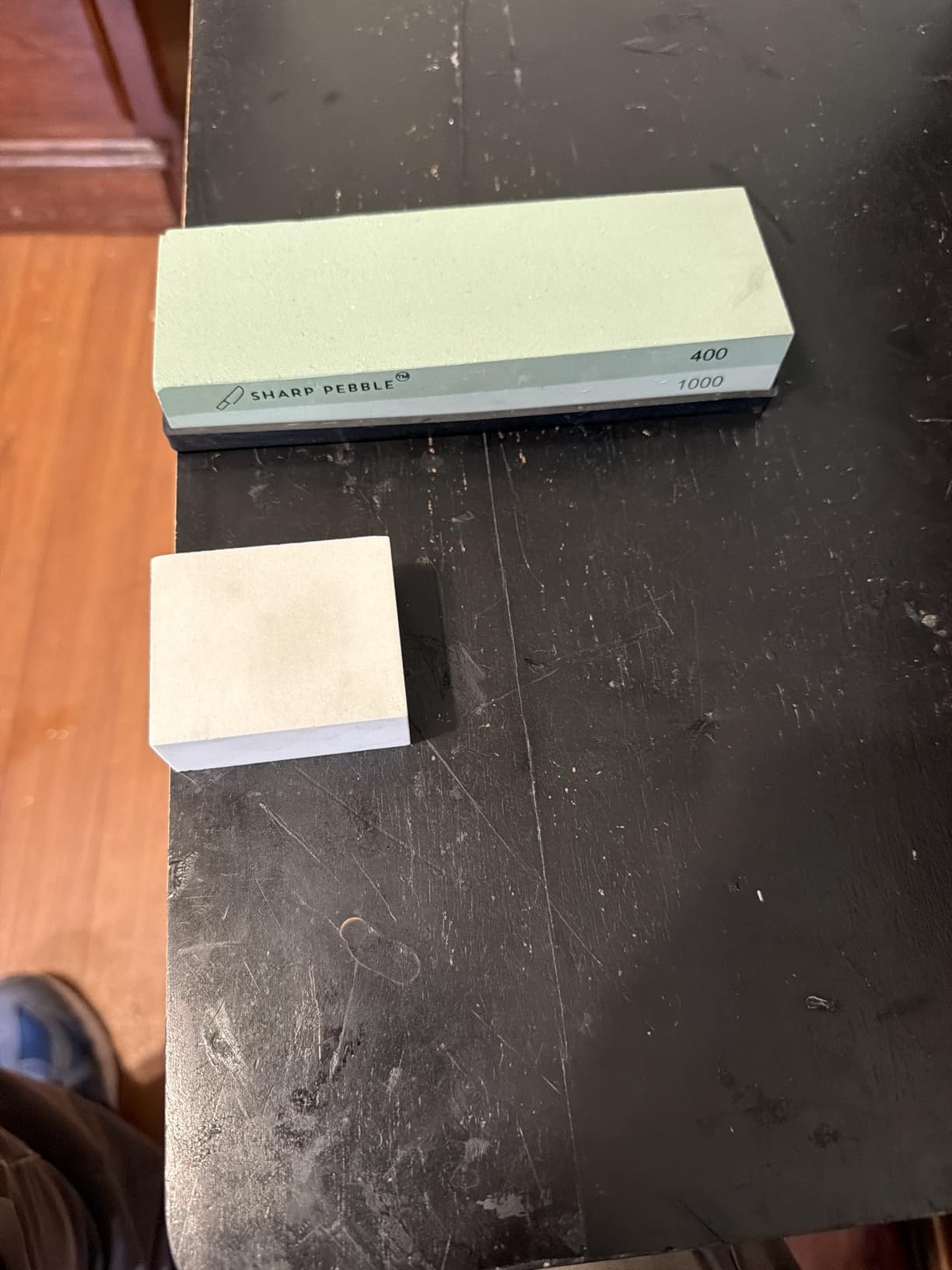
The honest drawback is wear. Carborundum is a softer abrasive than the bonded stones the Japanese makers use, so the center hollows out faster and you will be flattening more often than you would with a premium stone. Owners on r/sharpening who own this dual-sided model commonly pair it with a separate 6000 grit stone to reach a finer finish than the 1000 side can give. That is a reasonable upgrade path rather than a flaw.
Why the Flattening Stone Matters More Than Any Other Accessory
Waterstones wear unevenly. The center of the face gets used most, so it dishes into a shallow curve while the edges stay high. Once that happens, your blade rides on the high edges and the middle of your stroke does nothing. Reviewers describe the symptom accurately: sharpening gets slower, the sound changes, and the edge comes out wavy at the ends. Twenty or thirty seconds on the included flattening stone brings the face back and the whole kit starts working again.
400 Grit and 1000 Grit Do Two Very Different Jobs
The 400 grit is a repair stone. It removes metal quickly, which is what you want when an edge has been rolled, dulled for months, or lightly nicked. Use it briefly. The 1000 grit is a refinement stone, and it is the face you will use almost every session, taking a few strokes after each heavy use to bring a dull-but-intact edge straight back to sharp.
Specs That Define This Stone
The stone measures 7.25 inches long by 2.25 inches wide by 1 inch thick and weighs 1.6 pounds. That thickness is the quiet advantage here, because a one-inch stone does not flex under hand pressure the way thinner budget stones do. The model is listed as SP_400 in carborundum, the same material used in many shop-grade stones, and it works with water alone, so there is no oil to clean off your hands or your counter.
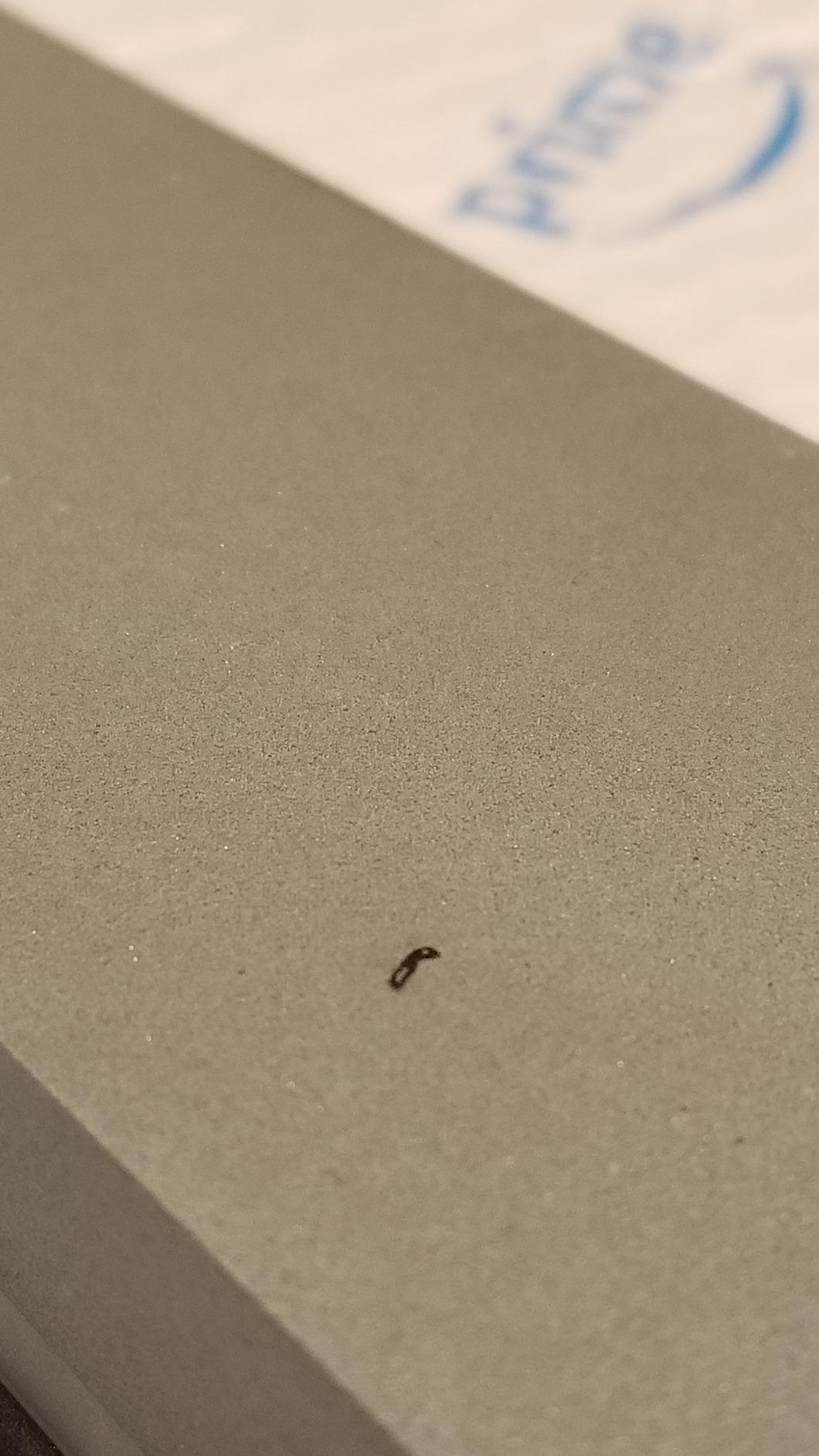
Who Should Skip It
Skip it if you own hard powder-metallurgy steel such as M4 or D2 and expect to reprofile blades regularly. A soft carborundum face will groove on that material, and a groove in the stone is permanent. It is also not the set to buy if you want a mirror finish, since a 1000 grit stone stops short of a true polish on most steel.
2. Intelitopia Complete Sharpening Stone Set – Most Complete Box for a First Setup
Intelitopia Complete Knife Sharpening Stone Set – Dual Grit Whetstone 400/1000 3000/8000 Knife Sharpener with Leather Strop, Flattening Stone, Bamboo Base, 3 Non-slip Rubber Bases & Angle Guide
Corundum 400/1000 and 3000/8000, leather strop, bamboo base, 5 lb
Pros
- Full 400 to 8000 grit ladder covers repair through polish
- Cowhide leather strop removes the last burr and adds shine
- Angle guide shortens the learning curve for first-timers
- Sturdy bamboo base with three non-slip rubber holders
- Works on chef
- santoku
- sushi
- cleaver
- hunting knives and scissors
Cons
- Included anti-slip base is not very grippy on wet surfaces
- Stones need soaking and frequent rewetting or they dry mid-session
- The 8000 grit face wears down noticeably faster than the coarse stones
This is the set I recommend when someone wants a full sharpening station rather than a single stone. Two dual-sided stones, a genuine cowhide strop, a bamboo base, three rubber holders, an angle guide, and a flattening stone. Nothing else in this roundup ships that much usable equipment.
The strop is the sleeper feature. Most people stop at 8000 grit and think they are done, but a strop loaded with compound removes the last of the burr and aligns the edge, which is what turns a sharp knife into one that will slice a sheet of paper without a hint of drag. Having it in the box means you get that step without a second purchase.
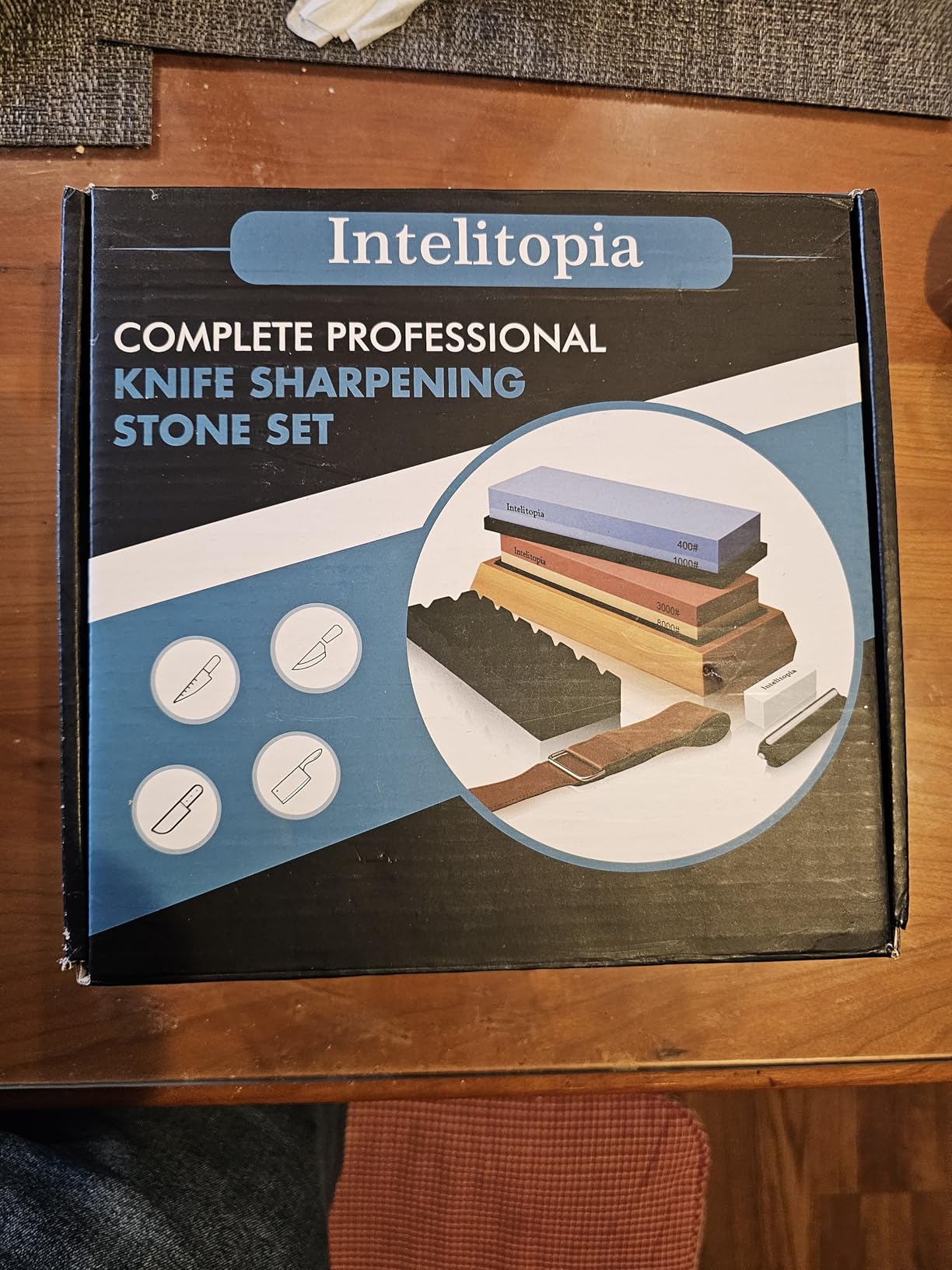
The 3000/8000 Face Is the Reason to Buy This Kit
Two stones in the same set both get called a whetstone, and the number on the side is the only difference. The 3000 face sits in the gap between edge repair and final polish, and it is the stone that produces the smooth keen edge a home cook notices most. The 8000 face refines further and is genuinely satisfying to watch, but reviewers are candid that it wears faster and that most kitchen knives do not need it.
Weight and Stability: The Honest Trade
At 5 pounds and measuring 9 by 8 by 3 inches, this is a substantial kit, and that weight is both its strength and its annoyance. Stability at the stone is excellent and the bamboo base does not flex, but the counter space it occupies is real. The included rubber holders help, and reviewers still report that the base is less grippy on a wet surface than the packaging implies. A damp towel under the base solves it in about two seconds.
Soaking and Rewetting Are Not Optional Here
Corundum stones of this type need to be wet to work properly. Soak before you start, and rewet during a long session, because a stone that dries mid-stroke stops cutting and starts polishing, and your strokes become inaccurate without you noticing. This is the single habit that separates people who like sharpening from people who put the kit in a drawer.
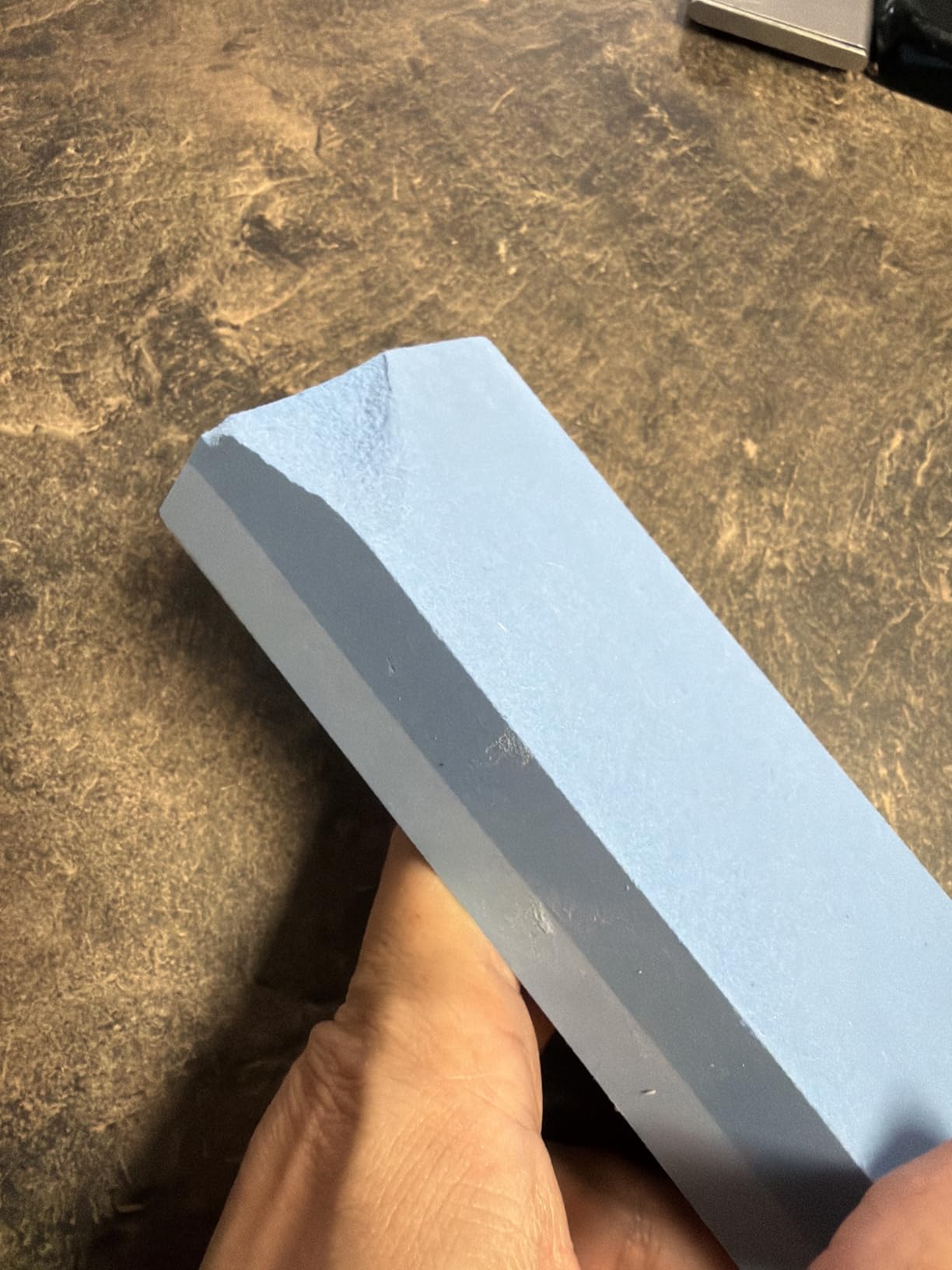
Who Should Skip It
Skip it if your kitchen counter is small or if you sharpen on the move. The footprint is the largest of any kit here apart from the large Sharp Pebble stones. Reviewers who rated the corundum density below Japanese-made stones also note that grit consistency varies slightly, which matters if you are chasing an exact finish rather than a working edge.
3. KNIFEPLANET Four-Grit Set – The Best Balance of Features and Size
Premium Knife Sharpening Stone Set – 400/1000 and 3000/8000-Grit Professional, Safe Knife Sharpener Set – Whetstone Set Includes Flattening Stone, Bamboo Base, and 2 Nonslip Rubber Bases Tan
400/1000 and 3000/8000 grit, bamboo base, flattening stone, 200 g
Pros
- Two-stone progression from 400 through 8000 in one set
- Flattening stone plus bamboo base with two rubber holders
- Compact 200 g weight stores in a drawer easily
- 4.6 rating across more than 5300 reviews
Cons
- Small stone face limits stroke length on longer knives
- Listed as fine grit
- so the 400 side is the only true edge-repair option
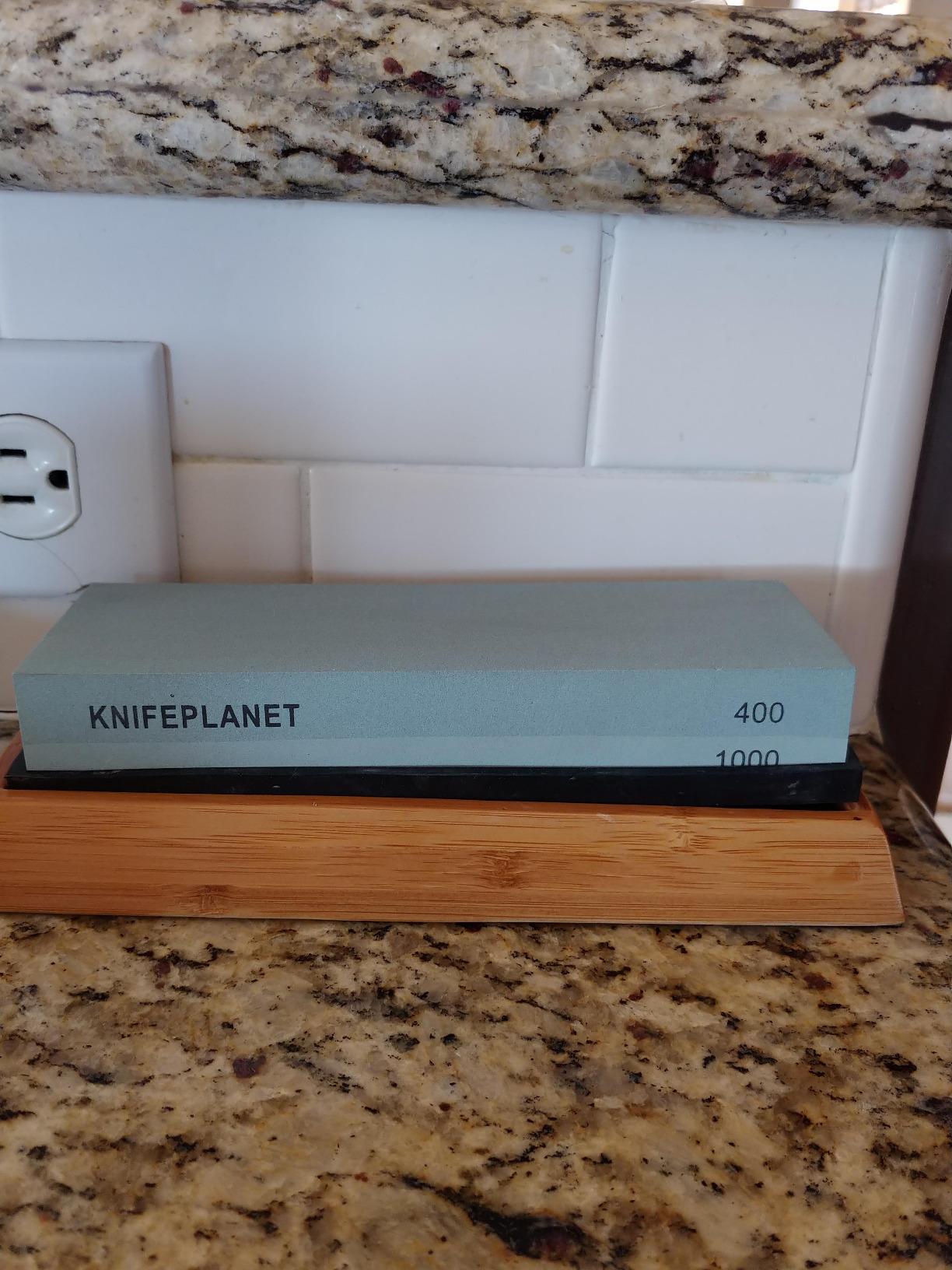
Two dual-sided stones, a bamboo base, two rubber holders, and a flattening stone, at 200 grams. That is the whole pitch, and it is a good one. This is the kit I would suggest to a cook in a small apartment who wants a complete system without a dedicated sharpening corner.
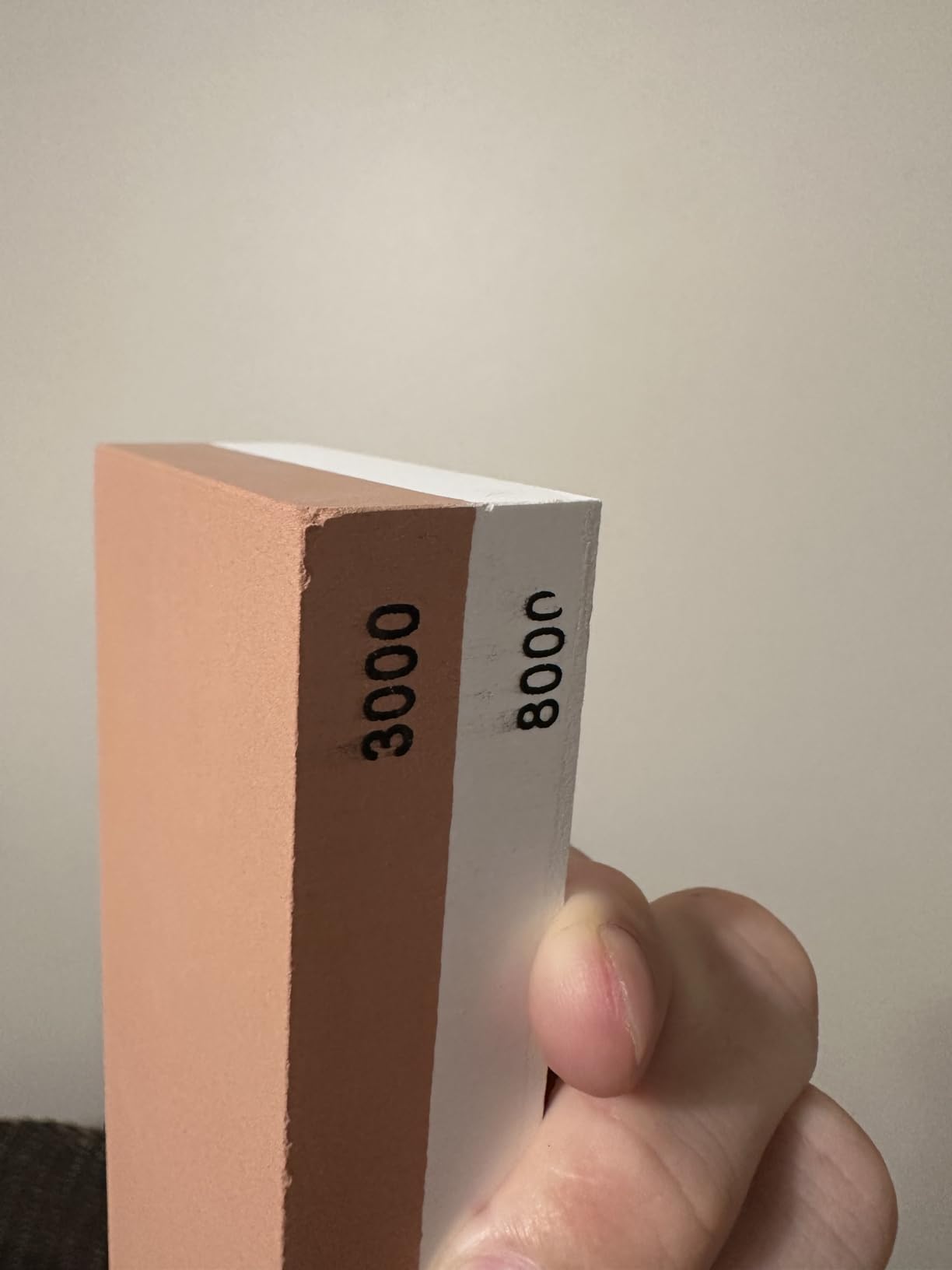
The 400 to 8000 spread is the standard ladder and it works. What sets this apart from the cheapest kits is the inclusion of a real flattening stone and a base that holds the stones at the right height. The 200 gram weight is genuinely light, which makes the stones easy to pick up and reposition, and it also means they are easier to tip over if you knock the base.
What the Compact Dimensions Actually Cost You
The stones measure 7.09 inches long by 2.35 inches wide by 1.18 inches thick. Seven inches is a workable length for a chef’s knife, but you will be working right in toward the bolster on a longer blade, and on a santoku or a slicing knife you can feel the difference. The one-inch-plus thickness is a genuine plus, because a thin stone flexes and gives you an uneven bevel.
Why the Fine Grit Label Is a Little Misleading
Amazon lists this set as fine grit, which tells you almost nothing useful. What matters is the range: four levels from 400 to 8000, which covers a full sharpen from a neglected edge to a polished finish. The caveat is that at this size the 400 face is the only real repair tool you have, and if you have a badly chipped blade you will want a bigger coarse stone.
Bamboo Base and Rubber Holders Working Together
The base sets the working height and the rubber bases sit the stones on top of it, so the stone face meets the blade at a comfortable angle rather than at floor level. That matters more than it sounds, because a low stone forces you to work with your wrist bent upward and it is the fastest route to sloppy strokes. Two holders mean you can keep one stone ready while you use the other.
Who Should Skip It
Skip it if you work on long slicers regularly, or if you need a mirror finish as an end goal. The compact face and the light frame are the trade for the neat storage, and on a long blade you will feel both.
4. wucgea 8-in-1 Whetstone Kit – The Broadest Budget Package
Wucgea Knife Sharpening Stone Kit – 400/1000 3000/8000 Grit Japanese Whetstone Set with Non-Slip Rubber Base, Angle Guide, Flattening Stone and Leather Strop
White corundum 400/1000 and 3000/8000, 8 piece kit, 3 lb
Pros
- Four grits of white corundum cover most work on stainless and everyday blades
- Angle guide helps beginners hold a consistent angle
- Bamboo base with non-slip rubber holders
- Leather strop with compound gives a polished edge
- Water-only system with easy cleanup
Cons
- Narrow stone face is less suitable for long blades
- Included flattening stone is small relative to the main stones
This is the kit people in r/chefknives ask about when they ask for a whetstone kit that includes multiple grits, a flattening stone, and a base. The answer is usually: buy the one where the accessory list is honest about what is inside. This 8-in-1 is that kit.
White corundum is a good middle ground between the cheapest carborundum and a Japanese bonded stone. It cuts faster than a soft stone, holds an edge reasonably well, and forgives beginners who put too much pressure on the blade. Two dual-sided stones give you the 400/1000 repair and refine step plus the 3000/8000 refine and polish step, and the strop handles the final edge alignment.
Soak for Five to Ten Minutes, Then Work
The stones need a short soak before use, and this is a real step, not a formality. A dry stone glazes over and rounds your bevel instead of cutting it. The water-only system means no oil, no residue, and a rinse under the tap is the entire cleanup. That is the single biggest reason people stay with wetstone sharpening rather than drifting back to a rod.
Where the Small Accessories Reveal Their Limits
The flattening stone in this kit is the smallest component, and that is worth flagging. A small lapping plate still works, but it takes noticeably longer to bring a full stone face back to flat, and beginners tend to skip it because of the time. The angle guide is genuinely useful on the front end, but on the back end it can drag on the stone surface and leave light scratches that you then have to grind out.
Dimensions and Weight
The kit measures 2.95 inches long by 1.38 inches wide by 7.48 inches tall and weighs 3 pounds. The narrow face is the main limitation. On a paring knife it is perfect; on a 10-inch slicer you will spend a lot of the stroke near the heel, which is where errors show up. If most of your blades are under 8 inches, this is not a problem you will hit.
Who Should Skip It
Skip it if you own one long slicing knife and several small blades, because the proportions are backwards for that collection. Also skip it if you want a genuinely fast-cutting stone for hard steel, because white corundum softens quickly against powder-metallurgy grades and you will be flattening more often than the price suggests.
5. DMT Deluxe Diamond Kit – Best for People Who Refuse to Maintain Stones
DMT Deluxe Diamond Professional Knife Sharpening Kit – Includes Set of 3 Diamond Whetstone Blocks for Kitchen Knives, Lawn Mower Blades, Hunting/Butchery Tools, and More – Comes in Natural Wood Box
Three diamond plates at 45, 25 and 9 micron in hardwood box, 1.8 lb
Pros
- No soaking
- flattening or slurry washing required
- Cuts roughly three times faster than comparable water stones
- Six inch bench stones allow long
- steady strokes
- Colour coded coarse
- fine and extra fine stages
- Some buyers report edges equal to Japanese water stones
Cons
- Finest plate is 1200 grit equivalent
- so a mirror edge needs another stone
- Hollow plastic base under the plates can deform under heavy pressure
- Grit ratings are not printed on the stones
Everything else in this roundup is a waterstone that needs feeding, flattening, and rinsing. This one does none of that, which makes it the odd one out and the right answer for a lot of people. Diamond does not absorb water, so the plate stays flat permanently and stays clean with a damp wipe.
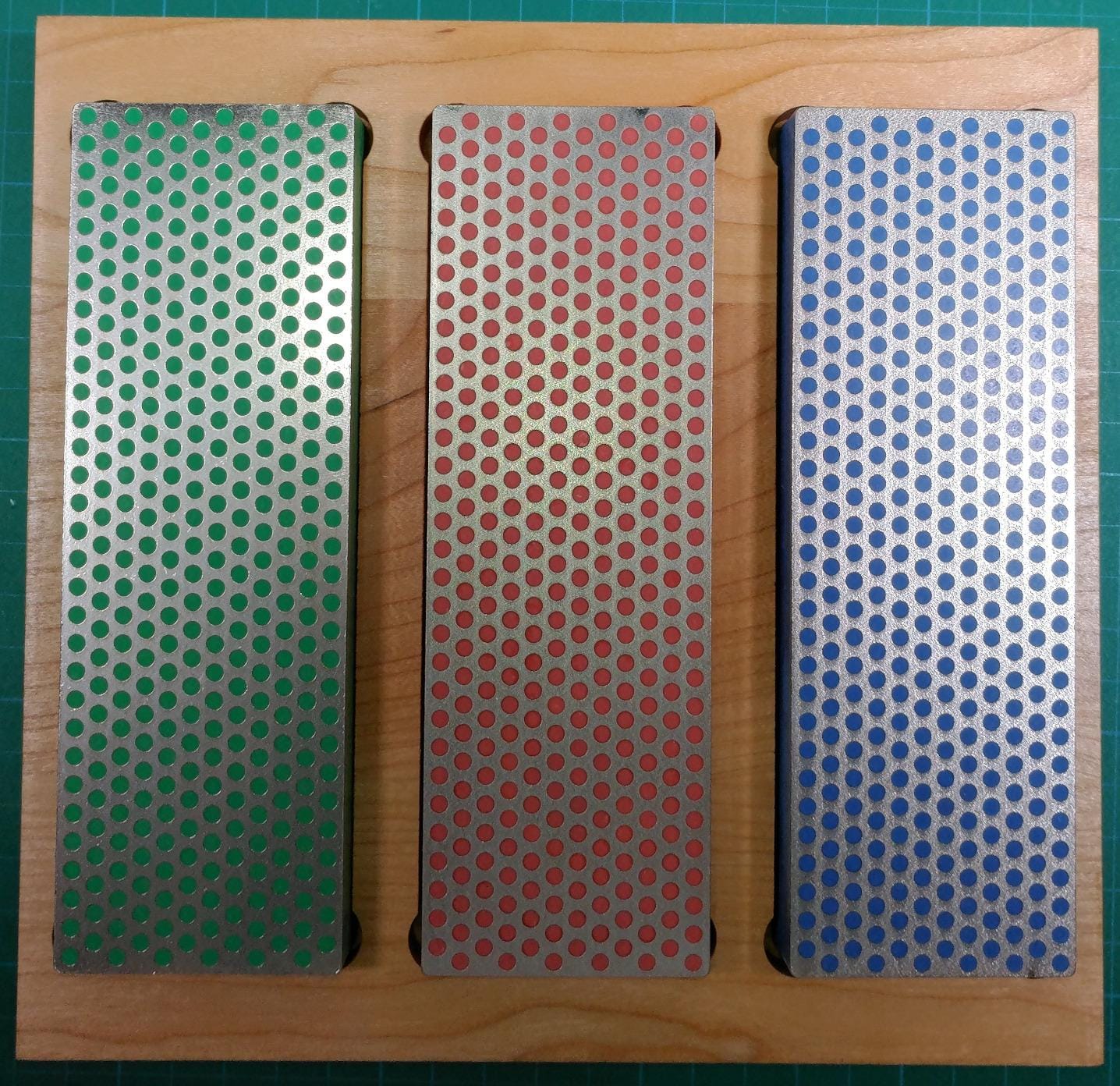
The three blocks are colour coded and the micron numbers are the honest way to read them: blue at 45 micron for restoring neglected edges, red at 25 micron for honing, green at 9 micron for polishing. Some buyers report results on kitchen knives that match or beat Japanese water stones, and plenty of long-time sharpeners use diamonds as their only system.
Why Diamond Cuts Faster and Stays Flat
Diamond is the hardest known material, so it does two things waterstone abrasive cannot. It does not soften or dish under hand pressure, which means your strokes stay accurate forever, and it does not need a substrate to hold it, so the grit stays put instead of releasing and dulling. The practical result is a stone that works roughly three times faster and never needs a lapping plate. The cost is that the 9 micron green plate is still only about 1200 grit equivalent, so it refines rather than polishes.
The Hardwood Box Is Storage, Not a Sharpening Base
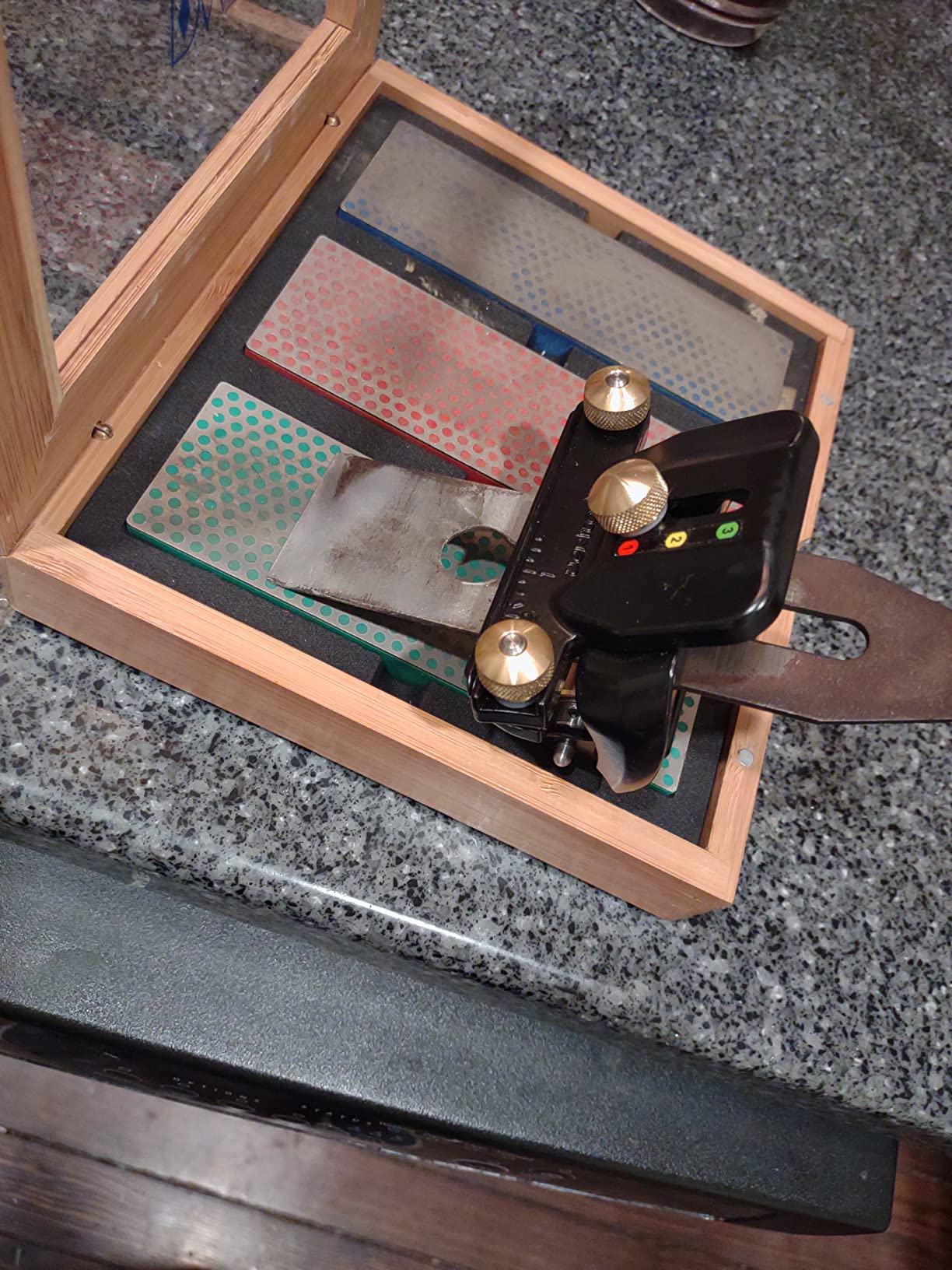
The oiled wooden box looks beautiful and keeps the plates protected, but reviewers are consistent that it is awkward to use as a working base for long knives, and the lid has no latch. The plates themselves sit in a hollow plastic holder, and that holder is the weak point: heavy downward pressure can deform it. The better answer is a separate flat surface and a damp towel, and a number of owners recommend pairing this kit with a purpose-made base for stability.
Micron Grading Versus Grit Number
Because diamond is graded by particle size rather than by grit number, the plates will not match the numbers on a waterstone. 45 micron is aggressive and closer to a 400 grit in feel. 25 micron hones. 9 micron refines to a keen working edge. Converting the numbers is only a rough guide, and reviewers note that grit is not printed on the plates, so the colour coding and the paper insert are your only reference. Keep the insert.
Who Should Skip It
Skip it if a mirror finish or a razor-shaving edge is your goal, because you would need a much finer stone added later anyway. It is also the heaviest spend in this group, so if you are not sure you will keep sharpening, a waterstone kit teaches the same skills for a fraction of the outlay.
6. Amazon Basics Whetstone Set – The One With a Warranty Behind It
Amazon Basics Whetstone Knife Sharpening Stone Set, Double-sided 400/1000 and 3000/8000 Grit Stones, Flattening Stone with Angle Guide, Non-Slip Bamboo Base, 3 Count, Black & Grey
400/1000 and 3000/8000 stones, flattening stone, angle guide, bamboo base
Pros
- Two dual-sided stones give four grit levels in one package
- Angle guide helps maintain correct angle and pressure
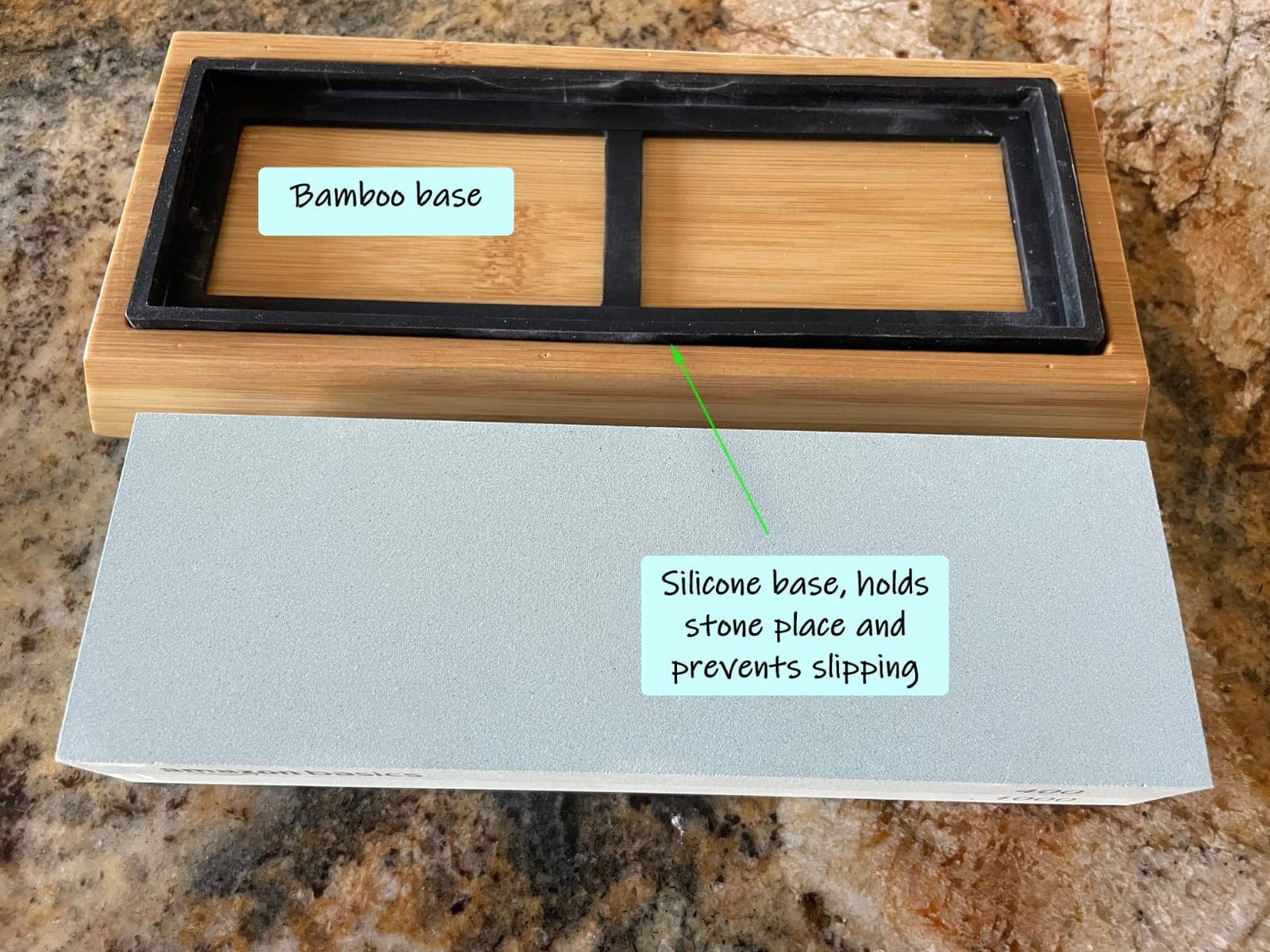
- Silicone holder plus bamboo base keeps the stone steady
- Water-based stones clean easily with no oil
- Backed by a 1 year limited warranty
Cons
- Finer grits are less useful for repairing badly nicked edges
- Stones still need periodic flattening as they wear
The distinguishing feature here is not a spec, it is a one-year limited warranty. That matters for a first kit more than most buyers think, because the most common beginner failure is a stone that arrives unevenly cast or a grit face that is not what the label says, and a warranty is the difference between a replacement and a disappointment.
Otherwise this is a competent maintenance kit. Two dual-sided stones covering 400/1000 and 3000/8000, water-based so cleanup is a rinse, a silicone holder that grips the stone, a bamboo base that grips the holder, plus a flattening stone and an angle guide. The 4.6 rating across more than 1400 reviews reflects a package that does its job without trying to be enthusiast gear.
The Silicone Holder Is the Detail That Sets It Apart
Most budget kits clamp the stone in a rubber ring that grips only the two ends. This one uses a silicone base that the stone sits into, which spreads the grip across the whole footprint and resists the sideways push that happens when your stroke wanders. Combined with the bamboo base underneath, it is one of the more stable arrangements in this roundup without you having to improvise.
Optimized for Maintenance, Not Rescue Work
Reviewers make the same point in different words: this set is tuned for keeping an edge sharp, not for rescuing a neglected one. The 400 face will take a dull edge and put it right, but if your blade is badly nicked or has never been sharpened in years, you will be doing a lot of work on the coarse side and then still starting over. Keep a coarser stone in reserve for the occasional project.
Size, Weight and Packing
The set measures 8.86 inches long by 5.6 inches wide by 2.87 inches tall and weighs 1.81 kg, which makes it one of the bulkier options even though the stones themselves are ordinary sizes. Owners mention that the packaging is sturdy and everything stays put, and the warranty is the piece most first-time buyers mention when they write reviews months later.
Who Should Skip It
Skip it if you want a leather strop or a loaded honing compound in the box, because neither is included and both change the finish you end up with. Otherwise, if you want a maintenance-focused kit with a safety net behind it, this is the straightforward choice.
7. goodjob 400/1000 Kit – Simplest Set That Still Ships With a Flattening Stone
Premium Knife Sharpening Stone Kit with Angle Guide & Flattening Stone
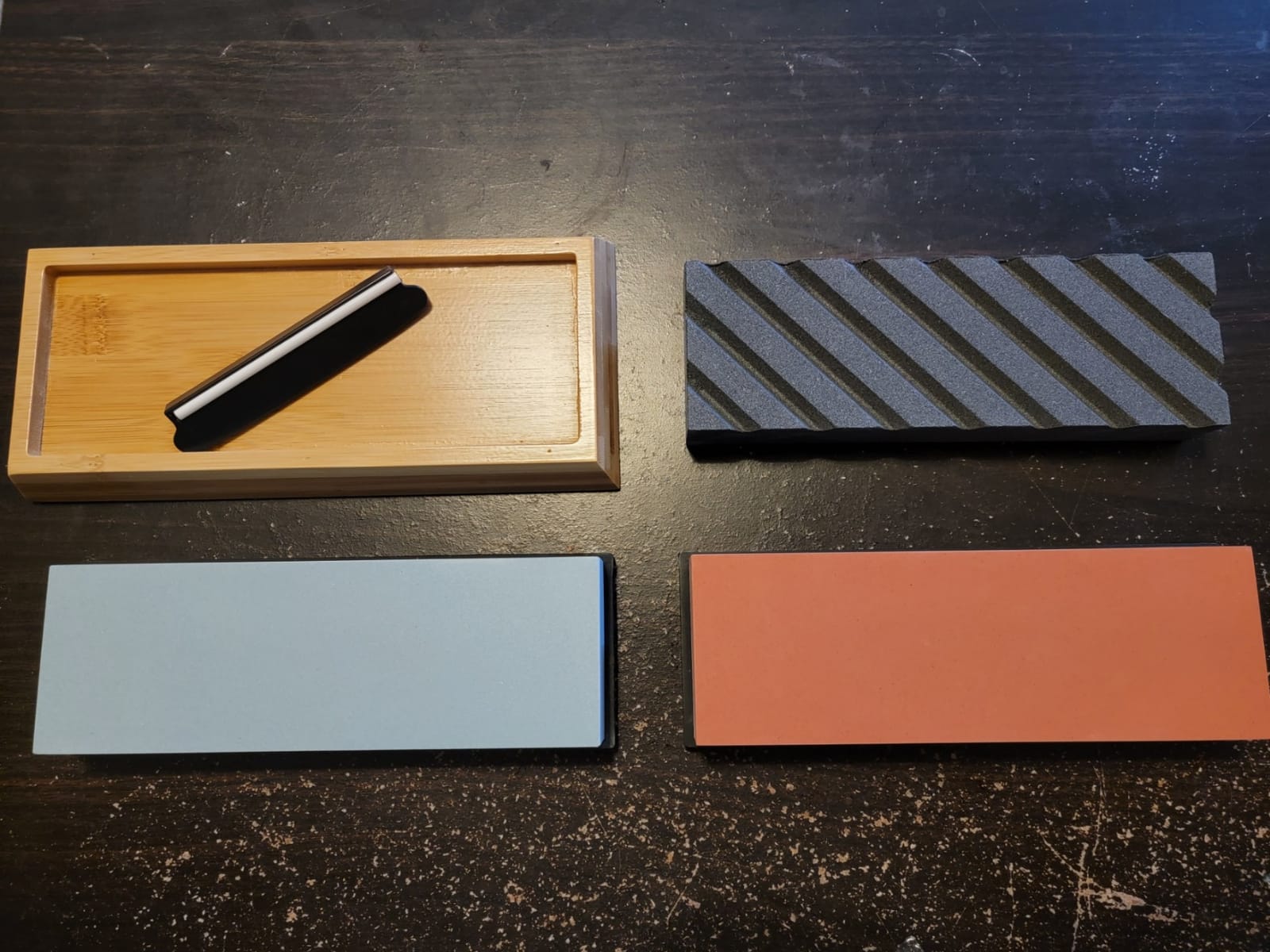
Dual-sided 400/1000 carborundum, angle guide, rubber pad, 16 oz
Pros
- Very affordable entry kit with angle guide
- rubber pad and flattening stone
- Angle guide helps beginners hold a repeatable bevel angle
- Handles everyday stainless kitchen knives well
- Water-only system is simple to clean
- 365-day warranty at this price level
Cons
- Soft stone suited to soft steels and can gouge on harder grades
- Center of the stone hollows quickly and the flattening stone is much smaller than the whetstone
- Rubber base can still slip on some countertops
One stone, two grits, and the three accessories that actually matter. If you own two or three knives and you sharpen them monthly, this is the smallest amount of equipment that still does the job properly. Adding more stones before you have the technique down is how people end up with a drawer of rocks they do not understand.
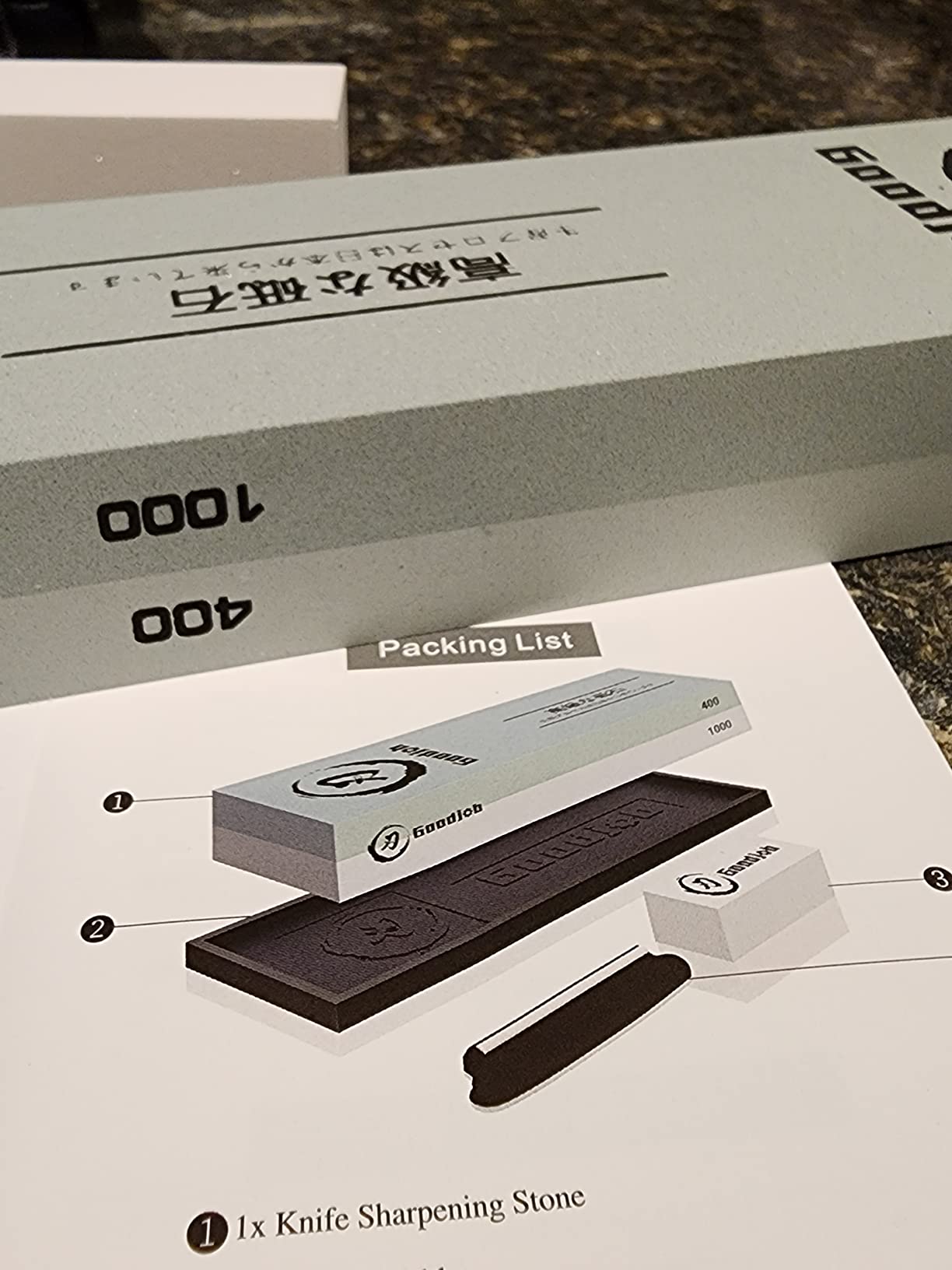
The 400 side is the working face and the 1000 side is your touch-up face, which maps neatly onto two real jobs: repairing a dull edge occasionally, and taking a few strokes to keep an edge keen in between. The brand is documented as originating in Osaka, and the stones are fired at 2000 degrees for 48 hours, which explains the price point more than any marketing language would.
Know the Limit of a Soft Carborundum Stone
Reviewers are direct about this: the stone is soft, and soft means it suits soft and medium steels. On everyday stainless kitchen knives it performs convincingly. On very hard powder-metallurgy steel, the abrasive can be gouged, and a gouge in the stone is permanent. If your collection skews toward modern superalloys, spend the extra and move up a class of abrasive.
The Flattening Stone Is Too Small, and That Matters
The white lapping plate included here is noticeably smaller than the whetstone it is meant to service. It still works, but it takes several passes to bring the full face back, and the hollow in the center develops faster than a full-size plate can correct. Owners report pairing it with a larger diamond plate later for that reason. Flatten the face every few sessions, and the stone will keep performing.
Dimensions and the 365-Day Warranty
The stone measures 7.1 inches long by 2.4 inches wide by 1.2 inches thick and weighs 16 ounces. That thickness is good for a kit at this level, because the stone does not flex under pressure. The warranty is a 365-day replacement against an order number, which is a real concession at this budget and worth more than the accessories it is bundled with.
Who Should Skip It
Skip it if you want a fine finishing stone, because the highest grit here is 1000 and the edge you finish on will always look toothy. That is a perfectly good edge, and for most kitchens it is the right one, but if you want a polished finish you need a second stone.
8. Sharp Pebble Large 400/1000/6000 Set – Best for Long Service Life and Long Strokes
Sharp Pebble Knife Sharpening Stones Kit -Grits 400/1000/6000
Three stones at 400, 1000, 6000 grit, 8 x 2.75 x 1 inch, 7 lb
Pros
- Oversized 8 inch stones give long strokes and good stability
- Three dedicated single-sided stones instead of dual-sided faces
- Heavy service life thanks to one inch stone thickness
- Bamboo base and flattening stone included
- Handles chef knives through machetes
- axes and dull swords
Cons
- Heaviest kit in this group and less convenient for small kitchens
- Missing a dedicated 3000 grit step between repair and final polish
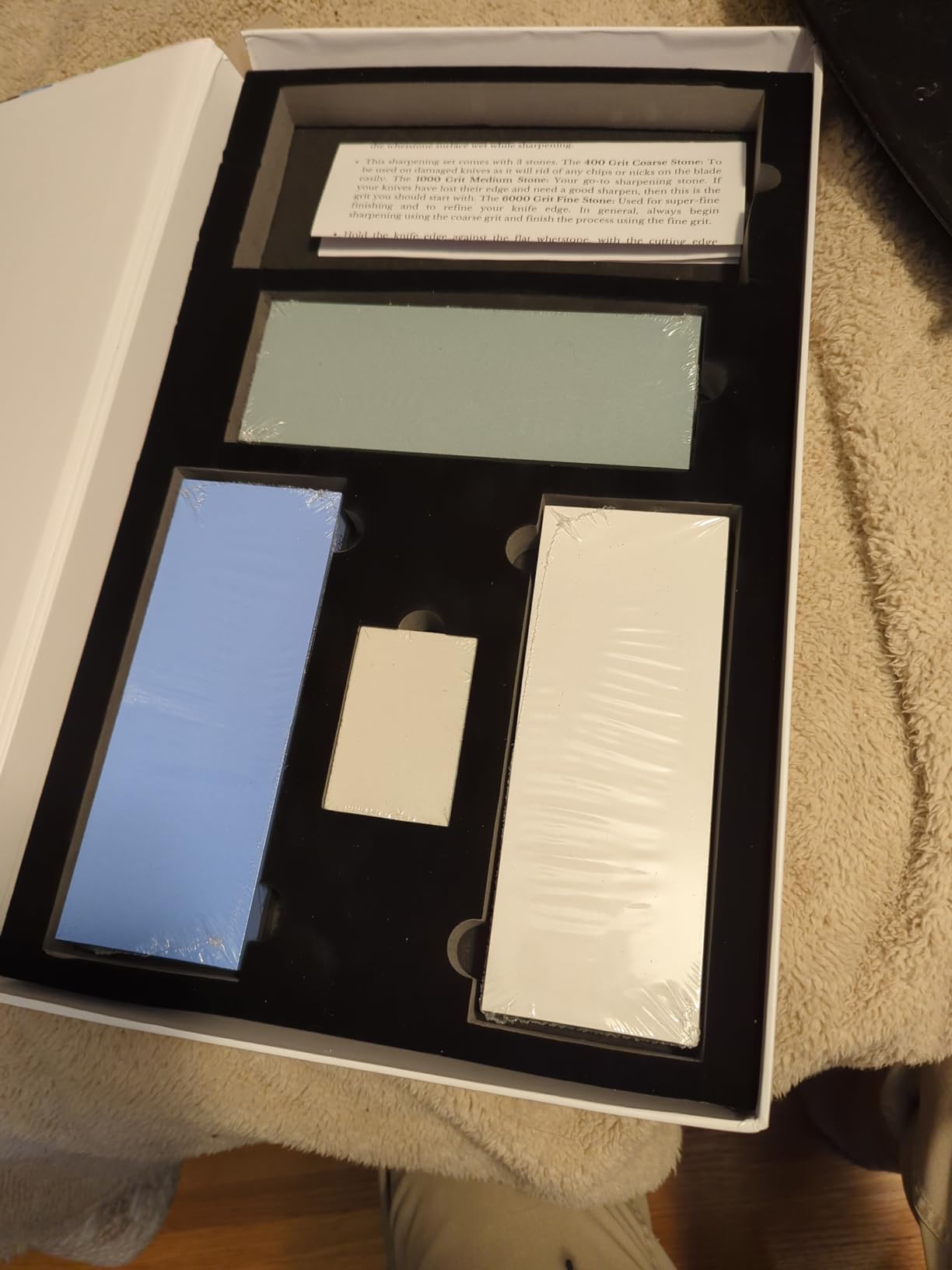
This is the set for people who sharpen regularly enough to think in years rather than months. At 7 pounds with three thick, single-sided stones, it is the heaviest kit here, and that weight is the entire point. More stone means more abrasive to wear away before flatness becomes a problem.
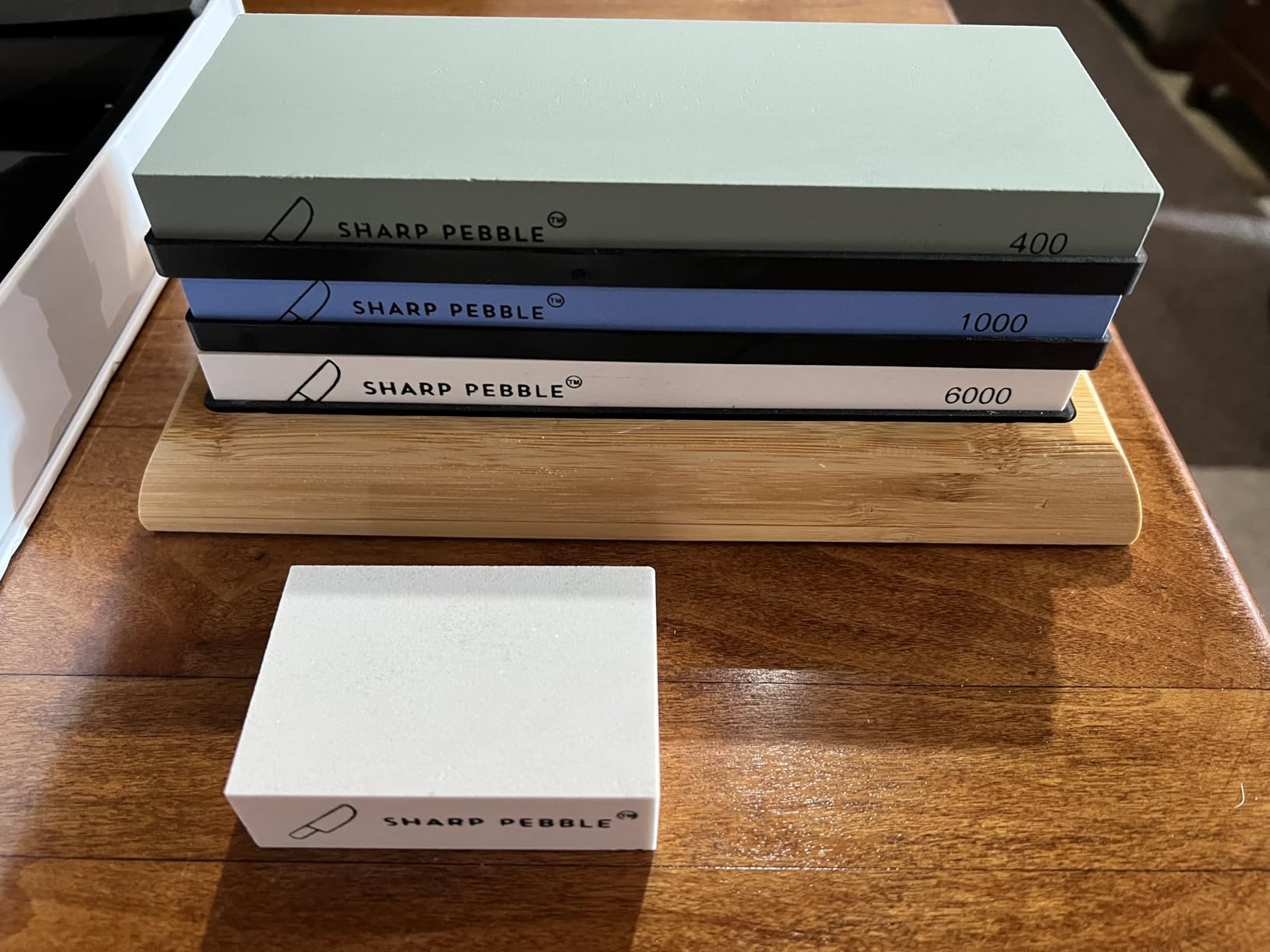
Three dedicated stones at 400, 1000, and 6000 grit is a simpler, older progression than the modern four-grit pairing, and it has an advantage: each face is labelled and unambiguous, so you cannot confuse sides at the counter in dim light. The 6000 stone is a genuinely fine finisher and produces the polished edge people buy premium stones for.
Why Single-Sided Stones Beat Dual-Sided Here
A dual-sided stone asks you to flip it mid-session, which means the wet side goes against your palm and the dry side contaminates the slurry when you turn it. Three separate stones on a tray never have that problem, and the bamboo base is wide enough to hold all three at once with the one you are using in front. On a kit this heavy that arrangement is what keeps the workflow fast.
The Gap at 3000 Grit Is Real but Manageable
Going from 1000 straight to 6000 skips the refinement stage that produces a smooth, keen edge. In practice you run 1000 longer than you think you need to, then deburr carefully on the finer stone and strop, and the result is close. If you care about the intermediate finish, adding a 2000 or 3000 stone later is the obvious upgrade, and a full-size diamond plate is the cheap way to do it.
Eight Inches, One Inch Thick, Seven Pounds
The stones measure 8 inches long by 2 and three-quarter inches wide at a full 1 inch thick, and the set is built from a silicon carbide and corundum blend. Eight inches is long enough to run a full chef’s knife in one continuous stroke without riding off the end, and one inch of thickness means the stone will not flex when you push forward. The material is water-based, so there is still no oil anywhere in the system.
Who Should Skip It
Skip it if you have a small counter or a small kitchen. Seven pounds of stones on a bamboo tray is not a thing you want to move every time you need the space. Reviewers also note it is overkill if you own a couple of kitchen knives and sharpen them once a year.
9. goodjob GB-12 Complete Kit – The Best Gift-Ready Package
Complete Knife Sharpening Stone Kit, Double-Sided Grit400/1000 & 3000/8000
400/1000 and 3000/8000 corundum, strop, compound, gloves, 16 oz
Pros
- Four grit levels plus a strop and green compound give a full workflow
- Cut-resistant gloves add real safety for beginners
- Bamboo base holds the stone firmly and angle guide helps consistency
- Several buyers rate it above visually similar kits
- Gift-quality packaging and box presentation
Cons
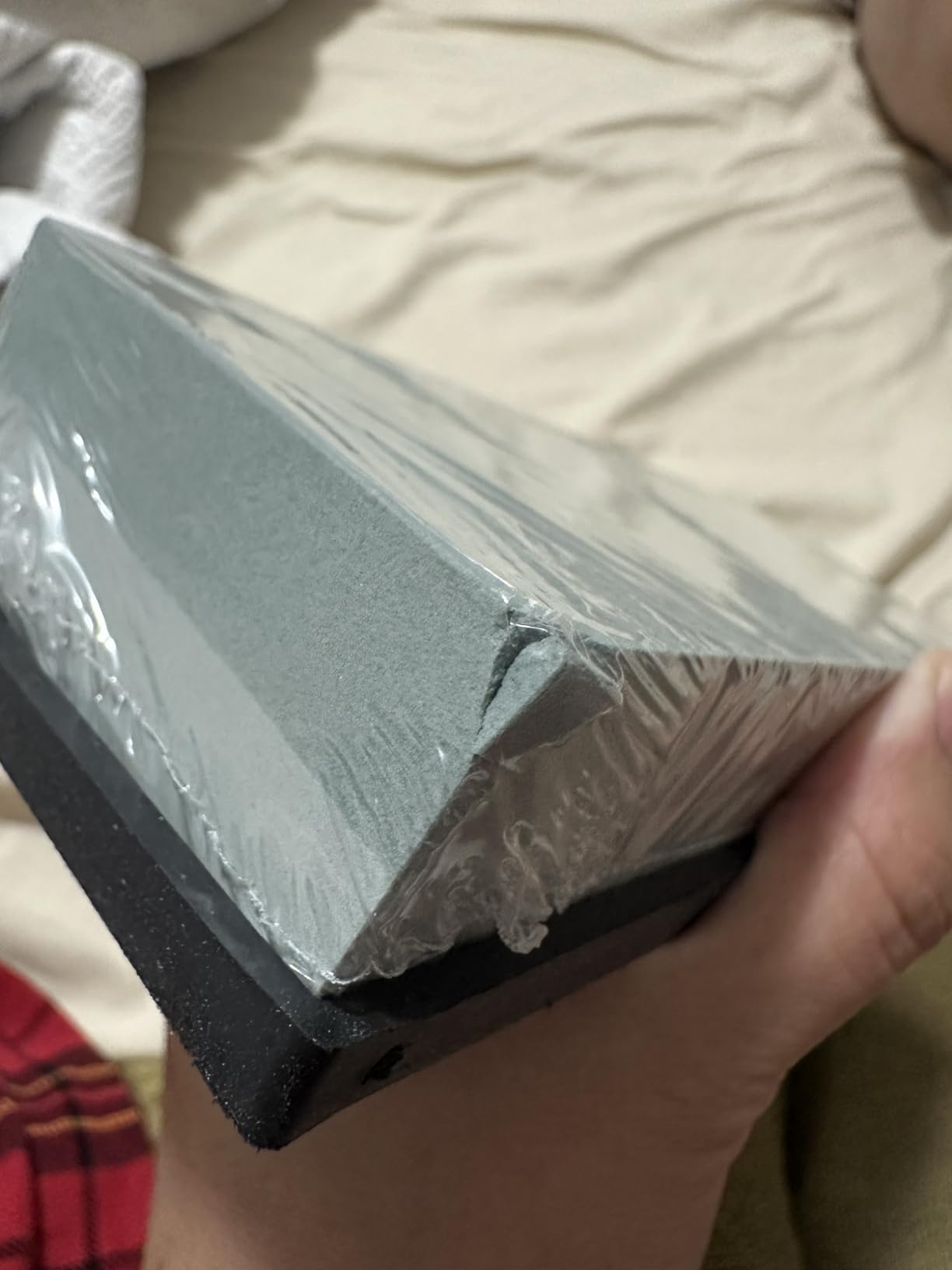
- Some units arrive with unevenly cast stones that need flattening before use
- Reported grit can be softer or coarser
- Angle guide can drag on the stone and scratch the blade
- Wooden stand can slip on a countertop
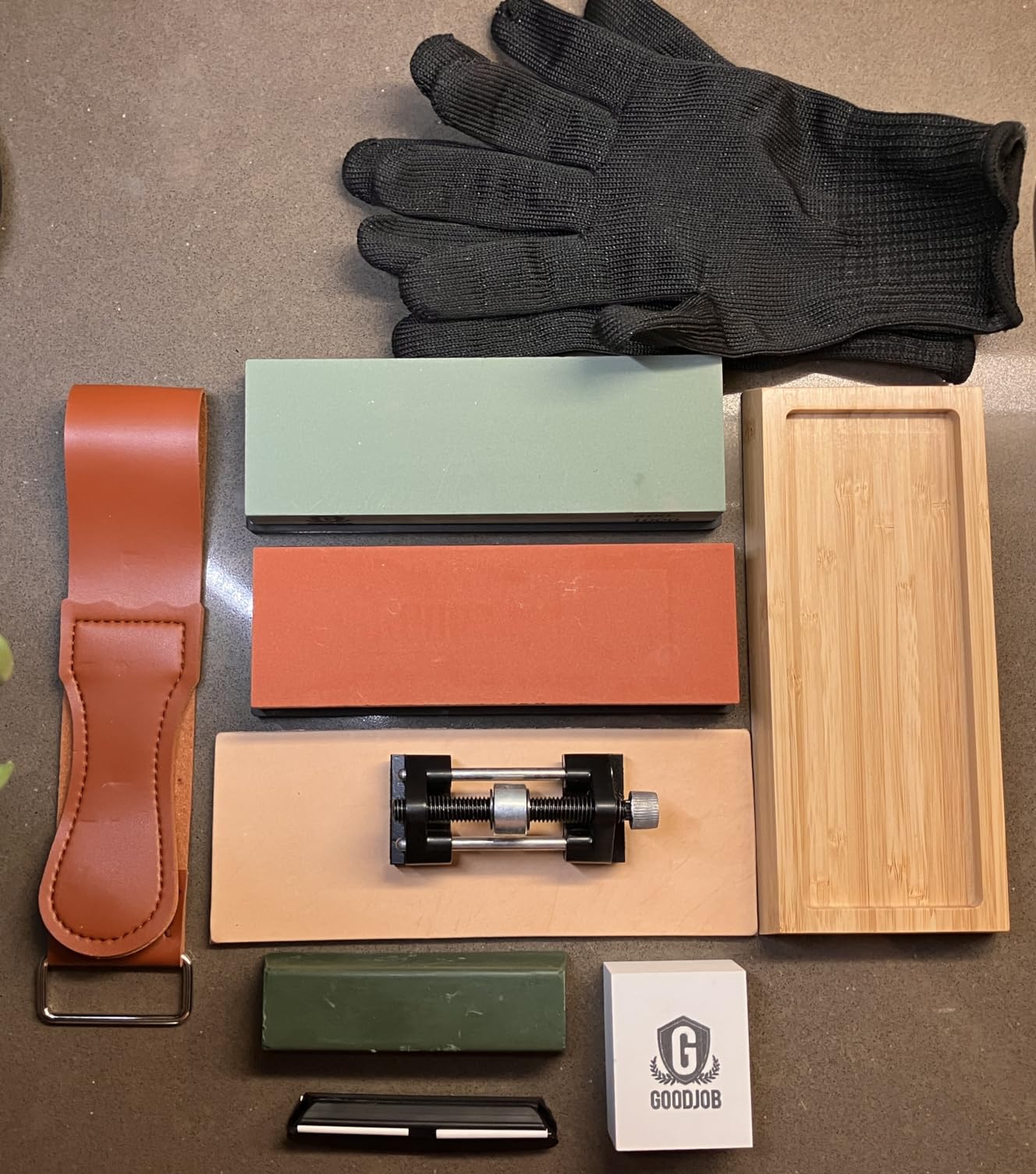
This is the one to buy when the person receiving it has never sharpened anything and will not read a manual. The box is complete and organized, it includes cut-resistant gloves, and the presentation is good enough to hand over as a present without wrapping it up again.
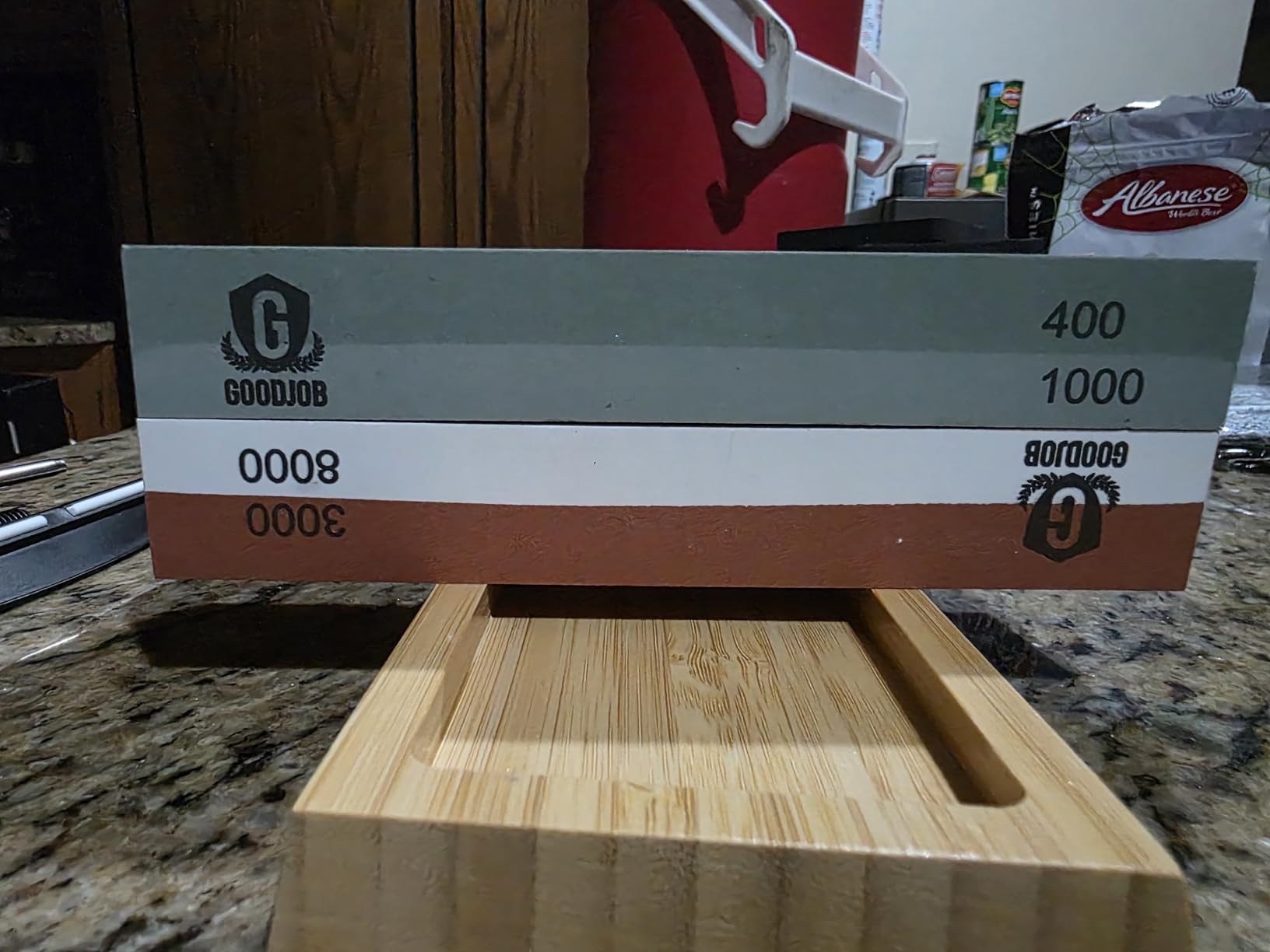
Functionally it covers the same ground as the other four-grit kits. Two dual-sided corundum stones at 400/1000 and 3000/8000, a leather strop loaded with green compound, a bamboo base with silicone non-slip pads, a flattening stone, an angle guide, and a honing guide. Buyers who compared it against visually similar kits with the same accessory list rate this one higher on stone quality, rubber grip, and wooden holder finish.
Quality Control Is the One Real Risk
Reviewers report the same issue in different words: some kits arrive with unevenly cast stones and with actual grit grades that do not match the label, running softer or coarser than printed. That is worth knowing because you should flatten every stone before the first session and test a corner of each face on a scrap blade. Customer service has been reported as responsive when a replacement stone was needed, and the set carries a one-year manufacturer warranty.
The Angle Guide Is a Crutch, Not a Tool
The angle guide helps a beginner establish a repeatable bevel, which is exactly why it is in the box. Owners also report it can drag on the stone surface during a stroke and leave light scratches that then need grinding out, and that the chisel guide rollers are lower quality than a standalone ball-bearing guide would be. Use the guide for your first few sessions, then work free of it.
The Green Compound and Strop Step
The strop and green polishing compound are what separate this kit from a plain four-grit set. After you finish on 8000 grit, a few passes on a loaded strop align the edge and remove the last of the burr, and that is the step that produces the polished finish. The gloves matter too, because a loaded strop pulled with a bare hand is how people nick a thumb.
Who Should Skip It
Skip it if you already sharpen and you know exactly which stones you want, because a curated set of two stones will serve you better than a general kit. Also weigh it against the simpler options if the recipient is not going to use the strop and gloves, since those are the parts that make this kit good rather than merely complete.
10. KING 1000/6000 Starter Set – The Recognized Japanese-Made Stone
KING Whetstone Starter Set Include 1000/6000 Grit Combination Whetstone made in Japan, Knife Angle Holder, B&B Japan Original Wiping Cloth and Stable Plastic Base
1000/6000 combination stone made in Japan, angle holder, 16 oz
Pros
- Japanese-made combination stone with a well-regarded 1000 grit side and 6000 grit finishing side
- Angle holder gives a repeatable bevel angle
- Ceramic rods protect the guide from direct blade contact
- Wiping cloth and plastic base complete the setup
- Backed by a 100 percent satisfaction guarantee
Cons
- Two grit levels only
- so a coarser repair stone is still needed
- Combination stone means flipping the stone between grits
There is a reason forums treat certain Japanese brands as the default recommendation, and this package is that recommendation in a form you can buy as a set. The 1000/6000 combination stone is made in Japan, and the 1000 grit is the workhorse side that handles general kitchen knives, stainless cutlery, and carving knives.
The 6000 side is where this earns its name. It delivers a noticeably finer finish than the 1000 and it is the reason posters on Kitchen Knife Forums repeatedly name a 1000 and 6000 pairing as the highest-value combination in stone sharpening. The 6000 side is also gentle enough for single-bevel Japanese blades, which is where a polished secondary bevel matters.
What the Combination Format Costs You
A single stone with 1000 on one side and 6000 on the other means you flip it between grit changes, and the wet side ends up against your palm. It also means only two levels of abrasive, so anything coarser than 1000 is missing. For a blade with a chip or a very dull edge you will want a separate coarse stone, and the set does not include one.
The Angle Holder Is the Smart Part
The included knife angle holder uses two ceramic protective rods, so the guide runs on ceramic points rather than a bare blade edge. That protects both the guide and the knife spine, and it gives a repeatable bevel angle that a beginner can reproduce session after session. The plastic base keeps the stone stable, and the high-absorbency wiping cloth is the correct tool for drying a wet stone quickly.
Rating and Guarantee
The set carries a 4.5 rating across more than 700 reviews, which is the smallest sample here, and a satisfaction guarantee that lets you return it if the stones do not suit your knives. Size and weight are modest at 16 ounces and 9 by 3.1 by 2.2 inches, so it stores easily, but that also means the stone is a bench size rather than a full oversized platform.
Who Should Skip It
Skip it if you own tools that need serious reprofiling, because there is no coarse face and no flattening stone in this set. It is built for maintaining an edge, not rebuilding one.
Whetstone Buying Guide: What Actually Matters
Most kit listings are written to sound identical, so the only way to choose well is to know which few differences are worth money. Here is how I think about them, and where the forums I read disagree with each other.
Map Grit Numbers to Tasks, Not to Adjectives
Ignore the words coarse, medium, and fine in a product title and read the numbers. A 400 grit stone removes metal quickly and is for reshaping a dull or lightly damaged edge. A 1000 grit stone refines that work and is the face you will use most often for routine maintenance. A 3000 grit stone smooths the scratch pattern from the coarser stones and produces a keen, slightly less aggressive edge. A 6000 to 8000 grit stone is for final refinement and a visible polish.
Map those to your week. A daily touch-up is a few strokes on 1000. A weekly full sharpen runs 1000 then 3000, deburring on the fine side. Edge repair starts at 400 and works up. If you buy only one stone, buy 1000. If you buy two, make the second 3000 or 6000. Everything else is optional, and the forum consensus is blunt that extra stones do not help anyone who has not mastered the first two.
Waterstone, Oilstone, or Diamond: Pick One System
Waterstones use water alone. They cut fast, they feel alive under the blade because you can feel the slurry, and the slurry tells you what is happening. They need soaking, they dish, and they need a flattening stone. Every kit in this roundup except the diamond set is a waterstone, and the water-only claim on the packaging is accurate for all of them.
Oilstones use oil, cut more slowly, and are messier to clean. They were standard for years and they are still excellent for hard steels, but for a modern kitchen the water-only system wins on cleanup alone. Diamond plates need no liquid at all, never dish, and cut several times faster, but they top out near 1200 grit equivalent and leave a more abrasive-looking finish.
Angle: The Number Beginners Get Wrong
The blade should meet the stone at 15 degrees for Japanese single-bevel knives and 20 degrees for most Western chef’s knives, with 25 degrees for a more durable edge on a knife you use hard. Every kit here that includes an angle guide is worth using for your first ten sessions, because the habit of holding a repeatable angle matters more than any stone choice. After that the guide is a crutch.
Carbon Steel or Stainless Changes Your Recommendation
This is the single most discussed point in the sharpening community and it is almost never covered in editorial roundups, so here is the short version. Stainless steel is harder and holds an edge longer, so a coarser, faster-cutting stone works well and a toothy edge from a 1000 or 2000 grit stone suits it, which is why carbon and stainless are often chosen differently. Soft carbon steel responds faster and a finer finish can be achieved more easily, so a 3000 to 6000 stone produces a better result on carbon than a 1000 does.
If you own a mixed collection, sharpen stainless with a coarser final grit and carbon with a finer one, and do not chase a single universal edge. That is the nuance behind most of the arguments on Kitchen Knife Forums, and it is why a kit offering both a 1000 and a 6000 face is more useful than one offering two similar mid grits.
Why the Flattening Stone Decides the Purchase
A stone wears fastest where you use it most, which is the center of the face. That hollow is called dishing, and once it develops, your blade contacts only the high outer edges, so your edge comes out wavy and the sharpening gets slower. A flattening stone, also called a lapping plate, is a hard flat surface you rub the stone against to restore the face.
Five steps cover it. Wet both the stone and the lapping plate. Rub them together in a back-and-forth motion, rotating the stone periodically so you work the whole face. Check with a machinist’s straightedge or the edge of a known-flat surface. Repeat until no light shows under the straightedge. Then clean both and you are ready. Twenty or thirty seconds is enough for a few sessions, a couple of minutes after heavy use.
Buy the kit with the flattening stone in the box. A kit that omits it is not cheaper, it is unfinished, and it is the reason so many cheap sets stop working after a few months. Two of the kits in this roundup include a lapping plate that is too small to do the job comfortably, so treat the included plate as a starting point rather than a permanent tool.
Japanese Stone Brands, Briefly
Brand matters less than people fear, and it matters more than most sellers admit. King is the best-known budget Japanese maker and its 1000/6000 pairing is the most frequently recommended value combination in forum threads. Naniwa Chosera is praised for a buttery feel and strong tactile feedback, but it needs soaking, so it rewards a wet habit. Shapton Pro stones are hard, tolerate splash-and-go use, and hold flat well, at the cost of very little feedback. Suehiro and Gesshin are the names most often recommended for hard stainless steels.
The practical takeaway is that hard stones hold flat and need less maintenance, while softer stones give you more feedback and cut faster. A beginner usually benefits more from the feedback, because feedback is how you learn what your hands are doing.
Four Red Flags That Mean Skip the Kit
First, no flattening stone anywhere in the box or on the listing. That is the clearest signal that the manufacturer did not think about the second month of use. Second, unlabelled grit on the stones themselves, which is how you end up unable to tell which side is which once the slurry covers everything.
Third, a glued or fixed base that does not open, because a stone that cannot be lifted out at a workable angle will be used with bad posture until the owner gives up. Fourth, a grit range that is fine only, with nothing below 1000, because that set cannot repair a dull edge and will frustrate you within a week. None of the ten sets here has all four, and each one is a legitimate buy when you know what it leaves out.
Maintenance: How to Keep Your Stones Working
Rinse and dry your stones after every session, and let them air dry face up rather than standing on edge, which is how cracks and chips happen. Do not leave a stone submerged continuously, because waterlogged stone can degrade at the surface and pick up rust spots. Oil is not needed on any waterstone in this roundup.
Flatten on a schedule, not when something feels wrong. Every five or six sessions for a home cook is a reasonable rhythm, and every single session if you are working hard steel or doing a lot of 400 grit work. Treat a stone as a tool with a service life rather than a purchase, and replace the grit stone when it stops cutting quickly, long before the frame is unusable.
Stones Versus Electric Sharpeners
An electric sharpener grinds a fixed, often too-steep angle into the blade every time you use it, and it takes metal off with each pass. A whetstone lets you choose the grit, the angle, and how much metal to remove, which is why enthusiasts and most working chefs stay on stones. The honest case for an electric unit is convenience and repeatability for knives you barely care about, not edge quality.
Neither approach beats the other for one specific job: a honing rod. A rod realigns an edge between sessions and takes seconds, and it complements any set on this list rather than replacing it.
Frequently Asked Questions
What whetstone is best for kitchen knives?
A two-stone whetstone set covering 400 or 1000 grit for edge repair and 3000 to 8000 grit for refining and polishing is the best setup for kitchen knives. Look for water-based stones, an included flattening stone, and a base that grips a wet counter. A 1000 grit stone is the single most useful stone to own if you only buy one.
Which brand of whetstones is considered the best?
Among Japanese makes, King is the best-known value brand and its 1000 and 6000 pairing is the most commonly recommended combination. Naniwa Chosera is favoured for buttery feedback but needs soaking. Shapton Pro stones are hard and hold flat with little feedback. Suehiro and Gesshin are often chosen for hard stainless steels. Complete kits from established brands also tend to arrive better made than unbranded lookalikes.
What do professional chefs use to sharpen their knives?
Most working chefs sharpen on waterstones rather than electric sharpeners, because stones let them choose grit and angle and remove far less metal per session. A common professional setup is a coarse stone around 1000 grit, a fine stone around 3000 to 6000 grit, a honing rod, and a loaded strop. Home cooks can use a smaller version of exactly that setup.
Do I need a flattening stone with my whetstone set?
Yes, if you buy a waterstone. Waterstones wear fastest in the center of the face, creating a hollow that produces a wavy edge and slows cutting. A flattening stone, also called a lapping plate, restores the flat surface in about twenty to thirty seconds per session. Kits that omit one are incomplete rather than cheaper, and the small plate included with some kits is only a stopgap.
Are the top kitchen knife sets something I need to match?
Not for sharpening. A whetstone set sharpens any quality knife you already own, and the knives themselves are a separate purchase decision. If you are starting from nothing, buy one good chef’s knife, a paring knife, and a whetstone set, and skip multi-piece knife blocks with thin stamped blades that are harder to sharpen than they look.
The Verdict: Which Whetstone Set Should You Buy in 2026?
If you have one good chef’s knife and you want the least risk, start with the Sharp Pebble 400/1000 kit. It is the set I recommend most often, because the stone is thick enough to be stable and the box includes a flattening stone, and those two facts prevent almost every beginner complaint I see. It will not give you a mirror finish, and it wears faster than a Japanese stone, but it will keep a knife cutting properly for years.
If you want the most complete setup in one box so nothing is missing later, the Intelitopia set gives you four grits, a cowhide strop, an angle guide, a bamboo base, and a flattening stone in a single purchase. If counter space is the constraint rather than budget, the KNIFEPLANET set puts the same four-grit coverage in a 200 gram package that disappears into a drawer.
If you will not maintain anything, the DMT diamond kit removes soaking, flattening, and cleanup from the process entirely, and the trade is that you stop short of a true polished edge. If you want a recognized Japanese-made stone, the KING 1000/6000 combination is the pairing that forum veterans name most often, and it is the right pick for a collection of Japanese blades.
Whatever you choose, buy the flattening stone, keep the stones wet, and use a coarser face only when you actually need to remove metal. That single habit is the difference between a whetstone set that works and one that ends up in a cupboard. If you are setting up the rest of your kitchen around it, our pick for the rest of the space is a proper counter setup, and the same goes for the rest of the house with our guide to outdoor dining sets for six.