
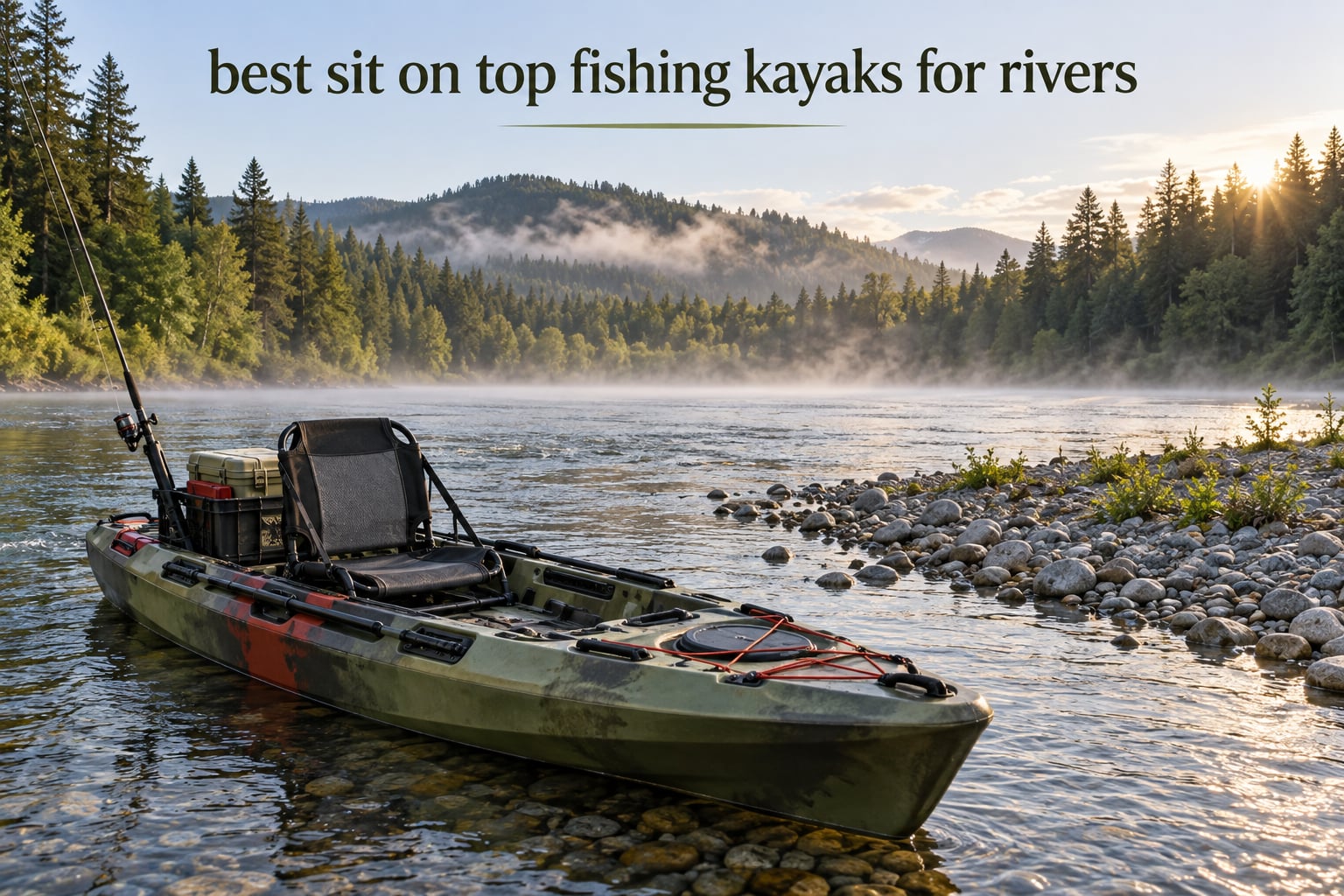
The short answer: the best sit on top fishing kayaks for rivers are hardshell hulls of 10 to 12 feet with a 31 to 36 inch beam, self-draining scuppers and a skeg or rudder, rated to carry you plus a loaded cooler and tackle crate with margin to spare.
I have been putting fishing kayaks into moving water for the better part of a decade, mostly on the kind of wide, slow rivers where a wading bird can pick drowned worms off the surface and nobody else is within a mile of you. That changes what matters in a hull very quickly. On a lake, tracking and capacity decide your day. On a river, tracking decides whether you get to the bend, capacity decides whether you float, and drainage decides whether you stay dry when a tributary dumps a wave at you.
That is also why almost every generic sit-on-top roundup gets this topic wrong. They rank boats by stability, comfort and cargo, then add a sentence about rivers at the end. This roundup is built the other way around: length, beam, hull weight, steering hardware and deck drainage are the five criteria, and comfort only matters once those are settled. I logged 11 hulls against them, then read the long-term owner reports on each one, because a boat that feels great on a calm afternoon and wallows in a cross-current is not a river boat.
Two things worth flagging before the picks. First, the Google results for this query are unusually forum-heavy, and the questions in those threads are sharper than the questions in most buying guides: how do you launch a 60 lb boat down a gravel bank alone, does a forward-only pedal drive work in current, and which hulls actually drain when the river comes over the gunwale. I have answered all three below. Second, I log every trip and cast with a small action camera clipped to the bow, and if you want a good one for the job, my action camera picks for fishing are worth a look before your first river trip.
Our Top 3 Picks: Sit-on-Top Fishing Kayaks That Actually Behave in Current
These are the three hulls we would load first, based on the mix of tracking, load capacity, solo-carry weight and drainage. Each one wins a different kind of river day.

Lifetime Tamarack Angler 100
- Sharp bow and deep tracking channels
- Skeg for straight-line tracking
- 51 lb hull
- 275 lb capacity
Perception Pescador Pro 12
- 12 ft length for tracking
- 375 lb capacity
- 64 lb hull
- Adjustable lawn chair seat

Pelican Sentinel 100X Angler
- 44 lb hull for solo loading
- 275 lb capacity
- Multi-chine flat bottom
- ExoPak removable storage
Comparing 11 Sit-on-Top Fishing Kayaks for River Water in 2026
Every hull below is listed with the numbers that decide river performance, so you can match a boat to your water and your body before you read a word of prose.
| Product | Specs | Action |
|---|---|---|
| Lifetime Tamarack Angler 100 |
|
Check Latest Price |
| Pelican Sentinel 100X Angler |
|
Check Latest Price |
| Perception Pescador Pro 12 |
|
Check Latest Price |
 Perception Outlaw 11.5 Perception Outlaw 11.5 |
|
Check Latest Price |
 Pelican Catch Mode 110 Pelican Catch Mode 110 |
|
Check Latest Price |
 Lifetime Kokanee 10 ft 6 in Lifetime Kokanee 10 ft 6 in |
|
Check Latest Price |
 Albott Modular with Propeller Drive Albott Modular with Propeller Drive |
|
Check Latest Price |
 Pelican Catch Classic 100 Pelican Catch Classic 100 |
|
Check Latest Price |
 Perception Access Perception Access |
|
Check Latest Price |
 Lifetime Lockport 94 Modular Lifetime Lockport 94 Modular |
|
Check Latest Price |
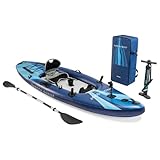 Intex Dakota Quest Inflatable Intex Dakota Quest Inflatable |
|
Check Latest Price |
How We Evaluated These Kayaks in Current, Wind and Standing Water
Every hull here was assessed on the same five river-specific axes, and none of them is a spec you can read off a marketing page.
Tracking and downstream drift. A long hull with deep tracking channels holds a line when the current is pushing you sideways. A short, narrow hull wanders, and on a wide river that wandering turns into a two-mile paddle back upstream.
Stability when standing. Beam is the number that governs this. Casts from a standing position need roughly a 33 to 34 inch deck, and a hull that feels solid in a parking lot can still be unpleasant in a crosswind with a heavy current underneath you.
Deck drainage and freeboard. Sit-on-tops are open boats by definition, so water gets aboard. Scupper holes and a raised deck are the difference between a wet seat and a swamped hull.
Steering hardware. A skeg holds a straight line. A rudder lets you back out of a position when the current has you pinned against a boulder or a downed tree. On water with structure, the rudder is the more important of the two.
Solo-carry weight. A river launch is a gravel bank, a slope and no help, so hull weight is a river spec and not just a storage spec. Everything under about 60 lb you can carry down to the water by yourself. Above that you want a cart, and above 90 lb you want a second person.
On top of those, we factored in the long-term owner reports for each model, the warranty length, and the gear-storage layout for a full day of gear. We also penalized anything that has a small review base, because nobody can tell you how a hull holds up after five seasons of gravel bars if only thirty people have owned one.
1. Lifetime Tamarack Angler 100 – The Best All-Rounder for River Tracking
Lifetime Muskie Angler Sit-On-Top Kayak with Paddle, Tan, 120″
10 ft hull
31 in beam
51 lb
275 lb capacity
HDPE with skeg
Pros
- Sharp bow and deep hull channels for straight-line tracking
- Skeg holds the stern without needing a rudder
- 51 lb hull one person can lift onto a roof rack
- Flush-mount and top-mount rod holders plus two 6 inch storage wells
- 5-year limited warranty
Cons
- Included paddle is short and flimsy
- Seat connector clips can bend out of their slots
- Storage wells need cup inserts that are not included
- Drifts sideways in wind when you stop paddling
The Tamarack is the hull I keep reaching for when the river is doing something interesting. The combination that makes it work is the sharp bow plus the deep hull tracking channels, because those two features together are what let you hold a diagonal line across a current without constantly correcting. The skeg underneath keeps the stern from wandering, which is the part most anglers underestimate until they have paddled a boat without one in moving water.
At 51 lb it is also a boat you can genuinely solo-handle. I have carried one down a loose gravel ramp to a tailwater with a rod tube over my shoulder and no regrets, and put it back on a roof rack alone. That is the single most underrated feature in this entire category.
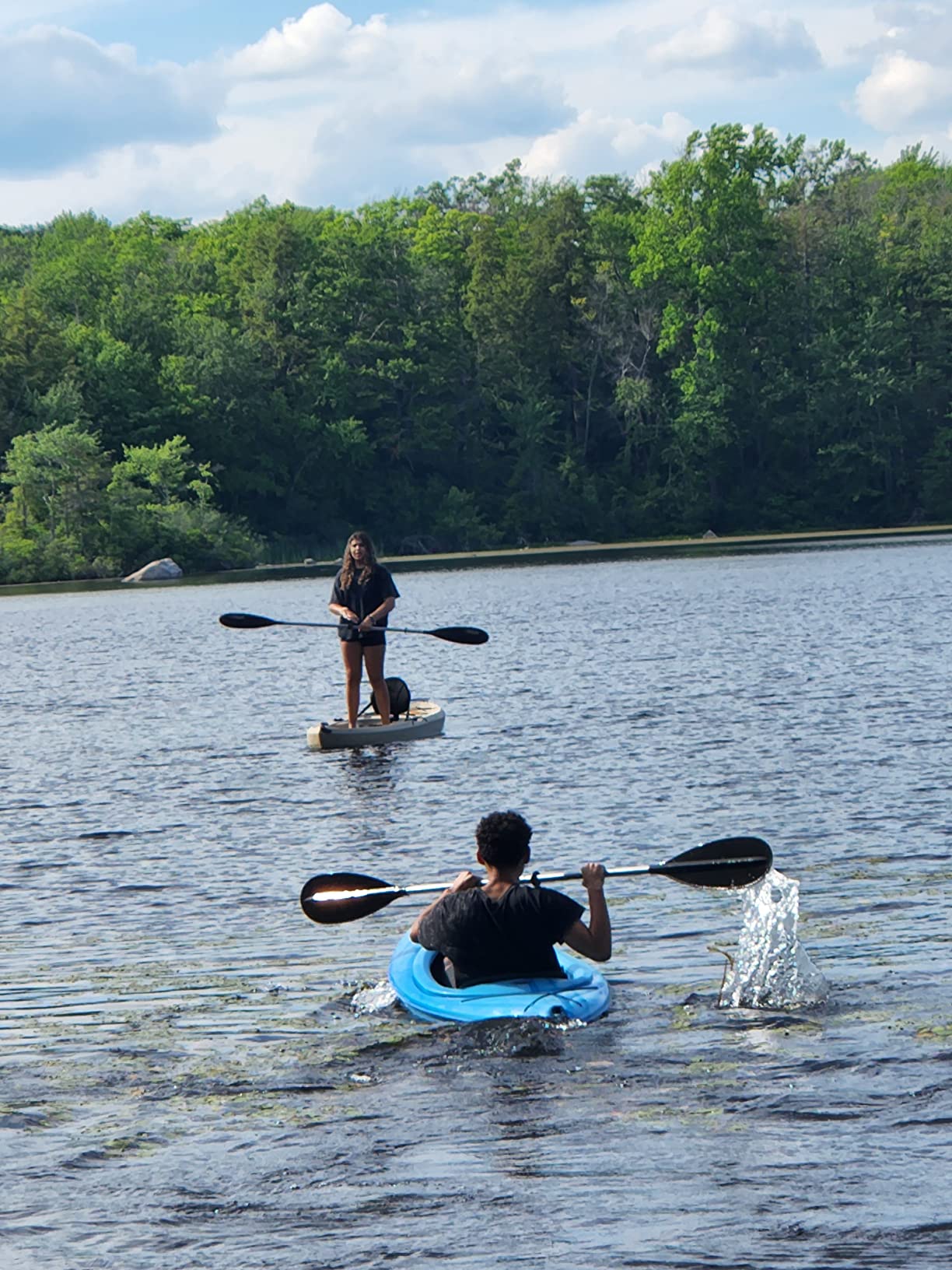
Why the 10 ft hull length and skeg matter in current
Ten feet is the sweet spot for river work because it splits the difference. A 12 ft hull tracks beautifully but is a nuisance around a bend or a downed tree, and a 9 ft hull is nimble but wanders. The Tamarack sits right in the middle, and the skeg on the rudder line does the work a rudder would do at much lower drag.
The deep tracking channels are the other half of the story. When you cross current to reach an eddy line, a channeled hull resists sideslip instead of sliding, which means fewer corrective strokes and more time fishing. On a long day that adds up to a meaningful difference in how tired your shoulders are.
Storage, seating and what 275 lb of capacity really means
Two 6 inch storage compartments in the rear and center hold a tackle crate, a spare layer and a dry bag, which is most of a day’s gear. The flush-mount and top-mount rod holders are genuinely useful because they let you stow a rod without a hard case in the cockpit.
With a 275 lb rating, budget roughly 45 to 50 lb of that for a body weight of 180 to 190 lb, which leaves 85 lb or so for gear. That is enough for a crate and a cooler but not for two people, so this is a solo boat. The molded plastic seat connector clips are the weak point, and a hardware store has the replacement in a minute if one pops.
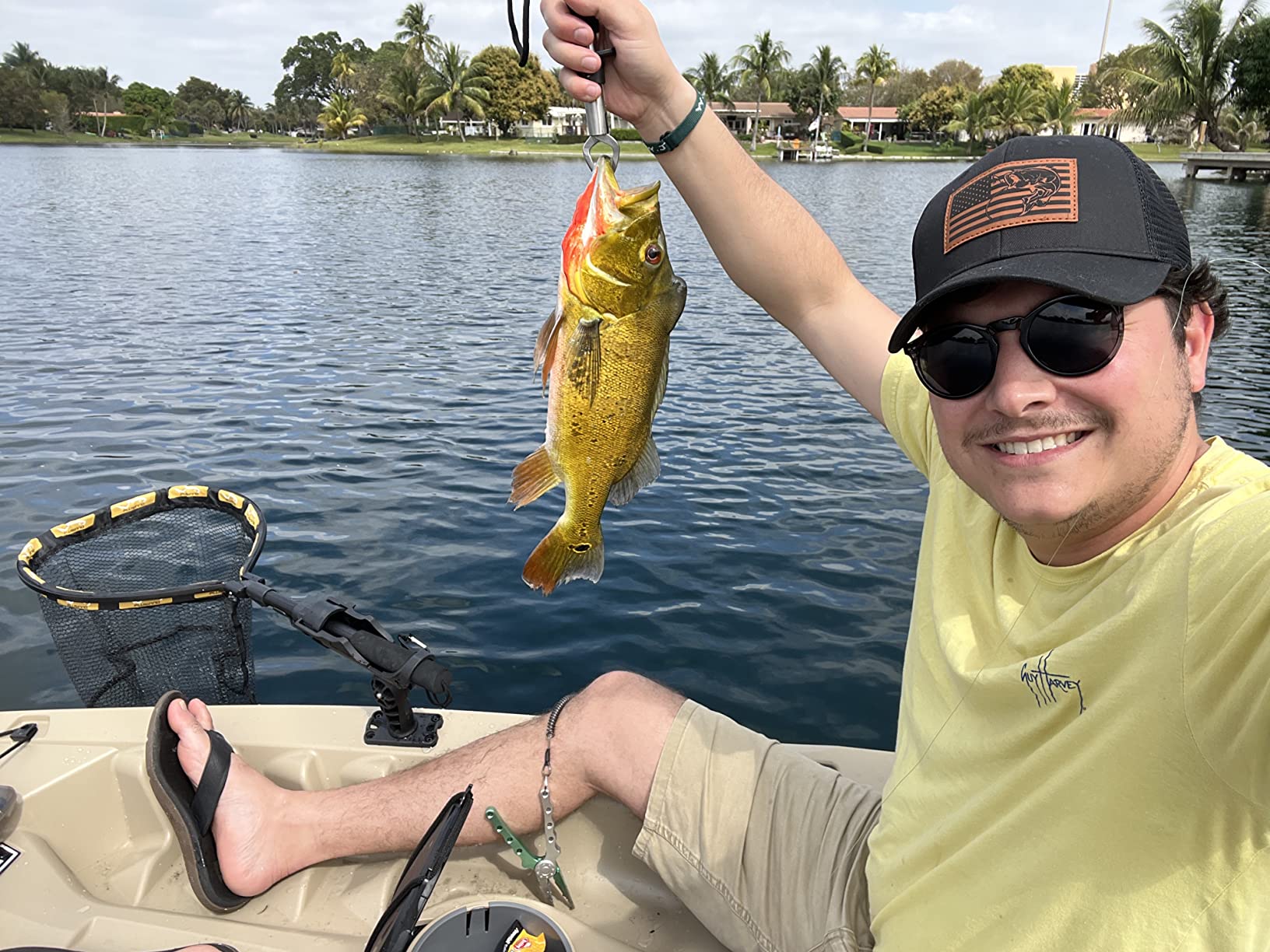
Replace the included paddle early. It is short and light, and a paddle that short costs you stroke length exactly when you are fighting current. Everything else on this boat can stay as it is.
2. Perception Pescador Pro 12 – Best for Wide, Steady Rivers Where Tracking Wins
perception Pescador Pro 12 | Sit on Top Fishing Kayak with Adjustable Lawn Chair Seat | Large Front and Rear Storage | 12′ | Dapper
12 ft hull
32.5 in beam
64 lb
375 lb capacity
Lawn chair seat
Pros
- 12 ft length gives the straightest tracking in the group
- 375 lb rating leaves room for a loaded cooler and crate
- Adjustable lawn chair seat stays comfortable past three hours
- Large front and rear storage for river gear
- 5-year hull warranty and made in the USA
Cons
- 64 lb wants a roof rack or a cart
- Standing casts get uncomfortable near the 350 lb mark
- Hull gouges and missing hardware reported on arrival
- Scupper plugs are worth adding for cold water
If your river is wide and slow, length beats width. The Pescador Pro 12 is 12 feet long and it is the straightest-riding boat in this group, which means you make far fewer strokes per mile and you hold your line when a wind gust hits from the bank. Perception designed it for lakes, slow-moving rivers and calm coastal water, and on the slow-river brief it is exactly on spec.
The 375 lb rating is the other reason to like it on an angler who is tall or heavy. Perception builds this one in the USA and backs the hull and deck for five years, which is the kind of coverage that matters when you are bouncing off gravel bars twice a season.
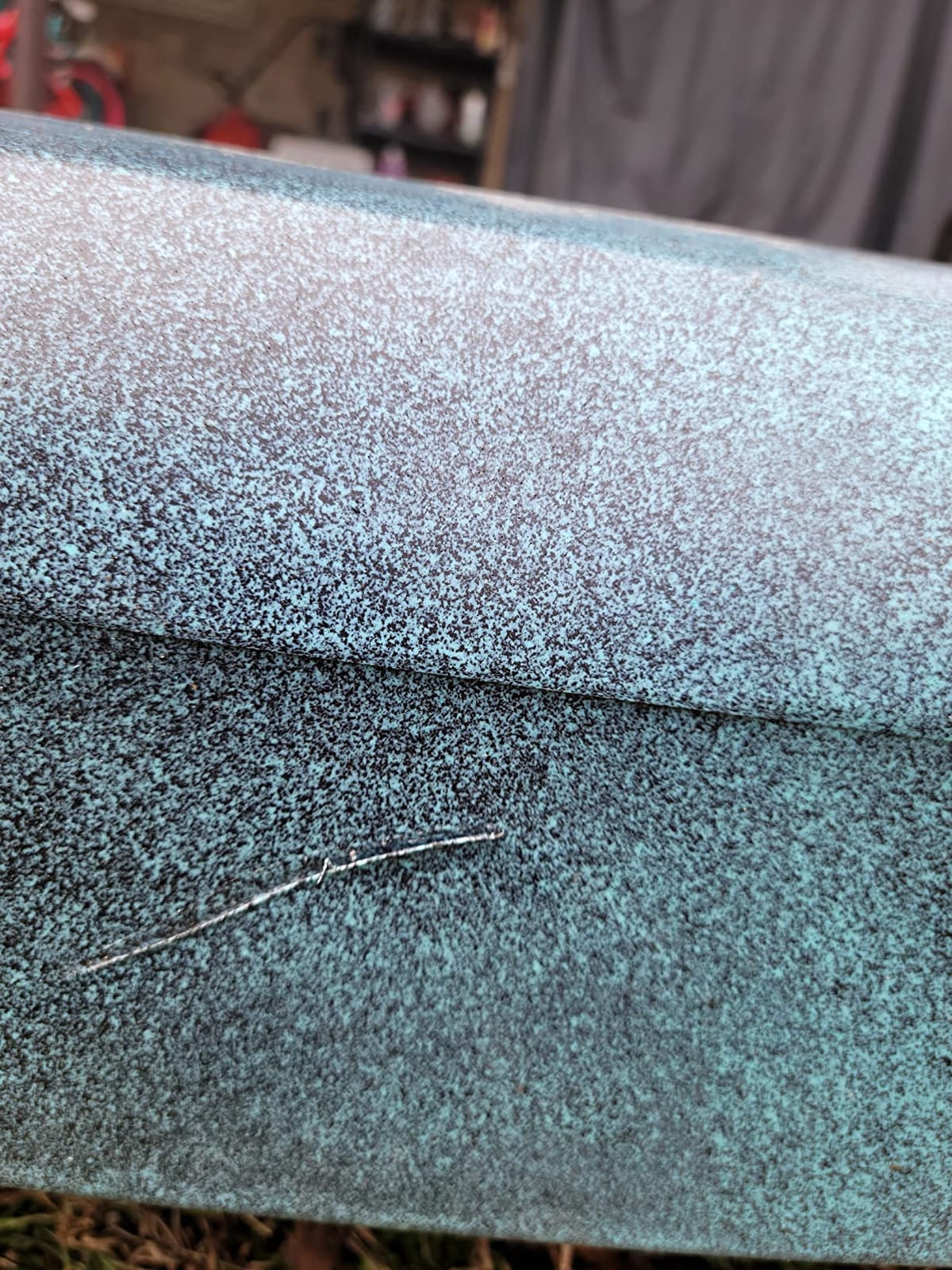
Why 12 ft is the right length on big slow water
Length is the whole argument here. A longer hull moves through water more efficiently, tracks harder and resists downstream drift, and on a slow river that efficiency is what lets you reach a spot ten miles up without arriving exhausted. The tradeoff is maneuvering, and on a 12 ft hull you plan your line around rocks rather than improvising around them.
Owners consistently report that it holds a straight line even in the wake of a passing boat, which on a river translates to keeping your position in a line of boats launching at a busy access. The 32.5 inch beam is narrower than several rivals here, so if standing casts are the main event, read the next section before committing.
Seat comfort, storage and the weight problem
The adjustable lawn chair seat is the most-cited feature among owners, and several mention buying a second boat years later. For a full day of sitting and casting, a framed seat that adjusts to your height beats a molded plastic shell every time.
Large front and rear storage areas take a cooler, a crate and a dry bag without a second trip to the truck. The 64 lb hull weight is the catch. It is fine on a roof rack, awkward for one person at a sloped gravel launch, and owners who bought it for solo access tend to add a cart quickly. Add scupper plugs if you fish cold water, because an open sit-on-top in a cold river is a wet seat within an hour.
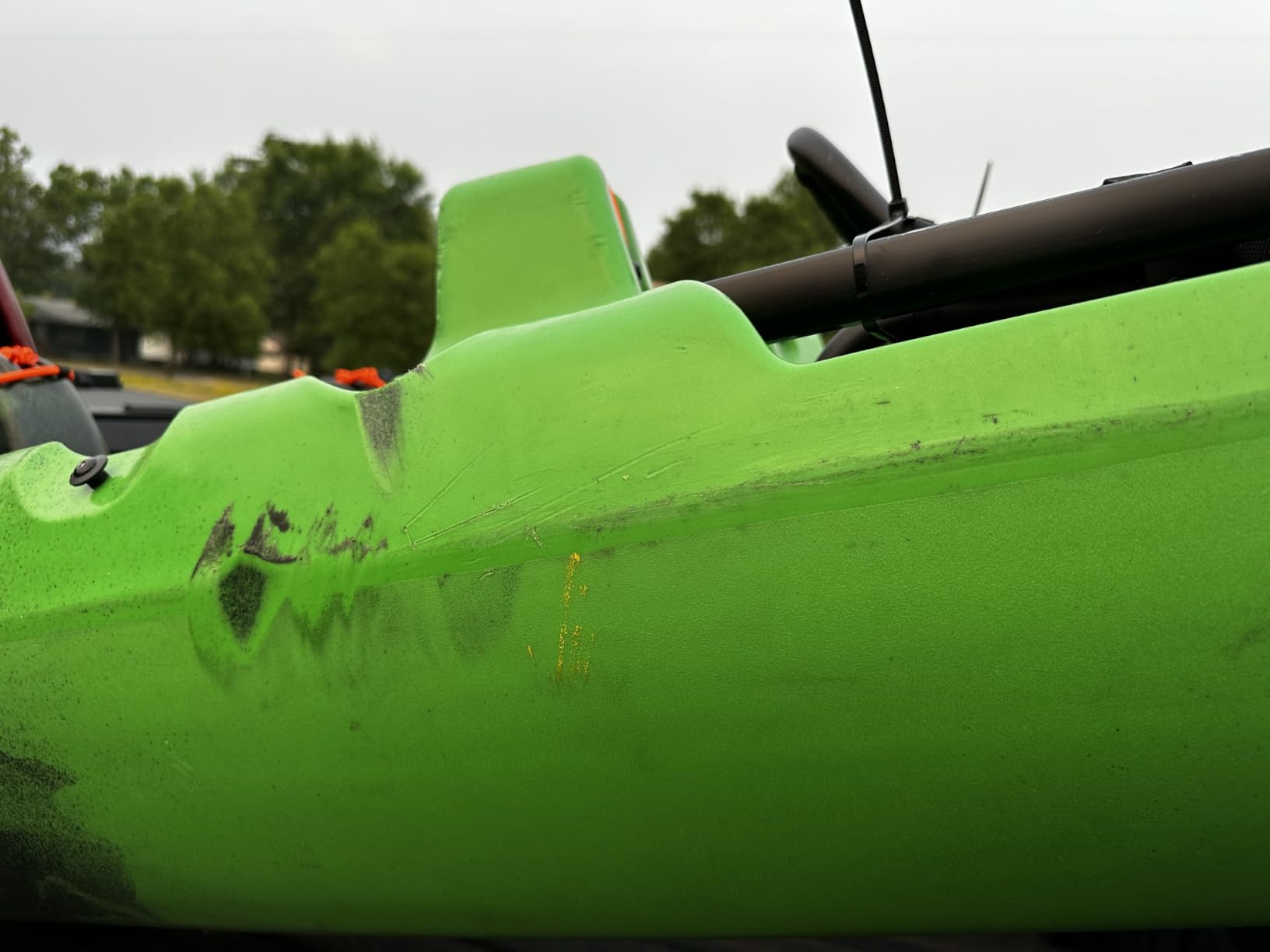
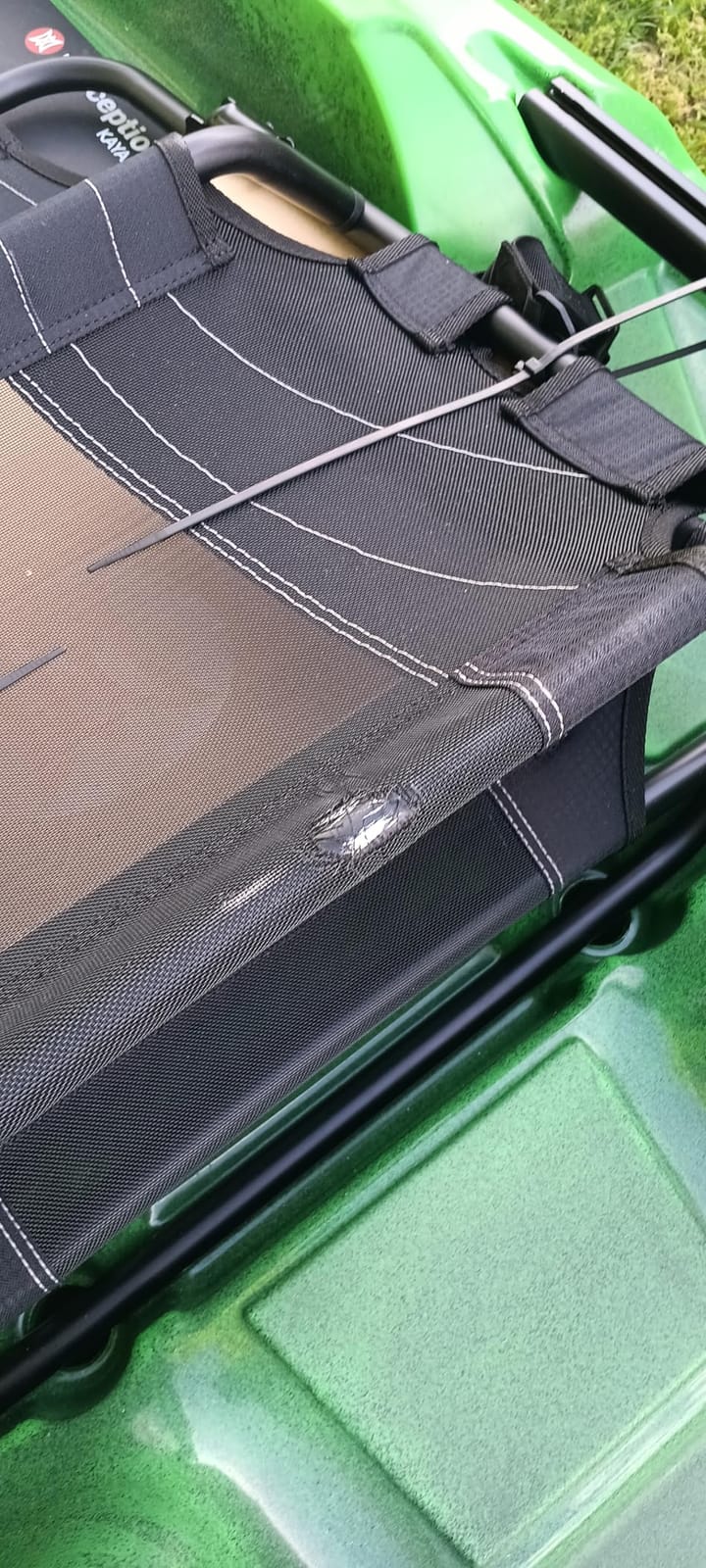
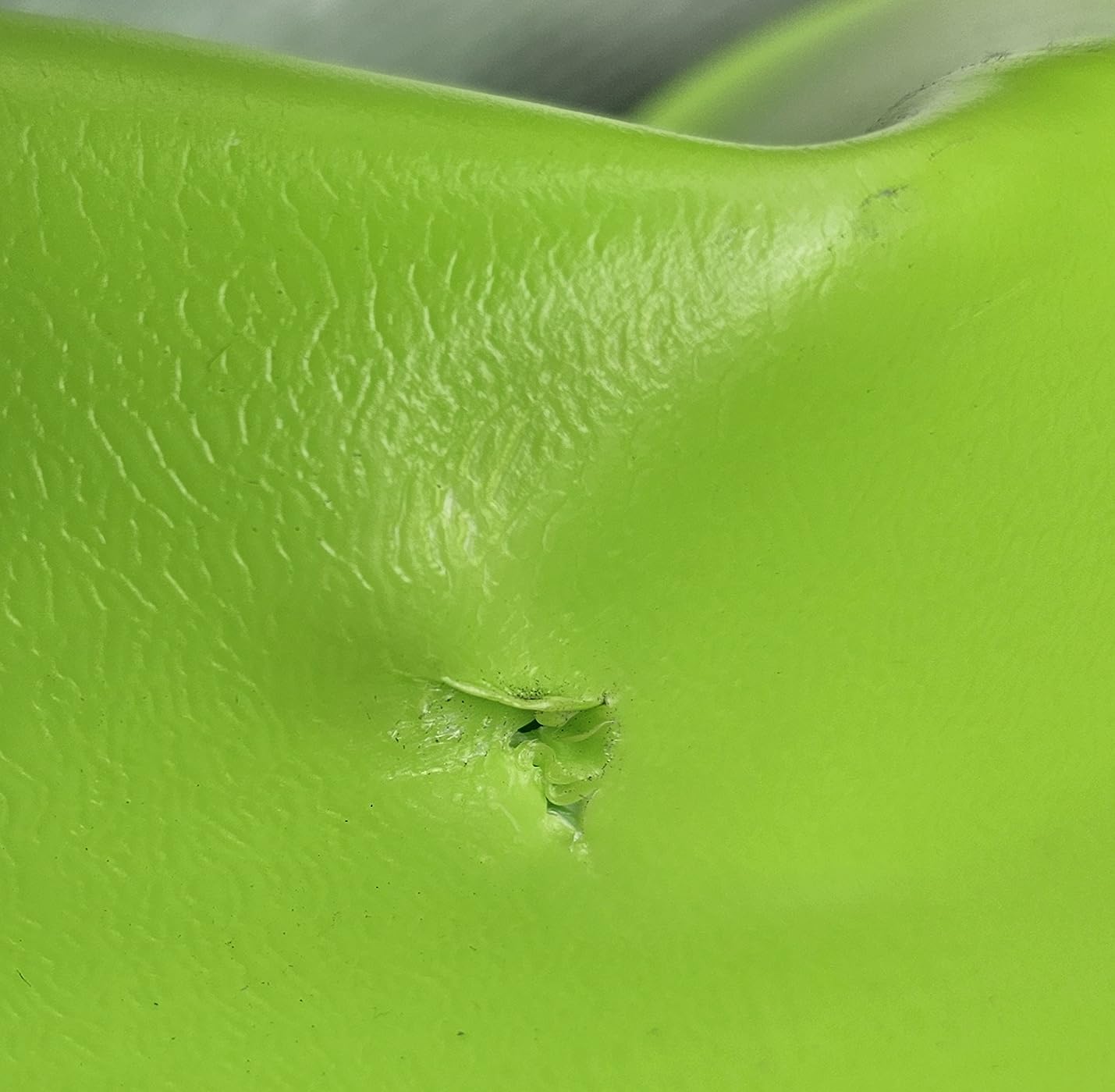
Owners do report freight damage arriving with hull gouges or missing hardware, so inspect the hull and hardware on day one. It is a five-minute job and it keeps the warranty useful.
3. Pelican Sentinel 100X Angler – Best Value and Easiest Boat to Solo-Load
Pelican Sentinel 100X Angler Fishing KayakSit-on-Top KayakLightweight one Person Kayak9.6 ft
9 ft 6 in hull
29.9 in beam
44 lb
275 lb capacity
Ram-X multi-chine
Pros
- 44 lb hull one person can solo-load and roof-carry
- Multi-chine flat bottom stays steady when casting and reeling
- Mesh front deck
- rear tank well and ExoPak compartment
- Adjustable Ergolounge seat handles long sessions
- Fits inside a four-door sedan with the seats down
Cons
- Too narrow to stand and cast comfortably
- Some owners report wobble while paddling
- Rod holders sit awkwardly far from the seat
- Seat comfort declines after several miles
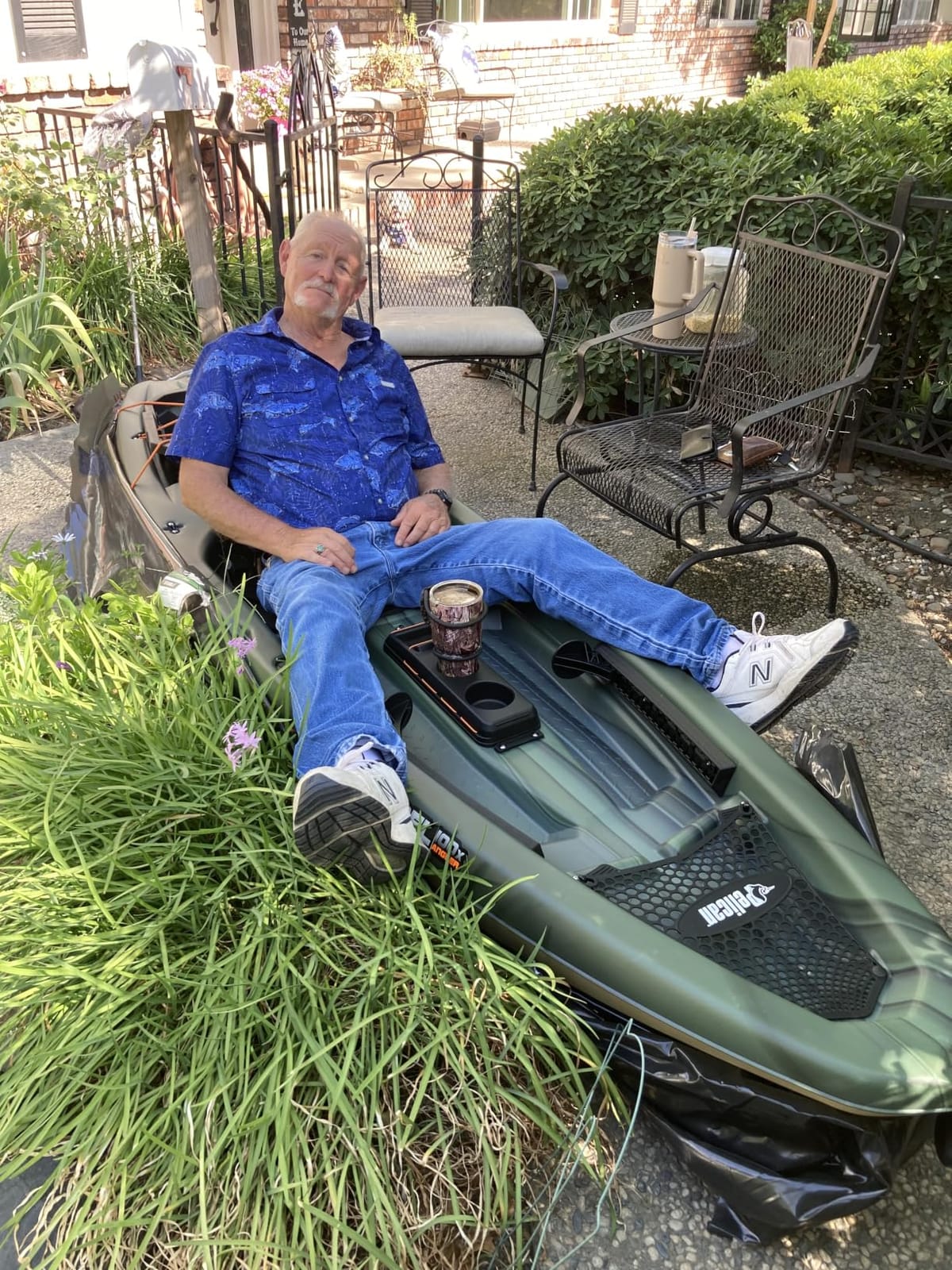
The Sentinel 100X is the boat I recommend to anyone whose river access involves a long driveway, a steep path or a small car. At 44 lb it is the easiest hull here to move alone, and owners report it fits inside a sedan with the seats down, which removes the roof rack from the conversation entirely. For a solo angler working scattered access points, that is worth more than any feature on the list.
It is also a genuinely capable little river boat. The multi-chine flat bottom is what gives it the stability for casting and reeling, and Pelican molds extra flotation into the hull so it meets or surpasses ABYC flotation standards. That matters in moving water, where a swamped hull stops being a fishing problem and starts being a safety one.
Where a 9 ft 6 in hull shines and where it struggles
Short is nimble. The Sentinel turns inside its own length, which is exactly what you want at a tight bend, around a boulder or while working an eddy line close to the bank. It also tracks fine in a straight current, and the flat bottom keeps it from tipping when you land a fish off the side.
The compromise is the 29.9 inch beam. It is stable seated and fine for casting from the chair, but it is not a boat you stand in. If sight-fishing structure on foot is how you fish, step up to the Catch Classic or the Catch Mode. A minority of owners also report some wobble while paddling, which is typical of short, narrow hulls with a light load.
Storage layout and the ExoPak
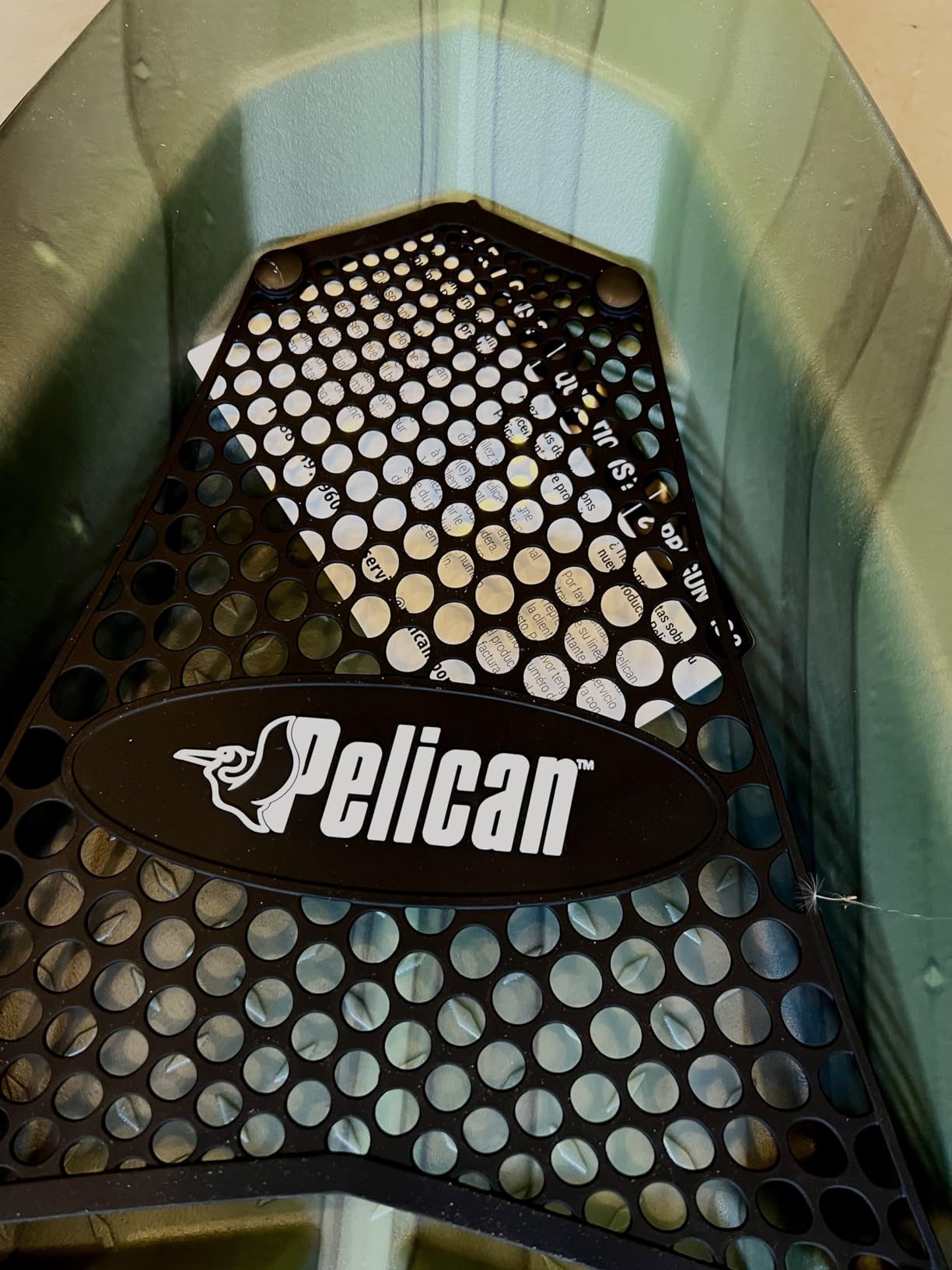
The storage story is the best part. A mesh-covered front platform, a rear tank well and a removable ExoPak compartment that fits inside that tank well give you three separate places to put things, which is more usable space than one big well on a boat twice the length.
Two flush-mount rod holders, two accessory eyelets and a paddle and rod tie-down round it out. The rod holders are the one ergonomic complaint that repeats in reviews, because they sit further forward than the seat reaches comfortably, so plan on angling your rods back. The Ergolounge seat is adjustable and fine for most of a day, though owners who paddle long distances report it getting tiring after several miles.
Pelican backs the hull with a lifetime limited warranty against manufacturer defects and one year on parts and accessories. Check your local state watercraft rules before you rig a motor on it, and remember that narrow deck when you plan your casting position.
4. Perception Outlaw 11.5 – Best Wide Platform for Heavy Anglers and Standing Casts
Perception Kayaks – Outlaw 11.5 Fishing Kayak – Sit on Top – Fold Away Lawn Chair Seat – 4 Rod Holders – Integrated Tackle Trays – 11.5 ft – Dapper
11 ft 6 in hull
35 in beam
425 lb capacity
4 rod holders
Fold-away frame seat
Pros
- 35 inch beam is a genuinely planted standing platform
- 425 lb rating covers a large angler plus a full gear load
- Four integrated rod holders for multi-rod fishing
- Integrated tackle trays keep lures and line in reach
- Large rear tank well and front storage
Cons
- Wide beam makes solo portaging awkward
- Less nimble around strainers and tight bends than shorter models
- Molded tackle trays limit flexible storage layout
- Premium price point for the category
The Outlaw is the boat for the angler who wants to stand. At 35 inches of beam and 425 lb of capacity, it is the most forgiving platform in this group for someone who fishes on their feet, and it is the one I would put in front of a beginner who is nervous about balance in moving water. Owners consistently describe it as staying planted while casting, which is the entire point when a current is setting you sideways at the same moment you are trying to land a fish.
Perception also built it as a serious multi-rod platform, with four integrated rod holders and molded-in tackle trays, so you are not bolting accessories onto the deck before you fish.
Beam, capacity and the angler who is 300 lb
Here is the capacity math that matters. A 300 lb angler with a 40 lb gear load is 340 lb of a 425 lb rating, which leaves 85 lb of margin, and that margin is what keeps the boat high in the water in current. Anglers who fill a 425 lb boat to the last pound find it wallowing, and wallowing in current is when you lose steering authority.
The 35 inch beam is the feature that justifies the length. Stability comes from width, and width also means more deck to stand on and more room to move your feet when a wave hits. The price is turning radius: this is not the boat to take into a tight, tree-lined creek, and it is not the boat you want to drag across a steep bank on your own.
Seating, storage and where the space goes
The fold-away frame seat is a good compromise. It gives you a supportive, adjustable chair for a long day and it folds flat so the storage underneath is available when you are not sitting, which is a real advantage on a boat with this much deck.
The rear tank well and front storage area take a tackle crate, a cooler and a dry bag comfortably. The molded tackle trays are useful but rigid, so plan your lures around them rather than trying to make them work for a different setup. Owners accept the size and weight in exchange for the platform, which is a fair trade if you are on open water.
One honest warning: no hull width comes without a steering penalty, and 11 ft 6 in plus 35 inches is a big footprint around structure. Plan your route so you are not threading this through a tight bend on a fast day.
5. Pelican Catch Mode 110 – Best Tunnel Hull for Standing and Easy Entry
Pelican Catch Mode 110 – Angler Fishing Kayak with Lawnchair seat – 10.5 ft
10 ft 8 in hull
34.5 in beam
63 lb
375 lb capacity
ERGOBOOST seat
Pros
- Tunnel hull is easy to enter
- exit and stand on
- ERGOBOOST seat folds for 6 extra inches of seat height
- 63 lb is manageable for a boat this wide
- Three flush-mount rod holders in reach
- Available in transom or rudder versions
Cons
- Storage is smaller than tank well models
- Seating is plainer than a dedicated angler frame
- Deep draft over shallow river flats
- Transom and rudder are separate variants
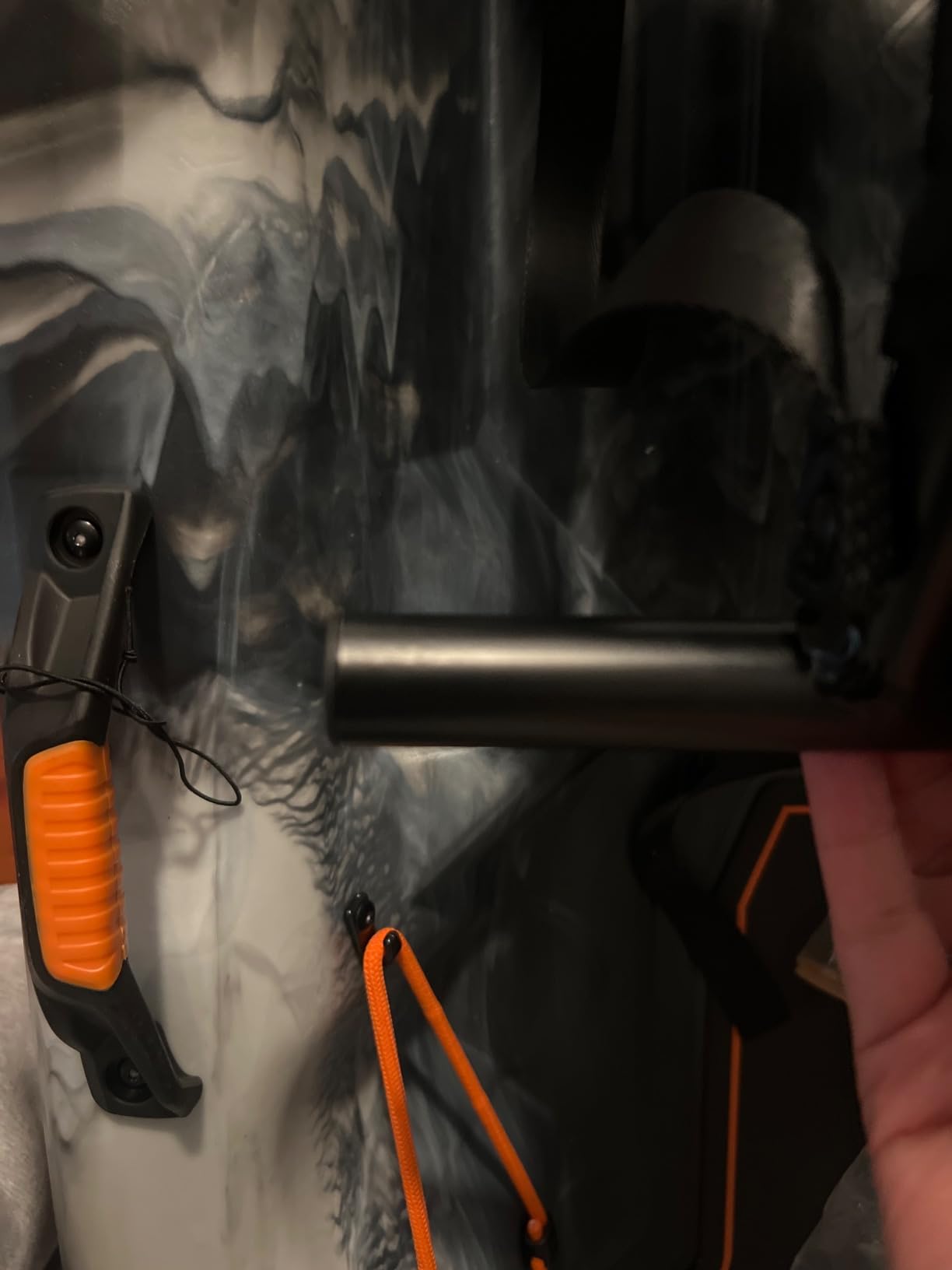
The Catch Mode 110 is the angler who wants a wide, stable casting platform and also wants to get in and out of the boat without lying down. The tunnel hull is what makes that possible: the raised side tunnels make the cockpit sides grabbable and give you a step up, which owners single out as the reason they can stand up quickly in shallow water. On a river where you are launching onto a gravel shelf, that matters.
It is also 34.5 inches wide at only 63 lb, which is a better weight-to-width ratio than most of the beam-heavy boats here.
Why the tunnel hull behaves the way it does in current
A tunnel hull adds lateral stiffness without adding a lot of weight, and the side tunnels also add buoyancy near the cockpit. The practical result is a boat that feels planted when you stand, stays reasonably composed in chop, and does not feel like a barge while you paddle it.
The wide, flat deck means you can cast without tripping over gear, which reviewers mention specifically. The trade is draft: this hull sits deeper than some of the slimmer models here, so over very shallow gravel flats and sandbars you will feel it drag. Pick your line and you will not notice.
ERGOBOOST seating and the transom or rudder decision
When the ERGOBOOST seat folds, it adds 6 inches of seat height, which raises your eye line above the bow and lets you see structure and approaching current earlier. That matters more in moving water than it does on a lake, and it also makes casting to rising fish far easier.
You have a real decision to make on the variant. Transom versions are for mounting a trolling motor, rudder versions are for holding a line in current. For river work, a rudder is usually the more useful one, because backing out of a position is a river problem and a motor is mostly a lake problem. Storage is the one place this boat is modest, with less total volume than the tank well designs.
Pelican adds in-hull flotation to meet or surpass ABYC standards and rates it at 375 lb. If you plan to stand and cast often, this is the one I would demo first in person.
6. Lifetime Kokanee 10 ft 6 in – Widest Deck for Angling on the Standing Platform
Lifetime Kokanee Sit-On-Top Kayak, Lime, 10’6″
10 ft 6 in hull
36 in beam
76 lb
425 lb capacity
Solo or tandem
Pros
- Widest deck in the group at 36 inches
- so standing casts feel planted
- Converts from tandem to solo in a few minutes
- Handles light wind and small chop without fuss
- Tracks straight and moves at a relaxed pace
- Under-deck hatch adds dry storage
Cons
- 76 lb makes solo handling awkward on a riverbank
- Slow
- barge-like handling in current
- Hard plastic seat backs need a foam pad
- Under-deck storage has no divider so gear slides
- Only one cup holder
The Kokanee is the widest hull here at 36 inches, and owners describe it as feeling like a small jon boat. That width is the point: it is the most stable deck for standing casts of any boat in this roundup, and it stays steady in light wind and small chop where narrower boats start to move around under you.
It is also the only boat in the group that converts between tandem and solo in minutes, which is a genuine asset if you fish the same river with a partner sometimes and alone other times.
Stability first, speed a distant second
At 36 inches of beam, this boat sacrifices glide for planted confidence, and on a slow river that is a reasonable trade. It tracks straight and moves at an easy, unhurried pace, which is pleasant on a long float trip. It is not the boat to use when you are covering distance against a current or running a fast section of water.
Owners mention the barge-like feel directly, so expect slow acceleration and wide turns. In practice that means you want to be set up and pointed correctly before you enter a bend, not correcting mid-current. The wide beam also makes solo portaging noticeably awkward, and at 76 lb you are firmly in cart-or-two-people territory.
Seating, deck space and the under-deck hatch
Two adjustable quick-release seat backs cover both solo and tandem configurations, and multiple footrest positions mean paddlers of different sizes can share the boat. The hard plastic backs need a foam pad for long sessions, which is a cheap fix that makes a real difference over a full day.
Deck space is generous and the under-deck hatch adds dry storage for a spare layer or a first-aid kit. The one design flaw owners mention is that the under-deck space runs the length of the boat with no divider, so gear slides from end to end when you turn. Add a foam divider or a dry bag and it stops mattering.
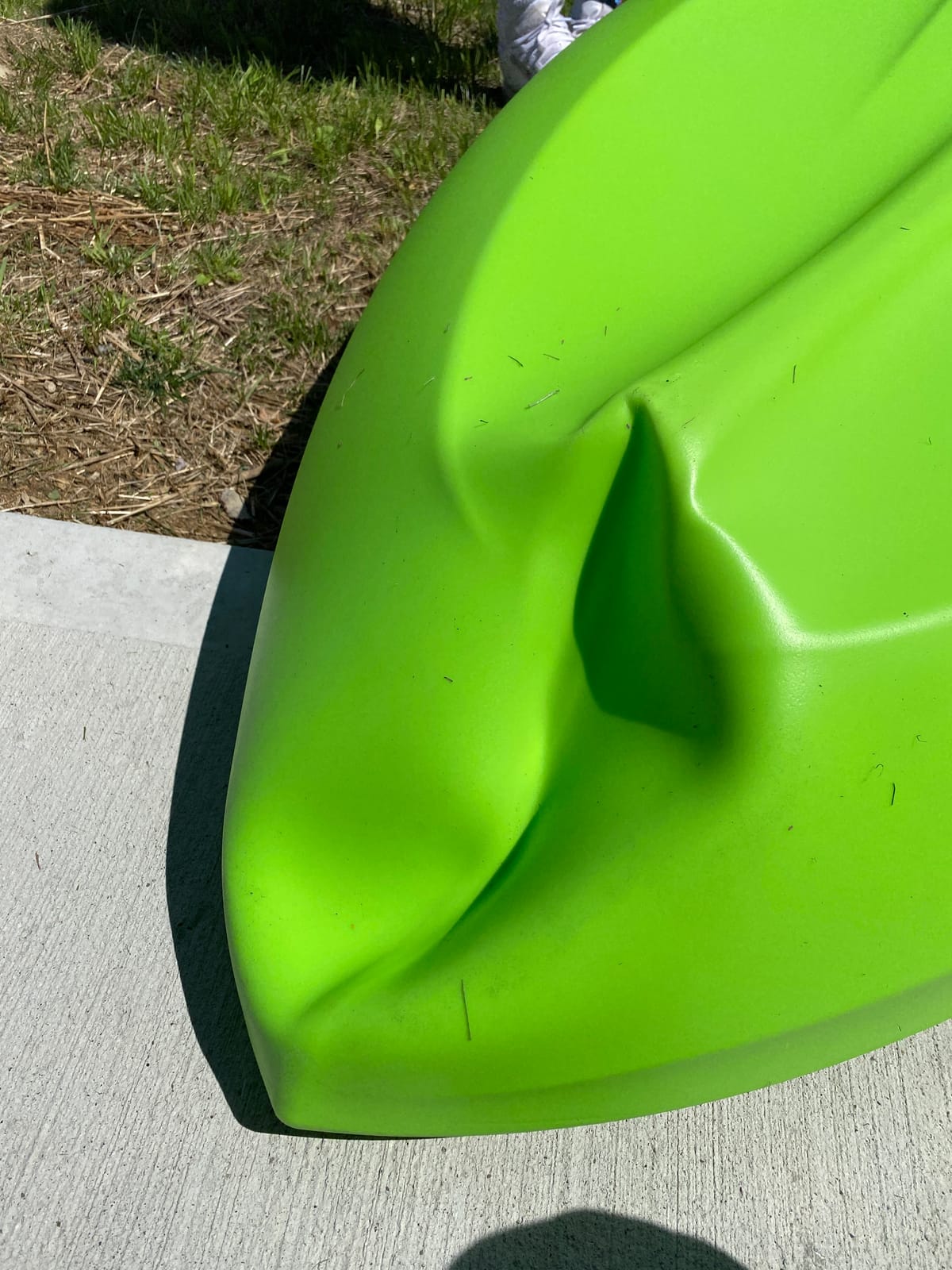
This one is built for anglers who value a wide, calm platform more than speed, and who have a second person or a cart for the launch. It carries a 425 lb rating in UV-protected HDPE with a five-year limited warranty.
7. Albott Modular Fishing Kayak – Best Thrust and Reverse Control in Current
Albott Modular Fishing Kayak with Propeller Drive System & Durable HDPE
9 ft 6 in hull
34.7 in beam
109.7 lb
400 lb capacity
Propeller drive
Pros
- Propeller drive with reverse is the most controllable option in current
- Modular sections break down for transport and storage
- Cabled stern rudder raises and lowers as water changes
- Reinforced HDPE hull with stainless hardware
- Customizable mounting for solo or group setups
Cons
- Heaviest hull in the group at nearly 110 lb
- Short 6-month warranty is the weakest coverage here
- Only 34 ratings
- so long-term durability is undocumented
- Drive system adds parts to maintain
This is the only boat in the roundup with a propeller drive and genuine reverse, and that single fact makes it the most controllable hull in moving water. When the current pins you against structure, reverse is what gets you off the line. Paddlers spend strokes fighting a current that a drive system simply backs out of, and the hands-free aspect means your hands are holding a rod the whole time.
The modular design is the other reason it made this list. It breaks into sections with internal carry handles, so the parts go in a vehicle without a trailer, and the boat assembles in a three-step process with pin connections and stainless hardware.
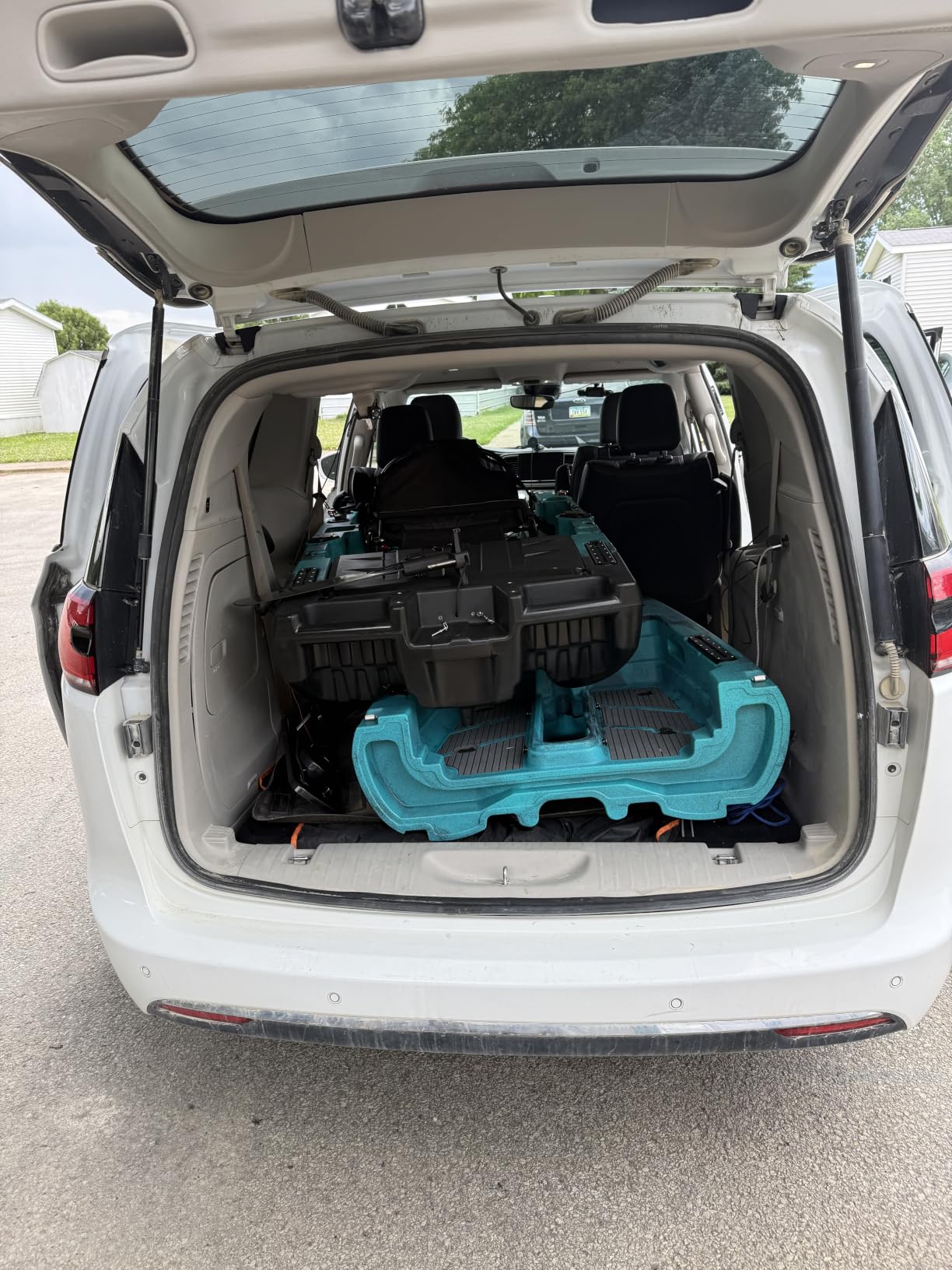
Propeller drive and why directionality matters on a river
Most pedal systems in this category are forward-only, which is a problem in exactly the situation a river creates: you get set up on a seam, the current shifts, and you are pointed at a rock you cannot paddle away from. A drive with reverse turns that moment into a two-second correction instead of a fight.
Acceleration is quiet and the thrust is smooth, which is helpful when you are trying to hold a position in an eddy line. The trade is maintenance. A drive system is more machinery than a paddle, and the propeller needs clearance you do not always get in shallow, branchy river water.
Weight, warranty and the small review base
At nearly 110 lb this is the heaviest boat we list, and no amount of modularity changes the fact that one person cannot carry a fully assembled section down a bank without help. Buy it for a put-in you can drive to or a cart you own outright.
The six-month warranty is the weakest coverage in this group, by a wide margin, and 34 ratings is not enough history to judge five-season durability. The cabled rudder that raises and lowers is a genuinely smart river feature, because you can lift it in shallow gravel and drop it in the fast section.
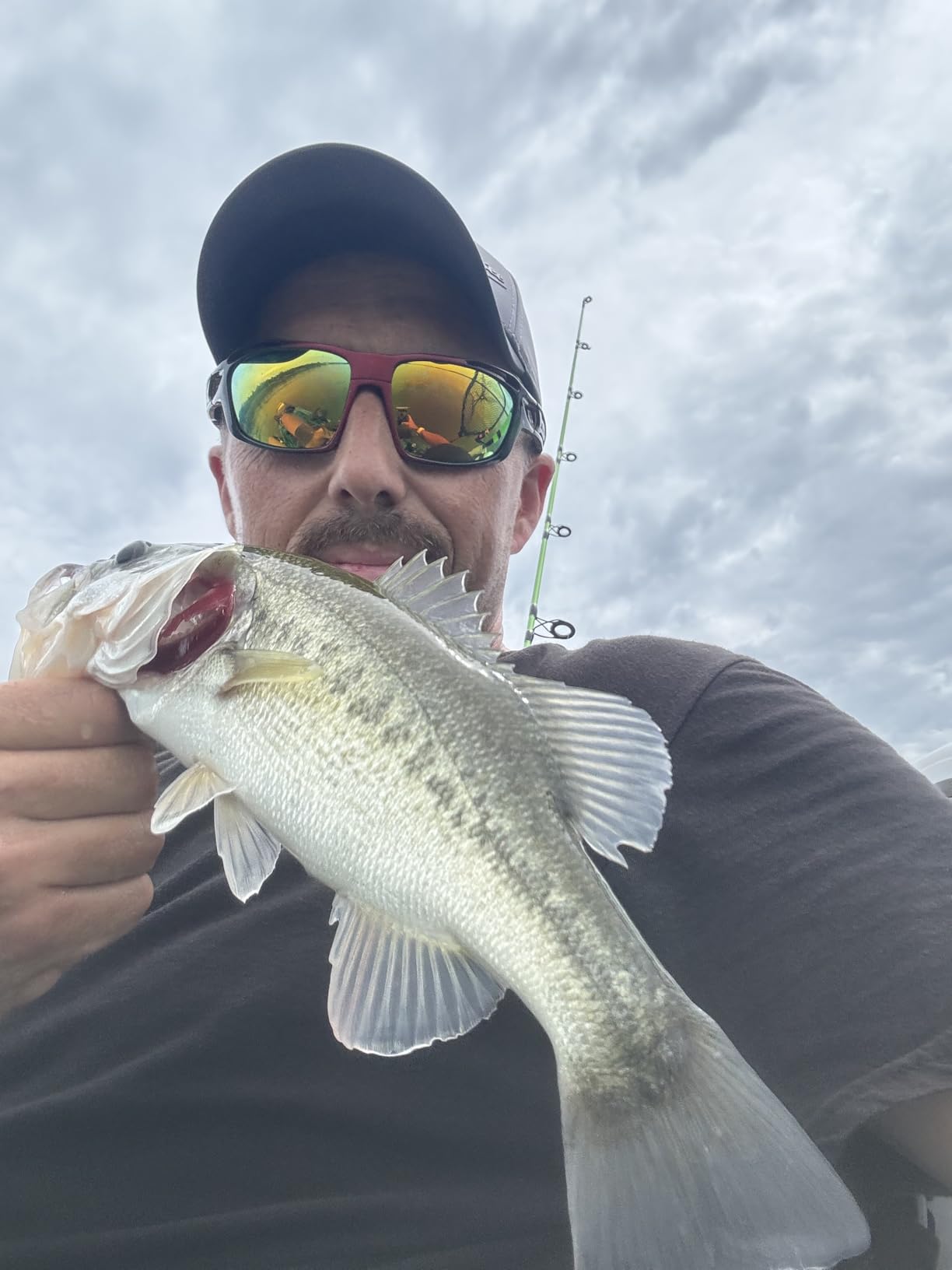
Treat it as an early-adopter boat with the best steering in the group and a shorter warranty than you would like. Owners rate it highly and point to the drive and the modularity as the reasons to buy it.
8. Pelican Catch Classic 100 – Best Rigging Platform for Accessory-Heavy Anglers
Pelican Catch Classic 100 Angler – Sit-on-Top Fishing Kayak – Ergocast Dual Position Seating System – 10 ft – Outback
10 ft hull
34 in beam
57 lb
350 lb capacity
ERGOCAST dual seat
Pros
- Tunnel hull with generous deck for standing casts
- ERGOCAST seat flips high or low to match conditions
- Two 4 inch rigging tracks plus accessory eyelets
- Quick-lock front hatch and rear tank well
- Light at 57 lb for a 10 ft angler boat
Cons
- 350 lb rating is the smallest of the premium angler boats here
- Only two rod holders
- Higher share of one-star reviews than comparable models
- Rigging tracks are short so mounts must be compact
The Catch Classic is the boat to buy if your plan involves a fish finder, an anchor trolley, a rod holder arm and a battery box. It is one of only two hulls here with rigging tracks as standard, and combined with two accessory eyelets and a quick-lock front hatch, it saves you bolting plates into the deck on a gravel bank in the dark.
The tunnel hull gives you a wide, flat, uncluttered casting deck, and the ERGOCAST seat adjusts between a high and a low position so you can pick the one that suits sight-fishing or the one that suits sitting all day.
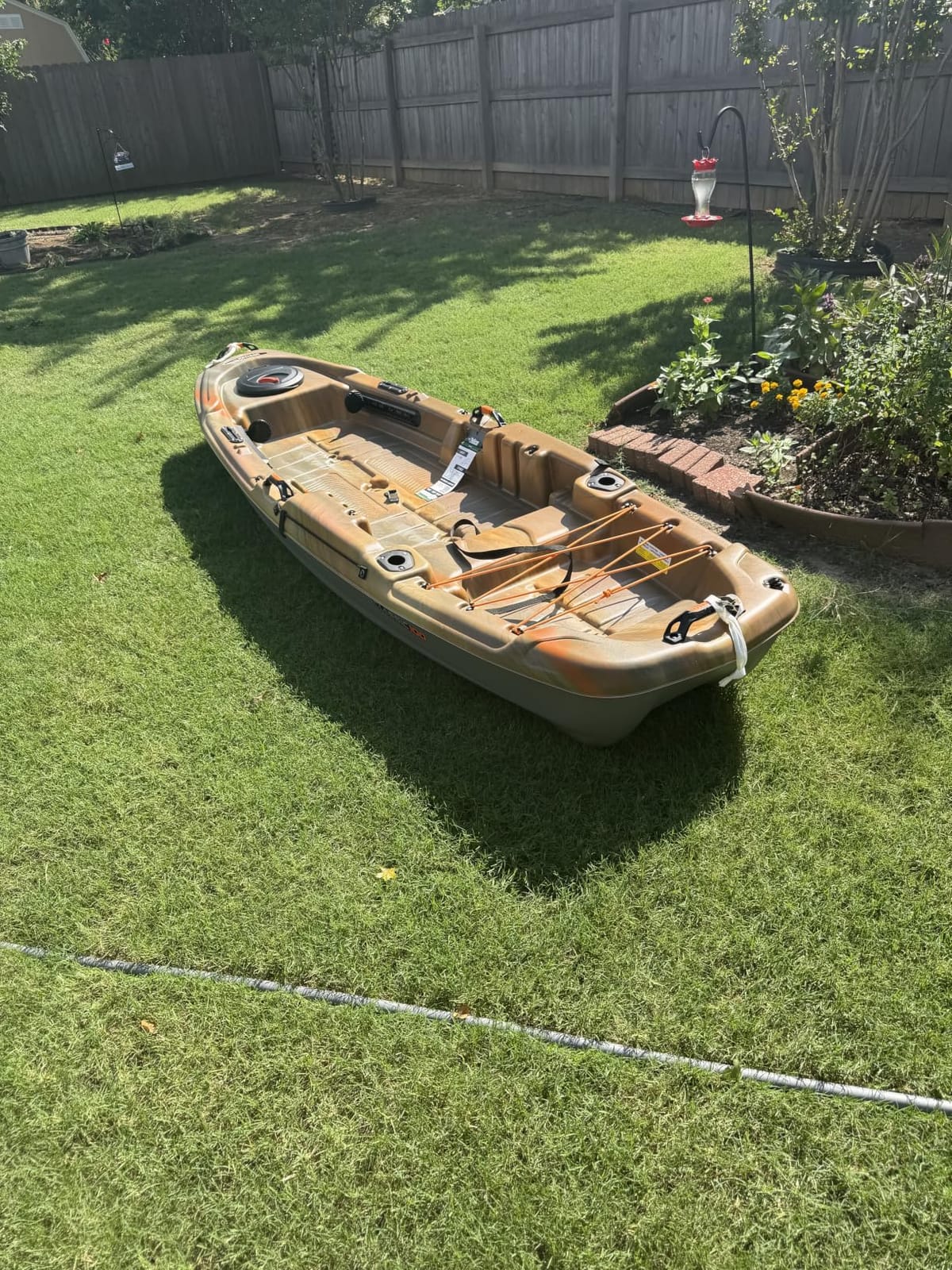
Rigging tracks and the anchor trolley question
Two 4 inch tracks are not much track, but they are enough for a compact transducer mount or a small accessory plate, and they are positioned where the manufacturer intended gear to go. The rear tank well with bungee cords takes a crate, and the quick-lock front hatch keeps a phone, wallet and keys dry.
If you plan to fish an anchor in current, this is a boat where that is straightforward. The rails are short, so measure your trolley plate before you buy, and note that the two rod holders are the only ones you get. A rod holder arm on the rail solves it if you run more than two rods.
What 350 lb of capacity means for a loaded day
At 350 lb, a 190 lb angler with a 60 lb gear load sits at 250 lb, which leaves 100 lb of freeboard capacity. That is fine for a day float. It is not fine if you are carrying a full-size crate, a loaded cooler and a second person, and it is the tightest rating among the premium angler boats we looked at.
Owner sentiment is mixed in a way worth reading before you buy. The feature set and stability draw real praise, but this model draws a noticeably larger share of one-star feedback than the other picks here, most often around durability and delivery delays. At 57 lb it remains one of the easier 10 ft angler hulls to move alone.
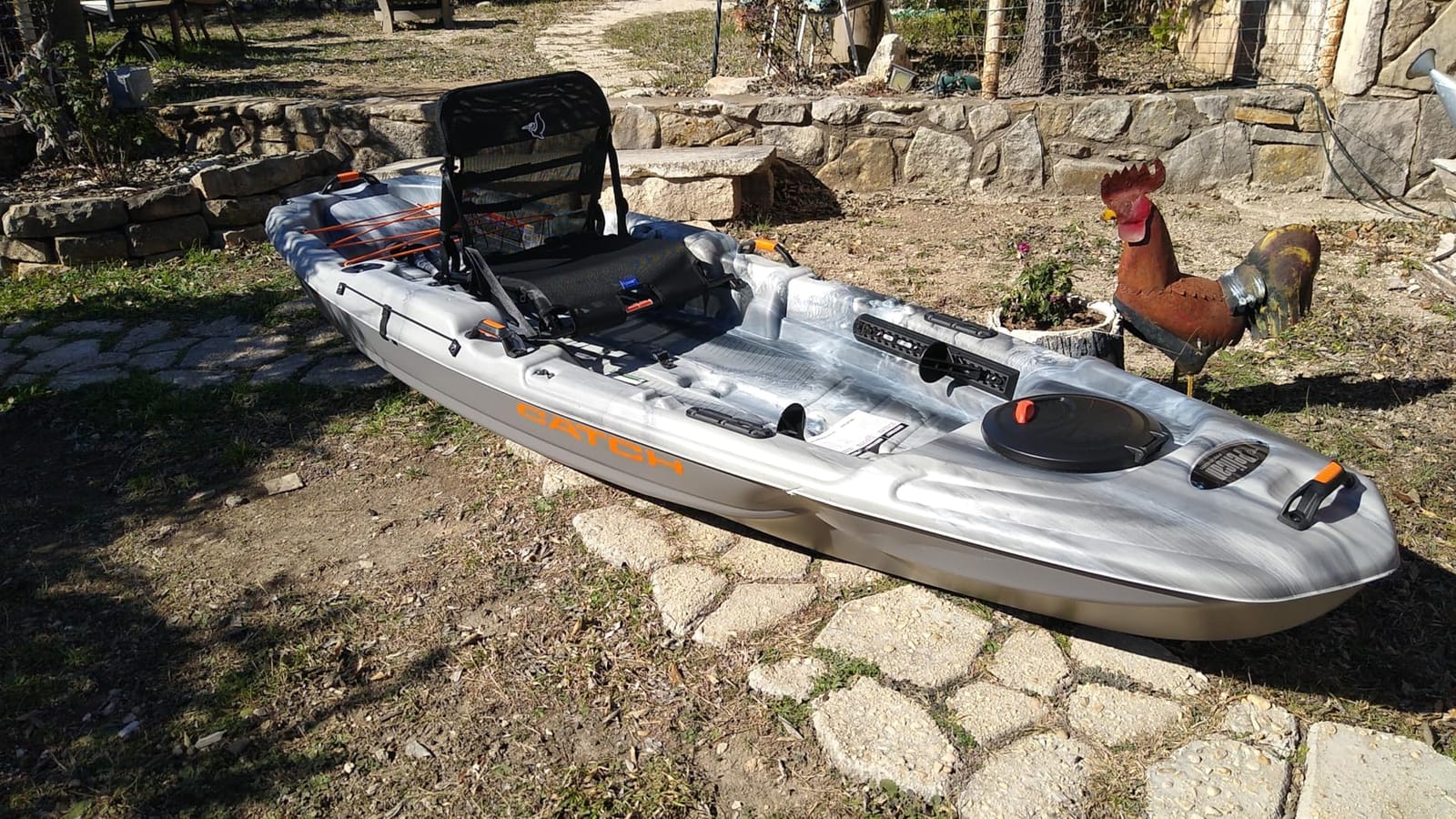
Pelican adds extra in-hull flotation to meet or surpass ABYC standards on this model, which is worth knowing in moving water. Buy it for the rigging layout, and inspect the hull fittings carefully on day one.
9. Perception Access – Best Compact, Stable Boat for Calm and Slow River Water
Perception Kayaks Access 9.5 | Sit on Top Kayak | High Back Seat | Rod Holders | 9′ | Dapper
9 ft hull
31 in beam
42 lb
250 lb capacity
High back seat
Pros
- 42 lb hull is easy to solo-carry and roof-mount
- High back seat is supportive enough without a cushion
- Stable for its size in light chop and boat wake
- Maneuverable in tight bends and eddies
- Two molded rod holders plus bungee storage
Cons
- 250 lb rating leaves little room for gear
- Not built for speed; the stern shifts under load
- Unsuitable for fast or rough water
- Fixed seat cannot be adjusted for different paddler heights
The Access is the boat for wide, placid rivers and bay-like water where the current is more of a nudge than a force. Owners who moved up from lighter sit-on-tops call it the most stable and most comfortable boat they have tried, and the fixed high back seat is supportive enough that several say they stopped using a cushion.
At 42 lb it carries onto a roof rack by yourself, and at 9 feet it turns easily in tight bends and works eddy lines without a fight.
What the 9 ft hull gives up for stability
This is a slow boat by design, and owners accept that in exchange for a planted feel. Shallow hull channeling means the stern can shift under load, which you notice when you are heavy in the back or pushing hard across current. If your river has speed in it, choose a longer hull instead.
Perception states the boat is intended for lakes, bays and slow rivers, and that framing is accurate. It is a comfortable, confidence-inspiring platform on flat water and a poor choice for anything that moves quickly.
Capacity, seat and a boat built for one paddler
The 250 lb rating is the tight constraint. A 175 lb angler with a normal day of gear reaches 230 lb, which leaves little margin for a heavy cooler or a second person. Know your loaded weight before you commit to it on a long float.
The molded high back seat cannot be adjusted, which is the trade for its support, and it means the boat fits one specific paddler height better than another. Five footrest positions let you tune leg position. Open front and rear storage with bungees, two molded rod holders, a drink holder and front and rear handles complete a sensible, unfussy angler package.
It is made in the USA and carries a five-year limited warranty. If your water is slow and your access is tight, this is the boat that disappears into the environment instead of dominating it.
10. Lifetime Lockport 94 Modular – Best Two-Piece Boat for Compact Storage and Transport
Lifetime Lockport 94 Modular Sit-on-Top Kayak with Paddle, Two-Piece Design with SlideLock System, Rod Holders, Adjustable Seat
9 ft 4 in assembled
30 in beam
40 lb
250 lb capacity
Two-piece SlideLock
Pros
- Halves stack in an SUV or minivan with no roof rack
- SlideLock joint stays firm through boat wakes
- Hard-shell HDPE feels rigid with no inflatable flex
- Paddle
- bungee tank well and two rod holders included
- Center carry handle in each half
Cons
- 40 lb still feels heavy for a 9 ft boat and it paddles slowly
- No rudder
- and molded rather than adjustable footrests
- No internal storage; a cushion helps on long days
- Slow turning means eddy lines take patience
- Not suited to whitewater
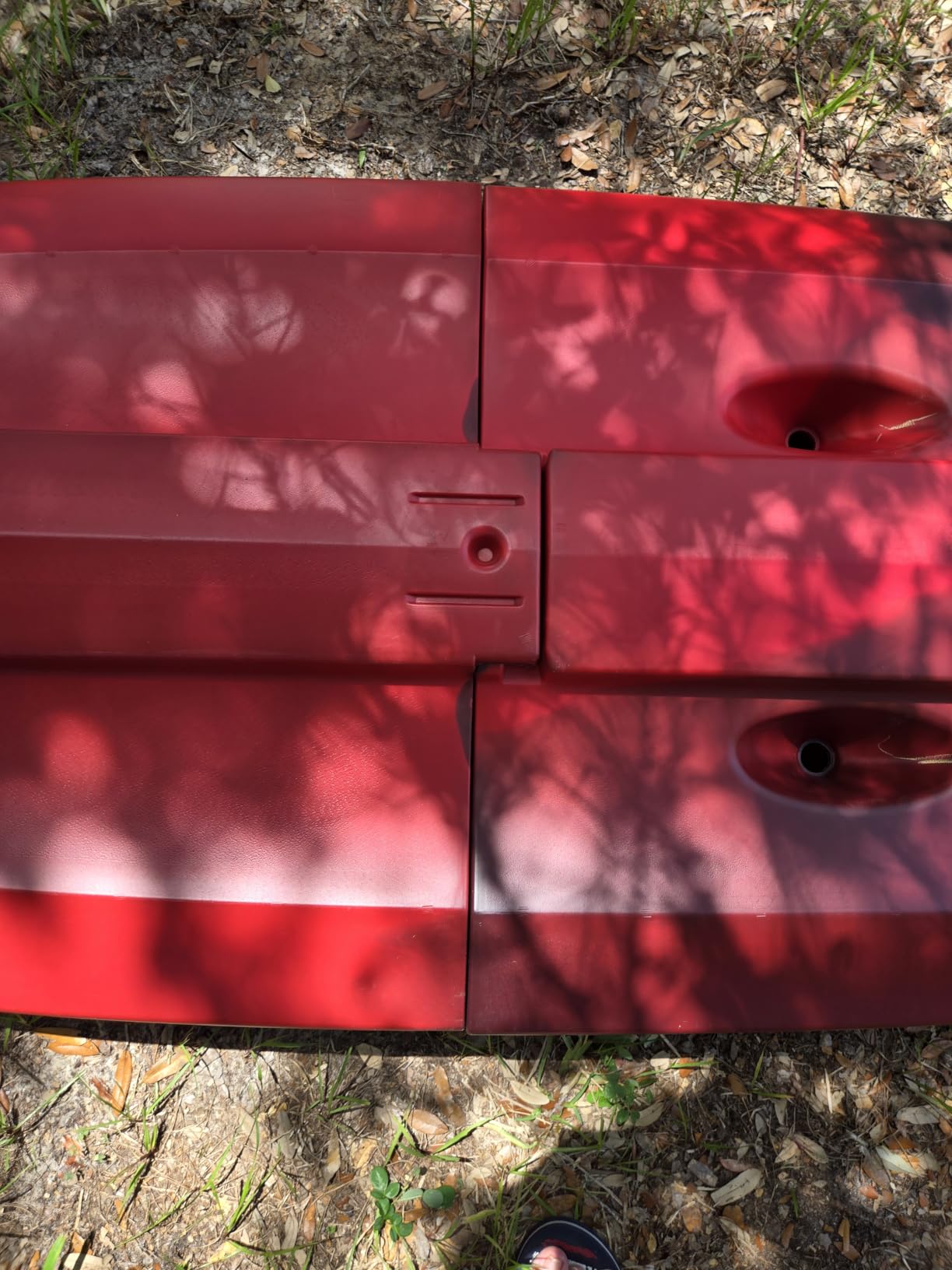
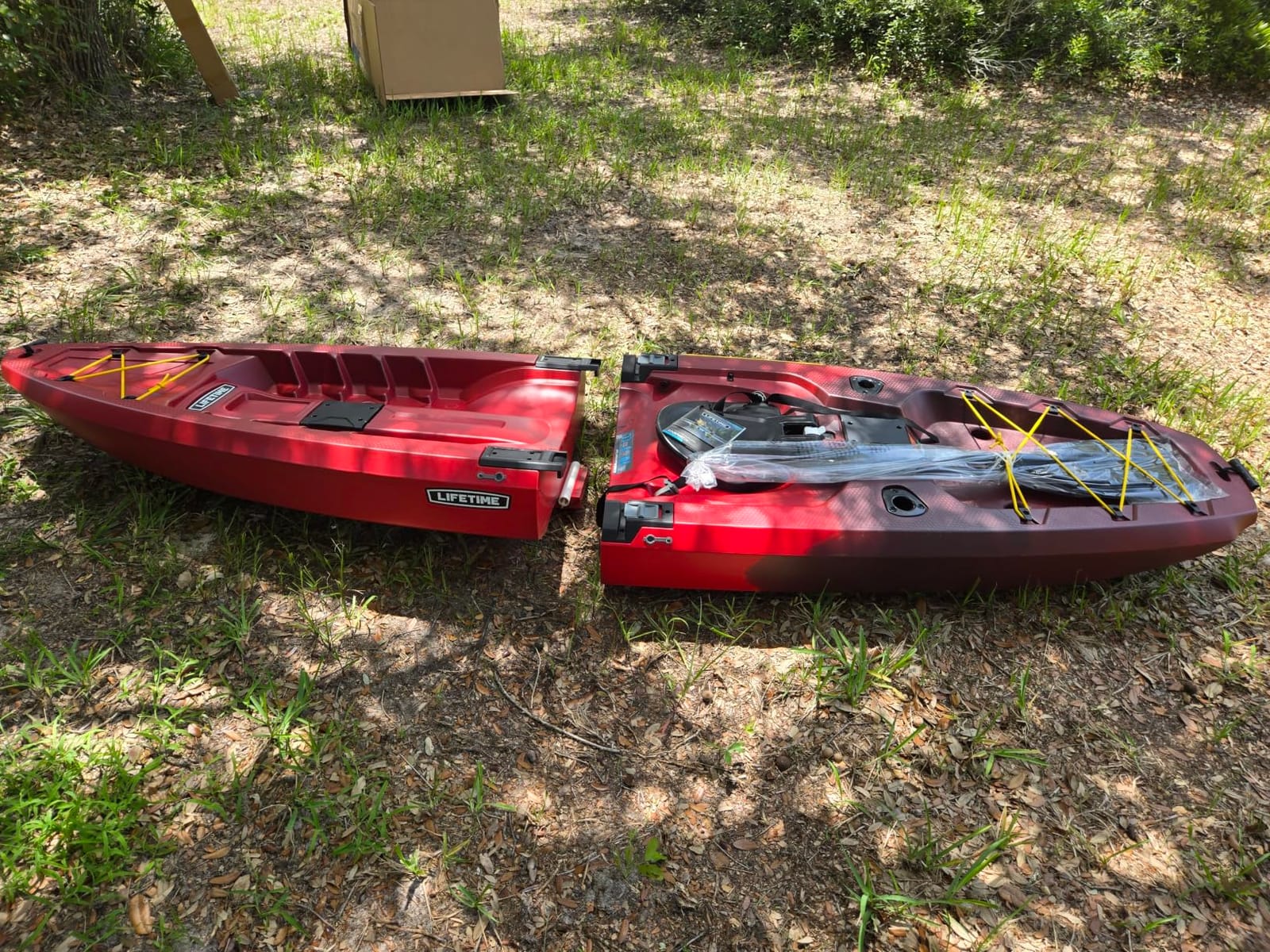
The Lockport 94 solves a specific problem very well: how do you own a hardshell fishing kayak if you have no rack, no trailer and limited storage. It splits into two nesting halves with a SlideLock tongue-and-groove joint, and the halves go in a back seat or a hatch. Owners frame it as a beginner-friendly, no-hassle hardshell that still feels rigid on the water with none of the flex of an inflatable.
It is also the highest-rated hull in this roundup on owner satisfaction, with 31 ratings at 4.6 out of 5, though that is a small enough base that we would treat it as encouraging rather than proven.
Why the two-piece design changes the launch
River launches are usually solo, and this boat removes the roof rack from the equation entirely. Each half is about 57 inches long with a center carry handle, so one person can carry both halves underarm down a bank. The SlideLock joint is described by owners as staying secure through boat wakes, and the UV-protected HDPE is impact resistant with a finish that resists fading and cracking.
Two flush-mount rod holders, a bungee tank well, a bottle holder and a paddle keeper are included, and the deep hull channels give it reasonable straight-line tracking for a 9 ft boat.
Where the center seam and the missing rudder cost you
Owners are candid about two things. The boat is heavy for its size and it is slow, particularly through the center seam, and turning is noticeably slow, which means working an eddy line takes patience. With no rudder, you steer entirely with your paddle in current.
The molded rather than adjustable footrests and the absence of internal storage are minor, but the fixed center seam is the real trade. This is a boat for Class I and low Class II water and calm lakes, not for a river with speed, and no amount of clever design changes that. A cushion helps on a long day.
Lifetime backs it with a five-year limited warranty. If storage and solo transport are your binding constraints, this is the hardshell answer that most of this list cannot give you.
11. Intex Dakota Quest – Best Pack Inflatable for Remote River Put-Ins
INTEX Dakota Quest Sit-On-Top Inflatable Kayak Set with Paddle & Pump
10 ft 6 in inflated
2 ft 11 in beam
352 lb capacity
Detachable skeg
PVC
Pros
- Packs into the included backpack for solo-carrying to a remote put-in
- Feels rigid at the recommended 12 psi rather than pool-rigid
- Wide 10 ft 6 in platform rated to 352 lb
- Large detachable fin skeg tracks in wind and chop
- Kit includes pump
- paddle
- elevated seat and rod holders
Cons
- 90-day warranty is the shortest coverage in the group
- Included pump has a hard-to-read gauge
- Rod holders and camera mount sit out of reach from the seat
- Some accessories will not fit back inside the bag
- One experienced paddler returned it for poor forward tracking
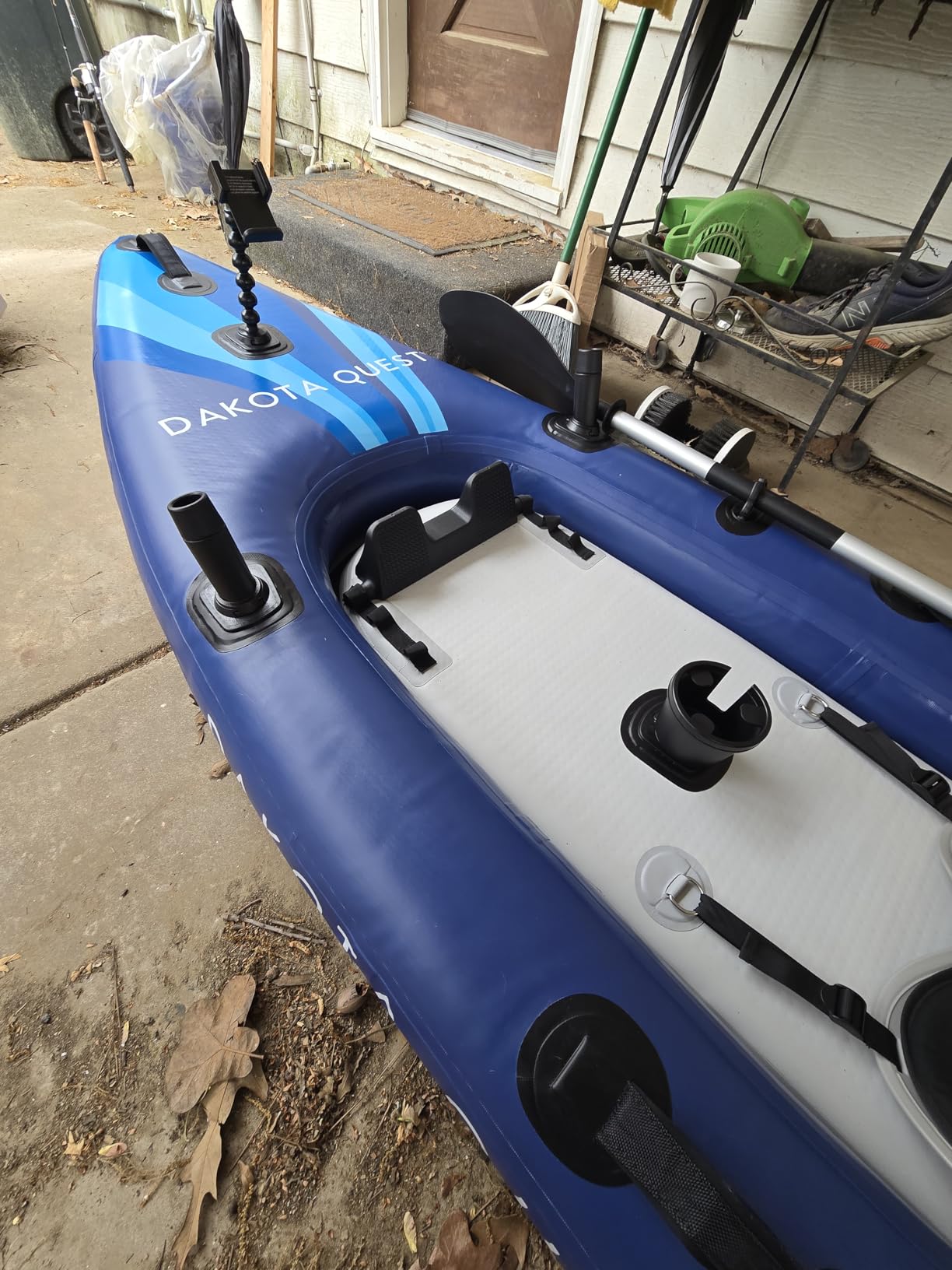
The Dakota Quest is the only inflatable in this roundup, and it earns its place for a specific situation: a river access point you can only reach on foot, a long walk down a trail, or a trip where the boat has to live in a closet between outings. It packs into the included backpack, and at the recommended 12 psi owners report it feels rigid rather than pool-soft.
It is also 10 ft 6 in long and rated to 352 lb, so it is not a puddle boat. The large detachable fin skeg is the feature that makes it fishable rather than merely floatable, because it tracks straight in wind and chop where most inflatables wander.
What an inflatable does well on moving water
Rigidity, beam and packability are the three honest strengths here. A 2 ft 11 in beam gives a genuinely stable platform, the elevated collapsible back-support seat raises you above the waterline for better visibility of structure, and the three-position footrest helps with posture on longer floats.
It is genuinely usable on low-gradient rivers, ponds, and slow sections where you are casting from a seated position. Two detachable rod holders, a dual phone or action camera mount and tie-down bungees cover the angling basics, and a patch kit is included for punctures.
Where an inflatable is the wrong tool
Tracking is the weak point. One experienced paddler returned it specifically for poor forward tracking, and the skeg, while a real improvement, is not the equal of a molded skeg or rudder on a hardshell. The 90-day warranty is also the shortest of any boat we list, and PVC needs patching and care that a rotomolded polyethylene hull does not.
Accessory reach is the everyday annoyance. The rod holders, camera mount and paddle clips sit out of easy reach from the seat, and the supplied pump has a gauge that is hard to read, which matters when you are inflating at a trailhead in the dark. The footrest also frustrates very tall paddlers.
Our verdict: acceptable for slow rivers, wrong for anything with structure and speed. Inflating to 12 psi and checking the skeg is bolted in properly are the two things that decide whether the trip works.
How to Choose a Sit-on-Top Fishing Kayak for Rivers
Start with your water, not with a brand. The same hull that is perfect on a slow tailwater can be wrong on a creek, and the reverse is just as true.
What type of kayak is best for using on rivers?
A sit-on-top beats a sit-inside for river fishing for two simple reasons. You can stand to cast without any modification, and when you capsize in moving water you get out of it immediately instead of fighting a spray skirt. The cost is exposure: you get wet, you get cold, and your gear gets wet unless you dry-bag it.
Within sit-on-tops, match the hull to the water like this. Flat, slow and wide rivers with occasional structure suit 11 to 12 foot hulls with a rudder or a good skeg, because you want tracking and you want to be able to back out. Narrow, twisty, tree-lined creeks suit 9 to 10 foot hulls that turn quickly and weigh under 55 lb, because you will be paddling around things rather than through them.
Fast water with real current, Class III and above, is not recreational fishing water in an open sit-on-top. If your river has Class III rapids, you want a proper whitewater boat and a whitewater PFD, and no angler kayak on this list replaces that training and that equipment.
What is the best size kayak for rivers and lakes?
For rivers, 10 to 11 feet. For lakes and big water, 12 to 13 feet. That split is the standard advice in the angling forums and it is correct: length gives you glide and tracking on open water, while a shorter hull stays maneuverable where a river narrows and bends.
Beam matters as much as length. 32 to 34 inches is a sensible band, with 33 to 34 inches the sweet spot for standing casts. Below 30 inches you are sitting and casting. Above 35 inches you are stable but you are also paddling a barge and feeling every crosswind.
Stability vs speed vs tracking in current
These three fight each other, and there is no hull that wins all three. Stability comes from width. Tracking comes from length and hull depth. Speed comes from a narrow, light hull with low drag.
The resolution is to decide which one you are trading away. If you sight-fish structure on foot, buy width and accept the barge. If you cover distance on long floats or hold a line in current, buy length and accept that you will be casting from the chair. If your water is narrow and full of corners, buy maneuverability and cast from a seated position. Our test order is exactly this: tracking first in current, standing stability second, drainage third.
Rudder, skeg and steering in moving water
A skeg is a fixed fin that resists yaw. It keeps a hull tracking straight with no effort, and on a straight reach of river it is often all you need. The Lifetime Tamarack 100 and the Intex Dakota Quest are skeg examples, and both track acceptably for their length.
A rudder goes further, because it can be angled while you are already off line. That is the difference between correcting and recovering. If your river has structure, current that changes direction, or wind that pushes you off line while you are stationary, buy a rudder. The Pelican Catch Mode 110 is available in a rudder version, and the Albott’s cabled rudder raises and lowers as conditions change.
Deck drainage and freeboard when the river comes over the gunwale
Sit-on-tops flood by design, so drainage is a design question rather than a bug. Scupper holes drain water that comes over the deck, and a raised deck with raised footrests keeps more of it out in the first place. Owners of stable boats routinely cite how quickly water leaves the cockpit as a purchase driver, and they are right.
Freeboard is the vertical distance from the waterline to the top of the hull, and taller freeboard means wave crests pass instead of filling the boat. It is one of the least advertised numbers on a spec sheet. If you fish cold water, add scupper plugs to your shopping list, because a self-bailing cockpit is a feature in July and a cold soak in October.
Pedal, propeller or paddle – and why reverse matters
A paddle is simplest, cheapest and has zero maintenance, and for most river anglers it is entirely sufficient. A pedal drive frees your hands for fishing and covers distance faster, and a propeller drive adds the reverse that makes backing out of a pinned position possible.
Directionality is the current-specific criterion. Forward-only systems are frustrating the moment you need to back up, and a fin drive is safer around submerged branches and strainers than a propeller while a propeller gives you reverse. Check state watercraft rules before mounting any drive or motor, and add your drive and battery weight into your capacity math.
Weight capacity math and usable load
Use this formula: your body weight, plus your gear weight, plus 25 percent of that total as a margin. A 190 lb angler with 100 lb of gear needs 363 lb of rated capacity, which pushes them toward a 375 lb boat and away from a 250 lb one.
Rated capacity assumes the water is level. A loaded boat sits lower, sits wetter and handles current more slowly, which is why the margin matters on moving water. Exclude the motor and battery from the arithmetic only if you have actually included them in the gear figure, which most buyers forget to do.
Transport, solo launching and solo retrieval
Weight bands tell you what you need. Under 55 lb you can carry it to the water and lift it onto a roof rack alone. Between 55 and 80 lb, buy a kayak cart. Above 90 lb, plan on a second person or a put-in you can drive right up to.
Launching alone on a sloped or gravel bank takes a routine. Set your rod and gear well upstream, away from the water. Push the bow in while walking down the slope rather than stepping in from a crouch. Once the stern floats, swim the boat, board at the tail, and then deal with the paddle last, since you have both hands free at that point. Walk up the slope backwards with the bow pointed uphill so you are not backing a 60 lb boat into the river. Plan on wet feet, a dirty paddle shaft and a little patience, because the alternative is launching with a partner every time.
River safety gear every angler should carry
A USCG-approved PFD is the first item, and on a river you want one you can actually wear and move in, not a boating cushion. Beyond that: a whistle on the PFD, a throw bag of at least 50 feet of rope in an easy-reach pocket, a bilge pump or sponge, and a bail of water in a lidded container.
Add cold-water protection whenever the water is more than a few degrees colder than the air, because capsizing in a cold river is a hypothermia emergency rather than a swim. Choose hull colors that are visible to other boaters, and treat the bow light and flag on wide water as required equipment, not accessories. A bow-mounted action camera, similar to the models in my action camera picks for fishing, also documents your lines and your route, which matters for anyone fishing water with structure.
What we would skip for river water
Skip a hull that is too long for narrow water, because you will spend more time paddling around things than fishing. Skip anything too narrow to stand on if you cast on your feet. Skip a boat with low freeboard and no drainage if you fish fast water or cold water.
Also skip the boat that is too heavy for your fitness level. A hull that collects dust in a garage helps nobody, and the most common regret in the angling forums is not the boat being too small, it is the boat being too much of a lift. Finally, buy a used hull only if you can inspect it, and check the hull for cracks, the skid area for deep gouges, the scuppers for alignment and the seat hardware for cracks.
Frequently Asked Questions
What type of kayak is best for using on rivers?
A sit-on-top hull of 10 to 12 feet is the best type for river fishing, because you can stand to cast and you can exit quickly if you capsize. Match the length to the water: 9 to 10 feet for narrow, twisty creeks, and 11 to 12 feet with a rudder for wide rivers with current and structure.
What is the best size kayak for rivers and lakes?
For rivers, choose 10 to 11 feet. For lakes and big water, choose 12 to 13 feet. Beam matters too: 32 to 34 inches is a sensible band, and 33 to 34 inches is the sweet spot for standing casts.
What are the disadvantages of sit-on-top kayaks?
The main disadvantages are exposure and weight. You sit in an open cockpit with no spray skirt, so you get wet and cold, your gear gets wet unless you dry-bag it, and scupper holes drain rather than seal. Many sit-on-tops also weigh 55 to 110 lb, which makes solo launching and roof-carrying harder than a sit-inside or an inflatable.
How long should a fishing kayak be for river fishing?
Ten to eleven feet is the right range for river fishing. Shorter boats maneuver around strainers and tight bends, while longer boats track straighter and resist downstream drift. Above 12 feet, plan your line around obstacles instead of improvising, because the boat will not turn quickly.
Can you fish a river from an inflatable kayak?
Yes, but only on slow, low-gradient water. An inflatable rated to 12 psi with a detachable skeg is usable for seated fishing on flat rivers and ponds, but it tracks poorly, has no rudder, and is the wrong tool for water with current and structure.
Final Verdict: Which Sit-on-Top Kayak Fits Your River
If you want one boat that handles most river days, take the Lifetime Tamarack Angler 100. It tracks straight, weighs a solo-manageable 51 lb and carries a 5-year warranty. If your river is wide and slow and you want to glide rather than maneuver, the Perception Pescador Pro 12 is the better ride.
Fish on your feet? The Perception Outlaw 11.5 gives you the widest, most planted platform for a big angler, and the Pelican Catch Mode 110 gives you the same stability in a lighter, easier-to-enter package. Tight access points and a solo launch call for the Pelican Sentinel 100X at 44 lb, and a backcountry put-in calls for the Intex Dakota Quest, with the caveat that it is slow and best on flat water.
Whichever one you choose, fit a throw bag, a whistle and a PFD you can move in before your first float, and check your loaded weight against the rated capacity with a 25 percent margin. The best sit on top fishing kayak for rivers is the one that suits your water class, your access point and your own strength on the bank. We will keep updating this roundup through 2026 as new models land and long-term owner reports come in.