
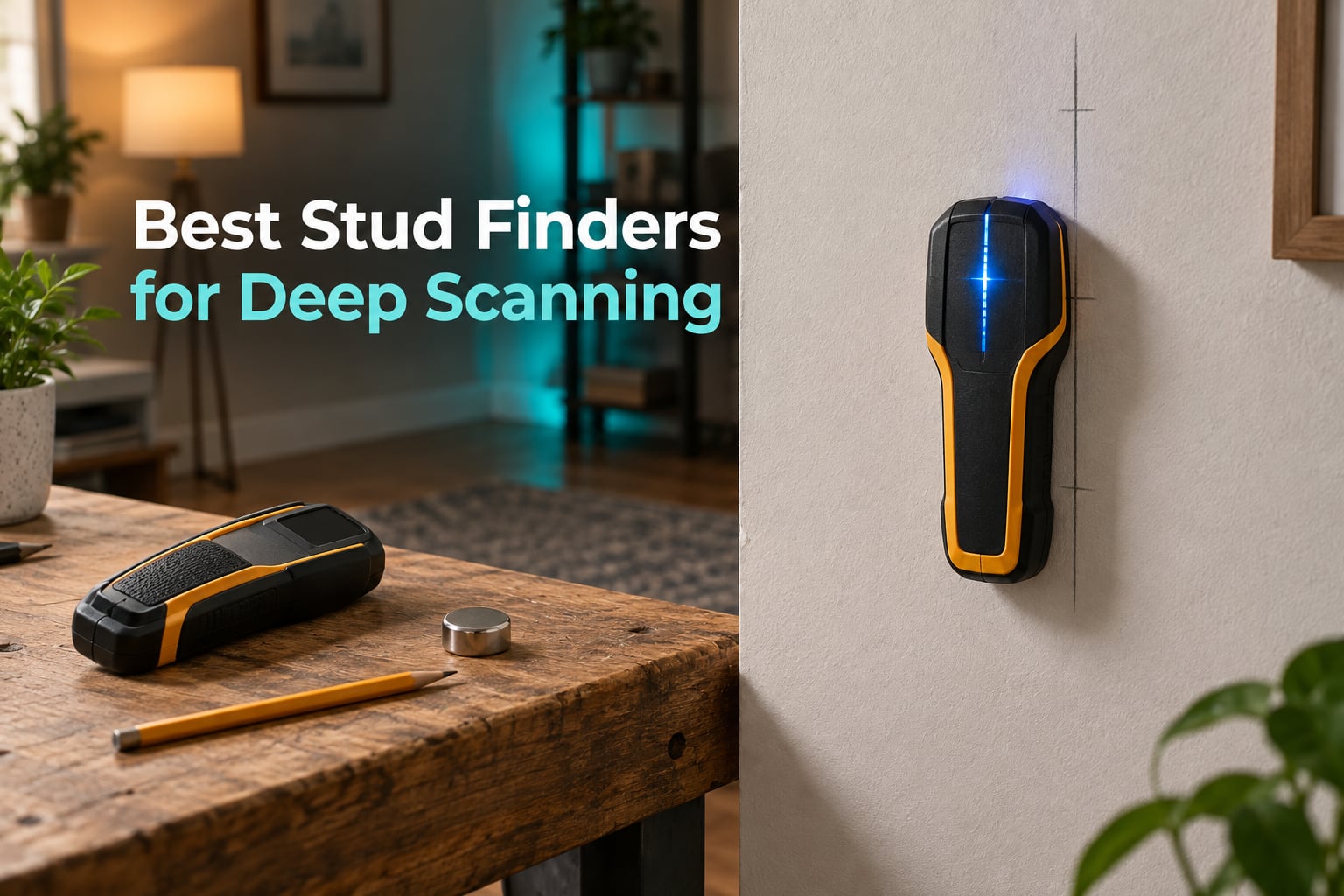
Most stud finders quit at the first layer of drywall. If your walls are thicker than that, the best stud finder for deep scanning is the only tool that keeps you from drilling into a pipe or a live wire. I spent weeks comparing ten wall scanners across the depth ranges they actually claim, from 0.75 inches up to 4 inches, and the differences between them turned out to matter far more than the marketing suggests.
The problem is specific. A single layer of drywall on standard framing is about half an inch thick, and a basic electronic finder handles that easily. Add a second sheet, some plaster over lath, a cement backer board behind tile, or a patched section from an old renovation, and the signal from a cheap capacitive sensor simply never comes back. That is the exact scenario forum users ask about most often: scanners that read a stud perfectly in a modern wall and then return nothing at all two rooms away.
So depth is the spine of this roundup, not a checkbox. For every pick below I break down the claimed detection depth, what that number actually means in practice, which wall materials it holds up on, and where the tool starts to struggle. I also flag the battery and live-wire behaviour, because those are the two details that decide whether a scanner is useful on a real job.
If you are short on time, the three scanners on the next line are the ones worth starting from. Deep scanning is a bit of a misnomer in this category, though, since it usually means “reads through drywall plus a bit more” rather than anything close to a true x-ray. We looked at similar criteria when we picked the best massage guns for deep tissue relief, where the headline number tells you far less than the spec sheet does.
The Three Scanners That Read Through More Than One Wall Layer


Those three all use a 13-sensor array, which is the single biggest reason they outperform the single- and dual-sensor designs in the rest of this list. Read the full reviews further down before you commit, because the depth numbers only tell half the story.
Comparing All 10 Deep-Scan Stud Finders in 2026
| Product | Specs | Action |
|---|---|---|
| Franklin ProSensor 710+ |
|
Check Latest Price |
| Franklin ProSensor MAX |
|
Check Latest Price |
| Franklin ProSensor M210 |
|
Check Latest Price |
 Walabot DIY 2 Walabot DIY 2 |
|
Check Latest Price |
 FNIRSI WD-01 FNIRSI WD-01 |
|
Check Latest Price |
 JAXWQ 5-in-1 Wall Scanner JAXWQ 5-in-1 Wall Scanner |
|
Check Latest Price |
 Zircon MultiScanner A200 Zircon MultiScanner A200 |
|
Check Latest Price |
 Mecurate 5-in-1 Wall Scanner Mecurate 5-in-1 Wall Scanner |
|
Check Latest Price |
 FOLAI 5-in-1 Wall Scanner FOLAI 5-in-1 Wall Scanner |
|
Check Latest Price |
 ZHDTW Wall Scanner WD-02 ZHDTW Wall Scanner WD-02 |
|
Check Latest Price |
Two patterns jump out. First, only one scanner in this group reaches beyond 2 inches for wood framing, and second, the deepest metal readings all come from scanners that cap out much shallower for wood. A scanner that reads rebar at 4.7 inches is not automatically a scanner that finds a stud at 4.7 inches.
1. Franklin ProSensor 710+ – The Deep-Scanning Favourite Trades Actually Name
Franklin Sensors ProSensor 710+ Stud Finder, 13-Sensor Wall Scanner
13-sensor array
1.6 inch deep detection
Wood and metal studs
Bubble level and ruler
Pros
- Largest owner feedback base in this category at over 10000 ratings
- Shows full stud width and center rather than just edges
- Works with no calibration step and even starting over a stud
- Bubble level and ruler help with accurate marking
Cons
- 1.6 inch depth is shallower than the ProSensor MAX
- Disposable batteries only and no rechargeable compatibility
- LED bar gives less detail than an LCD model
This is the tool that comes up again and again when people who use stud finders for a living talk about them. It is not the deepest scanner I tested, and that is exactly why I picked it first: it is the most repeatable one. A 13-sensor array reads the full width of a 1.5 inch stud in a single sweep, so the centre LED lights up between two edges rather than making you average a left and right reading.
What matters for deep-scanning work is that the array can hold a signal long enough for the display to resolve. Single-sensor tools flicker and drop out on thick material, which is where people get false positives and start drilling in the wrong place. The 710+ covers 1.6 inches, so it handles standard drywall plus a second sheet, thin plaster, and most standard metal framing without complaint.
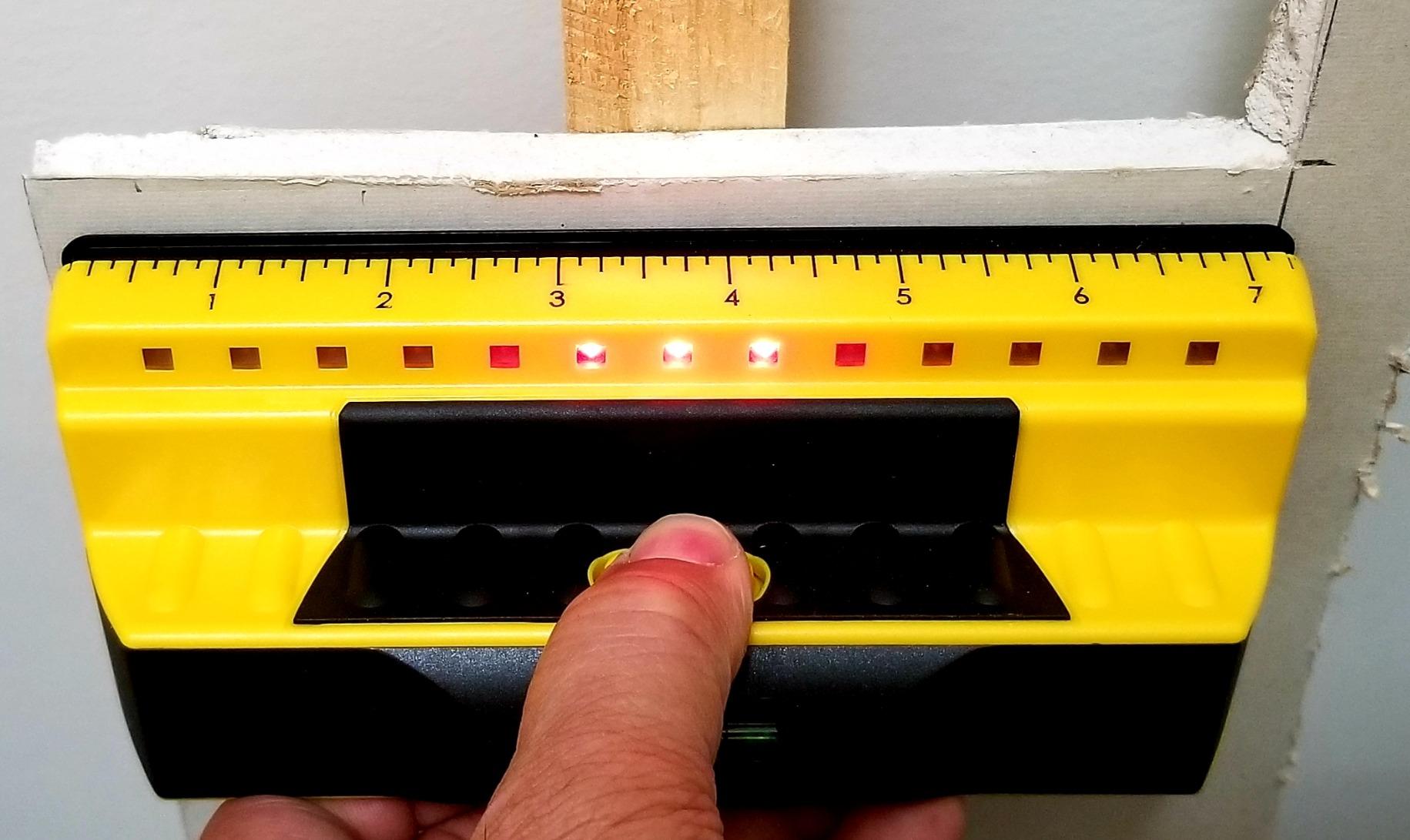
It is also the model most likely to already be in your van. Owners on woodworking forums describe keeping theirs for years, and the “Made in the USA” warranty note is a small reassurance that the housing will not crack in a job-site bag. Nothing here is flashy, and that is the appeal.
What 1.6 Inches of Depth Actually Covers
One sheet of drywall is roughly 0.5 inch, so 1.6 inches gives you about three layers of drywall, or drywall plus thin plaster, or drywall plus a light backer board. It will not punch through a heavy cement board or a thick plaster-and-lath sandwich.
The trade-off is that the 710+ reports edges and centre rather than a numeric depth. If you need to know how far back the stud sits, you are guessing from the wall thickness instead of reading it off a display.
Why the 13-Sensor Array Matters on Thick Walls
Most cheap capacitive finders use one or two sensors, so they detect the leading and trailing edge of density change and you do the geometry yourself. Thirteen sensors means the tool sees the whole stud face in one pass.
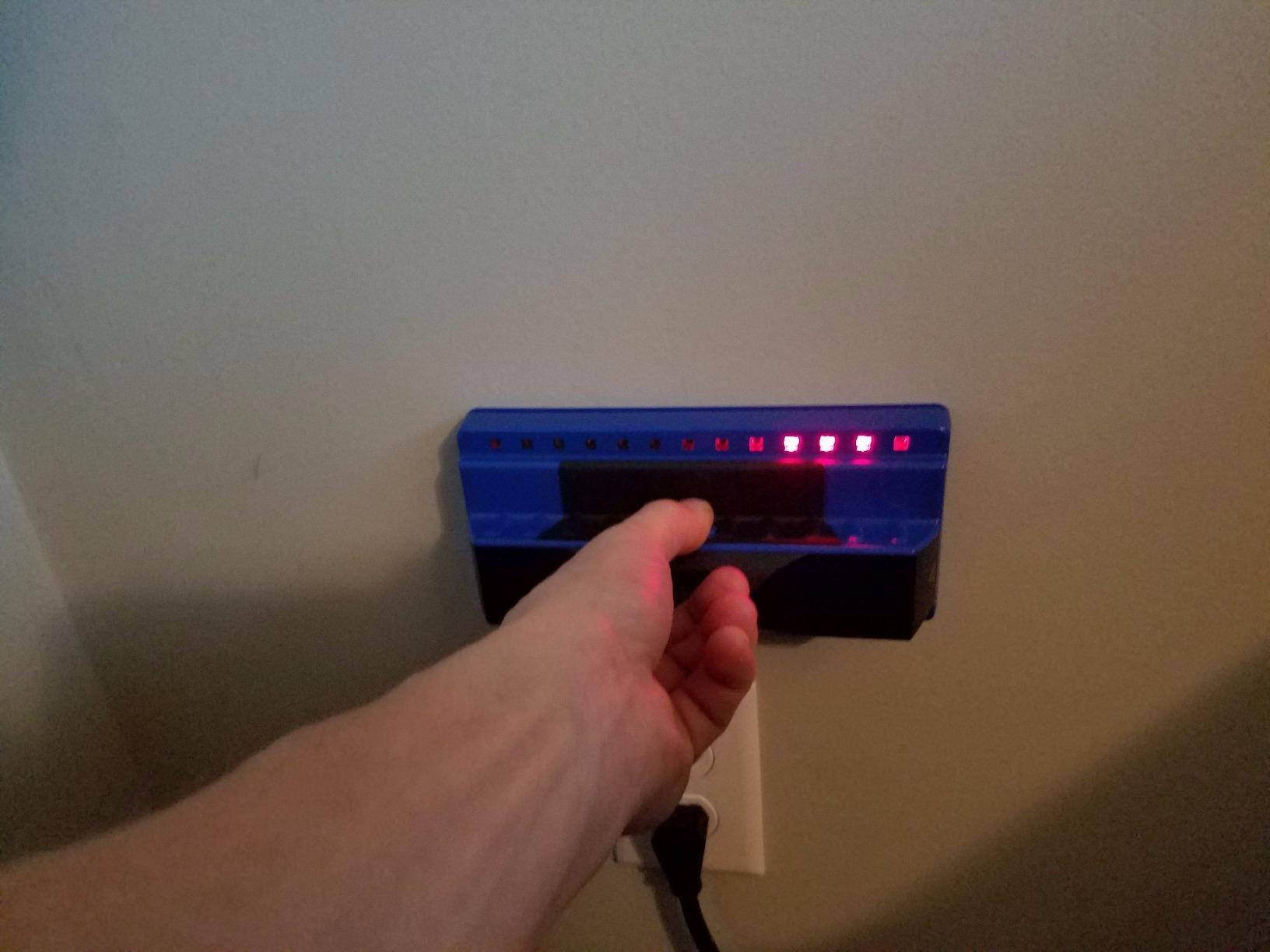
On a thick wall that difference shows up as confidence. A single-sensor unit on a double-drywall retrofit produces a wide, fuzzy band you cannot resolve. The 710+ narrows that band and lights the centre LED in the middle of it.
Who Should Buy the 710+ and Who Should Not
Buy it if you hang things in older plaster houses, need a reliable centre mark for a heavy mirror or a wall-mounted TV, or want a tool that starts working the moment you press the button. It is also the safe pick for anyone who is new to this category and wants something forgiving.
Skip it if your walls are genuinely thick enough to need 2 inches or more, or if you are tired of carrying spare batteries. The ProSensor MAX below reaches further, and the M210 accepts rechargeables.
2. Franklin ProSensor MAX – The Most Reach in the 710 Family
Franklin Sensors ProSensor MAX 13-Sensor Stud Finder, 2.5-in Deep Detection
13-sensor array
2.5 inch detection depth
Deep-scan and drywall modes
No calibration
Pros
- Deepest wood and wall detection in this roundup at 2.5 inches
- Handles multiple drywall layers plus plaster and OSB
- Press-and-hold operation with no calibration step
- Single and double stud indication on the LED bar
Cons
- Larger and bulkier body than slim LCD scanners
- Battery powered with no rechargeable compatibility noted
- Smaller owner feedback base than the 710+ family
This is the pick for anyone whose problem is specifically that the stud sits too far back. At 2.5 inches it reads through multiple drywall layers, plaster, OSB, plywood, MDF and large tile, which is the broadest wall-material list in the group.
Operation is simpler than most of the LCD scanners here. There is no calibration routine and no mode button to hunt for. You press and hold to start, sweep, and read the LED bar. It even works if you start your scan directly on top of a stud, which removes the most common beginner error.
Where the Extra 0.9 Inches Actually Helps
The gap between 1.6 and 2.5 inches is the difference between a retrofit wall and an awkward one. A second drywall sheet with a furring strip, a plaster patch over old lath, or tile on a backer board all push the usable range past what a 1.6 inch tool can resolve.
Because the 13-sensor array is the same generation as the 710+, the extra reach does not come at the cost of centre-finding accuracy. You still get full stud width and a green centre LED rather than a single ambiguous edge reading.
Mode Design and Multi-Layer Walls
Two detection modes are offered: a standard drywall setting and a deep-scan setting for thick material. In practice, the standard mode is faster and less noisy on ordinary walls, while deep mode is what you want the moment you hit a second layer.
Reviewers consistently rate the accuracy on thick or multi-layer walls as the standout feature, along with the centre LED and the no-calibration setup. The recurring complaint is size. At 1.1 pounds it is the heaviest tool in this roundup, and it is awkward in a tight corner.
Who Should Buy the MAX and Who Should Not
Buy it if you are working in older homes, dealing with retrofitted walls, tiling, or anywhere a 1.6 inch tool has left you empty-handed. Two scan modes also make it a good choice if you switch between easy walls and hard ones in the same day.
Skip it if you hang pictures on modern drywall, where the extra capability is wasted weight in your hand. It is also worth noting the owner base here is a fraction of the 710+, so you have less long-term field history to lean on.
3. Franklin ProSensor M210 – Live Wire Warnings on Every Pass
Franklin Sensors ProSensor M210 13-Sensor Stud Finder, Live Wire Detection
13-sensor array
1.7 inch deep detection
Live wire detection
Bubble level and pencil caddy
Pros
- Live wire detection before you drill
- 1.7 inch scan is deeper than the 710+
- Accepts standard rechargeable AA batteries
- Top ranked product in the Stud Finders and Scanners category
Cons
- Pencil caddy and bubble level add bulk
- Rechargeable support does not extend to lithium packs
- No numeric depth readout on the LED bar
Depth always wins in this category, and the M210 trades about a tenth of an inch of reach for the thing that actually prevents a disaster: a live wire alert. If you are drilling into walls with old or undocumented wiring, that trade is usually the right one.
It ranks near the top of its category on Amazon, which is meaningful for a tool where consistency matters more than headline specs. Reviewers point to the combination of deep scanning, the wire warning, and the full-width LED readout as the reason it holds up for hanging fixtures and drilling near wiring.
Depth and the Always-On Deep Scan
Deep scan here is always on at up to 1.7 inches for wood and metal studs, so there is no mode to remember. That simplicity is worth something on a job where you may be doing twenty mounts in a day.
Compared with the 710+ you gain a small amount of reach and lose nothing else. Both share the 13-sensor array, so the centre-finding behaviour is the same family.
What the Wire Alert Does and Does Not Catch
The alert is a safety net, not a guarantee. Every electronic wire warning in this category, including this one, is looking for an electrical field. Shielded cable, cable routed tight against framing, and cable running perpendicular to the scan can all hide from it.
Treat any wire warning as a reason to probe carefully with a detector or knock test before you break the surface. A clear signal does not mean the wall is empty, and a warning does not tell you how far the cable sits from the surface.
Batteries, Accessories and Daily Use
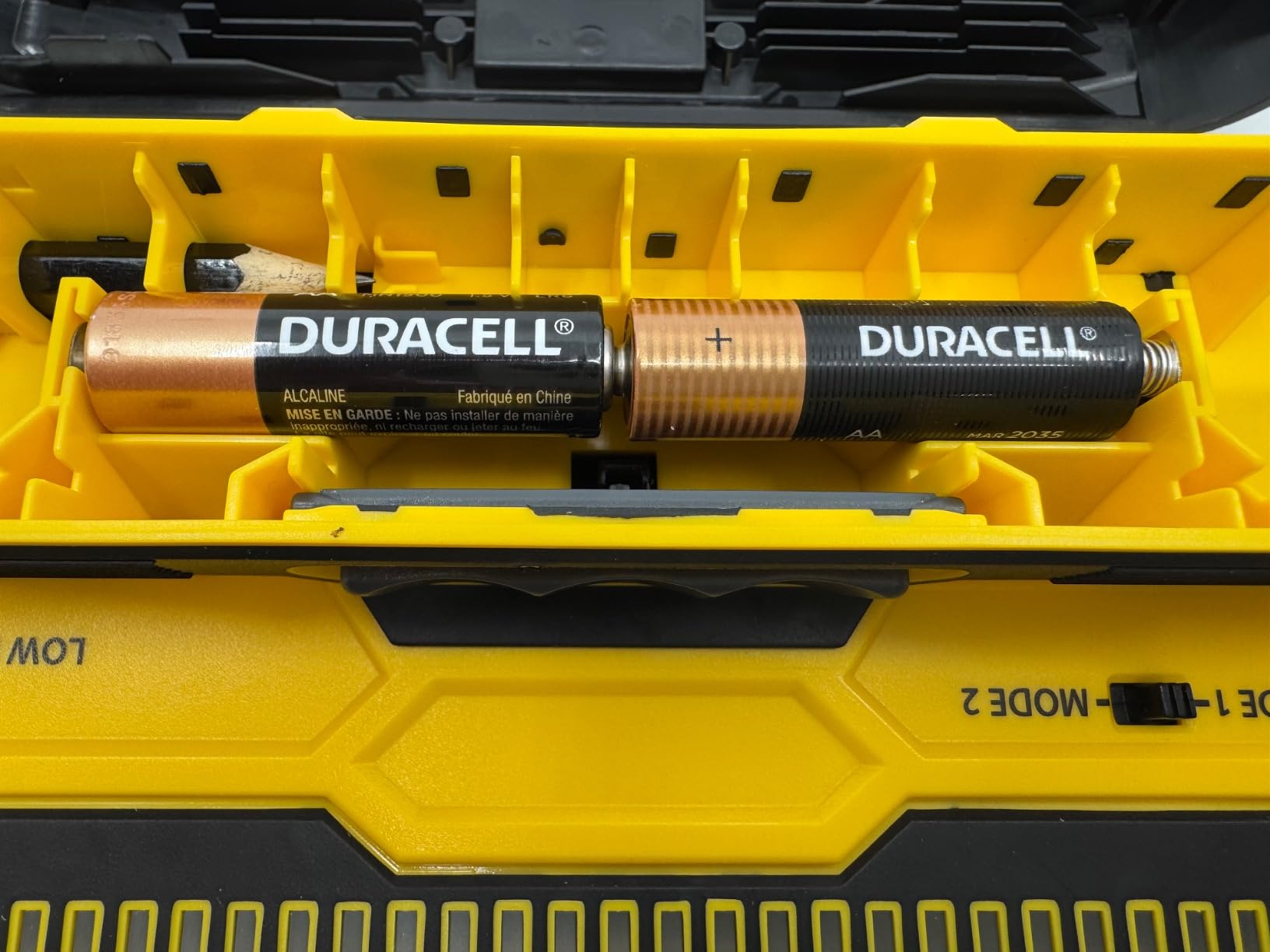
Two AA batteries power it, and unlike several competitors here it works with rechargeable cells, which matters if you are already carrying a charger. Lithium packs are a different story and are not supported.
The bubble level and pencil caddy are small quality-of-life additions. They add some bulk against a slim LCD scanner, but they let you mark and mount without a second tool in your teeth.
Who Should Buy the M210 and Who Should Not
Buy it if you are mounting heavy items in a house with older wiring, or if you work near conduit and cable runs where a missed wire is expensive. The rechargeable battery support is a genuine advantage for regular use.
Skip it if you need to see metal through thick material rather than wood, or if you want a numeric depth readout. The LED bar tells you centre and width, not inches.
4. Walabot DIY 2 – The Only Scanner That Shows You the Wall
Walabot DIY 2 – Visual Stud Finder & Wall Scanner for Drywall. Detects Wood & Metal Studs, Plastic & Metal Pipes, Live & Non-Live Wires
Visual imaging on a phone
4 inch detection depth
Built-in Wi-Fi
Works with iOS and Android
Pros
- Only unit in this roundup that renders a visual map of the wall
- Deepest reach here at 4 inches
- Creates its own Wi-Fi so it works with no router nearby
- Cuts through drywall and plywood reliably
Cons
- Needs a phone
- which often means a second person
- Must be recalibrated on every new wall
- Does not work on lath and plaster concrete tile brick or stucco
- Image is an inference from density rather than a true x-ray
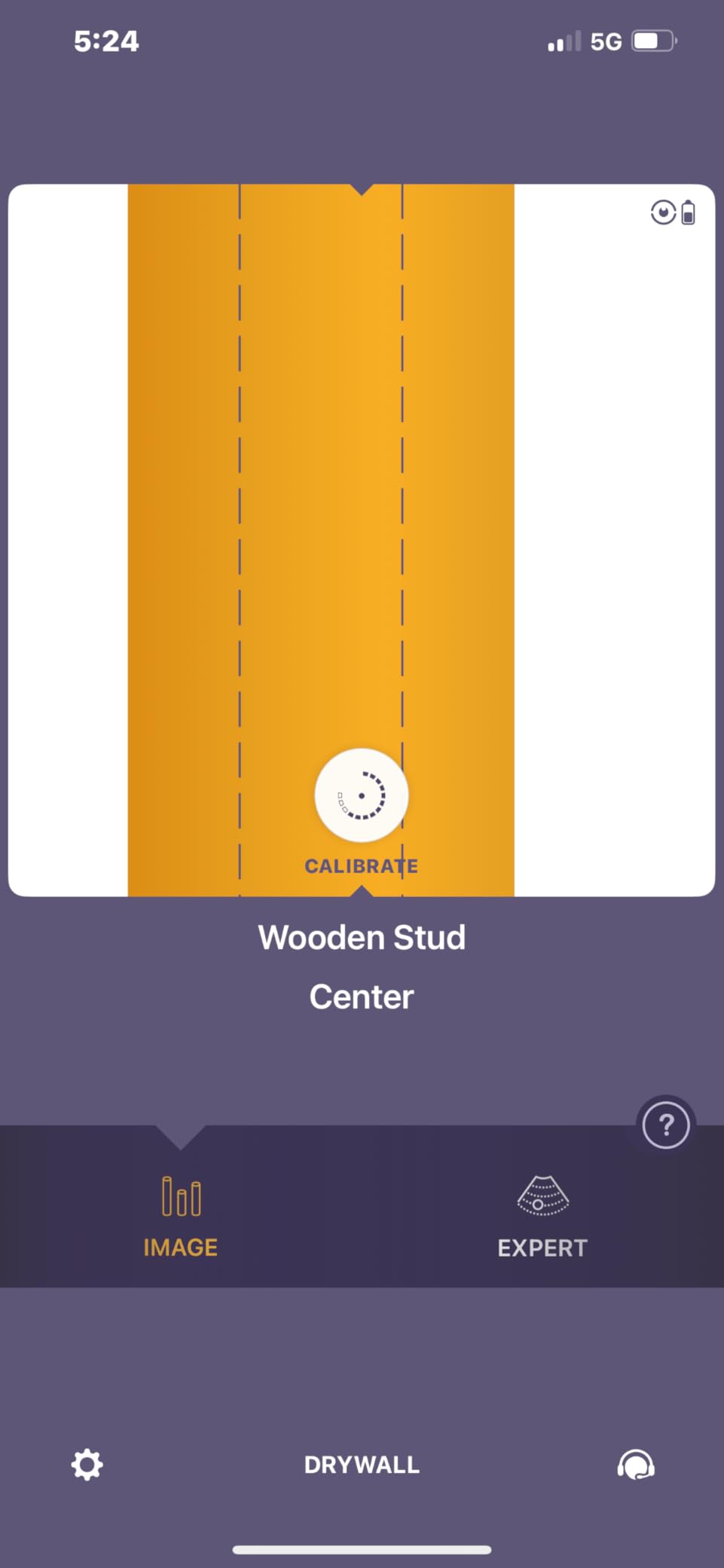
Everything else in this roundup beeps at you. The Walabot draws the wall on your phone screen, showing studs, pipes and wires with their relative depth. For a first-time user mounting floating shelves or grab bars, seeing the picture removes a lot of the interpretation guesswork.
It also reaches 4 inches, deeper than any other tool here for wood and general material. That reach comes with a strict wall-type list: drywall and plywood only. Lath and plaster, concrete, tile, brick, stucco and metal-backed walls are all listed as unsupported, which rules it out of exactly the old-house situations most people buy a deep scanner for.
What 4 Inches of Reach Really Buys You
On supported surfaces, 4 inches is enough to find studs behind a second drywall layer, backboard, or a run of pipe and cable in a modern wall cavity. That is real value for renovation work in houses built after 1970.
It does not translate into seeing through dense material. The published support list is the more useful number, because depth without wall compatibility is marketing.
Calibration, the App and the Phone
You calibrate by moving the device in a circle over the wall before each scan, then sweep slowly. The sweep can scuff fresh paint, which is worth knowing on a room you are about to decorate.
Ratings here have the widest spread of any product in this roundup. Fans describe flawless mounts for shelves and grab bars. Critics call the render a guess, report missed pipes and horizontal supports in older homes, and dislike the phone dependence, which often means a second pair of hands.
Who Should Buy the Walabot and Who Should Not
Buy it if you are visual, you are working in a modern drywall or plywood building, and you want to see pipes and wires rather than just hear about them. The own-Wi-Fi design also means it works in a basement or a new build with no network.
Skip it if your home has plaster, lath, tile or concrete, because those are outside its supported list entirely. It is also rechargeable with a cable included, and owners report it can stop accepting a charge after heavy use, so keep a wired tool in the van.
5. FNIRSI WD-01 – Rechargeable and Built for Metal and Rebar
FNIRSI WD-01 6 in 1 Rechargeable Stud Finder Wall Scanner, Positioning Hole
Rechargeable lithium polymer
4.7 inch ferrous metal
1.5 inch wood
Lath and plaster support
Pros
- Deepest ferrous metal reading here at 4.7 inches with 3.9 inches for copper
- Rechargeable so no disposables run out mid-job
- Positioning hole for fast exact marking
- Auto-calibrates in about a second
Cons
- AC wire warning can be over-sensitive
- Edge and centre readings less reliable on plaster and lath
- Wood detection capped at 1.5 inches
- Thinner owner feedback base than the top sellers
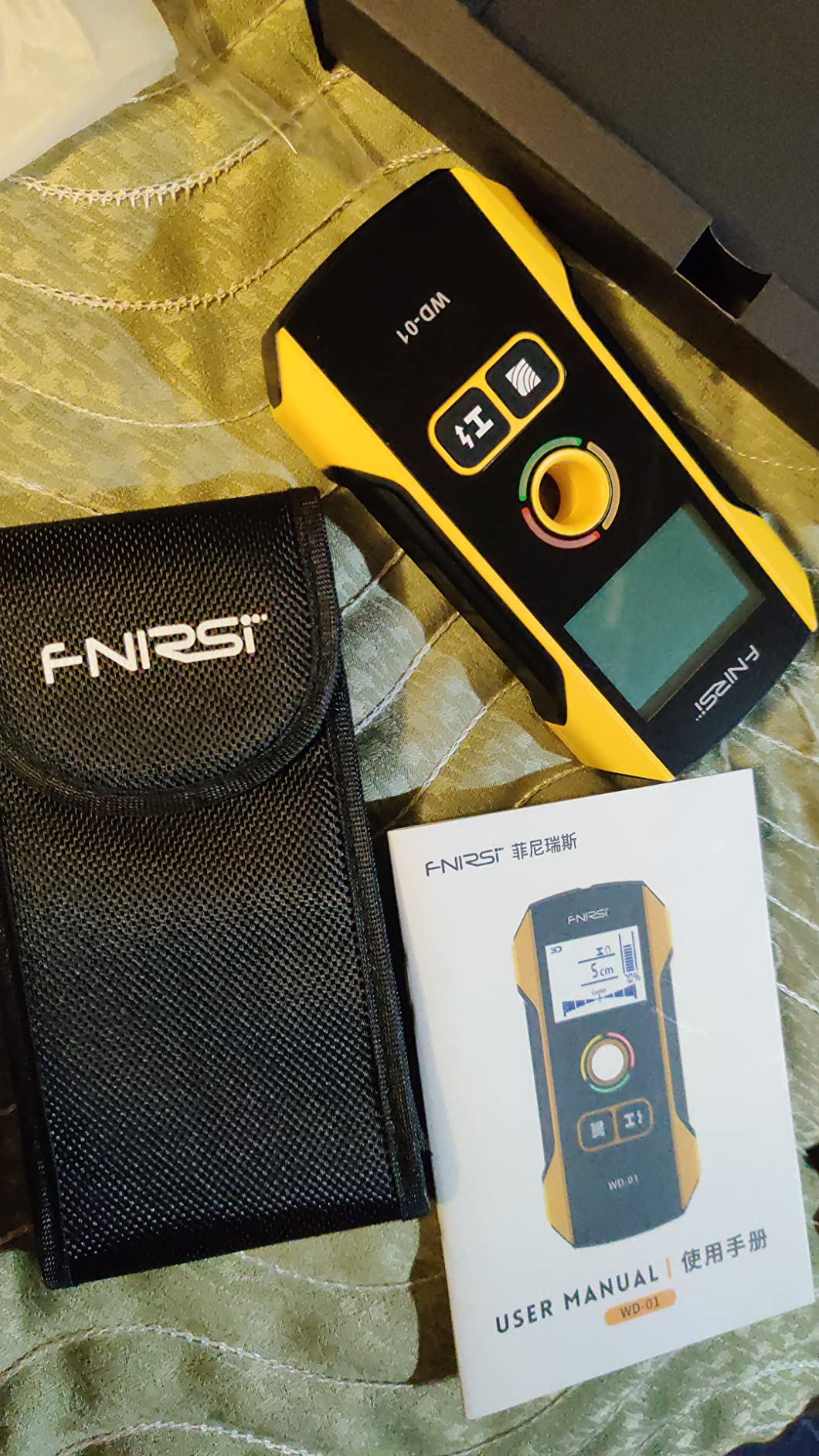
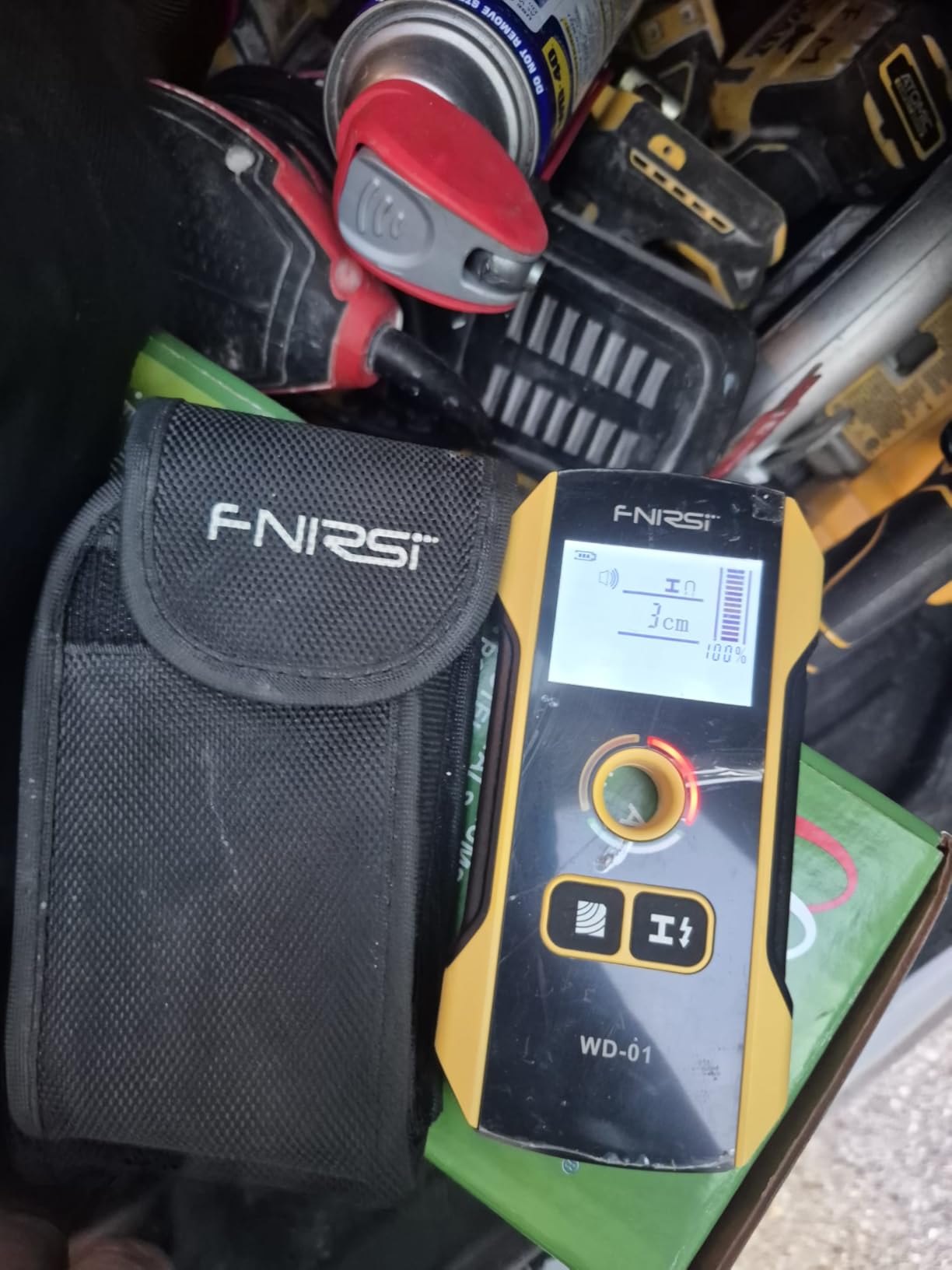
This is the tool for a different job. Six detection modes cover studs, live AC wire, copper wire, and both ferrous and non-ferrous metal, with ferrous reach out to 4.7 inches. Owners report using it successfully to locate rebar during concrete demolition work, which no other scanner in this roundup handles at that depth.
The rechargeable lithium polymer battery is the quiet advantage. There is nothing to replace between mounts, and auto-calibration happens in about a second, so the tool is ready before you have found your pencil.
Metal Depth and Wood Depth Are Different Numbers
Metal is easy to detect because it responds strongly to a magnetic or conductivity field, so it holds up at greater depth than wood. That is why this unit reads 4.7 inches for iron and 1.5 inches for wood, and why you should not read the 4.7 inch figure as a stud-finder spec.
For a stud-finder shopper, the honest reading is that 1.5 inches of wood depth is mid-pack. It handles two drywall layers and thin plaster, but it is not the choice for a thick lath-and-plaster wall.
Old Walls, Lath and Plaster
It auto-calibrates on lath, wallpaper, wood flooring and painted walls, which is a longer compatibility list than most budget scanners offer. Even so, reviewers report trouble centring reliably on lath and plaster, where the wall is full of small voids that confuse a density-based reading.
On those walls, pair it with a rare-earth magnet as described further down. The magnet finds the screws holding lath to the studs, and the magnet method is unaffected by wall density.
Who Should Buy the WD-01 and Who Should Not
Buy it if you are chasing metal framing, plumbing, or rebar, if you want a rechargeable tool that never runs flat, or if you work on a mix of drywall and lath. The positioning hole also makes repeat mounting noticeably faster.
Skip it if wood depth is your main concern, and be cautious if false AC wire warnings would slow you down. Several owners find the wire alert over-sensitive, flagging cables that are not there.
6. JAXWQ 5-in-1 Wall Scanner – The Backlit LCD Workhorse
Stud Finder Wall Scanner – 5 in 1 Stud Finder Tool w/Smart Chip and HD LCD Display, Stud Detector Beam Finders for the Center and Edge of Wood AC Wire Metal Studs Joist Pipe (Banana)
Backlit HD LCD
Three scan modes
Detects wood metal and live AC wire
Audio alerts
Pros
- Bright backlit LCD that stays readable in low light
- Three separate modes including deep scan for pipes and wires
- Audio alerts let you watch the wall instead of the screen
- Very large owner feedback base for a budget unit
Cons
- Average rating leaves room for inconsistent readings
- Needs recalibration against the wall before scanning
- No numeric depth measurement on the display
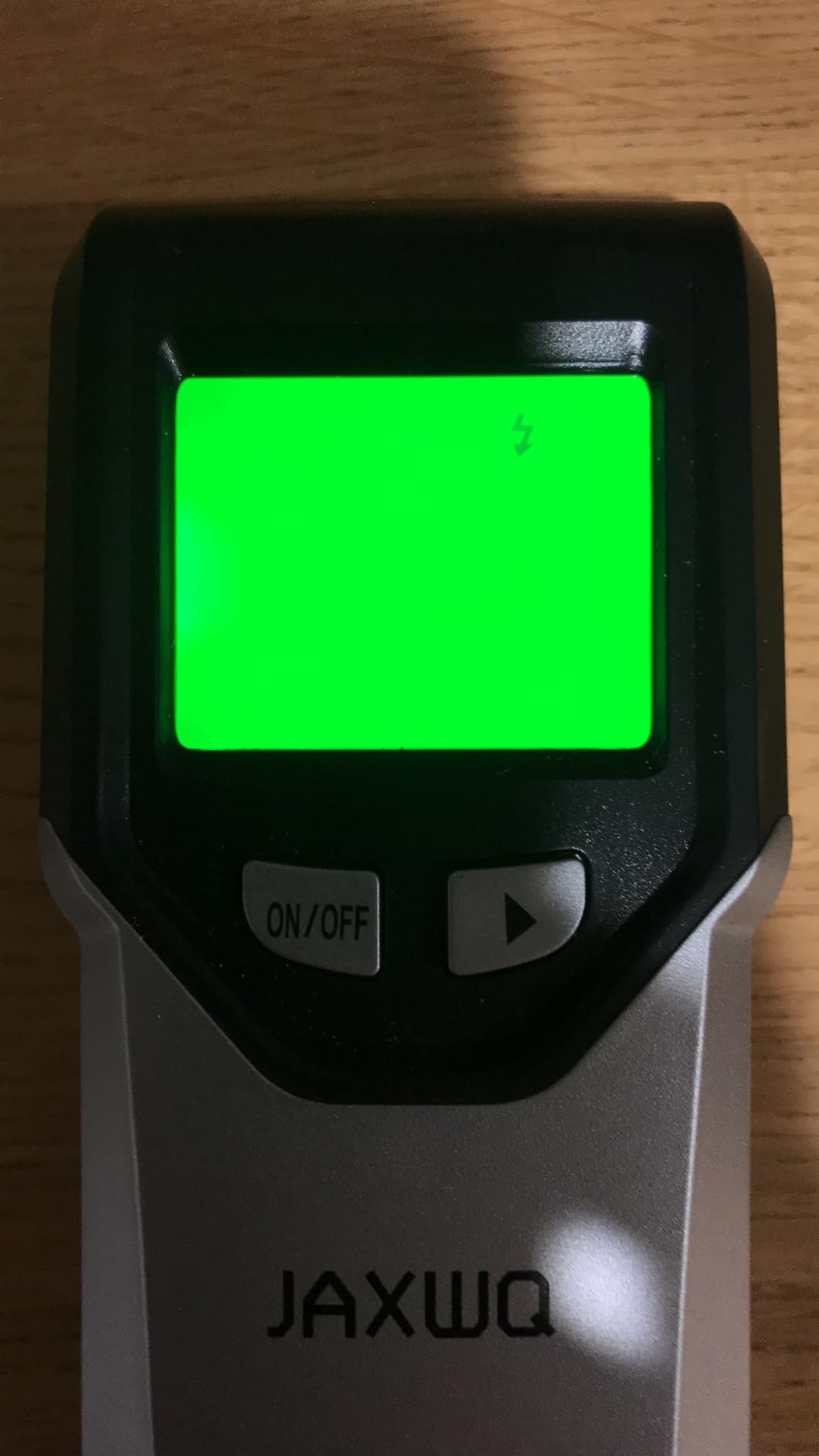
This is the pick if you want a screen you can actually read. The backlit HD LCD shows centre, edge, location and battery status, which makes it far better than a pure LED-bar tool in a dark basement or a poorly lit closet wall.
It also has the largest owner feedback base of any unit in this roundup, and it ranks first in its category. That matters: a tool this widely used will have exposed its weaknesses, and the reviews say the recurring one is repeatability rather than basic capability.
Three Modes and What Deep Scan Means Here
Stud scan mode finds the stud centre, deep scan mode detects the width of larger objects such as pipes and wires, and metal scan mode handles plumbing. In this unit, deep scan is about object width as much as it is about depth.
That is a slightly different use of the term than the Zircon MultiScanner, where DeepScan is a straightforward deeper read. The practical takeaway is the same: switch to deep mode when the wall is dense or you suspect something wider than a stud.
Where the False Readings Come From
Owners frequently report inconsistent accuracy, particularly on freshly painted walls or when the unit is not reset between passes. Fresh paint and joint compound change wall density, which is exactly the variable a density-based sensor measures.
The fix is procedural rather than a different tool. Recalibrate against the wall, sweep slowly, and repeat each measurement two or three times before you mark. A reading that will not reproduce is not a stud.
Who Should Buy This Scanner and Who Should Not
Buy it for everyday mounting in a modern house: shelves, pictures, curtain rods, a mid-weight TV. The display, the audio alerts, and the three modes cover most DIY jobs without a learning curve.
Skip it if you are hanging something genuinely heavy into plaster or lath, or if you need a documented depth figure to plan a fix. A roughly even spread of five-star and one-star ratings suggests it is fine most of the time and annoying when it is not.
7. Zircon MultiScanner A200 – The Mode Vocabulary Everyone Recognises
Zircon® MultiScanner™ A200 Stud Finder with Metal & Live Wire Detection
StudScan DeepScan and MetalScan
WireWarning for live AC
LCD with SpotLite pointer
Low battery indicator
Pros
- Three clearly named modes with well understood behaviour
- Large lit display with a clear red centre indicator
- Low battery warning stops the false readings weak 9V cells cause
- Limited lifetime warranty from an established brand
Cons
- Bulkier than slim LCD competitors in tight spaces
- Occasional false positives mean repeat passes are needed
- DeepScan tops out at 1-1/2 inches
- Requires a 9V alkaline battery
StudScan, DeepScan and MetalScan is the oldest mode vocabulary in this category, and it is the one most experienced users reach for by reflex. A long-running woodworking forum thread shows people buying a three-mode Zircon unit specifically for that reason, decades after the mode names were introduced.
Depth is modest at 1-1/2 inches for DeepScan, with StudScan at 3/4 inch. What you get instead is a very clear display, a SpotLite pointer for marking edges and centre, and a low battery indicator that removes one of the most common causes of nonsense readings.
StudScan, DeepScan and MetalScan Explained
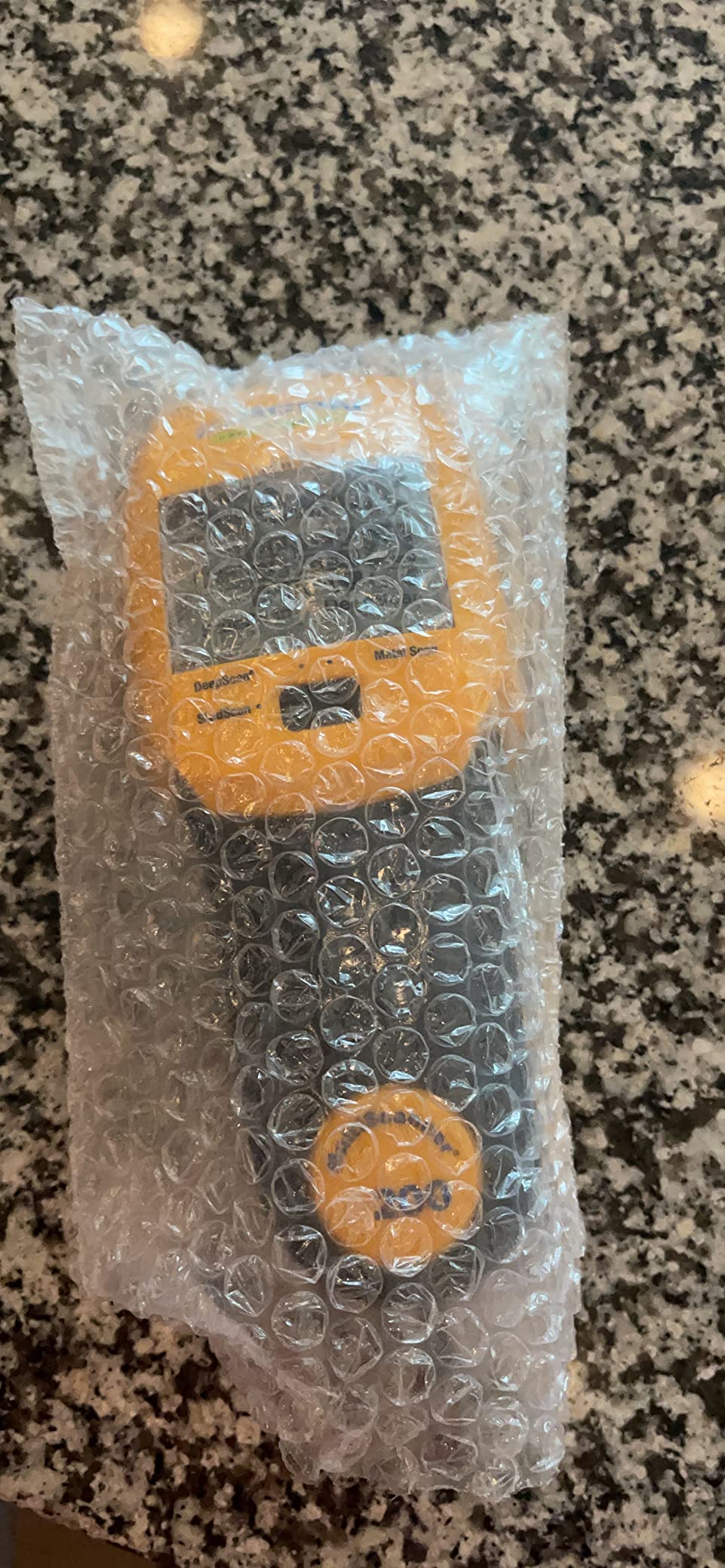
StudScan at 3/4 inch is tuned for standard single-layer drywall and gives the fastest, tightest reading. DeepScan widens the sensing field to 1-1/2 inches, which handles multiple drywall layers and thin plaster. MetalScan looks for ferrous and non-ferrous metal, which covers metal studs and plumbing.
Using the right mode matters more than people expect. Running StudScan on a thick wall is the most common reason this tool produces a fuzzy band instead of a clean edge.
WireWarning and the Low Battery Gauge
WireWarning alerts you to live AC wiring in any mode. As with the rest of the category, it detects an electrical field, so unshielded cable is caught more reliably than cable buried against a stud or run at an angle to the scan.
The low battery indicator is the sleeper feature. A weak 9V cell does not stop the tool, it just makes the readings drift, and most of the false positives attributed to the scanner are actually a dying battery. This one tells you before that happens.
Who Should Buy the A200 and Who Should Not
Buy it if you already know the mode language, if you want a warranty that outlasts the tool, and if you work in a house with metal framing or newer wiring where the wire alert is useful. It is also the one to keep as a second opinion next to another scanner.
Skip it if you are working in a very tight corner, since the body is bulkier than slim LCD rivals, or if you need more than 1-1/2 inches of reach. Repeat passes are worth planning for, as owners do report intermittent false positives.
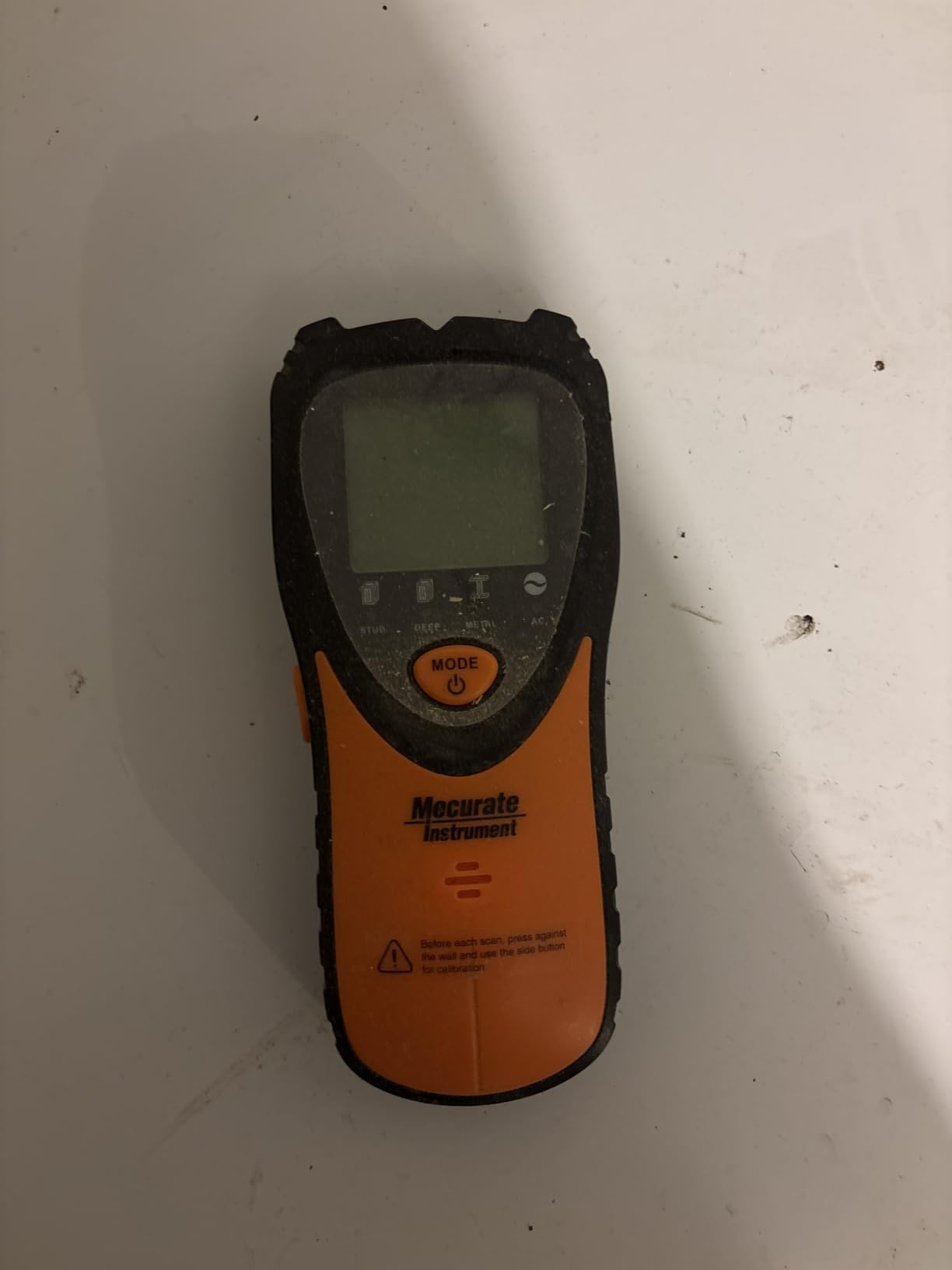
8. Mecurate 5-in-1 Wall Scanner – Four Labeled Depths and a Battery in the Box
Mecurate 5-in-1 Stud Finder Wall Scanner for Studs, Metal & Live AC Wires
Standard 3/4 inch deep 1-1/2 inch
HD LCD with live graphics
9V battery included
Audible live wire warning
Pros
- Four clearly labeled depth modes from 3/4 inch to 2-3/8 inch
- Battery and carrying pouch included so it is usable immediately
- Audio alerts let you scan by ear instead of watching the screen
- Straightforward calibration against the wall
Cons
- Must be recalibrated before each use and paint reduces accuracy
- Several reviewers report inconsistent repeat readings
- Not suitable for concrete brick or tile
- 1-1/2 inch deep mode is shallower than the top-tier scanners
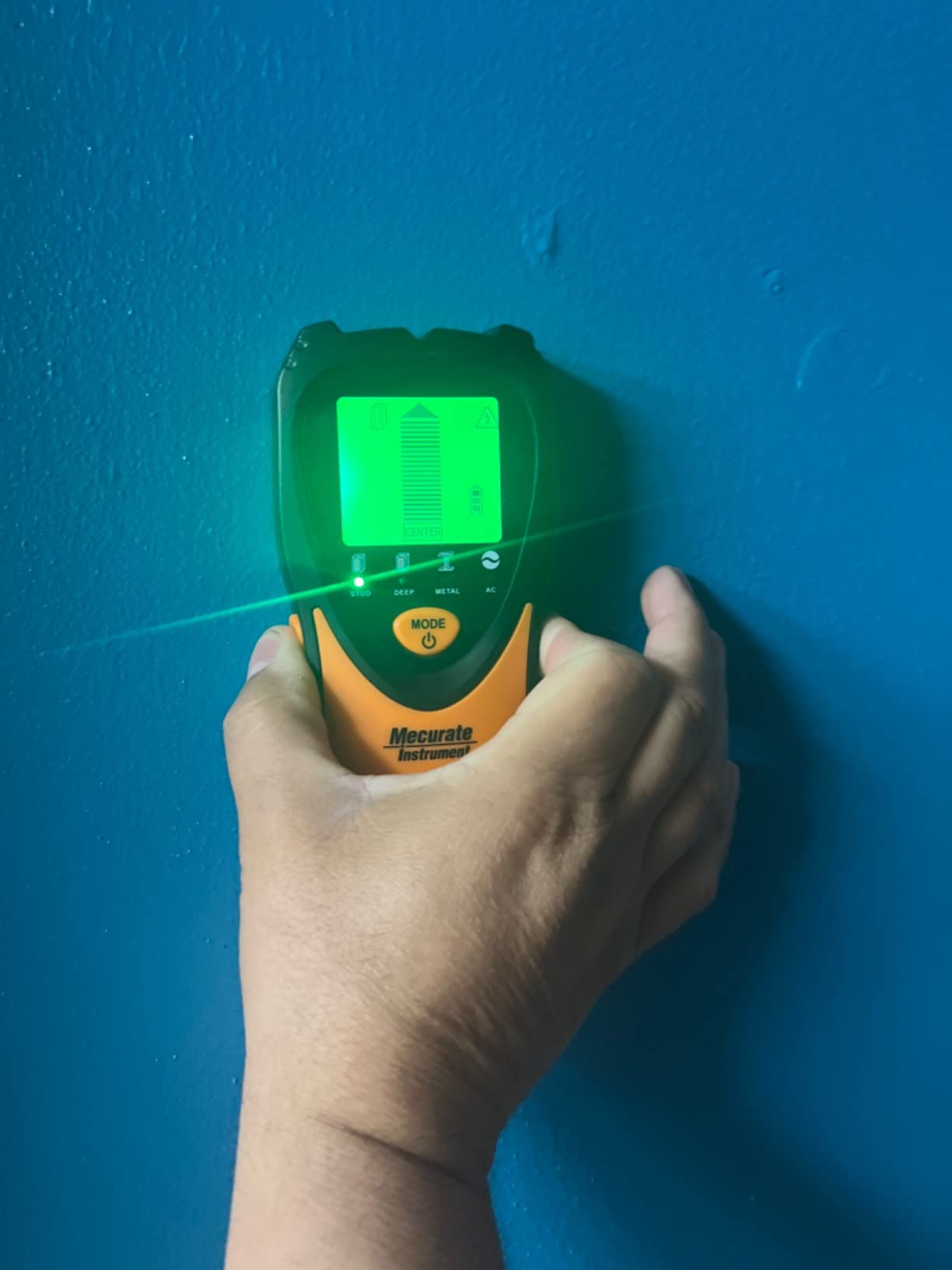
The Mecurate is the least confusing scanner in this roundup for someone who has never used one. Four labeled modes, each with a stated depth, tell you exactly what the tool is doing, and a 9V battery plus a carrying pouch come in the box.
It runs on a single 9V alkaline cell, which most people already have, and the HD LCD shows real-time detection graphics. The audible live wire warning lets you sweep with your eyes on the wall rather than on the screen.
Reading the Four Depth Modes
Standard mode reaches 3/4 inch, deep mode 1-1/2 inches, metal mode 2-3/8 inches, and AC mode 2 inches. Those numbers are the clearest published depth set in this roundup, even though the reach is not the deepest.
Two layers of standard drywall is about an inch, so this covers a typical retrofit. Beyond that you are into plaster and backer board territory, where the published limits start to be optimistic.
Calibration and Repeatability
Calibration against the wall is recommended before each use, and the top complaint from buyers is repeat-scan inconsistency on the same wall. Owners also report needing to reset the tool after each stud mark.
Treat that as a habit rather than a defect: calibrate, scan, mark, reset, scan again. The manufacturer’s own guidance is that it performs best on single-layer drywall, and it is not recommended for concrete, brick or tile.
Who Should Buy the Mecurate and Who Should Not
Buy it if this is your first stud finder, if you hang pictures and light shelves, and if you want something in the box that works the moment you unwrap it. The included battery and pouch remove two classic annoyances.
Skip it if you are mounting heavy loads into thick walls, working with concrete or masonry, or if you need a deeper read than 1-1/2 inches. There is no upgrade path here without buying a different tool.
9. FOLAI 5-in-1 Wall Scanner – Wire Warnings That Never Switch Off
Stud Finder Wall Scanner 5 in 1 Multifunctional Upgraded Smart Wall Scanner, Stud Sensor Beam Detector with Battery for Wood Metal and AC Wire Detection, Comes with HD LCD Display and Audio Alarm
Stud 1.5 inch
Metal 2.36 inch
AC wire 2 inch
Large LCD with audio alarm
Pros
- Strongest average rating among the entry-level multi-mode units
- Metal mode reaches 2.36 inches which is deeper than most budget scanners
- Wire warning stays active in every scan mode
- Large LCD and audio alarm are easy to read and hear
Cons
- Some owners report false stud readings when rescanning
- No published deep scan figure for multi-layer plaster
- Lightweight plastic body feels less solid than metal-bodied rivals
The FOLAI is the tool I would hand to a first-time user who insists on drilling into their own walls. It has the highest average rating of the entry-level multi-mode scanners here, and its always-on wire warning means you cannot accidentally switch the safety feature off.
Its metal reach of 2.36 inches is genuinely better than most of its class, and AC detection runs to 2 inches. It also lists concrete rebar detection among its intended uses, though the published stud depth is 1.5 inches.
Always-On WireWarning and Depth Limits
Most scanners require you to select a wire mode. Here the alert remains live in stud, deep, and metal scan, which removes the most common way people miss a cable. As always, treat it as a warning system rather than a guarantee, since shielded or tight-routed cable can stay hidden.
The stud figure of 1.5 inches covers one sheet of drywall plus another, which is most of what a modern installation needs. There is no published deep scan specification for multi-layer plaster, so treat that wall type as unsupported.
Reading Accuracy and Build
Owners like how straightforward it is and report it works well for everyday hanging. The recurring complaint is occasional inaccuracy, particularly when rescanning the same spot without recalibrating.
The body is lightweight plastic, and it feels less substantial in the hand than the metal-bodied Mecurate. Part of the review pool on this listing appears to cover an unrelated digital angle finder, so weigh the four-star average carefully against a smaller effective sample.
Who Should Buy the FOLAI and Who Should Not
Buy it for light to medium mounting work in drywall, particularly if you want the wire alert to stay switched on. The audio alarm and large display make it comfortable in a dark space.
Skip it for thick plaster, lath, or anything where a missed reading would be expensive. Its weight and plastic shell also make it less appealing as a permanent job-site tool.
10. ZHDTW Wall Scanner WD-02 – Rechargeable With the Battery Included
Premium Wall Scanner Stud Finder, Electronic Wall Stud Detector for Wood, Metal Studs, AC Wires, Joists, Pipes, Wire and Water Pipe Stud Finder, Visible Positioning Hole for Accurate Center Detection
Wood 1.5 inch metal 4.7 inch
AC wire 2 inch
Three sensitivity levels per mode
Battery included
Pros
- Rechargeable lithium polymer battery is included in the box
- TFT LCD with three sensitivity levels in each of three modes
- Automatic calibration on drywall plaster wood and painted walls
- Positioning hole speeds up accurate centre marking
Cons
- Smallest owner feedback base here at 198 ratings
- No published depth figure beyond 1.5 inches for wood
- Category sales rank is low so market validation is limited
- TFT screen is more fragile than a segment LCD in a tool bag
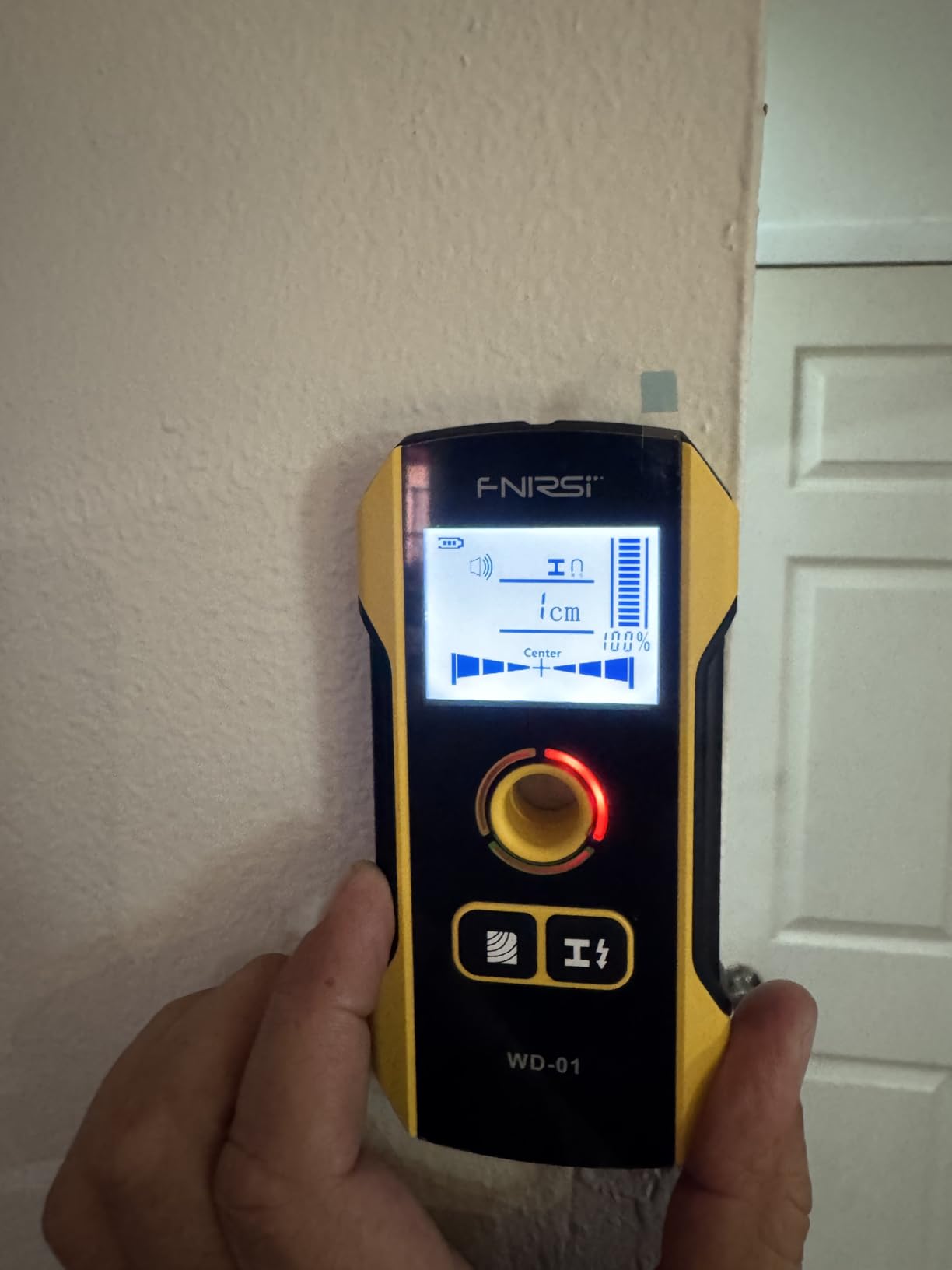
This is the most interesting inclusion in the list on paper, and the one with the least evidence behind it. Three modes with three sensitivity levels each, auto-calibration that explicitly covers plaster and painted walls, and a rechargeable battery that is included in the box.
The catch is the size of the owner base. At 198 ratings you have very little long-term field history, and a low category rank means it has been tried by fewer people than anything else here. Treat it as a promising option rather than a proven one.
Three Sensitivity Levels and Why They Matter
Sensitivity control is a genuinely useful feature that most tools in this roundup skip. On a wall with heavy texture, thick plaster, or a lot of joint compound, a single fixed sensitivity either over-reads or goes quiet.
Three levels per mode let you start high for a fast sweep, then drop down for fine positioning. That is closer to how a contractor works than a one-mode scanner.
What 4.7 Inches of Metal Depth Is Worth
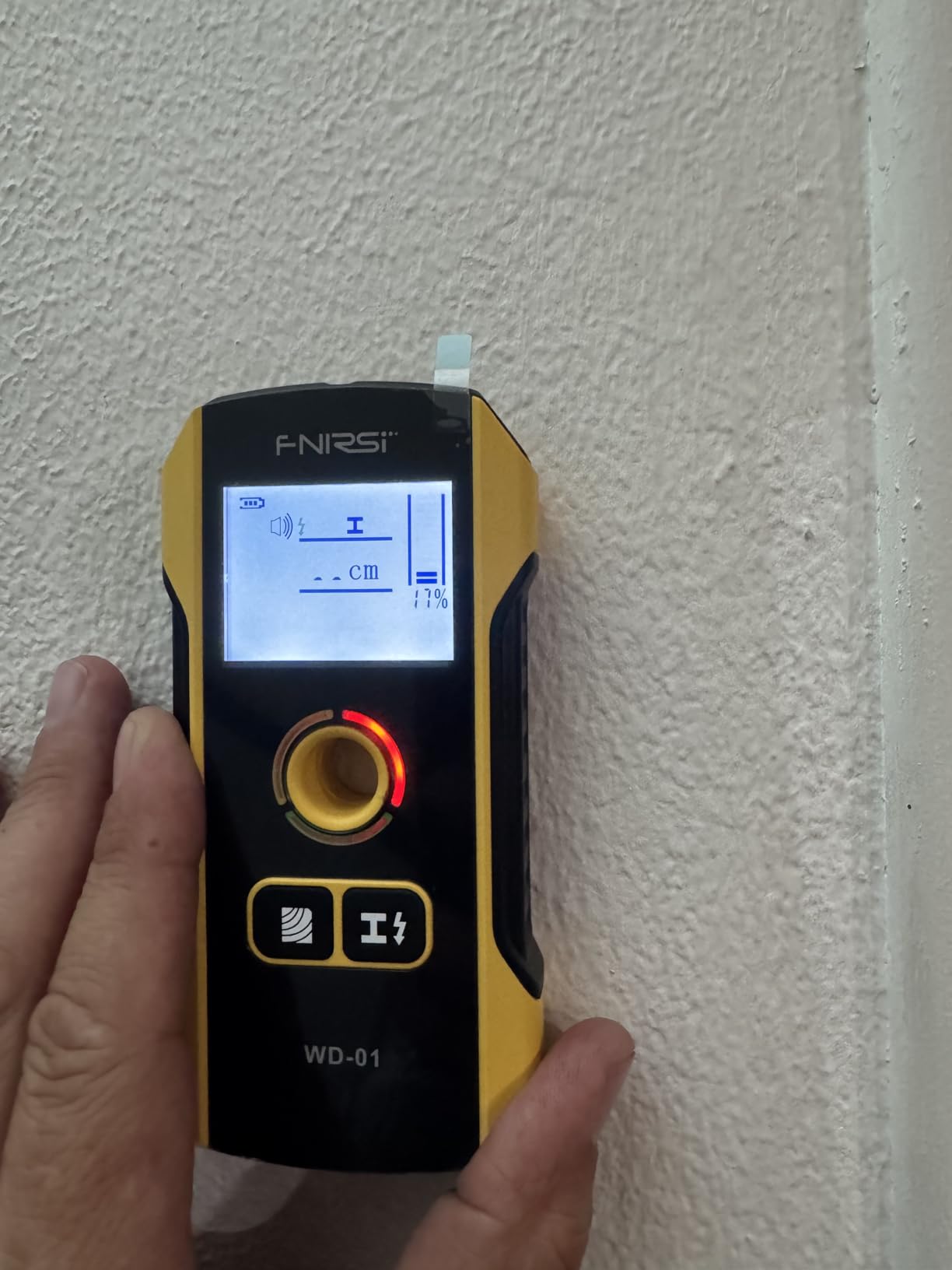
The 4.7 inch figure is for metal, not wood. Ferrous and rebar detection at that depth is useful for concrete work, plumbing runs and renovation, and it puts this unit in the same bracket as the FNIRSI WD-01 for that task.
For wood framing the published depth is 1.5 inches, with 2 inches for live AC wiring. So the sensible pairing is: metal scanning at pro level, wood scanning at budget level.
Who Should Buy the WD-02 and Who Should Not
Buy it if you work on plaster or freshly painted walls and want adjustable sensitivity, if you want a rechargeable tool with no separate battery purchase, and if you are willing to be an early adopter.
Skip it if durability evidence matters to you, or if you are mounting something heavy where a proven tool with a long owner record is the safer bet. The TFT screen is also more fragile in a job-site bag than a segment LCD.
What Depth Do You Actually Need?
Most buyers are over-indexing on the biggest number on the box. Here is what the wall, not the marketing, should dictate.
Standard Drywall Over Wood Studs
About half an inch of board over framing. Anything in this roundup handles it comfortably, and a 3/4 inch mode is genuinely sufficient. Spend your attention on display quality and edge versus centre finding instead of depth.
Double Drywall and Retrofit Walls
Roughly an inch of material, and this is the scenario forum users ask about most. You want 1.5 inches of published reach as a floor, which points to the ProSensor MAX, the ProSensor M210, the FNIRSI WD-01, or the FOLAI.
Plaster Over Lath
Thick, irregular and full of voids. Published depth helps less here than scan repeatability, because the wall is not a uniform slab. The ProSensor MAX lists plaster among its supported materials, and the ProSensor 710+ holds up on thin plaster. For heavy lath, add a rare-earth magnet.
Tile and Cement Backer Board
This is the hardest common case. The ProSensor MAX lists large tile explicitly, and the FOLAI lists rebar detection among its uses. Anything rated only for drywall will struggle, and the Mecurate explicitly says not to use it on tile.
Metal Framing and Concrete
For steel studs, a metal-specific mode matters more than depth. The Zircon A200 and the FNIRSI WD-01 both have dedicated metal modes, and the FNIRSI adds 4.7 inches of ferrous reach. The Walabot is not an option here, since it does not support concrete or metal-backed walls.
Ceilings and Overhead Work
Overhead scanning punishes heavy tools. The ProSensor 710+ weighs 6.4 ounces and the ProSensor MAX is 1.1 pounds, which is a large difference with your arm above your head. A light body with a bubble level is worth more than extra reach up there.
StudScan vs DeepScan: What the Modes Actually Do
StudScan and DeepScan are the same measurement at different sensitivity and field widths. StudScan is tuned for a single layer of standard drywall and returns a tight, fast edge reading. DeepScan widens the sensing field so a scanner can push through thicker or denser material and resolve the width of larger objects such as pipes and wires. The names are long-standing, which is why experienced users ask for deep scan mode by name. On the Zircon A200, StudScan reaches 3/4 inch and DeepScan reaches 1-1/2 inch. On the FOLAI, deep mode is treated as a wider-object mode alongside metal mode.
Magnetic, Electronic or Radar: Which Sensor Type Reads Deepest
There is no single answer, because the three types fail in different directions. Capacitive electronic scanners measure a change in wall density, so more material between the sensor and the stud means a weaker, blurrier signal. Magnetic scanners, which are really a rare-earth magnet in a plastic puck, do not care about depth at all. They find the screws and nails driven into a stud, and every screw marks a stud. One long-running woodworking forum thread describes rare earth magnets as working better than anything else, and the same poster notes the electronic scanner also finds the electrical wires. That combination is the practical pro method: magnet for the stud location on a thick wall, electronics for the wires.
Radar units like the Walabot render a visual map, which is helpful and fast on supported walls, but the supported wall list is narrow. Radar is the same underlying technology you meet in all-in-one printers with wireless scanning, where it trades range for a readable image rather than a beep. For our money on an old plaster house, the answer is a 13-sensor electronic finder plus a magnet in your pocket, not a radar scanner.
How to Use a Deep-Scan Stud Finder Correctly
Five steps separate a clean reading from a guess, and none of them require a different tool.
1. Calibrate on the same wall you are scanning. Hold the power button flat against an empty section of that wall for a second or two before you sweep. Calibrating on a different surface, or on a stud, is the single most common cause of a false positive.
2. Start slow and keep the orientation fixed. Sweep at a steady pace parallel to the expected stud run. Turning the tool in your hand mid-pass changes the sensor angle and produces a reading that will not reproduce.
3. Mark both edges, then the centre. If the tool gives you edges, mark them and measure the midpoint. If it has a centre indicator, use it and still sanity-check by measuring.
4. Repeat every reading from a fresh calibration. A stud reading reproduces three times in a row. Anything that appears once is a void, a pipe, a wire, or a calibration artefact.
5. Cross-check before you drill. Knock along the wall, run a magnet across the surface, or confirm with a second scanner if the load is heavy. A cheap neodymium puck magnet finds screws through plaster that defeat every electronic unit in this roundup.
Troubleshooting Ghost Readings, Double Studs and Dead Zones
These four symptoms account for almost every complaint we saw across thousands of owner reviews.
The reading will not repeat
Usually a calibration artefact, a dying battery, or a low-quality 9V cell. Replace or recharge the battery, recalibrate on an empty patch of the same wall, and sweep again. Tools with a low battery indicator, such as the Zircon A200, catch this before it starts.
A wide fuzzy band instead of a clean stud
You are probably in the wrong mode for the wall, or the wall is thicker than your tool reaches. Switch to deep scan, and if it persists, the wall is beyond the tool. Move up a depth class rather than trying harder with the same one.
Two studs very close together
This is a real condition, not a fault, and it happens at corners, around windows, and wherever two studs are doubled for a heavy load. Confirm with a knock test and a magnet rather than assuming the tool is wrong.
No reading at all where a stud must be
On plaster and lath, use a rare-earth magnet to find the screw or nail heads. On metal-backed or unusual walls, a radar unit or a second opinion beats repeated sweeps of a tool that has already told you it has nothing.
What Experienced Trades Recommend
Discussion threads rank high for this query, and the consensus is consistent. On a large tools forum, one user replacing a roughly 25-year-old Craftsman asks simply for the best, treating service life as the benchmark. The recurring answers are the Franklin ProSensor 710 and 710+, plus Zircon units with a DeepScan mode. A contractor forum poster names both in the same breath: a Zircon with DeepScan Mode, and the Franklin 710 as the one they consider best. A woodworking forum poster describes the 710 as the tool that finds electrical wires as well as studs.
The pattern across those threads is worth more than any spec sheet. People keep the same multi-sensor scanner for years, and they keep it because it finds the stud centre, not just an edge, and because it works on their actual wall type. That buy-once instinct is the same one behind headphones for deep work: pick a tool that will still be there in five years. If a tool only works on new drywall, it will not survive contact with a 1920s plaster house.
Frequently Asked Questions
What is the best stud finder for finding deep studs?
For most people, the best stud finder for deep scanning is the Franklin ProSensor MAX, which reads to 2.5 inches through multiple drywall, plaster and tile layers. The ProSensor 710+ is the safer all-round choice, with a 13-sensor array and 1.6 inches of reach, and the Zircon MultiScanner A200 covers the mode vocabulary most experienced users already know.
How deep can a stud finder scan?
Most electronic stud finders scan 0.75 to 1.5 inches reliably, which covers one or two layers of standard drywall. Deep-scan models reach 1.5 to 2.5 inches, and radar units such as the Walabot DIY 2 claim up to 4 inches. Metal detection runs deeper than wood, so a 4.7 inch rebar rating does not mean a 4.7 inch stud rating.
What is the difference between stud scan and deep scan on a stud finder?
Stud scan mode is tuned for a single layer of standard drywall and gives a fast, tight edge reading. Deep scan widens the sensing field so the scanner can push through thicker or denser material and resolve wider objects such as pipes and wires. On the Zircon A200, StudScan reaches 3/4 inch and DeepScan reaches 1-1/2 inch.
Which deep scan stud finder can scan through tile?
The Franklin ProSensor MAX is the clearest answer, because its published specification names large tile along with multiple drywall layers, plaster, OSB, plywood and MDF, with 2.5 inches of detection depth. Most budget scanners are not rated for tile at all, and the Mecurate explicitly excludes it.
Why does my stud finder keep giving false readings?
The most common causes are skipping calibration, a weak battery, and scanning a wall the tool cannot reach. Calibrate on an empty patch of the same wall, replace the battery, and sweep slowly at a fixed angle. Repeat each reading from a fresh calibration, and treat anything that only appears once as a void or a cable.
Are magnetic stud finders better than electronic ones?
Neither is better at everything. A rare-earth magnet ignores wall density entirely and finds the screws holding lath to studs, which makes it the most reliable method on thick plaster. An electronic scanner adds wire detection, tells you when you have passed a stud, and gives you a centre reading, so most trades carry both.
Can a stud finder detect metal studs?
Yes, using a dedicated metal mode. The Zircon MultiScanner A200 and the FNIRSI WD-01 both scan for metal as a separate mode, and the FNIRSI reads ferrous metal to 4.7 inches and copper to 3.9 inches. The Franklin ProSensor 710+ and M210 also detect wood and metal studs, and radar units show metal visually.
How do I calibrate a stud finder for accurate results?
Hold the power button flat against an empty section of the same wall you are about to scan for one to two seconds, then begin sweeping. Never calibrate on a stud, and never calibrate on a different wall surface. Recalibrate before every reading if you are marking several mounts in a row, since the sensor adapts to the density around it.
Which Stud Finder Should You Buy?
Pick the Franklin ProSensor 710+ if you want the most reliable all-round tool and a scanner that experienced trades already name. Pick the ProSensor MAX if your walls are genuinely thick, plastered, or tiled, since 2.5 inches is the deepest wood reach in this roundup. Pick the M210 if drilling near old wiring is part of your week, because the live wire alert is the best of the 13-sensor family.
Pick the FNIRSI WD-01 or the ZHDTW WD-02 if your real target is metal, plumbing or rebar rather than wood, and pick the Walabot DIY 2 if you want to see the wall and work only in modern drywall and plywood. For light everyday hanging, the JAXWQ and FOLAI scanners give you a readable backlit screen for very little, and the Mecurate is the friendliest place to start if you have never used one. Our full ranking of the best stud finder for deep scanning options is the table further up, and the button on each review shows the current listing.
Whatever you choose, calibrate on the wall you are about to scan, repeat every reading, and carry a rare-earth magnet in your pocket for plaster. That last habit has saved more walls than any mode setting.