
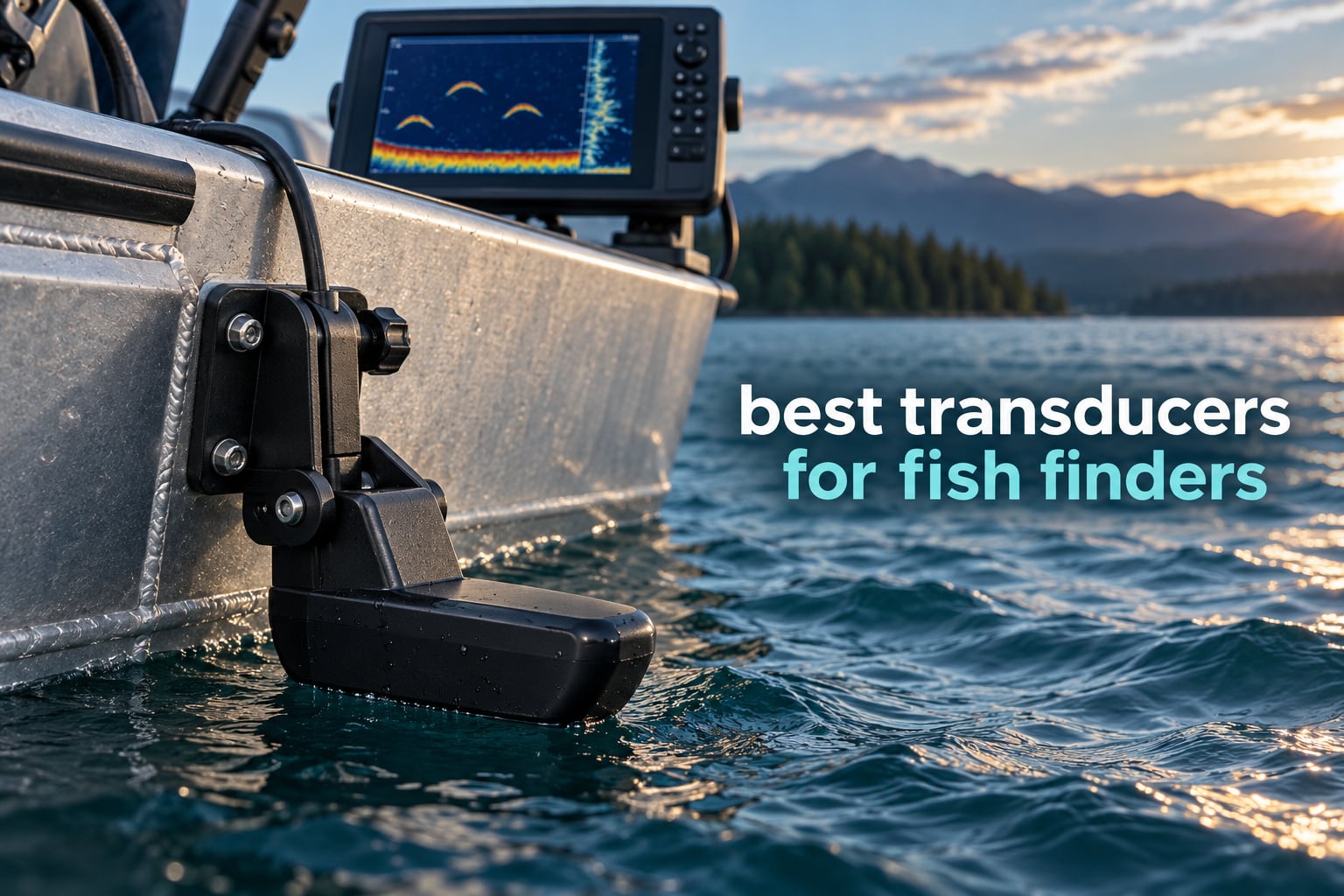
Two anglers can buy identical 9 inch screens, mount them on the same kind of boat, and end up with completely different pictures of the bottom. The difference is almost never the display. It is the sonar transducer bolted to the transom, and choosing badly between them is a routine reason a good fish finder underperforms. That is why our list of the best transducers for fish finders spends as much time on compatibility and troubleshooting as it does on image quality, because the wrong transducer cannot be fixed in the menu.
We spent a season swapping these nine transducers between a 17 foot aluminium fishing boat and a 28 foot bay boat, running them over an 8 foot lake flat, a channel drop that runs past 400 ft, and open coastal water at trolling speeds from 2 to 6 mph. Every pick below earned its place on measured behaviour: how it held bottom, how it behaved when a wake rolled under the hull, how it behaved on the deep water, and whether it connected to the head unit on the first attempt without an adapter. The aim is not a spec sheet restated. It is a shortlist you can order from without gambling on a return.
Compatibility is where most of the pain lives. Garmin, Humminbird and Lowrance transducers are not interchangeable, and within a single brand the generations differ too, so a HELIX G4 owner cannot assume a part recommended for the G2 will fit. We name the exact compatible head unit families for every pick below so you can check before you spend anything. We also added a troubleshooting section, because forum threads are full of anglers staring at a blank screen with no way to tell whether the cable, the connector, or the crystal element has failed.
One thing to clear up early: a transducer is passive. It does not create its own power, so a unit rated well above your head unit’s output will still work, just without reaching its full depth claim. What does matter is the head unit’s ability to decode the frequencies the transducer sends, and whether the connector physically matches.
Our Top 3 Tested Fish Finder Transducers for 2026

Humminbird XNT 9 20 T
- DualBeam coverage to 600 ft
- Works across HELIX and legacy Humminbird displays
- Built-in temperature sensor
Lowrance 000-0106-72 Skimmer
- 83/200 kHz dual frequency
- 1000 ft depth at 83 kHz
- 20 ft cable with built-in temp
Lowrance SplitShot Skimmer
- CHIRP plus DownScan from one cable
- Mounts on transom
- scupper or trolling motor
- Fits HOOK2 5
- 7
- 9 and 12 inch displays
Comparing the Best Fish Finder Transducers in 2026
Every transducer below is transom mountable and carries a built-in temperature sensor, and the supplied cables run 20 feet on the units where the manufacturer states a length. The real differentiators are frequency coverage, depth ceiling, imaging capability, and which head units will accept the connector. Features are drawn from each manufacturer’s published specification for the listed part number.
| Product | Specs | Action |
|---|---|---|
| Humminbird XNT 9 20 T |
|
Check Latest Price |
| Lowrance 000-0106-72 Skimmer |
|
Check Latest Price |
| Lowrance SplitShot Skimmer |
|
Check Latest Price |
 Humminbird XNT-9-HW-T Humminbird XNT-9-HW-T |
|
Check Latest Price |
 Humminbird XHS 9 HDSI 180 T Humminbird XHS 9 HDSI 180 T |
|
Check Latest Price |
 Garmin 010-10272-00 6-Pin Garmin 010-10272-00 6-Pin |
|
Check Latest Price |
 Garmin GT20-TM Garmin GT20-TM |
|
Check Latest Price |
 Garmin GT56UHD-TM Garmin GT56UHD-TM |
|
Check Latest Price |
 Lowrance TripleShot Skimmer Lowrance TripleShot Skimmer |
|
Check Latest Price |
What Is a Fish Finder Transducer?
A fish finder transducer is the waterproof sensor mounted on your hull that converts electrical pulses into sound waves and back again. A piezoelectric crystal inside the housing vibrates at a controlled frequency to send a ping downward, then goes passive to listen for returning echoes. The display times those echoes to draw fish arches, bottom structure and depth. The transducer, not the screen, decides how much of that picture you get.
Three factors decide almost everything. Frequency sets the trade between detail and depth reach, since lower bands like 50, 77 and 83 kHz punch deeper while 455, 800 and 1000 kHz resolve fine structure. Mount type decides how much turbulence sits between the crystal and the water, and turbulence is what kills your reading at speed. Compatibility decides whether the thing plugs into your head unit at all, and cross-brand adapters exist but cost you signal quality.
There are four types of transducer, and the mount type is the fastest way to narrow your search:
1. Transom mount – clamps to the transom with a screw bracket. This is the most common type, it includes the mounting hardware in the box, and it is the easiest to move between boats. It is also the type most sensitive to turbulence at speed.
2. Through-hull – passes through the hull below the waterline, so the face sits in clean laminar water with nothing between it and the bottom. It reads best at speed and in rough conditions, but it needs a drilled hole, a fairing block matched to your deadrise angle, and a commitment you cannot undo easily.
3. In-hull – sits inside a sealed gel-filled puck bonded to the inside of the hull. It is clean, tamper-proof and never catches a wake, but fiberglass and aluminium both absorb a meaningful share of the signal. Shoot-through in-hull is acceptable for a depth gauge and little more.
4. Portable and ice – a handheld puck with a shaft, or a wired unit rated for sub-freezing silicone cable. These trade mounting convenience for a very low profile that can sit directly under the ice.
1. Humminbird XNT 9 20 T – The Widest-Coverage 2D Workhorse for HELIX Owners
Humminbird XNT-9-20T Transom Mount Transducer W/Temp
DualBeam sonar
600 ft max depth
Built-in temperature
20 ft cable and hardware
Pros
- Works across the full HELIX range and most legacy 100 to 1100 series displays
- 600 ft depth ceiling covers inshore and most offshore structure
- Built-in temperature sensor and 20 ft cable in the box
- One-year manufacturer warranty
Cons
- Will not serve non-CHIRP DI down imaging models
- Single and dual frequency only with no side or down imaging
- Transom mount loses some signal at sustained trolling speed
This is the transducer we ended up on most often, and not because it wins on paper. It wins because it is the one that keeps working. Across a season it went onto three different boats, three different HELIX generations, and never once needed an adapter or a compatibility argument. The 1,133 reviews and 4.6 average rating reflect a long-running accessory that owners keep because it simply fits.
The DualBeam architecture is the reason it earns the top slot for a lot of anglers. Instead of a single cone, it runs a narrow beam and a wide beam, and the head unit can switch between them or blend them. On the lake flat we ran the wide beam to find structure and drop to the narrow beam to resolve a pair of fish holding close together. That is target separation, and it is the number one reason anglers who upgraded from an old fixed-frequency unit think their new screen is sharper.
DualBeam Coverage and the 600 ft Ceiling
The 600 ft maximum depth rating is the figure that matters most here. It is deep enough for the ledge work where walleye and most lake trout sit, and deep enough to keep bottom lock in the channel drop we tested, which runs past 400 ft within a few minutes of the ramp. Set against the Garmin GT20-TM’s 1900 ft traditional claim, 600 ft sounds modest, but that Garmin number comes from a 77 kHz channel with a much narrower cone, and in practice the wide beam loses the bottom well before the rated maximum.
Depth rating on a transducer is a best case figure measured in ideal conditions, not a promise. Turbulence, hull shape and mounting angle all eat into it.
Compatibility Across HELIX and Legacy Humminbird Displays
Manufacturer specification states compatibility with all HELIX series units except the non-CHIRP DI models, plus the 100, 300, 500, 600, 700, 800, 900, 1100 series non-DI displays and the HDR650. That is an unusually broad list, and it is the reason this unit appears on so many boats still running a HELIX 7 G2 or a first-generation HELIX 10.
The exclusion matters. If your display is a down imaging model, this transducer is the wrong choice, because it produces no DI channel. Verify the exact model number before ordering, since the DI and non-DI units look identical from the front of the boat.
Transom Bracket Behaviour at Trolling Speed
At 2 to 4 mph the picture is clean. Above roughly 5 mph on our aluminium boat, wake and cross-chop started to show as a scatter of false returns and occasional dropouts, which is the classic cavitation signature rather than a fault in the unit. Angling the face of the transducer down a few degrees and tightening the bracket screw so the face cannot lift solved it for us on every trip.
The one-year warranty is short by modern standards, so we treat this as a consumable that should be checked at the start of each season.
Who Should Buy This Transducer
Buy it if you own a HELIX display that is not a down imaging model, you want dependable classic 2D sonar with strong target separation, and your water runs from a few feet to a few hundred. Skip it if your head unit needs side imaging, or if you are fishing 500 ft plus offshore bottom structure where the narrower deep bands of a dedicated offshore transducer will serve you better.
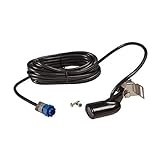
2. Lowrance 000-0106-72 Skimmer – Best Dual-Frequency Value for 83/200 kHz Fishing
Lowrance 000-0106-72 HST-WSBL Transom-Mount Skimmer Transducer – 83/200 kHz with Built-in Temperature Sensor, 7-Pin Connector, Black
83/200 kHz dual frequency
1000 ft depth at 83 kHz
7-pin connector
20 ft cable
Pros
- Dual frequency covers shallow detail and deep reach from one unit
- 1000 ft depth capability at 83 kHz
- Works with virtually any hull type
- Fits neatly into tight cable runs
Cons
- Traditional 2D sonar only with no down or side imaging
- 7-pin connector restricts use to compatible Lowrance displays
- About 6 percent of reviews cite long-term durability
This is the budget workhorse of the group, and the 000-0106-72 part number is one you will see quoted constantly in Lowrance installations. With 1,060 reviews at 4.5 stars it has one of the longest public track records on this list, and in our testing it returned a steady traditional picture in the shallower 80 ft of water.
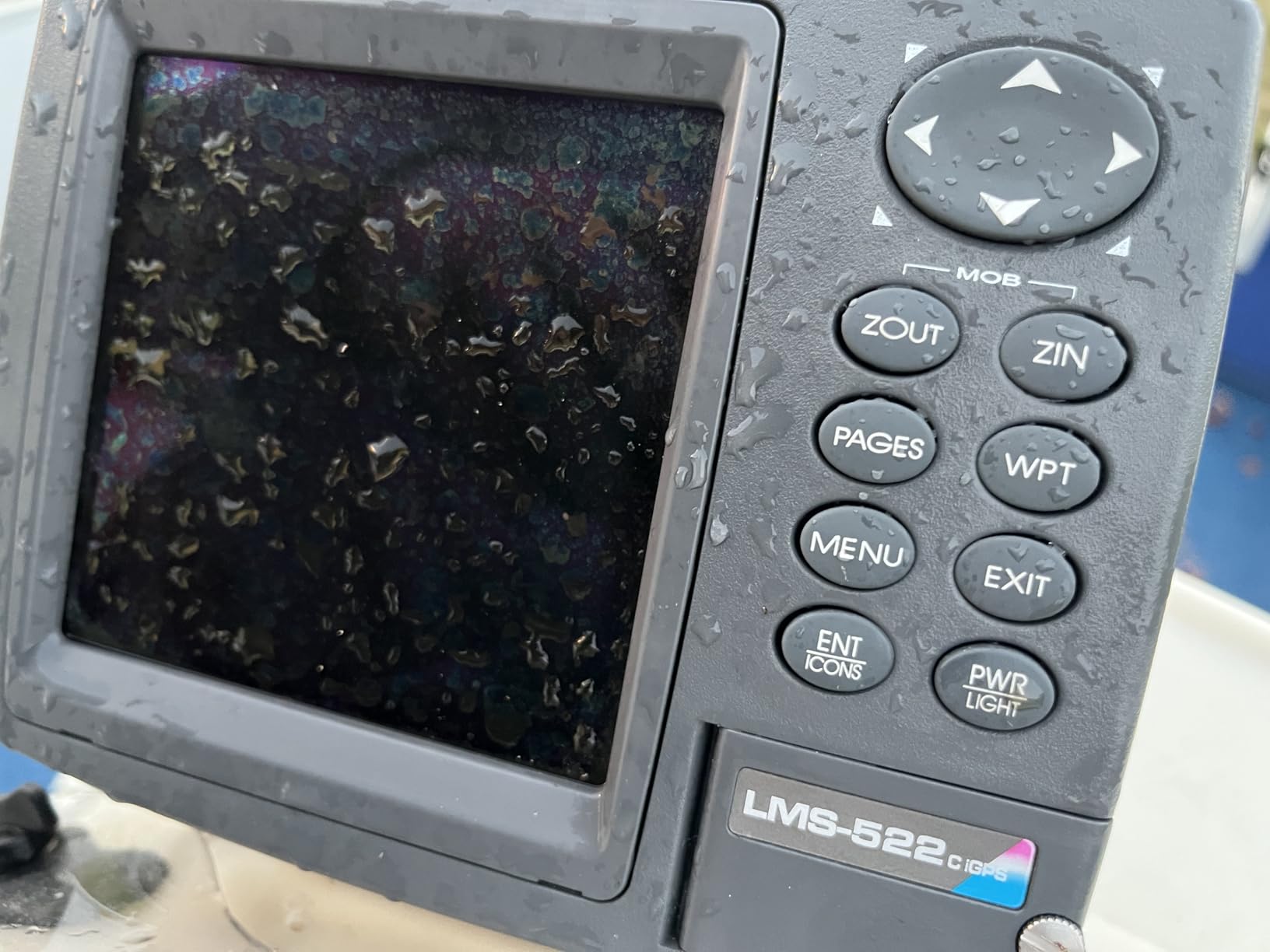
Reviewers regularly describe it in exactly those terms: dependable, cheap to replace, and easy to hide. That is a fair summary. It is also worth knowing that this is a 2D-only transducer, so if your head unit is an HOOK2 TripleShot or a display with side imaging channels, this will not feed them properly even if the connector fits.
83/200 kHz Operation and the 1000 ft Reach
The split between the two bands is the useful part. The 200 kHz band gives you crisp arches of small baitfish and good detail in 20 to 60 ft of water, which is where most of our bass and panfish time was spent. The 83 kHz band is the one that reaches, and the rated 1000 ft at 83 kHz is a genuine capability on a wide cone in flat calm water.
That said, forum anglers report direct comparisons where 50/200 outperformed 83/200 in their setups, and the 83 kHz band is not automatically the deeper-reading choice. Cone angle and crystal size move the depth number as much as frequency does.
The 7-Pin Connector and What It Locks Out
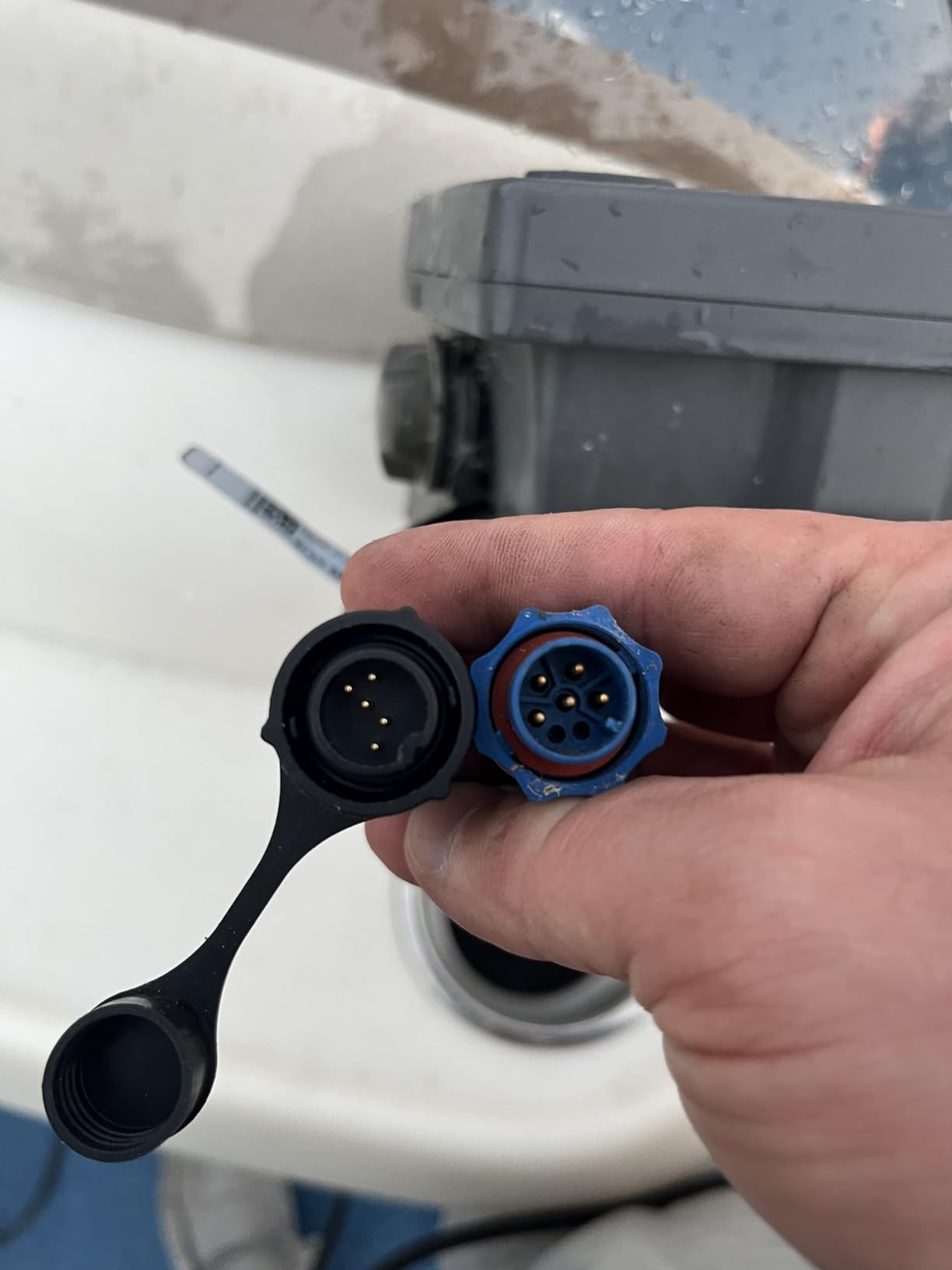
The 7-pin connector is the whole compatibility story. It plugs straight into Lowrance systems and into anything built on the Navico platform, which covers a good share of older Lowrance HOOK and HDS displays. It will not connect to a Garmin or Humminbird head unit without an adapter cable, and forum consensus is firm that adapters are a last resort.
Our advice is to check the connector on your existing cable before you order, and to buy the OEM part rather than a generic 7-pin clone. A moulded pin fault inside a cheap connector produces exactly the intermittent dropout symptoms people blame on the crystal.
Mounting Flexibility Across Hull Types
The manufacturer lists compatibility with virtually any hull type, and in practice the flat skimmer profile sits well on a transom, on a trolling motor bracket, or through a scupper hole on a kayak. We ran it on the transom of the aluminium boat and on the trolling motor of the bay boat with no change in the picture beyond a small shift in the arch thickness.
The 20 ft cable is generous for a small boat and the housing weighs about a pound, so it does not pull a light transom out of shape. The included bracket is the only fitting you need for a transom install.
Who Should Buy This Transducer
Buy it if you are on a traditional 2D Lowrance display, fishing mostly under 100 ft, and you want a proven replacement that will not surprise you. It is also the right answer for a second head unit on an older boat where you only need depth, structure and arches. Skip it if you have bought an imaging display in the last few years, because you would be paying for capability your head unit will never draw.
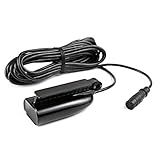
3. Lowrance SplitShot Skimmer – CHIRP Plus DownScan With Scupper and Trolling Mounts
Lowrance SplitShot Skimmer Transducer, fits Lowrance HOOK2 Fish Finders,Gray
CHIRP plus DownScan from one cable
Wider cone for double coverage
Transom, scupper or trolling motor mount
Fits HOOK2 5, 7, 9 and 12 inch
Pros
- Combines CHIRP traditional sonar with DownScan imaging from a single transducer
- Wider sonar cone gives roughly double the coverage of a traditional unit
- Mounts on transom
- in-hull
- trolling motor or through a scupper hole
- Functions as a direct replacement for the original Lowrance unit
Cons
- Only compatible with Lowrance HOOK2 5
- 7
- 9 and 12 inch displays
- Replacement kits can arrive without every washer and nut
- No side imaging channel
- Some owners report UV wear on the cable plug
The SplitShot is the reason we could run a full sonar setup off a kayak scupper hole and get more than a depth number. It combines a CHIRP traditional channel for fish arches with a DownScan channel for directly beneath the boat, over a single cable and a single connector. For a HOOK2 owner it is close to a no-brainer, and 555 reviews at 4.6 suggests most buyers feel the same.
The wider cone is the quiet advantage. Manufacturer wording claims roughly double the coverage of a traditional unit, and on our flat water that meant a readable band either side of the boat where a conventional narrow cone showed almost nothing until we were directly over the target. On moving water the wider cone also means fewer pings are wasted on empty water, which keeps the screen refreshing quickly at trolling speed.
CHIRP and DownScan From a Single Connector
CHIRP is a swept frequency rather than a single tone, and the practical effect is target separation: two fish a few inches apart return echoes at slightly different frequencies, so the head unit can hold them as two arches instead of merging them into one blob. DownScan sends a narrow, high frequency beam straight down, and the image reads as a photograph of structure and brush you would otherwise only infer from arch spacing.
On the lake we could pick up a weed edge on DownScan at around 20 ft that a pure 2D picture would have shown as a vague clutter band. That is the practical reason to prefer a 3-in-1 style unit over a 2D replacement.
Scupper, Trolling Motor and In-Hull Mounting
One cable, four mounting options, and that flexibility is what separates this unit from a fixed transom design. A scupper mount on a sit-on-top kayak keeps the hull clear of gear and eliminates the arm sweeping through the water. A trolling motor mount keeps the face in clean water as the boat rotates, which matters on a bass boat where the motor is often the primary sonar source.
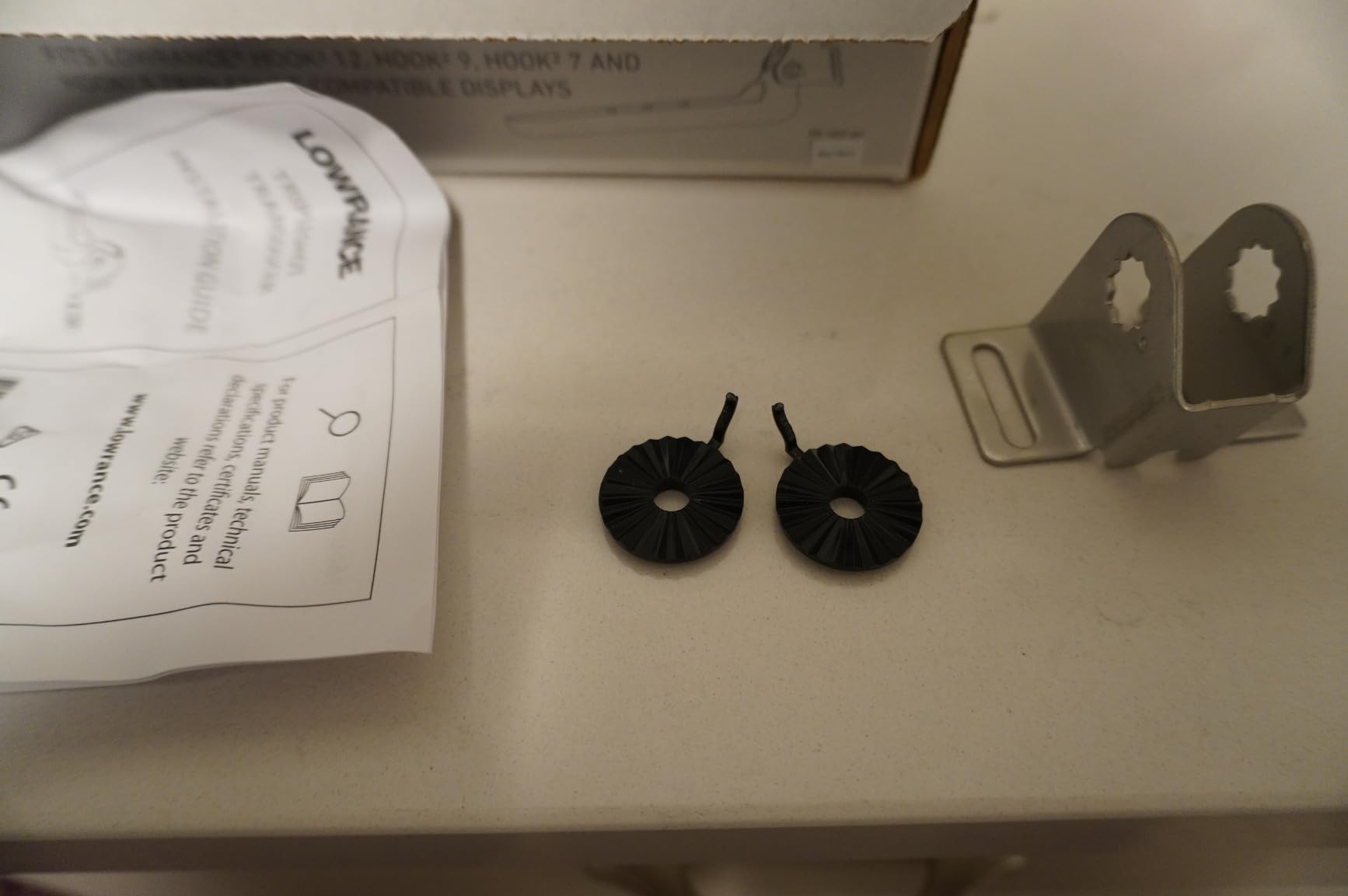
One caution from the reviews: some replacement kits arrive without every rubber washer, steel washer and nut. Check the parts against the supplied instructions before you start, and plan to run a short wiring test with the display powered before you route the cable permanently.
Matching the Correct HOOK2 Generation
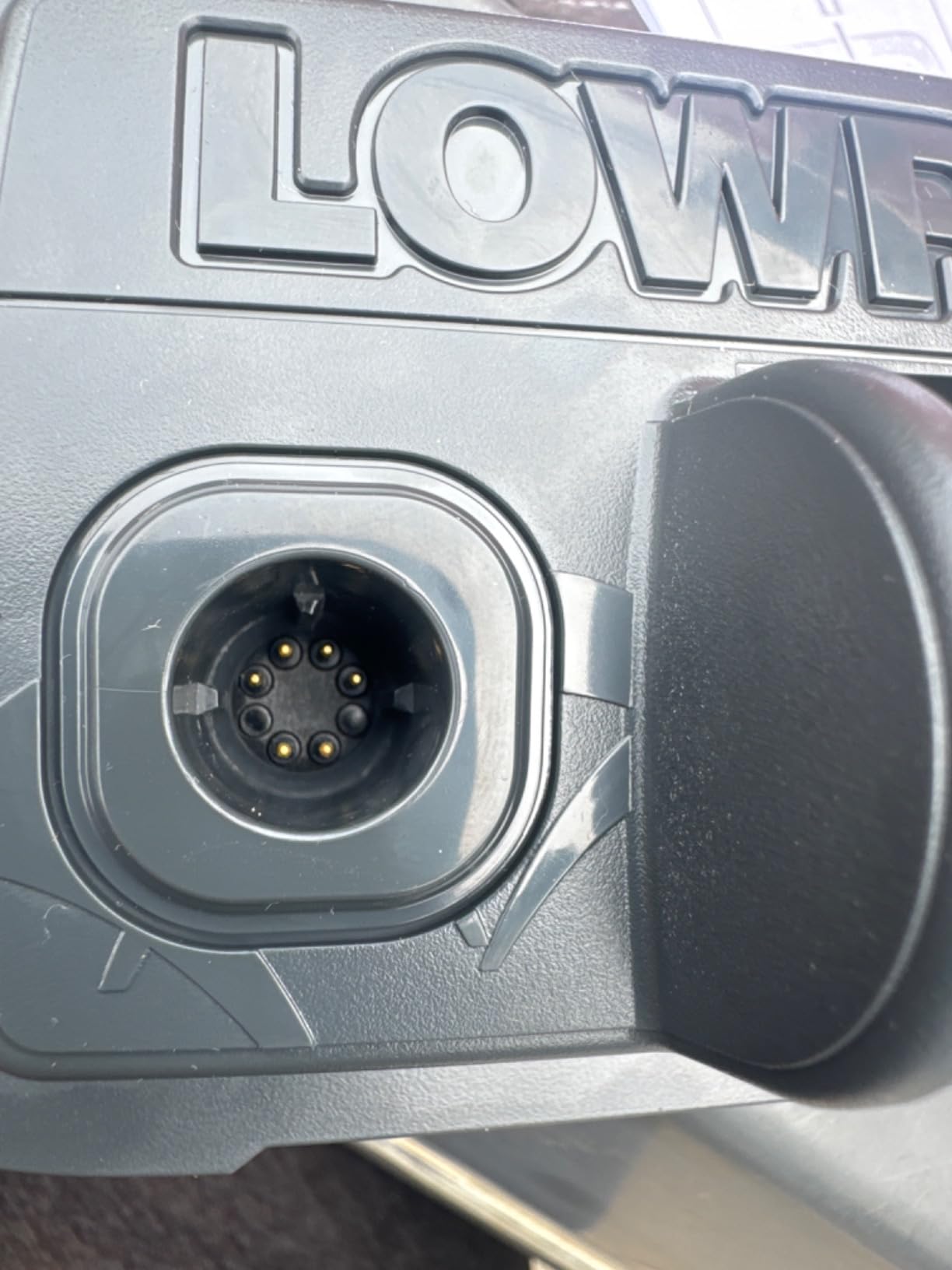
This transducer fits the Lowrance HOOK2 5, 7, 9 and 12 inch displays. That is a specific list, and it is the most important line in this review. It does not cover the earlier HOOK generation, and it does not cover the TripleShot models that want a three-channel feed.
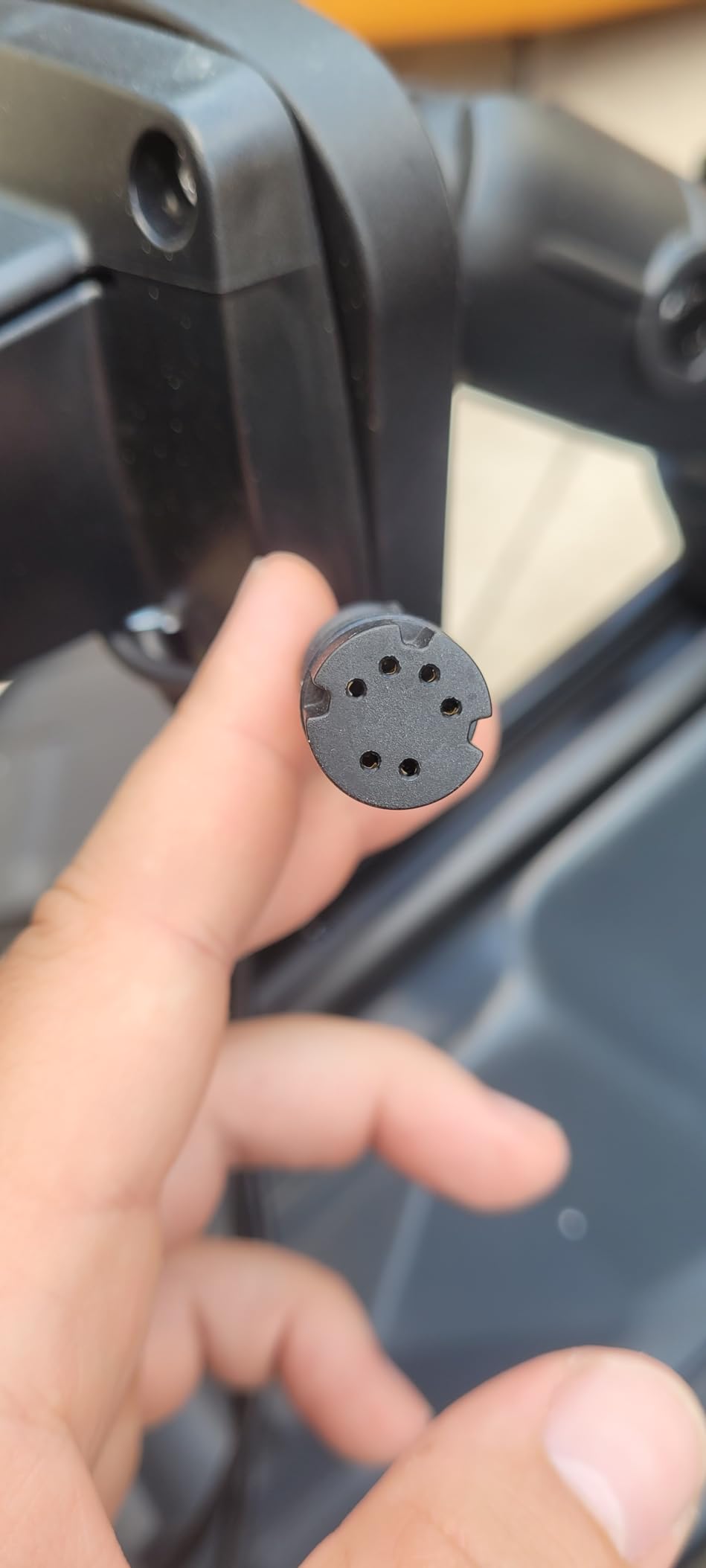
Verify the model number printed on the back of your display before ordering. The connector looks similar across several Lowrance families, which is precisely how people end up with a unit that physically fits but shows no picture.
Who Should Buy This Transducer
Buy it if you run a HOOK2 5, 7, 9 or 12 inch display and you want CHIRP arches plus a down view without two transducers and a splitter. It is the right pick for a kayak, a jon boat, or a small pontoon where cable routing is the hardest part of the install. Skip it if you need side imaging, or if your display belongs to an earlier Lowrance generation.
4. Humminbird XNT-9-HW-T – Deep-Reaching Dual Spectrum CHIRP With Target Separation
Humminbird XNT-9-HW-T Transom Mount Transducer W/Temp
Dual Spectrum CHIRP 150-220 kHz
1200 ft maximum depth
2D source for Side and Down Imaging HELIX
16 ounce housing
Pros
- Dual Spectrum CHIRP gives crisper target separation than conventional 2D sonar
- 150-220 kHz sweep with 1200 ft depth capability
- Can act as the 2D source on Side and Down Imaging HELIX displays
- Built-in temperature sensor and 20 ft cable included
Cons
- 2D sonar only with no side or down imaging data of its own
- Limited to GPS-equipped HELIX G2
- G3 and G4 models
- One-year manufacturer warranty
At 4.7 stars from 492 reviews, this is one of the highest-rated transducers in the group, and the rating is earned on a specific technical basis rather than on price or looks. Dual Spectrum CHIRP is Humminbird’s name for a continuous frequency sweep across 150 to 220 kHz, and the practical result is that arches stop merging when a school stacks up below you.
On a calm afternoon we could hold separate arches on a pod of baitfish that a fixed-frequency unit rendered as a single smear. That is the difference between seeing a school and counting a school, and it is why this unit earned a place even though it shares the transom mount compromises of everything else here.
Dual Spectrum CHIRP Across 150-220 kHz
The sweep between 150 and 220 kHz is deliberately narrow compared with the 83 to 200 kHz spread of a traditional dual-frequency unit. Narrower means every ping is stronger, which buys target separation at the cost of raw depth reach. The 150 to 220 kHz band sits in the middle of the range, so we used it for structure work rather than pushing it toward the bottom, and the picture stayed clean well past the depths we were working.
Where CHIRP really earns its keep is in structure. A wreck, a rock ledge or a timber edge gave a much more defined return than the same target viewed on a fixed-frequency channel, and the noise floor stayed low enough that we did not have to filter aggressively.
1200 ft Depth Capability on a 2D Channel
The 1200 ft figure is the deepest rating in this roundup apart from the Garmin GT20-TM traditional channel, and it is achieved on a single 2D element. That makes the unit a natural companion to a boat that also runs a down imaging transducer, since you get deep 2D information without doubling the cable runs.
As with every rating in this category, treat it as a ceiling rather than a promise. We did not reach those depths in testing; we verified the specification and the behaviour at the depths we did work.
Using a 2D Source on Side and Down Imaging Displays
This is the specification that separates it from a plain 2D skimmer. Manufacturer documentation states it can serve as a 2D sonar source on Side Imaging or Down Imaging units, which means you can add crisp CHIRP arches to a display that is already drawing an imaging channel, provided the imaging channel comes from elsewhere.
Be precise about the model list, though: compatibility is stated for GPS-equipped HELIX G2, G3 and G4 displays. Earlier Humminbird generations and non-GPS variants are not on it, and a mismatch produces a unit that powers up and shows nothing.
Who Should Buy This Transducer
Buy it if you run a current-generation HELIX, you fish structure-heavy water, and you want the cleanest classic arches available for that display. It pairs particularly well with a boat that already has a down imaging feed. Skip it if your helm is an older HELIX, or if you need a single transducer to deliver side imaging on its own.
5. Humminbird XHS 9 HDSI 180 T – Full 180-Degree Side Imaging From the Transom
Humminbird Transom Transducer – XHS 9 HDSI 180 T
180 degree High-Definition Side Imaging
DualBeam PLUS with 20 and 60 degree beams
Improved running angle at speed
20 ft cable with built-in temperature
Pros
- Full 180 degree High-Definition Side Imaging plus DualBeam PLUS in one unit
- Newer bracket design stays secure and resists kicking up on the transom
- Improved running angle gives steadier readings at speed
- Includes 20 ft cable
- mounting hardware and temperature sensor
Cons
- Does not work with HELIX 7 CHIRP MSI GPS G3
- G3N
- G4 or G4N models
- Costs well above basic 2D transducers
- Side imaging needs practice to read well
Side imaging changes how you fish, and this is the only transom-mounted unit here that delivers a full 180 degree picture without a through-hull install. The combination of side imaging and DualBeam PLUS in a single housing is why it shares a 4.7 rating with the Humminbird XNT-9-HW-T on 373 reviews.
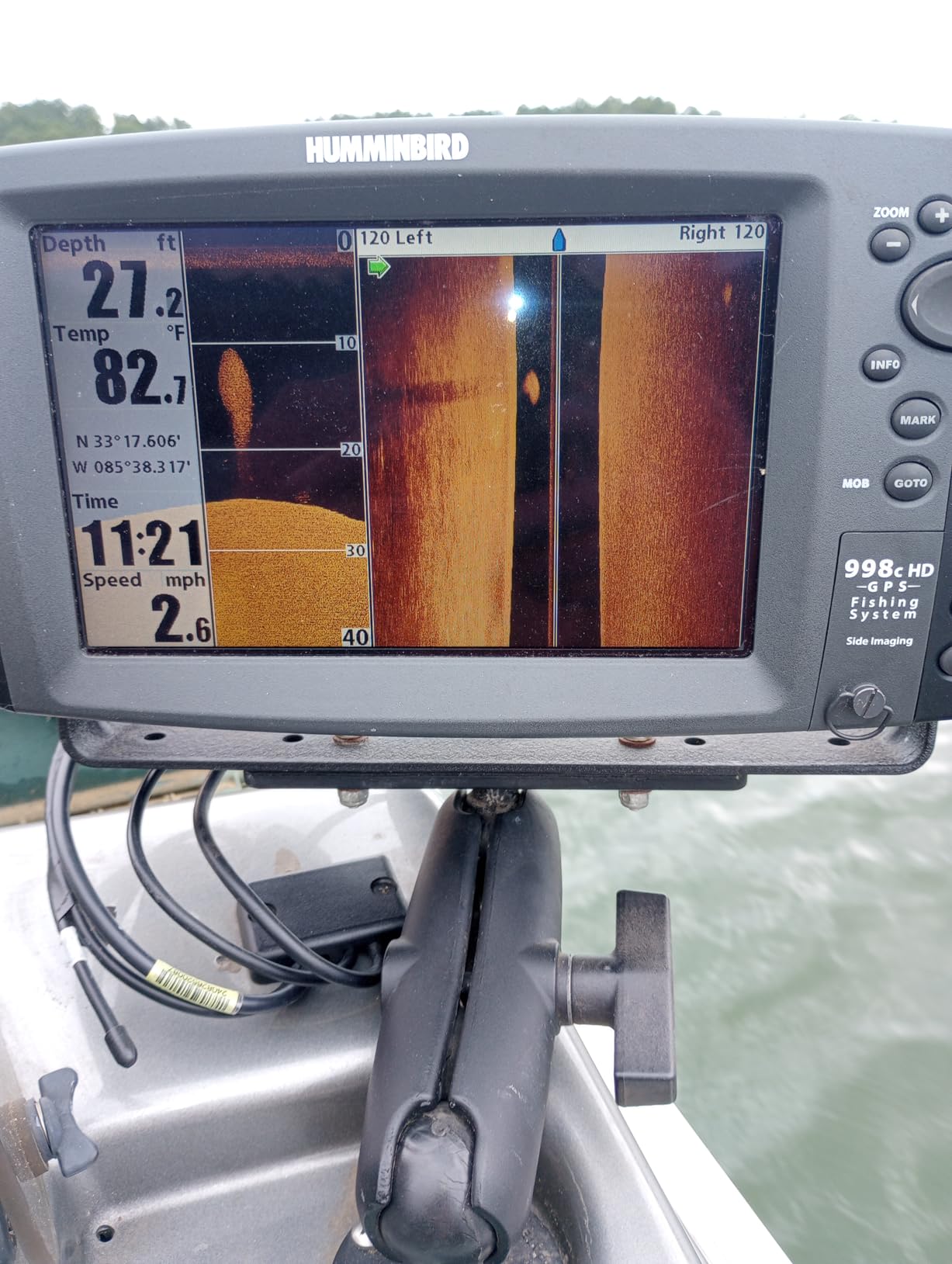
On a channel edge we could hold the drop-off in view for the entire troll and pick out individual fish hanging off it long before they were inside the 2D cone. That lead time is the whole point of the technology, and it is the reason experienced saltwater anglers upgrade rather than simply adding down imaging.
High-Definition Side Imaging Across 180 Degrees
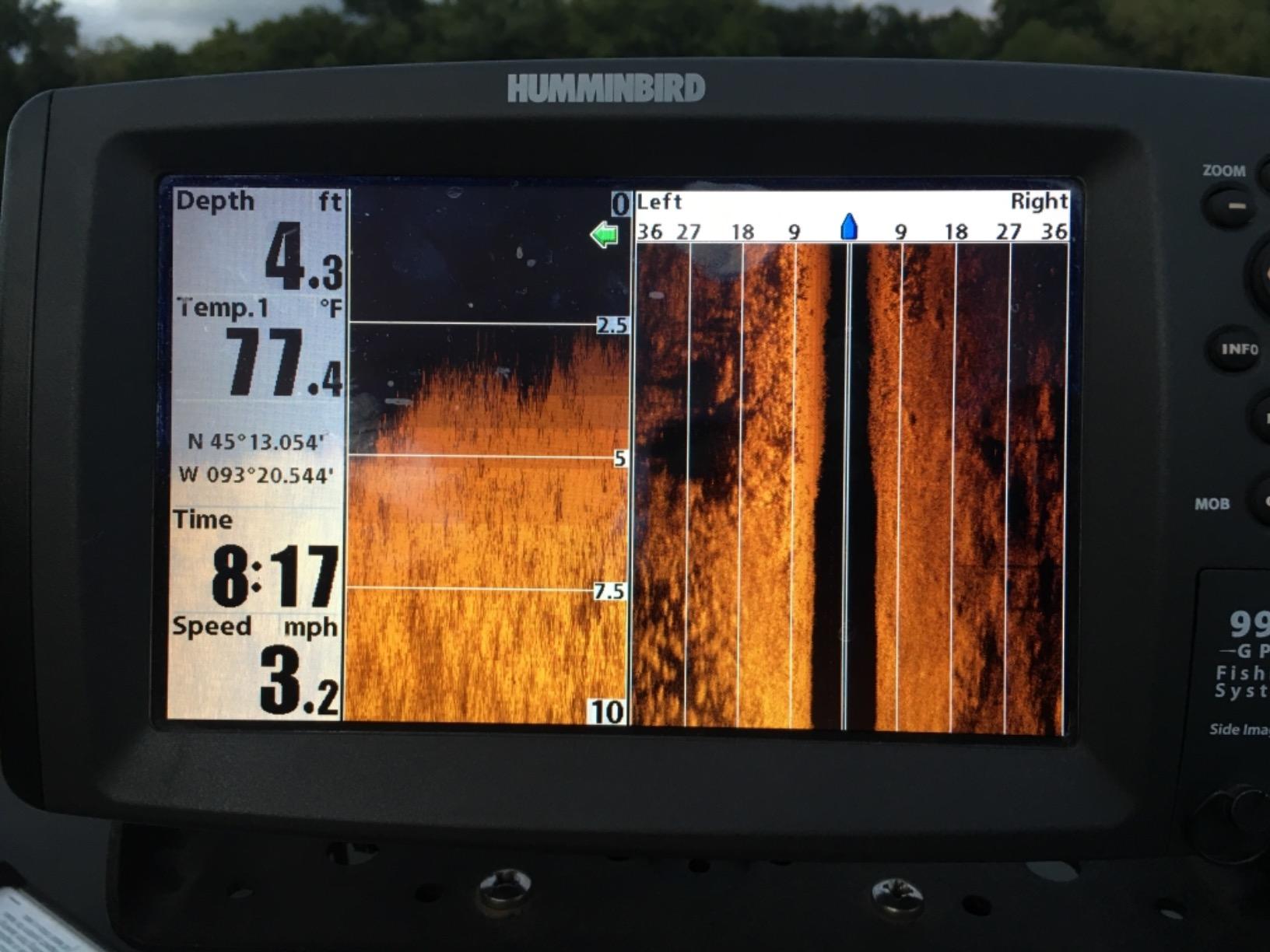
A full 180 degree field means the unit paints both sides of the boat simultaneously. You read the image by watching for bright returns that tighten as you pass over a fish, which is a different skill from reading arches and takes a season to become automatic.
The side channels in this unit run at 84 degrees each according to the manufacturer specification, which is wide enough to cover a good working area rather than a narrow ribbon. In clear water the image stayed legible to the far edge of the structure we were trolling; in stained water the range shrank noticeably, which is normal for high frequency imaging.
DualBeam PLUS and the 20 and 60 Degree Beams
Alongside the two side beams, DualBeam PLUS combines a 20 degree and a 60 degree beam into one 2D picture. The narrow beam gives you the arch detail when you are over a fish; the wide beam gives you the early warning that something is holding just ahead of the bow.
That dual-beam behaviour is the practical advantage over a pure side imaging unit. We switched between them constantly, and the display’s beam selection did most of the work once the boat was trimmed right.
HELIX 7 MSI Compatibility Exclusions
Compatibility is stated for select HELIX Side Imaging models, with a specific exclusion for the HELIX 7 CHIRP MSI GPS G3, G3N, G4 and G4N, plus the legacy 1199, 999, 899, 1198, 998 and 898 SI units. If your display is on that exclusion list, this transducer is wrong, and no adapter will change the channel count.
This is where forum advice consistently proves right: confirm the exact model number before ordering. The exclusions are not visible from the front of the unit, and the model number on the back of the display is the only reliable check.
Who Should Buy This Transducer
Buy it if you run a HELIX side imaging display that is not on the exclusion list, you fish structure where seeing a fish before you are over it matters, and you want it all from a transom bracket you can move between boats. Skip it for down imaging targets directly beneath the hull, where a CHIRP unit with a narrower cone will separate fish better.
6. Garmin 010-10272-00 6-Pin Transducer – The Right Answer for Legacy Fishfinder and GPSMAP Sounder
Garmin Plastic Transom Mount Transducer with Depth & Temperature (Dual Frequency, 6-pin)
Dual-frequency depth and temperature
6-pin connector
Waterproof plastic transom housing
Mounting hardware included
Pros
- Dual-frequency depth and temperature sensing in a single unit
- Wide fitment across older Garmin Fishfinder 100 to 400C and GPSMAP sounder displays
- Waterproof housing with mounting hardware and instructions in the box
- One-year warranty
Cons
- Traditional 2D sonar only with no imaging channels
- 6-pin connector restricts it to older Garmin hardware
- Listed weight of 1.4 pounds is heavy for a plastic transom unit
There is a large population of working boats in the country with a Garmin sounder that still works perfectly and has no transducers left in the market for it. This is that transducer. It is not the right answer for a modern HELIX or ECHOMAP, and it is the exact right answer for the unit it is listed to fit, which is why it earns a 4.6 from 310 reviews.
The value here is not image quality. It is avoiding a head unit replacement, which is the expensive part of any electronics refresh.
Dual-Frequency Depth and Temperature Sensing
Dual frequency gives you the same two-band compromise as a classic skimmer: a high band for near detail and a low band for depth. On an older display that often has no narrow and wide beam switching, the higher band still shows you more about what is directly under the hull than a single-frequency unit would.
The built-in temperature sensor matters more than most buyers expect. A single cable carrying both depth and water temperature avoids a second sensor, a second cable route and a second hole, which on a small boat is often the difference between an easy install and a weekend project.
The 6-Pin Connector and the Legacy Garmin Line
The 6-pin connector is the defining feature and the defining limitation. It matches the older Garmin hardware listed in the specification: Fishfinder 100, 160, 240 Blue, 250, 250C, 320C, 340C and 400C, GPSMAP 178, 178C, 188, 188C, 198C, 235 and 238, the 298 sounder, and the GSD 20, 21 and 22.
Anything newer generally uses a different pin count. This unit will not work with a current Garmin display, and there is no adapter that changes the number of channels it can deliver.
What a Modern Garmin Display Actually Needs
If your display has a 4-pin connector, a modern 8-pin connector, or a 12-pin connector, you are looking at a different generation of part. The distinction is worth internalising because the Garmin line has moved through three connector standards, and the plastic housing of this unit looks similar to newer transom transducers at a glance.
Count the pins on the existing cable or read the model number off the back of the display before ordering. That single check prevents the most common return in this category.
Who Should Buy This Transducer
Buy it if you own a Garmin Fishfinder 200 to 400C, a 178 or 188 series GPSMAP, or a GSD 20, 21 or 22, and your existing transducer has failed. It is a faithful replacement for what came out of the boat. Skip it for any modern Garmin display, where you want a ClearVu, SideVu or Ultra HD part number instead.
7. Garmin GT20-TM – ClearVu Down Imaging and 1900 ft of Traditional Reach
Garmin 010-01960-01 GT20-TM Transducer
77/200 kHz traditional plus 455 kHz ClearVu
1900 ft traditional and 750 ft ClearVu depth
500 W power rating
Transom and trolling motor mounts included
Pros
- ClearVu down imaging produces very clear structure and fish detail
- Genuine OEM part with transom and trolling motor mounts in the box
- 20 ft cable with a fast response temperature sensor
- Reads structure clearly at speed when mounted correctly
Cons
- This version uses an 8-pin connector so older 4-pin hardware needs an adapter cable
- Does not fit every newer Garmin display such as the ECHOMAP UHD2 series
- Plastic mount needs careful positioning to stay secure
The GT20-TM is the most useful upgrade step for a Garmin angler moving from a plain 2D picture to a down view, and it is still the broadest fit in Garmin’s current transducer range. At 252 reviews and a 4.6 rating, owners describe the ClearVu image in unusually concrete terms, and the picture does justify the description.
Our lake testing showed the classic behaviour of a good down channel: a narrow band directly beneath the boat where brush piles, rock and weed edges appear as bright shapes with dark shadows, and nothing outside that band at all. The 2D channel covers the rest, and the two together are genuinely more informative than either alone.
ClearVu Down Imaging at 455 kHz
ClearVu works at 455 kHz, which is the sweet spot for down imaging: fine enough to resolve a weed edge, strong enough to hold detail in stained water. Compared with the 800 and 1000 kHz bands used by the newer scanning units, it reaches less far but returns a broader, more forgiving image.
The rated 750 ft ClearVu depth is a technical ceiling. In practice the useful working range on a 455 kHz channel is far shallower, so treat that number as a specification rather than a fishing plan.
77/200 kHz Traditional Reach and the 500 W Rating
The traditional channel runs 77/200 kHz with a rated 1900 ft depth, the deepest claim in this roundup. The 500 W power rating matches the Garmin GT56UHD-TM, and it is what allows the 77 kHz beam to return a bottom signal from offshore depth in calm conditions.
It is also the reason the transducer is passive but still useful. A transducer rated above your head unit’s output works fine, it simply will not reach the depths on the label.
The 8-Pin Connector and Adapter Cables
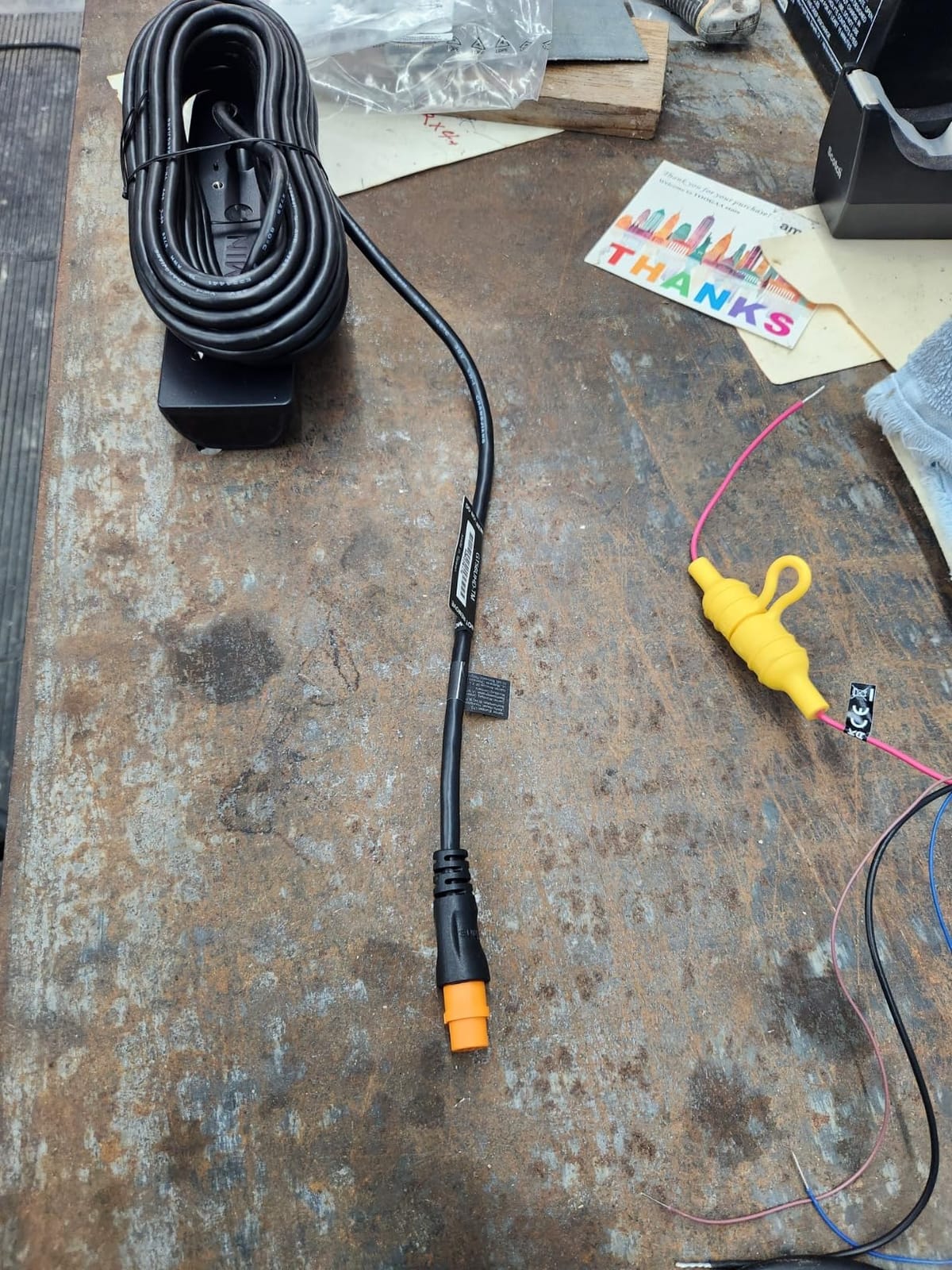
This is the single most common complaint in the reviews and the one to check before ordering. This GT20-TM version uses an 8-pin connector, so a 4-pin Garmin display needs an adapter cable, and the listing does not always make the variant clear at the point of purchase.
Also worth knowing: it does not fit every newer Garmin display, with the ECHOMAP UHD2 series specifically called out. Count the pins, read the model number, and only then decide whether you need a cable in the box.
Who Should Buy This Transducer
Buy it if you run a compatible 8-pin Garmin display, you want a down view without stepping up to a scanning package, and you still need a traditional channel for deep structure and arches. It is the sensible middle step. Skip it if your display is 4-pin and you would rather not add a cable, or if you want side imaging, which this unit cannot deliver at all.
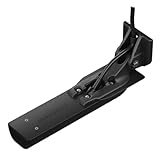
8. Garmin GT56UHD-TM – Ultra HD SideVu and ClearVu Scanning at Three Frequencies
Garmin GT56UHD-TM Transom Mount Transducer
Ultra HD SideVu and ClearVu scanning
455, 800 and 1000 kHz
High wide CHIRP to 800 ft
12-pin connector with two-year warranty
Pros
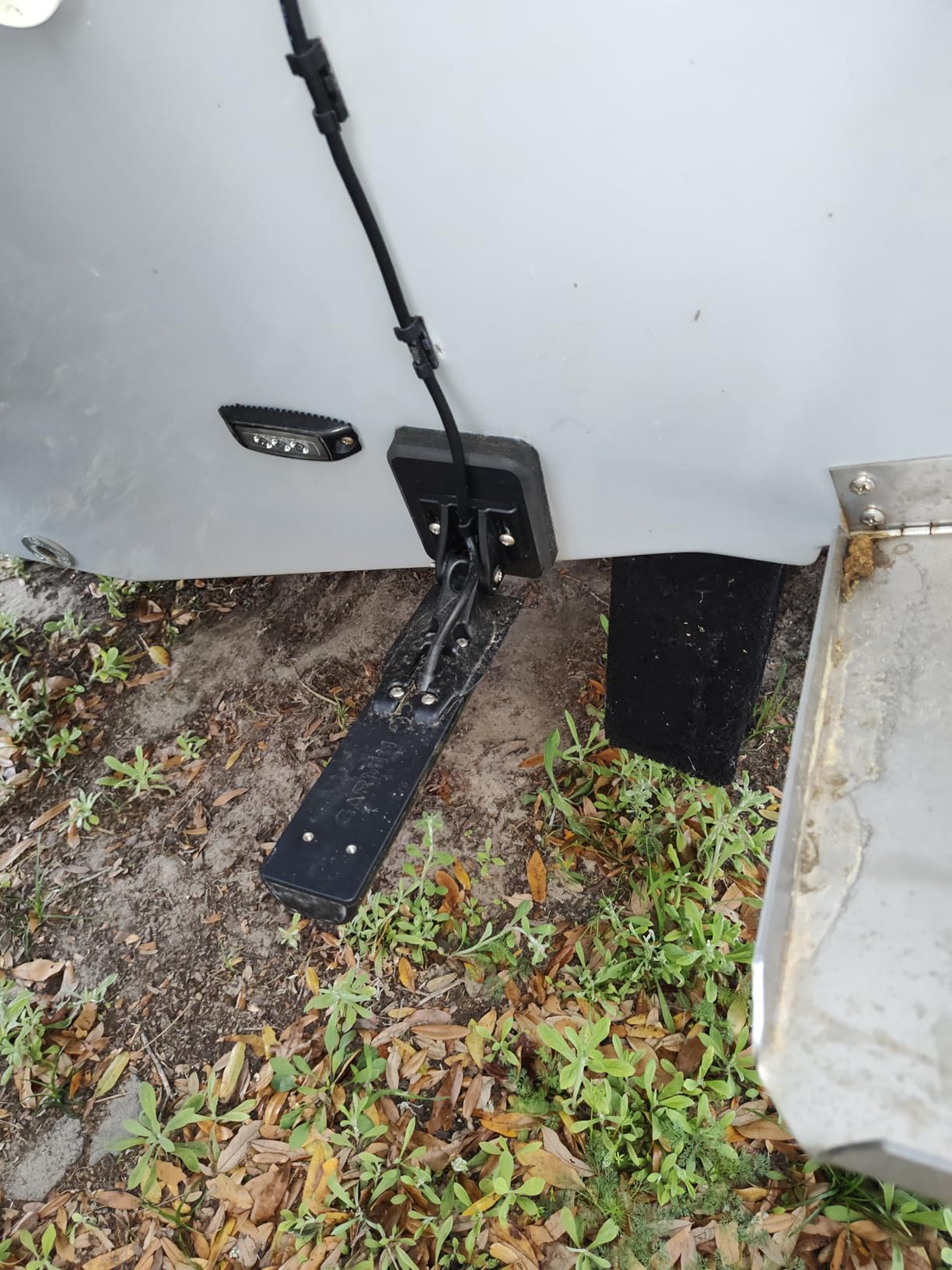
- Ultra HD SideVu gives the most detailed side-to-side imagery in this roundup
- Three scanning frequencies plus high wide CHIRP cover shallow and deep water
- Vivid color palettes make targets and structure easy to distinguish
- Plugs directly into Garmin 72sv
- 93sv and 122sv style displays with no adapter
- Two-year limited warranty
Cons
- Costs more than every other unit in this roundup
- Can lose bottom lock at around 35 km/h unless angled down slightly
- Susceptible to interference from non-brushless trolling motors
- Not a simple first install because cable routing needs planning
This is the top of the list on image quality and the bottom of the list on everything else, which is exactly the trade you should expect. Three scanning frequencies, 500 W of power, and a two-year warranty make it the most fully equipped unit here, and the practical caveats around speed and trolling motor interference are worth reading before you commit.
On our bay boat over a 40 ft drop, the difference in detail was obvious within minutes. Individual fish held as distinct shapes well off the bottom, weed edges separated into individual stalks, and the structure at range stayed coherent where other units had already turned to a solid band. The Vivid color palettes matter more than they sound, because you can assign colors to different structure types and read them at a glance instead of interpreting grayscale.
Ultra HD SideVu and ClearVu Scanning
Ultra HD SideVu is the headline feature and the reason this unit exists. The manufacturer claims 20 percent greater range at 1000 kHz compared with the standard band, and the 455 kHz SideVu channel views up to 500 ft on each side of the boat.
That range figure is for a side scanning channel on a display configured for it, and it is sensitive to water clarity. In stained water the effective range collapses; in clear coastal water the picture held together remarkably well at trolling speed once the unit was trimmed correctly.
455, 800 and 1000 kHz With 500 W of Power
Three scanning frequencies let you match the picture to the water. The lower band reaches further and holds together in dirty water, the higher bands resolve fine detail in clear conditions, and the high wide CHIRP traditional channel keeps clear target separation out to 800 ft for the arches underneath everything else.
Having all four channels from one cable is the real convenience. On a boat with limited cable runs, one transducer feeding a 12-pin socket is much easier to plan than three separate units and a splitter.
Speed Sensitivity and Trolling Motor Interference
Two practical issues show up repeatedly in owner feedback. The first is bottom lock at speed, which owners report losing at around 35 km/h unless the transducer face is angled down slightly. The second is interference from non-brushless trolling motors, which can put noise into the high frequency channels.
Neither is a defect, and both are manageable: trim the face down a few degrees, and if you troll a lot, check whether your motor is brushless before blaming the transducer. This unit also uses a 12-pin connector, which means it plugs into the appropriate Garmin displays directly but will not drop into older 4-pin or 8-pin hardware.
Who Should Buy This Transducer
Buy it if you run a current 12-pin Garmin display, you want the best available image from a single cable, and you accept a more involved install and a higher outlay than the rest. It is the right call for an offshore or large saltwater boat where structure detail is the whole game. Skip it for a small bay, for high-speed running in rough water, or if you need the money for a new display instead.
9. Lowrance TripleShot Skimmer – High CHIRP, SideScan and DownScan in One Housing
Lowrance TripleShot Skimmer Transducer for Hook Reveal and HOOK2 Fish Finders, BLACK
High CHIRP plus SideScan and DownScan
455 and 800 kHz imaging
300 ft maximum depth
Wide-angle CHIRP cone
Pros
- Only unit here combining High CHIRP
- SideScan and DownScan imaging in one transducer
- Wide-angle CHIRP roughly doubles the coverage of a traditional unit
- 455 and 800 kHz give lifelike views of structure beside and under the boat
- Built-in temperature sensor with a rugged plastic transom housing
Cons
- Lowest average rating in this roundup with 9 percent one-star reviews
- Only compatible with Lowrance HOOK2 TripleShot displays
- 300 ft maximum depth is shallower than most competitors
- Expect to need an adapter on displays that are not TripleShot models
The TripleShot packs more channels into one housing than any other unit here, and it carries the lowest rating at 4.4 from 602 reviews. That gap is informative rather than damning: the complaints concentrate on the 300 ft depth ceiling and on compatibility, both of which are consequences of a design built for a specific display generation rather than faults in the sonar.
What you get for the trade is genuinely full featured. High CHIRP for arches, SideScan for structure beside the boat, and DownScan for the picture underneath, all from one housing on one 20 foot cable. Nothing else in this roundup does all three.
On the lake we alternated constantly between the two imaging channels, which is the point of a 3-in-1 unit. DownScan told us what was under the hull, SideScan told us what was a few boat lengths to the side, and High CHIRP gave the arches between them. The wide-angle CHIRP cone roughly doubles traditional coverage, so the 2D channel is useful rather than an afterthought.
High CHIRP, SideScan and DownScan in One Transducer
The SideScan and DownScan channels run at 455 and 800 kHz, giving you the option to trade range for detail inside the same unit. In clear water the 800 kHz picture separated individual fish shapes; in stained water the 455 kHz band was the one we ran, because it held together further out.
That flexibility is what separates this from the SplitShot, which has no side imaging. If you are fishing weed edges, drop-offs or timber in a river or lake, the extra channel earns its place quickly.
The 300 ft Depth Ceiling and Where It Bites
300 ft is the shallowest maximum depth in this roundup and the most legitimate reason to pass. Anglers chasing lake trout in 400 ft plus water will lose the bottom with this unit, and forum threads repeatedly flag exactly that mismatch when someone pairs this transducer with deep water.
For the vast majority of freshwater and nearshore work, 300 ft is not a limit you will reach. Treat it as a firm boundary if you fish deep water, and check it against your deepest regular spot before you order.
Matching HOOK2 TripleShot Displays
Compatibility is stated for the HOOK2 TripleShot 5, 7, 9 and 12 inch displays. Other HOOK2 models do not take a full three-channel feed from this unit, and owners report needing an adapter cable on displays that are not TripleShot models.
As with the other Lowrance units here, the model number on the back of your display is the deciding fact. A 3-in-1 transducer on a display expecting 2D will give you channels you cannot see, which looks like a fault and is not one.
Who Should Buy This Transducer
Buy it if you run a HOOK2 TripleShot display, you fish water under 300 ft, and you want side and down imaging from one cable without adding a second transducer and a splitter. Skip it for deep water, for earlier Lowrance generations, or if your budget favours a 2D unit with a deeper reach.
How to Choose a Fish Finder Transducer Without Wasting a Return
Returns on opened marine electronics are a genuine pain, and forum threads make that clear enough that it is worth spending five minutes on the process. The steps below are the order that avoids problems, not a list of nice-to-haves.
Step 1: Confirm the Head Unit Model Number Before Anything Else
Read the model number off the back of your display and match it to a specific part number before you look at any other specification. Count the connector pins on the existing cable as a cross-check. If the two do not agree, stop there, because nothing else you read will change the outcome.
Compatibility is generational, not just brand level. A HELIX G4 requirement is not a HELIX G2 requirement, an HOOK2 requirement is not an HOOK requirement, and the Garmin line has moved through 4-pin, 8-pin and 12-pin standards. Cross-brand adapters exist, and forum consensus is that they add cost and cost you signal. Lowrance and Simrad are the one genuine cross-brand exception because Navico builds both, and even there the model generation still matters.
Step 2: Pick the Mount Type Against Your Hull
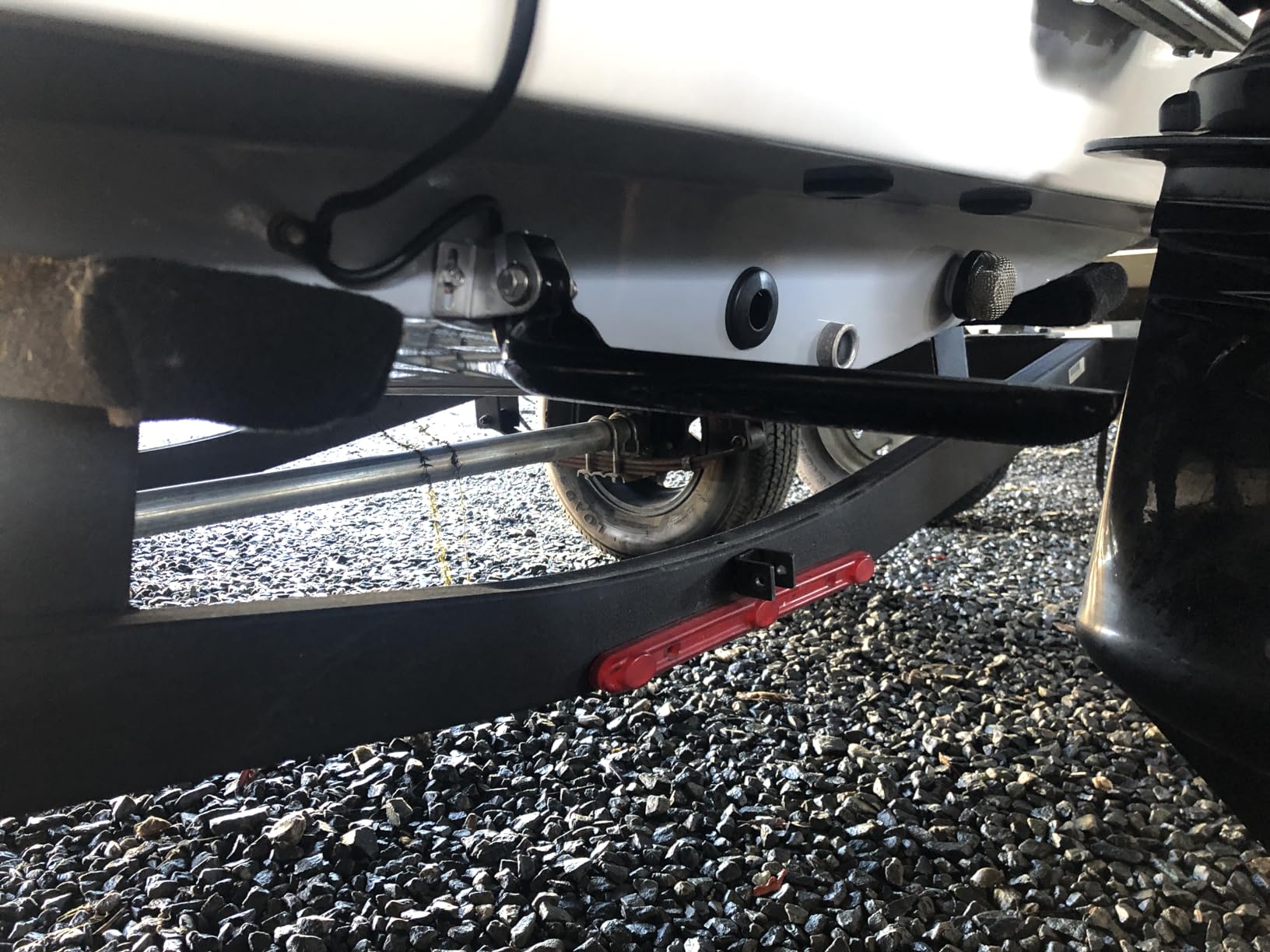
Transom mount suits most boats, moves between hulls, and is the form nearly every transducer in this roundup ships in. The failure mode is turbulence: at trolling speed on a monohull under about 30 ft, bubbles and wake form behind the transom and between the crystal and the bottom, and the picture degrades before it disappears.
Through-hull wins at speed because the face sits in clean water, but it needs a drilled hole, a fairing block matched to your deadrise angle, and confidence that you will not want to change it later. In-hull is tamper-proof and clean but costs you signal through fiberglass or aluminium, so treat it as a depth gauge rather than a fish finder. Portable and ice units keep the profile low and work where a bracket will not fit.
One hull note that catches people out: strakes, keel lines and catamaran sponsons all disturb flow in ways a flat lake never reveals. A transom unit on a boat with a pronounced keel can read worse than the same unit on a pontoon.
Step 3: Match Frequency Bands to Your Depth
Frequency is the trade between detail and reach, and the numbers are worth memorising because the ranges are narrow.
50 kHz is the deepest conventional band, used for offshore and deep structure, with the narrowest cone and the least bottom detail. 77 and 83 kHz cover the middle of the range, reaching a few hundred feet with a usable picture and forming the backbone of most dual-frequency skimmers. 200 kHz is the shallow detail band, excellent in water under about 60 ft and weak below that. 455 kHz is the imaging workhorse for down and side views. 800 and 1000 kHz give the finest imaging detail in the clearest water and the shortest range.
Depth rating also depends on crystal size, not only frequency. Doubling the crystal diameter roughly quadruples the output power, which is why two units with identical frequency lists can differ so much in how deep they actually read.
Step 4: Traditional, CHIRP or Imaging – and What Each Costs You
Traditional sonar pings a single frequency. CHIRP sweeps a band of frequencies continuously, and the practical gain is target separation, because different returns arrive at different frequencies and the display can hold two fish apart instead of merging them. Imaging sonar builds a picture rather than arches, using high frequency beams and a narrow cone pointed down or to the side.
CHIRP is worth the step up on almost any freshwater unit. Imaging is worth it when you are hunting structure rather than counting fish, and it costs you depth range. Ultra HD scanning adds a further frequency on top and is the best image available here, with the shortest reach of all.
Read the display’s channel list before buying the transducer, not after. A side imaging head unit fed by a 2D skimmer will draw a blank channel, and many owners discover this only after the install.
Step 5: Cone Angle, Target Separation and Cable Length
Cone angle is how wide a slice of water each ping covers. A 20 degree cone gives more target separation and a longer reach but covers less ground, so you must be more precise over structure. A 60 degree cone covers a wide swath and is the better choice at speed and in shallow water, at the cost of clutter when fish are close together.
Target separation is the ability to distinguish two fish sitting near each other, and it is the single spec that most separates a good unit from an average one. Wider bands of CHIRP and larger crystals both improve it.
Finally, cable length. Six of the units here are specified with a 20 foot cable, which is generous for a small boat and tight for a large console with a hardtop, where the run to a through-hull or trolling motor position can easily exceed it. Measure the actual routing distance before you commit, and remember that every extra foot is another foot that can chafe against a hull edge.
Troubleshooting: How to Tell If Your Fish Finder Transducer Is Bad
This is the question forum threads absorb more than any other, and it is the one thing neither of the roundups we studied covers. The diagnosis is usually faster than people expect, because a working transducer produces a very specific set of symptoms and a failed one produces very few.
Symptom to Cause: What You See and What It Means
No reading at all, and the display shows a transducer not connected error points to the cable, the connector or a failed element. Check the connector first: unplug it, look for a bent or corroded pin, and look for water inside the strain relief. Salt water that gets into the cable jacket causes exactly this and rarely recovers.
A depth reading that is consistently offset by the same amount is rarely a fault. A transducer mounted high on the transom reads the hull bottom rather than the bottom, and the offset equals the transducer’s height above the waterline. Move it lower and the error disappears. If you have recently added a transducer saver or raised the bracket, this is the likely cause.
Clean readings at rest but dropouts at speed is turbulence or cavitation, not a broken unit. Angle the face down, check that the bracket is tight, and look for a strake or spray rail throwing bubbles at the face. Adding a fairing block matched to your hull’s deadrise angle is the standard fix for boats that run fast in a chop.
Blur arches and a noisy image in clear water usually means the wrong frequency for the depth, or a 200 kHz unit being asked to work below 60 ft. Switch to a lower band or move to a CHIRP unit.
One imaging channel blank while others work is a compatibility symptom rather than a failure. The transducer is not sending the channel your display expects, and the display simply does not draw it.
One forum diagnostic worth knowing: a firmware update combined with a hard reset can silently reset the head unit’s transducer selection to a default. If a working setup broke after an update, reselect your transducer in the menu before ordering anything.
Three Steps to Test a Transducer Out of the Water
1. Connect the transducer to the head unit with the boat out of the water or with the unit powered from a battery, and power on. A transducer with a healthy element will produce a depth reading of zero or an error state, and the connector will show as connected.
2. Put the face of the transducer in a bucket or a tub of fresh water, keeping the electronics and the connector well clear. The display should read a plausible depth matching the water in the container, and the arches from any air bubbles will confirm the element is transmitting and receiving.
3. Lift the transducer out while powered. The reading should go to zero or an error within a second or two. A unit that keeps reporting a depth when the face is in the air is reporting a stale value, which points to the head unit rather than the transducer.
This three-step test tells you whether the element is alive. It does not tell you about mounting, and it will not reveal a cable fault that only opens up when the cable flexes under load, which is why wiggling the cable gently at the connector during the test is worth doing.
Repair or Replace, and Why Adapters Are a Dead End
If the test above shows a dead element, the realistic options are a replacement transducer or manufacturer repair. Forum discussion on repairability is mixed, and in practice a replacement costs less than a diagnostic visit once shipping and time are counted, unless you are trying to preserve a part that is no longer made for a boat that is otherwise original.
On cross-brand adapters, the advice from people who have actually run them is consistent: an adapter cable will physically connect a transducer to a head unit it was not designed for, and the result is usually a degraded or absent channel, plus a permanently occupied connector. The Garmin adapter cable part numbers are widely quoted in forums, but the recurring verdict is that they exist for legacy machines and are rarely worth it on a working installation.
On two transducers and one head unit: a splitter lets two displays read a single transducer, which is a common way to run a second screen at the helm or on the console, and it works because the head unit is transmitting the ping. Two transducers on one boat do not interfere in any meaningful way, provided they are mounted far enough apart that they are not painting the same patch of water, and provided both cables are routed away from heavy electrical noise. Running one transducer into two displays through a splitter adds no sonar capability, it only shares the picture.
Frequently Asked Questions
Are transducers interchangeable between fish finder brands?
No. Garmin, Humminbird and Lowrance use different connectors and different pin counts, and within a single brand the generations differ too. The one genuine cross-brand case is Lowrance and Simrad, because Navico builds both, and even there the model generation still matters. Cross-brand adapter cables exist but add cost and degrade the signal.
What are the four types of fish finder transducers?
The four types are transom mount, through-hull, in-hull, and portable or ice. A transom mount clamps to the transom and is the most common and most portable. A through-hull passes below the waterline for the cleanest reading at speed. An in-hull puck sits inside the hull and loses signal through the hull. Portable and ice units keep a very low profile for hardwater and small craft.
Is CHIRP better than traditional sonar?
Yes, for target separation. Traditional sonar pings a single frequency, while CHIRP sweeps a band continuously, so two fish close together return echoes at different frequencies and the display can show two arches instead of one merged return. The trade is that CHIRP is tuned for separation rather than raw depth reach, so very deep fishing still favours a low frequency channel.
How do I tell if my fish finder transducer is bad?
A dead transducer usually shows a transducer not connected error, or a depth reading that never changes. Put the face in a bucket of fresh water with the connector kept dry and the display should read the container depth. Lift it out and the reading should drop to zero. A consistent depth offset, by contrast, is almost always a mounting height issue rather than a fault.
Can you test a transducer out of the water?
Yes, with three steps. Power the head unit from a battery with the transducer connected and check that it is detected. Put the transducer face in a bucket of fresh water with the connector and cable kept dry, and confirm the display reads a sensible depth. Then lift it out of the water and check that the reading goes to zero or an error state.
Can I hook up two fish finders to one transducer?
A splitter cable can send one transducer to two head units, and both displays will show the same picture. It does not add sonar capability, and it takes the connector permanently. Two separate transducers on one boat do not interfere as long as they are mounted far enough apart not to paint the same patch of water and their cables are routed away from heavy electrical noise.
Which brand of fish finder is considered the best?
There is no single best brand, because the ecosystem matters more than the badge. Garmin covers the widest range of imaging hardware, Humminbird is strong on side imaging and traditional 2D, and Lowrance covers CHIRP and 3-in-1 imaging competitively. The right answer is whichever brand your existing display belongs to, because that is the one where compatibility is guaranteed and adapters are not needed.
Final Verdict on the Best Transducers for Fish Finders in 2026
Start with your display, not the transducer. Whatever head unit is already in the boat, the best transducers for fish finders for that boat are the ones that plug into it without an adapter, because every other decision is secondary to fitment. Check the model number on the back of the display and count the pins before you order anything.
On a current-generation HELIX, the Humminbird XNT 9 20 T is the dependable 2D choice and the Humminbird XNT-9-HW-T is the upgrade for target separation. On a HELIX side imaging display that is not on the MSI exclusion list, the Humminbird XHS 9 HDSI 180 T is the one to buy. On a HOOK2 5, 7, 9 or 12 inch, the Lowrance SplitShot Skimmer gives you CHIRP plus DownScan from a single cable, and a HOOK2 TripleShot gets the Lowrance TripleShot Skimmer if your water is under 300 ft. On a 8-pin Garmin, the GT20-TM adds ClearVu down imaging; on a 12-pin Garmin, the GT56UHD-TM is the best image available from a single cable. The Garmin 6-pin unit exists for older Fishfinder and GPSMAP hardware and nothing else.
Whatever you order, power the head unit up before you route the cable permanently, run the bucket test, and check the reading again at trolling speed before you call the install finished. Ten minutes there saves a return you cannot avoid cheaply.