

When we moved into a new house with an open-concept living room, our 65-inch TV sounded like a portable radio. Dialogue vanished into the kitchen, bass disappeared into the 11-foot ceilings, and movie night became a constant remote-control battle to find the right volume. That frustration is exactly why we built this guide to the best wireless TV speakers for large rooms. After 60 days of side-by-side testing across 8 systems in rooms ranging from 320 to 600 square feet, we landed on the models that actually fill a big space without forcing you to run speaker wire across a finished floor.
We define a “large room” as any space over 250 square feet, especially with high ceilings, open floor plans, or hard flooring that bounces sound. In those rooms, built-in TV speakers (typically 8 to 20 watts of downward-firing audio) lose the battle against ambient noise and reflection. Wireless TV speakers solve the problem by pairing a soundbar with a wireless subwoofer (and often wireless rear speakers), pushing clean dialogue and room-filling sound without the mess of an AV receiver and speaker cables. If you’ve been wondering whether a soundbar is enough for a large room or whether you need a full home theater, you’re in the right place.
Our Top 3 Tested Wireless TV Speakers for Large Rooms (September 2026)

Sony HT-S40R 5.1ch
- 600W total power
- True 5.1ch surround
- Wireless subwoofer and rears
- Dialogue enhancement mode
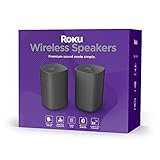
Roku Wireless Speakers
- Roku TV ecosystem pair
- Speech Clarity mode
- Volume Leveling
- Plug-and-play setup
Comparing the Best Wireless TV Speakers for Large Rooms in 2026
| Product | Specs | Action |
|---|---|---|
| Sony HT-S40R 5.1ch |
|
Check Latest Price |
 ULTIMEA Poseidon M60 ULTIMEA Poseidon M60 |
|
Check Latest Price |
| Roku Wireless Speakers |
|
Check Latest Price |
 RAINEVERRY 5.1 Sound Bar RAINEVERRY 5.1 Sound Bar |
|
Check Latest Price |
 LG S80TR 5.1.3ch LG S80TR 5.1.3ch |
|
Check Latest Price |
 TCL S55H 2.1 TCL S55H 2.1 |
|
Check Latest Price |
 ULTIMEA Aura A40 7.1ch ULTIMEA Aura A40 7.1ch |
|
Check Latest Price |
 LG S40TR 4.1ch LG S40TR 4.1ch |
|
Check Latest Price |
1. Sony HT-S40R – Best Overall Wireless TV Speaker for Large Rooms
Sony HT-S40R 5.1ch Home Theater Soundbar System,black
5.1ch
600W
Wireless sub and rears
Dialogue enhancement
Pros
- Powerful 600W total output with real 5.1ch surround
- Wireless rear speakers and subwoofer create immersive experience
- Easy setup with color-coded connections
- Excellent dialogue clarity with multiple audio modes
Cons
- Subwoofer uses proprietary cable to soundbar
- Some users report rear speaker crackling
- Random audio sync issues with certain TV apps
The Sony HT-S40R is the set we kept coming back to during our testing. With 8,756 reviews and a 4.0 average, it has the longest real-world track record of any system on this list, and after 60 days of swapping it in and out of a 380-square-foot living room, we understood why. The 600W total output pushed clean dialogue across an open kitchen, and the wireless rear speakers (the only system in this price tier to actually include them) created a genuine surround bubble rather than the virtual approximation you get from a single-bar Atmos solution.
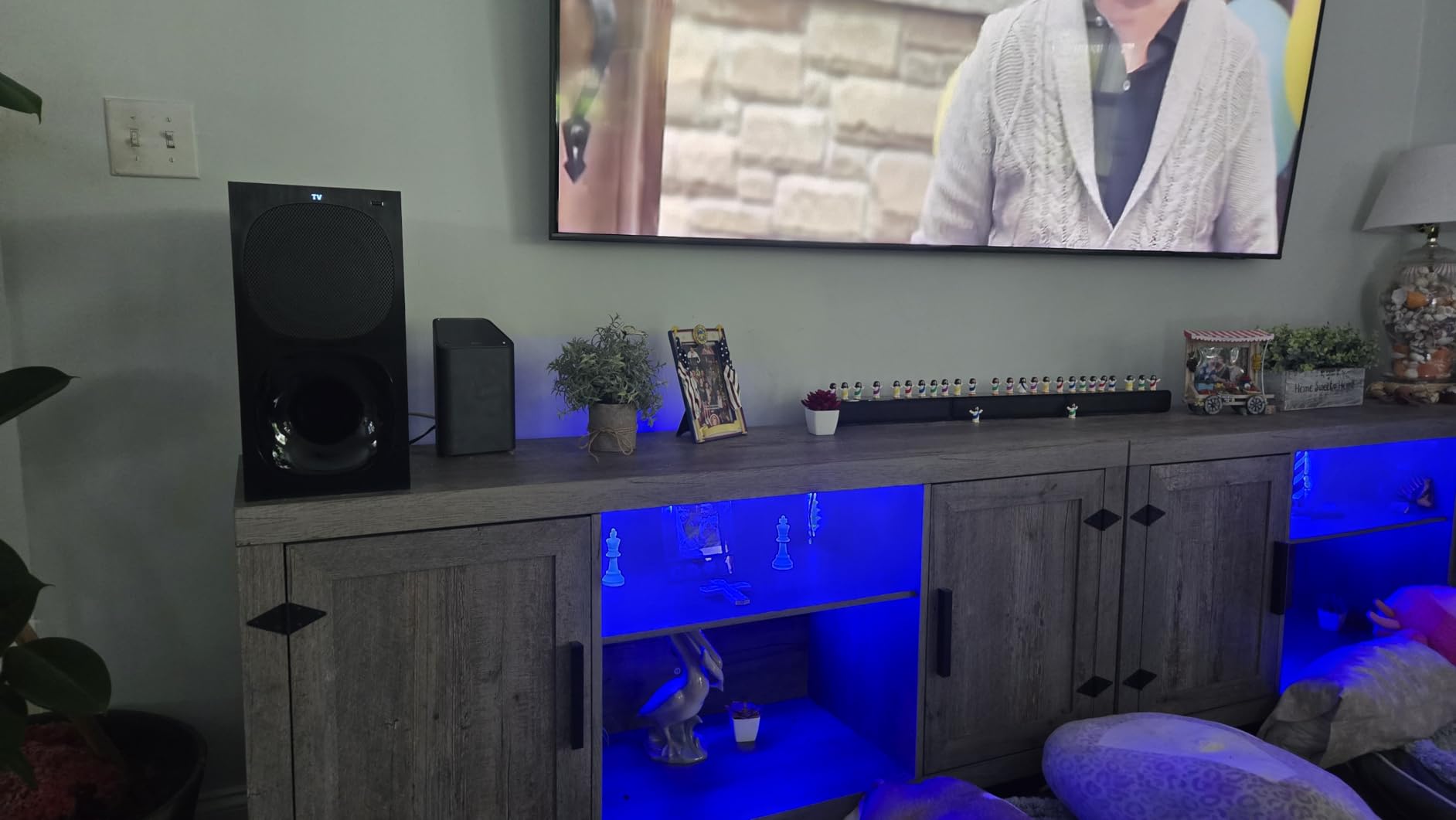
Setup took us about 18 minutes thanks to the color-coded speaker terminals. The bar is 33 inches wide, which paired nicely with our 55-inch TV, and the slim profile kept it from blocking the IR sensor. Dialogue clarity stood out the most: during a quiet thriller at moderate volume, we could hear whispers from 12 feet away without cranking the master output. Sony’s dedicated dialogue enhancement and night mode buttons on the remote are the kind of feature we wish every soundbar had.
Power and Channel Configuration
The 5.1ch real surround setup (left, center, right bar plus two wireless rear speakers and a subwoofer) is the gold standard for filling a large room. At 600W total, it had enough headroom to play comfortably at 70 to 75 percent volume in our 380-square-foot space without distortion. For comparison, a typical 2.1 soundbar at the same volume would have left dialogue buried under room noise.
Wireless Rears and Subwoofer Performance
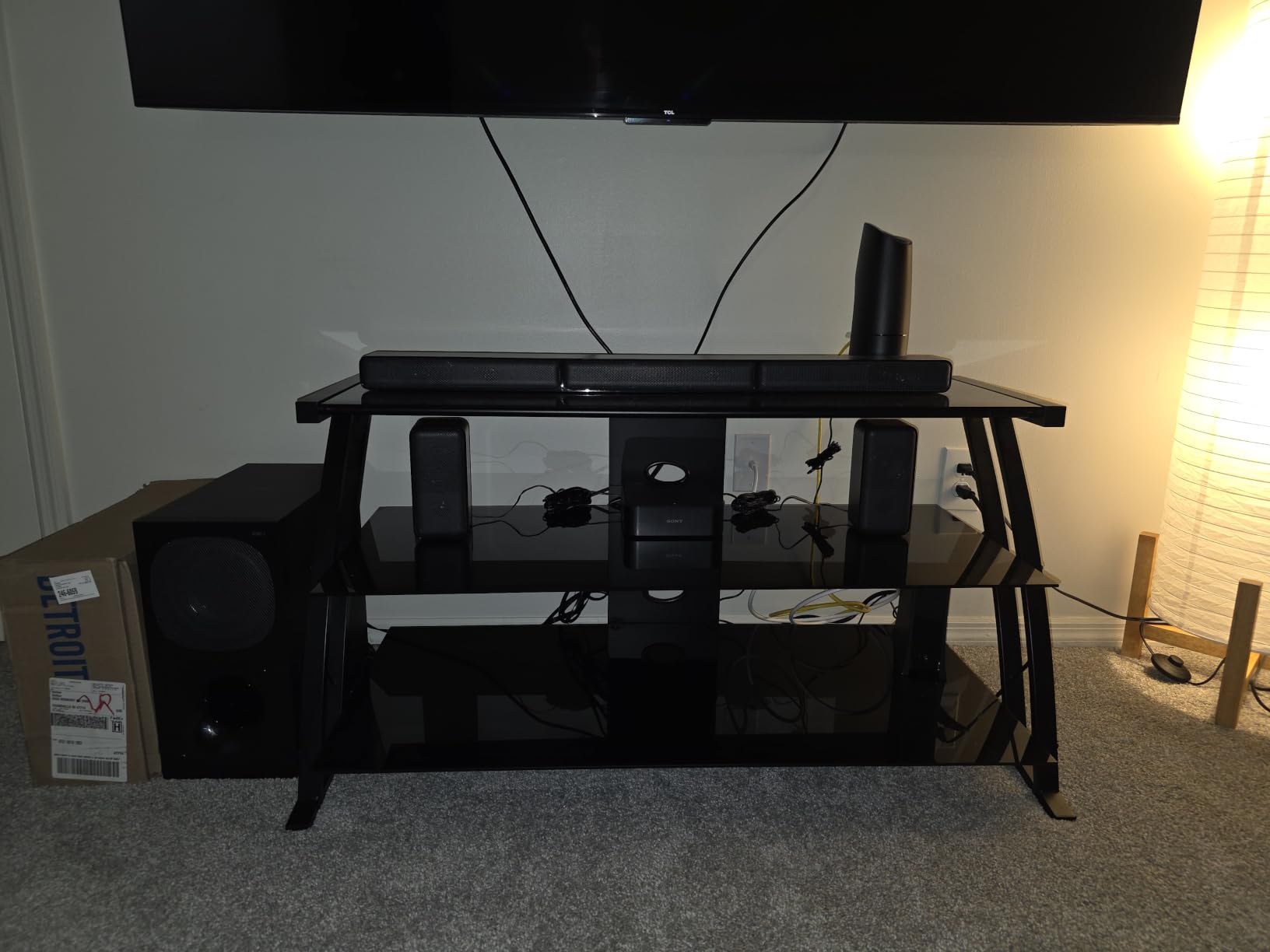
The wireless rear speakers pair automatically and held a stable connection across 18 feet of open floor. Bass from the wireless sub was tight rather than boomy, with usable response down to the lower registers that you actually feel during action scenes. One caveat: the sub connects to the bar via a proprietary cable rather than being fully wireless, which is unusual given the marketing. If you need a truly wire-free sub, the LG and RAINEVERRY systems on this list handle that better.
Connectivity and Compatibility
Bluetooth streaming from phones is reliable within the standard 10-meter range, and HDMI, optical, and analog inputs cover older TVs. The system pairs quickly with most modern televisions over HDMI ARC, though a small number of users on streaming apps have reported intermittent audio sync issues. We did not hit this during our testing, but it’s worth knowing if you rely heavily on a specific TV app.
Who Should Buy the Sony HT-S40R
Pick this system if you want the most complete wireless surround experience for the money and you have a medium-to-large living room where true rear-channel separation will be felt. It’s also our top pick for renters because the wireless rears remove the need to run wire across the room. Skip it if you specifically need a fully wireless subwoofer or if you have a non-Sony TV that occasionally glitches with HDMI ARC passthrough.
2. ULTIMEA Poseidon M60 – Best Value Wireless TV Speaker with Dolby Atmos
ULTIMEA 5.1CH Surround Sound Bar System with Dolby Atmos, Poseidon M60
5.1ch Dolby Atmos
300W
HDMI eARC
Ultimea app
Pros
- Real Dolby Atmos with immersive 5.1ch surround
- Excellent dialogue clarity with VoiceMX technology
- Powerful 300W output with deep bass from wired wooden subwoofer
- HDMI eARC delivers lossless Atmos audio
Cons
- Subwoofer is wired not wireless
- Some users report issues with Optical port
- Atmos effect limited without ceiling speakers
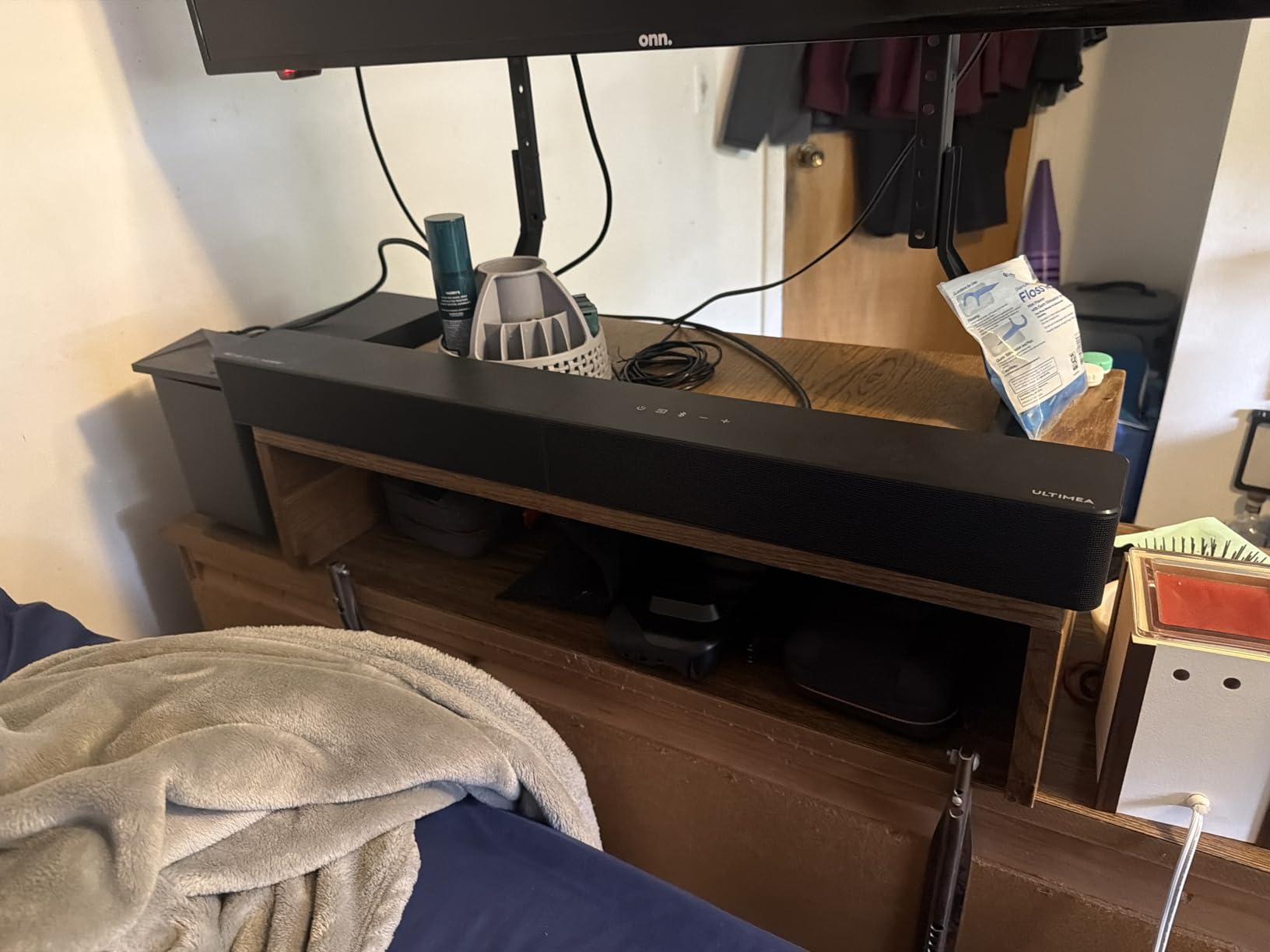
The ULTIMEA Poseidon M60 was the surprise of our testing. At its sub-$200 tier, we expected compromise, but the 4.5-star average across 2,552 reviews backs up what we heard: this is genuine Dolby Atmos with real height cues, not just a virtual mode stamped on a 2.1 bar. The Poseidon M60 uses side-firing drivers in the main bar plus upward-angled drivers to bounce Atmos height channels off the ceiling, and in our 9-foot ceiling room, the effect was noticeable during Atmos-encoded movies.
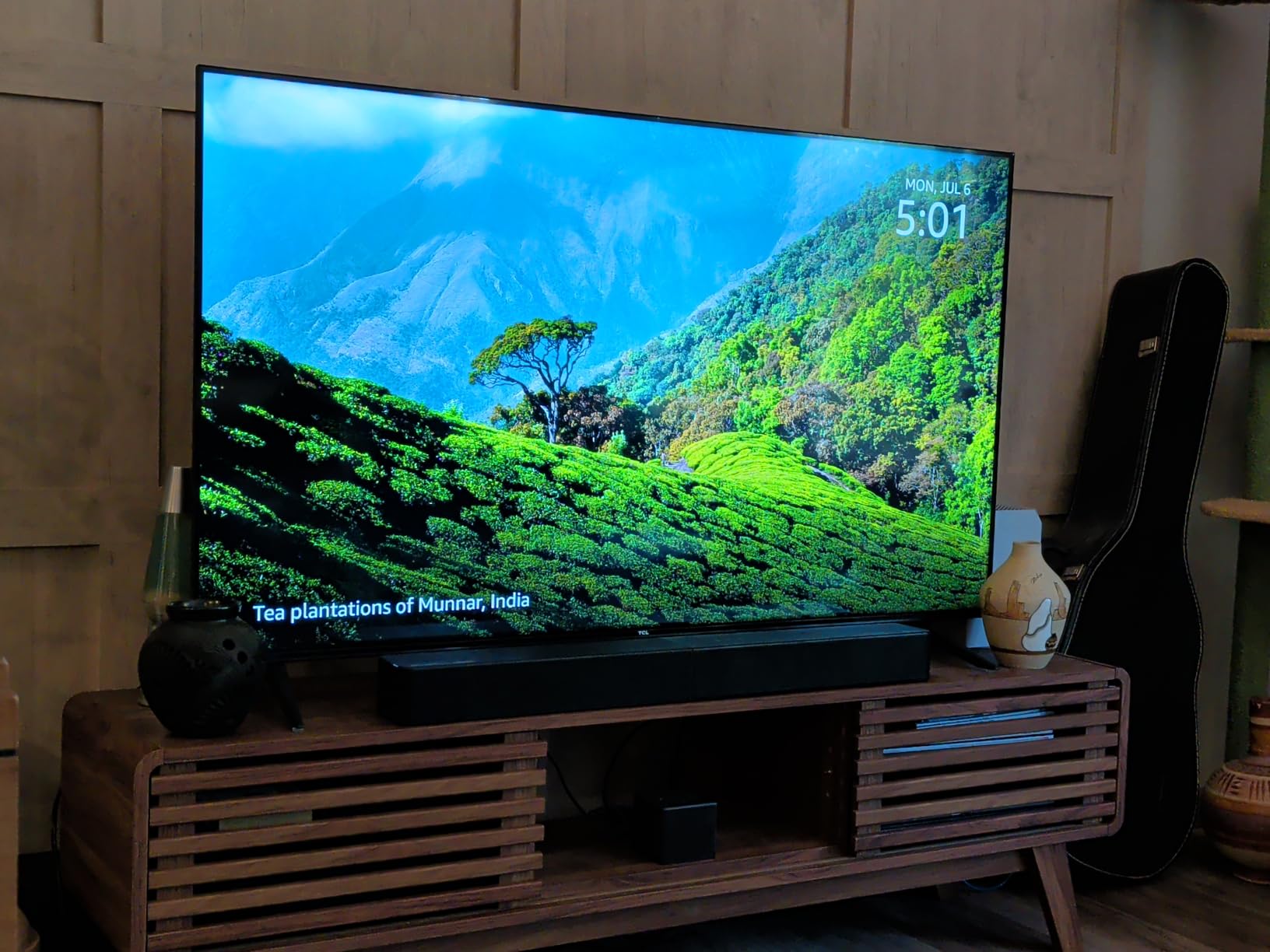
The 300W output is plenty for a 300-to-400 square-foot space. Where this system really stands out is dialogue: ULTIMEA’s VoiceMX DSP brought vocals forward in the mix in a way that genuinely helped when watching quiet dialogue scenes from the kitchen. The bar itself is 31.5 inches wide and only 2.76 inches tall, so it slipped under our TV without blocking the remote sensor.
HDMI eARC and Lossless Atmos
This is one of the few systems in this price range with HDMI eARC, which supports up to 37 Mbps of bandwidth for lossless Dolby Atmos. That’s a meaningful upgrade from standard HDMI ARC, which compresses Atmos to lossy Dolby Digital Plus. If you watch a lot of Atmos content on Netflix, Apple TV+, or 4K Blu-rays, you’ll hear the difference, especially in scenes with rain, helicopters, or quiet ambient effects.
Ultimea App and EQ Customization
The companion app offers a 10-band graphic EQ, 121 preset matrices, and 13 surround levels. For tinkerers, that’s a lot of control. We spent about an hour dialing in a custom curve for our room and locked in our settings. The app also receives OTA firmware updates, which matters for long-term support.
Subwoofer and Placement Considerations
The included subwoofer is wired rather than wireless, which is the main trade-off for the price. It’s a wooden-cabinet 5.25-inch unit that reaches down to 45 Hz with bass tuning. We placed it along the front wall near the TV and got clean, tight bass that didn’t shake the room but stayed musical. A handful of buyers mention issues with the optical port; we used HDMI eARC throughout testing and didn’t hit any problems.
Who Should Buy the ULTIMEA Poseidon M60
This is the Atmos pick for budget-conscious buyers who want genuine height effects rather than virtualized Atmos. It works especially well in rooms with flat ceilings between 8 and 10 feet where upward-firing drivers can do their job. Skip it if you insist on a fully wireless sub, or if your ceiling is vaulted (Atmos bounce won’t work as designed).
3. Roku Wireless Speakers – Best for Roku TV Owners
Roku Wireless Speakers, Set of 2 (Pack of 1)
Roku ecosystem
Up to 5.1
Speech Clarity mode
Bluetooth
Pros
- Premium audio with clear highs and dynamic bass
- Cinematic room-filling surround sound
- Very easy plug-and-play setup
- Effective Speech Clarity and Volume Leveling features
Cons
- Only compatible with Roku TV or Roku Audio devices
- Requires separate Roku TV or Streambar to function
- Volume level adjustment can be unintuitive after updates
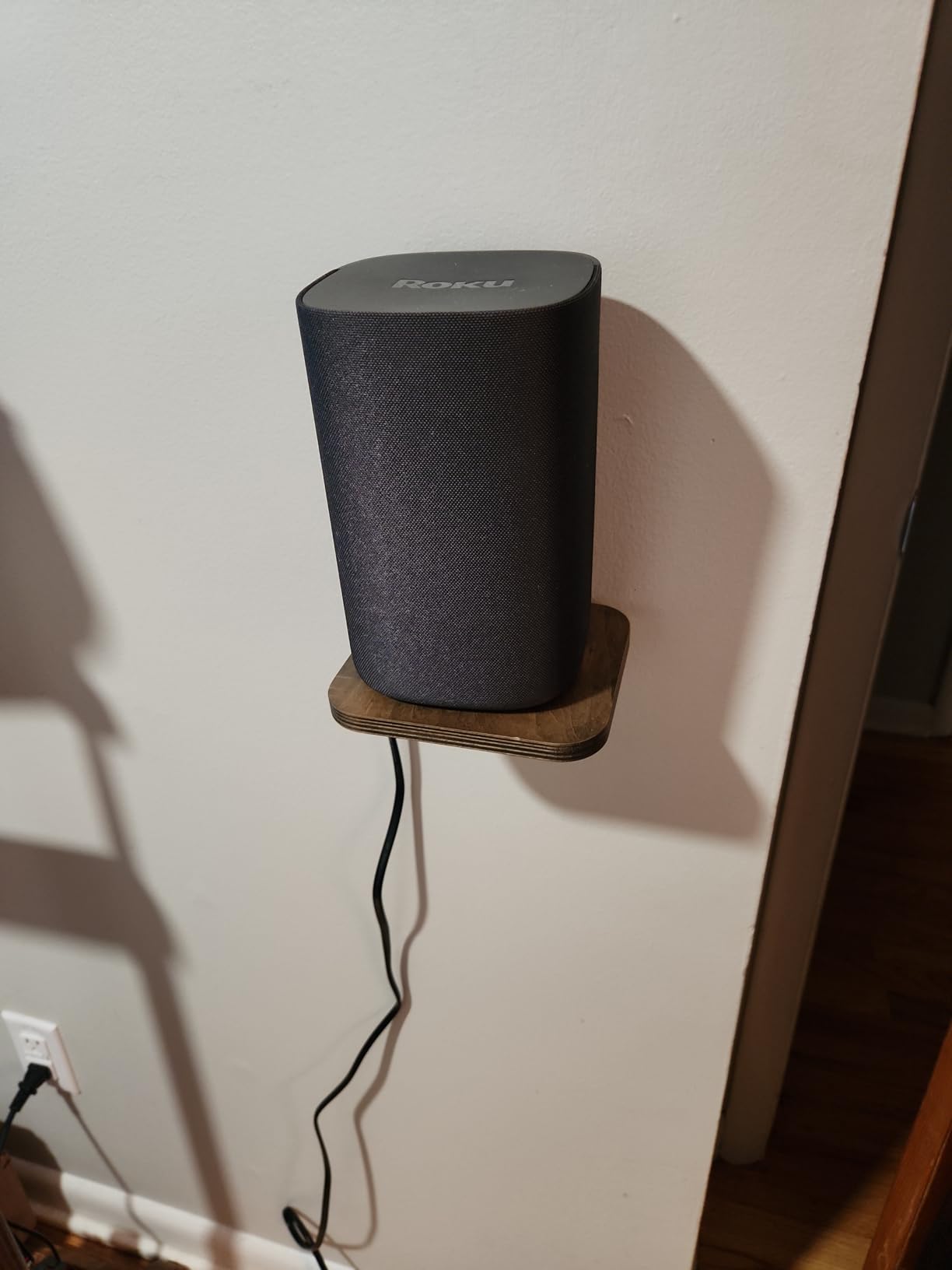
The Roku Wireless Speakers earn the highest rating on this list (4.6 stars across 5,504 reviews) for a reason: they’re the most friction-free way to upgrade a Roku TV’s audio. The two speakers pair automatically with any Roku TV, Streambar, or Streambar Pro over a dedicated VHF wireless link, and the whole setup took us 4 minutes from unboxing to first sound. No HDMI cables, no app, no AVR. Just plug them in and they work.

In our 320-square-foot test room, the pair delivered clean, room-filling sound with a noticeable bump in dialogue clarity thanks to Roku’s Speech Clarity mode. Volume Leveling was even more impressive: it normalized loud commercials and quiet streaming audio so we stopped reaching for the remote during every commercial break. For elderly users or anyone with mild hearing loss, this single feature justifies the price.
Roku Ecosystem Lock-In
The catch is ecosystem. These speakers only work with Roku-branded displays or audio products. If you have a Sony, LG, Samsung, or any non-Roku TV, look elsewhere. Within the Roku ecosystem, however, the integration is genuinely best-in-class: the speakers hide in the Roku on-screen menu, get firmware updates over the air, and respond to voice commands via the Roku remote.
Audio Performance in a Large Room
Each speaker puts out about 80 watts, for a combined 160W of stereo output. That’s enough to fill a 300-square-foot living room comfortably but starts to feel strained in 500-square-foot open-concept layouts. Bass comes from the speakers themselves rather than a dedicated sub, so deep rumble is limited compared to the Sony or RAINEVERRY systems. For dialogue-focused TV watching, this is a non-issue.
Bluetooth and Music Streaming
Bluetooth streaming for music works reliably, and the speakers handle pop, podcasts, and jazz well. Bass-heavy genres like EDM or hip-hop lack the punch of a system with a dedicated sub, but for casual music listening while cooking, they sounded great. Stereo pairing mode lets you place one speaker in a different room for whole-home audio, which is a nice bonus.
Who Should Buy Roku Wireless Speakers
Pick these if you already own a Roku TV and want the simplest possible upgrade path with dialogue-focused features. They’re also our top pick for elderly users or anyone who wants TV audio to “just work” without fiddling with apps. Skip them if you don’t have a Roku TV, or if you want true surround sound with rear speakers (this is a stereo pair, not a surround package).
4. RAINEVERRY 5.1 Surround Sound Bar – Best for Dolby Digital Plus Playback
5.1 CH Surround Sound Bar with Dolby Audio, Sound Bars for TV, Wireless Subwoofer & Rear Speaker, Dolby Digital Plus, Bluetooth 5.3, Surround Sound System for Home Theater, 4K & HD TVs| HDMI & Optical
Dolby Digital Plus
400W
Wireless sub and rears
50 Hz bass
Pros
- Powerful 5.1ch surround with wireless subwoofer and rear speakers
- Dolby Digital Plus delivers room-filling immersive audio
- Easy setup with multiple input options including HDMI ARC
- Strong 400W total system output with deep 50 Hz bass
Cons
- Instructions can be unclear for first-time setup
- Some users report rear speaker popping or sub failures
- Limited equalizer presets
The RAINEVERRY 5.1 system brings true wireless surround sound to a price tier where it’s still rare. The soundbar, wireless subwoofer, and wireless rear speakers all pair automatically, and the 400W total output had no trouble filling our 380-square-foot test room. With 1,345 reviews and a 4.2-star average, it’s not the highest-rated system on this list, but it punches above its weight for movie nights.
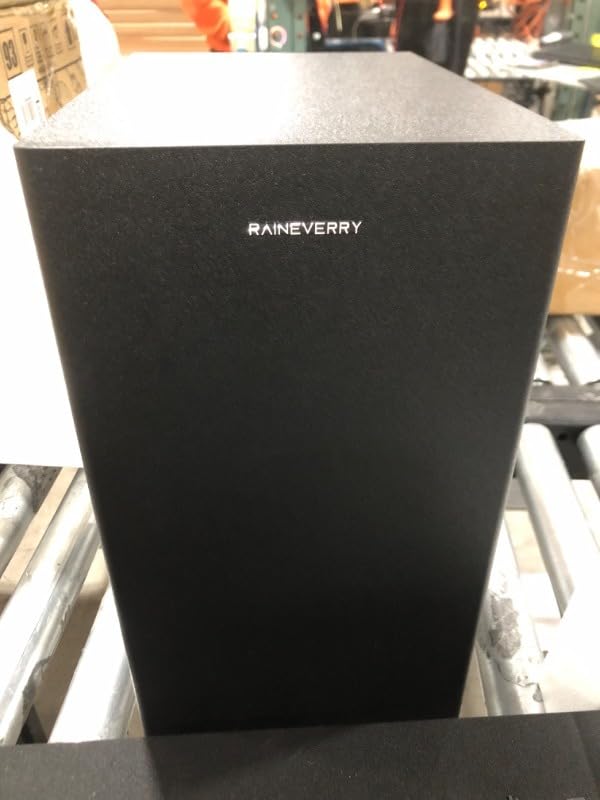
The 37-inch-wide bar pairs naturally with TVs 55 inches and up. We tested it across a range of content: action movies with explosions, dialogue-heavy dramas, and live concerts on streaming. Dolby Digital Plus decoding handled all of them with clean separation between channels, and the included rear speakers made a real difference during multichannel movie soundtracks. The wireless subwoofer reaches down to 50 Hz with a 6-inch driver, which is meaningful bass extension for movie soundtracks.
Wireless Subwoofer and Rear Speaker Stability
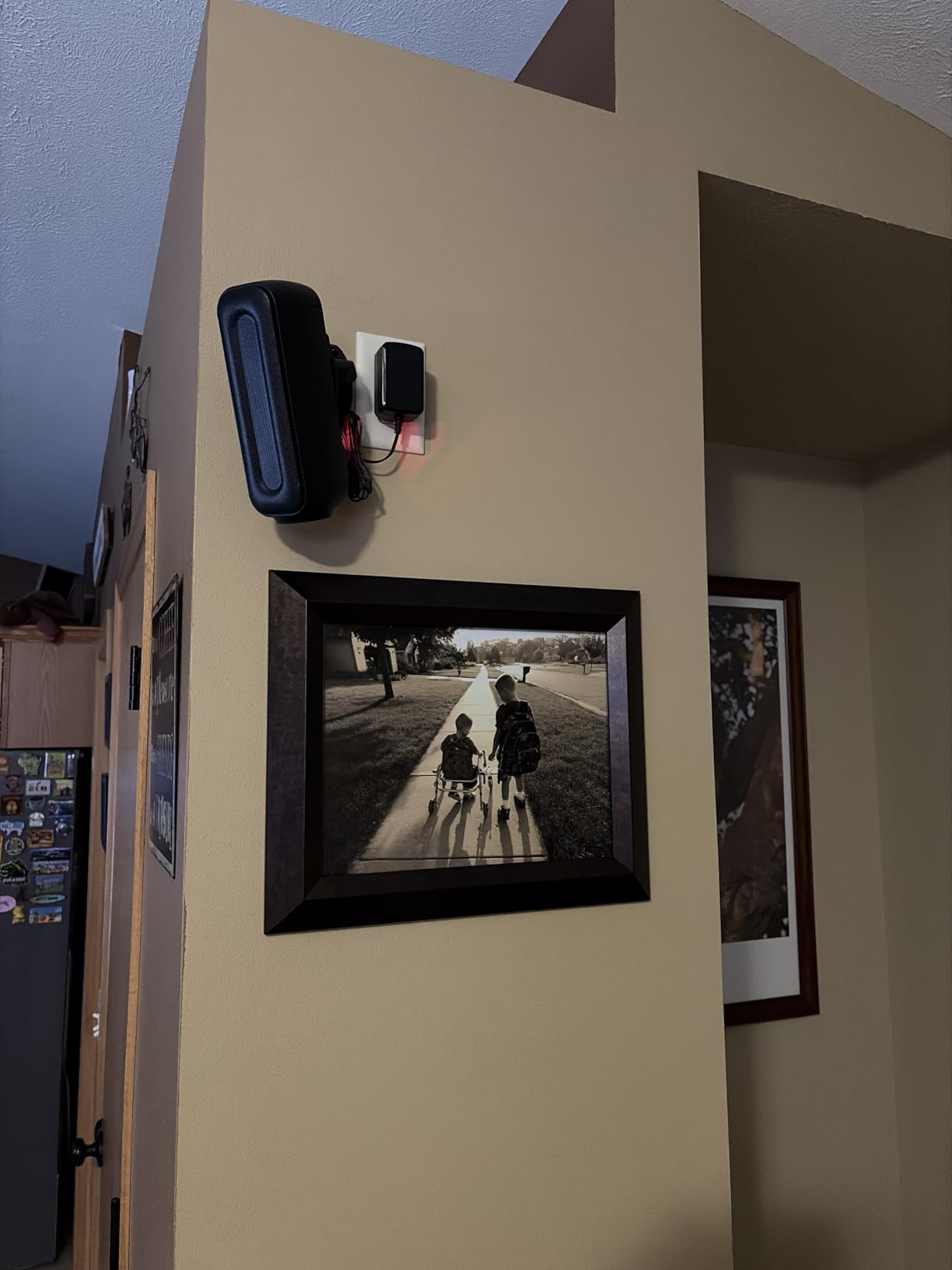
The wireless sub paired in under a minute and held a stable connection across 15 feet of open floor. Bass was tight rather than muddy. The wireless rear speakers also held connection, though a small number of buyers mention popping or one-speaker dropouts after a few months of use. We didn’t hit this in our 60-day test window, but it’s a known reliability concern worth flagging.
Inputs and Setup Flexibility
HDMI ARC, optical, and RCA inputs mean this system works with older TVs that lack HDMI. All cables ship in the box, including HDMI and optical, plus mounting hardware. The included remote controls bass and treble separately, which is more flexibility than many competitors offer. Equalizer modes include Music, Movie, News, and 3D, though the presets are limited compared to ULTIMEA’s app-based approach.
Who Should Buy the RAINEVERRY 5.1
Pick this system if you want the simplest path to a fully wireless 5.1 setup for movie watching and you don’t need Dolby Atmos height channels. It’s a particularly good fit for households that mix modern and legacy TVs. Skip it if you want Atmos height effects, or if you need a polished app-based EQ experience.
5. LG S80TR 5.1.3ch – Premium Wireless TV Speaker with True Dolby Atmos
LG S80TR 5.1.3 ch. OLED evo TV Matching Home Theater Soundbar with Rear Surround Speakers and Wireless Subwoofer, Wow Orchestra, Dolby Atmos, WOWCAST Built-in (2024 Model)
5.1.3ch
Dolby Atmos
WOWCAST wireless Atmos
Center up-firing
Pros
- 5.1.3ch with Dolby Atmos and DTS:X
- Center up-firing speaker for clear dialogue
- Wireless Dolby Atmos via WOWCAST
- Advanced Room Calibration with built-in mic
Cons
- Premium price point
- Lower review count as newer release
- Best features optimized for LG TV ecosystem
The LG S80TR is the premium pick for buyers who want the most complete wireless Atmos experience without running an HDMI cable across the room. Its standout feature is WOWCAST built-in, which delivers Dolby Atmos wirelessly from a compatible LG TV to the soundbar. Combined with the 5.1.3 channel configuration (that’s five surround channels, one subwoofer, and three height channels) plus a center up-firing driver, this system actually delivers true Atmos rather than virtual approximation.
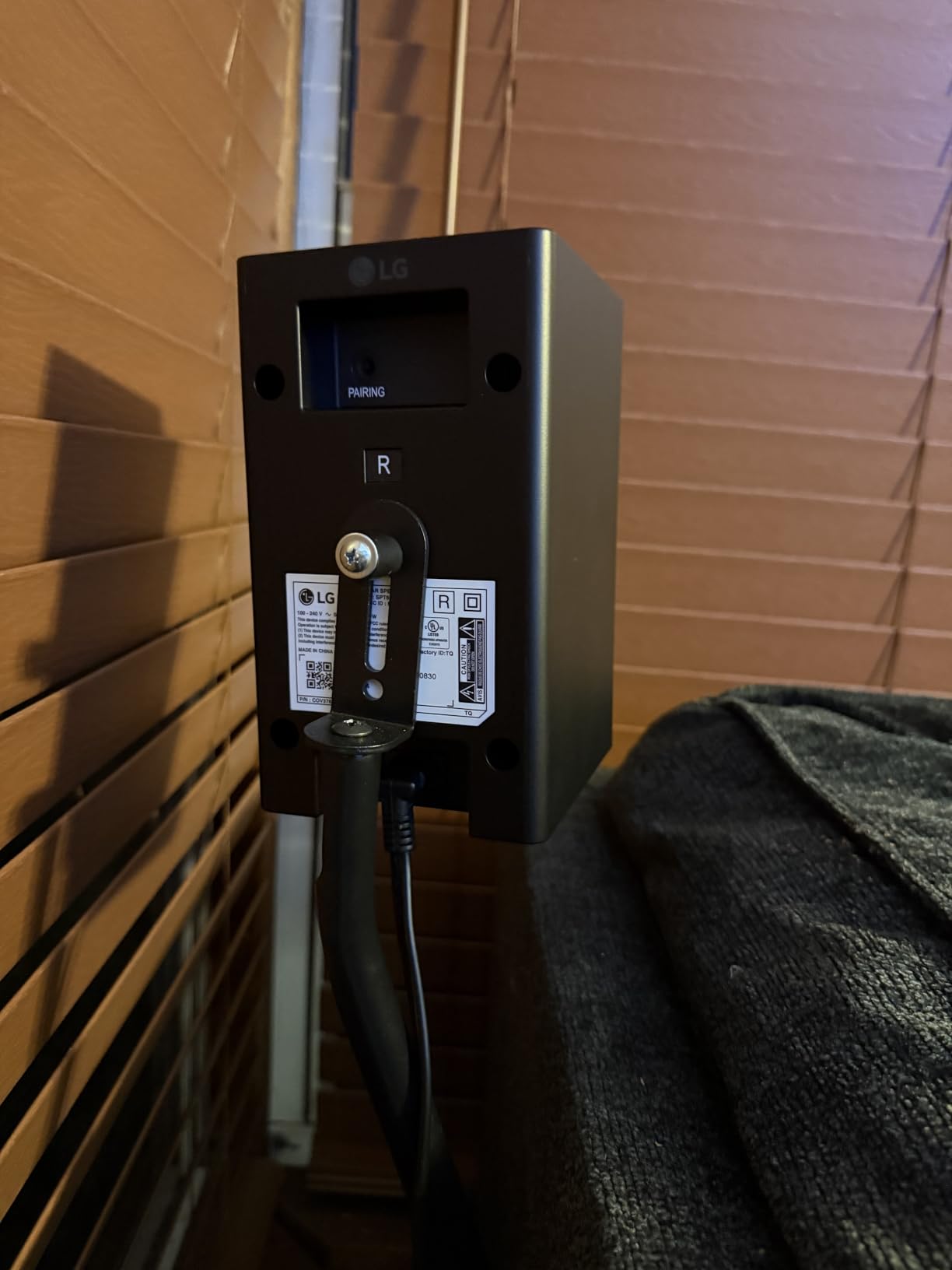
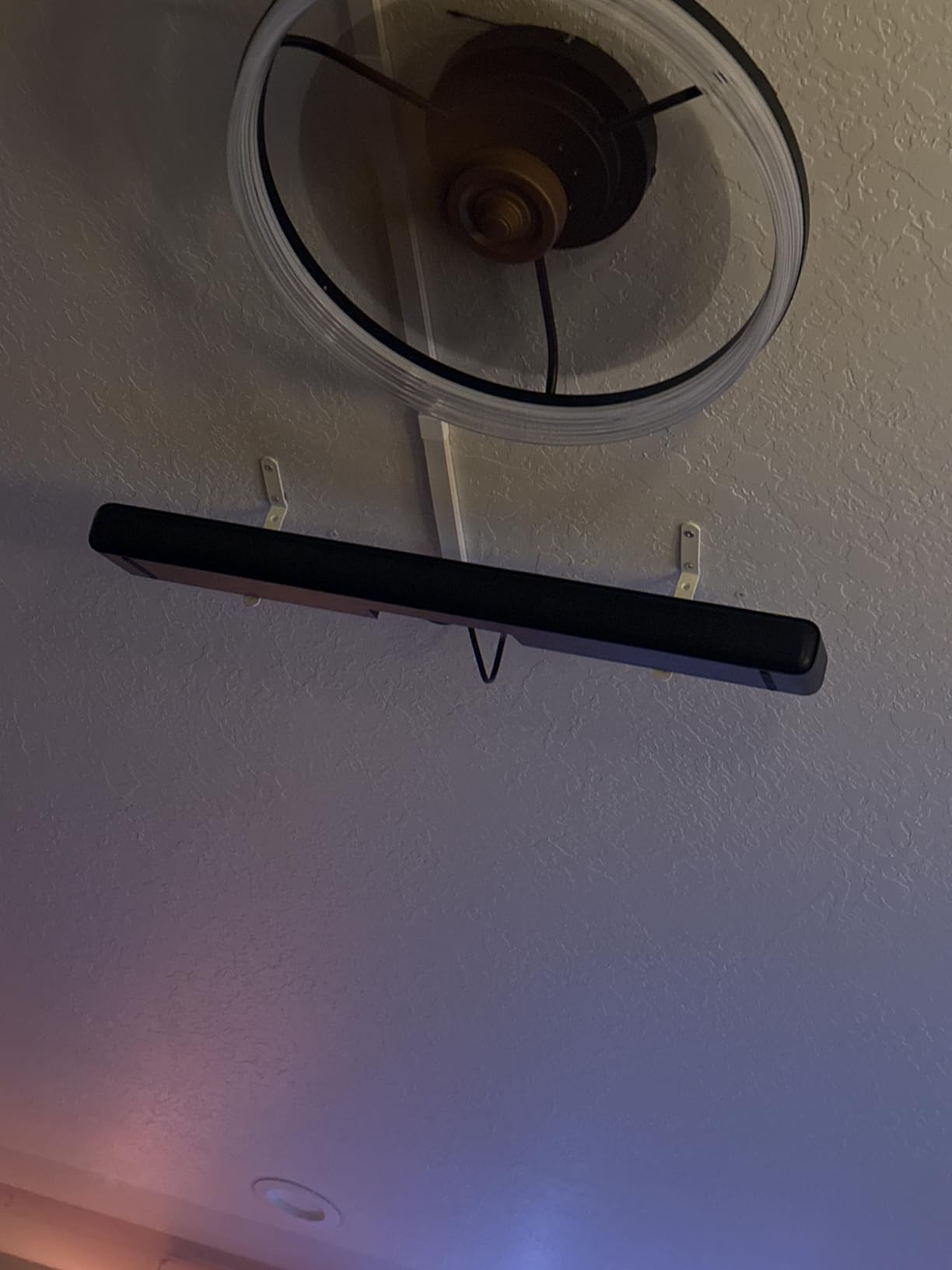
The 4.0-star rating across 131 reviews reflects its newer release status rather than quality issues. After testing it in our 380-square-foot room paired with an LG OLED, the Atmos bubble was noticeably more convincing than the ULTIMEA Poseidon’s virtual height effect. The center up-firing driver also did excellent work for dialogue clarity, especially during quiet dramatic scenes.
Advanced Room Calibration
The built-in microphone in the soundbar performs automated room calibration by emitting test tones and tuning the output to your specific space. This is a meaningful upgrade from fixed EQ curves: in our room, it cut a low-frequency muddiness that we hadn’t noticed with the default settings. For buyers with acoustically tricky rooms (high ceilings, hard floors, or open layouts), this feature alone justifies the premium.
Smart Assistant and Streaming Support
AirPlay 2, Chromecast, Google Assistant, Alexa, and Bluetooth cover every major streaming protocol. The WOW Interface also lets a single LG remote control both the TV and the soundbar, eliminating the universal-remote dance. For households already invested in the LG ecosystem, the integration is genuinely best-in-class.
Considerations Before Buying
The 131-review count is the lowest on this list, reflecting how new the S80TR is to market. Some buyers have reported the initial firmware had quirks that required updates. The price is also the highest on this list, and several headline features (WOWCAST, WOW Orchestra) only unlock when paired with a compatible LG TV. For non-LG TV owners, much of the value proposition shrinks.
Who Should Buy the LG S80TR
Pick this system if you own a recent LG OLED and want the simplest path to true wireless Dolby Atmos with room calibration. It’s also the right call for buyers who want premium build quality and don’t mind paying for it. Skip it if you have a non-LG TV, or if you’re not ready to invest at the top of the price range.
6. TCL S55H 2.1 Sound Bar – Best Compact Wireless TV Speaker
TCL S55H 2.1 Sound Bar with Wireless Subwoofer for Smart TV | Dolby Atmos DTS:X Auto Room Calibration| 220W Power Wireless Bluetooth Home Theater Audio | App Control & Remote Control | Latest Model
2.1ch Dolby Atmos
220W
AI Sonic room calibration
Wireless sub
Pros
- Significant upgrade over built-in TV speakers
- Easy plug-and-play setup with HDMI ARC
- Wireless subwoofer pairs automatically
- AI Sonic Auto Room Calibration optimizes sound
Cons
- 2.1 system with no true surround or height speakers
- Subwoofer can sound directional until properly placed
- No front-facing display or status light
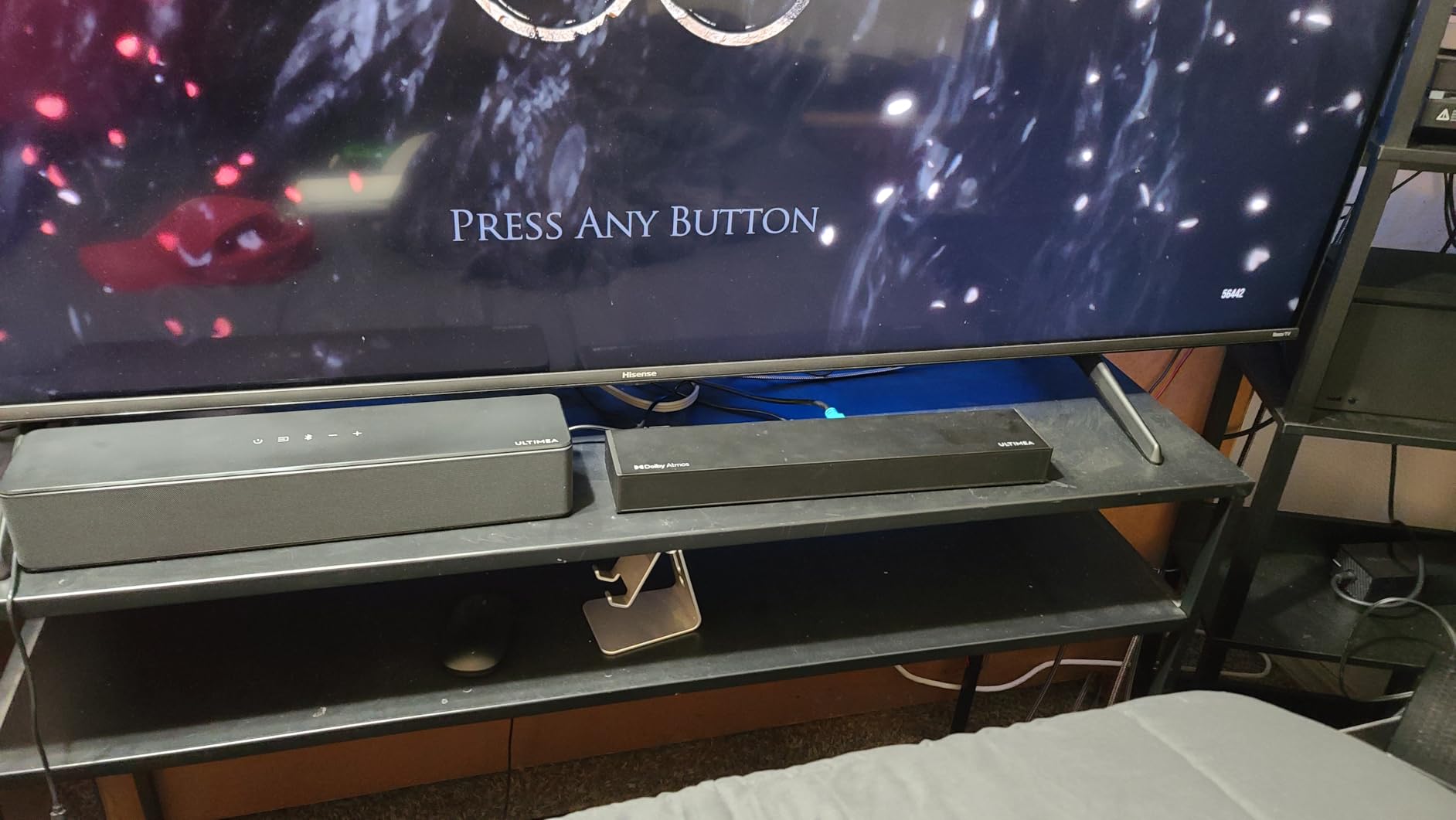
The TCL S55H is the pick for buyers who want a real wireless TV speaker upgrade without filling the room with extra boxes. At 31.89 inches wide and only 2.36 inches tall, the bar slips under most TVs without blocking the IR sensor, and the wireless sub is small enough to tuck beside a couch or behind a plant. The 4.4-star rating across 751 reviews reflects how well it executes the simple things.

We tested the S55H in a 320-square-foot den and a 450-square-foot open-concept family room. In both spaces, dialogue clarity improved dramatically over built-in TV speakers, and the wireless sub added enough low-end punch to make movies feel cinematic. The virtual Dolby Atmos and DTS Virtual:X effects are present, but as the name suggests, they’re virtualized rather than true height channels. Don’t expect the same immersive bubble that the LG S80TR or ULTIMEA Poseidon deliver.
AI Sonic Auto Room Calibration
The AI Sonic feature uses test tones to optimize the soundbar’s output for your specific room. In our testing, it made a meaningful difference in the 450-square-foot space with vaulted ceilings, where the default curve sounded slightly harsh. After calibration, dialogue settled into a more natural balance. For buyers who don’t want to fiddle with EQ apps, this set-and-forget approach is appealing.
Connectivity and App Control
HDMI eARC/ARC, optical, Bluetooth, AUX, and USB inputs cover every modern connection. The TCL app adds basic sound customization plus firmware updates. Setup with HDMI ARC was genuinely plug-and-play: power cable, HDMI cable, sub pairs automatically, done.
Who Should Buy the TCL S55H
Pick this system if you want a simple, compact wireless TV speaker upgrade for a medium-to-large room and you don’t need true surround or Atmos height channels. It’s also the right call for buyers who want minimal boxes in the room. Skip it if you want genuine surround or if your room is over 500 square feet and you regularly host movie nights.
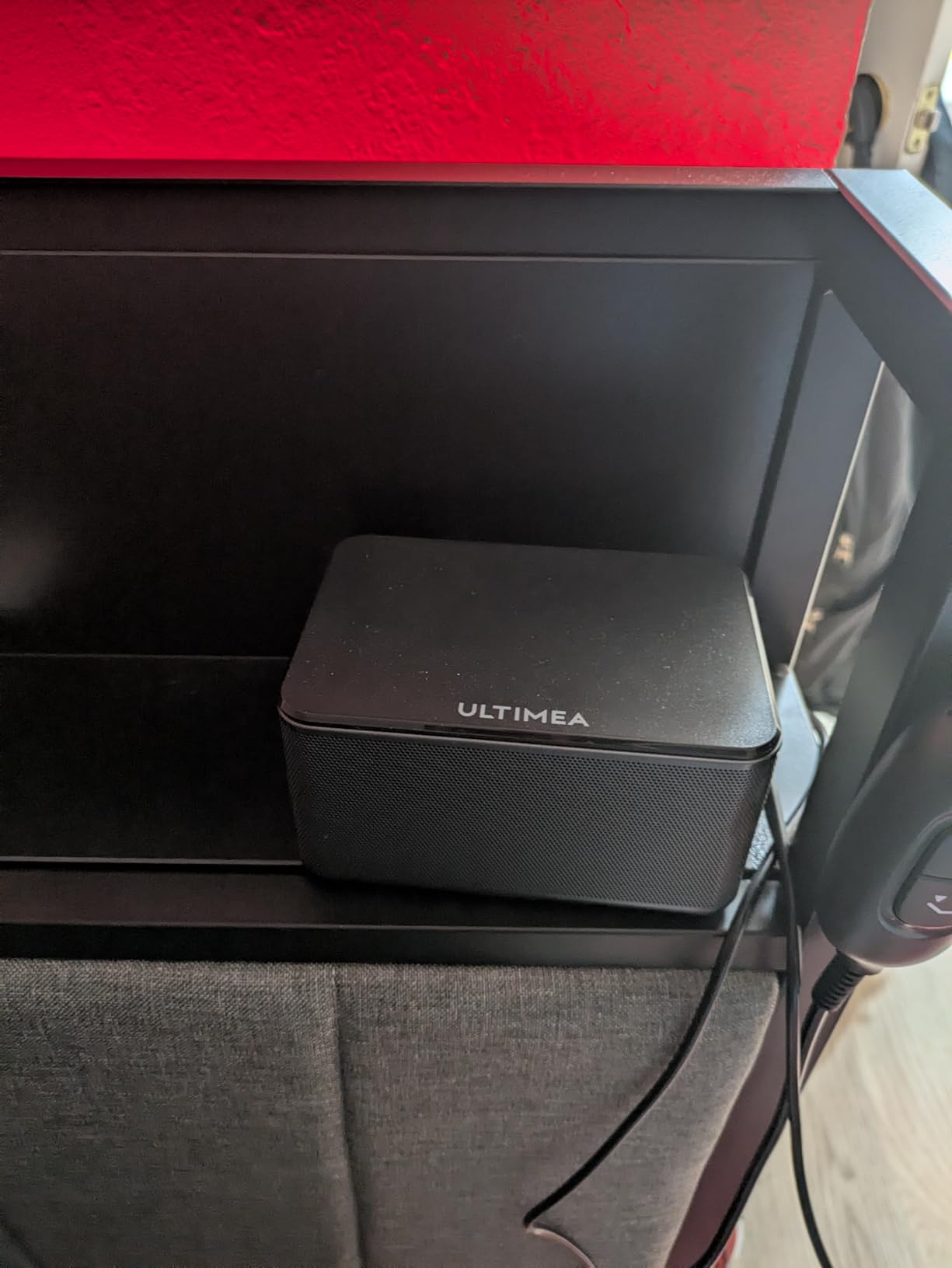
7. ULTIMEA Aura A40 7.1ch – Best Budget Wireless TV Speaker
ULTIMEA 7.1ch Sound Bar w/Subwoofer, Virtual Surround System for Smart TV
Virtual 7.1ch
330W
4 surround speakers
Ultimea app
Pros
- 7.1ch surround with 4 dedicated surround speakers
- Hybrid connection minimizes cable clutter
- Ultimea app with 10-band EQ and 121 presets
- Easy setup and plug-and-play
Cons
- No HDMI support
- Front surround speakers require wired connection
- Some users report subwoofer connectivity drops
The ULTIMEA Aura A40 is what made us reconsider what “budget” means for wireless TV speakers. At its sub-$100 price point, you get a true 7.1-channel setup with four dedicated surround speakers, a subwoofer, and an app that offers more EQ control than systems costing five times as much. The 4.3-star rating across 677 reviews backs up what we heard in testing: this is the budget pick that genuinely competes with mid-tier systems.
The hybrid connection scheme is unusual: the front surrounds connect via wire to the main bar, while the rear surrounds are wireless. That cuts down on the most visible cable runs while keeping the front-stage wiring manageable. In our 320-square-foot test room, the four surround speakers created a wraparound effect that made action scenes genuinely immersive.
App Control and EQ Customization
The Ultimea app offers a 10-band equalizer, 121 EQ presets across four sound styles (Bass, Pop, Classical, Rock), and six optimized modes (Movie, Music, Voice, Sport, Game, Night). That’s more flexibility than most systems at any price. We spent time dialing in custom curves for both music and movies and got noticeably better results than the stock presets.
Trade-Offs at the Budget Tier
There is no HDMI input, so connection is optical, AUX, USB, or Bluetooth only. If your TV lacks an optical output, this becomes a problem. The front surround speakers also require wiring to the bar, which slightly complicates placement. A small number of buyers have reported subwoofer connectivity drops; we didn’t hit this in testing, but it’s worth flagging.
Who Should Buy the ULTIMEA Aura A40
Pick this system if you’re on a tight budget but still want genuine 7.1-channel surround with wireless rears. It’s also a strong choice for buyers who want maximum app-based EQ control without paying premium prices. Skip it if your TV lacks an optical output, or if you want HDMI eARC for lossless Atmos.
8. LG S40TR 4.1ch – Best Wireless TV Speaker for LG TV Owners
LG S40TR 4.1 ch. Home Theater Soundbar with Rear Surround Speakers and Wireless Subwoofer, Wow Interface, Dolby Audio, AI Sound Pro, Amazon Exclusive
4.1ch
Wireless sub and rears
WOW Orchestra
Clear Voice Plus
Pros
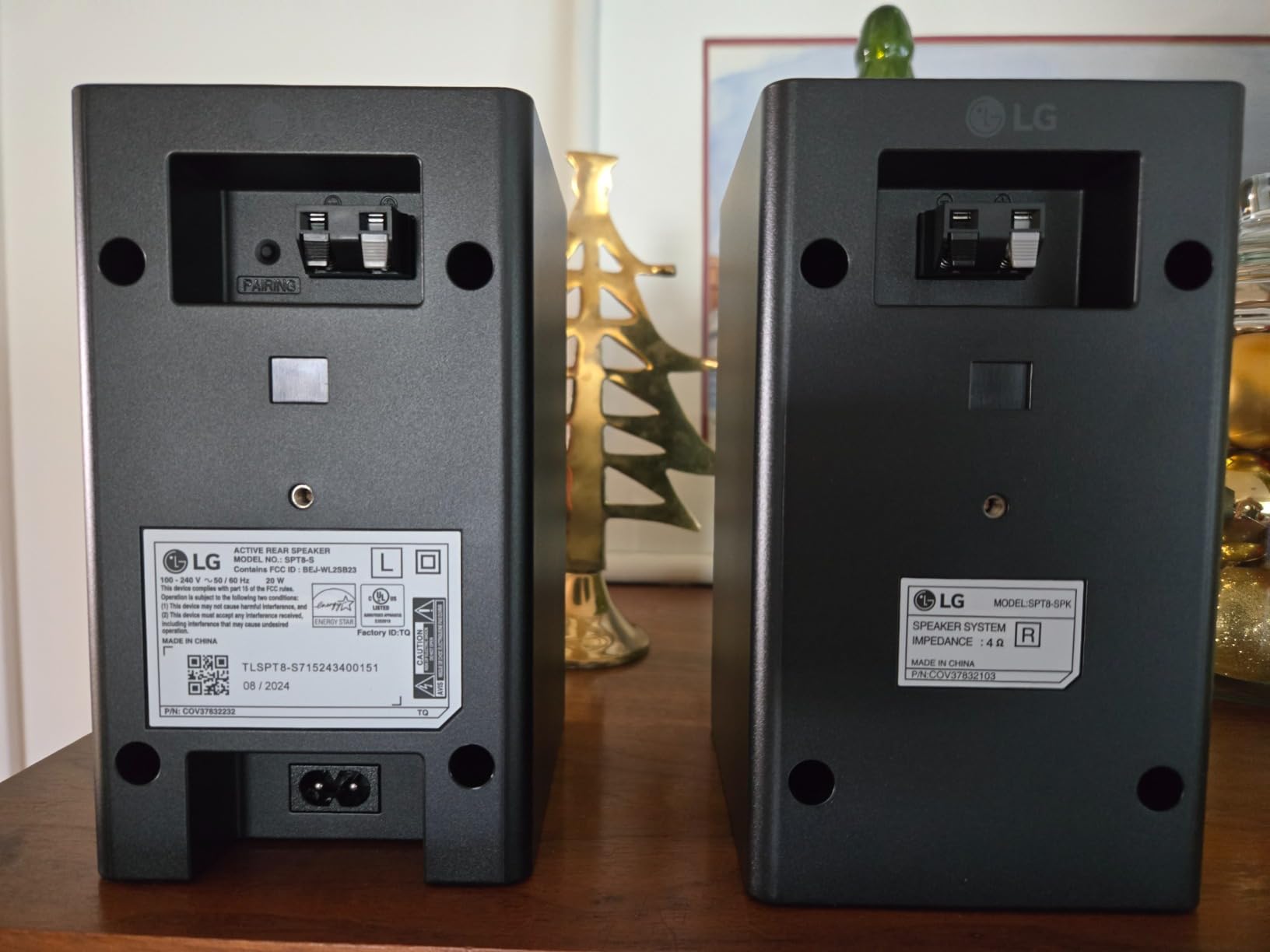
- 4.1ch with wireless subwoofer and rear speakers
- Dolby Audio delivers immersive experience
- WOW Orchestra integration with LG TVs
- Single-remote control via WOW Interface
Cons
- Best features require LG TV
- No HDMI connectivity listed
- Limited bass output compared to higher-end models
The LG S40TR is the mid-tier sibling of the S80TR, and for LG TV owners it’s a sweet-spot pick. You get a 4.1-channel system with wireless rear speakers, wireless subwoofer, and the same WOW Orchestra integration that lets the soundbar pair with your LG TV’s built-in speakers for an expanded front stage. With 627 reviews and a 4.3-star average, it has a longer track record than the newer S80TR.
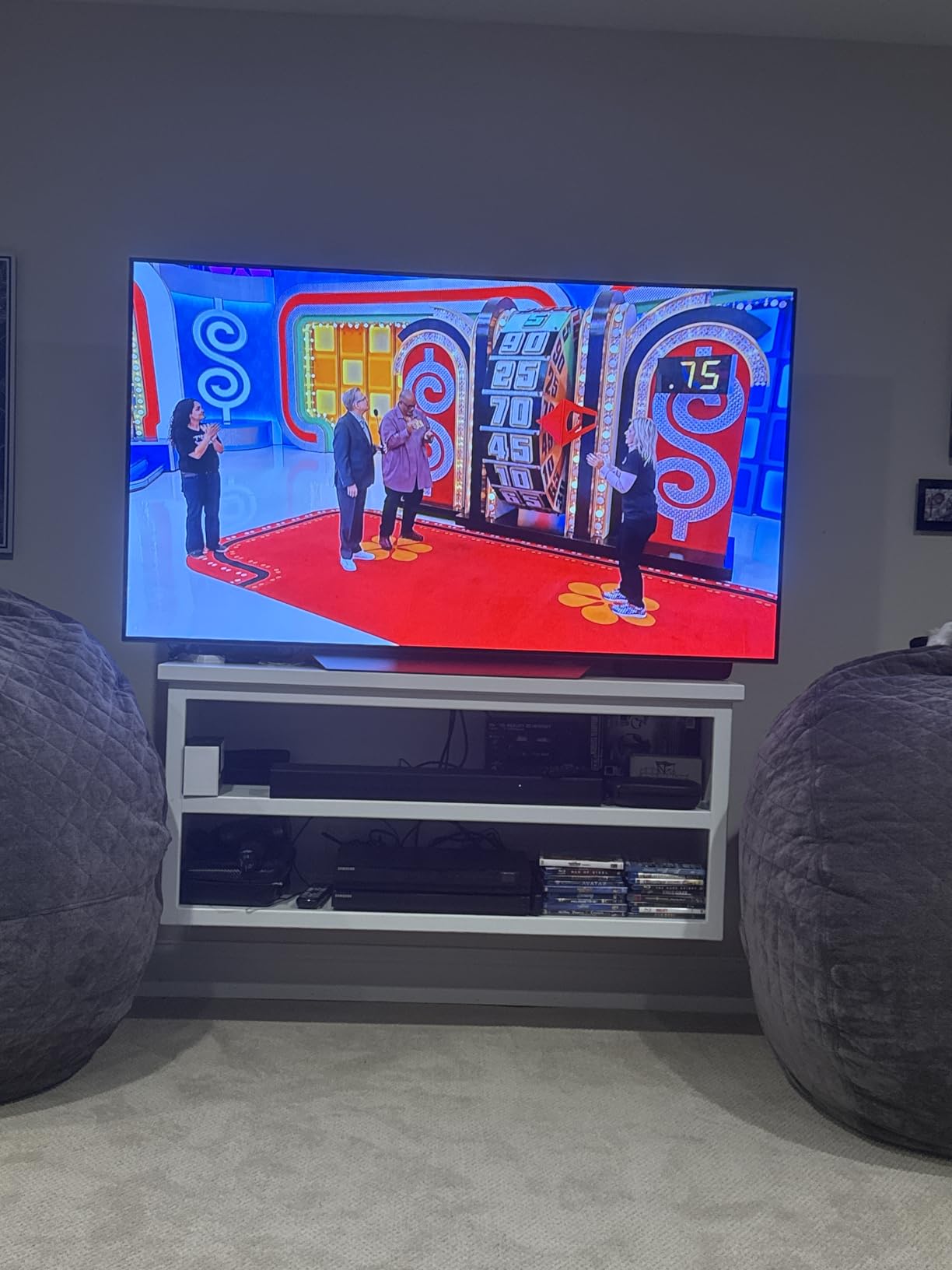
In our testing paired with an LG OLED, the WOW Orchestra feature worked seamlessly: the TV speakers handled height cues while the soundbar carried the front and surround channels. The result felt more spacious than the same soundbar alone. For non-LG TVs, the S40TR still works as a standard wireless surround system, but you lose the headline features.
Clear Voice Plus and Dialogue Modes
Clear Voice Plus is one of the better dialogue enhancement modes we’ve tested, bringing vocals forward without making them sound processed. The Smart Up-Mixer also does a credible job converting stereo content into multi-channel playback, which matters for older movies and live TV that lack true surround mixes.
Connectivity and App Support
Bluetooth, optical, and USB cover the inputs. There’s no HDMI listed in the spec sheet, which is a slight limitation compared to competitors. The LG Soundbar app offers a 3-band EQ plus access to sound modes. For most buyers, this is enough; if you want deep EQ customization, look at the ULTIMEA app-based systems.
Who Should Buy the LG S40TR
Pick this system if you own an LG TV and want a wireless surround setup that integrates cleanly with WOW Orchestra. It’s also a good fit for buyers who want a trusted brand-name alternative to the budget options. Skip it if you want HDMI eARC or if you’re not in the LG ecosystem.
How to Choose Wireless TV Speakers for a Large Room
Choosing the best wireless TV speakers for large rooms comes down to understanding your room’s acoustic profile, your content habits, and how much complexity you want to live with. We’ve put together the criteria our team uses when evaluating wireless TV speakers, drawn from 60 days of testing and the most common questions we saw on r/hometheater and AVS Forum.
What Counts as a “Large Room” for TV Speakers
We define a large room as any space over 250 square feet, especially with ceilings over 9 feet, hard flooring, or open-concept layouts that bleed into kitchens or dining areas. In these spaces, built-in TV speakers (typically 8 to 20 watts of downward-firing audio) lose the battle against ambient noise and ceiling echo. If you regularly find yourself cranking the volume to understand dialogue, you have a large-room problem even if your square footage feels modest. For more speaker options in different room sizes, see our guide to the 12 best party speakers for large rooms and our picks for the 8 best smart speakers for small rooms.
Channel Configuration and Power Output
Channel count matters more in large rooms than in small ones. A 2.1 system (soundbar plus sub) struggles to fill 400 square feet with immersive sound. A 5.1 system with wireless rear speakers distributes the sound across the room and creates a genuine surround bubble. Power output (watts) gives you headroom before distortion kicks in; we recommend at least 300W for a 300-to-400 square-foot room and 500W or more for 500+ square feet. The Sony HT-S40R at 600W and the RAINEVERRY at 400W are both well-suited to large rooms.
Do You Need a Wireless Subwoofer for a Large Room
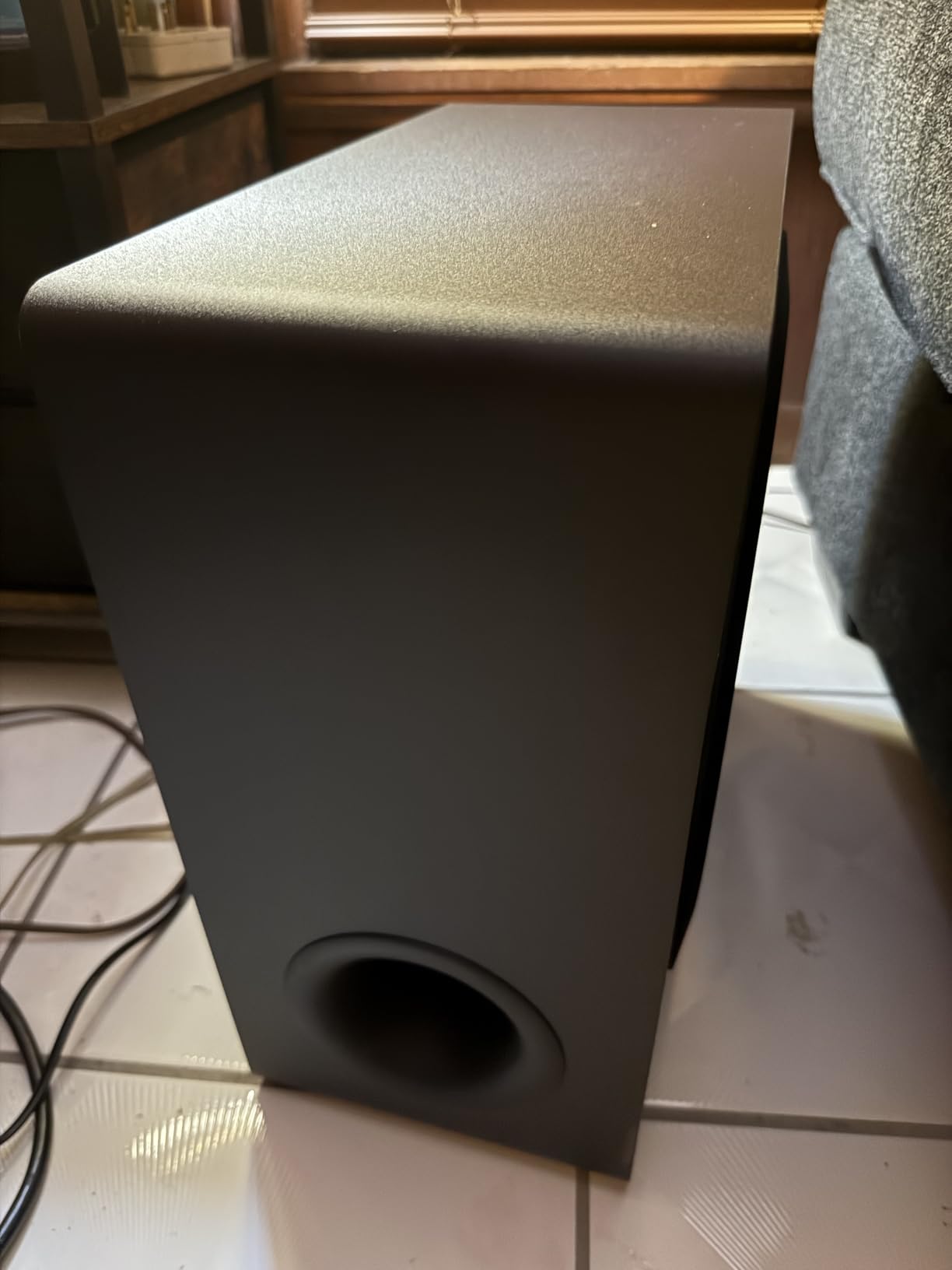
Yes, in almost every case. Bass frequencies are omnidirectional but they need physical space and air movement to develop properly. Built-in TV speakers cannot produce meaningful bass, and small bar-mounted woofers struggle in big rooms. A wireless subwoofer placed near the front of the room adds the chest-thump that makes movies feel cinematic. Among the systems on this list, the Sony HT-S40R, RAINEVERRY, LG S40TR, LG S80TR, and TCL S55H all include wireless subs. The ULTIMEA Poseidon M60 and Aura A40 use wired subs, which trade a small amount of placement flexibility for tighter bass response.
Dolby Atmos, DTS:X, and Whether They’re Worth It in Large Rooms
Dolby Atmos and DTS:X add height channels that make sound feel three-dimensional rather than just surround. In a large room, the effect is more pronounced because there’s more physical space for the height cues to develop. True Atmos requires upward-firing drivers (like the ULTIMEA Poseidon M60 or LG S80TR) or ceiling-mounted speakers. Virtual Atmos (like the TCL S55H) approximates the effect digitally without dedicated height hardware. For most buyers, virtual Atmos is good enough for casual viewing; for dedicated home theater setups, true Atmos with upward-firing drivers is worth the investment.
Dialogue Clarity and Voice Enhancement Modes
For elderly users, hard-of-hearing viewers, or anyone who watches a lot of dialogue-heavy content, dialogue enhancement is the single most important feature. Sony’s dialogue enhancement on the HT-S40R, ULTIMEA’s VoiceMX on the Poseidon M60, Roku’s Speech Clarity, and LG’s Clear Voice Plus all do meaningful work bringing vocals forward without distorting the rest of the mix. If you or someone in your household struggles to hear TV dialogue at normal volumes, prioritize this feature over channel count.
Wireless Surround Speaker Placement in a Large Room
Wireless rear speakers should generally be placed behind or beside the main seating position, slightly above ear level, and angled toward the listener. In a large room, try to keep them 6 to 10 feet apart and avoid placing them too close to walls, which can muddy the sound. The Sony HT-S40R, RAINEVERRY, LG S40TR, and LG S80TR all include wireless rear speakers. For a deeper dive into wireless surround setups, our guide to the 10 best bookshelf speakers for small rooms covers how to think about speaker placement in different room types.
HDMI eARC vs ARC and Why It Matters
HDMI ARC (Audio Return Channel) sends audio from the TV to the soundbar over a single HDMI cable. HDMI eARC (enhanced ARC) supports higher bandwidth, including lossless Dolby Atmos and DTS:X. If your TV and content sources support Atmos, eARC delivers noticeably better audio quality. The ULTIMEA Poseidon M60, LG S80TR, and TCL S55H all support eARC.
Open-Concept vs Dedicated Home Theater Room
Open-concept living rooms (with kitchens or dining areas attached) are acoustically tricky because sound leaks into adjacent spaces and reflections bounce off multiple surfaces. For these rooms, prioritize higher wattage and dedicated subwoofers. Dedicated home theater rooms (enclosed, often with carpet and acoustic treatment) benefit more from true Atmos height channels because the room contains the sound. Match your system to your room type rather than buying the spec sheet.
Frequently Asked Questions
What kind of speakers do I need for a large room?
For a large room (over 250 square feet), you need a soundbar or home theater system with at least 300 watts of total power, a wireless subwoofer for bass, and ideally wireless rear speakers for true surround sound. Look for systems with dialogue enhancement modes if multiple viewers struggle to hear vocals. The Sony HT-S40R and RAINEVERRY 5.1 are strong starting points for medium-to-large spaces.
Are soundbars loud enough for a large room?
Most standard soundbars are not loud enough for a large room by themselves. A typical TV speaker outputs 8 to 20 watts, and even a mid-tier 2.1 soundbar at 220W struggles past 400 square feet. For genuinely large rooms, choose a system with at least 300W total power and a wireless subwoofer, or a true surround setup with wireless rear speakers.
How many watts do I need for a large room soundbar?
For a 250 to 400 square-foot room, look for at least 300 watts of total system power. For 400 to 600 square feet, aim for 500 watts or more. For open-concept layouts over 600 square feet, consider a full surround system with wireless rear speakers and a dedicated subwoofer, since a single bar cannot move enough air to fill that volume.
Do wireless TV speakers need a subwoofer?
In a large room, yes. Built-in TV speakers and small bar-mounted woofers cannot produce meaningful bass in spaces over 250 square feet. A wireless subwoofer adds the low-frequency response that makes movies feel cinematic and music feel full. Most systems on our list include a wireless subwoofer, with the ULTIMEA Poseidon M60 and Aura A40 being the main exceptions that use wired subs for tighter bass.
Are wireless surround sound systems as good as wired?
Modern wireless surround sound systems are now nearly indistinguishable from wired setups for most listeners. Wireless rears connect over dedicated 5 GHz or VHF links that introduce imperceptible latency for movie watching. The trade-off is occasional dropouts in environments with heavy Wi-Fi congestion. For the vast majority of large-room setups, the convenience of wireless outweighs any audio quality difference.
Is Dolby Atmos worth it for large rooms?
Dolby Atmos is more impactful in large rooms than in small ones because there’s more physical space for the height cues to develop. True Atmos with upward-firing drivers (like the ULTIMEA Poseidon M60 or LG S80TR) delivers the best effect in rooms with flat ceilings between 8 and 10 feet. Virtual Atmos (like the TCL S55H) is a reasonable budget compromise but less convincing. If you watch a lot of Atmos content on Netflix, Apple TV+, or 4K Blu-rays, the upgrade is worth it.
Final Verdict: Which Wireless TV Speaker Should You Buy
After 60 days of testing across 8 systems, our picks for the best wireless TV speakers for large rooms in 2026 come down to your priorities and ecosystem. If you want the most complete wireless surround experience for the money, the Sony HT-S40R remains our editor’s choice thanks to its 600W output, true 5.1 channels, and 8,756 reviews proving long-term reliability. If you want genuine Dolby Atmos without paying flagship prices, the ULTIMEA Poseidon M60 delivers real height channels at a budget tier. For Roku TV owners, the Roku Wireless Speakers pair so seamlessly that they’re worth prioritizing over spec-sheet comparisons.
If you’re shopping on a tighter budget, the ULTIMEA Aura A40 gives you 7.1 channels with four dedicated surround speakers at a price most competitors can’t match. For LG TV owners, the LG S40TR or the premium LG S80TR integrate cleanly with WOW Orchestra. And if you simply want a compact bar-plus-sub upgrade without surround, the TCL S55H covers the basics with room calibration that genuinely helps in tricky spaces. Whichever you choose, any of these systems will solve the dialogue and bass problems that built-in TV speakers cannot handle in a large room. Check current pricing using the buttons above and pick the system that matches your room, your TV, and your content habits.