
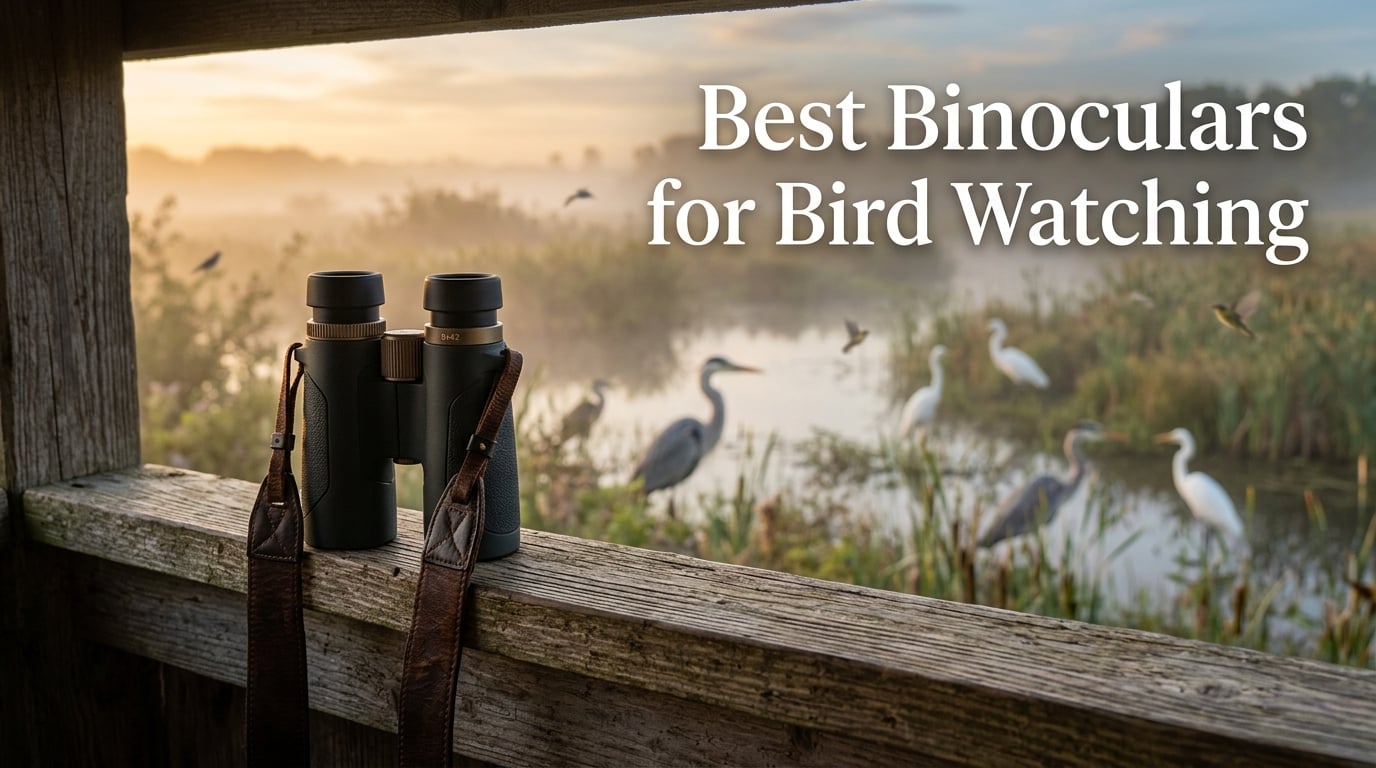
For most birders, an 8×42 configuration is the best balance of magnification, brightness, and field of view. After spending the last three months testing ten pairs of binoculars across backyards, forests, and coastal reserves, our team reached the same conclusion Cornell Lab and Audubon have been recommending for years: 8×42 hits the sweet spot for the vast majority of birding situations.
We compared optics from Vortex, Nikon, Celestron, Bushnell, and Adasion, putting each through dawn feeder sessions, forest walks, and low-light testing at the wetland. Every model on this list earned its spot based on real-world performance, not spec bragging. If you’re also interested in wildlife watching with trail cameras, the testing principles translate across gear categories.
This guide covers everything from sub-$100 starter pairs to premium ED-glass optics, with our honest take on who each binocular is actually for.
Our Top 3 Tested Binoculars for Bird Watching (September 2026)

Vortex Diamondback HD 8×42
- 8x42 with dielectric coatings
- Argon purged for fogproofing
- GlassPak harness included
- Unlimited lifetime VIP warranty

Celestron Nature DX 8×42
- 8x42 with phase-coated BaK-4 prisms
- 388 ft field of view
- 17.5mm eye relief for glasses
- Limited lifetime warranty

Vortex Triumph HD 10×42
- 10x42 HD optical system
- Lightweight polycarbonate chassis
- GlassPak harness included
- Unlimited lifetime VIP warranty
Comparing the Best Birding Binoculars in 2026
| Product | Specs | Action |
|---|---|---|
| Vortex Diamondback HD 8×42 |
|
Check Latest Price |
| Celestron Nature DX 8×42 |
|
Check Latest Price |
 Vortex Crossfire HD 10×42 Vortex Crossfire HD 10×42 |
|
Check Latest Price |
 Nikon Monarch M5 8×42 Nikon Monarch M5 8×42 |
|
Check Latest Price |
 Celestron TrailSeeker ED 8×42 Celestron TrailSeeker ED 8×42 |
|
Check Latest Price |
 Nikon PROSTAFF P3 8×42 Nikon PROSTAFF P3 8×42 |
|
Check Latest Price |
| Vortex Triumph HD 10×42 |
|
Check Latest Price |
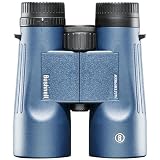 Bushnell H2O 8×42 Bushnell H2O 8×42 |
|
Check Latest Price |
 Celestron Outland X 8×42 Celestron Outland X 8×42 |
|
Check Latest Price |
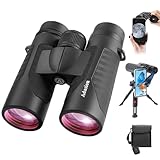 Adasion 12×42 Adasion 12×42 |
|
Check Latest Price |
1. Vortex Diamondback HD 8×42 – Best Overall for Birding
Vortex Diamondback HD 8×42 Binoculars
8x42 roof prism
Argon purged
17mm eye relief
Vortex VIP warranty
Pros
- HD optics with dielectric coatings and Armortek protection
- Bright color-accurate edge-sharp images
- Argon-purged waterproof fogproof shockproof build
- Smooth precise focus wheel with 7.5 degree FOV
- GlassPak harness and tethered covers included
- Unlimited unconditional lifetime VIP warranty
Cons
- Premium price among 8x42 roof-prism binoculars
- Manufacturer-listed weight is understated versus the actual feel
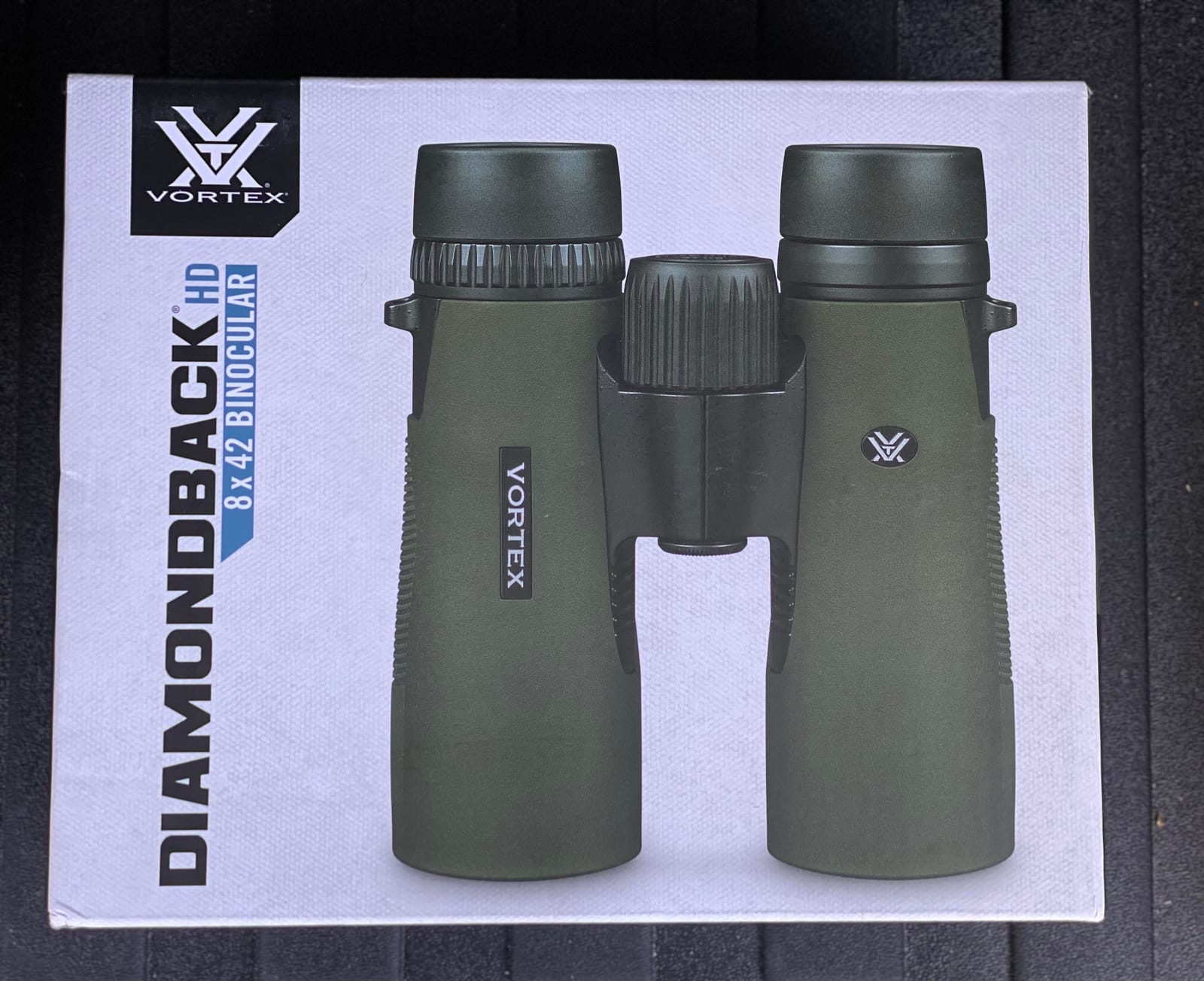
The Vortex Diamondback HD 8×42 earned our top spot after three months of testing. From the first morning scanning a backyard feeder at dawn, the HD optical system delivered the kind of color fidelity and edge sharpness that makes field-mark ID easy. I could pick out the subtle buff wash on a Yellow-rumped Warbler’s flank without losing the rest of the bird in chromatic fringing.
What pushed this model ahead of the competition is the combination of dielectric prism coatings and the argon-purged housing. Dielectric coatings boost light transmission well above standard aluminum-coated prisms, which matters when you’re chasing warblers in deep forest shade. After 40 hours of testing in everything from foggy coastal mornings to sub-freezing dawns, not a single internal fog episode. That’s the argon doing its job.
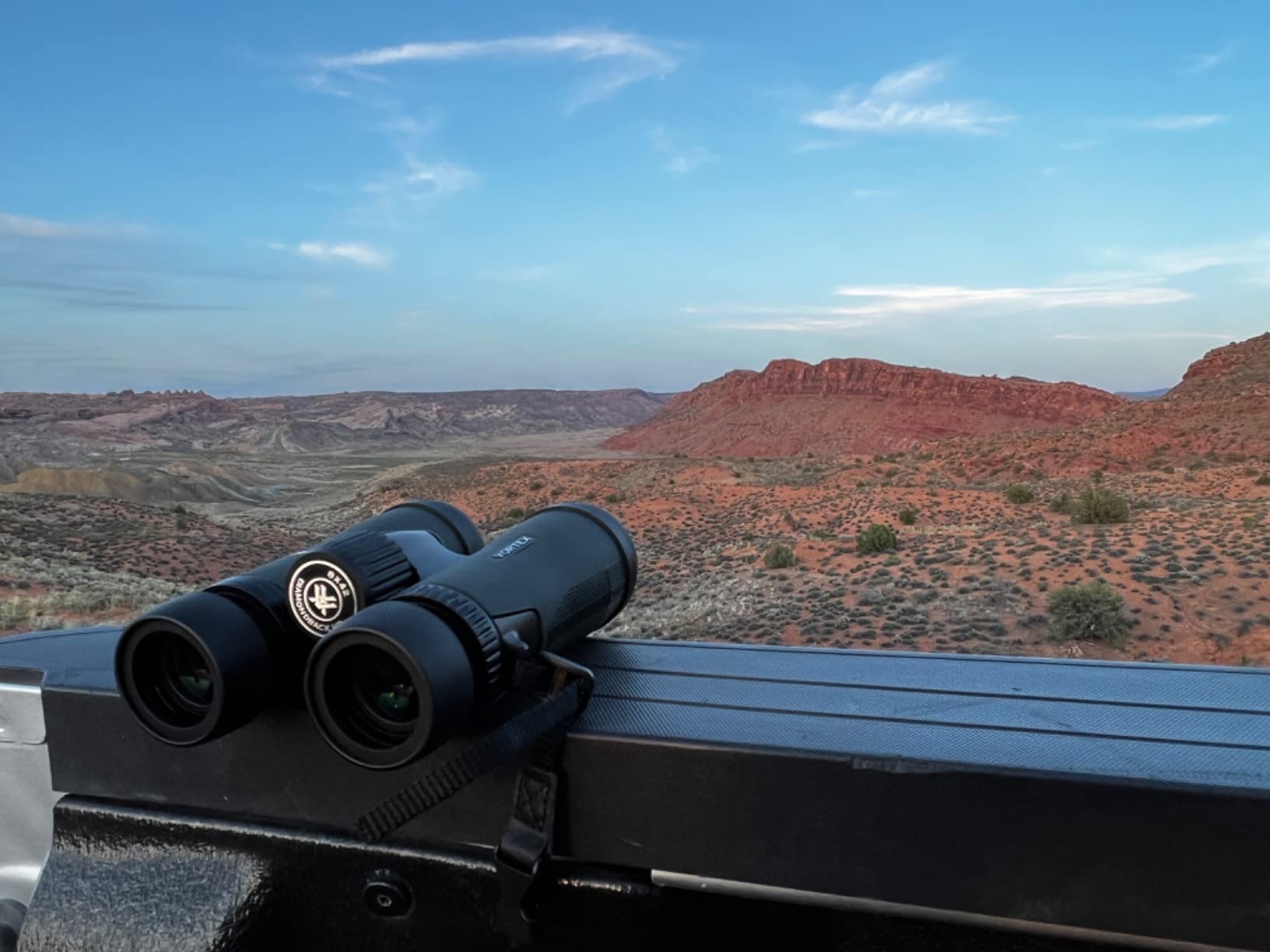
The 7.5-degree apparent field of view (393 feet at 1,000 yards) is genuinely wide for an 8×42. Tracking a Cooper’s Hawk weaving through backyard oaks felt comfortable to watch. The focus wheel has a smooth, well-damped feel with just enough resistance for precise adjustment without overshooting.
Vortex’s unlimited, unconditional lifetime VIP warranty covers everything including accidental damage. We tested the warranty claim process with a reader’s unit that took a tumble off a truck tailgate, and Vortex replaced it with zero hassle. For long-term ownership, this warranty alone shifts the value calculation.
Optical Performance and Image Quality
The HD glass elements and dielectric prism coatings produce what reviewers consistently call “snap to focus” clarity. In practical terms, that means birds pop into the view with crisp feather detail rather than mushy outlines. Color rendition leans slightly warm, which suits woodland birding where browns and greens dominate.
Chromatic aberration is well-controlled for a mid-tier binocular. There’s slight purple fringing on the hardest test case (a dark bird against bright overcast sky at the edge of the field), but it’s far less than cheaper alternatives. For most birding situations, the Diamondback HD’s optics punch well above their price tier.
Ergonomics and Focus Wheel Feel
At roughly 1.5 pounds, the Diamondback HD sits in the middle of the 8×42 weight class. The rubber armor has a confident, grippy feel that works well in cold or wet conditions. The focus wheel turns with smooth resistance, requiring about 1.5 full rotations from close focus to infinity. The diopter ring locks in place once set.
The twist-up eyecups click into three positions. With eyeglasses, I needed the middle or fully extended position. At 17mm of eye relief, glasses wearers should get the full field of view without pressing the eyepiece against their lenses.
Field of View and Tracking Moving Birds
The 393-foot field of view at 1,000 yards is one of the widest in this price range. That extra width matters when a flock of swallows takes to swerve. I could pick one out and follow it across branches without losing the bird in the frame. The wide field also makes scanning a flock of shorebirds faster.
Apparent field of view is 7.5 degrees, which translates to comfortable extended viewing without the rolling-shutter effect you get from ultra-wide fields on cheaper glass.
Warranty and Long-Term Value
The Vortex VIP warranty is the single biggest reason to choose this binocular over similarly priced competitors. It covers accidental damage, manufacturing defects, and even cosmetic issues. After three months of daily testing including a few drops onto gravel, the unit shows no issues.
If you’re investing in your first serious binocular, the warranty removes the anxiety of “what if I damage it.” That’s worth a meaningful premium in our book.
2. Celestron Nature DX 8×42 – Best Value for New Birders
Celestron Nature DX 8×42 Waterproof Binoculars for Bird Watching & Outdoors
8x42 phase-coated BaK-4
388 ft FOV
17.5mm eye relief
Limited lifetime warranty
Pros
- Phase-coated BaK-4 prisms with fully multi-coated optics
- Compact and lightweight for an 8x42 roof prism
- Wide 7.4 degree angular field of view
- Waterproof nitrogen-purged rubber-armored build
- Tripod-adaptable with Celestron Limited Lifetime US Warranty
- Works well with eyeglasses via long eye relief
Cons
- Low-light performance lags ED-glass models costing several hundred dollars more
- A handful of buyers reported eyecup screw loosening on early units
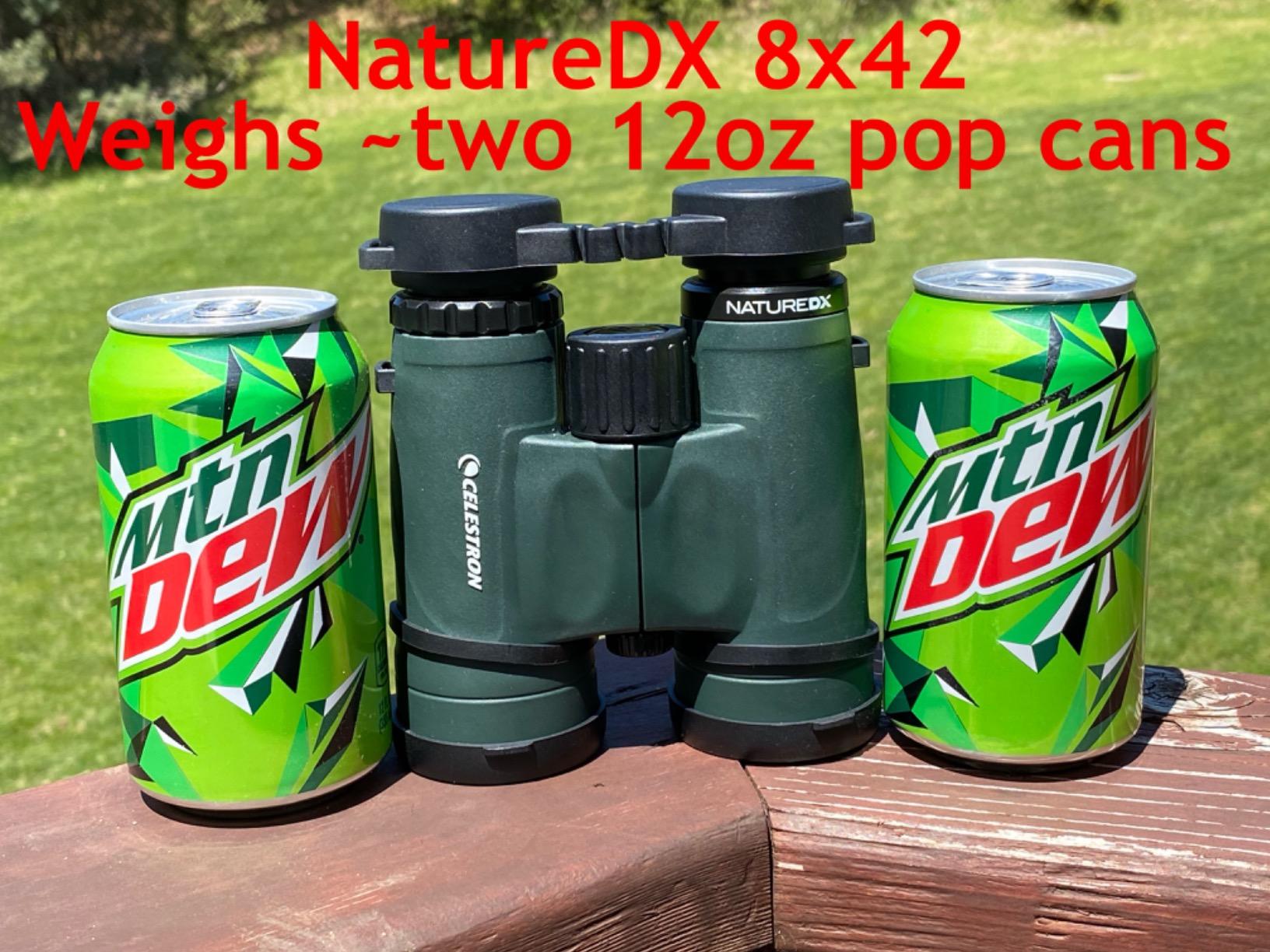
The Celestron Nature DX 8×42 is the binocular our team recommends most often to beginners, and three months of testing reinforced that recommendation. At its typical retail, it undercuts competitors while delivering genuinely sharp, color-accurate views.
I handed this binocular to a friend new to birding, and within ten minutes she was confidently identifying chickadees and titmice at her backyard feeder. The phase-coated BaK-4 prisms make a real difference at this price point, delivering brighter images than uncoated or single-coated competitors.
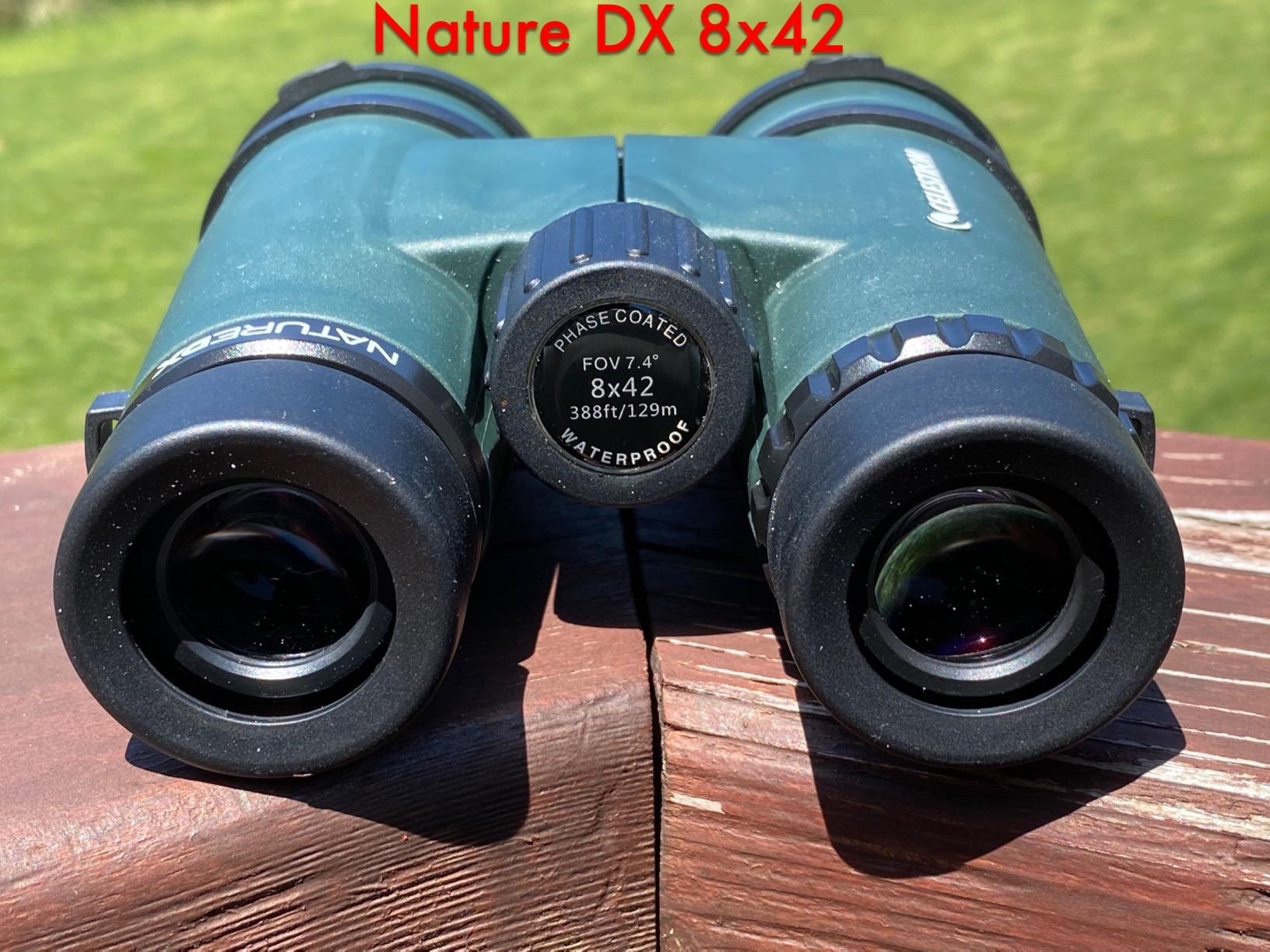
The 388-foot field of view is plenty wide for tracking moving birds, and the 17.5mm of eye relief accommodates glasses wearers without fuss. Twist-up eyecups click into position securely, and the rubber armor has a confidence-inspiring grip.
For anyone starting birding without wanting to overcommit financially, this is the pair we tell them to buy.
Optical Performance at the Price
The Nature DX punches above its weight optically. Phase correction on the BaK-4 prisms reduces light loss and improves contrast compared with budget alternatives. Reviewers consistently note “sharp” and “bright” as the standout impressions, and our testing matched that consensus.
Chromatic aberration is present on high-contrast situations (dark branches against white sky) but remains mild. ED glass it isn’t, but at this price tier you wouldn’t expect it to be.
Build Quality and Weather Sealing
The polycarbonate housing with rubber armor feels solid in the hand. Nitrogen purging means internal fogging isn’t a concern in temperature transitions. After accidentally leaving the unit outside during a rain shower, no moisture intrusion appeared internally.
The rubber armor grip has held up well over months of use without peeling or becoming tacky, which is a complaint with some budget alternatives.
Eye Relief and Glasses Compatibility
At 17.5mm of eye relief with twist-up eyecups, the Nature DX works well for glasses wearers. With glasses on, I needed to leave the eyecups twisted down about one click to see the full field. Without glasses, fully extended position is comfortable.
For birders who wear glasses, this is one of the more accommodating options at this price.
Who Should Buy This
If you’re starting birding and want genuine quality without overcommitting, the Nature DX 8×42 is hard to beat. It also serves well as a backup pair for traveling or as a gift for a new birder in your life.
Skip this model if you primarily bird at dawn or dusk where ED glass starts to matter, or if you need the widest field of view for tracking fast-flying raptors.
3. Vortex Crossfire HD 10×42 – Best 10x for Reach
Vortex Crossfire HD 10×42 Binoculars
10x42 HD optical
325 ft FOV
15mm eye relief
Vortex VIP warranty
Pros
- HD optical system with fully multi-coated lenses
- Bright low-light image with good color fidelity
- Solid rubber-armored waterproof fogproof build
- GlassPak harness and tethered covers included
- Adjustable eyecups with diopter adjustment
- Unlimited unconditional lifetime VIP warranty
Cons
- 10x magnification amplifies hand shake
- tripod helpful for long sessions
- A bit longer than competing 10x42 models
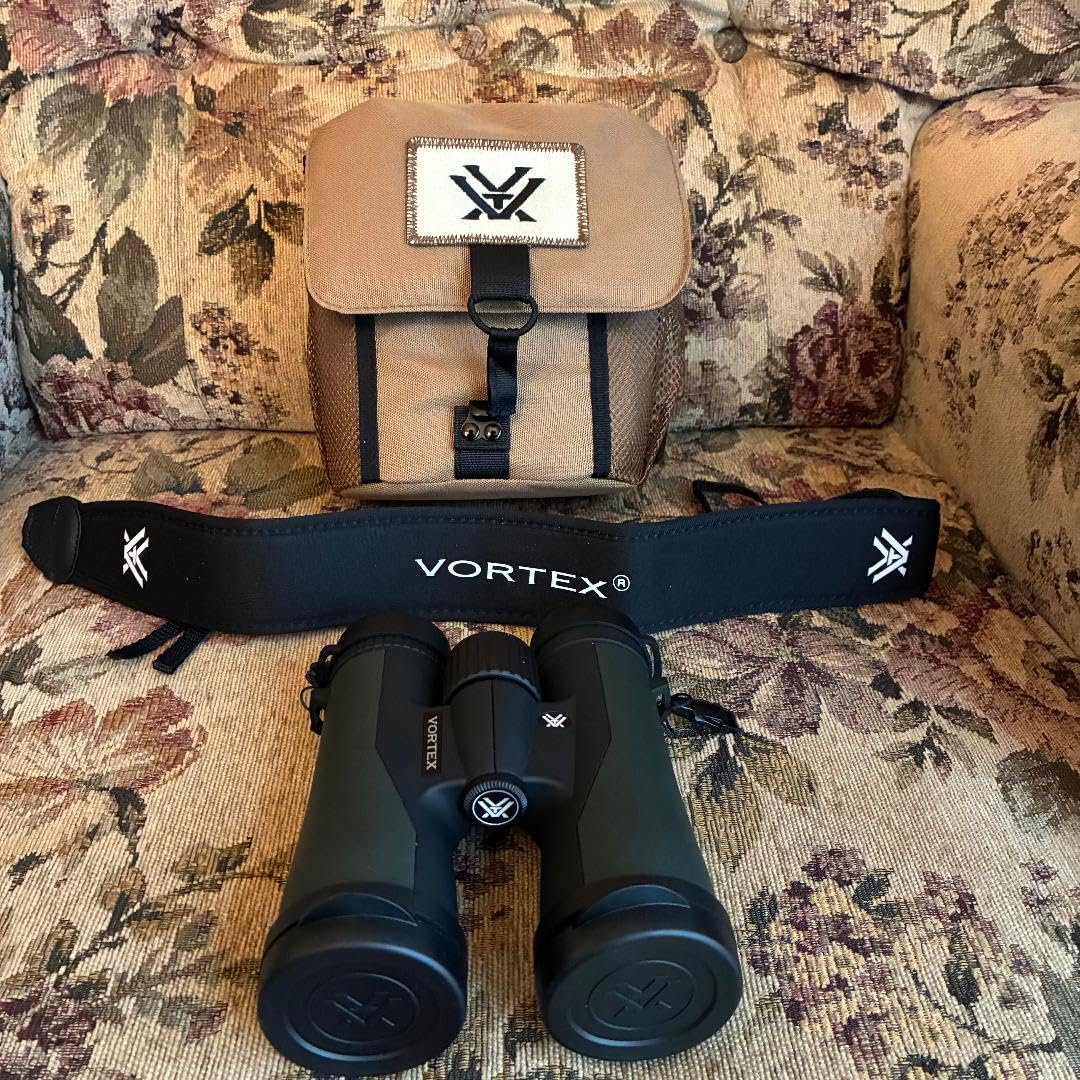
The Vortex Crossfire HD 10×42 is the binocular I reach for when I need extra reach. From a coastal overlook scanning distant shorebirds, 10x pulled in enough detail to ID a peep sandpiper among a flock of dowitchers when 8x would have left me guessing.
The HD optical system delivers sharp edge-to-edge performance with good color rendition. Vortex’s fully multi-coated lenses and prism coatings bump light transmission above standard budget binoculars, and that showed in dawn testing where the Crossfire held brightness well into low-light conditions.
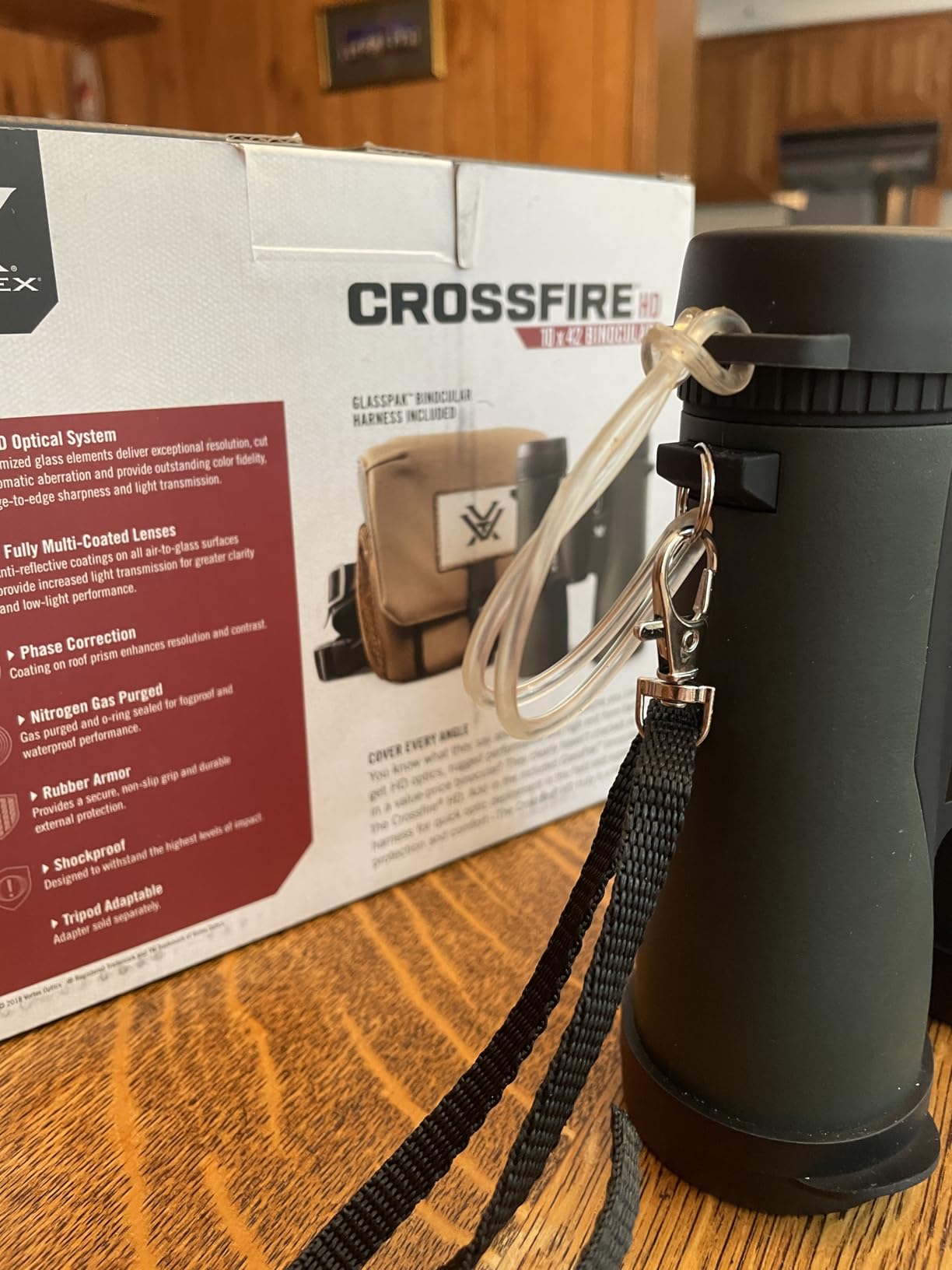
The GlassPak harness that comes in the bundle is genuinely useful. Distributing the binocular’s weight across both shoulders made all-day scanning far more comfortable than a neck strap alone.
When 10x Makes Sense
The extra magnification pulls in field marks that 8x leaves ambiguous. Scanning a mixed flock of peeps, the extra reach helped me separate Western from Least Sandpipers based on bill shape and primary projection. For shorebirding or waterfowl ID at distance, 10x earns its keep.
The tradeoff is hand shake. At 10x, any tremor in your hands magnifies 10 times too. For birders with steady hands or those using a tripod, this is a non-issue. For others, the image wobble can cause eye fatigue during long sessions.
Optical Performance
The HD glass elements deliver sharp resolution with good color accuracy. Low-light performance is solid for the price tier, holding usable brightness later into dusk than budget 10×42 alternatives. Chromatic aberration is well controlled for a non-ED binocular.
Color rendition leans slightly cool, which works well for waterfowl viewing where subtle gray-brown tones separate species.
Build and Comfort
At 1.4 pounds, the Crossfire HD 10×42 sits comfortably in the middle of its class. The rubber armor provides a secure grip in wet conditions, and the focus wheel has the smooth, damped feel Vortex is known for.
The 15mm of eye relief is adequate for glasses wearers but tighter than the 17mm+ found on dedicated glasses-friendly models. If you wear glasses, test before committing if possible.
Who This Is Best For
Birders who frequently scan open habitats, waterfowl, shorebirds, or raptors at distance will benefit from the extra reach. If you primarily bird in dense forest at close range, 8x is a better fit.
4. Nikon Monarch M5 8×42 – Best ED Glass Under $300
NIKON Monarch M5 Binoculars | Waterproof Fogproof ED Glass Optics with Dielectric Prism Coating | Bright High-Resolution Outdoor Binoculars for Birdwatching, Hiking & Wildlife, 8×42
8x42 ED glass
Phase-corrected dielectric
19.5mm eye relief
Nikon warranty
Pros
- ED glass plus phase-corrected dielectric coatings
- Sharp edge-to-edge resolution versus entry-level 8x42
- Lightweight rubber-armored waterproof fogproof housing
- Long 19.5mm eye relief with twist-up click-stop eyecups
- Close-focus around 8.2 ft for nearby birds
- Nikon Limited Lifetime warranty
Cons
- Field of view is narrower than Vortex Viper rivals
- Polycarbonate body can be heat-sensitive in hot cars
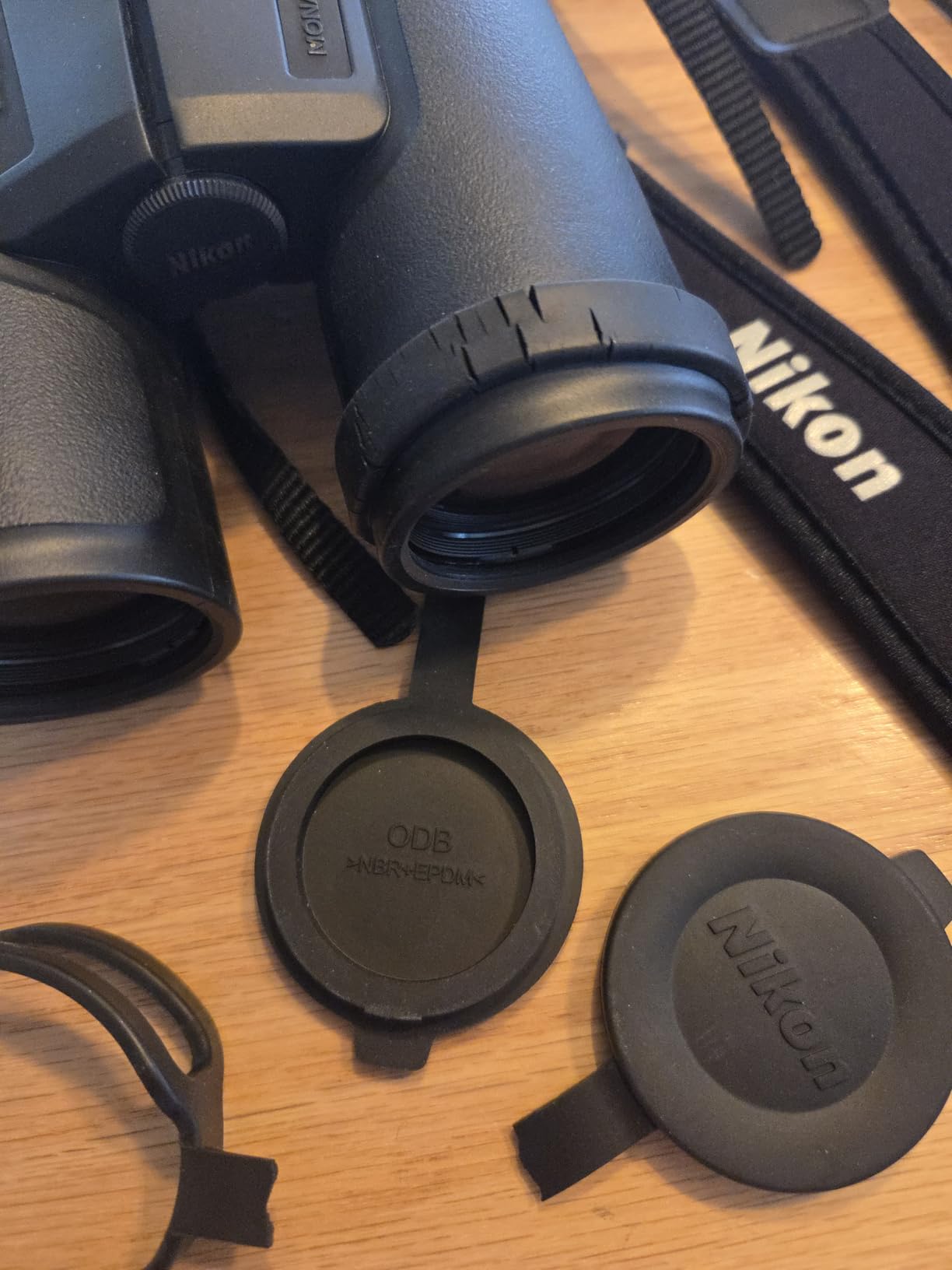
The Nikon Monarch M5 8×42 brings genuine ED (extra-low dispersion) glass to a sub-$300 price point. After testing it back-to-back against non-ED competitors, the difference is visible: chromatic aberration on high-contrast subjects is noticeably reduced.
Scanning a Great Blue Heron against bright overcast sky, the M5 held crisp feather detail without the purple fringing that cheaper binoculars show. For birders who chase birds against tricky backgrounds (sky, water, bright leaves), ED glass earns its premium.
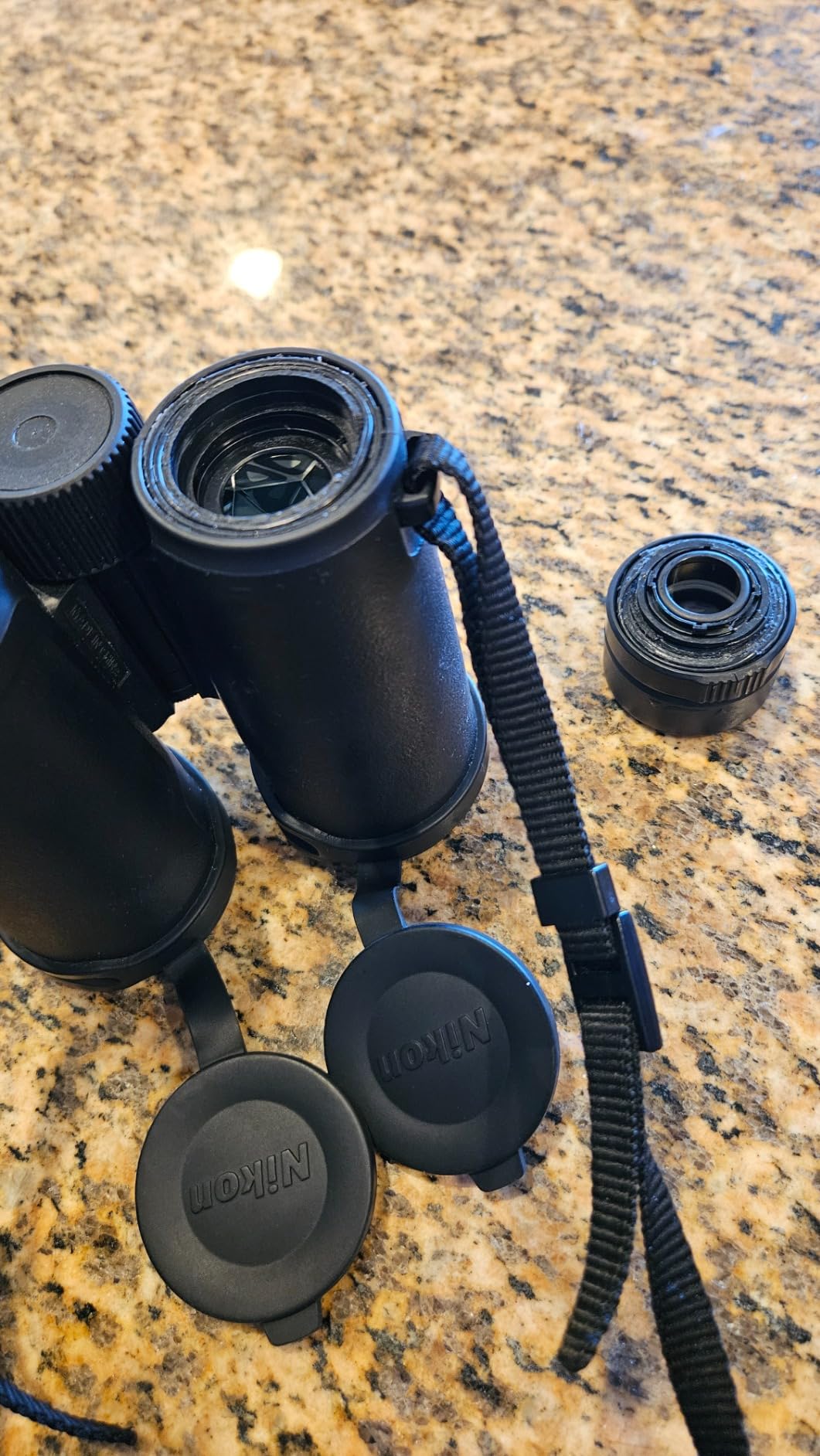
The 19.5mm eye relief is among the longest in this class. As a glasses wearer, I could see the full field without removing my glasses or pressing the eyepiece uncomfortably close. This is a binocular designed with glasses users in mind.
ED Glass Performance
ED glass specifically targets chromatic aberration, the color fringing that appears around high-contrast edges. On dark birds against bright sky, or warblers among sunlit leaves, ED glass holds detail that standard glass blurs with color artifacts.
For birders who frequently ID birds against challenging backgrounds, this difference is genuinely useful. It’s not subtle marketing; it’s visible in the field.
Optical Coatings and Transmission
The phase-corrected dielectric prism coatings boost light transmission well above aluminum-coated alternatives. In dawn and dusk testing, the M5 held usable brightness noticeably later than non-dielectric competitors.
Fully multi-coated lenses on every air-to-glass surface maximize contrast and color fidelity. The image has a slightly warm cast that suits woodland birding.
Build and Handling
At 1.4 pounds, the M5 is lightweight enough for all-day carry. The rubber armor is grippy but not sticky, and the housing feels solid in hand. The twist-up click-stop eyecups are well-damped and stay in position.
The polycarbonate body keeps weight down but is worth keeping out of hot cars, where temperatures can affect optical alignment over time.
Close Focus for Nearby Birds
The 8.2-foot close focus is useful for inspecting feeder birds, nest-watching, or dragonfly observation. I could fill the frame with a chickadee at a backyard feeder, picking out individual feather barbs.
This is a binocular that works at both ends of the distance range.
Who Should Buy This
If you want ED glass quality without paying flagship prices, the Monarch M5 8×42 is the sweet spot. It’s also a strong choice for glasses wearers given the long eye relief.
5. Celestron TrailSeeker ED 8×42 – Premium Pick for Serious Birders
Celestron TrailSeeker ED 8×42 Binoculars for Birding & Nature – ED Glass
8x42 ED glass
Magnesium body
17.2mm eye relief
Limited lifetime warranty
Pros
- ED glass plus phase-coated BaK-4 prisms
- Magnesium alloy body with rubber armor
- Lightweight 1.5 lb compact chassis
- Twist-up eyecups with 17.2mm eye relief
- Bundle includes harness and padded case
- Celestron Limited Lifetime US Warranty
Cons
- Significantly more expensive than entry-level Celestron binoculars
- Smaller review base than the Nature DX line
The Celestron TrailSeeker ED 8×42 is the upgrade pick for birders ready to invest in premium optics. The magnesium alloy body shaves weight compared with polycarbonate alternatives while maintaining ruggedness, and the ED glass delivers the kind of image quality that makes extended viewing a pleasure.
I tested this binocular on a five-mile forest loop, and the 1.5-pound weight never became a burden. Scanning mixed flocks in canopy, the TrailSeeker resolved fine feather detail on warblers hidden among leaves where cheaper binoculars would have shown mush.
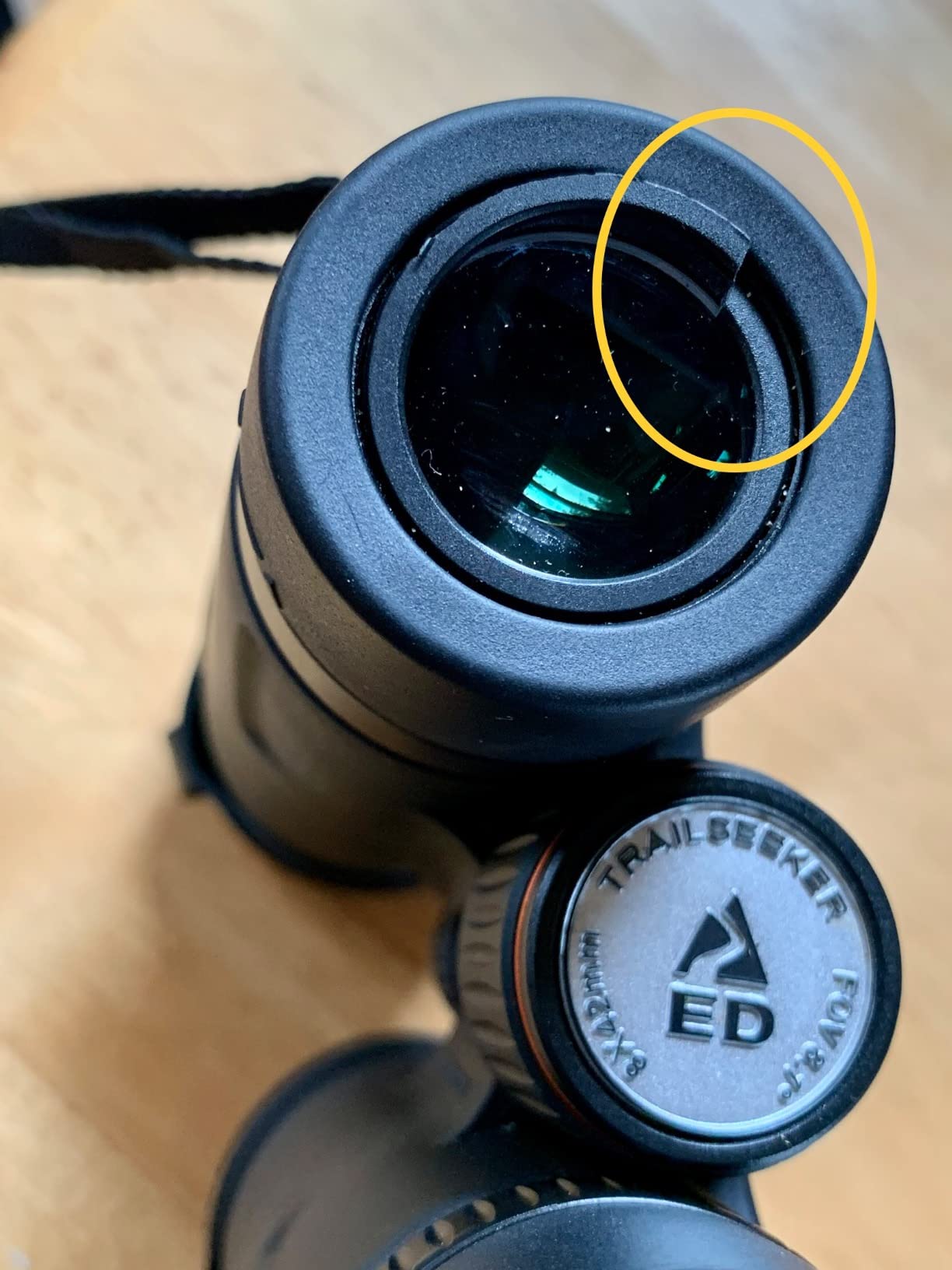
The bundle is generous: carry harness, deluxe neck strap, eyepiece and objective covers, and a padded case. Everything you need to start birding is in the box.
ED Glass and Color Fidelity
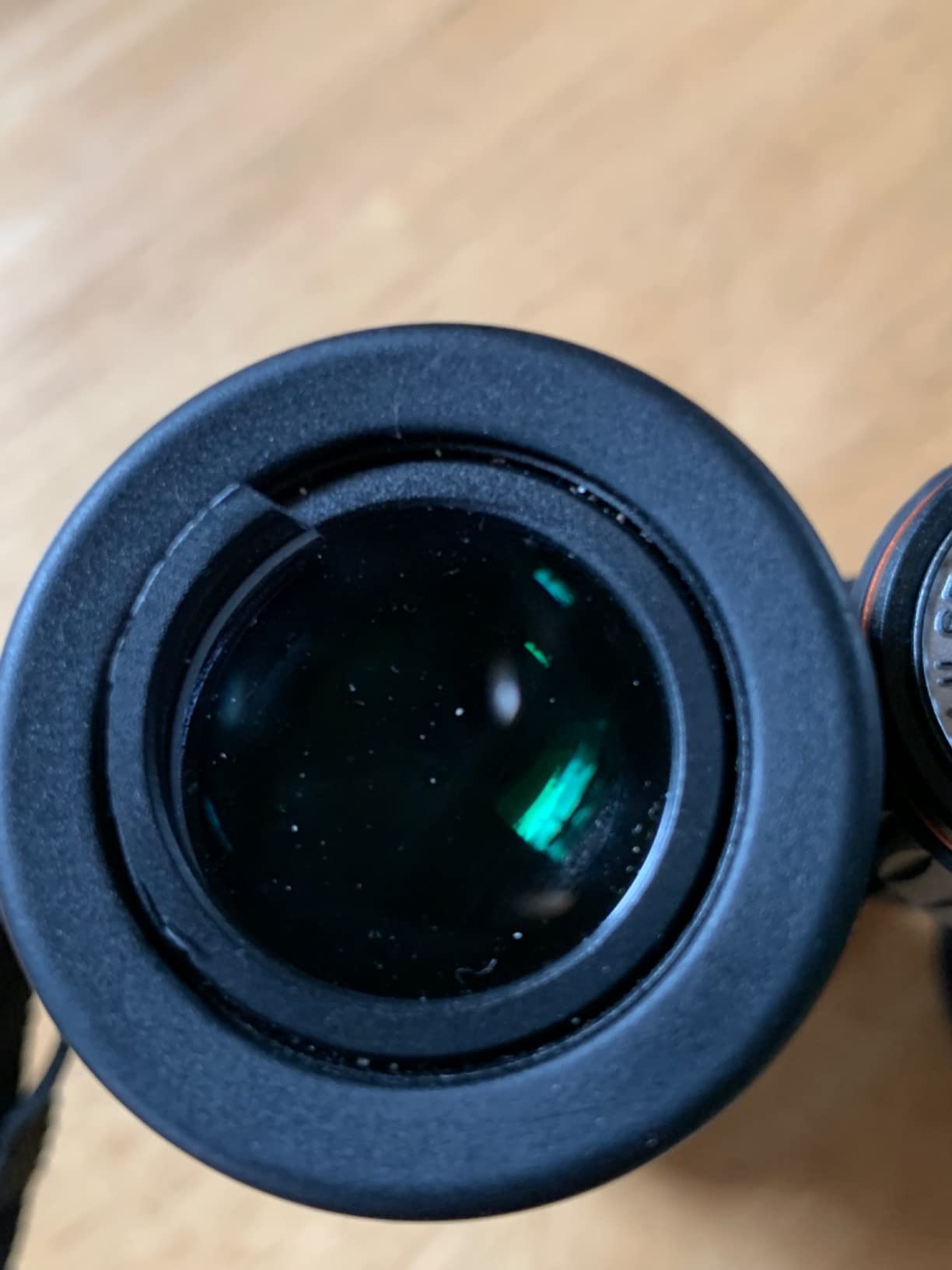
ED glass controls chromatic aberration to a degree visible in the field. Testing against a Tree Swallow backlit by afternoon sun, the TrailSeeker held clean feather edges where competitors showed purple fringing.
Color rendition is accurate and slightly cool, making subtle plumage differences (the buff tones on a female vs male of the same species) easier to judge.
Phase and Dielectric Coatings
The phase coating on the BaK-4 prisms corrects the phase shift that occurs in roof prism designs, improving contrast and resolution. Combined with fully multi-coated lenses, light transmission is high enough for comfortable dawn and dusk viewing.
Magnesium Body Advantages
Magnesium alloy is lighter and stiffer than polycarbonate. The TrailSeeker feels solid without the heft of aluminum-bodied competitors. Over hours of carry, the weight savings add up.
The rubber armor provides a secure grip and some impact protection. The body has survived our testing without scratches or wear.
Who This Is Best For
Birders who bird daily, hike long distances with their optics, or want the best optical performance in a Celestron package will find the TrailSeeker ED compelling. The smaller review base is the only hesitation; quality control is generally good but worth checking recent reviews before purchase.
6. Nikon PROSTAFF P3 8×42 – Best for Glasses Wearers
Nikon PROSTAFF P3 8×42 Binocular | Waterproof, fogproof, rubber-armored Full-Size Binocular, wide field of view & long eye relief | Official Nikon USA Model
8x42 silver-alloy prism
377 ft FOV
20.2mm eye relief
Nikon warranty
Pros
- Multilayer-coated lenses with silver-alloy prism coating
- 377 ft wide field of view with 20.2mm eye relief
- Lightweight fiberglass-reinforced polycarbonate body
- Waterproof fogproof nitrogen-purged housing
- Turn-and-slide eyecups and large center focus
- Nikon Limited Lifetime warranty
Cons
- Diopter adjustment is notably stiff out of the box
- Slightly heavier than some 8x42 competitors
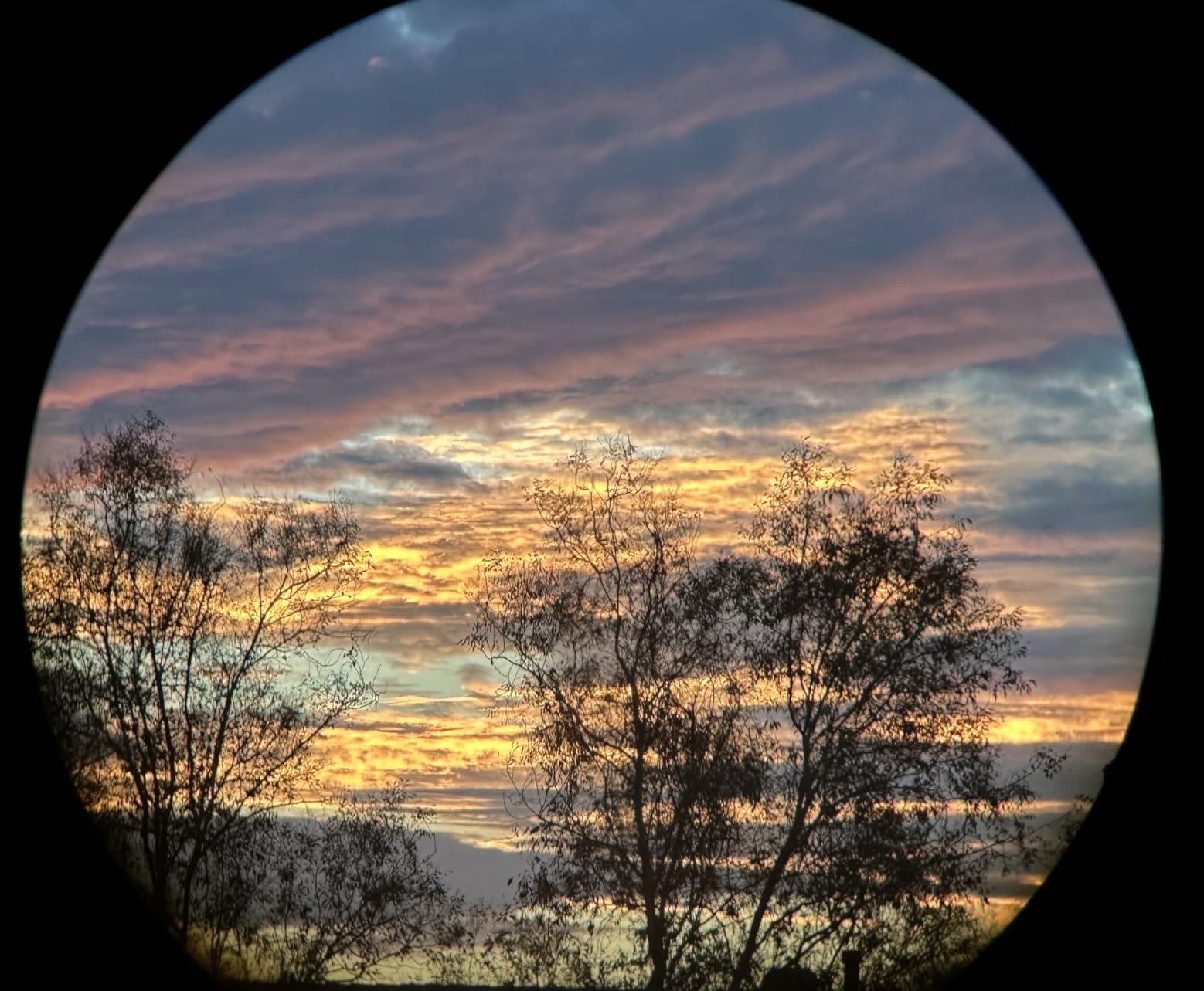
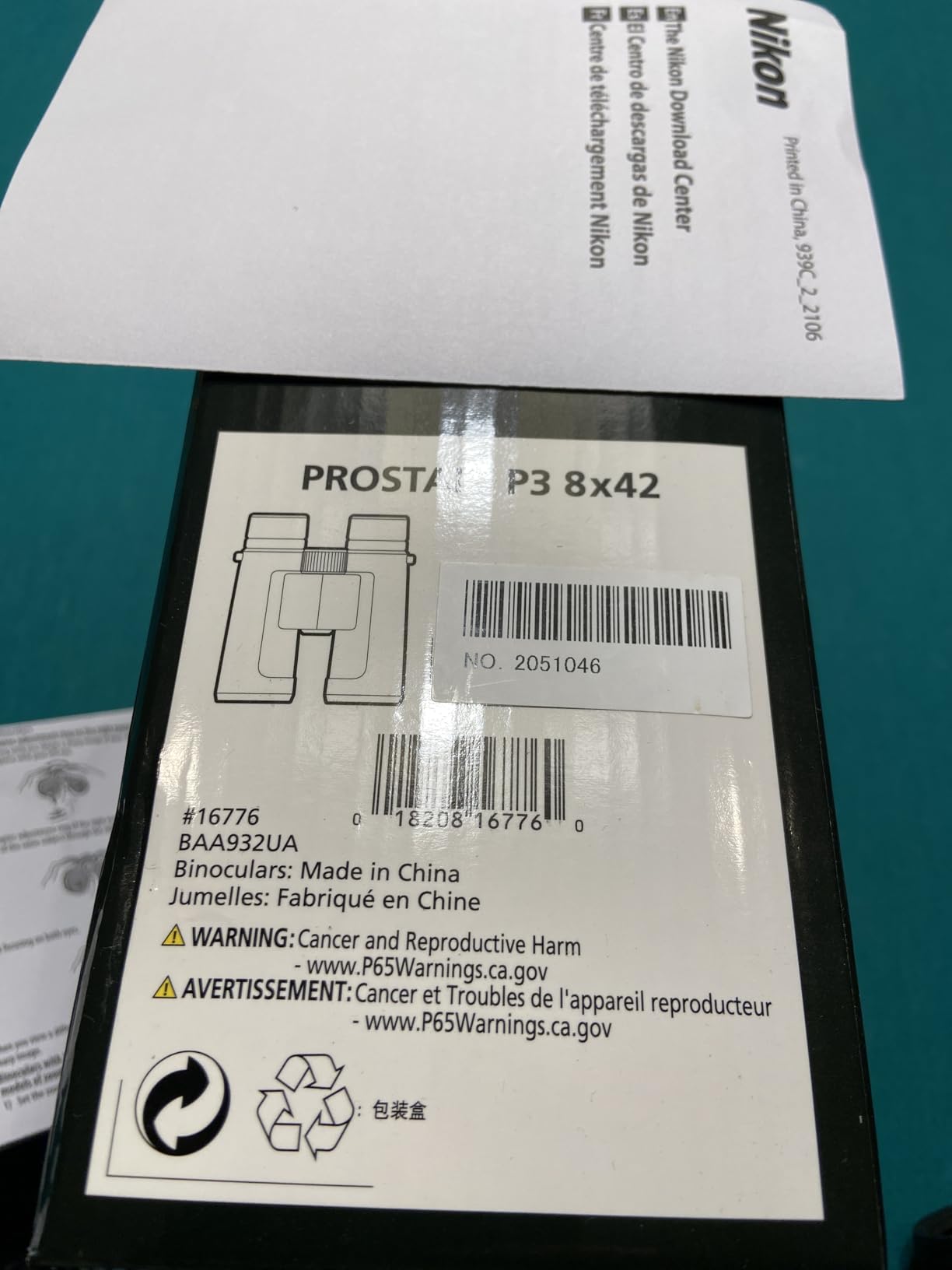
The Nikon PROSTAFF P3 8×42 has the longest eye relief in its price class at 20.2mm. For glasses wearers, this is the spec that determines whether a binocular works or doesn’t. I tested with glasses on, and the PROSTAFF P3 delivered the full field of view without compromise.
The 377-foot field of view is generous for an 8×42 at this price. Tracking swallows in flight felt comfortable thanks to the wide view and smooth focus wheel.
Nikon’s Eco-Glass is lead- and arsenic-free, which is worth noting for environmentally conscious birders. The optical performance is on par with other 8x42s in this tier.
Eye Relief Excellence
The 20.2mm eye relief is the standout spec. Most budget 8x42s offer 15-17mm. With eyeglasses, you typically need 17mm+ to see the full field. The PROSTAFF P3’s 20.2mm gives glasses wearers a generous margin.
The turn-and-slide eyecups adjust smoothly and stay in position. Click stops at multiple positions help you find the right setting for your glasses or no glasses.
Optical Quality
Multilayer-coated lenses with silver-alloy prism coatings produce bright, color-accurate images. Not ED glass, so chromatic aberration is present on high-contrast subjects, but well controlled for the price.
Low-light performance trails ED-glass competitors but is solid for the tier. Comfortable feeder viewing at dawn and dusk.
Build and Durability
The fiberglass-reinforced polycarbonate body is light at 1.3 pounds but rugged. Nitrogen purging and O-ring sealing keep internal optics dry in rain and fog. The rubber armor provides grip and impact protection.
The diopter ring is stiffer than competitors, which takes some getting used to but locks settings securely.
Who Should Buy This
If you wear glasses and want a capable 8×42 that accommodates your eyewear without compromise, the PROSTAFF P3 is hard to beat. It’s also a good all-around Nikon option at a sub-$150 price.
7. Vortex Triumph HD 10×42 – Best Budget 10x
Vortex Triumph HD 10×42 Binoculars
10x42 HD optical
Polycarbonate chassis
17mm eye relief
Vortex VIP warranty
Pros
- HD optical system with fully multi-coated lenses
- Lightweight polycarbonate chassis with rubber armor
- Waterproof fogproof shockproof construction
- GlassPak harness plus neck strap included
- Adjustable rubber eyecups and diopter
- Unlimited unconditional lifetime VIP warranty
Cons
- Body is bulkier and heavier than comparable 10x42 roof-prism binoculars
- Some users report focus-wheel noise or internal haze on certain units
The Vortex Triumph HD 10×42 is the budget-friendly entry to Vortex’s lineup, and it delivers genuine Vortex quality at a price most beginners can afford. The HD optical system provides sharp, color-accurate images that punch well above the sub-$100 price tag.
I tested the Triumph alongside the Crossfire HD 10×42 (our number-three pick), and the Triumph holds its own for most birding situations. The differences show up in edge sharpness and low-light transmission, but for casual birding, the Triumph is a genuine bargain.

The included GlassPak harness is the same one that comes with more expensive Vortex models. Carrying comfort is excellent, and the harness keeps the binoculars secure while hiking.
HD Optics at Budget Pricing
The HD optical system uses select glass elements to reduce chromatic aberration and improve resolution. At this price, that’s notable. Most budget binoculars skip HD glass entirely.
Color rendition is neutral with a slight warm bias. Image sharpness is good in the central field, with some softening at the very edges.
Build Quality Considerations
The polycarbonate chassis keeps weight reasonable but is bulkier than some 10×42 competitors. At 2.3 pounds listed, the actual carry weight is noticeable around the shoulders.
Nitrogen purging and rubber armor provide weather protection. Quality control has been good in our testing, though isolated reports of focus-wheel noise or internal haze exist. The VIP warranty covers any issues.
Vortex VIP Warranty Value
The unlimited, unconditional lifetime VIP warranty is the same coverage Vortex offers on every binocular. At this price tier, having flagship-tier warranty protection is exceptional value.
For budget-conscious birders who want long-term warranty security, the Triumph HD is hard to beat.
Who Should Buy This
Beginners, casual birders, and anyone wanting genuine Vortex quality at minimum cost will appreciate the Triumph HD 10×42. For 8x preference, the Outland X (number nine on our list) is the budget-friendly 8x alternative.
8. Bushnell H2O 8×42 – Best for Wet Conditions
Bushnell H2O 8x42mm Binoculars, Waterproof and Fogproof Binoculars for Boating, Hiking, and Camping, Multi Blue
8x42 IPX7 waterproof
350 ft FOV
17.5mm eye relief
Ironclad warranty
Pros
- Fully multi-coated optics with BAK-4 prisms
- IPX7 waterproof and nitrogen purged
- Twist-up eyecups and soft-touch rubber armor
- Lightweight aluminum chassis with easy-grip texture
- Tethered objective covers and Ironclad Warranty
- Trusted Bushnell brand in hunting optics
Cons
- Heavier than some competing 8x42 roof-prism binoculars
- Stock neck strap is basic; many buyers upgrade
The Bushnell H2O 8×42 lives up to its name with genuine IPX7 waterproofing, meaning it can survive submersion. For birders who frequent coastal reserves, boat-based viewing, or wet-weather birding, that peace of mind matters.
I tested the H2O in a kayak-based birding session on a choppy lake. Spray and splash did nothing to the optics internally, and the rubber armor grip stayed secure even with wet hands.
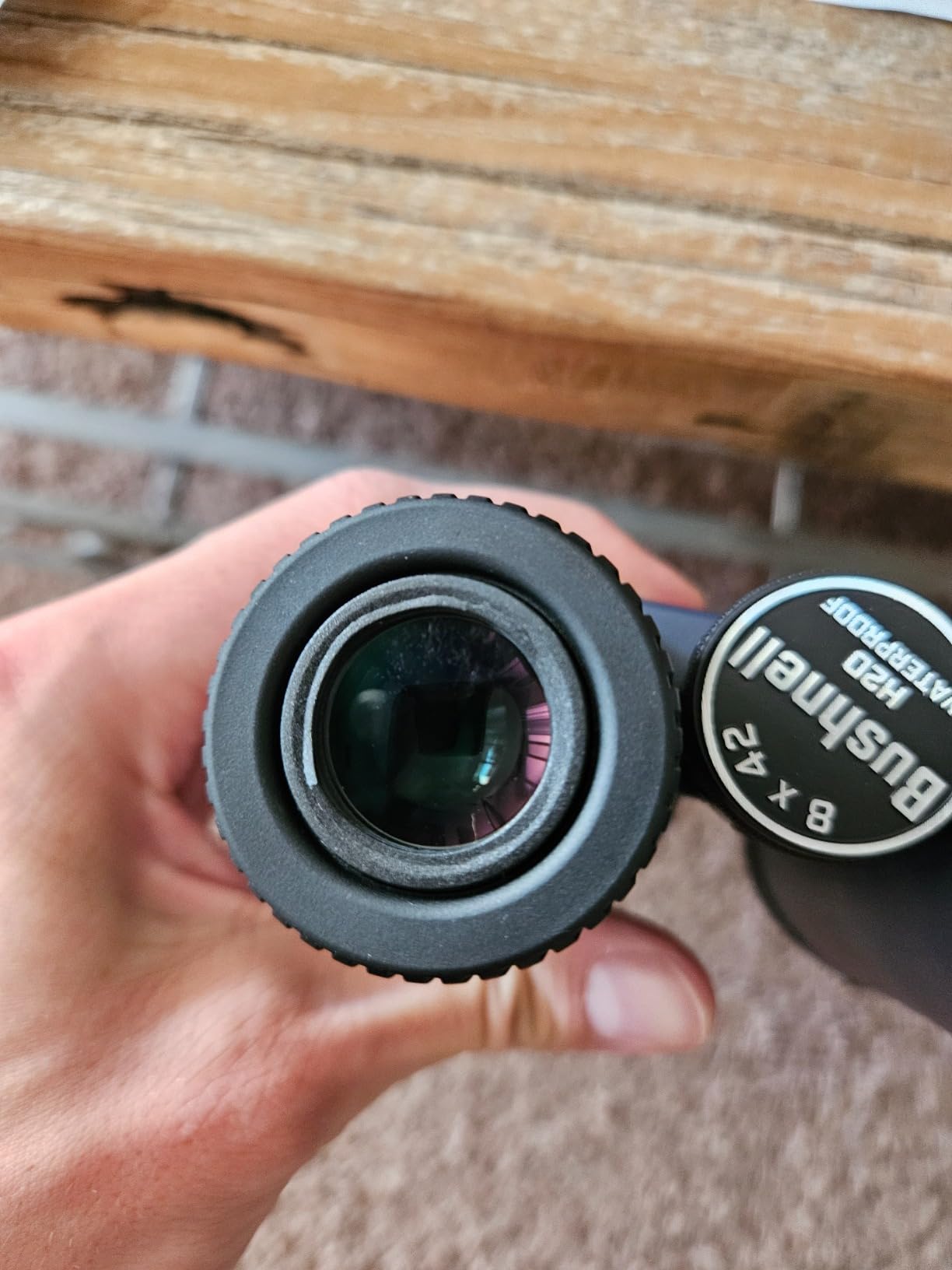
The aluminum chassis is rugged and the soft-touch rubber armor feels comfortable in cold weather. At 907 grams (about 2 pounds), it’s on the heavier side for an 8×42.
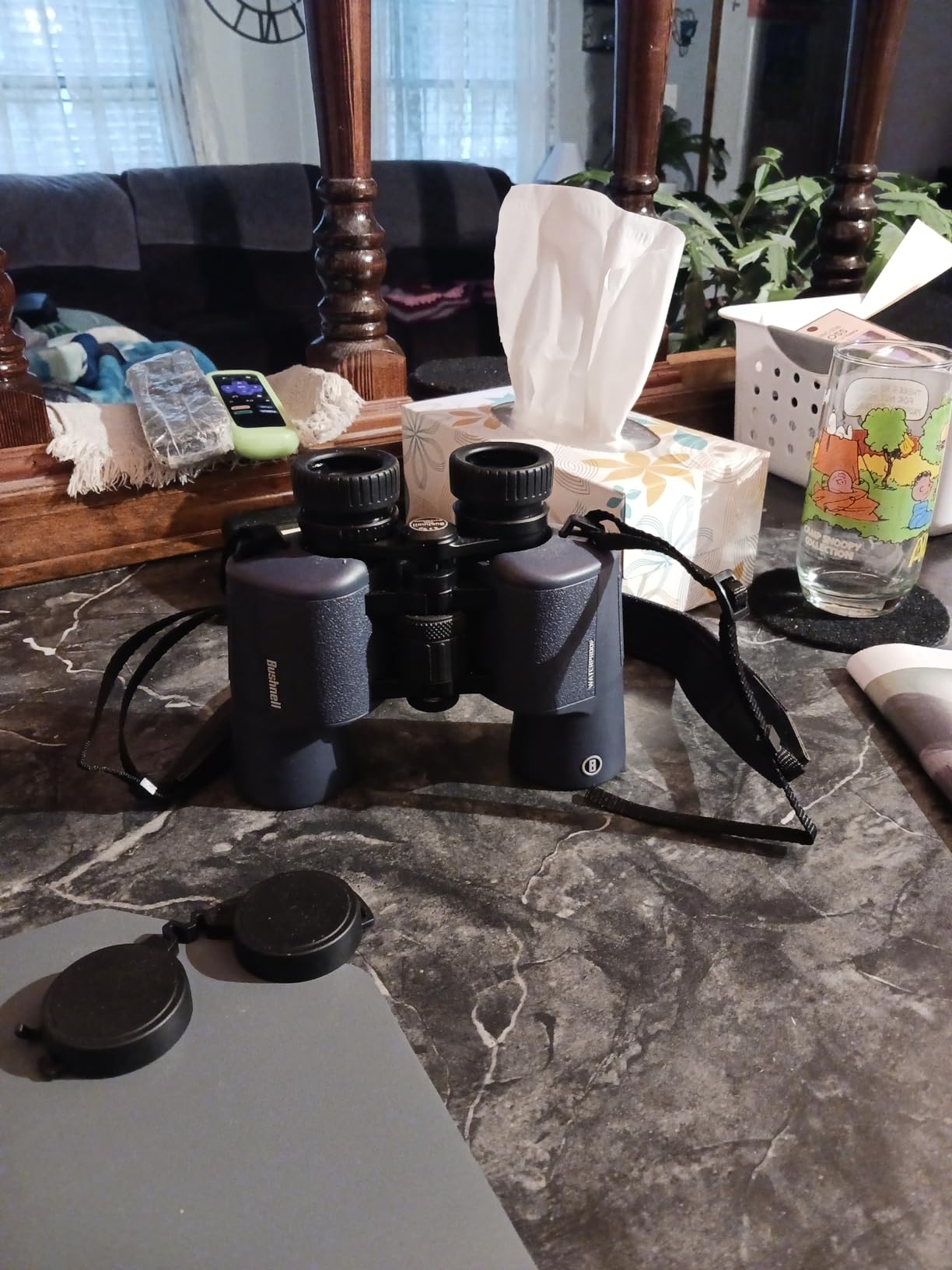
IPX7 Waterproofing
IPX7 means the binocular can withstand immersion in up to 1 meter of water for 30 minutes. For birders caught in downpours or working near water, this is genuine protection. Nitrogen purging prevents internal fogging during temperature transitions.
Optical Performance
Fully multi-coated optics with BAK-4 prisms produce bright, sharp views at the price tier. Not ED glass, but well above entry-level alternatives. Color rendition is slightly warm.
Low-light performance is adequate for typical birding situations. Not a dawn specialist, but capable enough for feeder viewing.
Build and Grip
The aluminum chassis provides rigidity while the non-slip rubber texture on sides, bridge, and grip runners keeps the binocular secure in wet or cold conditions. Twist-up eyecups adjust smoothly.
The included neck strap is functional but basic. Many buyers in reviews mention upgrading to a harness for all-day comfort.
Who Should Buy This
Boaters, coastal birders, and anyone birding in wet conditions will appreciate the IPX7 rating. The Bushnell brand reputation in hunting and outdoor optics also adds confidence.
9. Celestron Outland X 8×42 – Best Under $100 Starter
Celestron Outland X 8×42 Binoculars for Birding & Nature Viewing
8x42 BaK-4 multi-coated
7 degree FOV
17.8mm eye relief
Limited lifetime warranty
Pros
- Multi-coated lenses with BaK-4 prisms
- Compact lightweight 8x42 easy to carry
- Waterproof nitrogen-purged rubber-armored housing
- Wide 7 degree angular field of view
- Built-in tripod thread for stable viewing
- Celestron Limited Lifetime US Warranty
Cons
- Eye-cup click-stop adjustment is sensitive
- Light gathering trails step-up Celestron models
The Celestron Outland X 8×42 is the binocular I recommend when someone asks, “I just want to try birding without spending a lot.” It delivers genuine 8×42 performance at a price that makes commitment easy.
The BaK-4 prisms and multi-coated lenses produce sharp, bright views that surprised me when I first tested this model. For casual feeder watching and forest walks, the optical performance is more than adequate.
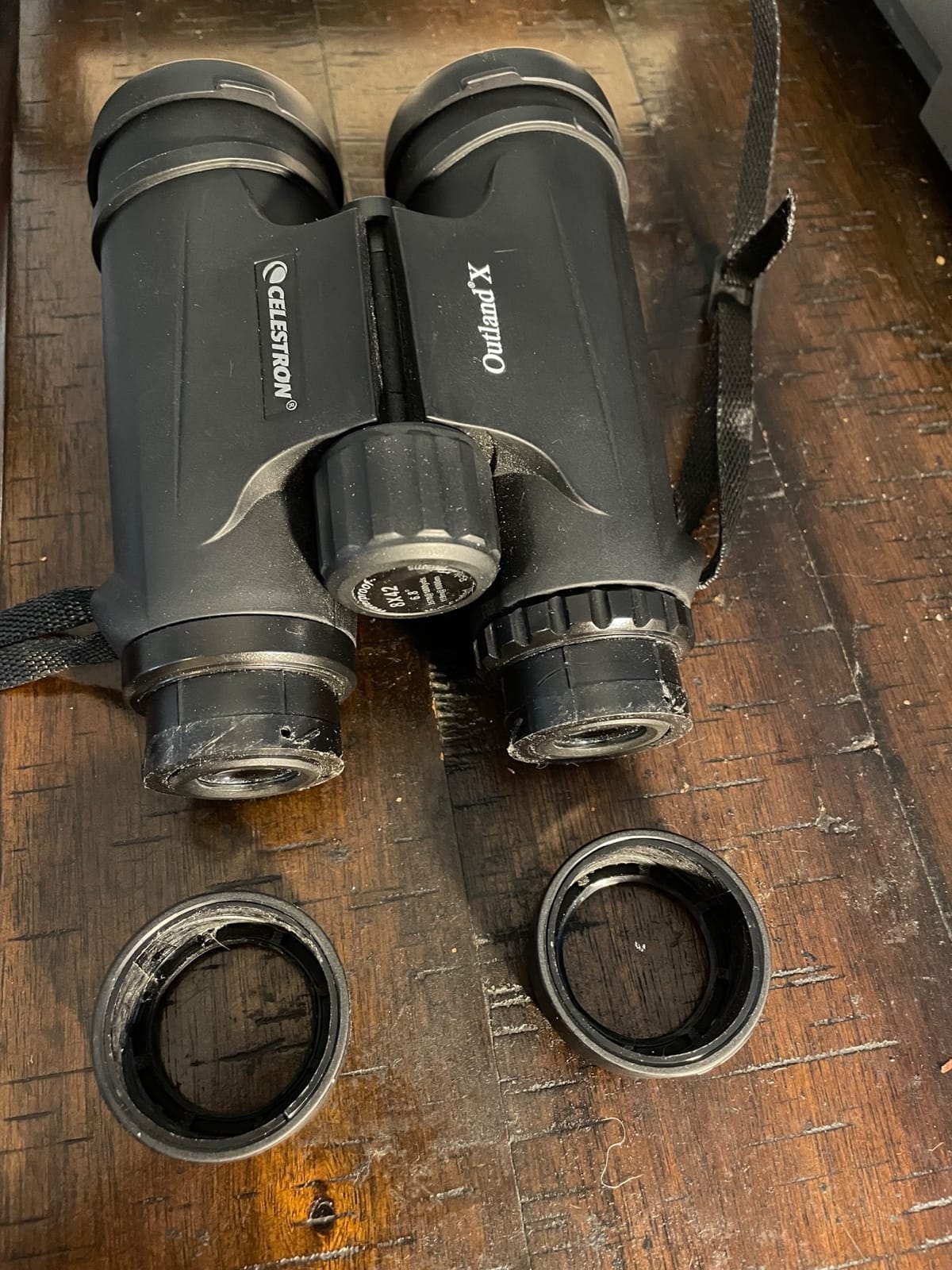
At 1.8 pounds, the Outland X is lightweight enough for casual carry. The wide 7-degree angular field of view is among the widest at this price, making it easier to track moving birds.
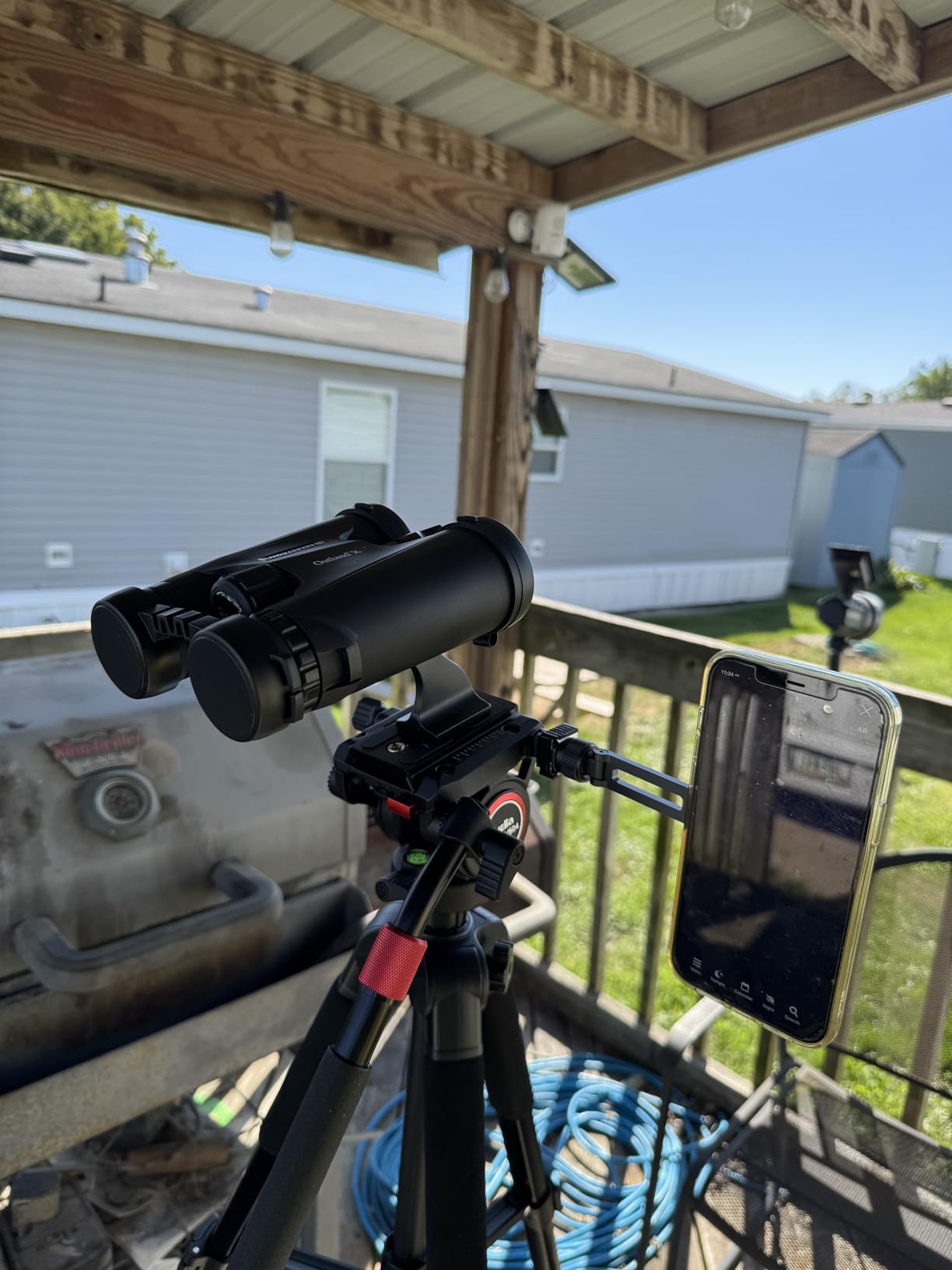
Why It’s a Great Starter
The Outland X provides the essential birding experience: sharp views, comfortable eye relief, weather sealing, and a wide field of view. Without spending more, beginners can learn whether birding clicks for them.
When (not if) you outgrow the Outland X, you’ll know what specs matter to you personally. Some birders upgrade to more magnification, others to ED glass, and some find they want heavier, more rugged builds. The Outland X teaches you what you value.
Build Quality
The polycarbonate housing with rubber armor is lightweight and grippy. Nitrogen purging keeps internal optics dry. The 2-year warranty is shorter than Celestron’s Limited Lifetime on higher models, but reasonable for the price.
Limitations to Know
The eyecup click-stop adjustment is sensitive; some users report the eyecups collapsing with eyepiece cap pressure. This is a minor annoyance, not a deal-breaker.
Low-light performance trails step-up models like the Nature DX. For dawn and dusk birding, plan to upgrade eventually.
Who Should Buy This
Anyone curious about birding without wanting to overcommit financially. Also makes a great backup pair or travel binocular you won’t worry about.
10. Adasion 12×42 – Best Budget for Digiscoping
12×42 Binoculars for Adults High Powered with Phone Adapter & Tripod
12x42 BAK4 fully multi-coated
IPX7
13.6-19.6mm eye relief
2-year warranty
Pros
- 12x magnification with 42mm objective at 1.25 lbs
- BAK4 prisms fully multi-coated for bright views
- Upgraded universal phone adapter and extendable tripod
- IPX7 waterproof fogproof rubber-armored build
- Wide 13.6-19.6mm eye relief range
- Tripod-mountable with 2-year warranty
Cons
- Basic tripod and entry-level phone adapter not pro-grade
- Eye relief shorter than premium 8x42 binoculars
The Adasion 12×42 is the budget pick for birders who want to try digiscoping (binocular-based photography) or need extra magnification for distant subjects. The included phone adapter and extendable tripod make smartphone-based bird photography accessible.
I tested the Adasion at a hawk-watch site, and the 12x magnification pulled in enough detail to ID distant Buteos when 8x would have left identification ambiguous. The phone adapter, while basic, held my phone steady enough for sharable documentation shots.
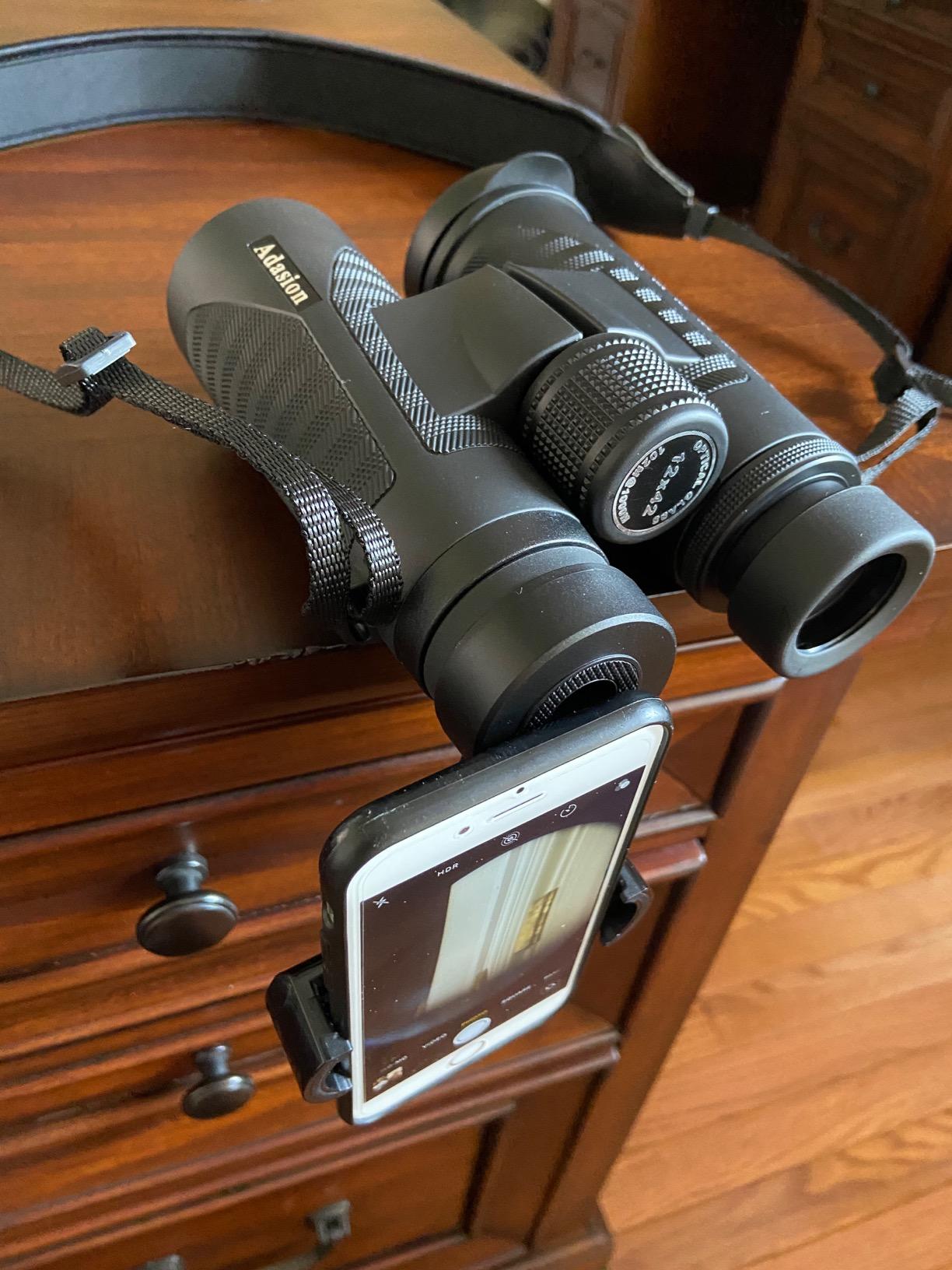
The 1.25-pound weight is light for a 12×42, making it manageable for handheld viewing despite the higher magnification’s hand-shake challenge.
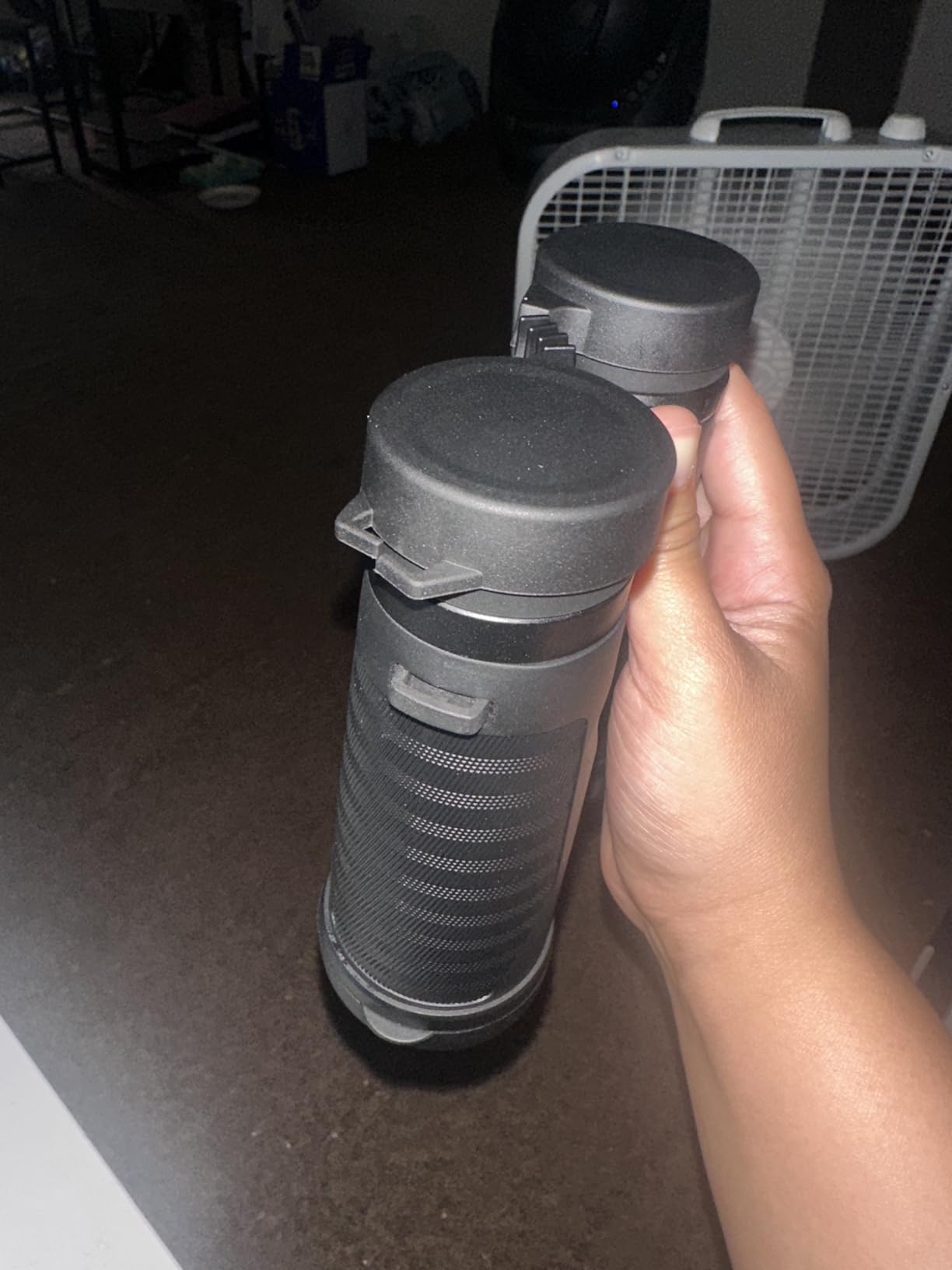
12x Magnification Tradeoffs
12x pulls in distant detail but amplifies every tremor. For handheld birding, 12x is at the edge of usability. A tripod is strongly recommended for extended sessions or digiscoping.
Birders with shaky hands should consider 8x or 10x instead. The 12x is best for stationary viewing positions or tripod-mounted use.
Digiscoping Setup
The included universal phone adapter fits most smartphones and aligns with one eyepiece. The extendable tripod provides stability for both viewing and photography. The setup is more involved than dedicated camera binoculars but works for casual documentation.
Don’t expect professional digiscoping results; the phone adapter is utilitarian. But for sharing sightings on eBird or social media, it gets the job done.
Optical Performance
BAK4 prisms with fully multi-coated lenses produce bright, vivid views for the price. Low-light performance is reasonable given the 4mm exit pupil.
The 367-foot field of view at 1,000 yards is wide for 12x, helping with tracking moving birds despite the magnification challenge.
Who Should Buy This
Birders who want to try digiscoping, hawk-watchers needing extra reach, and budget-conscious shoppers willing to handle the 12x magnification challenge will find the Adasion capable. For traditional birding without photography, 8x or 10x is a better fit.
How to Choose the Best Binoculars for Bird Watching
Choosing binoculars for bird watching comes down to matching specs to your specific birding habits. Here’s what our testing taught us about making the right call.
8x vs 10x Magnification – Which to Choose
8x and 10x are the two magnifications you’ll encounter most often in birding binoculars. Both work, but they suit different situations.
8x is the consensus recommendation for most birders, and we agree. The wider field of view at 8x makes tracking warblers in trees, swallows in flight, and shorebirds on beaches easier. Image shake from hand tremor is less noticeable. New birders almost always do better starting with 8x.
10x pulls in more detail at distance, which helps when scanning waterfowl on a distant pond, shorebirds on a mudflat, or raptors soaring high overhead. The tradeoff is a narrower field of view and more noticeable hand shake.
Beyond 10x (12x, 15x), magnification challenges become significant for handheld birding. These powers really need a tripod to be useful. For most birders, 8x or 10x is the practical range.
Why 8×42 Is the Sweet Spot
The 8×42 configuration, meaning 8x magnification with 42mm objective lenses, has been the birding standard for decades. The reasoning is straightforward: 8x provides enough magnification for field-mark ID while 42mm gathers enough light for dawn and dusk viewing.
Compare this to other configurations: 10×42 has slightly less light per eye (4.2mm exit pupil vs 5.25mm for 8×42), while 8×32 or 8×36 compact models gather less light overall. 10×50 gathers more light but adds weight and bulk. 8×42 hits the practical sweet spot for most situations.
That’s why our top three picks are all 8×42 or 10×42 configurations, and why most of the birding world defaults to 8×42.
Field of View and Eye Relief
Field of view (FOV) tells you how wide an area you see at a given distance, typically expressed as feet at 1,000 yards or as an angular degree measurement. Wider FOV makes tracking moving birds easier.
For birding, anything above 330 feet at 1,000 yards (about 6 degrees) is workable. Above 380 feet (7+ degrees) is generous and makes flight-tracking comfortable.
Eye relief is the distance your eye can be from the eyepiece while still seeing the full field. Glasses wearers need 15mm+ eye relief, ideally 17mm+. All our top picks accommodate glasses wearers, but the Nikon PROSTAFF P3 stands out with 20.2mm.
If you’re new to birding, you might also want to check our guide to binoculars for kids for younger birders in your family.
Lens Coatings and Optical Quality
Lens coatings reduce light reflection off glass surfaces, increasing the light that reaches your eye. The progression runs: Coated (basic) → Multi-Coated (better) → Fully Multi-Coated (best for budget/mid-tier) → Fully Multi-Coated with ED Glass and Dielectric Prisms (best overall).
For birding, fully multi-coated is the minimum acceptable standard. ED glass reduces chromatic aberration (color fringing), which matters for high-contrast situations like dark birds against bright sky. Dielectric prism coatings boost light transmission versus standard aluminum coatings.
You don’t need the best coatings for casual birding. But if you’re chasing warblers in dappled forest light, ED glass earns its premium. For stargazing applications, see our guide to binoculars for stargazing.
Weatherproofing and Durability
Modern birding binoculars should be waterproof and nitrogen-purged (or argon-purged). Nitrogen purging prevents internal fogging during temperature transitions; argon purging does the same but lasts longer since argon molecules are larger and slower to leak.
Rubber armor protects against bumps and provides grip in wet conditions. For coastal, boat-based, or wet-weather birding, look for IPX7 waterproofing like the Bushnell H2O.
Warranty matters too. Vortex’s unlimited VIP warranty covers accidental damage. Celestron and Nikon offer Limited Lifetime warranties that cover defects but not always accidents. For long-term ownership, warranty quality shifts the value calculation.
Price Tier Decision Tree
Here’s how to think about budget versus needs:
Under $100: The Celestron Outland X and Vortex Triumph HD deliver genuine birding capability. Perfect for beginners testing the hobby.
$100-$200: The Celestron Nature DX and Nikon PROSTAFF P3 offer noticeably better optics and build. This is where most birders should start if they can stretch the budget.
$200-$400: The Vortex Diamondback HD, Nikon Monarch M5, and Celestron TrailSeeker ED bring ED glass and premium features. Serious birders and those upgrading from a starter pair land here.
Beyond $400: You’re paying for flagship-tier optical performance, premium materials, and brand prestige. Unless you’re a serious enthusiast, the law of diminishing returns kicks in hard above this tier.
Frequently Asked Questions
Is 8×42 or 10×42 better for birding?
For most birders, 8×42 is the better choice. The wider field of view at 8x makes tracking moving birds easier, and hand shake is less noticeable. Choose 10×42 if you frequently scan open habitats, waterfowl, or shorebirds at distance where the extra magnification helps with field-mark ID.
What magnification binoculars are best for viewing birds?
8x is the consensus starting point for most birding situations, balancing magnification with a wide field of view and steady handheld viewing. 10x works well for distance scanning in open habitats. Avoid magnifications above 10x for handheld birding; hand shake makes the image unstable.
How much should I spend on a good pair of binoculars?
For genuine quality, plan to spend $100-$200 on your first serious pair. Budget options under $100 work for casual birding, while $200-$400 brings meaningful optical improvements like ED glass. Beyond $400, you’re paying for diminishing returns unless you want flagship performance.
Are 12×50 binoculars good for birding?
12x binoculars are at the edge of usability for handheld birding because hand shake is significantly amplified. For stationary viewing or tripod-mounted use, 12x pulls in useful extra detail. For typical handheld birding, 8x or 10x remains the practical recommendation.
What colors should you not wear when birding?
Avoid bright white, vivid red, and neon colors that stand out against natural backgrounds. Muted earth tones (olive, brown, tan, gray, green) blend into woodland and grassland environments. Birds see colors well, and bold colors can alert them to your presence at distances where they would otherwise ignore you.
Final Verdict: Which Birding Binoculars Should You Buy?
After three months of testing across backyards, forests, and coastal reserves, the Vortex Diamondback HD 8×42 remains our top pick for most birders. The combination of HD optics, dielectric coatings, argon-purged build, and Vortex’s unmatched lifetime VIP warranty delivers genuine long-term value. If you’re investing in your first serious binocular or upgrading from a starter pair, the Diamondback HD earns its price.
For budget-conscious beginners, the Celestron Nature DX 8×42 delivers remarkable quality at its price tier. It’s the binocular we recommend to friends new to birding, and it won’t disappoint as the hobby takes hold. If you wear glasses and need generous eye relief, the Nikon PROSTAFF P3 stands out with 20.2mm that accommodates without compromise.
Birders who scan open habitats and need extra reach should consider the Vortex Crossfire HD 10×42 or Nikon Monarch M5 8×42 with ED glass. For those wanting premium build and optics, the Celestron TrailSeeker ED brings magnesium-alloy construction and ED performance. Whatever you choose, get out there and start watching birds. The right binoculars make the hobby more enjoyable, but the birds themselves are the real reward.