
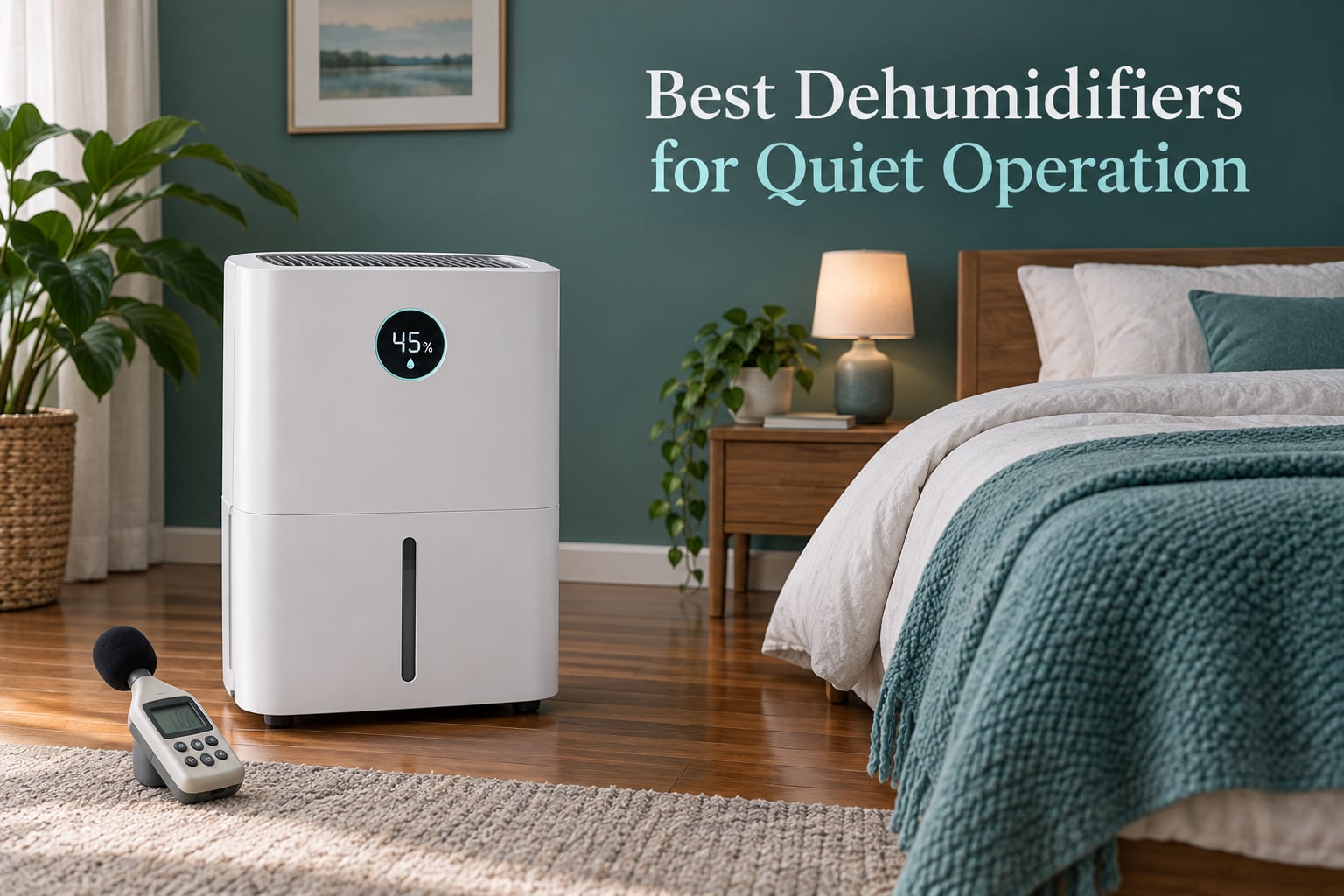
A quiet dehumidifier is one whose published noise rating sits below roughly 45 decibels, which is about the level of a refrigerator hum. Below 40 dB you can run it overnight in a bedroom or beside a desk without competing against sleep or conversation. Anything at 50 dB and above is a laundry-room or utility-room machine, and the r/Appliances quiet-dehumidifier thread treats published dB claims skeptically for exactly that reason.
That is the whole problem with most quiet-dehumidifier roundups. They treat quiet as one adjective in a bullet list. For the best dehumidifiers for quiet operation, we did the opposite: every pick below carries a stated decibel figure, and we label where that figure comes from, because manufacturer ratings are almost always measured at a fixed distance with the fan at its lowest setting. Published numbers are a starting point for judging a machine, not a promise about what you hear at 3am.
We also kept a hard line on capacity, because a machine that is silent but cannot pull moisture from a damp basement is not a solution. Each of the ten models below is rated in pints per day, mapped to a coverage area, and checked for the drainage and energy details that decide whether you will actually keep it running. If noise is the factor you obsess over in other categories too, we apply the same decibel-first method to the quietest massage guns and laptop cooling pads we have covered.
Our Top 3 Quiet Dehumidifiers for Large Rooms, Bedrooms and Small Spaces
The Waykar 120 Pint leads this group because it pairs a 40 dB low-speed setting with more owner reviews than any other model here. The Waykar 23 Pint is the quietest compressor machine in the roundup at 35 dB, and the AEOCKY 50 Pint holds 40 dB while moving 50 pints a day. Those three cover most household situations between them.
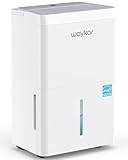
Waykar 120 Pint 6000 Sq Ft
- 40 dB on low and 55 dB at max
- Up to 120 pints per day
- 2025 Energy Star certified
- 6.56 ft continuous drain hose


AEOCKY 50 Pint 40 dB
- 40 dB even at the highest setting
- 50 pints per day
- 3500 sq ft
- 3-year machine warranty
Every Pick Compared: dB, Capacity, Coverage and Drainage
This table is the fastest way to scan the roundup. Two figures deserve attention before anything else: the noise rating, which is the reason this article exists, and the tank size, which decides how often you carry water downstairs.
| Product | Specs | Action |
|---|---|---|
| Waykar 120 Pint 6000 Sq Ft |
|
Check Latest Price |
| HUMILABS 30 Pint 36 dB |
|
Check Latest Price |
| AEOCKY 50 Pint 40 dB |
|
Check Latest Price |
 Tenergy Sorbi 1000ml Tenergy Sorbi 1000ml |
|
Check Latest Price |
 BREEZOME 60 oz Dual-Semiconductor BREEZOME 60 oz Dual-Semiconductor |
|
Check Latest Price |
 HOGARLABS 30 Pint Ultra Silent HOGARLABS 30 Pint Ultra Silent |
|
Check Latest Price |
 Gasbye 4500 Sq Ft Energy Star Gasbye 4500 Sq Ft Energy Star |
|
Check Latest Price |
 Waykar 23 Pint 35 dB Waykar 23 Pint 35 dB |
|
Check Latest Price |
 Uhome 30 Pint 39 dB Uhome 30 Pint 39 dB |
|
Check Latest Price |
 SereneLife 91 oz 2-in-1 SereneLife 91 oz 2-in-1 |
|
Check Latest Price |
How We Picked: dB Verification and Review Thresholds
Selection rules were simple and stated up front. We required a published noise rating or a consistent owner noise description, a review count high enough for the noise reports to be meaningful, and a specification sheet that tells us how the machine drains and how much it draws.
Where a manufacturer publishes a decibel figure, we report it as manufacturer spec. Where the figure comes from owner descriptions, we say so in the copy. We did not measure these machines in an anechoic chamber, and this article makes no claim that it did. If a listing gives no decibel rating at all, we tell you rather than inventing a figure.
1. Waykar 120 Pint 6000 Sq Ft – Best Overall at 40 dB on Low With 3,902 Owner Reviews
Waykar 6000 Sq.Ft Energy Star Dehumidifier for Basement & Home, 120 Pint/Day with Drain Hose & Tank, Ultra Quiet (40 dB), Smart Auto Comfort Mode
40 dB on low / 55 dB max
Up to 120 pints/day
6,000 sq ft
470W
Pros
- Low setting holds 40 dB for a 120-pint compressor
- Most reviewed model in this roundup
- Auto Comfort Mode adjusts target humidity by room temperature
- Continuous 6.56 ft drain hose included
- 2025 Energy Star certified
Cons
- Reaches 55 dB at maximum
- 1.24 gal tank fills daily without a hose
- Some owners report failure around the one-year mark
This is the strongest all-round case for quiet operation with real capacity behind it. Manufacturer spec puts it at 40 dB on the low fan setting and up to 55 dB at maximum, so the number you actually live with depends entirely on which mode the humidistat is running. Owners describe a damp basement turning dry within days, which is the outcome that matters more than the decibel reading.
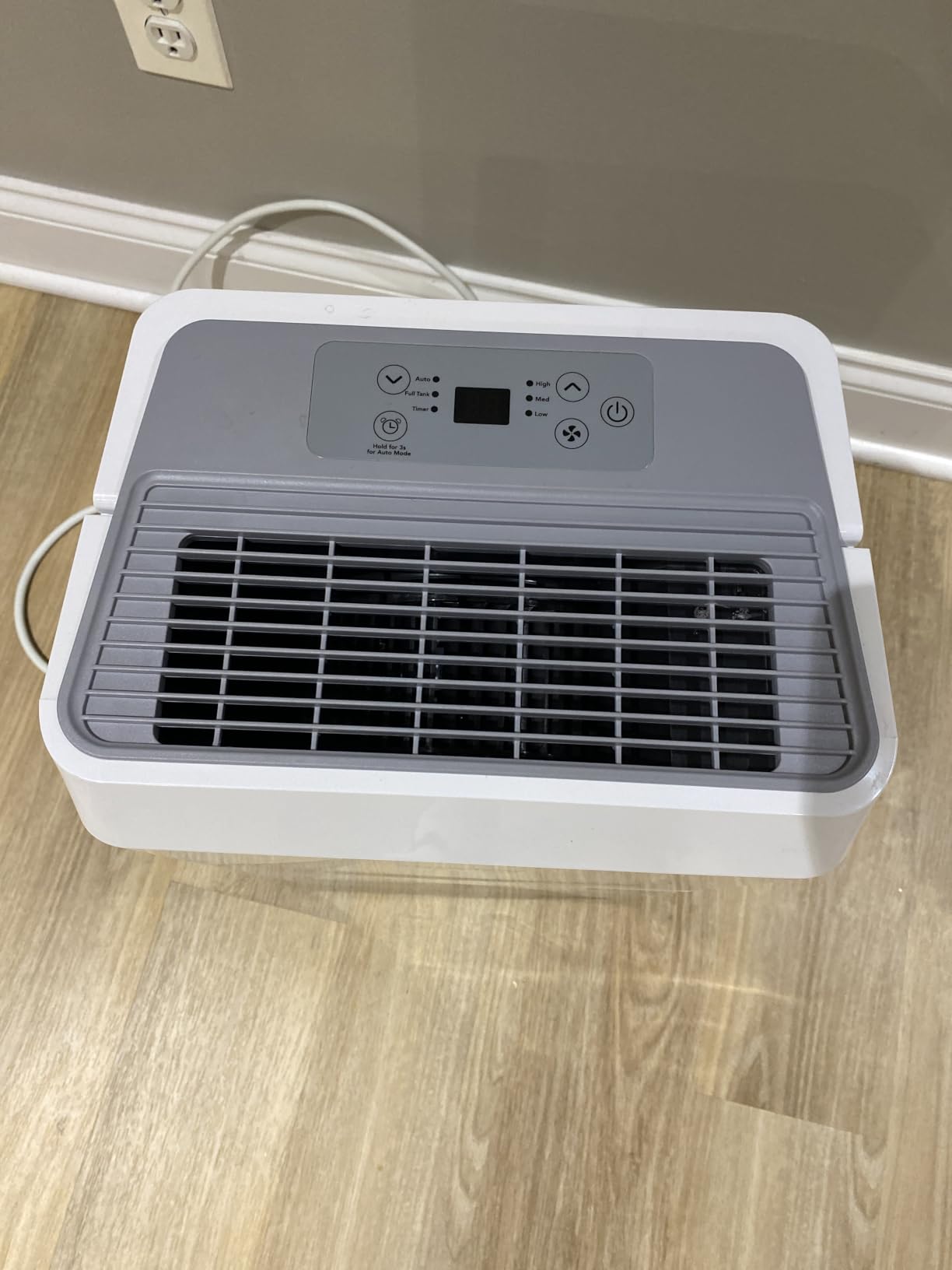
The Smart Auto Comfort Mode is the feature I would not give up. It shifts the target humidity as room temperature changes, which means the machine spends more of its life cycling gently instead of running flat out. That directly reduces the hours the compressor spends at full tilt, and full tilt is where the noise lives.
Where the 40 dB Figure Holds and Where It Does Not
At 40 dB the low setting is quieter than a refrigerator hum, which is the practical threshold for a finished basement or a home office. Push to maximum and you reach 55 dB, and that is a conversation-level machine. Owners running this in a bedroom typically set the humidity target so the humidistat rarely calls for full speed.
Extraction and Drainage for a Real Basement
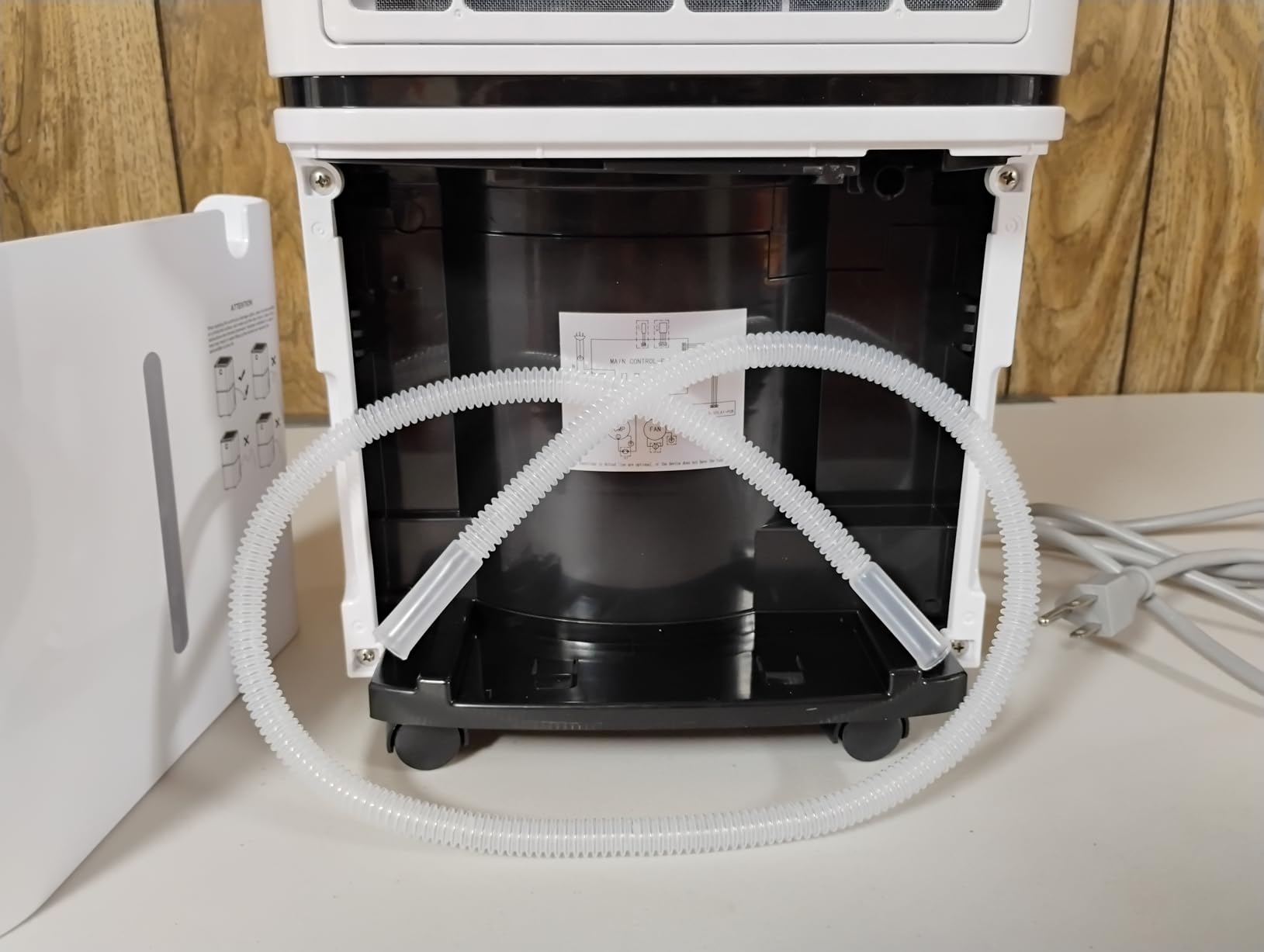
Up to 120 pints per day across 6,000 square feet is more than most basements need, which is useful when you have not measured your square footage accurately. The 1.24 gallon tank is small for a machine this size, so plan on the included 6.56 foot drain hose running to a floor drain before you need it.
Auto-defrost reaches down to 42F, so cool basements do not freeze the coil solid. The unit weighs 28.8 pounds, and the built-in wheels matter more than the spec suggests when the only route is up basement stairs.
Who Should Buy This and Who Should Not
Buy it if you have a large, genuinely damp basement and want the option of running the compressor hard without the room becoming unbearable. The Energy Star 2025 certification using 40% less electricity matters here, since a machine this size left on continuously is a real line on the meter.
Skip it if the job is a bedroom or a closet. At 28.8 pounds and up to 55 dB at maximum, it is the wrong shape and the wrong weight for a bedside table. A cluster of owners reports units failing around the one-year mark, though the free replacement service is cited repeatedly as a reason the frustration is tolerable.
2. HUMILABS 30 Pint 36 dB – A Genuinely Bedside-Compatible Compressor Unit
2000 Sq.Ft Dehumidifier for Basement Home Bedroom Bathroom – 36 dB 30 Pint
36 dB
30 pints/day
2,000 sq ft
0.53 gal tank
Pros
- 36 dB is a bedside-friendly compressor rating
- Real sleep mode that disables all lights
- Compact body suits small rooms
- Auto shut-off with tank-full indicator
- Included 3.3 ft drain hose
Cons
- 0.53 gal tank needs emptying several times daily
- Spill-prone tank handling
- Top panel is dim and hard to read
At a published 36 dB, this is one of only two compressor machines in the group rated low enough for a bedroom, and owners describe the compressor noise as acceptable for sleeping. A real compressor paired with a bedside-friendly rating is rare. The trade is extraction: 30 pints per day covers 2,000 square feet, which is a bedroom, a home office or a small finished basement rather than a whole wet basement.
Three modes cover fast drying, automatic control and sleep, and the sleep mode kills the indicator lights entirely, which matters more than most spec sheets admit. Several owners report buying more than one after the first worked, and measuring 25 to 30 pints per day in large humid rooms matches the rated figure.
Why the Tank Is the Real Limitation
The 0.53 gallon reservoir is the single most repeated complaint in the reviews. In humid conditions it fills several times a day, and the tank design makes it easy to spill when you detach it. The fix is straightforward: attach the included 3.3 foot hose to a floor drain and stop thinking about it.
Control Panel and Practical Details
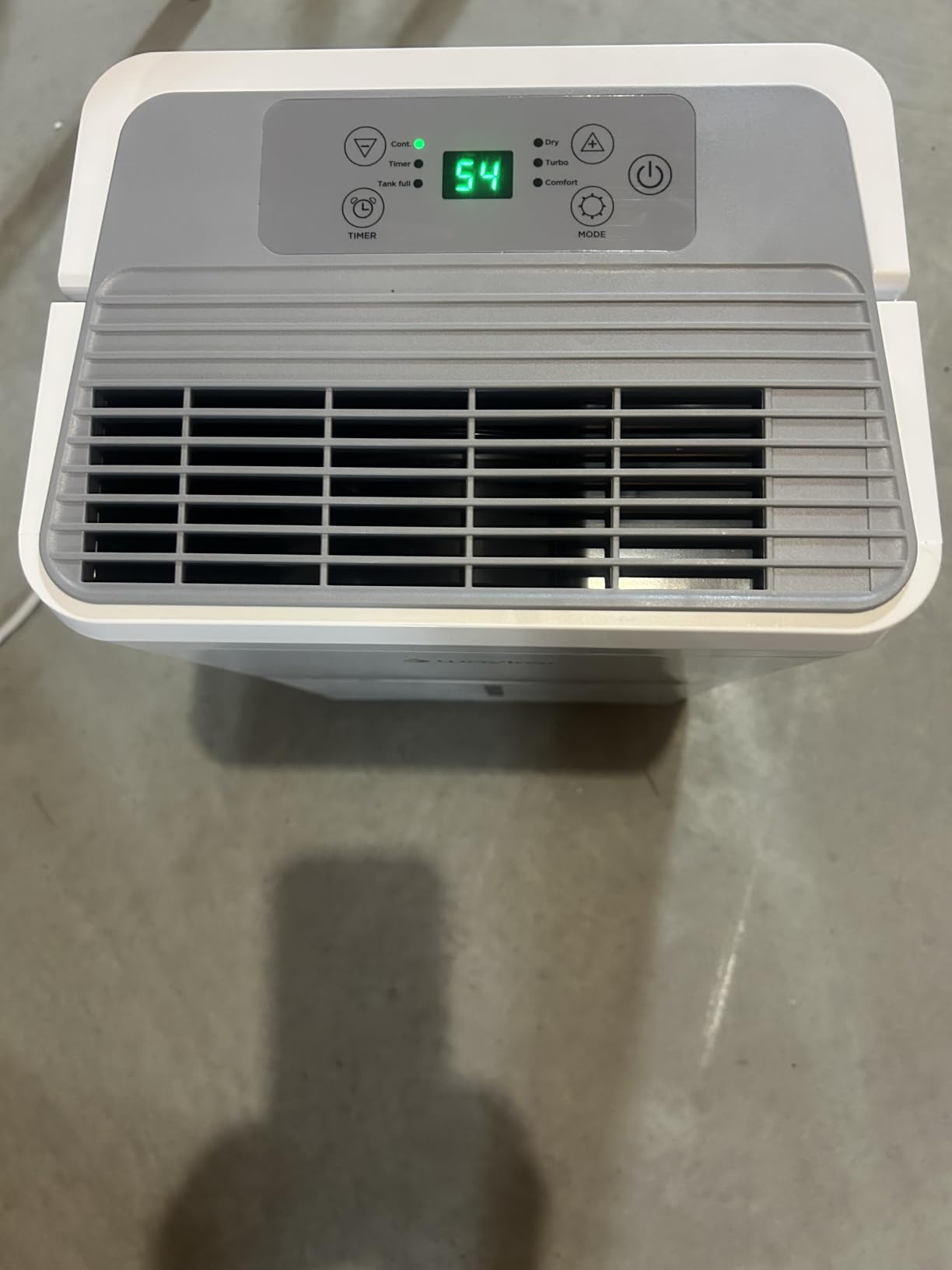
The top-mounted panel uses six buttons and a digital readout, but it is dim and cryptic, particularly the dim, angled interface. Wheels and a hidden handle make it easy to move between rooms, and the removable rear air filter is a washable type.
This is a 115V unit with a US plug, worth noting if you have seen the same model listed with a UK plug elsewhere. The warranty runs 12 months.
Who Should Buy This and Who Should Not
Buy it for a bedroom, a nursery or a home office where you want continuous humidity control without a machine hum. It is the pick I would put next to a bed, given the sleep mode and the 36 dB rating.
Skip it for a large basement, and do not buy it planning to run it tank-only. A handful of owners also report units failing after being plugged in while still tipped from packaging, so leave it upright and settled before you power it up.
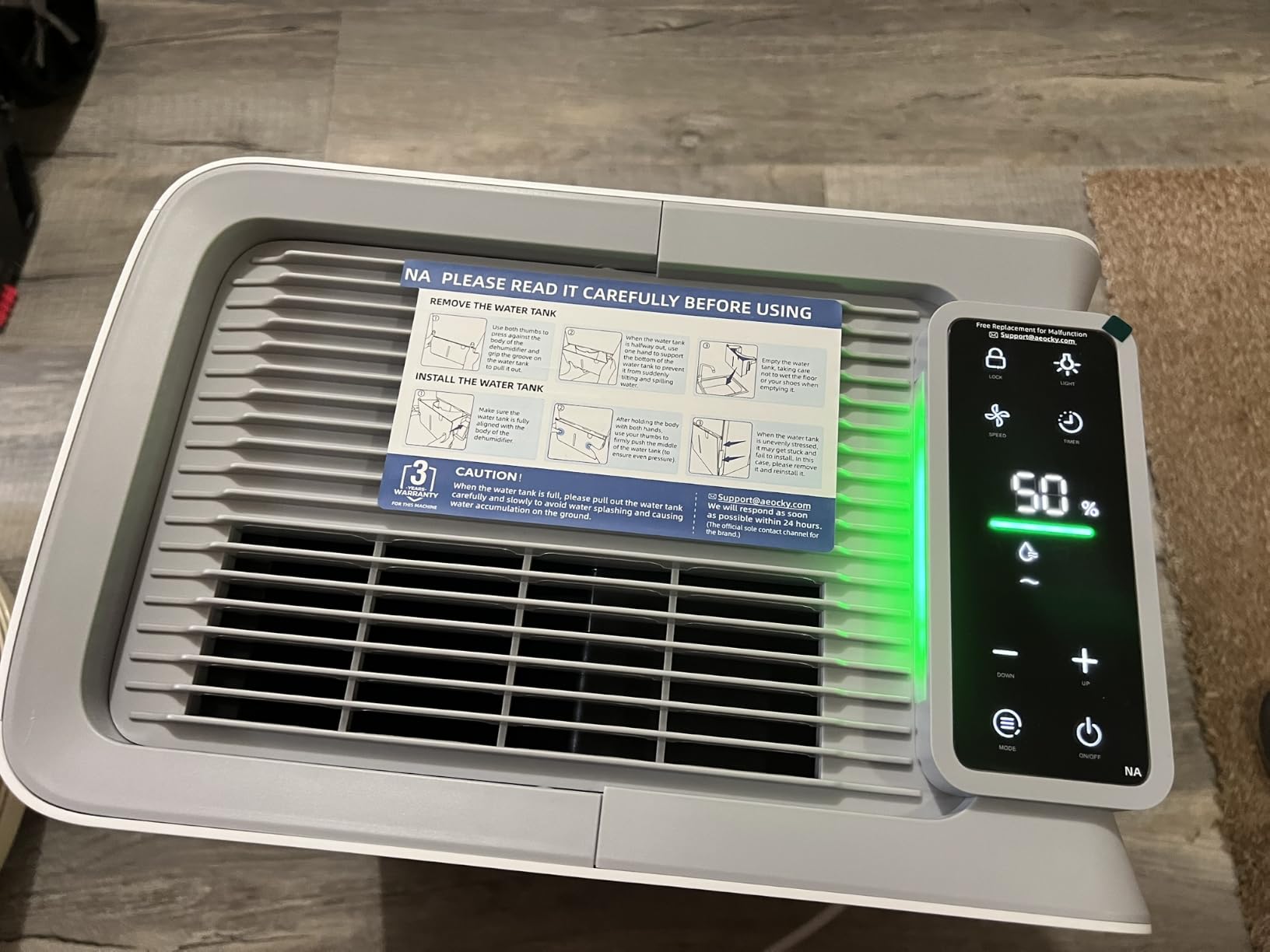
3. AEOCKY 50 Pint 40 dB – Large Rooms That Stay Unobtrusive at Full Setting
AEOCKY 50 Pint/Day, 3500Sq.Ft Ultra-Quiet 40dB Dehumidifier with Drain Hose
40 dB
50 pints/day
3,500 sq ft
0.8 gal tank
Pros
- 40 dB holds even at the highest setting
- Owners report outperforming a 50-pint Frigidaire
- Auto-defrost to 65F for cool basements
- 3-year machine warranty
- Light enough to move on casters
Cons
- 0.8 gal tank needs emptying 2-3 times daily
- Air movement is loudest at max fan speed
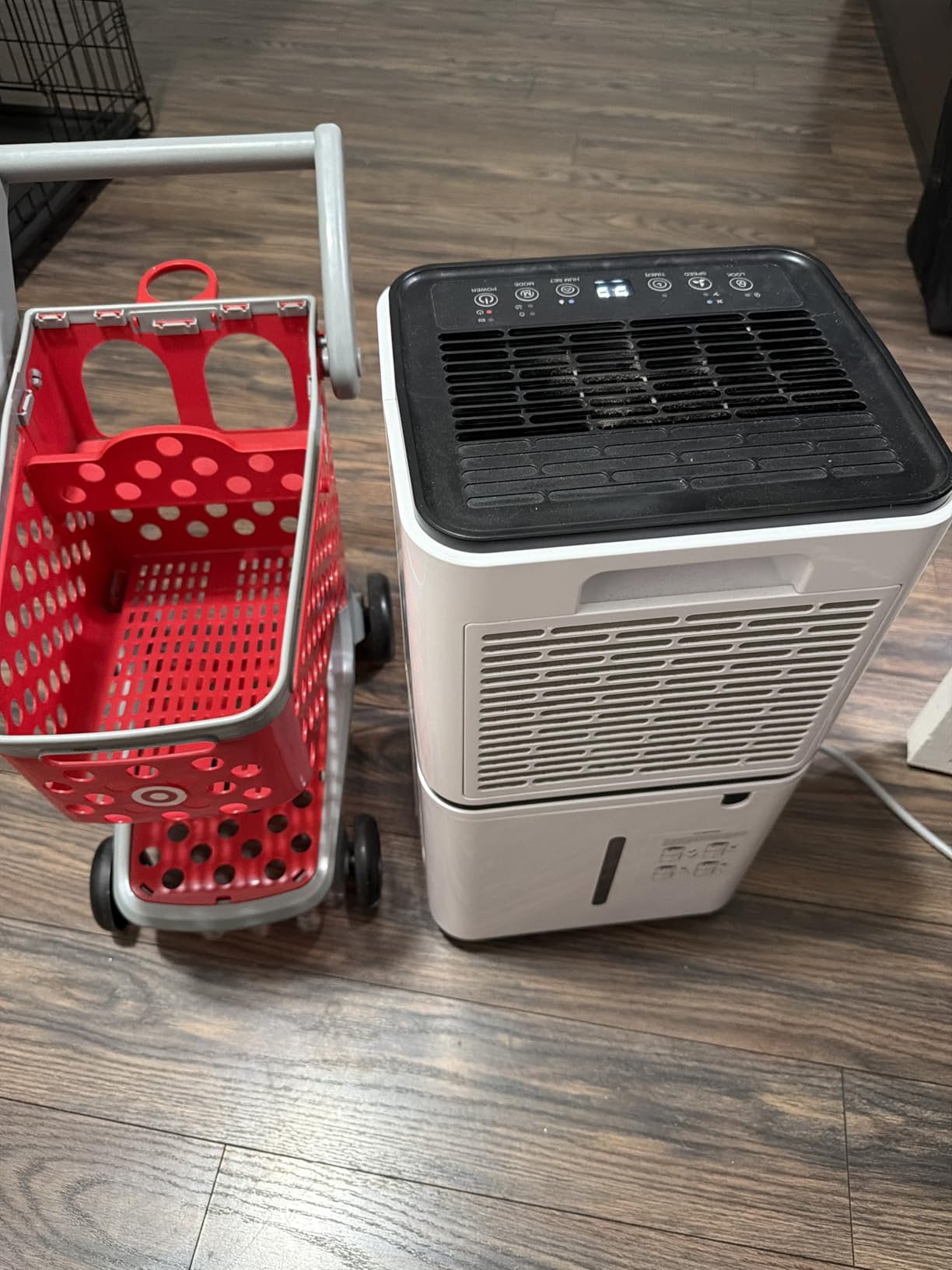
This is the most unusual claim in the roundup: owners report roughly 40 dB even at the highest dehumidification setting, and several say they returned louder competitors before settling on this one. Getting 50 pints per day across 3,500 square feet at that noise level is genuinely rare, and the 4.4 average across 1,352 reviews backs the volume of positive noise reports.
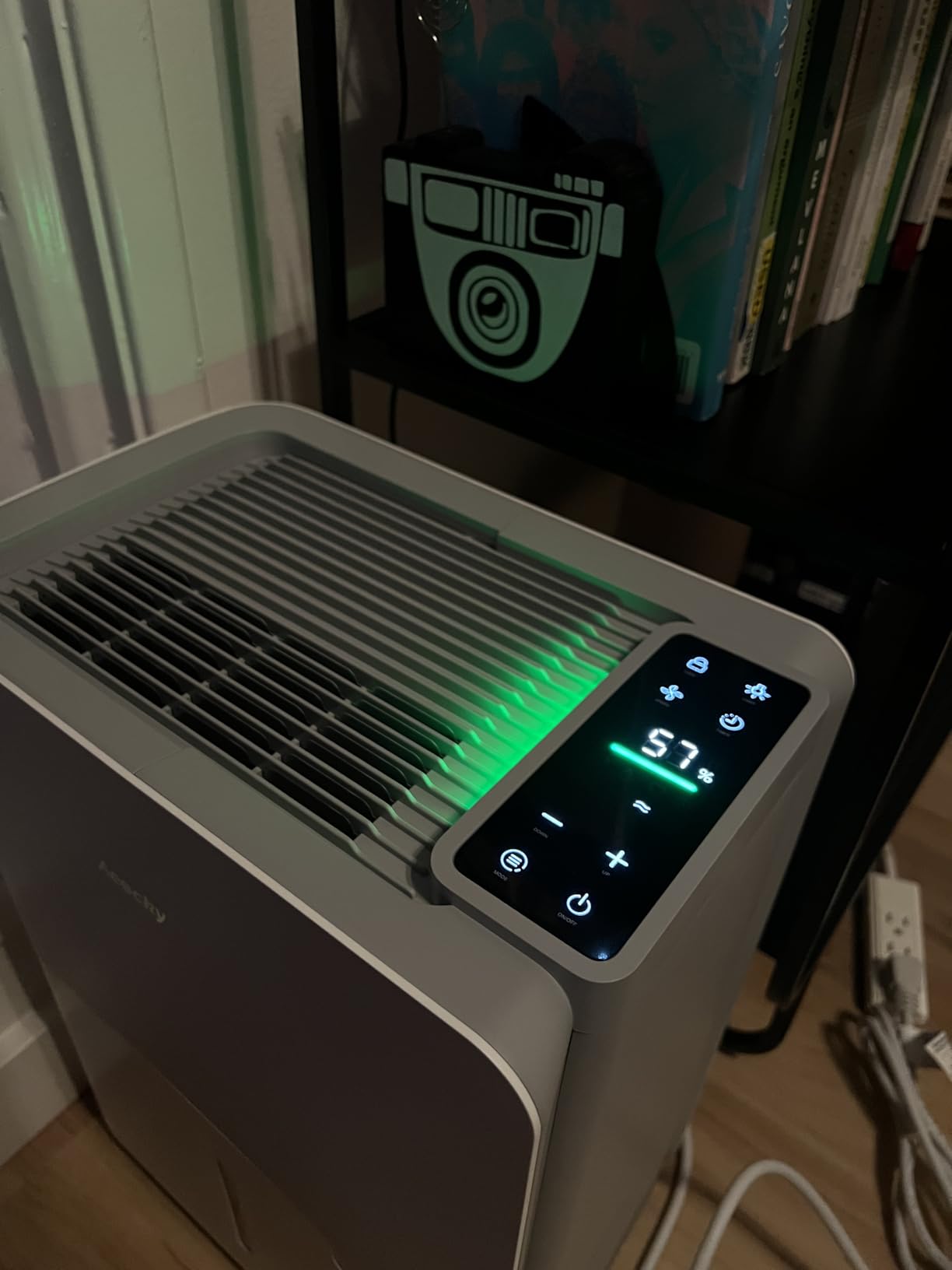
The build leans toward longevity. The coil uses 7mm high-tooth pure copper tubing with hydrophilic fins, the warranty runs three years, and the instructions call for a 24-hour wait after unpacking so the compressor oil settles.
Acoustic Design and Fan Noise
Manufacturer spec credits a dual-chamber acoustic structure for the 40 dB figure. The one consistent negative note is that air movement is loudest at maximum fan speed, which is a different sound from compressor hum and easier to mask with a closed bedroom door.
Drainage Setup Decides Your Daily Routine
The 0.8 gallon tank is small relative to 50 pints of daily extraction, and without the included hose it needs emptying two or three times a day. A 2 meter hose and a garden hose adapter ship in the tank, so continuous gravity drainage takes under a minute to set up.
Who Should Buy This and Who Should Not
Buy it if you need genuine whole-room capacity in an occupied space and refuse to accept a 50 dB machine to get it. The humidity control range of 40% to 80%, child lock and 24-hour timer make it a good fit for a family basement or a main-floor living area.
Skip it if your space is under 1,000 square feet, where you would be paying for capacity you cannot use and living with a 25.3 pound chassis. The auto-defrost threshold of 65F is higher than some competitors, so very cool crawl spaces are not its strength.
4. Tenergy Sorbi 1000ml – Best Two-in-One Pick for Closets and Bathrooms
Tenergy Sorbi 1000ml Air Dehumidifier w/Purifying Function, True HEPA Filter, Auto Shutoff, Touch Control Adjustable Air Speed, Ultra-Quiet, Ideal for Closets & Bathrooms
35-42 dB
Peltier 750ml/day
200 sq ft
6 lb body
Pros
- Near-silent on the low fan speed
- Doubles as a True HEPA air purifier
- Only 45W and 6 lb
- ETL and CARB certified
- 1L tank is easy to wash
Cons
- High fan speed is loud
- Limited to about 200 sq ft
- Filter light behavior is confusing
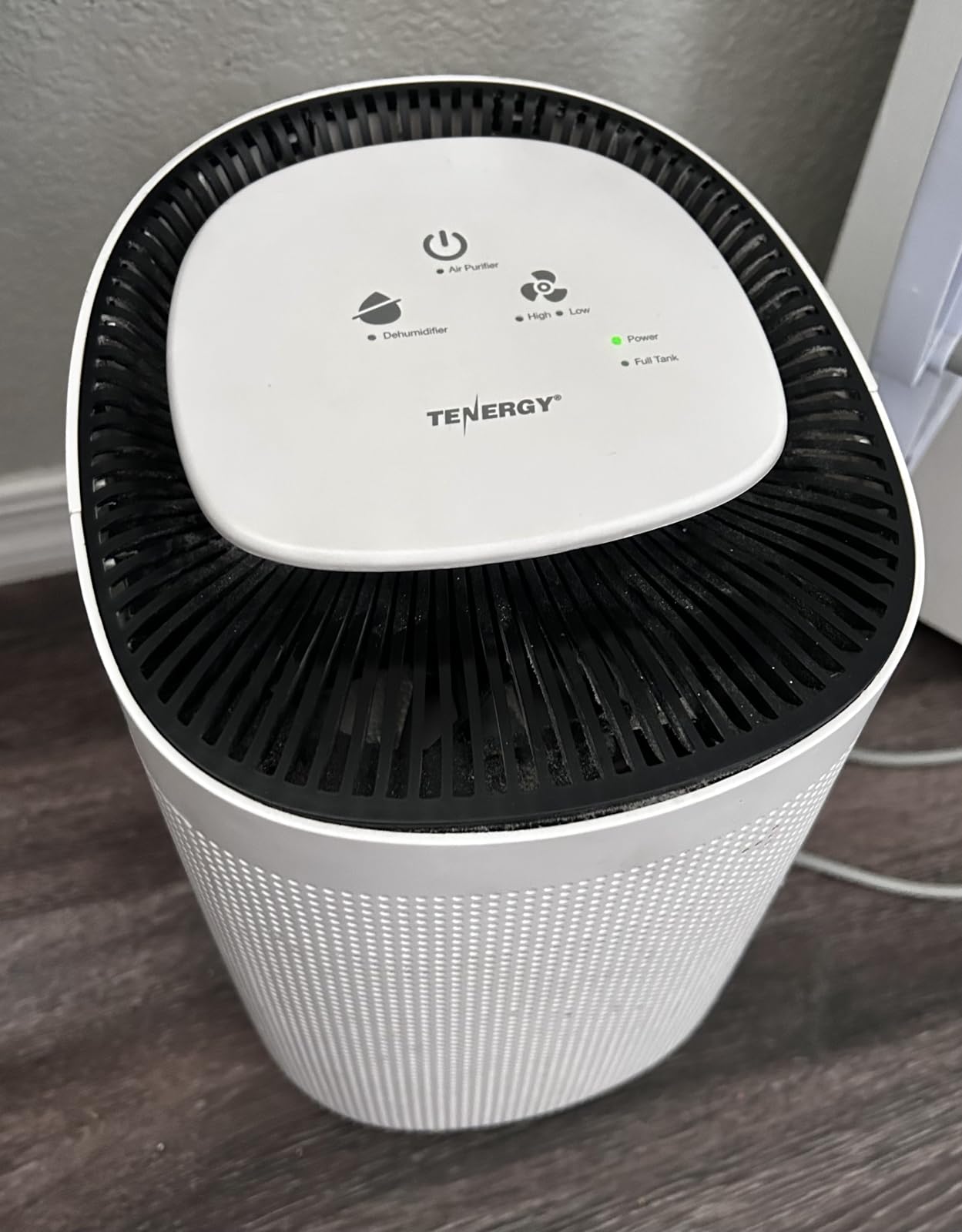
For a bathroom, walk-in closet or RV, the tradeoff that ruins most compressor dehumidifiers does not apply. There is no compressor here, just a Peltier semiconductor module pulling 750ml a day at 45 watts, and on the low fan speed owners describe it as just above a whisper and inaudible from the bed.
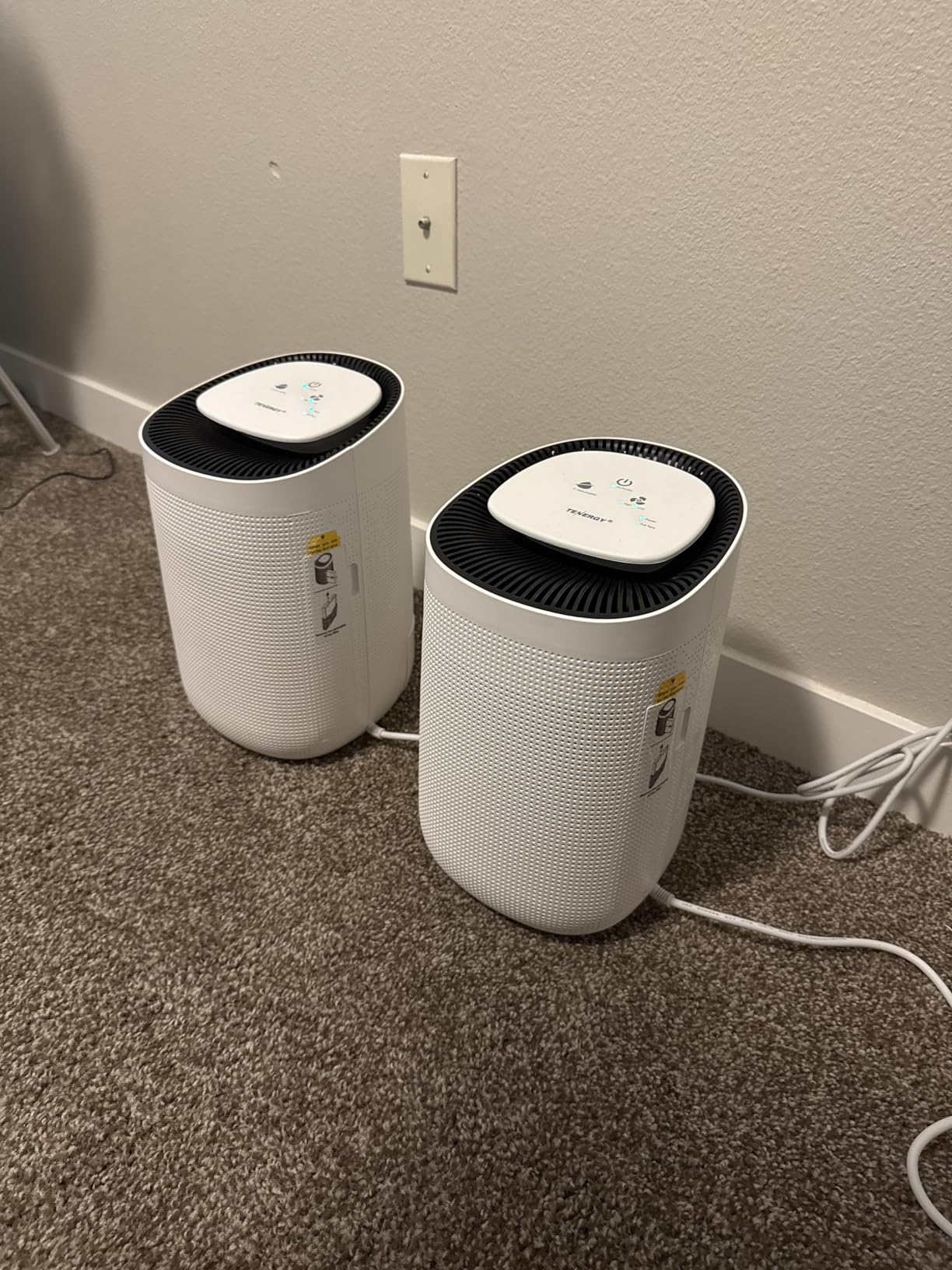
The True HEPA filtration is what separates it from other thermo-electric boxes. At 22 CFM and 200 square feet of rated coverage, it clears window fog and closet dampness effectively, and the removable 1 liter tank is easy to empty and clean every few days.
The Fan Speed Truth Nobody Puts in the Listing
There is only one speed listed in the spec sheet, but the touch control adjusts air speed in practice. The low setting is the quiet one. On high, owners compare it to a large fan, so the number you care about applies to quiet mode, not to the machine at full output.
Durability Is the Secondary Concern
Several owners report units stopping working somewhere between one and four years of continuous use. The filter-replacement light behavior is confusing and hard to reset, and the filter door itself is described as flimsy. The warranty is one year, extended to two with registration.
Who Should Buy This and Who Should Not
Buy it for the small, enclosed spaces where a compressor unit is absurd: a bathroom, a closet, a boat or an RV. The 6 pound body and the 12 inch height mean it can sit on a shelf, which no full-size model here can do.
Skip it for a bedroom above roughly 200 square feet, or for a basement. Semiconductor cooling has a fraction of the extraction of a compressor, so humidity in a large room will barely move no matter how long it runs.
5. BREEZOME 60 oz Dual-Semiconductor – Most Versatile for Portable Small-Space Work
60 OZ Dehumidifiers for Home, Dual-Semiconductor Quiet Dehumidifier with Timer Sleep Mode Auto-Off 7 Colors Light Portable Small Dehumidifiers for Bathroom, Cloakroom, RV
35 dB sleep mode
700ml/day
350 sq ft
48W
Pros
- Sleep mode rated at 35 dB
- 1.8L tank visible from three sides
- 48W draw and 1.15 kWh per day
- Built-in handle moves easily room to room
- Blinking full indicator works while traveling
Cons
- Roughly a two-year service life reported by some owners
- Weak extraction in larger rooms
- Needs frequent emptying in humid air
Owners compare this unit to soft white noise rather than a machine hum, and a 35 dB sleep mode on a thermo-electric design is about as quiet as portable dehumidification gets. Dual semiconductor condensers deliver up to 700ml per day, and the 1.8 liter tank is larger than the machine’s footprint suggests.
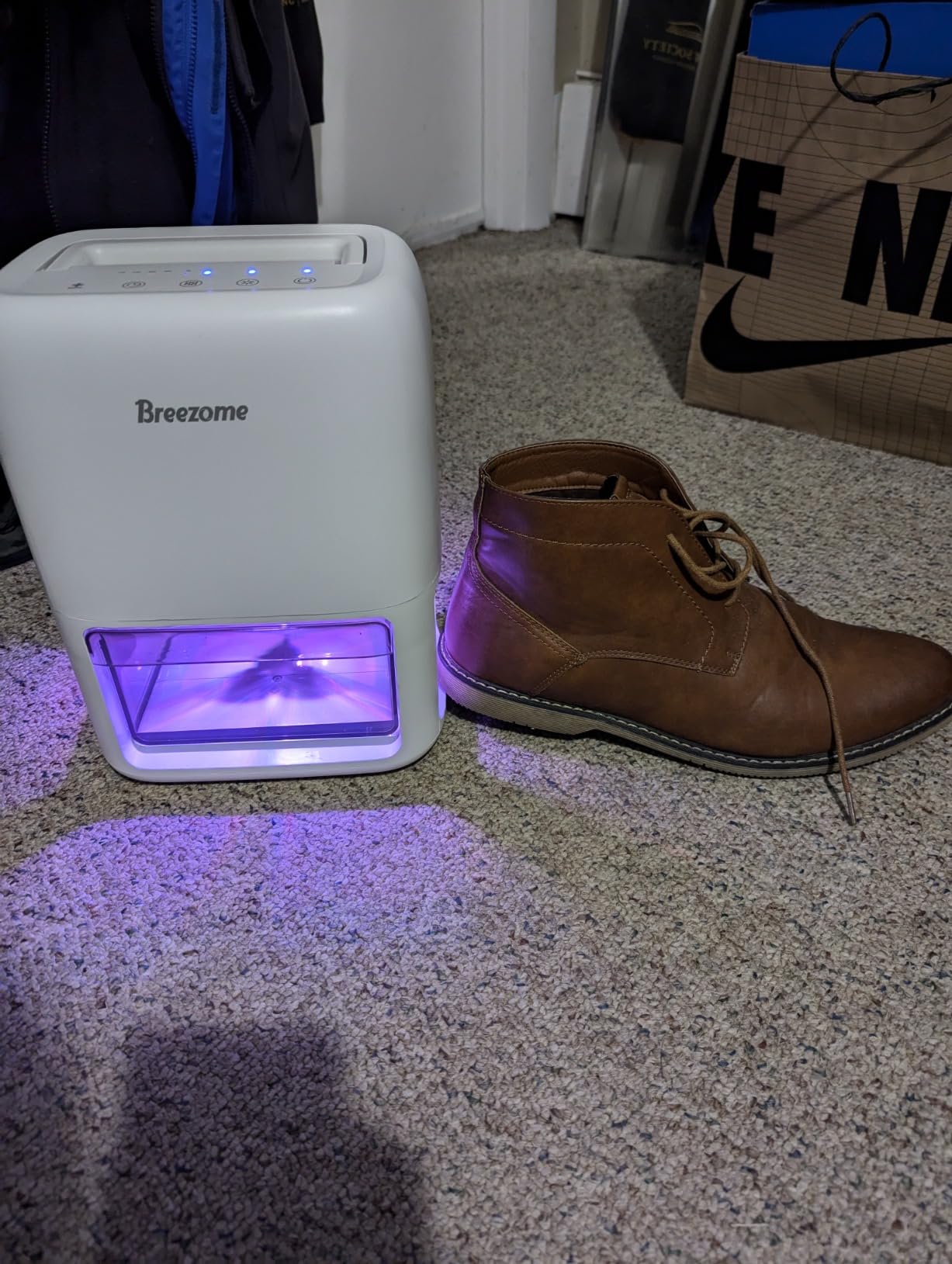
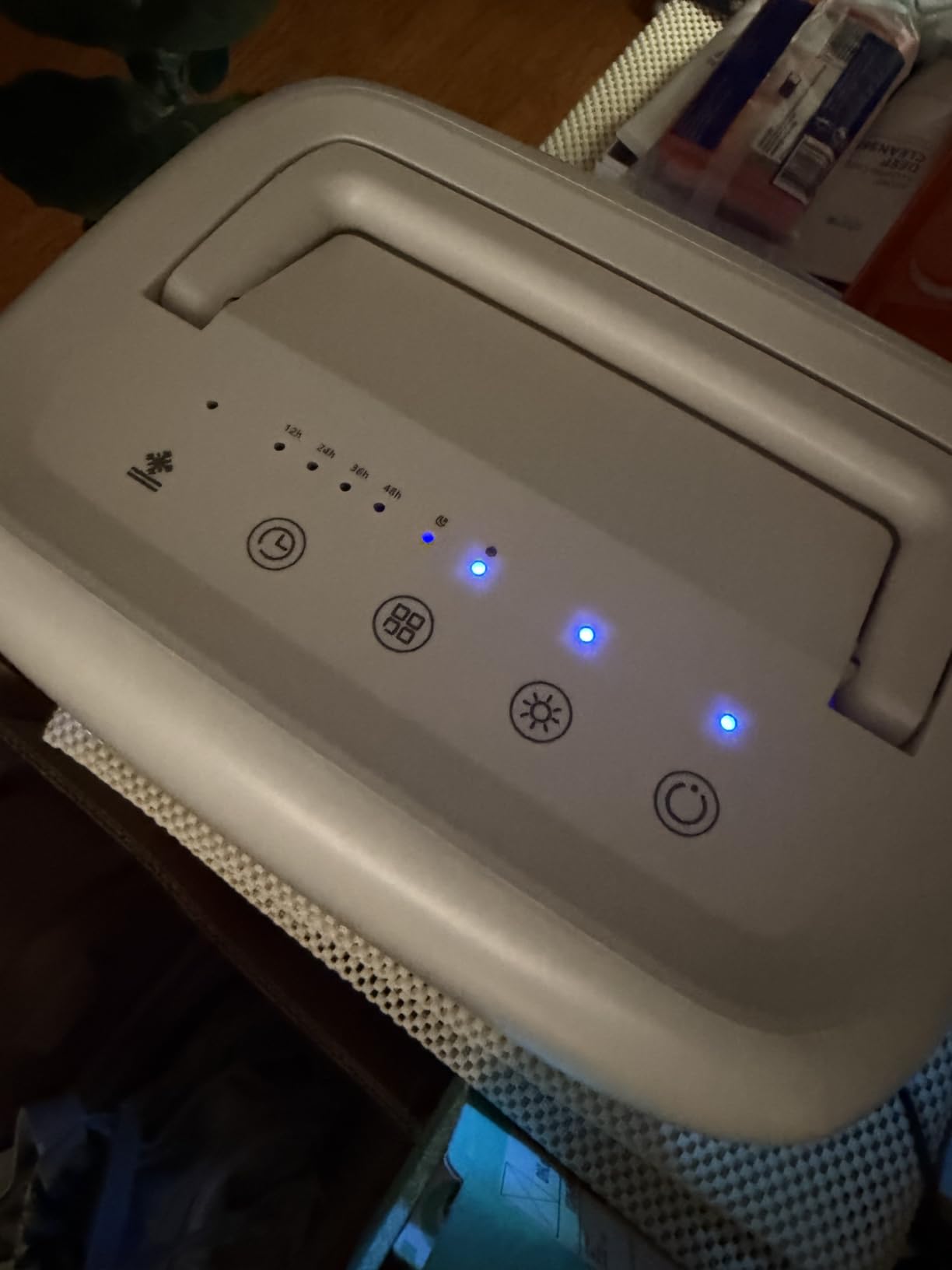
It draws 48 watts, roughly 1.15 kWh over 24 hours of operation, which is trivial next to any compressor unit. The 12, 24, 36 and 48 hour timer is unusually generous for a unit this size, and the adjustable color night light doubles as a status indicator you can switch down at night.
Clear Tank, Small Room, Modest Results
The tank is see-through from three sides, so you check it without lifting anything, which matters for a bathroom unit you want to leave running. Rated coverage is 350 square feet, and owners report it working effectively in bathrooms, closets, RVs and studios.
Where the Budget Ends
The recurring negative theme is lifespan. Multiple owners describe buying a replacement roughly every two years, and some report barely any water collected in larger or poorly ventilated rooms. Reported humidity reductions are modest, a few percentage points, but steady.
Who Should Buy This and Who Should Not
Buy it as a seasonal fix for a closet, a crawlspace cabinet or a bathroom, and accept that it is a small-area tool. The timer options and the visible tank make it a good travel companion in an RV.
Skip it if the space is above roughly 500 square feet or if you want a set-and-forget humidity target. At 1.7 kg it is portable, and at 700ml per day it is not going to hold a room below 50% relative humidity for long.
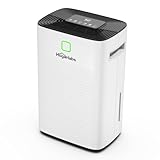
6. HOGARLABS 30 Pint Ultra Silent – Best for Indoor Clothes Drying on a 40 dB Rating
HOGARLABS 30 Pint Dehumidifiers for Home and Basements, with 3 Working Modes, Overflow Protection, and Auto Shut off Restart. Ultra Silent Dehumidifier with Drain Hose and Digital Control Panel.
40 dB
30 pints/day
2,000 sq ft
0.66 gal tank
Pros
- Dedicated drying mode alongside smart and continuous
- Digital panel with timer and child lock
- Seven fan speeds
- Auto shut-off with overflow protection
- Four universal wheels and two pull handles
Cons
- 0.6 gal tank needs regular manual emptying
- Tall form factor suits large rooms only
Laundry drying is where quiet matters differently. You want to hear the machine working, and a constant hum competes with conversation in the room where you are folding. The published 40 dB sits in the range where most people stop noticing it after a few minutes, and a dedicated drying mode is what most of the compressor picks in this roundup do not offer.
Three modes cover smart, drying and continuous, and the digital control panel adds a timer, a child lock and a washable filter. Humidity control spans 30% to 80%, and auto shut-off with overflow protection stops the unit when the 0.66 gallon tank fills.
Noise Alongside a Washing Machine
At 40 dB in a utility room that already contains a washer and dryer, the dehumidifier is rarely the loudest thing running. The seven fan speeds give you real control over the sound, which matters more in a laundry setup than in a bedroom where you would just use the lowest speed.
Space and Drainage Reality
The body measures 12.57 by 8.84 by 19.45 inch, and owners are clear that this is not a closet or small-room machine. Continuous drainage via the included hose is the sensible setup, and the 2 year extended warranty with lifetime technical support is stronger than most competitors offer.
Who Should Buy This and Who Should Not
Buy it for a laundry room, a finished basement utility area or a main-floor hallway where you dry clothes indoors. The mobility hardware, including four wheels and two pull handles, makes moving it between a laundry room and a drying rack straightforward.
Skip it for a small bedroom. The footprint and the 0.6 gallon tank are both wrong for tight spaces, and you would be paying for capacity the room cannot use.
7. Gasbye 4500 Sq Ft Energy Star – Highest Rated Pick for a Large Damp Basement
Gasbye 4500 Sq.Ft. 2026 Energy Star Dehumidifier for Basement & Large Rooms with Drain Hose, Max 115 Pints/Day | 45dB Quiet Compressor | 1.7 Gal Water Tank | Auto Shut-Off & Restart, Black
45 dB
Up to 115 pints/day
4,500 sq ft
1.72 gal tank
Pros
- Highest average rating here at 4.6
- Energy Star 2026 certified
- 1.72 gal tank is far larger than other big units
- Three drainage options including a 3/4 inch garden hose
- 50 pints per day at 65F
Cons
- 43 pounds is the heaviest chassis here
- 24 inch tall body takes floor space
- Only one fan speed setting
At 4.6 average across 911 reviews, this carries the highest average rating of any model in the group, with about 80% five-star reviews. The 45 dB figure is at the upper edge of what we would call quiet, which is honest to say plainly: it suits a basement, garage or living room you can close the door on, not a bedside table.
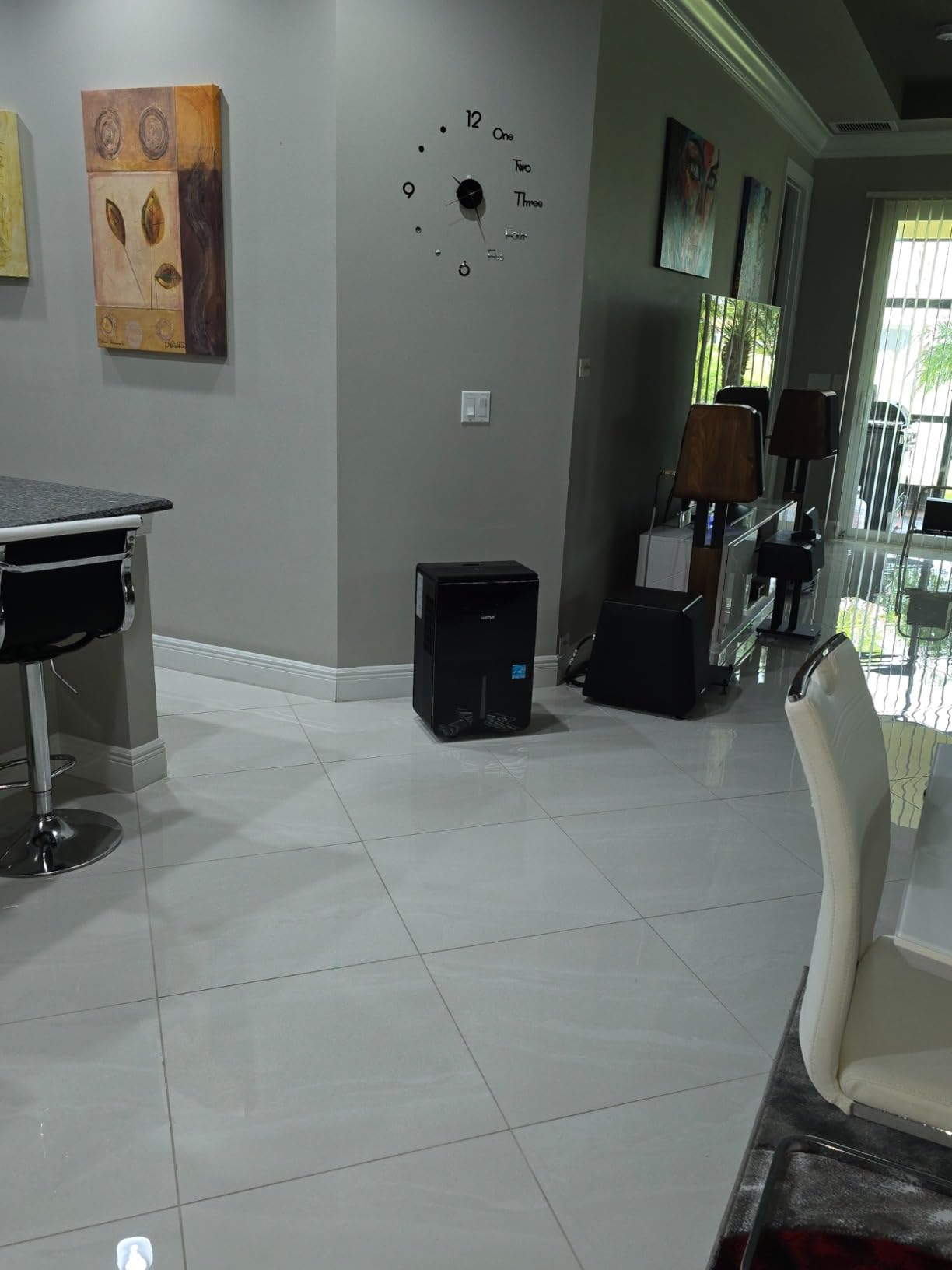
Where it wins is efficiency and tank size. Energy Star 2026 certification, unique ID 3417537, is paired with 115 watts less consumption than non-certified models, and the 1.72 gallon tank is the largest here, so you empty it far less often than with a 30-pint machine.
Measured Extraction at Real Temperatures
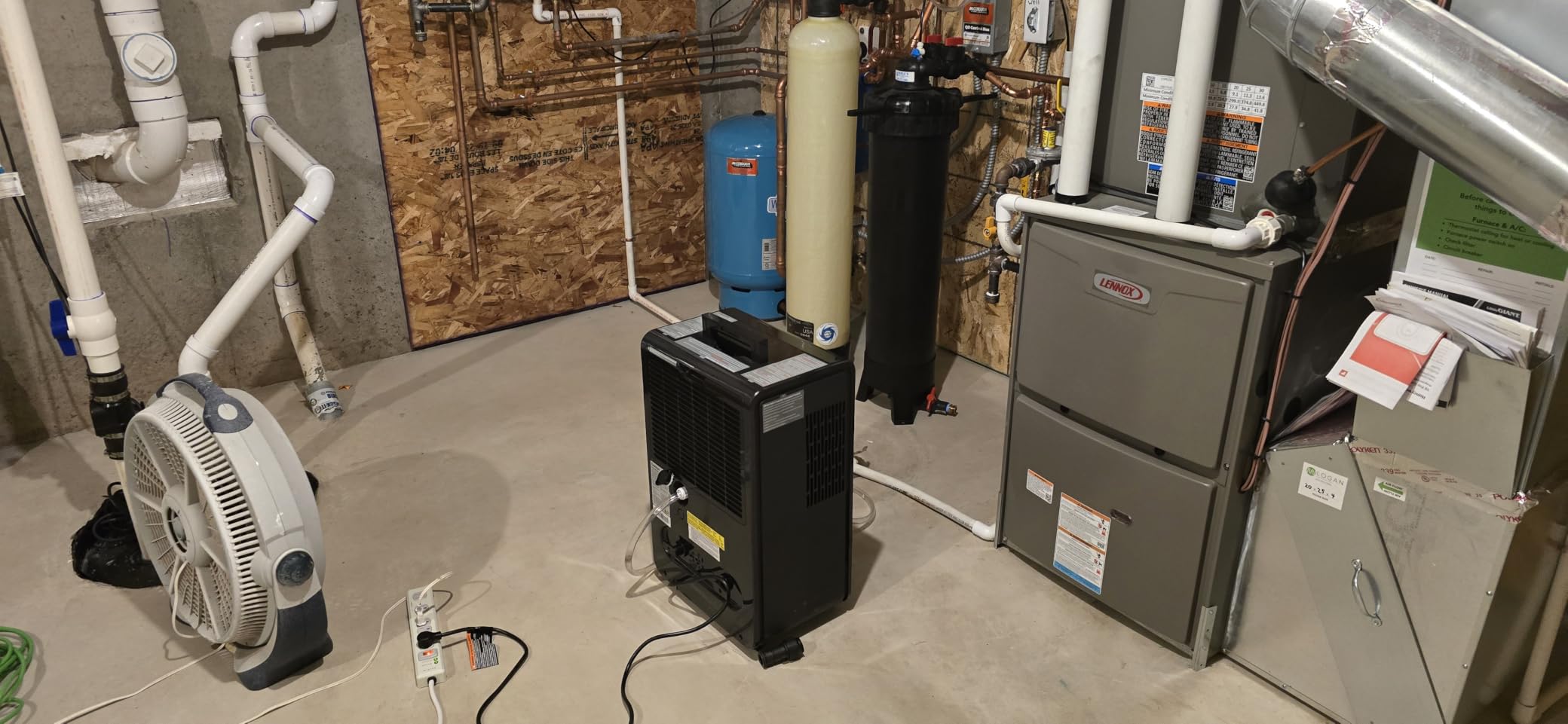
The numbers that matter in a basement are the lower-temperature ones. Output is 73 pints per day at 80F and 60% relative humidity, and 50 pints per day at 65F and 60%, before the headline 115 pints peak at 86F and 80% is reached. Airflow is listed at 12,600 cubic feet per hour and the compressor draws 500 watts.
Four Modes and Three Drainage Routes
Normal, Turbo, Comfort and Continuous cover most control needs, and the auto shut-off triggers 3% below target with restart 3% above, plus settings recall after a power outage. You can drain into the tank, a 5 foot hose or a standard 3/4 inch garden hose adapter.
Who Should Buy This and Who Should Not
Buy it for a large, cool basement where you care about running cost as much as noise. The 5-tier copper coil construction and 2 year defect coverage are aimed at longevity in exactly that environment.
Skip it if you have to carry it. At 43 pounds and 24 inches tall, this is the bulkiest machine here, and moving it up basement stairs without help is a real consideration. One fan speed setting also means less control over the sound than the other compressor picks offer.
8. Waykar 23 Pint 35 dB – Best for Narrow Rooms, Hallways and RVs
Waykar 23 Pint Energy Star Home Dehumidifier, Ultra Quiet 35 dB
35 dB
23 pints/day
1,500 sq ft
165W
Pros
- 35 dB is the quietest compressor rating here
- Slim chassis fits hallways and RVs
- 22.6 lb carries with one hand
- 15% RH continuous mode for laundry
- 2025 Energy Star certified
Cons
- 0.4 gal tank is the smallest here
- Some owners report Error 88 or stopped extraction
- Underpowered for very low target humidity
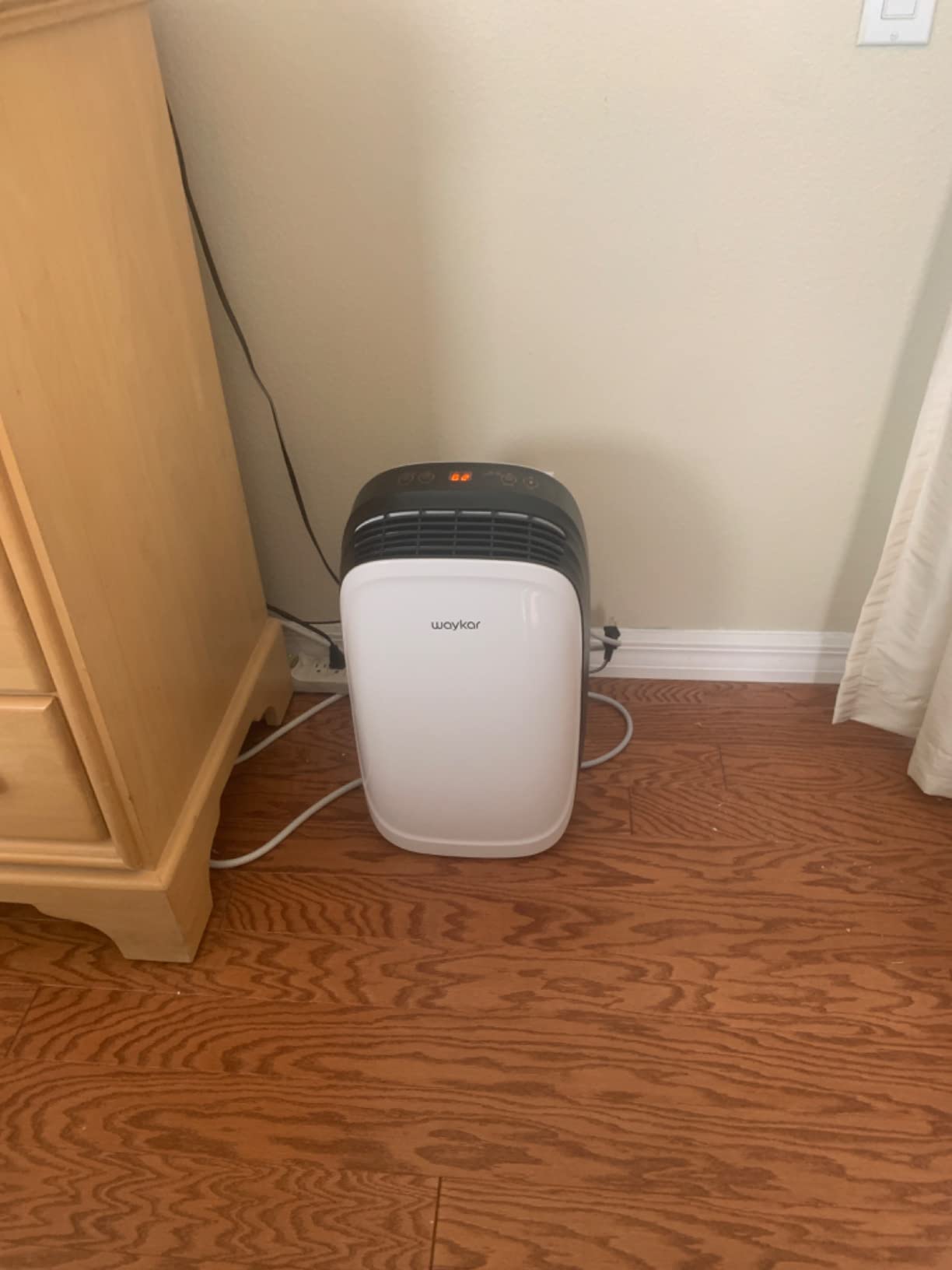
A 35 dB compressor rating is rare enough that this machine earns its place. Owners single out the noise level and the slim chassis as the reason to choose it over larger units, and several run two of them in different rooms. Rated output is 23 pints per day at standard conditions, rising to 30 pints per day at 95F and 90% relative humidity.
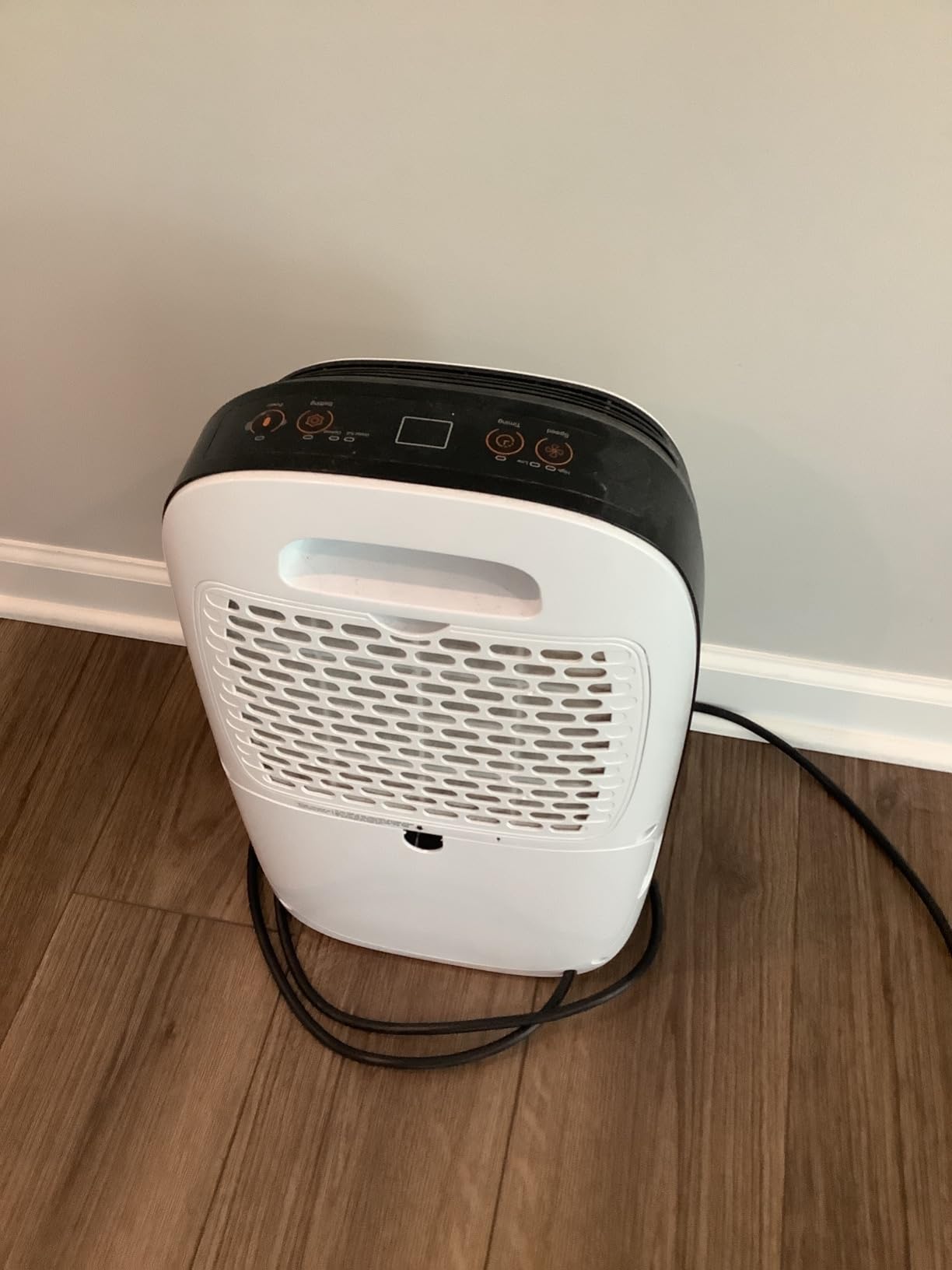
The body is 11.02 by 7.68 by 15.2 inch, narrow enough for a hallway or an RV where a full-size square unit will not go, and light enough at 22.6 pounds to carry one-handed. Airflow is 59 CFM on 165 watts, which is where the Energy Star 2025 certification and the claimed 40% energy reduction come from.
Four Modes and a 15% Continuous Setting
Comfort, Dry, Turbo and Continuous cover normal use, and the humidity control range of 15% to 80% includes a 15% continuous mode aimed at laundry and storage rather than living space. A 20-second self-drying cycle helps keep the coil from holding moisture between runs.
Reliability and Tank Size Are the Trade-Offs
The 0.4 gallon tank is the smallest in the roundup and fills quickly, so plan on the 3.3 foot drain hose. Some owners report units that ran but stopped dehumidifying, or showed an Error 88 code after a power interruption, and one reviewer found it underpowered for a very low target and moved up in size.
Who Should Buy This and Who Should Not
Buy it for a small bedroom, a hallway, an office or an RV where a slim, light, genuinely quiet compressor is the point. Waykar’s free replacement service is repeatedly cited by owners as a reason the reliability risk is manageable.
Skip it for a basement. At 1,500 square feet of rated coverage it is a room unit, and a sub-40% target in a damp space will outrun 23 pints per day.
9. Uhome 30 Pint 39 dB – Best for a Home Office or Apartment
Pros
- Owners report barely hearing it running
- Effective in rooms up to about 1000 sq ft
- Activated carbon filter adds purification
- Auto shut-off with red tank indicator
- Light enough to store away in winter
Cons
- 0.45 gal tank is very small for 30 pints of capacity
- Included 23.6 in drain hose is too short
- Some units leak near the power cable and ice up
A 39 dB rating with 30 pints per day of rated extraction is a good pairing for a home office or a small apartment, and owners report barely hearing it running while they work. The activated carbon filter adds a layer of air purification that most compressor units at this size skip.
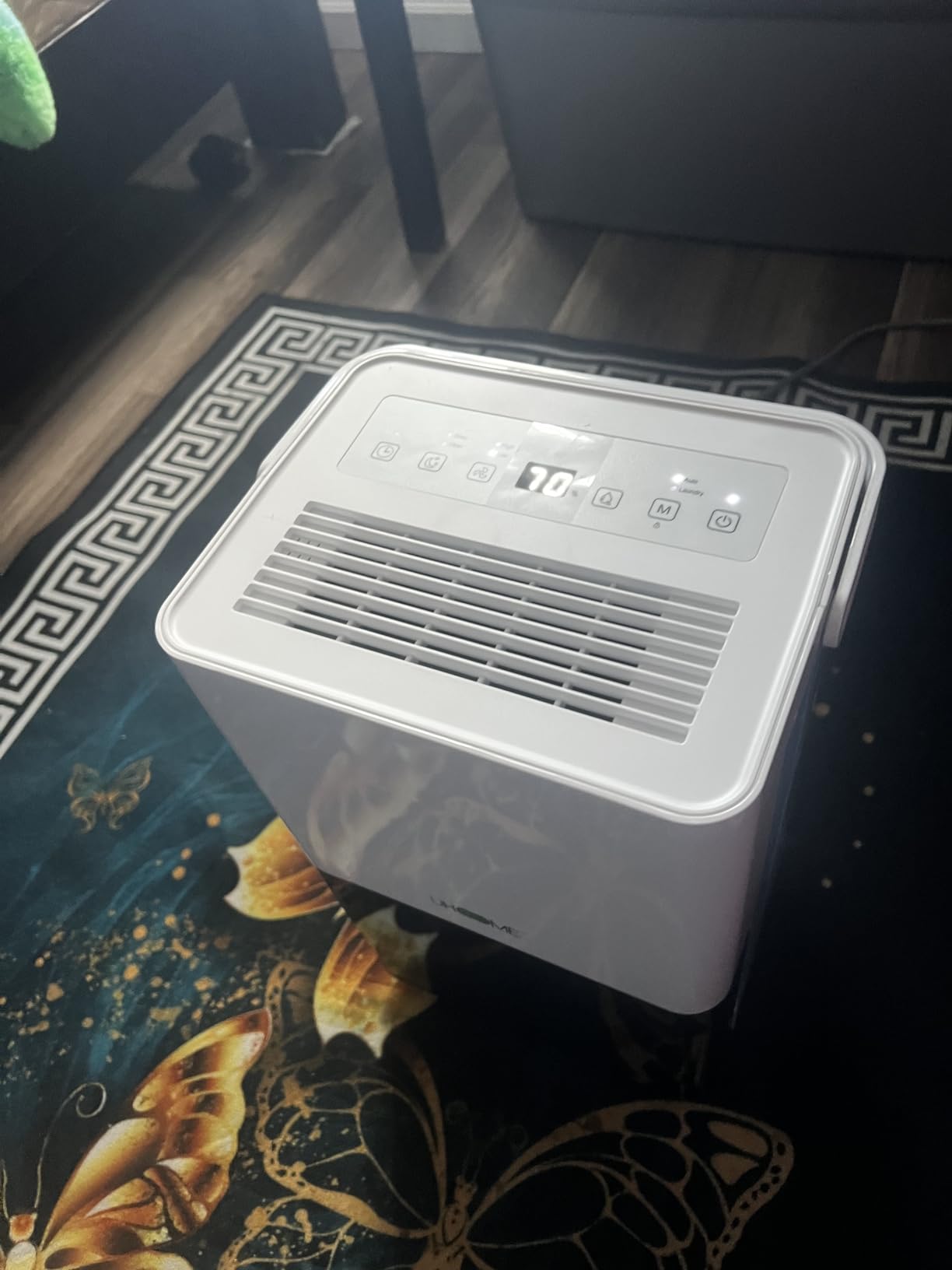
Humidity control is set from 30% to 80% with a 5% sensor differential, and two modes cover laundry-style continuous running and automatic custom control. Newer batches add a sleep mode and child lock. The 20.8 pound body moves with one hand and stores away when the season turns.
Drainage Is Where Setup Matters Most
Two issues dominate the negative feedback. The 0.45 gallon tank is very small relative to a 30-pint daily rating and needs emptying two or more times a day, and the included 23.6 inch hose is too short for most real installations. Some owners also report the continuous drain failing to engage, so the tank keeps filling even with a hose attached.
Build Quality and Placement Notes
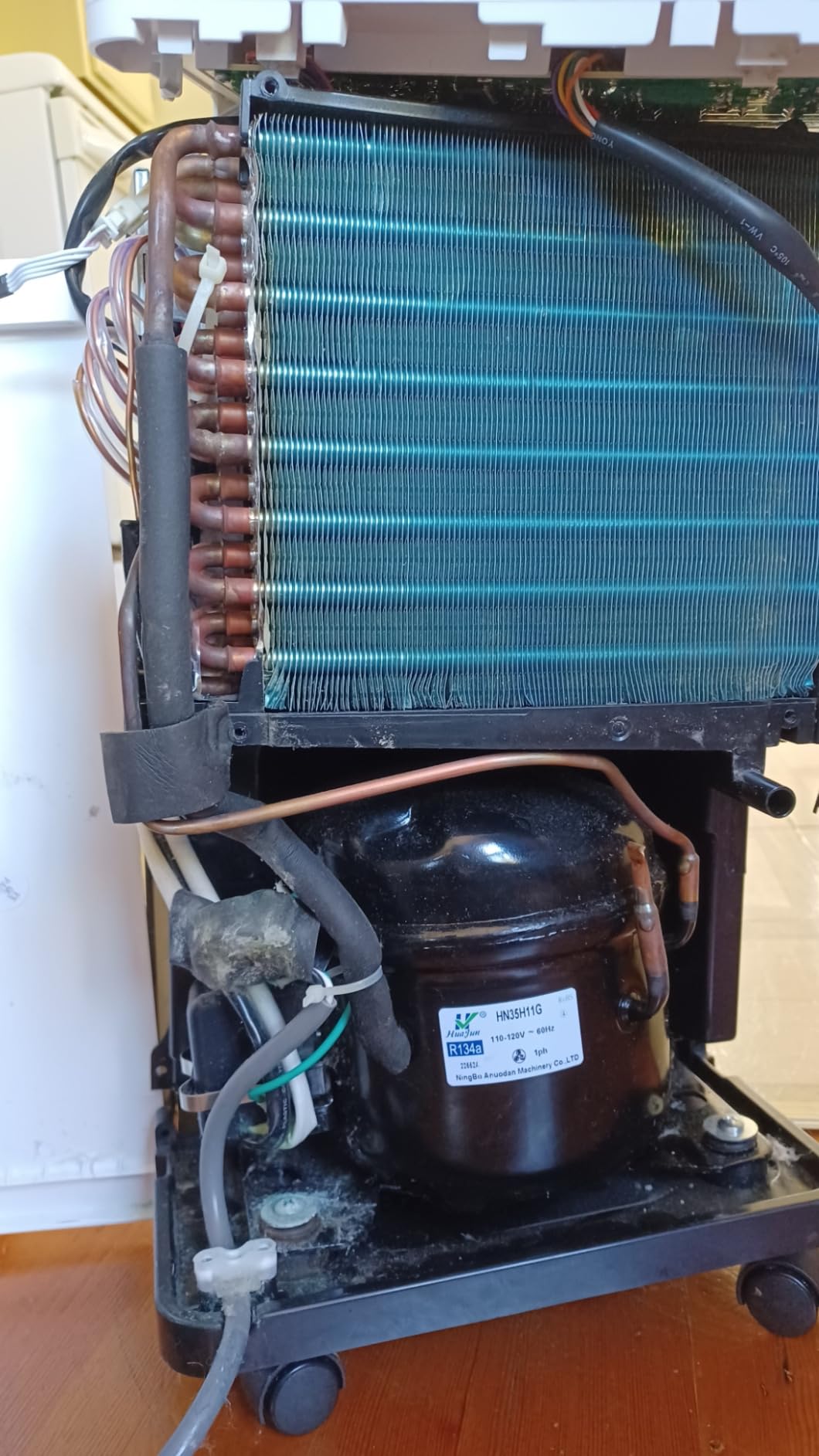
The body is plastic ABS, and a minority of owners report leaking out of the bottom near the power cable along with icing, plus occasional humidity sensor failures where the unit does not stop at the set point. Top-mounted controls are awkward for shorter users when the unit is raised, so place it at floor level rather than on a stand.
Who Should Buy This and Who Should Not
Buy it for a home office, a bedroom under about 1,000 square feet, or an apartment where you want a compact machine with a filtration bonus. Owners planning continuous drainage get much better results than those relying on the tank.
Skip it if you cannot route a drain. The 1-year quality service is shorter than several competitors, and a unit you have to empty twice a day in humid weather will end up switched off, which defeats the purpose of buying a quiet machine at all.
10. SereneLife 91 oz 2-in-1 – Best Design for Closets and Drawers at 50 dB
Pros
- Removable cylinder works inside closets and drawers
- Indicator light can be switched off at night
- Matte black finish suits a bedroom
- 91 oz tank with digital humidity readout
- Simple setup without reading the manual
Cons
- 50 dB is the loudest rating in this roundup
- Some units crack and leak from the bottom
- Touch buttons sometimes need two taps
The honest verdict here is about noise: at a stated 50 dB, this is the loudest specification in the roundup and it is not a sleep machine. What it does better than anything else on this list is reach the places a dehumidifier cannot go, because the removable cylinder detaches from the base and recharges in 2 to 3 hours.
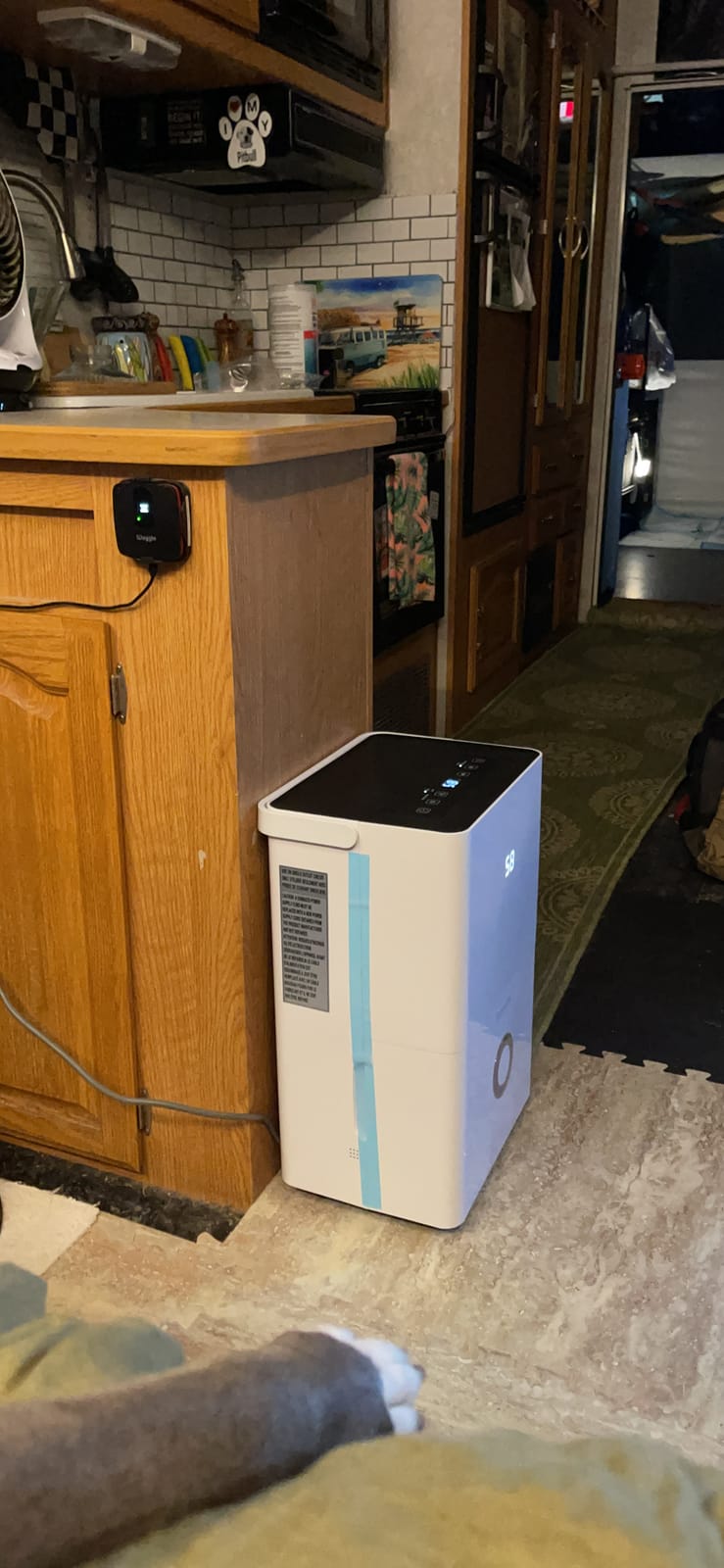
Set the cylinder inside a closet, a linen cupboard or a drawer, and it pulls moisture from enclosed spaces with no ducting and no floor space. Back on the drying base it does the same job as a small room unit across 216 square feet. The 6, 12 and 24 hour timer and sleep mode cover unattended running, and the indicator light can be switched off at night while the unit keeps working.
Humidity Control and Night Behaviour
Smart humidity detection holds the room between 45% and 55% relative humidity, with a digital readout and a 91 ounce tank. That range is less aggressive than a mold-suppression setting, which suits a bedroom where you want stable comfort rather than a dry space.
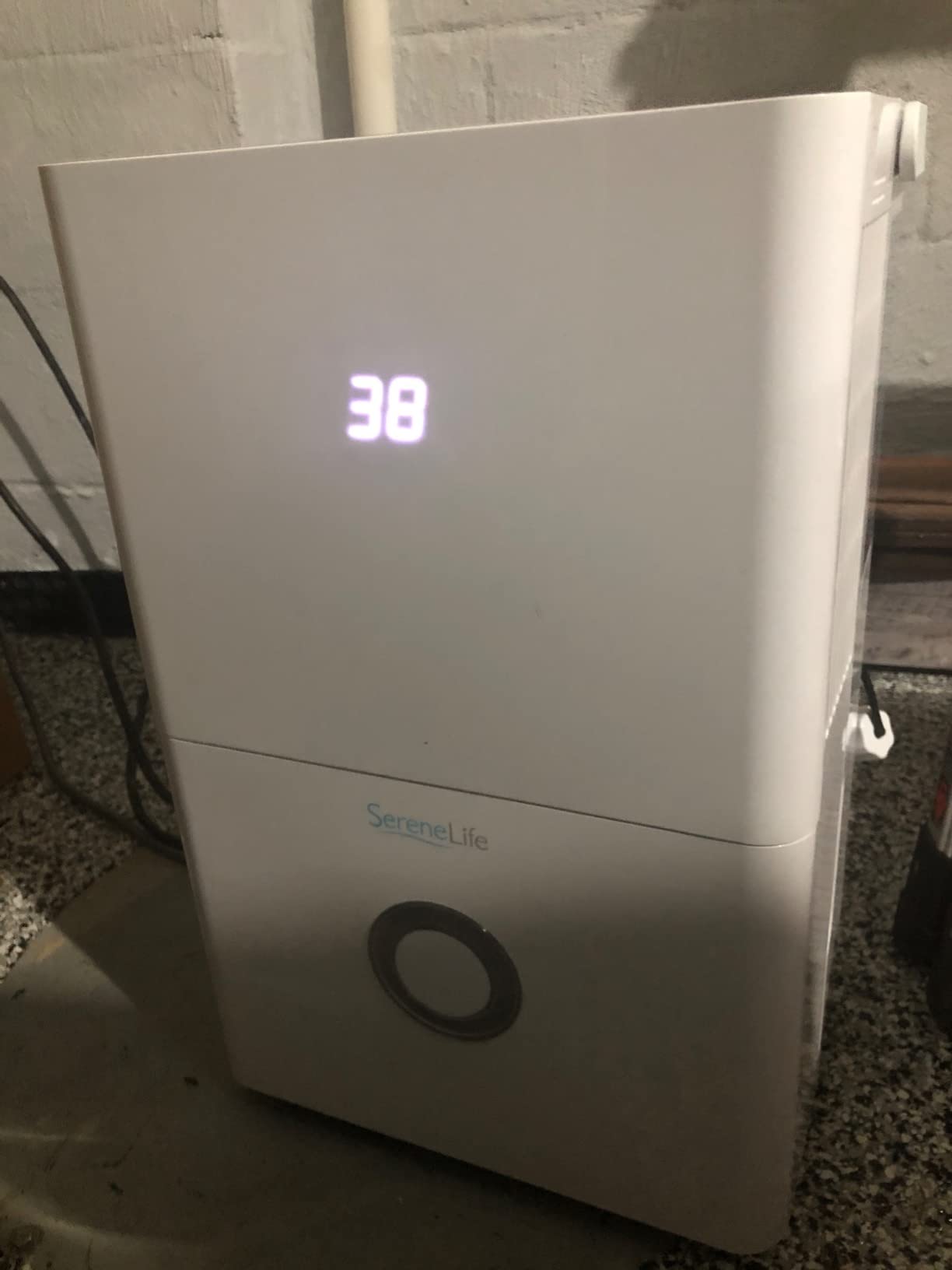
Durability and the Two-Fan-Speed Limitation
At 5.7 pounds and 9 by 6 by 13 inch it is the lightest machine here, and some owners still have theirs going after two or three years. Against that, a few models began cracking and leaking from the bottom before two years of use, and the touch buttons sometimes need two taps to register.
Who Should Buy This and Who Should Not
Buy it for a bedroom where appearance matters, a walk-in closet, or a home with drawers and cabinets that collect damp. The matte black finish does not show fingerprints, which is why it looks at home next to a bed even though you may not run it there.
Skip it as a primary whole-room dehumidifier. At 50 dB it is a machine you switch off at night, and 216 square feet of coverage is a closet, not a room.
How to Choose a Quiet Dehumidifier Without Guessing
Start with the decibel tier rather than the pint rating, because the tier decides which rooms the machine can live in. Under 35 dB sits in a bedroom beside a bed. The 35 to 40 dB band works in a bedroom with a closed door, a nursery or a home office. The 40 to 50 dB range suits a finished basement, garage or living room, and anything above 50 dB is a utility-room machine.
Compressor, Desiccant or Thermo-Electric
A compressor dehumidifier pulls humid air over cold refrigerant coils, condenses the water into a tank and blows drier air back out. It is the only one of the three that moves serious volume of water, and it is also the only one with a compressor hum and a periodic restart after an auto-defrost cycle. Owners in the r/Appliances quiet-dehumidifier thread describe that restart as the loudest moment, more disruptive than steady-state fan noise.
Thermo-electric units use a semiconductor cooling module with no compressor at all, so they are almost silent, but they pull 700ml a day at most in the models here. Desiccant units, which use silica gel or similar absorbent material, are silent for the same reason and trade away capacity in the same way. Neither category will fix a damp basement.
Why Published dB Numbers Disappoint
Manufacturer figures are measured at a set distance, usually with the fan at minimum and often with the doors and panels of a room absorbing sound. Two more factors distort the number in real homes. Sleep and quiet modes lower fan speed, which lowers decibels and lowers extraction at the same time, so a 35 dB sleep figure does not describe a machine working at full tilt.
Basement acoustics change the equation too. A concrete slab transmits vibration from the chassis, so a unit that measures acceptably on carpet can hum through a basement floor. Leaving clearance on all sides, keeping the air filter clean, leveling the chassis and closing the basement door do more than almost any specification change.
Capacity, Drainage and Running Cost
Match pints per day to the space and the climate, not the coverage number printed on the box. A 30-pint machine handles a bedroom or a 2,000 square foot basement; a 50-pint machine handles a wet one; a 120-pint machine handles a large one where water arrives faster than you can empty a bucket. If you plan to run any compressor unit continuously, buy the drain hose and set it up on day one rather than after your third trip up the stairs.
Running cost tracks compressor draw. The compressor models here draw 165 to 500 watts, while the semiconductor units draw 45 to 48 watts. Over a month of continuous running that gap is significant, which is why the three Energy Star certified picks are worth a closer look if the machine will run day and night.
Setting the Humidity Target Properly
Most people set a dehumidifier as low as it will go, then wonder why the house feels cold and the noise seems unbearable because the machine never stops cycling. For comfort and for dust mite and mold suppression, a target between 30% and 50% relative humidity is the range most guidance recommends. Put a cheap hygrometer in the room, set the humidistat a few points above the reading you want to hold, and the compressor will run less and the room will be quieter without any change to the machine.
Frequently Asked Questions
What brand of dehumidifier is the quietest?
Among compressor models, the Waykar 23 Pint at 35 dB and the HUMILABS 30 Pint at 36 dB are the quietest rated machines in our roundup. The Waykar 120 Pint and AEOCKY 50 Pint hold 40 dB while moving far more water. If you want absolute silence rather than low hum, look at semiconductor units such as the Tenergy Sorbi or BREEZOME, which run at 35 dB or below because they have no compressor at all.
What is the best dehumidifier with low noise?
It depends on the room. The Waykar 120 Pint is the best overall for a damp basement because it holds 40 dB on low and has the most owner reviews. The Waykar 23 Pint at 35 dB suits a bedroom or RV, and the HUMILABS 30 Pint at 36 dB is the best bedside option with a true sleep mode. For closets and bathrooms, the Tenergy Sorbi is quieter still.
How many decibels is a quiet dehumidifier?
A quiet dehumidifier is generally rated below 45 decibels, roughly the level of a refrigerator hum. Under 35 dB is quiet enough to sleep beside, 35 to 40 dB works in a bedroom with a closed door or a home office, and 40 to 50 dB suits a finished basement or garage. Above 50 dB you will hear it clearly across a room.
Do quiet dehumidifiers work as well as loud ones?
Not always, and it depends on why the machine is quiet. Compressor models rated at 40 dB move as much water as louder ones at the same capacity, and they only get louder when you force the fan to maximum. Thermo-electric and desiccant units are quiet by design but pull roughly 700 millilitres a day, a fraction of a compressor, so they cannot treat a large or genuinely damp space.
Is a desiccant dehumidifier quieter than a compressor unit?
Yes, because a desiccant unit has no compressor and no refrigerant circuit, so there is no hum and no periodic restart after a defrost cycle. The trade is capacity, since desiccant and thermo-electric models in this roundup are rated around 700 millilitres per day against 30 to 120 pints for compressor machines. That makes them realistic for closets, bathrooms and RVs rather than basements.
How can I make my dehumidifier quieter?
Five things help. Leave clearance on every side so the fan is not muffled, which is the opposite of what most people do. Clean the air filter, since a clogged one forces the fan to work harder. Level the chassis and use an anti-vibration mat on a concrete basement slab. Set the humidity target with a hygrometer so the compressor cycles gently rather than continuously. And close the door of the room, which cuts perceived noise more than any specification change.
Why does my dehumidifier get loud suddenly?
The most common cause is the compressor restarting after an auto-defrost cycle, which owners in the r/Appliances quiet-dehumidifier thread describe as the loudest moment of operation. A second common cause is a clogged air filter forcing the fan to run faster than it should. A third is the unit sitting flush against a wall or on an uneven floor, which turns normal vibration into a rattle.
Which Quiet Dehumidifier Fits Your Room
If the priority is capacity in a damp basement without a house full of noise, the Waykar 120 Pint wins on review volume and holds 40 dB on its low setting. For a bedroom, the HUMILABS 30 Pint at 36 dB with a true sleep mode is the one I would put beside a bed. The Waykar 23 Pint at 35 dB covers narrow rooms and RVs where space is the constraint.
For closets, bathrooms and RVs, the Tenergy Sorbi and the BREEZOME are near-silent because they have no compressor. Large finished rooms on a budget get the AEOCKY 50 Pint, and indoor clothes drying gets the HOGARLABS with its dedicated drying mode. Whichever you choose, set up continuous drainage on day one and check the noise in the room you actually sleep in, not the showroom. That is the whole difference between a quiet dehumidifier and one you switch off.
Readers who want the same decibel-first treatment for other gear can start with our guide to the quietest power supplies, which uses an identical method of published noise figures and stated measurement conditions.