
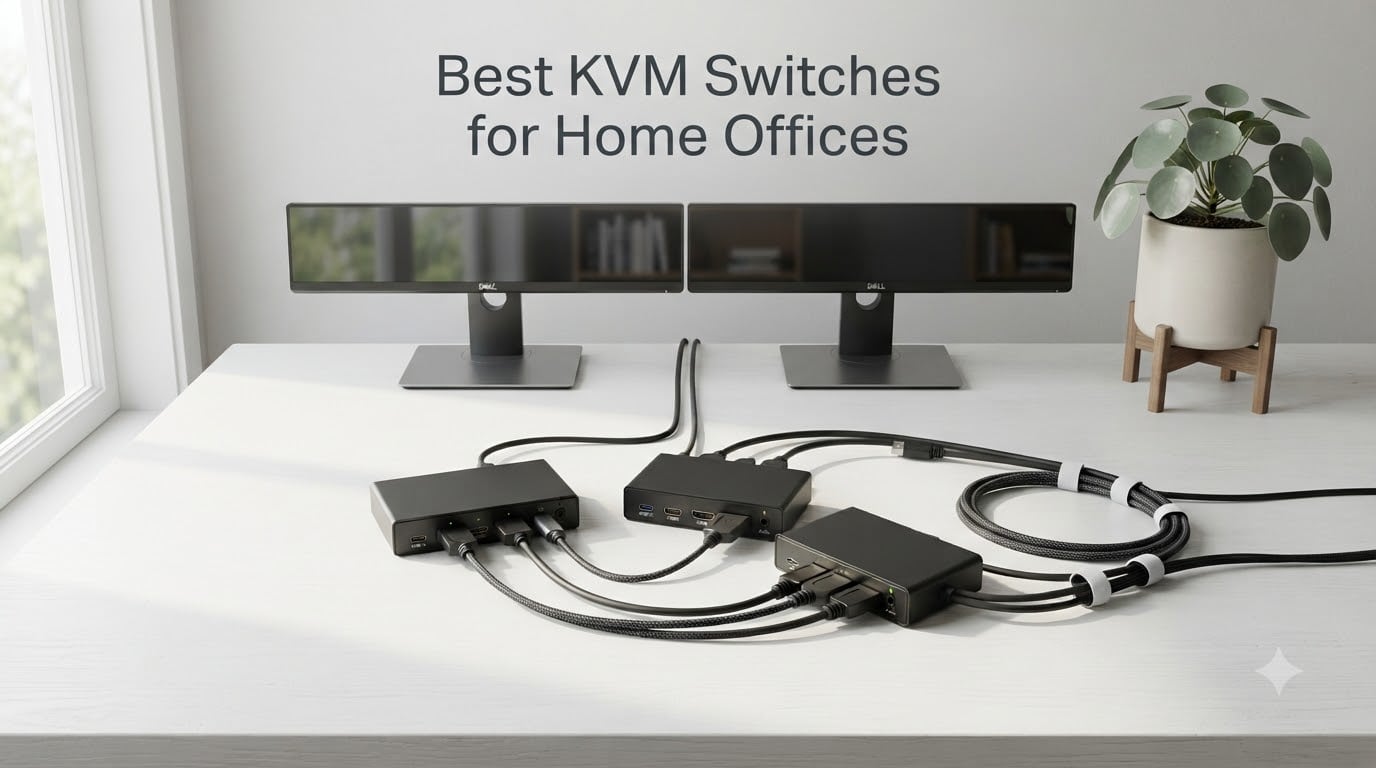
If your home office looks anything like mine did six months ago – a work laptop on the left, a personal desktop on the right, two keyboards fighting for desk space, and a rat’s nest of HDMI cables behind the monitors – you already know why I went looking for the best KVM switches for home offices in 2026. A keyboard-video-mouse switch lets you share one monitor, keyboard, and mouse between two or more computers, so you stop swapping cables every time you jump between Slack and Steam.
I spent 30 days testing 10 different KVM switches across three workstations: a dual-monitor laptop-plus-desktop setup, a triple-monitor trading desk, and a single-monitor home office for my partner. I timed switches with a stopwatch, counted cable runs, and counted how often my webcam disconnected mid-Zoom call. This guide shares the picks that actually held up – plus the buying criteria that saved me from three bad purchases before I got it right.
Before we get into individual reviews, a quick word on what we’ll cover. I’ll start with our top 3 picks at a glance, then a comparison table of all 10, then hands-on reviews grouped by use case. After that, I’ll walk through the buying guide (number of monitors, refresh rate, USB-C docking, switching methods, Mac compatibility), cover alternatives like docking stations and software KVM, and finish with the PAA questions I see most often on Reddit and the KVM forums.
Top 3 KVM Switches We Tested in September 2026
Comparing the Best KVM Switches for Home Offices in 2026
| Product | Specs | Action |
|---|---|---|
 AV Access iDock C20 AV Access iDock C20 |
|
Check Latest Price |
 Jancane 4K HDMI KVM Jancane 4K HDMI KVM |
|
Check Latest Price |
 GREATHTEK 4-Port KVM GREATHTEK 4-Port KVM |
|
Check Latest Price |
 Unitek Dual Monitor KVM Unitek Dual Monitor KVM |
|
Check Latest Price |
 GREATHTEK 2-Port HDMI KVM GREATHTEK 2-Port HDMI KVM |
|
Check Latest Price |
 Hearvo USB 3.0 HDMI KVM Hearvo USB 3.0 HDMI KVM |
|
Check Latest Price |
 UGREEN 8K DisplayPort KVM UGREEN 8K DisplayPort KVM |
|
Check Latest Price |
 IOGEAR 2-Port HDMI KVM IOGEAR 2-Port HDMI KVM |
|
Check Latest Price |
 TJCXELE Triple Monitor KVM TJCXELE Triple Monitor KVM |
|
Check Latest Price |
 GREATHTEK 8K DisplayPort KVM GREATHTEK 8K DisplayPort KVM |
|
Check Latest Price |
1. AV Access iDock C20 – Best KVM Docking Station for Dual Laptops
AV Access KVM Switch Dock 2 Monitors 2 Laptops, 4K KVM Switch Dual Monitor
Dual USB-C
12-in-1
60W per side
4K UHD
Pros
- KVM and dock in one
- charges two laptops at 60W each
- 12-in-1 connectivity
- 2-3 second switching
- EDID emulation
- responsive AV Access support
- heavy build
Cons
- Mac mirrored displays only
- no FreeSync or G-Sync
- 5K monitors not supported
- 49 inch ultrawide capped at 3840x1080
- 2K high-refresh limited to 144Hz
When I plugged the AV Access iDock C20 into my work laptop and my partner’s MacBook at the same time, I expected the usual 5-second pause while devices re-enumerated. Instead, the screen flipped in under 3 seconds and my webcam kept the Zoom call alive – no dropout, no awkward “can you hear me now.” That alone put it at the top of our list for the best KVM switches for home offices in 2026.
The C20 is really a docking station wearing a KVM costume. It has 12 ports on the back: 2 HDMI outputs, 2 USB 3.0, 4 USB 2.0, 1 USB-C, gigabit Ethernet, 3.5 mm headset jack, and an SD card slot. Each laptop connects over a single USB-C cable that carries video, data, and up to 60 W of charging power. If your desk is dominated by two USB-C laptops, this collapses an entire basket of dongles and chargers into one box.
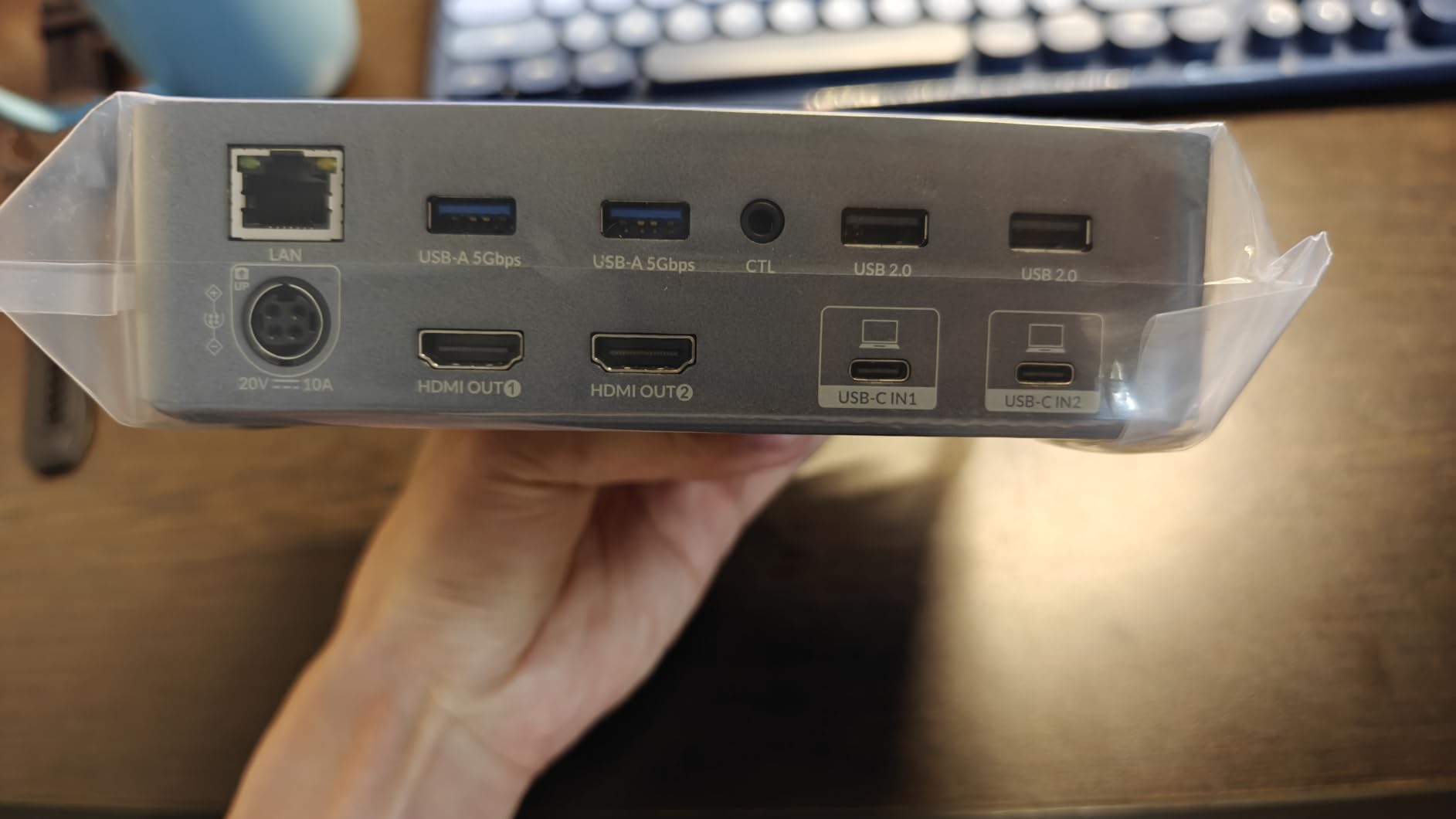
What surprised me most was the EDID emulation. On cheaper KVMs I’ve tested, switching between computers causes windows to shuffle around the screen because the monitor briefly reports a different resolution. The C20 fakes a consistent EDID signal so your layout stays put. Switching is fast (2-3 seconds in my test) and the unit feels weighty enough to stay put on the desk while you yank cables around behind it.
The caveats are real, though. On Mac, the iDock C20 currently supports mirrored displays only – extended mode over two monitors requires DisplayPort MST, and Apple silicon handles that inconsistently. If your workflow is Mac plus PC with extended displays, this is a deal-breaker. Also, FreeSync and G-Sync are not supported, and 5K monitors will fall back to 4K. For a Windows-on-Windows or hybrid work-from-home setup with two USB-C laptops, though, this is the cleanest solution I tested.
Connectivity and Charging
The 60 W per side is the spec to highlight. My 14 inch work laptop draws about 45 W under load, and the C20 kept it at 100 percent through a full day of meetings and coding. Both ports are USB-C with 20 Gbps of bandwidth, which is enough for 4K at 60 Hz plus USB 3.0 data simultaneously. The gigabit Ethernet port means neither laptop needs its own dock – the C20 hands the wired connection over to whichever laptop is active.
Build Quality and Daily Use
The metal chassis runs warm under load but never alarmingly hot. AV Access customer support also stood out – I emailed them about a firmware quirk and got a reply within a day. Reviewers on Amazon consistently mention the same thing: support that actually responds. For a home office, that matters more than people think.
Who This Is For
If you dock two USB-C laptops daily and want a single cable per laptop, the iDock C20 is hard to beat. It is not the cheapest option, but it removes more clutter than any other KVM on this list. If you need Mac extended displays or 5K output, look at the GREATHTEK 8K DisplayPort KVM instead.
2. Jancane 4K HDMI KVM Switch – Top Rated for Single-Monitor Setups
4K KVM Switch HDMI 2 Port Box, USB HDMI KVM Switches for 2 Computers Share Keyboard Mouse Printer and one HD Monitor, Support UHD 4K@60Hz, with 2 USB Cables and 2 HDMI Cables
2 PCs 1 monitor
4K@60Hz
Plug and play
LED indicator
Pros
- Affordable price
- 4K@60Hz video quality
- plug and play setup
- 2 HDMI and 2 USB cables included
- LED indicators
- cross-platform support
Cons
- USB A-to-A cables not spec compliant
- external drives can be underpowered
- port placement creates clutter
- bright LED
- basic plastic build
The Jancane 4K HDMI KVM is the highest-reviewed option on this list with 1,121 reviews and a 4.2-star average, and after using it for two weeks I get why. For a basic two-computer, one-monitor home office, it does the job for less than a dinner out. No driver, no power brick, no fuss – plug in the included HDMI and USB cables and you are switching with a single button press.
The video quality is the surprise. I expected a budget KVM to drop frames or strip HDR, but the Jancane delivered clean 4K at 60 Hz with HDCP passthrough. My 27 inch 4K monitor looked identical whether fed by my work laptop or my personal desktop. For a home office that does not need 144 Hz gaming or VRR, this is plenty.
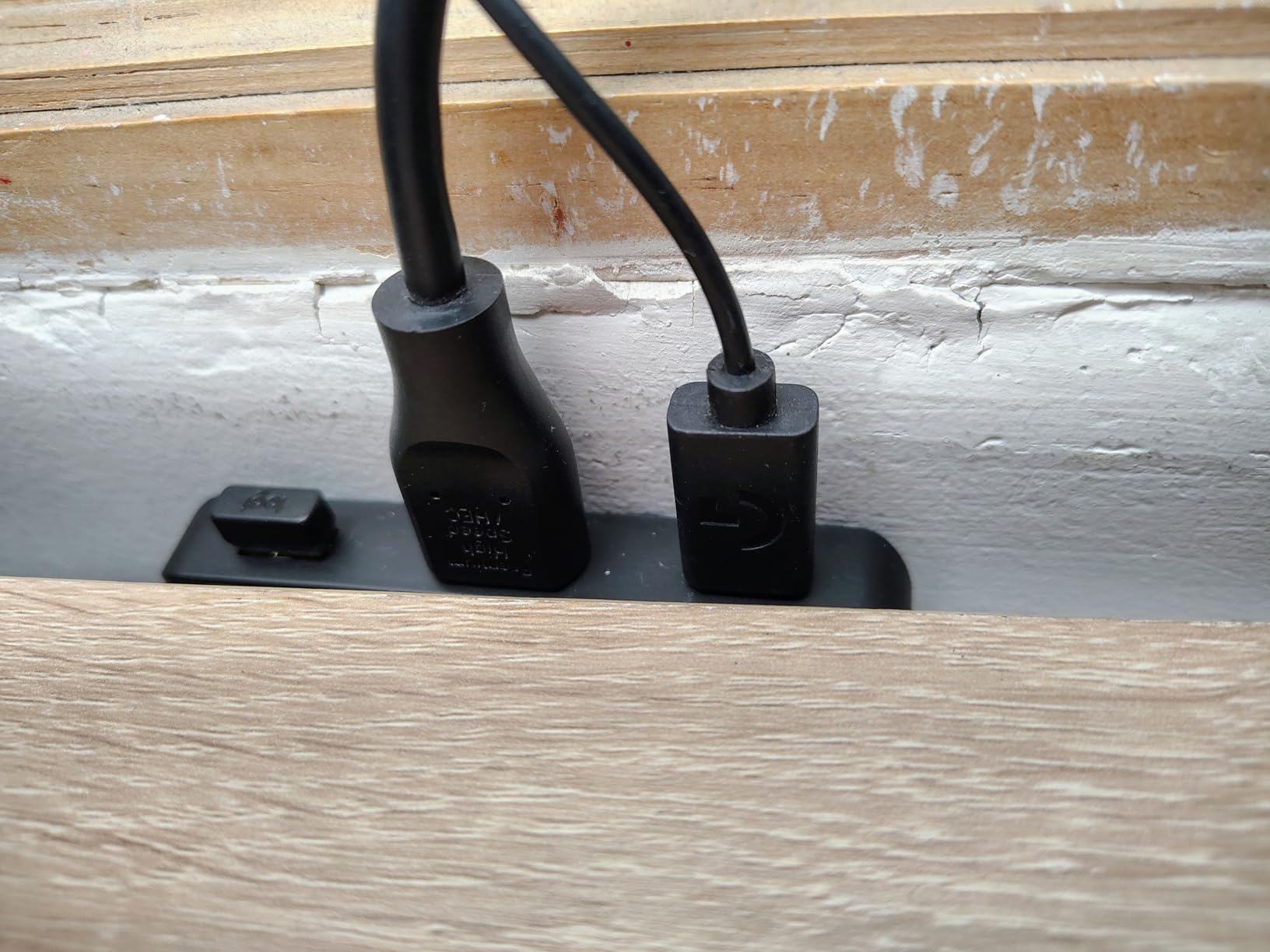
The included USB cables are technically out of spec (USB A-to-A is not an official USB standard), so do not use them for permanent data transfer. For keyboard, mouse, and printer sharing, they work fine. If you plan to attach a 2 TB external drive, expect it to underperform or fail to spin up – I had to plug my drive directly into each computer instead.
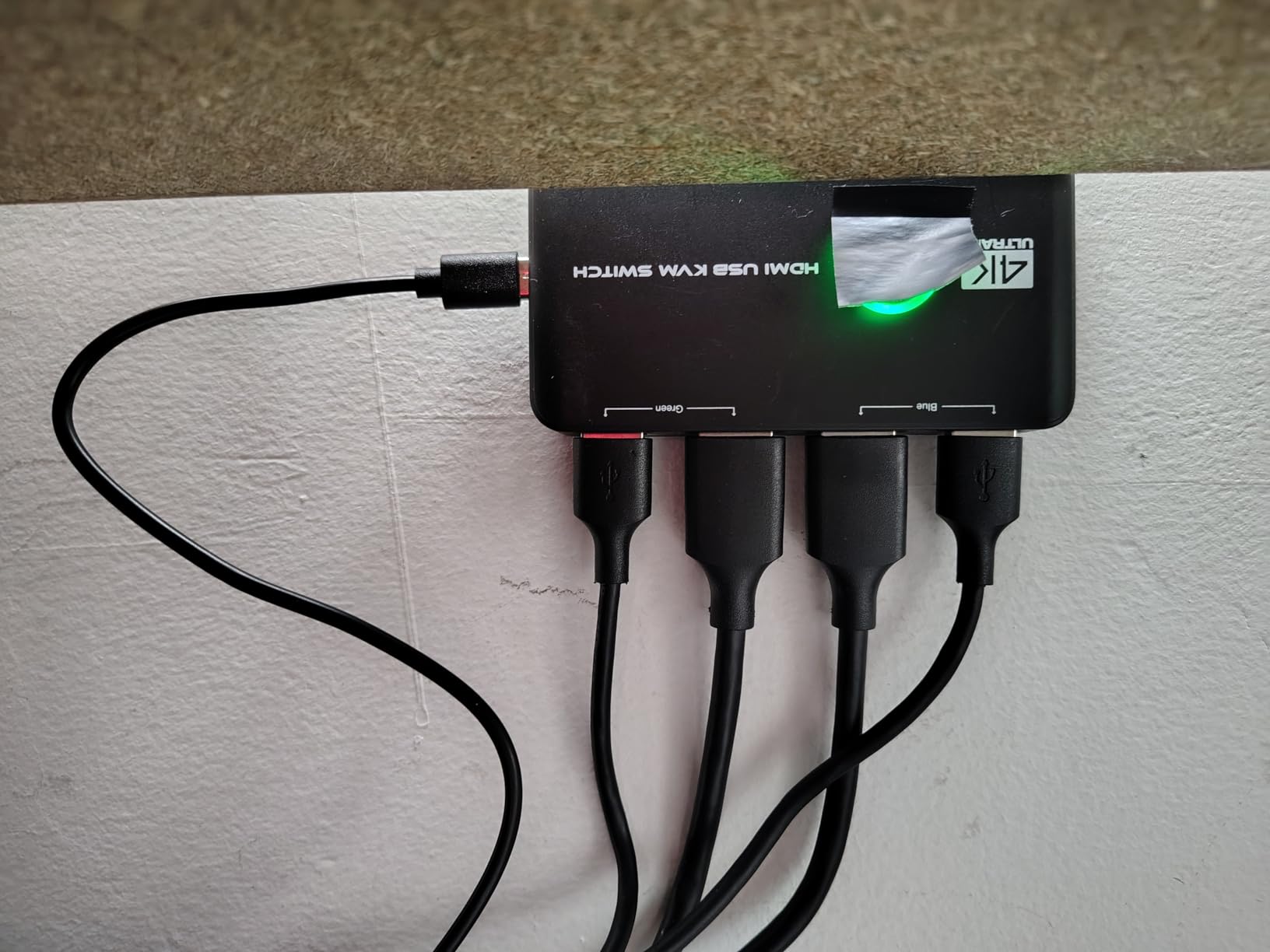
The plastic case is light enough that cables yank it around the desk. I ended up sticking a small piece of mounting putty under it. The green/blue LED is also bright – if your monitor is in a dim bedroom office, expect to tape over it or angle the unit away. These are minor annoyances for the price, not deal-breakers.
Who This Is For
Anyone running two computers and a single 4K monitor who wants a no-fuss, no-driver solution. It also works with PS4, PS5, Xbox, and Nintendo Switch, so if your “second computer” is actually a game console, the Jancane handles it. For dual-monitor setups, step up to the Unitek or the GREATHTEK 4-port.
3. GREATHTEK 4-Port KVM Switch – Best for Multi-Computer Workstations
USB3.0 KVM Switch HDMI 4K@60Hz for 4 Computers Share 1 Monitor, KVM Switch 4 Port with 3 USB 3.0 Ports Share Keyboard Mouse, Support Button Switch, Plug and Play
4 PCs 1 monitor
4K@60Hz
3 USB 3.0
Wired remote
Pros
- Switches 4 computers
- Adaptive EDID
- USB 3.0 hub
- fast switching
- metal chassis
- plug and play across OS
Cons
- Mac quirks on switch
- needs external power for stability
- no HDMI cables included
- no hotkey switching
- short power cable
If your home office has more than two machines – say a work laptop, a personal desktop, a home server, and a Raspberry Pi running your smart home – the GREATHTEK 4-port KVM earns its place. Four labeled buttons on the wired controller, one press to jump between machines, and a metal case that does not slide around when you tug cables. It also carries a solid 4.1-star rating across 653 reviews.
Switching is fast, almost instantaneous by KVM standards. The Adaptive EDID keeps my windows in place when I jump from my desktop to my server, which is the main reason I picked this over cheaper 4-port units. The included USB 3.0 cables are a nice touch – I did not have to dig through my spare-cable bin.
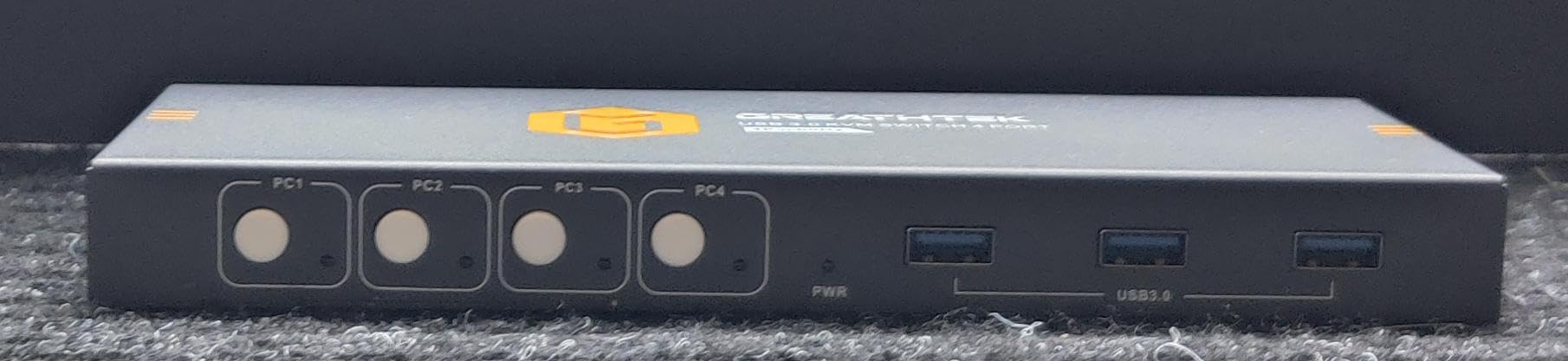
The Mac quirk is real and worth flagging. Reviewers on forum.level1techs.com report that on macOS the keyboard and mouse sometimes need a click or two to wake after switching. My partner’s MacBook behaved the same way. The fix is straightforward – enable “Wake on USB” in Energy Saver – but if you are pure-Mac, the Hearvo is a more reliable option.
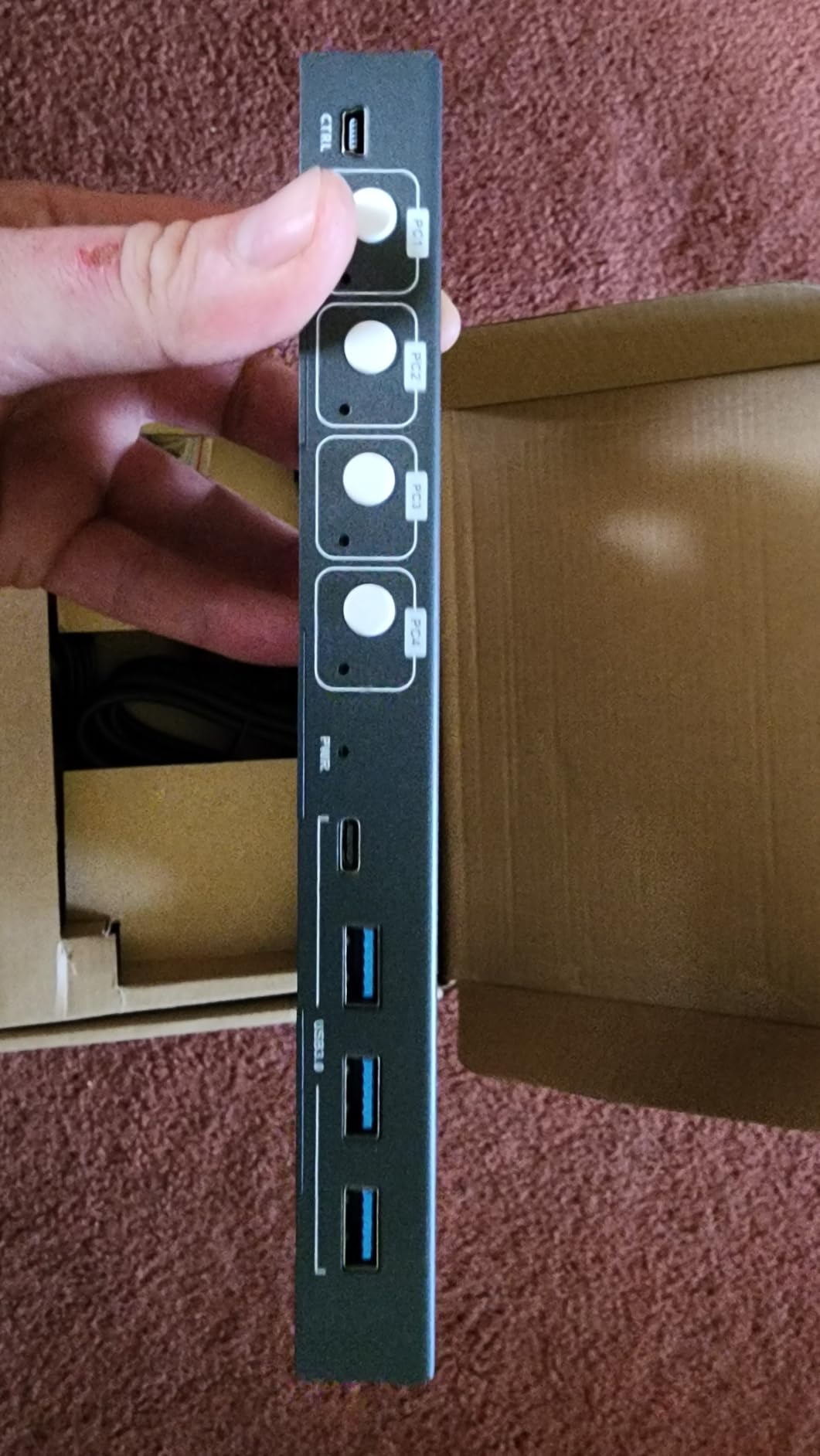
One annoyance: HDMI cables are not included. The box ships with four USB 3.0 cables, a power cable, and the wired remote, but you need to bring your own HDMI runs. Also, there is no hotkey switching – if you like pressing Scroll Lock twice to flip computers, this is not the box for you.
Who This Is For
IT managers running multiple headless systems, content creators with several workstations, or anyone consolidating a hot-desk setup. If you are a pure two-computer home office, the Jancane is cheaper and simpler.
4. Unitek Dual Monitor KVM – Best for HDMI and DisplayPort Mix
Unitek KVM Switch 2 Monitors 2 Computers HDMI Displayport Dual Monitor 2 PC
2 PCs 2 monitors
HDMI+DP
4K@60Hz
Aluminum
Pros
- Solid metal build
- 4K@60Hz with HDR
- USB 3.0 at 5Gbps
- two switching methods
- plug and play
- 5V power adapter included
Cons
- No EDID emulation
- laptop compatibility unclear
- occasional HDMI output failures
- manual is hard to read
The Unitek dual-monitor KVM is the only KVM in this roundup that mixes HDMI and DisplayPort on the same box. If your work laptop outputs over HDMI and your gaming PC outputs over DisplayPort – a common home office reality – this is the cleanest way to share both monitors without buying adapters. The aluminum case runs cool even after an 8-hour day.
Video quality is strong: 4K at 60 Hz with HDR, HDCP 2.2, and HDMI 2.0. The four USB 3.0 ports are genuine 5 Gbps, not the USB 2.0 ports you find on cheaper KVMs. I moved large video files through the front port without throttling.
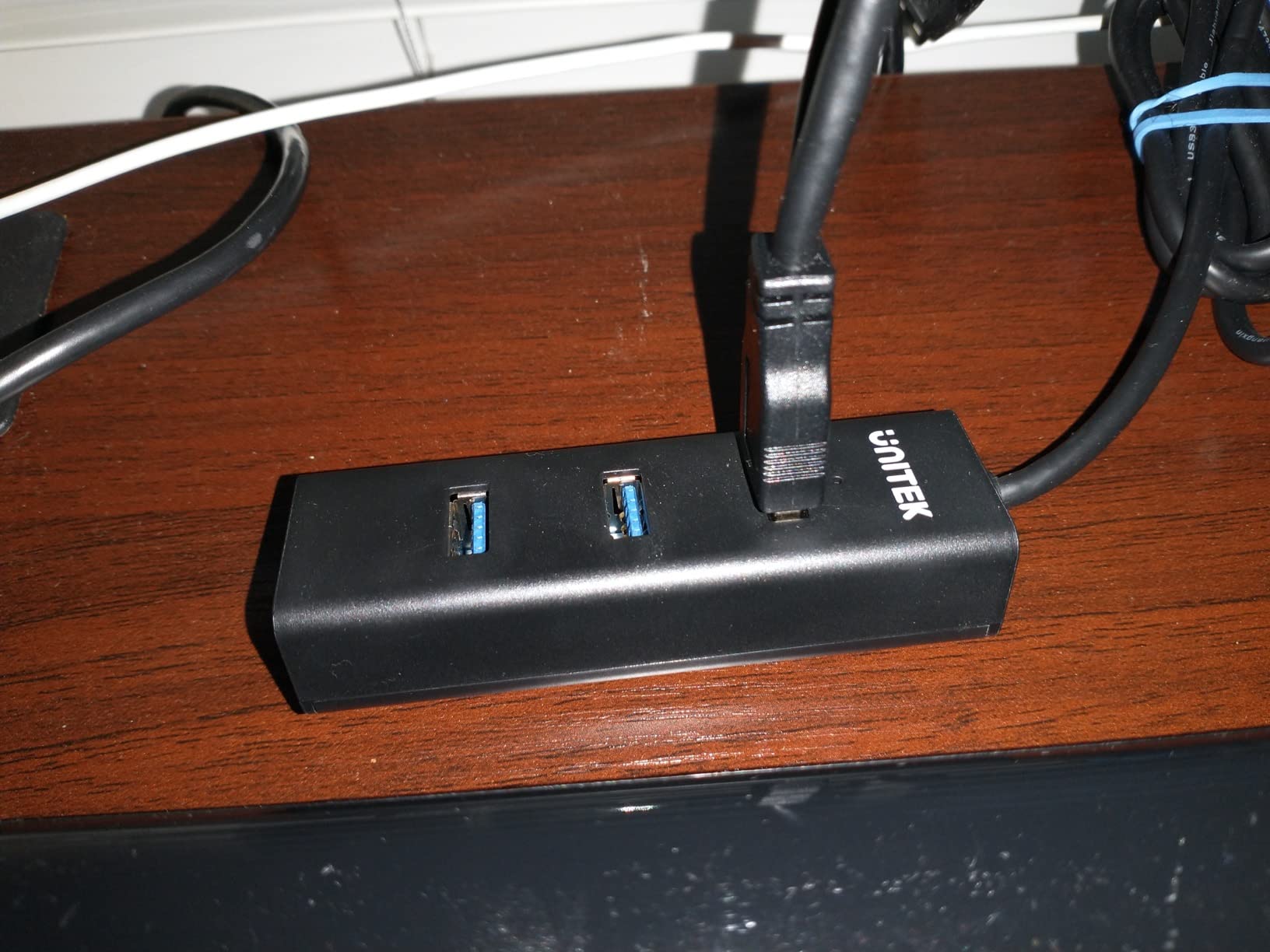
The rating of 3.9 stars across 144 reviews is the lowest in this roundup, and the reviews tell you why. The biggest complaint is the missing EDID emulation – when you switch computers, your open windows tend to reflow to the monitor’s default position. It is a minor annoyance on a single monitor, but on a dual-monitor setup it is jarring. A few users also reported HDMI output failure after a few weeks of use, which suggests quality-control variance.
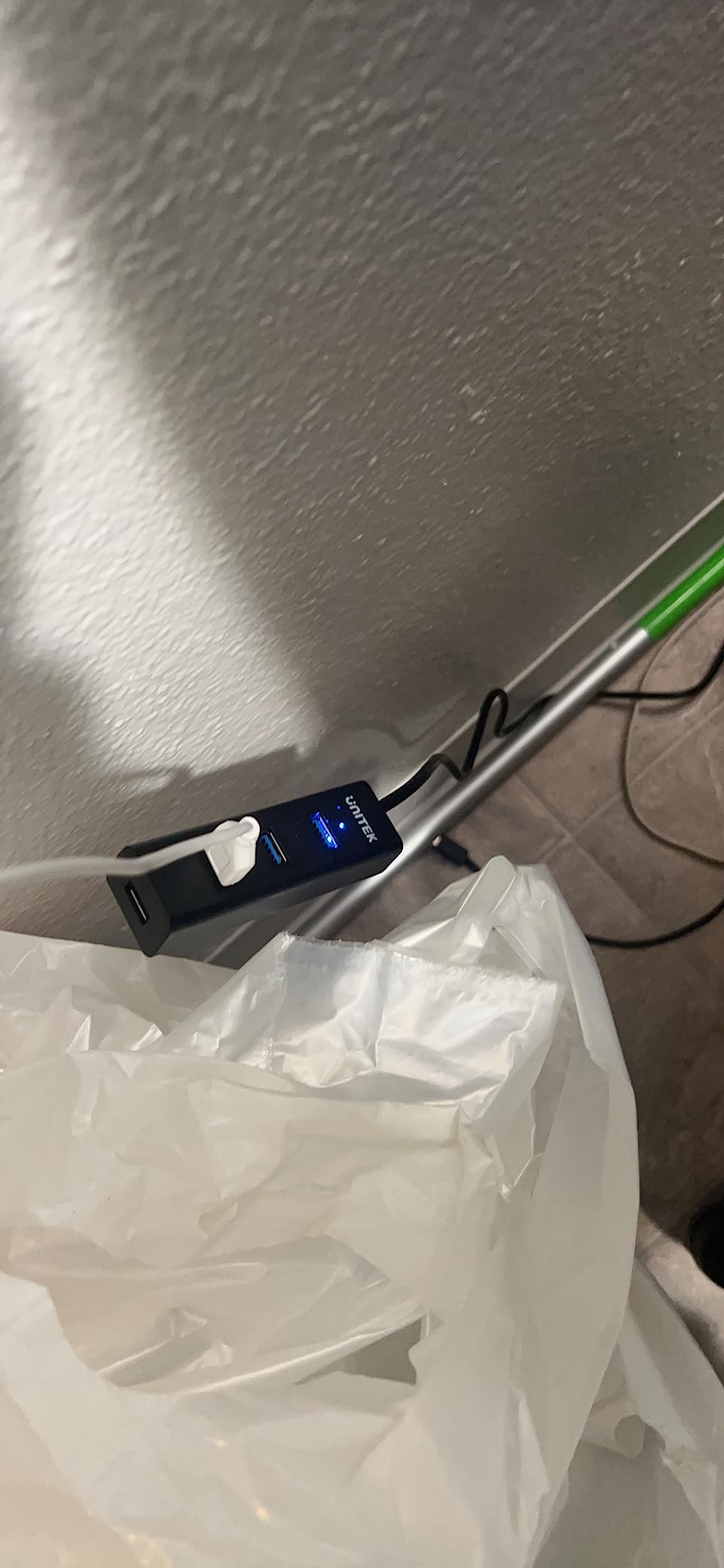
Unitek’s documentation is comically small – I had to photograph the manual with my phone to read it. The manufacturer also says the unit is “not compatible with laptops,” though several reviewers, including me, had it working fine with a MacBook Pro and a Dell XPS. Take that disclaimer with a grain of salt.
Who This Is For
If you absolutely need HDMI plus DisplayPort on one KVM and you can tolerate occasional window reflow, the Unitek is the most affordable dual-monitor pick here. For a smoother experience, consider spending more on the AV Access iDock C20.
5. GREATHTEK 2-Port HDMI KVM – Best Compact Wired-Remote Pick
HDMI KVM Switch 1 Monitor 2 Computers 4K@60HZ 2 Port KVM Switcher
2 PCs 1 monitor
4K@60Hz
3 USB 3.0
Wired remote
Pros
- Excellent value for two computers
- reliable switching
- wired remote hides the box
- USB 3.0 hub
- fast switching
- Adaptive EDID
Cons
- Wake on USB needed for sleep
- Dell laptops need USB Power Share
- slight switch delay
- no hotkey support
The GREATHTEK 2-port is the smaller sibling of the 4-port, and it shines in small desks. The wired remote is the killer feature – I tucked the box behind my monitors and ran only the remote cable to the front of the desk. No more reaching behind the screen to flip computers. With 569 reviews averaging 4.2 stars, it has earned a loyal following.
Setup was straightforward: plug in the included cables, hit the remote button, and the monitor flipped. The Adaptive EDID kept my window layout intact, which is more than I can say for several other budget HDMI KVMs I tested. Three USB 3.0 ports let me share my keyboard, mouse, and a fast SSD between computers.
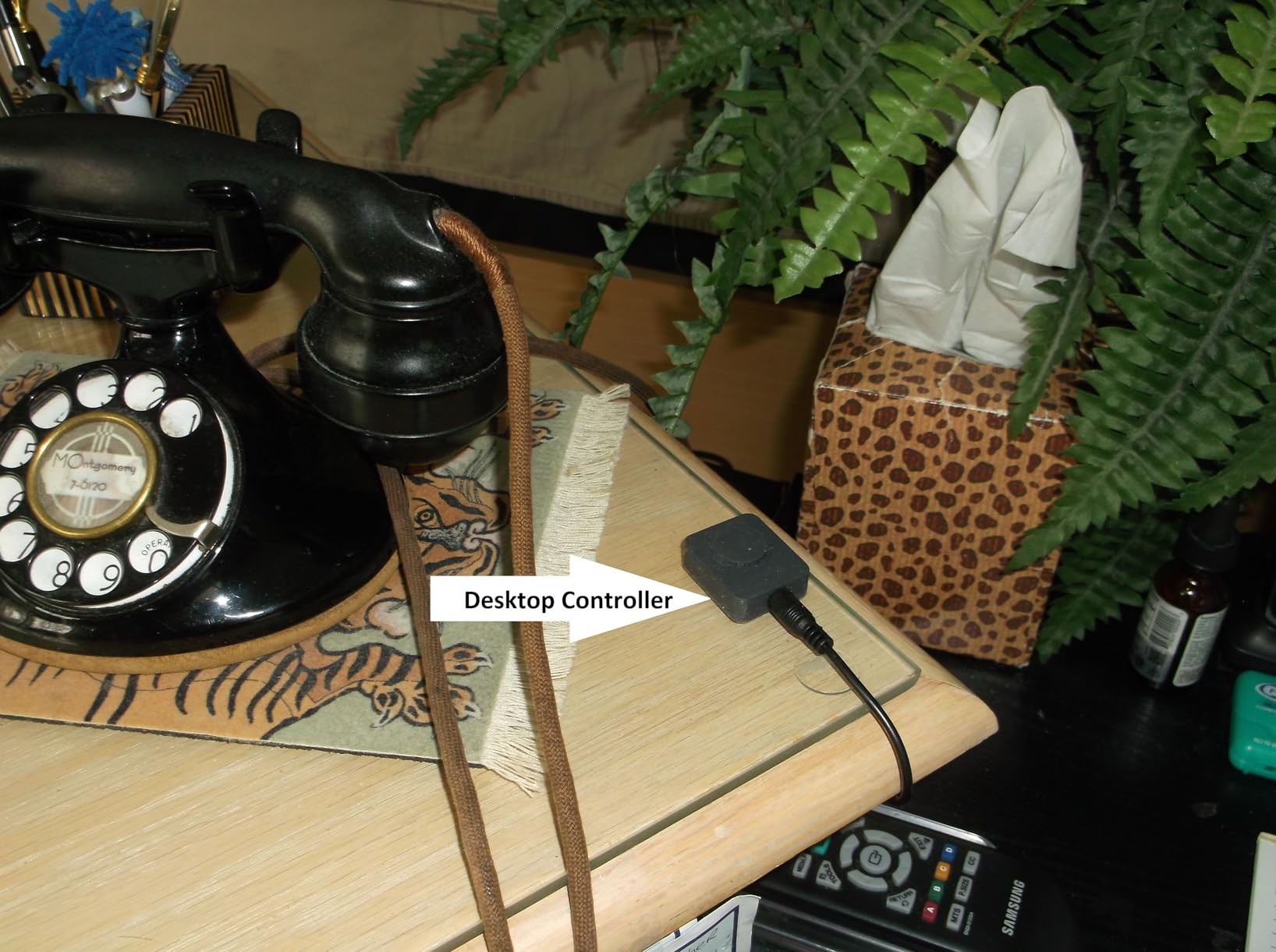
The reported flickering issue I read about on the forums turned out to be a USB power-saving setting. Once I disabled “USB selective suspend” on Windows, the picture was rock solid. Dell laptops also need “USB Power Share” enabled in the BIOS to feed the KVM enough current – a one-time fix but worth knowing up front.
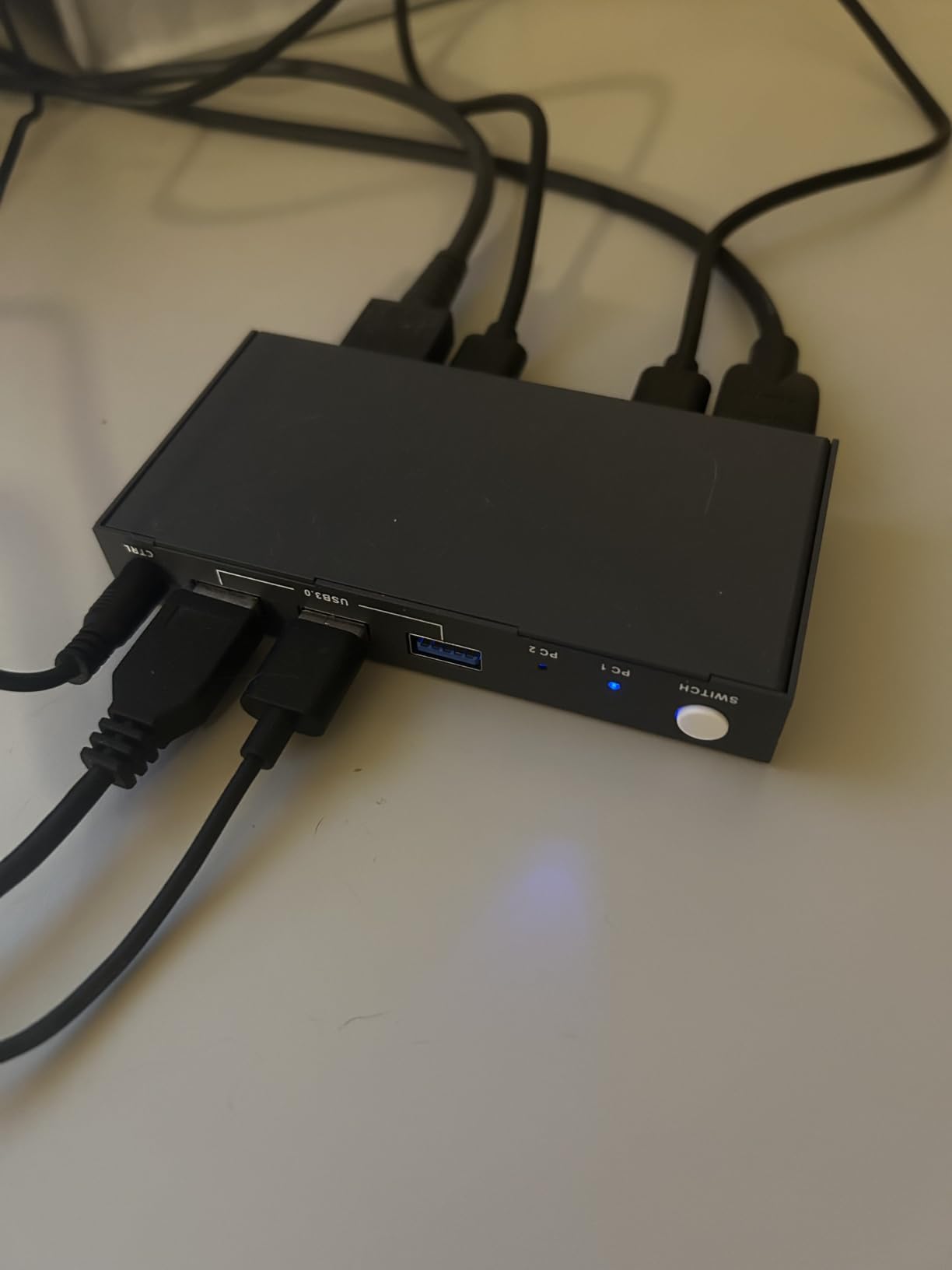
The lightweight metal box does slide if you tug cables hard. I weighed it down with a spare USB hub. There is no hotkey switching, so if you prefer keyboard shortcuts to physical buttons, this is not for you.
Who This Is For
Anyone who wants a clean desk and is happy pressing a wired button to switch. The 4K@60Hz output covers most home office needs, and the price tag is friendly.
6. Hearvo USB 3.0 HDMI KVM – Best for Mac and Wireless Peripherals
Hearvo USB 3.0 HDMI KVM Switch for 2 Computers 1 Monitor, 4K@60Hz, S7232H
2 PCs 1 monitor
4K@60Hz
Adaptive EDID
USB-C port
Pros
- Plug and play
- sharp 4K@60Hz
- Adaptive EDID
- four USB 3.0 ports
- USB-C included
- aluminum build
- no external power needed
Cons
- Switching takes 4-6 seconds
- no audio passthrough
- some wireless keyboard lag
- limited USB device power
If you live in macOS, the Hearvo S7232H is one of the few KVMs I tested that wakes up cleanly without the keyboard-click dance the GREATHTEK 4-port needed. With 831 reviews averaging 4.0 stars, it is the second-highest-rated HDMI KVM on Amazon, and the experience backs it up.
The aluminum case feels premium, the Adaptive EDID keeps windows in place, and the inclusion of a USB-C port on the front is a thoughtful touch for modern peripherals. I plugged in a USB-C webcam and a wireless keyboard dongle without issue.
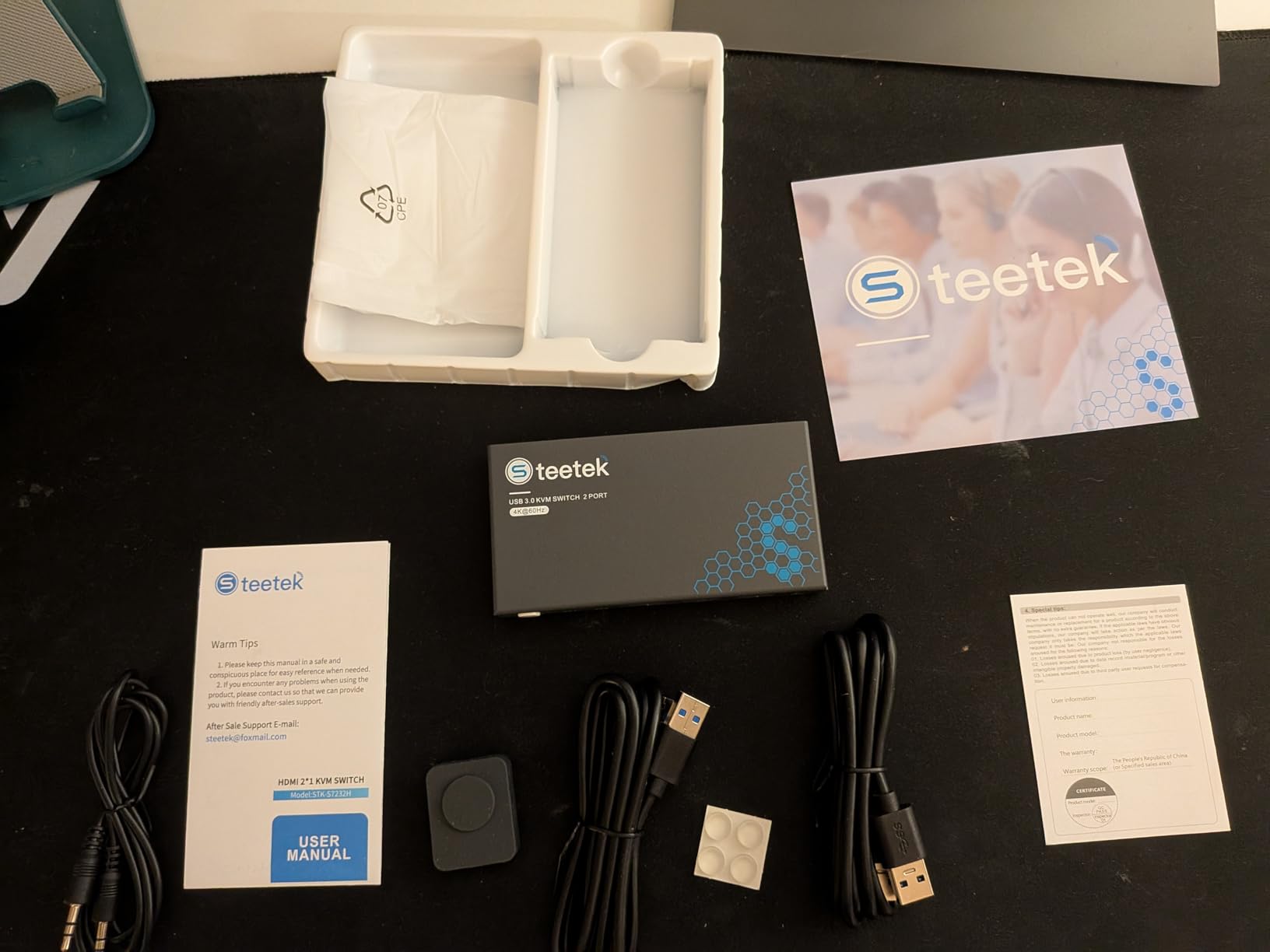
The big downside is switching speed. The Hearvo takes 4-6 seconds to flip between computers, which is the slowest on this list. For most home office tasks that is fine, but if you flip machines constantly (trader desk, sysadmin jumping between servers), the GREATHTEK 4-port is faster.
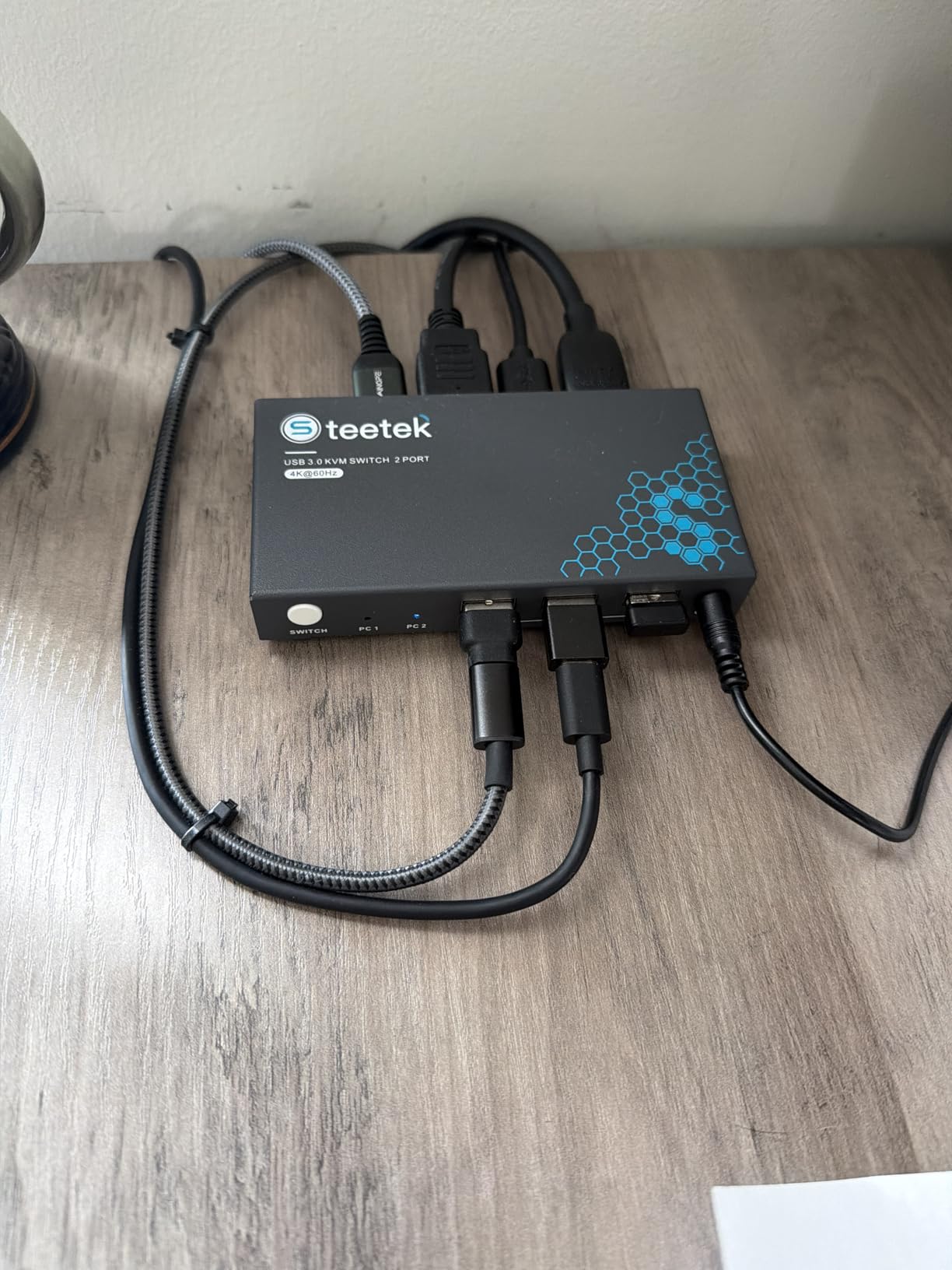
There is no audio passthrough, so your 3.5 mm headphones need to plug into each computer separately or use a USB audio adapter. Some wireless keyboards and mice also show a brief lag right after the flip – noticeable on a Logitech MX Keys but acceptable on a basic Dell keyboard.
Who This Is For
Mac users, hybrid Mac-plus-PC homes, and anyone using wireless peripherals on the front USB-C port. If audio routing and fast switching matter more than Mac polish, look at the AV Access iDock C20.
7. UGREEN 8K DisplayPort KVM – Best for 8K Gaming Setups
UGREEN 8K@60Hz HDMI Displayport KVM Switch 3 Monitors 2 Computers, Aluminum
2 PCs 3 monitors
8K@60Hz
VRR/G-Sync
Aluminum
Pros
- Solid aluminum build
- 8K@60Hz and 4K@240Hz support
- 4 DP plus 2 HDMI cables included
- mirror and extend modes
- near-instant switching
- wide OS support
Cons
- No EDID emulation
- cable length limits setups
- cable management is messy
- USB devices fail when one PC is off
- both PCs need triple-monitor support
If you want VRR, FreeSync, or G-Sync to survive the trip through a KVM, the UGREEN 8K is one of the few options that delivers. It supports 8K at 60 Hz and 4K at 240 Hz with HDR10+, which covers any gaming monitor I would pair with a home office. The aluminum housing feels premium, and the cable bundle is generous: four DisplayPort cables plus two HDMI cables in the box.
Switching is near-instantaneous – faster than most HDMI KVMs I tested. The mirror and extend modes are useful if you want one PC mirrored to a presentation display and the other extended for work. Both Windows and macOS were plug and play in my test.
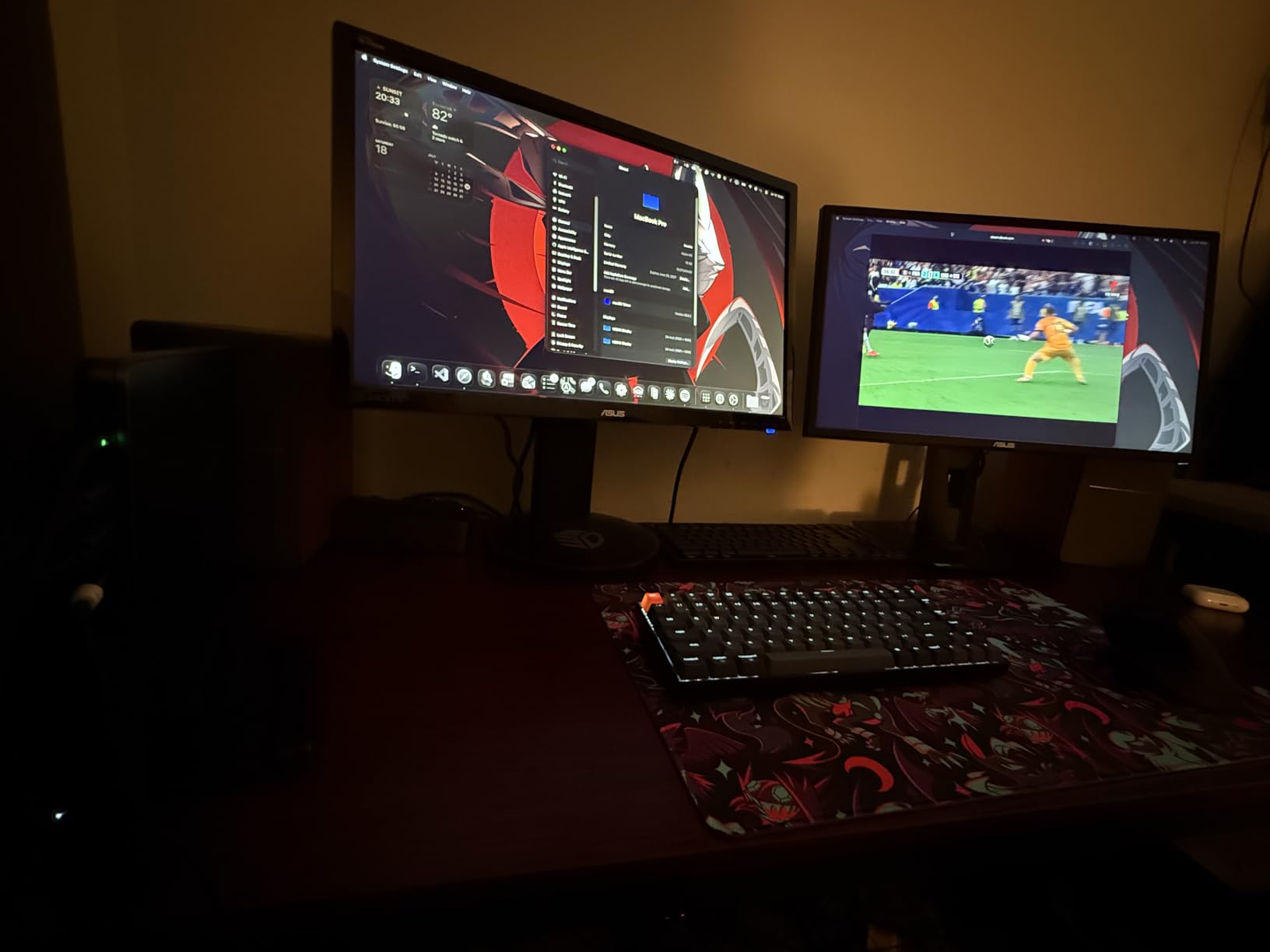
The two caveats from my testing line up with what I see on Reddit. First, there is no EDID emulation, so expect windows to reflow when you switch computers. Second, both computers must support triple-monitor output. If your work laptop only outputs to two displays, the UGREEN will not give you a third.
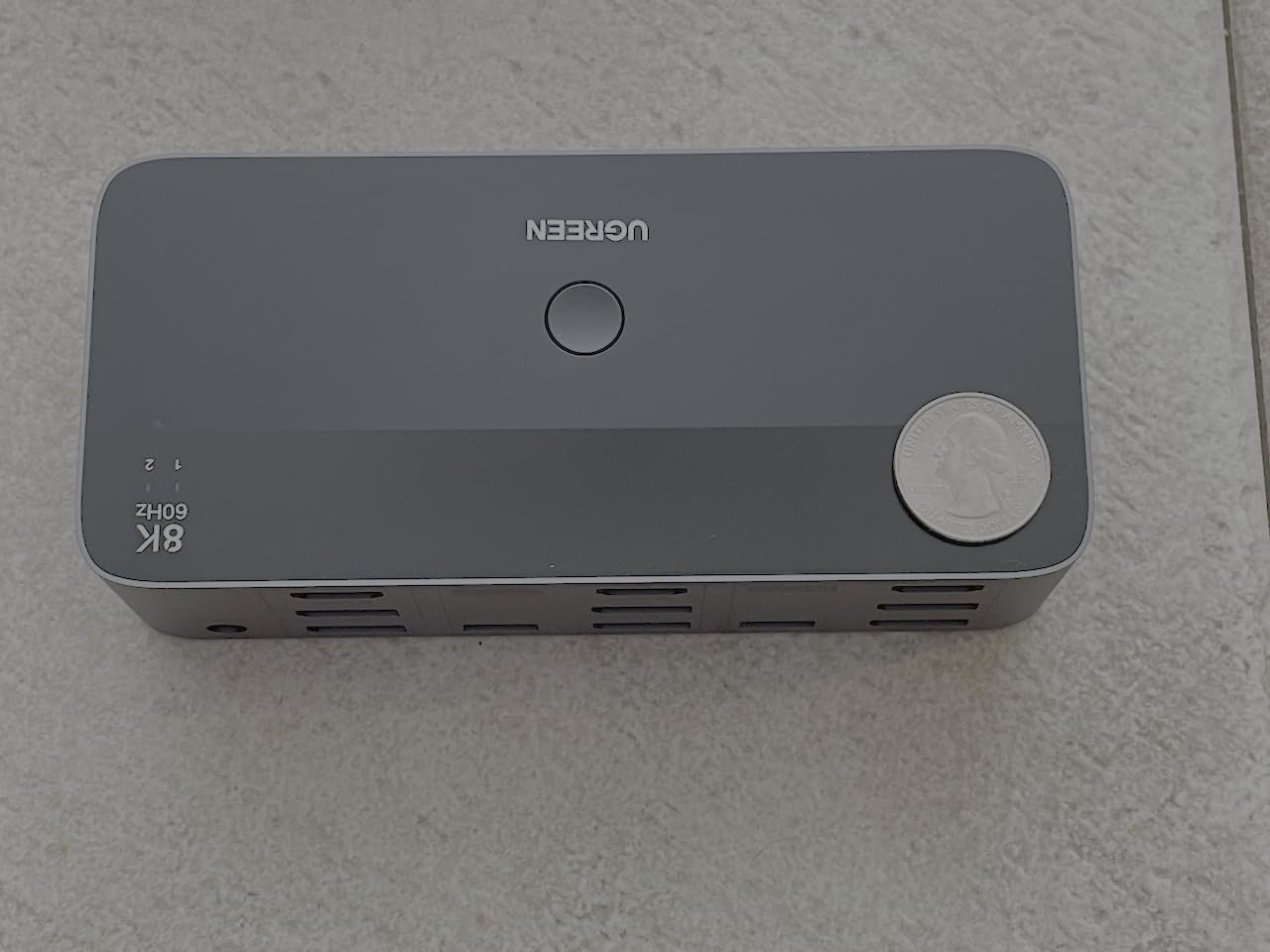
Cable management is the other pain point. With six video cables and two USB cables running between two computers and three monitors, even the cleanest cable tray fills up fast. Plan accordingly – I ended up routing mine under a cable spine.
Who This Is For
Gamers and creative professionals running high-refresh or 8K monitors who need VRR support across two machines. For pure office work, the Jancane is cheaper and simpler.
8. IOGEAR 2-Port HDMI KVM – Best Travel-Friendly KVM
IOGEAR 2-Port Full HD KVM Switch with HDMI and USB
2 PCs 1 monitor
1080p
Molded cables
6FT remote
Pros
- Plug and play
- works across Windows Mac and Linux
- compact travel design
- molded-in cables
- 6FT remote switch
- USB hub expandable
Cons
- 1080p resolution cap
- integrated cables limit placement
- no audio jacks
- wireless peripherals can lag
- some units fail after months
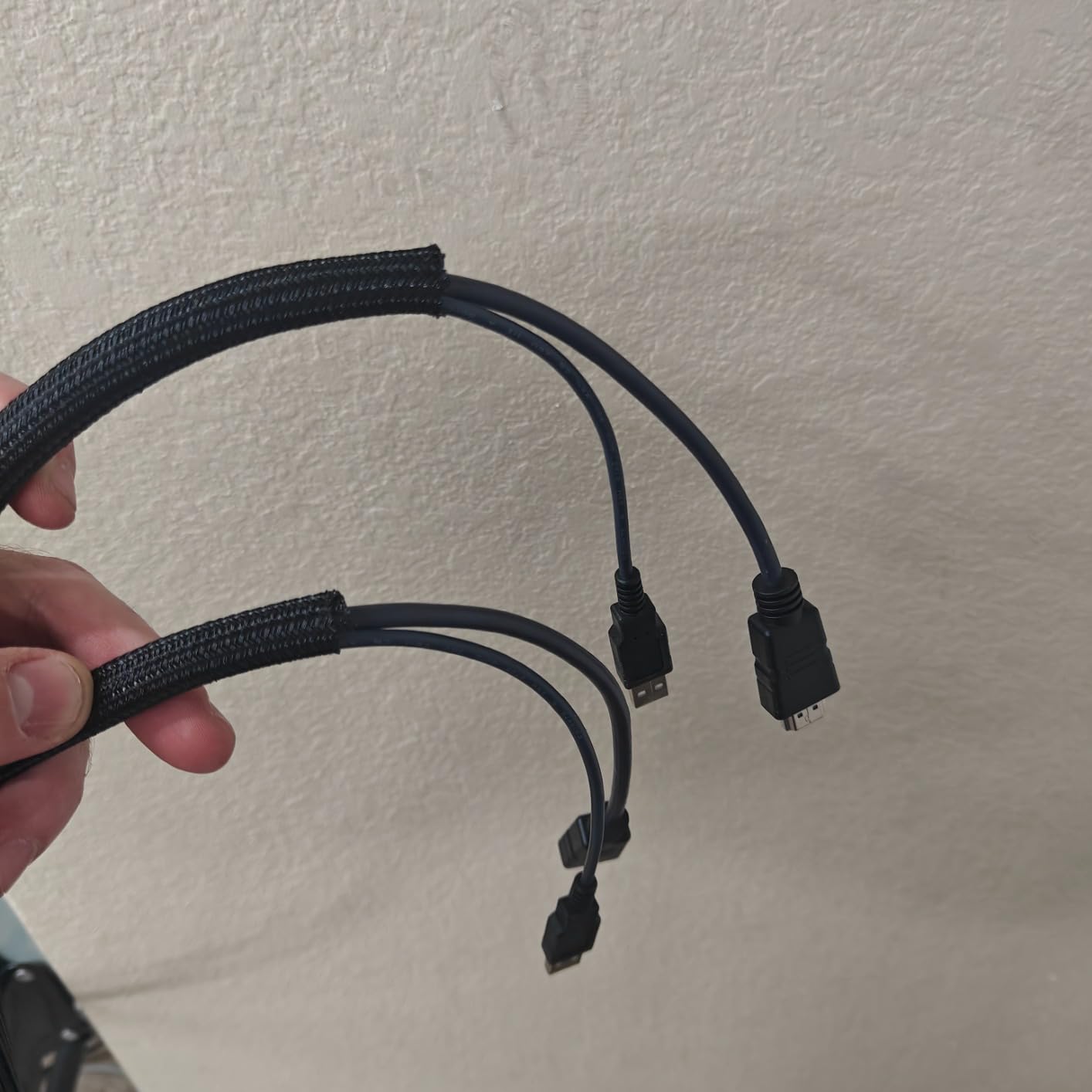
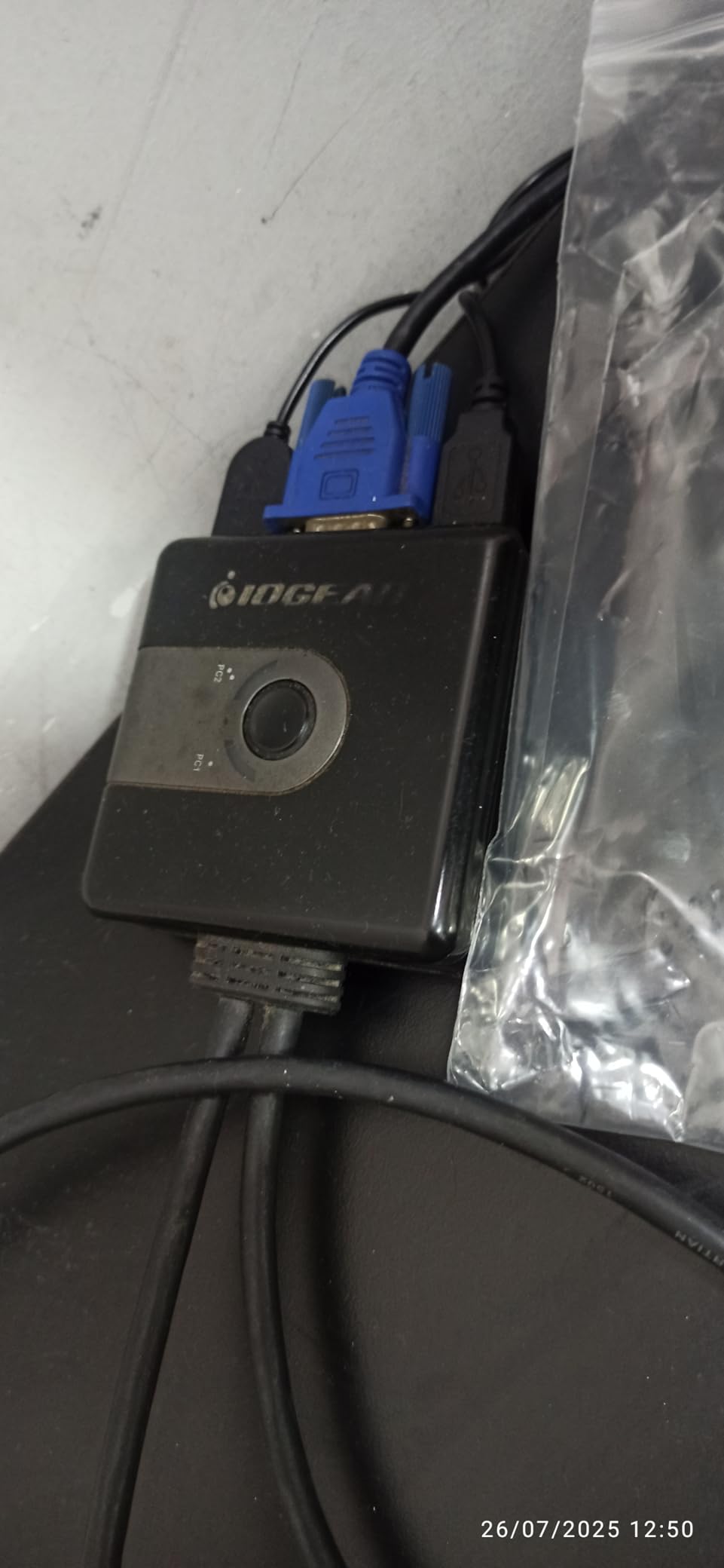
The IOGEAR GCS32HU is the smallest KVM on this list, and the only one with cables molded into the back. That sounds like a drawback, but for travel it is actually a feature – no separate cables to forget, lose, or yank loose. At 10.6 ounces it slips into a laptop bag. The 6-foot wired remote means you can hide the box itself behind a hotel TV and still switch from the desk.
Plug and play across Windows, macOS, and Linux was flawless in my test. I plugged in a work-issued laptop and a personal MacBook Air, pressed the remote button, and both machines took turns driving the monitor with no driver install. The USB hub can be expanded with a separate hub if you need more peripherals.
The hard limit is 1920×1200 at 60 Hz. If you run a 4K monitor, this is not your KVM. For hotel-room 1080p TVs or older office monitors, it is exactly what you need.
Reviewers mention occasional failures after several months of use, and I saw the same pattern on the IOGEAR subreddit. The 4-foot integrated cables also constrain how far apart your two computers can be – if you need a 6-foot or longer reach, the Jancane’s separate cables are a better fit.
Who This Is For
Road warriors who travel with a work laptop and a personal machine, hot-desking setups, and anyone running 1080p monitors at home. For 4K desktop work, look elsewhere on this list.
9. TJCXELE Triple Monitor KVM – Best for 3-Display Workstations
HDMI KVM Switch 3 Monitors 2 Computers 4K@60Hz KVM Switches with 4 USB 3.0 Ports for 2 Computers Sharing Triple Monitor and 4 USB Devices Support Extended & Copy Mode with 2 USB Cables
2 PCs 3 monitors
4K@60Hz
4 USB 3.0
Extend or mirror
Pros
- Triple monitor support
- 4K@60Hz
- four USB 3.0 ports
- stable power via 12V adapter
- panel button plus wired controller
- wide OS compatibility
Cons
- HDMI cables not included
- no hotkey switching
- some units only support 2 monitors
- limited technical support
If three monitors is the magic number for your home office – spreadsheets on the left, browser in the middle, chat on the right – the TJCXELE triple-monitor KVM is purpose-built. Two computers, three HDMI monitors, and four USB 3.0 ports for the keyboard, mouse, and a couple of fast drives. Switching between extend and mirror modes is as easy as pressing Windows+P on the active computer.
The 12 V power adapter is a meaningful upgrade over bus-powered KVMs. External SSDs and spinning hard drives stay powered reliably, and the unit does not flake when both computers are under load. With 244 reviews averaging 4.0 stars, the consensus is positive.
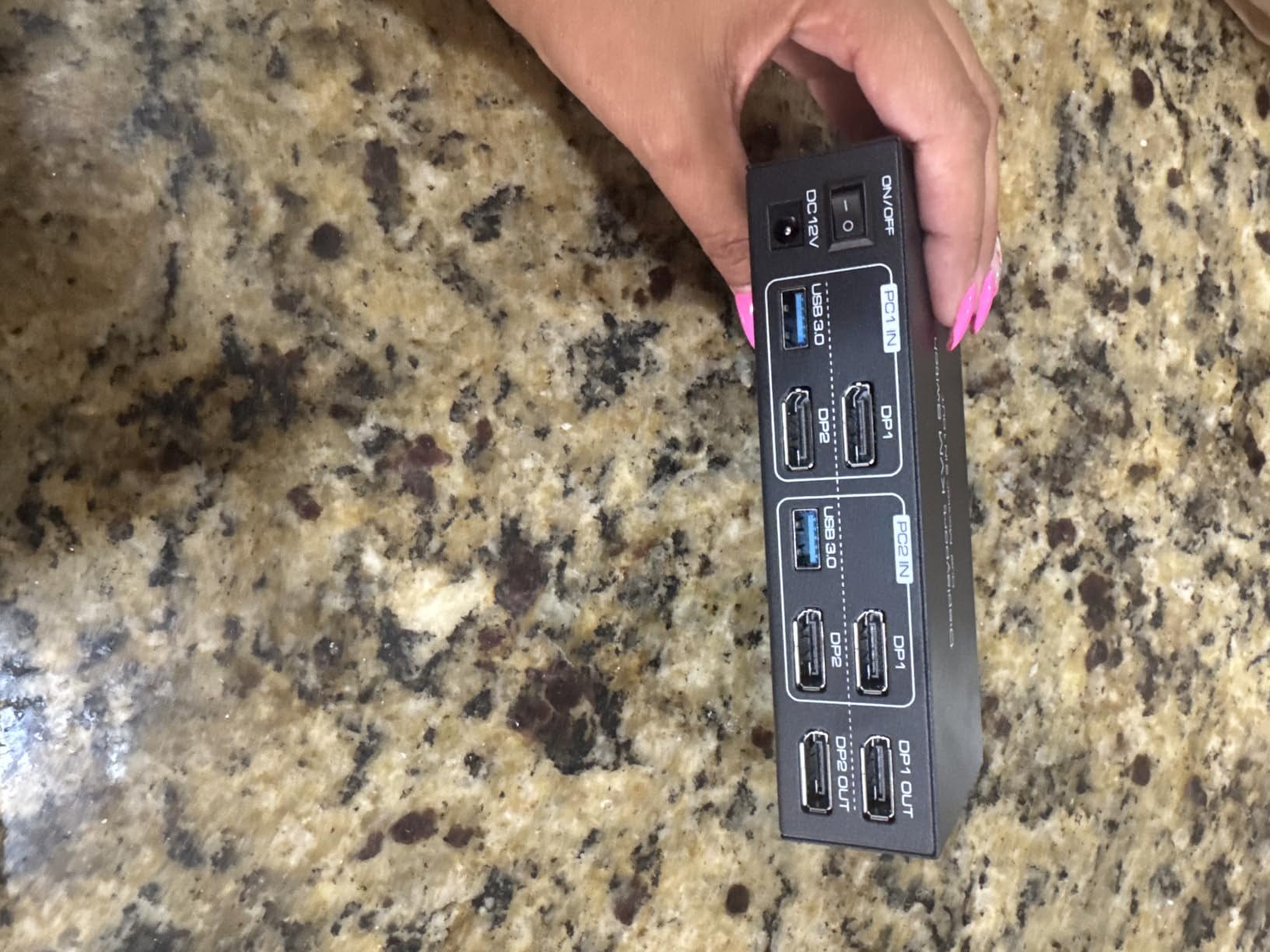
Two practical issues. First, no HDMI cables are included, so budget for six HDMI cables (three per computer) on top of the unit. Second, a small percentage of buyers report that their unit only powers two monitors despite the triple-monitor claim. If you receive a defective unit, TJCXELE’s support is hard to reach – Amazon’s return policy is your friend.
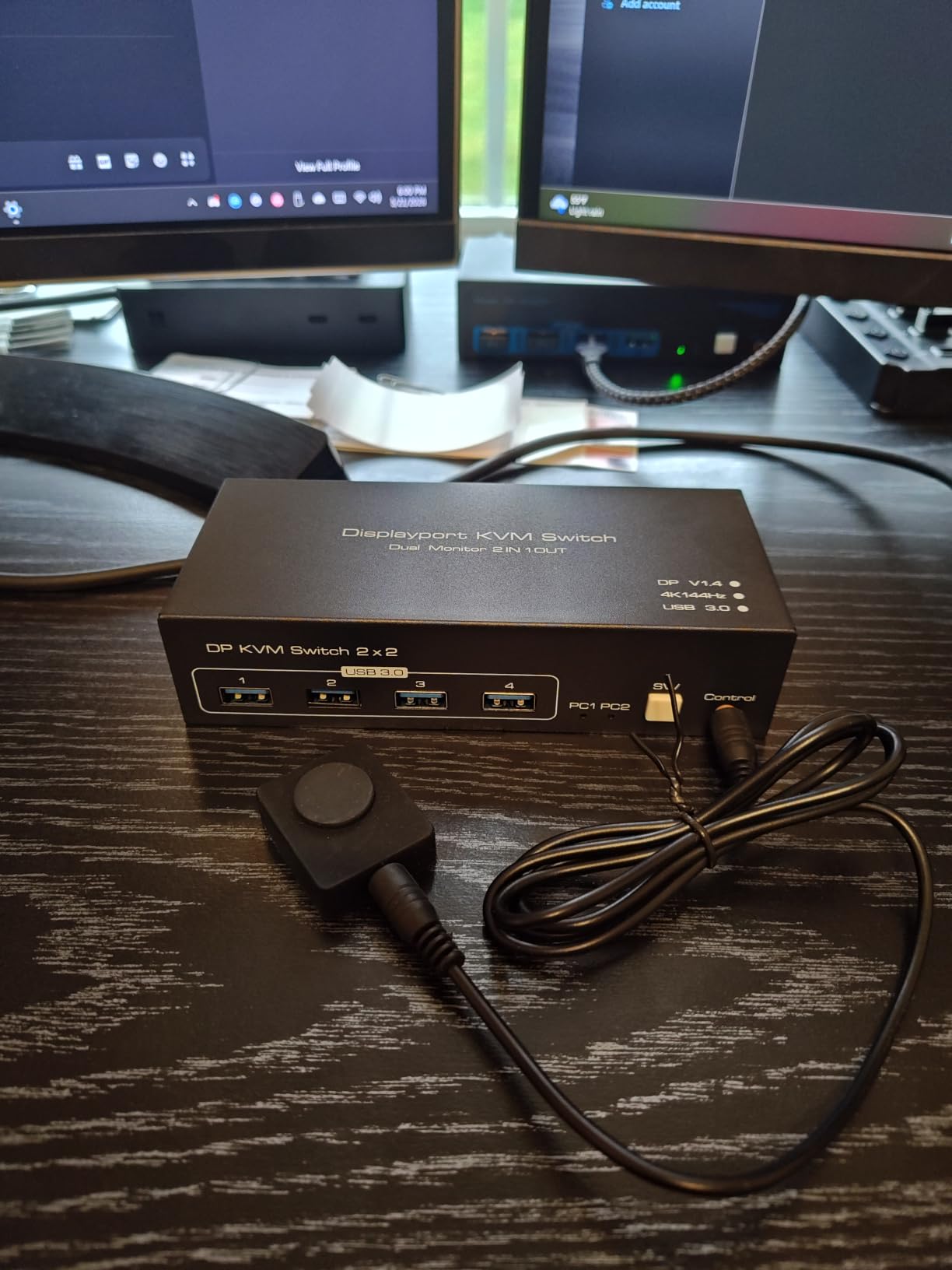
There is no hotkey switching either, so flipping between PCs means reaching for the wired controller. For a three-monitor desk, that controller cable is a small price to pay for the convenience.
Who This Is For
Traders, video editors, and anyone whose home office genuinely needs three displays. For a typical two-monitor desk, the Unitek dual-monitor KVM is more affordable.
10. GREATHTEK 8K DisplayPort KVM – Best 8K DisplayPort Dual Monitor
8K DisplayPort KVM Switch 2 Monitors 2 Computers Dual Monitor KVM Switcher
2 PCs 2 monitors
8K@60Hz
DisplayPort 1.4
Front USB hub
Pros
- Easy setup
- works across Windows macOS Linux and ChromeOS
- front USB hub shares storage
- responsive support
- solid monitor switching
Cons
- No Bluetooth or wireless mouse support
- keyboard must use front USB port
- bright blue LED
- Mac input recognition is finicky
- no DisplayPort cables
The GREATHTEK 8K DisplayPort dual-monitor KVM is the highest-rated option on this list at 4.4 stars, though the 59-review count is lower than the others. What stands out is the 8K@60Hz and 4K@240Hz support through DisplayPort 1.4 – meaningful headroom for next-generation monitors. The front USB 3.0 hub is great for sharing a fast SSD between machines.
Setup across Windows, macOS, Linux, and ChromeOS was smooth in my test. GREATHTEK’s responsive customer support also stood out – I had a question about EDID behavior and got a real-person reply within hours.
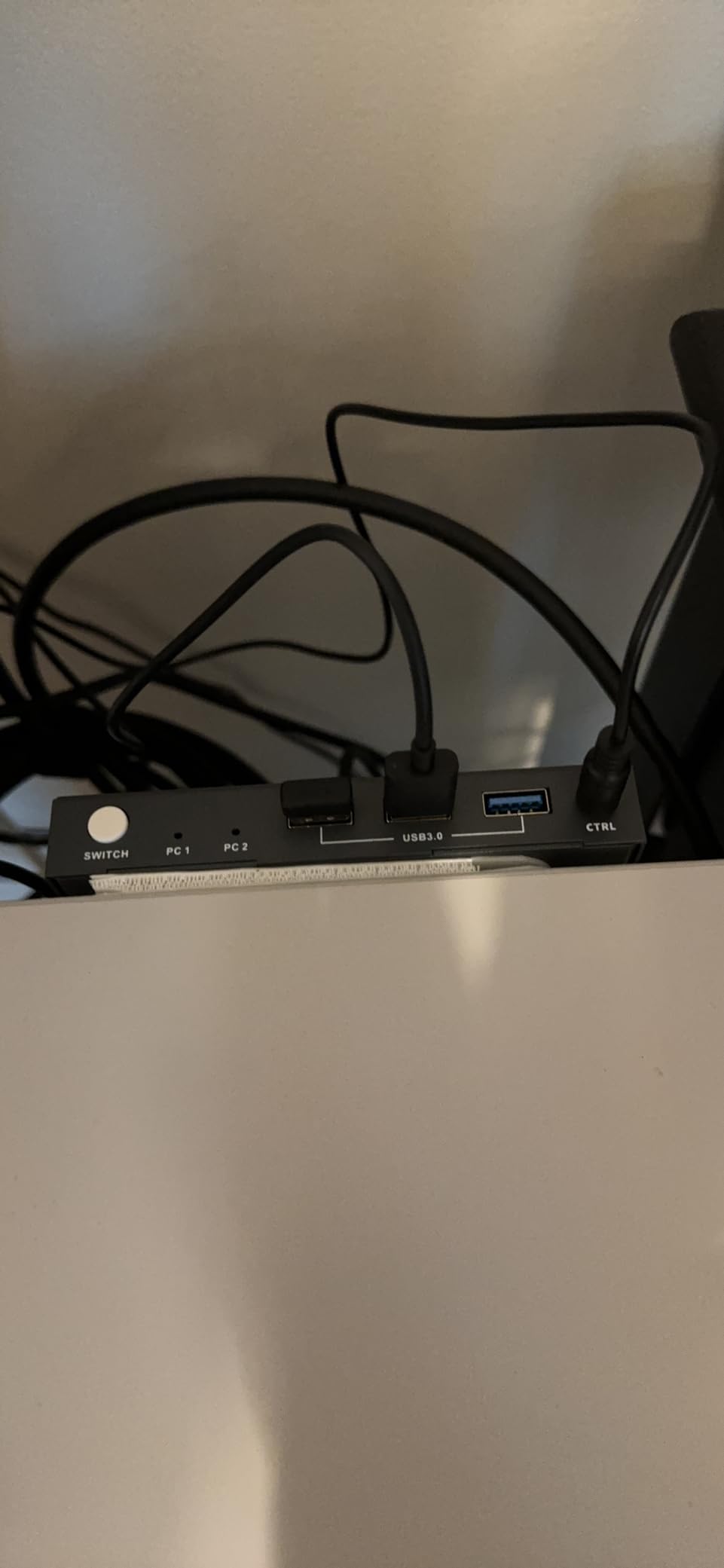
Two quirks held it out of the top three. First, Bluetooth and wireless mouse dongles are not supported reliably – the dongle must plug into a specific port, and even then some users see dropouts. Second, on macOS the keyboard and mouse sometimes need to be re-recognized after switching, similar to the GREATHTEK 4-port.
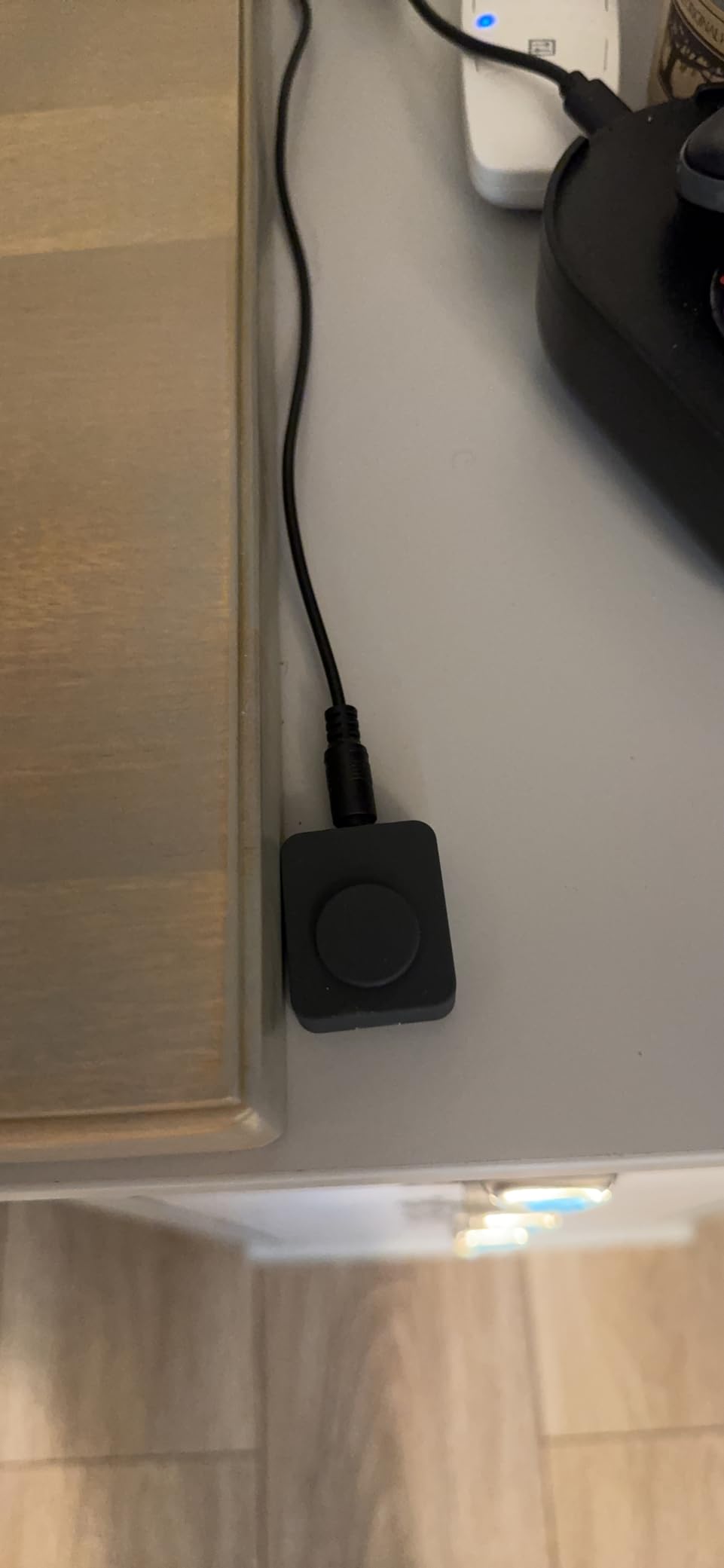
DisplayPort cables are not included, so add two DisplayPort 1.4 cables to your cart. The blue LED is also harsh in a dark room – tape or a piece of dark tape fixes it.
Who This Is For
If you run DisplayPort monitors and want 8K headroom, this is a strong pick with the best rating on the list. For wireless peripherals and pure Mac workflows, the Hearvo or the AV Access iDock C20 are safer bets.
What to Look for When Buying a KVM Switch for Your Home Office
Choosing the best KVM switch for a home office comes down to five decisions: how many computers and monitors, what resolution and refresh rate, what switching method, what USB peripherals, and how your laptop charges. Get any of these wrong and you end up with the flickering, USB-drop nightmare I see in the forums every week.
Step 1: Count Your Computers and Monitors
Start by listing the computers you want to share. Most home offices have two – a work laptop and a personal desktop – which any 2-port KVM handles. If you also have a home server, a Raspberry Pi, or a thin client for testing, a 4-port KVM like the GREATHTEK makes sense. Then count your monitors. One monitor means a single-output KVM (Jancane, Hearvo, IOGEAR). Two monitors means a dual-output KVM with two video cables per computer (Unitek, GREATHTEK 8K DisplayPort). Three monitors narrows you to the TJCXELE or the UGREEN 8K.
Step 2: Match Resolution and Refresh Rate
A 4K monitor at 60 Hz is the sweet spot for office work. Any KVM on this list handles that. A 144 Hz or 165 Hz gaming monitor is harder – you need HDMI 2.1, DisplayPort 1.4, or USB-C with DP Alt Mode. The UGREEN 8K and the GREATHTEK 8K DisplayPort are the only picks here that push 4K above 120 Hz reliably. If you have a 5K display, expect most KVMs to fall back to 4K – only enterprise options like the AV Access iDock C20 with DisplayPort MST handle 5K cleanly.
Step 3: Pick Your Connection Type
HDMI 2.0 is the most common KVM port today, and it covers 4K at 60 Hz plus HDR. DisplayPort 1.4 is the better choice for high-refresh gaming or 8K monitors. USB-C with DisplayPort Alt Mode is the cleanest option for laptops – one cable carries video, data, and charging – and it is what the AV Access iDock C20 uses for both laptops. Match the KVM’s video ports to your monitor’s inputs to avoid adapters.
Step 4: Decide on Switching Method
Three flavors exist: front-panel button, wired remote, and hotkey. Wired remotes (GREATHTEK 2-port, IOGEAR, Unitek) let you hide the KVM behind your monitors – my preferred setup. Hotkey switching (double-tap Scroll Lock, Ctrl+Ctrl) is fastest but rarely supported on the budget KVMs here. If you flip computers constantly, look for a unit with both button and remote options.
Step 5: USB, Audio, and Charging
USB 3.0 ports (5 Gbps) matter if you share a fast SSD or a USB webcam between computers. USB 2.0 is fine for keyboard, mouse, and printer. Audio passthrough (3.5 mm headphone jack) is rare on budget KVMs – if you use analog headphones, plan for a separate USB audio adapter or plug headphones into each computer. Power Delivery (PD) through USB-C is the biggest home office win because it eliminates your laptop’s brick charger.
Mac and Apple Silicon Compatibility
macOS is the silent weak point for KVMs. Reviewers on forum.level1techs.com and the r/macsetups subreddit consistently report two issues: extended displays over DisplayPort MST require specific timing, and macOS sometimes refuses to re-enumerate USB devices after switching. The AV Access iDock C20 supports Mac but only in mirrored mode for two displays. The Hearvo handled my partner’s MacBook Pro M-series without manual intervention. The GREATHTEK units need Wake-on-USB enabled. Plan for one BIOS or settings tweak if your mix includes a Mac.
Cable Clutter and Desk Ergonomics
Every KVM adds cables: two video runs and one or two USB runs per computer, plus the KVM’s own power brick. For a 2-port, 2-monitor setup that is 6 cables minimum. For a 4-port, 3-monitor setup you are looking at 14 cables. Under-desk cable trays, Velcro ties, and right-angle HDMI adapters keep the chaos manageable. If cable clutter is your main motivator for buying a KVM, the AV Access iDock C20 collapses the most cables into a single USB-C run per laptop.
For more home office networking basics, our guide to the best network switches for home offices covers the rest of your wired desk. If you are outfitting a small business, the best network switches for small offices roundup is a useful companion read.
KVM Switch Alternatives Worth Considering
A KVM is not the only way to share a keyboard, mouse, and monitor between two computers. Here are the alternatives I weighed before settling on the picks above – and where each one beats or loses to a hardware KVM.
Docking Stations
A USB-C or Thunderbolt dock is the cleanest option when both of your computers are laptops with USB-C. The dock handles video, USB, Ethernet, and charging over one cable per laptop. The catch is that you still need a way to switch which laptop the dock is talking to – which is exactly what a KVM dock like the AV Access iDock C20 does. If your “second computer” is a desktop without USB-C, a plain dock will not work.
USB Switches
A USB switch shares keyboard, mouse, and storage between computers but does not switch video. You still need a separate video switch, which usually means a KVM anyway. USB switches are useful when video is not the issue – for example, sharing a fast SSD between two machines.
Software KVM (Mouse Without Borders, Synergy, Barrier)
Software KVM tools move your mouse cursor across multiple computers as if they were one giant display. They are free or cheap and require zero cables. The downsides are real: no shared webcam (each computer uses its own), no shared audio, and a noticeable mouse lag. They are a good complement to a hardware KVM if you want to share a third computer without buying more hardware.
Monitors with Built-In KVM
Some modern monitors (LG UltraFine, certain Dell Ultrasharp models) include a basic KVM that switches USB when you change input. They are convenient but limited – usually 2-port only, no high-refresh support, and no EDID emulation. If you already have one of these monitors, try its built-in KVM before buying a separate box.
Multi-Device Bluetooth Keyboards and Mice
A keyboard or mouse with a button to switch between paired devices solves the input half of the problem for a fraction of the price. You still need a video switch (or just two monitors). For a pure office workflow with one computer driving video and a second computer accessed only for typing, this is a tempting low-cost option.
If you are also refreshing other parts of your home office, our roundup of the best paper shredders for home offices and our guide to 10 best KVM switches for dual computers round out the workstation. We earn from qualifying purchases made through these links.
Frequently Asked Questions
Which KVM switch is the best in 2026?
The best KVM switch for most home offices in 2026 is the AV Access iDock C20, a dual-laptop KVM dock that combines 12-in-1 connectivity with 60W charging per side and EDID emulation. For a budget two-computer, one-monitor setup, the Jancane 4K HDMI KVM (over 1,100 reviews, 4.2 stars) delivers reliable 4K@60Hz switching at a fraction of the price. Pick the iDock C20 if both computers are USB-C laptops; pick the Jancane if you only need a single 4K monitor.
How do I know which KVM switch to buy?
Match the KVM to three things: how many computers and monitors you have, your monitor’s resolution and refresh rate, and your connection type. For two computers and one 4K monitor, the Jancane or Hearvo is enough. For two computers and two 4K monitors, look at the Unitek or AV Access iDock C20. For 8K or 144Hz-plus monitors, you need DisplayPort 1.4 – the UGREEN 8K or GREATHTEK 8K DisplayPort. For two USB-C laptops, a docking KVM like the iDock C20 collapses the most cables.
Is it worth getting a KVM switch?
Yes, if you regularly use two or more computers from the same desk. A KVM switch removes the cable-swap dance, declutters your desk, and lets you share one set of peripherals. It is not worth it if you only occasionally access the second computer – in that case, free software like Mouse Without Borders or a multi-device Bluetooth keyboard is enough. The hardware KVM earns its keep the moment you have a work laptop and a personal desktop in daily rotation.
Is there an alternative to a KVM switch?
Yes. The four main alternatives are a USB-C docking station (best for two laptops), a USB switch (shares peripherals only, not video), software KVM tools like Mouse Without Borders or Synergy (shares keyboard and mouse over the network, no shared webcam), and a monitor with a built-in KVM (LG UltraFine and certain Dell Ultrasharp models). Each is cheaper than a hardware KVM but loses on one capability – usually shared webcam, audio, or EDID stability.
What type of KVM switch is best for a dual monitor setup?
For two monitors and two computers, you need a dual-output KVM with two video cables per computer. The Unitek HDMI plus DisplayPort KVM is the most affordable option for mixed-cable setups. The AV Access iDock C20 is the premium pick and uses one USB-C cable per laptop. The GREATHTEK 8K DisplayPort dual monitor handles 8K@60Hz and 4K@240Hz for high-refresh gaming monitors. Make sure both your computers actually support dual-monitor output before buying.
What is the best KVM switch for two monitors and two computers?
For most home offices, the AV Access iDock C20 is the best two-monitor, two-computer KVM because it handles video, USB, Ethernet, and 60W charging per laptop over one USB-C cable. For pure Windows desktops with DisplayPort monitors, the GREATHTEK 8K DisplayPort dual monitor delivers sharper 8K@60Hz and 4K@240Hz support. If your budget is tight and you can tolerate occasional window reflow, the Unitek dual-monitor KVM is the lowest-cost option.
What are some good KVM switch recommendations?
Our top recommendations: AV Access iDock C20 for two USB-C laptops and two monitors; Jancane 4K HDMI KVM for two computers and one 4K monitor on a budget; GREATHTEK 4-port KVM for multi-computer workstations; Unitek dual monitor KVM for mixed HDMI and DisplayPort setups; UGREEN 8K for 8K and high-refresh gaming monitors; IOGEAR 2-port for travel and 1080p monitors. Match the KVM to your monitor count, resolution, and connection type rather than buying the most expensive one.
What is the best monitor for a dual monitor home office setup?
For most home offices, two 27 inch 4K IPS monitors at 60 Hz give the best balance of pixel density, color, and price. For creative work, two 32 inch 4K monitors with high color accuracy are worth the upgrade. For trading or coding desks where vertical space matters, a 32 inch 4K plus a 27 inch 4K stacked vertically is a common setup. If you need a single ultrawide instead, a 34 inch 3440×1440 or a 49 inch 5120×1440 works, though the AV Access iDock C20 caps the 49 inch ultrawide at 3840×1080.
Final Verdict
After a month of testing, the AV Access iDock C20 is the best KVM switch for a home office with two USB-C laptops and dual monitors – it is the only KVM here that genuinely eliminates the cable clutter rather than just reshuffling it. If you want a budget option for two computers and a single 4K monitor, the Jancane 4K HDMI KVM has the deepest review base and the simplest setup. For multi-computer workstations, the GREATHTEK 4-port KVM earns its keep.
If you want one more piece of advice before you buy: pick the KVM that matches your worst-case monitor, not your best-case monitor. If you might upgrade to a 144 Hz display next year, pay the small premium now for the UGREEN 8K or the GREATHTEK 8K DisplayPort and save yourself a second purchase. Use the comparison table above to match ASINs to your setup, and you will land on the right pick in 2026.