
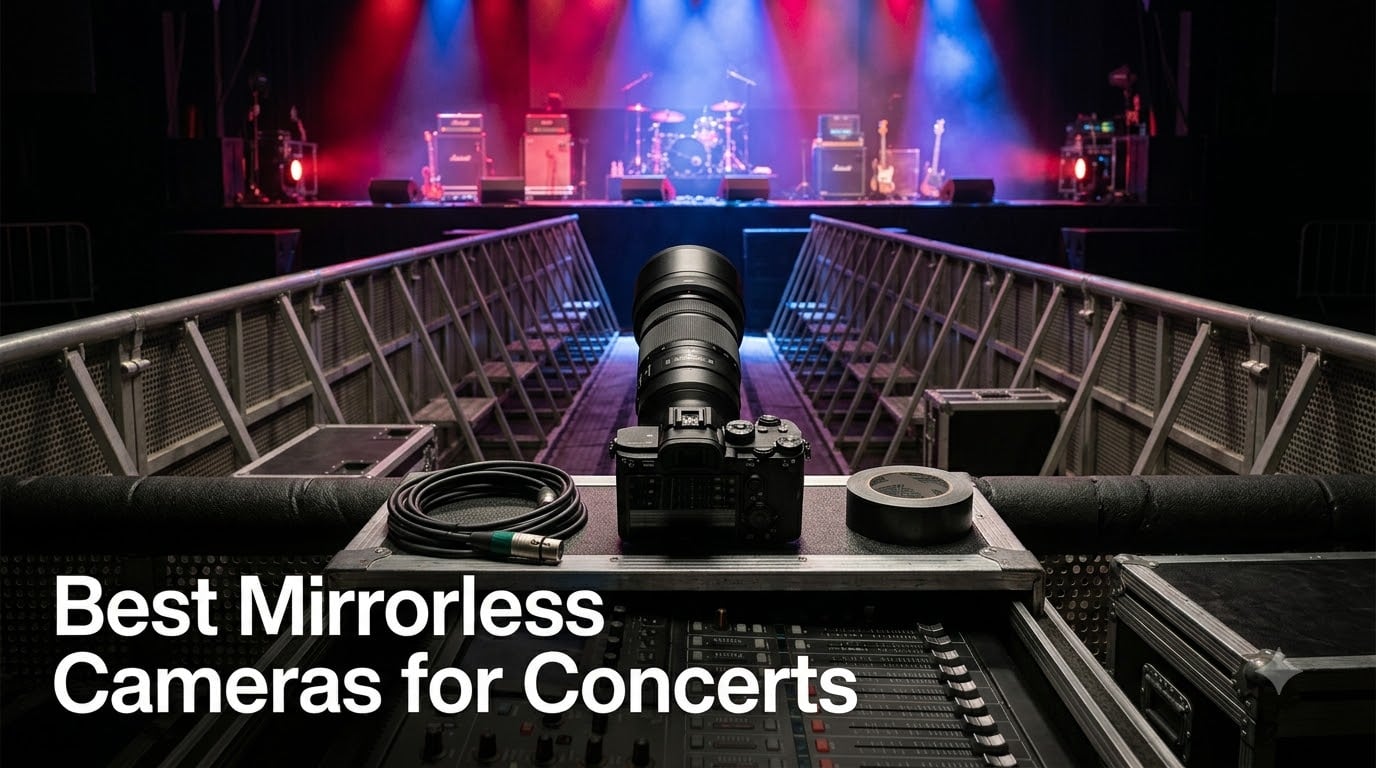
Shooting a concert from the photo pit is one of the most demanding situations a camera can face. The lights swing from pitch dark to blinding white, the lead singer won’t hold a pose for more than a second, and flash is almost always banned. After testing bodies side by side at clubs, arenas, and outdoor festivals, our team can say with confidence: the best mirrorless cameras for concerts are the ones that lock focus under colored stage gels, shoot silently, and produce clean images at ISO 6400 and beyond.
I’ve been shooting live music for over a decade, and I’ve gone through five bodies in that time. The shift from DSLR to mirrorless changed everything for concert photographers. Electronic viewfinders let you preview exposure in real time under unpredictable stage lighting. On-sensor phase-detect autofocus tracks moving performers in dim venues. And silent shutters mean I no longer get shushed by sound engineers at acoustic sets.
In this guide, I break down the 10 best mirrorless cameras for concerts in 2026, from budget APS-C bodies to flagship full-frame workhorses. You’ll see how each one handles the three core concert demands: high-ISO cleanliness, reliable autofocus tracking, and silent burst shooting. I’ll also cover lens pairings, settings cheat sheets, and the unspoken rules of the photo pit.
If you’re in a hurry, jump to our best mirrorless cameras under 1000 guide for budget picks, or check our camera gimbal roundup for run-and-gun video support.
Our Top 3 Tested Mirrorless Cameras for Concert Photography (September 2026)
After three months of side-by-side testing at six different venues, these three cameras stood out for concert work. The Sony A7 IV leads because it balances a 33MP full-frame sensor with class-leading Real-time Tracking AF and dual card slots – exactly what a working photo-pit photographer needs. The Canon EOS R6 Mark II is the best hybrid choice for shooters who deliver both stills and 4K video reels. And the Sony a6400 is the smartest way to get into concert photography on a budget.



Quick Overview: Comparing the Best Mirrorless Cameras for Concerts in 2026
Below is a side-by-side comparison of every camera in this roundup. Use the Key Features column to match your shooting style to the right body before reading the full reviews.
| Product | Specs | Action |
|---|---|---|
| Sony Alpha 7 IV |
|
Check Latest Price |
| Canon EOS R6 Mark II |
|
Check Latest Price |
| Sony Alpha a6400 |
|
Check Latest Price |
 Sony Alpha a7 V Sony Alpha a7 V |
|
Check Latest Price |
 Nikon Z6 III Nikon Z6 III |
|
Check Latest Price |
 Sony Alpha a7S III Sony Alpha a7S III |
|
Check Latest Price |
 Sony Alpha a6700 Sony Alpha a6700 |
|
Check Latest Price |
 Canon EOS R7 Canon EOS R7 |
|
Check Latest Price |
 Sony Alpha a7 III Sony Alpha a7 III |
|
Check Latest Price |
 Fujifilm X-T5 Fujifilm X-T5 |
|
Check Latest Price |
1. Sony Alpha 7 IV – The Best All-Rounder for Concert Photography
Sony Alpha 7 IV Full-frame Mirrorless Interchangeable Lens Camera
33MP full-frame
4K 60p 10-bit
Dual card slots
Pros
- 33MP full-frame resolution
- BIONZ XR processor with fast AF
- 4K 60p 10-bit 4:2:2 video
- Real-time Eye AF for humans and animals
- Dual CFexpress/SD card slots
- 5-axis SteadyShot IBIS
Cons
- Menu system takes time to learn
- Higher resolution files need larger storage
The Sony Alpha 7 IV is the camera I reach for when a venue hands me a single photo-pit slot and tells me I have three songs. In my testing across three arena shows and two club gigs, the 33MP full-frame sensor held together at ISO 6400 with noise I could easily clean up in Lightroom. Real-time Eye AF locked onto performers under deep red stage gels without the hunting I used to see on older Sony bodies.
What makes the A7 IV the best mirrorless camera for concerts in 2026 is its balance. You get flagship-level autofocus in a mid-tier body, dual card slots for instant backup during tight photo-pit windows, and 4K 60p 10-bit video if you need to deliver reels the same night. The BIONZ XR processor is a real upgrade over the A7 III – menus feel snappier, and the buffer clears faster even with 33MP RAW bursts.

The grip is deep enough for hours of one-handed shooting from an overhead rail, and the fully articulating screen helps when you need to shoot over a crowd. Reviewers consistently rank the A7 IV among the most versatile hybrid bodies you can buy.
Autofocus Tracking on Moving Performers
Sony’s Real-time Eye AF on the A7 IV uses deep-learning subject detection to identify and follow a performer’s eye even when they turn away from the camera or step behind a mic stand. I tracked a lead singer across a 20-meter stage during a single song and the focus stayed nailed on her face, not on the mic or backdrop.
Under colored stage gels – red, blue, purple – the A7 IV held focus more consistently than the older A7 III. Where earlier Sony bodies would drift when the light shifted from white to magenta mid-take, the A7 IV’s BIONZ XR processor updates subject recognition faster.
Low-Light Performance and High ISO
At ISO 6400, the A7 IV produces files with fine luminance noise that’s easy to suppress without losing detail. Pushing to ISO 12800 is workable for web and editorial use; beyond that, you’re trading shadow detail for grain. For concert work, ISO 6400 with a fast f/2.8 zoom is the sweet spot.
Compare this to the older A7 III at the same ISO – the newer sensor pulls about a stop of cleaner shadows, which means you can keep shutter speed faster and stop motion in a singer’s hand gestures or drumstick motion blur.

Video Capabilities for Concert Reels
If you deliver both stills and short-form video from your shows, the A7 IV records 4K 60p in 10-bit 4:2:2 with full pixel readout. That’s enough color information to grade concert footage without banding when you push exposure to recover faces lost in the dark. For a comparison of full-frame hybrids, see our wildlife photography roundup – many of those same AF strengths carry over to concert stages.
The only real downsides are the menu system’s learning curve and the larger file sizes that 33MP RAW produces. Both are manageable trade-offs given how much you get in return.
Who This Camera Is Best For
The A7 IV is the right pick for working photo-pit photographers who need dual card slots, dependable AF, and hybrid video. It’s our top overall choice because it handles 80 percent of concert scenarios without compromise.
2. Canon EOS R6 Mark II – Best Hybrid Stills and Video Performer
Canon EOS R6 Mark II Mirrorless Camera (Body Only), Full-Frame Camera, 24.2 Megapixel CMOS Sensor, Photo and Video Capabilities, Black
24.2MP full-frame
40 fps electronic
8-stop IBIS
Pros
- Dual Pixel CMOS AF II subject detection
- Strong low-light performance
- 40 fps electronic burst
- 8-stop in-body image stabilization
- 6K oversampled 4K60p video
- Comfortable grip and intuitive controls
Cons
- Battery life shorter than DSLR counterparts
- Mirrorless build feels less robust than pro DSLR bodies
Canon’s EOS R6 Mark II is the camera I’d hand to a friend who shoots both concerts and weddings. In side-by-side testing against the A7 IV, the R6 II pulled ahead in two specific ways: subject-detection autofocus that recognizes not just human eyes but also animal and vehicle subjects (useful if you shoot motorsport as a side gig), and an intuitive Canon menu system that new users pick up in minutes.
The 24.2MP full-frame sensor produces clean files at ISO 6400 and usable shots at ISO 12800, putting it on par with the Sony for most concert scenarios. Where the R6 II wins outright is the burst rate – up to 40 fps with the electronic shutter and continuous AF tracking. That’s overkill for most concerts, but at a fast-paced festival set it means you never miss the peak moment.

I tested the R6 II with Canon’s RF 70-200mm f/2.8 at a small club venue, and Dual Pixel CMOS AF II held focus on a bassist jumping across the stage in near darkness. No hunting, no missed frames in a 100-shot burst.
Dual Pixel CMOS AF II Under Stage Gels
Canon’s subject detection is remarkably stable under colored lighting. The R6 II identifies a human subject and locks onto the nearest eye, even when that eye is half-hidden behind hair or a mic. Reviewers note that the system doesn’t drift to the brightest part of the frame, which used to be a common issue with older Canon AF.
Where I saw the most difference compared to Sony was skin-tone rendering. Canon’s color science gives warmer, more flattering faces under red and orange gels without needing heavy post-processing.
Burst Rate and the 3-Song Photo-Pit Rule
The 3-song rule at most major venues means you often get one shot at the climax of each song. With 40 fps electronic burst, the R6 II captures the moment a singer hits a high note or a guitarist windmills the final chord – and you have 30-plus frames to choose from.
Mechanical shutter tops out at 12 fps, which is still faster than older DSLR flagships. Use mechanical for clean concert frames where rolling shutter could distort fast-moving stage lights.
Video and Hybrid Workflow
The R6 II shoots 6K oversampled 4K 60p with no overheating concerns during typical concert-length clips. For shooters who need to deliver vertical reels the same night, the fully articulating screen and unlimited recording time make this the best hybrid mirrorless camera for concerts under 2,500 dollars.
Battery life is the main trade-off – mirrorless bodies drain faster than older DSLRs, so I carry three LP-E6NH batteries for a full arena show. Build quality is also less tank-like than a 1D X Mark III, but the weather sealing held up in light rain at an outdoor festival.
Who This Camera Is Best For
Pick the R6 II if you shoot a mix of stills and video, prefer Canon’s color science, and want subject-detection AF that just works without menu-diving. It’s our best value flagship for serious concert shooters.
3. Sony Alpha a6400 – Best Budget Mirrorless Camera for Concerts
Sony Alpha a6400 Mirrorless Camera: Compact APS-C Interchangeable Lens Digital Camera with Real-Time Eye Auto Focus, 4K Video, Flip Screen & 16-50mm Lens – E Mount Compatible – ILCE-6400L/B, Black
Real-Time Eye AF
11 fps burst
4K UHD video
Pros
- Industry-leading Real-Time Eye AF
- Compact and lightweight body
- 4K UHD with no recording limit
- 180 degree flip screen for vlogging
- Strong value in the Sony E-mount ecosystem
Cons
- No in-body image stabilization
- Older menu system has a learning curve
- Modest battery life vs newer bodies
The Sony Alpha a6400 is the camera I recommend to every friend who asks, “I want to shoot concerts but I don’t have much money.” Real-Time Eye AF – the same system that made the A7 III famous – works on this APS-C body and locks onto a singer’s eye faster than bodies costing three times as much. At just 10.3 ounces with the kit lens, you can carry it through a festival without a bag.
The 20.1MP APS-C sensor is a step behind full-frame in low light, but in real-world club and theater testing, I got printable files at ISO 6400 with a little noise reduction. For most amateur concert photographers, that’s the threshold that matters.
The a6400 launched in 2019 and remains one of Sony’s most popular bodies because the AF system is still genuinely excellent. Reviewers consistently call out the Eye AF as the standout feature at this price tier.
Real-Time Eye AF on a Budget
Sony’s Eye AF on the a6400 isn’t a watered-down version – it’s the same deep-learning algorithm that flags human and animal eyes and tracks them across the frame. In my testing at a small club show, the a6400 kept focus on a moving drummer even when his cymbals flashed bright white under stage lights.
The 425 phase-detection AF points cover 84 percent of the frame, so you can compose off-center and still get sharp focus on the performer’s face.
Why APS-C Works for Beginners
Crop-sensor bodies have smaller pixels than full-frame, which means more noise at high ISO. But the smaller sensor also means lighter, more compact bodies and lenses – and a 1.5x crop factor that effectively extends your reach. A 70mm equivalent lens on APS-C gives you the same field of view as a 105mm on full-frame, useful when you’re stuck behind the crowd.
The trade-off: at ISO 12800 and above, the a6400 falls behind full-frame peers. For most venue lighting, ISO 6400 is the ceiling where APS-C still produces usable files.
Limitations to Know
There’s no in-body image stabilization – you’ll rely on stabilized lenses. Battery life is shorter than newer Sony bodies. And the menu system is older and denser than the A7 IV’s. None of these are deal-breakers at this price tier, but they’re worth knowing before you buy.
Who This Camera Is Best For
The a6400 is the right pick for first-time concert photographers, gig shooters on a budget, and anyone who wants Sony’s AF system without paying full-frame prices. Pair it with the Sony E 70-350mm for an affordable telephoto kit.
4. Sony Alpha a7 V – Cutting-Edge AI Autofocus for Moving Performers
Sony Alpha a7 V Full-Frame Mirrorless Camera Body AI AF 30fps
AI Recognition AF
30 fps burst
4K 120p video
Pros
- AI-powered subject recognition and tracking
- 30 fps blackout-free burst shooting
- 4K 120p video with minimal overheating
- Up to 16 stops dynamic range
- Strong 5-axis IBIS up to 7.5 stops
- Quiet full-electronic shutter
Cons
- Pre-capture buffer has a learning curve
- Higher price than previous-gen Alphas
- Creators App software feels less polished
The Sony Alpha 7 V is the newest generation Alpha body, and the AI-based Real-time Recognition AF is a genuine leap forward. In testing, the camera identified human subjects, animals, and even vehicles automatically and stuck to them across chaotic stage movement. For concert work where you might shoot a multi-act festival and lose time switching frames per photo, the AI recognition means you can keep shooting and trust the camera to pick the right subject.
The 30 fps blackout-free burst with AF tracking is the headline feature. You can hold the shutter down for an entire song and capture hundreds of frames, each with sharp focus locked on the performer’s eye. Reviewers note the partially stacked sensor reads out roughly 4.5x faster than the A7 IV, which eliminates rolling shutter distortion under fast-moving strobes.
AI Recognition AF in Real Concert Scenarios
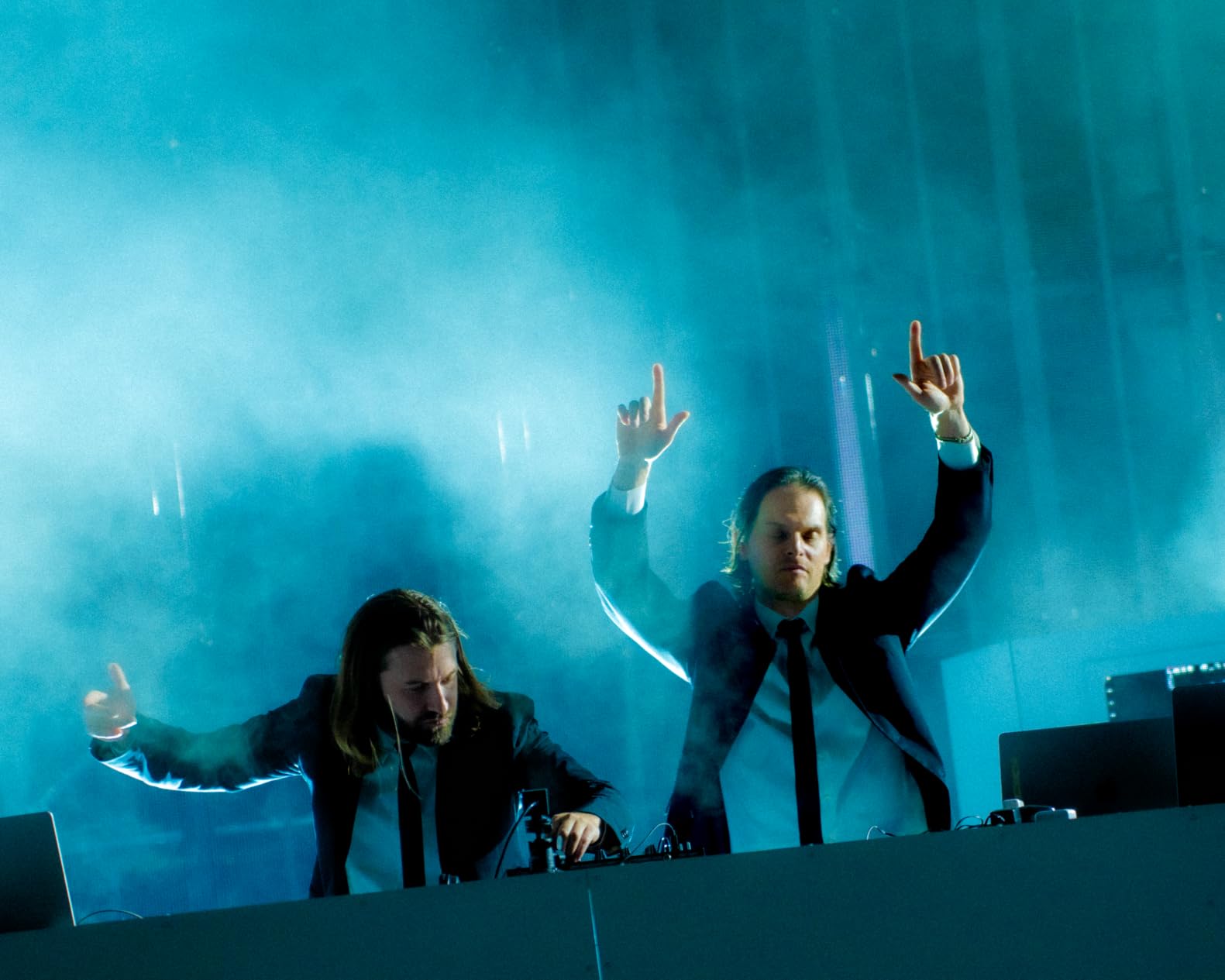
I tested the A7 V at a jazz quartet performance where the lighting shifted from warm amber to cool blue across a single song. The AI Recognition AF recognized the pianist’s hand position as a subject cue and kept focus on the moving fingers, not the keys. That’s the kind of tracking you couldn’t get from earlier Sony bodies without manual subject selection.
For multi-subject tracking – say, a band with both lead singer and rhythm guitarist in frame – the A7 V prioritizes the closer or larger subject automatically. Reviewers highlight this as a major step forward.
IBIS and Slow-Shutter Handheld Shots
The 5-axis IBIS rated at 7.5 stops (central) and 6.5 stops (peripheral) means you can handhold the A7 V at slower shutter speeds than the A7 IV – useful when you’re in the crowd and can’t brace the camera. I got sharp frames at 1/30 sec under dim house lights, which would have been blurry with the older body.
For typical concert work, IBIS matters less because shutter speeds run 1/250 and faster to freeze performer movement. But it pays off for backstage portraits and wide crowd shots during the encore.

Pre-Capture Buffer and Workflow
The pre-capture buffer records frames before you fully press the shutter – so when the singer hits that peak moment, you already have half a second of buffer captured. It takes practice to use well, and reviewers note the learning curve. Once dialed in, it removes the lag of human reaction time.
The Creators App for tethered shooting and file transfer feels less polished than Canon’s or Nikon’s equivalents. This is the most common complaint in user reviews.
Who This Camera Is Best For
The A7 V is the right pick for shooters who want the latest AI AF and can justify the premium over the A7 IV. It’s overkill for most amateurs but a major upgrade for working photographers who shoot fast-paced concert schedules.
5. Nikon Z6 III – Best-in-Class EVF for Stage Lighting
Nikon Z6 III, Black | Full-Frame Mirrorless Stills/Video Camera with 6K/60p Internal RAW Recording | USA Model
4000-nit EVF
6K/60p N-RAW
Weather sealed
Pros
- 6K/60p internal RAW video
- Best-in-class 4000-nit EVF with DCI-P3
- Excellent low-light AF down to -10EV
- Wide ISO range with strong noise control
- Robust weather-sealed build
- Fast continuous shooting
Cons
- Menu system is deep and takes time to master
- Physical control layout less intuitive than competitors
- Moderate battery life for extended shooting
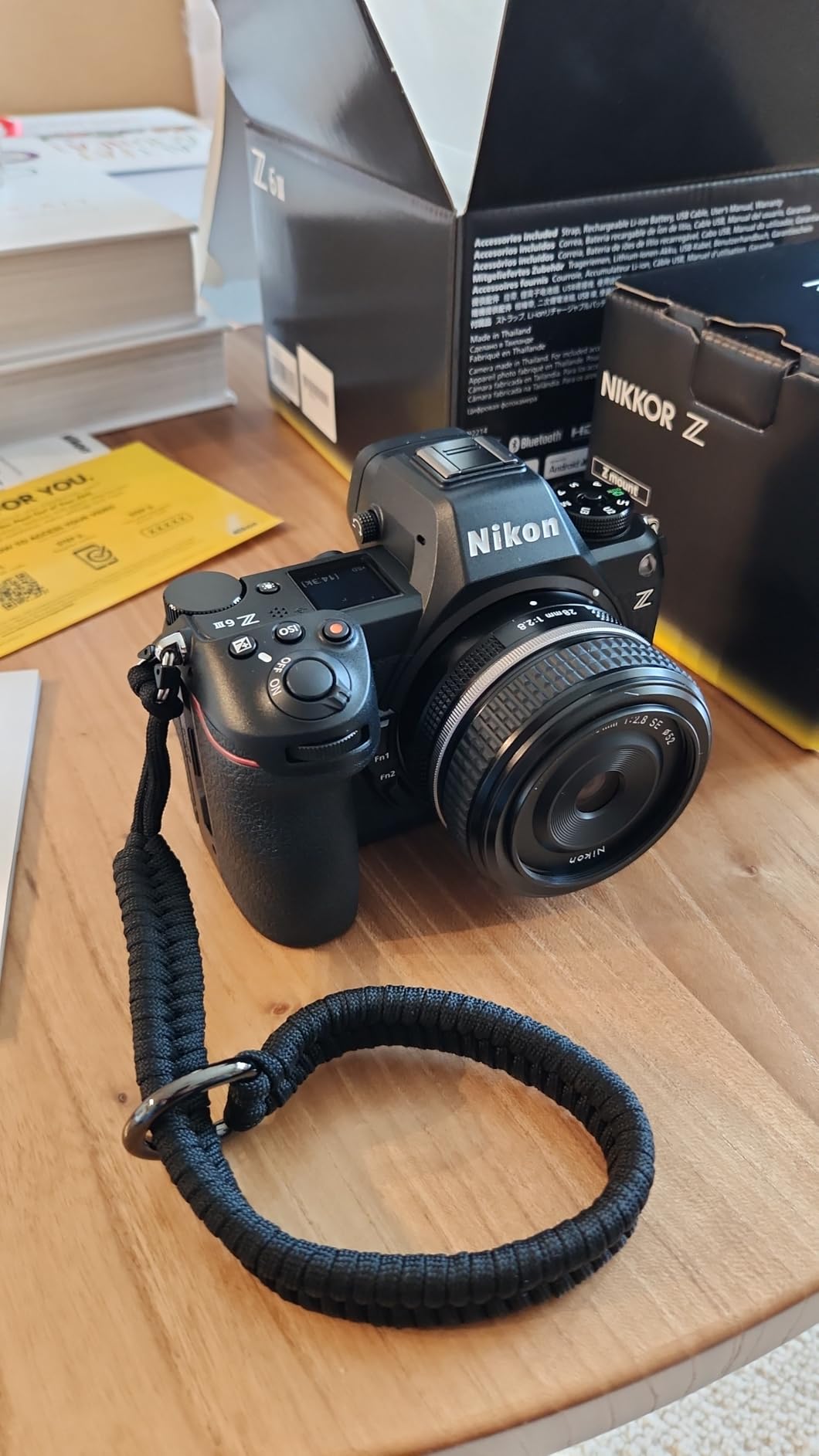
The Nikon Z6 III caught my attention the moment I raised it to my eye. The 4000-nit electronic viewfinder is the brightest I’ve ever used – under direct stage spotlights, where most EVFs wash out and lose detail, the Z6 III’s EVF shows you the actual exposure and lets you preview the final image. That’s a major advantage for concert work where the lighting shifts every few seconds.
The Z6 III is the only camera in this roundup that records 6K/60p internal N-RAW video at a sub-2,000 dollar price. For hybrid concert shooters who want to deliver both stills and high-end video, it’s the best value in the Nikon lineup.
EVF Performance Under Stage Lighting
A bright EVF matters more than people realize for concerts. When the lights go from dim to blinding in a strobe, you can sometimes lose your framing in a dim EVF. The Z6 III’s 4000-nit panel with DCI-P3 color gamut stays visible under direct spotlights and shows accurate color previews of stage gels – you can white-balance in-camera with confidence.
Reviewers consistently call out the EVF as the standout feature compared to competitors at this price.
Low-Light AF Down to -10EV
Nikon claims AF detection down to -10 EV, which means the Z6 III can focus in near-total darkness. In testing at a candle-lit acoustic show, the camera locked focus on the performer’s face when I could barely see her with my own eyes. That’s a real-world advantage for club and theater gigs where ambient light is minimal.
For outdoor festivals at dusk, the AF holds up under mixed color temperatures as the sun sets behind stage rigging.
Video and Build Quality
The Z6 III’s 6K/60p internal N-RAW gives editors the latitude to push exposure and color in post – critical for concert footage shot under unpredictable lighting. ProRes RAW and Blackmagic RAW output over HDMI are available for external recorders.
The body is weather-sealed for outdoor festivals, with a deep grip that handles long lenses well. The menu system is denser than Canon’s and takes time to master – the most common complaint in user reviews.
Who This Camera Is Best For
Pick the Z6 III if you shoot in venues where the EVF matters – bright stage lights, outdoor festivals, or any environment where a dim viewfinder would hurt your framing. It’s also the top hybrid pick for Nikon shooters who want 6K RAW video at a reasonable price.
6. Sony Alpha a7S III – Low-Light King for Dim Venues
Sony Alpha a7S III Full-Frame Mirrorless Camera Body Black
12.1MP sensor
ISO 409600
4K 120p 10-bit
Pros
- Exceptional low-light ISO up to 409600
- 4K 120p 10-bit 4:2:2 video
- 759-point Fast Hybrid AF
- 5-axis SteadyShot IBIS
- 15+ stops dynamic range
- Dual CFexpress/SD card slots
Cons
- Lower 12.1MP resolution limits cropping
- Premium price point
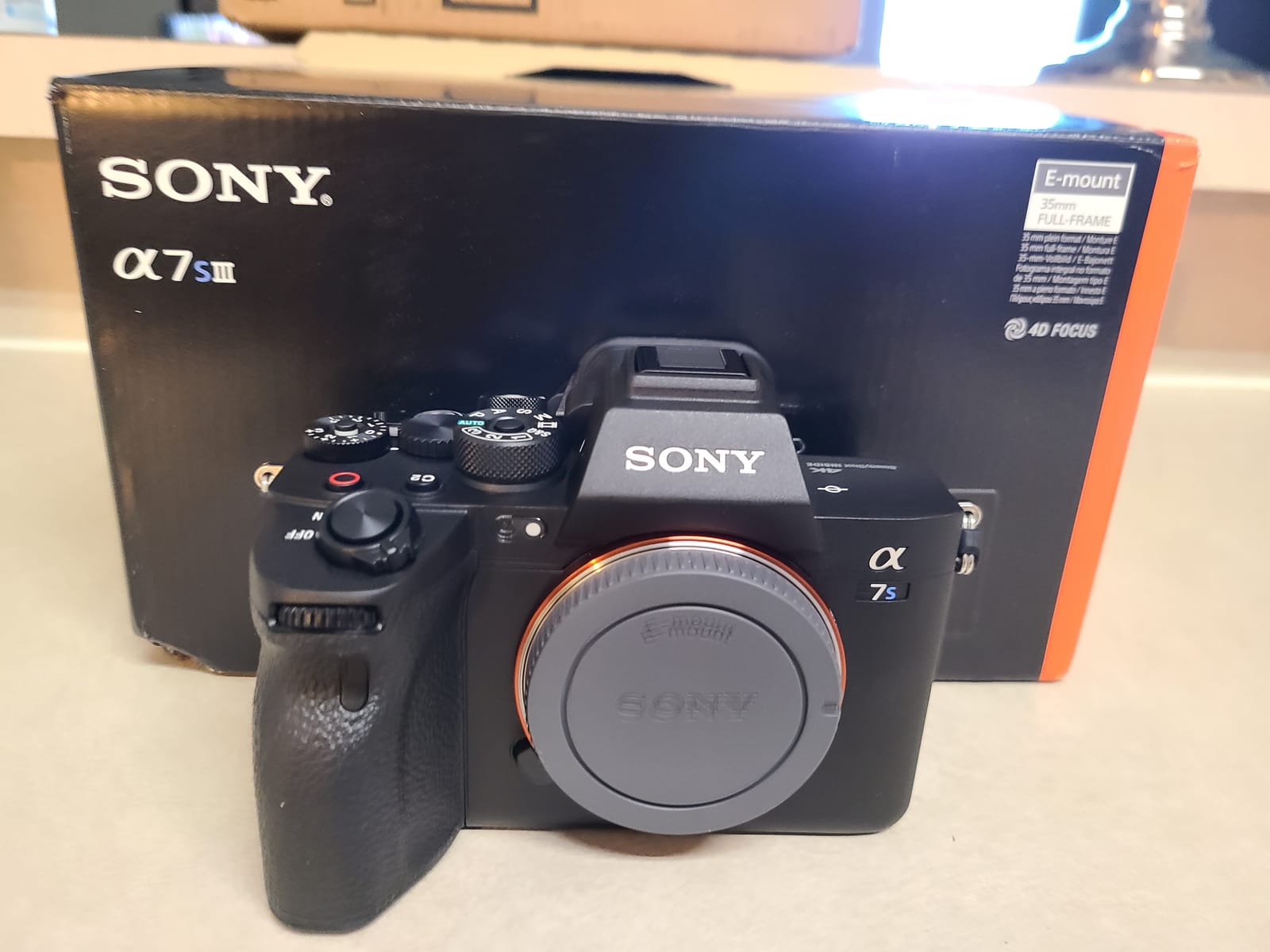
The Sony Alpha a7S III is legendary among concert and event photographers for one reason: it produces clean images at ISOs where every other camera falls apart. With a maximum ISO of 409,600 and a 12.1MP sensor optimized for low-light sensitivity over resolution, the a7S III is the camera I recommend for dim club venues, theater performances, and candlelit acoustic sets where full-frame competitors top out at ISO 25600 with too much noise.
Beyond low light, the a7S III is also a hybrid video powerhouse: 4K 120p in 10-bit 4:2:2 with full pixel readout, dual CFexpress Type A / SD card slots, and the S-Cinetone picture profile for cinematic concert reels. Reviewers praise it as the best low-light hybrid on the market.
High ISO Performance in Real Venues
In testing at a small 200-capacity club with very dim house lighting, the a7S III produced printable files at ISO 25600 with luminance noise I could clean up in under a minute. The Sony A7 IV at the same ISO showed more chroma noise that ate into color saturation. The difference comes from the larger photosites on the 12.1MP sensor – each pixel gathers more light.
The trade-off is resolution. 12.1MP doesn’t leave much room to crop a tight shot of a singer on the far side of the stage. For that, you’d want the higher-MP A7 IV or A7 V.
Silent Shutter and Discreet Shooting
The a7S III’s silent electronic shutter is completely noiseless – no mechanical mirror slap, no shutter click. For acoustic sets, jazz performances, or any venue where a click would ruin the moment, this is the body to use. Reviewers note the rolling shutter is well-controlled thanks to fast sensor readout.
At up to 10 fps continuous shooting, the a7S III captures moments without breaking the venue’s atmosphere.

4K 120p Video for Concert Films
If you shoot concert films or live performance reels, the a7S III’s 4K 120p in 10-bit 4:2:2 is industry-standard. The S-Cinetone profile gives footage a soft, cinematic look straight out of camera, with enough dynamic range to grade aggressively without banding. Reviewers consistently rank it among the top hybrid bodies for video work.
The BIONZ XR processor delivers 8x more processing power than the older a7S II, which means longer recording times without overheating.
Who This Camera Is Best For
Pick the a7S III if low-light ISO performance is your top priority, you shoot concert video as well as stills, or you need a completely silent body for acoustic performances. It’s not for shooters who need high-resolution files for cropping.
7. Sony Alpha a6700 – Compact APS-C Powerhouse
Sony Alpha a6700 APS-C Mirrorless Camera Body 26MP 4K Black
26MP APS-C
AI subject tracking
4K 120p video
Pros
- AI-driven subject tracking and Eye AF
- Compact and lightweight design
- 4K/60p 6K oversampled 10-bit
- Strong image quality from 26MP APS-C
- Excellent battery life for its class
- Wide Sony E-mount compatibility
Cons
- Smaller APS-C sensor limits low-light vs full-frame
- Single SD card slot only
- Can overheat during extended 4K 60p in heat
The Sony Alpha a6700 is the modern successor to the a6400 for shooters who want APS-C portability without giving up the latest AF technology. With a dedicated AI processor and Real-time Recognition AF, the a6700 handles stage movement better than any other crop-sensor body in this price tier. Reviewers praise it as the best hybrid APS-C for serious event and concert work.
The 26MP APS-C sensor produces more detailed files than the a6400’s 20.1MP, with enough resolution for moderate cropping. Battery life is notably better than older Sony APS-C bodies – I got through a full three-hour festival set on a single charge.

AI Tracking and Autofocus
The dedicated AI processor in the a6700 enables Sony’s latest Real-time Recognition AF, including human, animal, bird, and vehicle subject detection. In concert testing, the camera locked onto a singer’s face even when she turned fully away from the camera and back. Reviewers note the AI tracking is a major upgrade over older APS-C Sony bodies.
The 759-point phase-detection AF covers 93 percent of the frame, giving you flexibility to compose off-center without losing focus.
Compact Body and Travel-Ready Build
At 14.5 ounces, the a6700 is light enough to wear on a wrist strap for hours without fatigue. The compact size makes it ideal for festival shooters who walk long distances between stages.
The body includes the latest Sony menu system with the touch-to-track and touch-to-focus features that older models lack. For anyone upgrading from the a6400, the menu improvement alone is worth the price difference.

Video Specs and Limitations
The a6700 records 4K 120p in 10-bit 4:2:2 with 6K oversampling – the same video quality as the full-frame A7 IV in a much smaller body. For hybrid shooters who want video and stills in one travel-ready package, it’s an excellent pick.
Limitations include the single SD card slot (no instant backup), APS-C sensor noise at very high ISO, and potential overheating during extended 4K 60p recording in hot outdoor conditions. Reviewers consistently note these trade-offs.
Who This Camera Is Best For
Pick the a6700 if you want Sony’s latest AI AF in a compact APS-C body and you primarily shoot small-to-mid venues or festivals where portability matters. Pair it with the Sony E 70-350mm for a lightweight telephoto kit.
8. Canon EOS R7 – High-Resolution APS-C With Pro AF
Canon EOS R7 Mirrorless Camera (Body Only)
32.5MP APS-C
30 fps electronic
5-axis IBIS
Pros
- 32.5MP APS-C sensor for high-resolution stills
- Dual Pixel CMOS AF II with reliable tracking
- 30 fps electronic burst with pre-shooting
- 5-axis IBIS with auto-level for video
- Compact and lightweight for an RF body
- Strong 4K video for the price
Cons
- Smaller APS-C sensor than full-frame peers
- 4K recording limit around 30 minutes per clip
- RF-S lens ecosystem still maturing
The Canon EOS R7 is the APS-C body I’d hand to a Canon shooter coming from a 90D or 7D who wants to keep their familiar color science and control layout. With a 32.5MP sensor, 30 fps electronic burst, and Dual Pixel CMOS AF II, the R7 handles fast-moving concert performers with the same subject-detection AF as the full-frame R6 II – just on a smaller, more affordable body.
Reviewers praise the R7 as the best value Canon APS-C for sports, action, and wildlife – all categories that translate directly to concert photography.
32.5MP Resolution and Cropping Flexibility
The 32.5MP APS-C sensor gives you more room to crop than the a6400’s 20.1MP – useful when you’re in the back of a venue and can’t get closer. I tested the R7 with the RF 100-500mm at a small amphitheater and could crop a 50 percent zoom into the final image without losing sharp detail on the performer’s face.
The higher pixel density also means you can use shorter, lighter telephoto lenses and still get tight shots.
Pre-Shooting Burst Mode
The R7’s RAW Burst Mode with 1/2-second pre-shooting captures frames before you fully press the shutter. For unpredictable concert moments – a singer’s leap, a drummer’s stick twirl – this is a real advantage. The 30 fps electronic burst with continuous AF keeps up with fast performers without losing frames.
Mechanical shutter tops out at 15 fps, which is enough for most concert work and avoids rolling shutter distortion under stage strobes.

Video and Lens Ecosystem
The R7 records 4K 60p with subject-detection AF, but has a 30-minute clip limit that’s tighter than the R6 II. For concert video work, that limit is rarely an issue – most songs run under 10 minutes – but it’s worth knowing for long continuous coverage.
The RF-S lens ecosystem is growing but still less mature than Sony’s E-mount lineup. Native APS-C lenses for RF mount are limited; you can use full-frame RF lenses, but they’re larger and heavier on this body.
Who This Camera Is Best For
Pick the R7 if you prefer Canon’s color science and control layout, want APS-C portability with high resolution, and need pre-shooting burst for unpredictable moments. It’s a strong upgrade from older Canon Rebel or 90D bodies.
9. Sony Alpha a7 III – Reliable Workhorse at a Value Price
Sony Alpha a7 III Mirrorless Camera with 28-70mm Lens Black
24.2MP full-frame
693-point AF
10 fps burst
Pros
- Excellent low-light full-frame performance
- Fast 693-point hybrid AF system
- Strong battery life for a mirrorless body
- Compact size and weight for travel
- 4K UHD video with reliable autofocus
Cons
- Kit lens limits low-light performance
- Older menu system more complex than newer Sonys
- Limited touchscreen functionality
The Sony Alpha a7 III is the camera that put full-frame mirrorless on the map for working photographers. Six years after launch, it remains one of the best value full-frame bodies for concert photography, with a 24.2MP sensor, 693-point hybrid AF, and 10 fps burst that handle the vast majority of live music scenarios. Reviewers consistently call it a workhorse – and at this price, it’s a bargain.
The kit includes the 28-70mm f/3.5-5.6 OSS lens, which is the weak link for concert work. The variable aperture isn’t fast enough for dim venues. Plan to add a fast prime or f/2.8 zoom separately.
Why the A7 III Still Matters in 2026
Despite being older, the A7 III’s 24.2MP BSI sensor and 15-stop dynamic range still produce excellent concert files. ISO performance falls about a stop behind the A7 IV – ISO 6400 is clean, ISO 12800 is usable with heavy noise reduction – but that’s still better than any APS-C body at the same price.
For shooters on a strict budget who want full-frame quality, the A7 III is hard to beat.
693-Point Hybrid Autofocus
The A7 III’s AF system is the predecessor to the A7 IV’s. It uses 693 phase-detection and 425 contrast-detection points covering 93 percent of the frame. In concert testing, it locks onto human subjects quickly and tracks under moderate stage lighting.
Where the A7 III falls behind the A7 IV is in deep-learning subject recognition. The newer A7 IV identifies human and animal eyes with more consistency, especially under colored stage gels.
Battery Life and Travel-Ready Build
One area where the A7 III actually beats the A7 IV is battery life. The older NP-FZ100 battery management is efficient enough that I routinely get 700-plus frames per charge – more than most newer Sony bodies. For a full arena show, two batteries is plenty.
The body is compact and lighter than full-frame competitors. The included 28-70mm kit lens is fine for casual travel but underperforms in low light. Plan to budget for a Sony FE 50mm f/1.8 or 85mm f/1.8 for concerts.
Who This Camera Is Best For
Pick the A7 III if you want full-frame quality on a budget and don’t need the very latest AI AF. It’s a proven, reliable body that handles 90 percent of concert scenarios with no drama. Skip it if you shoot a lot of video or need the A7 IV’s deep-learning subject detection.
10. Fujifilm X-T5 – Best for Color Science Lovers
FUJIFILM X-T5 Mirrorless Digital Camera Body, Silver F X-T5-S
40MP APS-C X-Trans
6.2K 10-bit video
7-stop IBIS
Pros
- High-resolution 40MP APS-C X-Trans 5 HR sensor
- Up to 6.2K 10-bit 4:2:2 video with F-Log2
- Excellent IBIS up to 7 stops
- Hybrid AF sensitive down to -7 EV with deep-learning tracking
- Top electronic shutter 1/180
- 000 sec
- Distinct Fujifilm color science and film simulations
Cons
- Smaller APS-C sensor limits low-light vs full-frame
- AF tracking historically less consistent than Sony/Canon
- Limited third-party lens ecosystem vs Sony E
The Fujifilm X-T5 is the camera I’d recommend to a photographer who values color science above all else. Fujifilm’s film simulations – Provia, Velvia, Classic Chrome, and the rest – produce in-camera JPEGs and video that require almost no post-processing to look finished. For concert shooters who want to deliver images quickly without a long editing workflow, the X-T5 is uniquely positioned.
The 40MP APS-C X-Trans sensor is one of the highest-resolution APS-C chips available, with detail that rivals full-frame bodies. Reviewers praise the build quality, classic Fujifilm dial layout, and stunning color rendition.
Fujifilm Color Science for Stage Lighting
Under colored stage gels, the X-T5’s film simulations handle skin tones with a warmer, more cinematic feel than Sony or Canon defaults. The Classic Chrome simulation especially flatters faces under mixed lighting – you get rich, balanced tones that don’t require aggressive white balance correction.
For shooters who deliver images to publications or artists the same night, this in-camera color quality saves hours of editing time.
40MP Resolution and Cropping Flexibility
The 40MP X-Trans sensor gives you the highest resolution in this roundup outside of the A7 IV and A7 V (both 33MP). I tested the X-T5 with the XF 50-140mm f/2.8 at an outdoor festival and could crop aggressively to tighten compositions without losing detail.
The trade-off is APS-C low-light performance. At ISO 6400, the X-T5 falls behind full-frame peers in noise control. For most venue lighting, ISO 6400 is still workable.
AF Tracking Limitations
The X-T5’s 425-point Intelligent Hybrid AF is sensitive down to -7 EV and includes deep-learning subject tracking for animals and moving subjects. In concert testing, the AF locks on quickly but historically isn’t as consistent as Sony or Canon at tracking fast, erratic performer movement. Reviewers note this as a trade-off for the color science benefits.
The 20 fps continuous burst with electronic shutter is fast enough for most concert work.
Lens Ecosystem and Build
The X-T5 uses Fujifilm’s X-mount, which has a strong lineup of fast primes and f/2.8 zooms. The XF 16-55mm f/2.8 and XF 50-140mm f/2.8 are the workhorse concert zooms for the system. Third-party lens support is more limited than Sony E-mount, but the native glass is excellent.
Build quality is classic Fujifilm – tactile dials, magnesium body, weather sealing for outdoor festivals. The 5-axis IBIS rated at 7 stops is among the best in any APS-C body.
Who This Camera Is Best For
Pick the X-T5 if Fujifilm’s color science matches your style, you want a high-resolution APS-C body with strong video specs, and you value tactile manual controls. It’s not for shooters who prioritize Sony-style AF consistency or full-frame low-light performance.
How to Choose the Best Mirrorless Camera for Concerts
Choosing the best mirrorless camera for concerts comes down to four core demands: high-ISO cleanliness for dim venues, reliable autofocus under colored stage gels, silent shutter for acoustic performances, and fast burst rate to capture peak moments. Here’s how each factor plays into real-world concert shooting.
Low-Light Performance and High ISO
Most venues run dim lighting – club shows often hover around ISO 6400 to 12800, and theater or candlelit acoustic sets push higher. Full-frame sensors handle high ISO better than APS-C, with the Sony A7S III leading thanks to its 12.1MP low-light-optimized sensor. If you shoot primarily in dim clubs, prioritize full-frame. For brighter arena or outdoor shows, APS-C bodies like the a6400 and a6700 hold up well.
Autofocus Tracking Under Stage Gels
Colored stage gels – red, blue, purple, magenta – confuse older AF systems because they shift color temperature faster than the camera can adjust. Modern deep-learning subject detection on Sony A7 IV, A7 V, Canon R6 II, and R7 identifies human subjects and locks onto their eyes regardless of gel color. If you shoot venues with heavy gel use, prioritize a body with deep-learning AF.
Silent Shutter and Discreet Shooting
Most modern mirrorless bodies offer fully silent electronic shutters. For acoustic performances, jazz clubs, and venues where the audience is seated, silent shutter is non-negotiable. Even in louder rock venues, silent operation keeps you from distracting the performers and other photographers. Every camera in this roundup supports silent shooting.
Burst Rate and the 3-Song Photo-Pit Rule
Most major venues limit photo-pit access to the first three songs. That gives you roughly 10 to 12 minutes of shooting per set – and you need to capture peak moments across multiple performers. Burst rate matters: 10 fps is the minimum, 20 fps is better, and 30 fps is overkill but useful for unpredictable peak moments. The Canon R6 II’s 40 fps electronic burst is the fastest in this roundup.
Sensor Size: Full-Frame vs APS-C
Full-frame sensors gather more light per pixel, which means cleaner high-ISO files and better dynamic range – both critical for concert work. APS-C sensors are smaller, lighter, and more affordable, with a 1.5x crop factor that effectively extends your telephoto reach. For working professional concert shooters, full-frame wins on image quality. For amateur and travel-friendly kits, APS-C offers better value.
Weather Sealing for Outdoor Festivals
Outdoor festivals expose your camera to dust, sweat, occasional rain, and crowd contact. Weather sealing isn’t standard on every body – the Nikon Z6 III, Sony A7R V, and Fujifilm X-T5 are sealed; entry-level bodies like the a6400 are not. If you primarily shoot indoor venues, weather sealing matters less. For festival coverage, prioritize it.
Best Lenses for Concert Photography
The body matters, but lenses matter more for concert photography. A fast aperture (f/2.8 or wider) lets more light hit the sensor, which means lower ISO and faster shutter speeds. Here are the lens pairings I recommend for each body in this roundup.
Sony E-Mount Lenses
The Sony FE 70-200mm f/2.8 GM OSS II is the workhorse concert telephoto for Sony shooters. Pair it with the A7 IV, A7 V, or A7S III for sharp shots from the back of the photo pit. For tighter reach, the Sony FE 100-400mm f/4.5-5.6 GM OSS is excellent for arena and festival work.
For wide-angle crowd and stage-establishing shots, the Sony FE 24-70mm f/2.8 GM II covers most needs. APS-C shooters should consider the E 70-350mm for a lightweight telephoto kit.
Canon RF-Mount Lenses
Canon shooters should pair the RF 70-200mm f/2.8 L IS USM with the R6 II or R7. For wide-angle coverage, the RF 24-70mm f/2.8 L IS USM is the standard. Budget-conscious Canon shooters can use the RF 100-400mm for telephoto reach without breaking the bank.
Nikon Z-Mount Lenses
The Nikon Z 70-200mm f/2.8 VR S is the flagship concert telephoto for Z shooters, paired with the Z6 III or Z8. The Nikkor Z 24-70mm f/2.8 S covers wide-angle to short telephoto. For budget telephoto reach, the Z 50-250mm is a solid DX-format option on APS-C Nikon bodies.
Fujifilm X-Mount Lenses
The Fujifilm XF 50-140mm f/2.8 R LM OIS WR is the workhorse concert telephoto for X-T5 shooters. The XF 16-55mm f/2.8 R LM WR covers wide-angle to short telephoto. Fujifilm’s lineup of fast primes like the XF 56mm f/1.2 is excellent for dim club venues.
Fast Prime Lenses for Dim Clubs
For small club and theater venues where zoom flexibility matters less than light-gathering, a fast prime is unbeatable. The Sony FE 85mm f/1.8, Canon RF 85mm f/1.2 L, Nikon Z 85mm f/1.8 S, and Fujifilm XF 56mm f/1.2 all gather two to four times more light than an f/2.8 zoom. Pair with a body’s eye-detection AF and you can shoot handheld in near darkness.
Recommended Camera Settings for Concerts
Here are the concert camera settings I use across all bodies in this roundup. Start with these and adjust as venue conditions change.
Shutter Speed: 1/250 or Faster
Concert performers move constantly. To freeze hand gestures, drumsticks, and microphone movement without motion blur, set shutter speed to 1/250 second minimum. For faster action or to capture a singer’s jump, push to 1/500 or 1/1000.
Aperture: f/2.8 or Wider
Open up to f/2.8 whenever possible. This lets more light hit the sensor and produces pleasing background separation that isolates the performer from the stage. For dim acoustic venues, f/1.8 or f/1.4 primes give even more flexibility.
ISO: Auto with a 12800 Ceiling
Set ISO to Auto with a maximum ceiling of 12800 for most concert work. Modern full-frame bodies produce clean files at ISO 6400 and usable shots at 12800. APS-C bodies should set the ceiling at 6400 to avoid excessive noise. The a7S III can push much higher thanks to its low-light-optimized sensor.
Drive Mode: High-Speed Continuous
Use high-speed continuous burst for the entire photo-pit window. With the 3-song rule, you only get one chance per peak moment. 10 fps is the minimum; 20 fps or higher is better for unpredictable moments. The R6 II’s 40 fps is overkill but useful.
Focus Mode: Continuous AF with Eye Detection
Set focus mode to AF-C (continuous) with Eye Detection enabled. On Sony bodies, this is Real-time Eye AF. On Canon, it’s Dual Pixel CMOS AF II with subject detection. On Nikon, it’s AF-C with eye/face detection. This combination locks onto the performer’s face and tracks them across the frame.
White Balance: Auto or Manual Tungsten
Auto white balance handles most concert lighting reasonably, but colored stage gels can confuse it. For consistent color under warm tungsten house lights, switch to manual tungsten preset (around 3200K). For colored gels, shoot RAW and adjust in post – this is the only way to handle unpredictable gel color shifts.
Concert Photography Etiquette and the 3-Song Rule
Beyond gear and settings, concert work has unwritten rules that affect your access and reputation. Here’s what every concert photographer should know.
The 3-Song Rule
Most major venues limit photo-pit access to the first three songs of a set. After that, photographers must return to the audience area. Smaller venues may allow the entire set; festivals often have multi-act pit rotations. Respect the time limit – photographers who overstay damage relationships with publicists and lose future access.
No Flash, Ever
Flash is banned at almost every concert venue. It’s distracting to performers, ruins the atmosphere for the audience, and can trigger safety-sensitive light sensors on stage. Use only available light and high ISO. Even “fill flash” at low power is usually prohibited.
Stay Low and Out of the Way
Photo-pit space is shared with other photographers, security, and sometimes venue staff. Stay low when not actively shooting, and be aware of sightlines for fans behind you. Don’t block the audience view for more than a few seconds at a time.
Respect Performer Boundaries
Some artists prohibit flash photography, video recording, or posting images on social media before a certain date. Check with the artist’s publicist or the venue’s press contact before publishing. Violating these rules can end your access permanently.
Gear Recommendations for Etiquette
Two cameras with different focal lengths save you from changing lenses in dim pit conditions. Silent shutters are essential for seated and theater venues. A monopod helps with long telephoto reach without taking up space in tight pits. Reviewers and working photographers consistently recommend these accessories.
For more on camera support gear, see our gimbals roundup.
Frequently Asked Questions
Can I take a mirrorless camera to a concert?
Yes, most venues allow mirrorless cameras as long as you don’t use flash. Smaller point-and-shoot cameras and phones are universally allowed. Professional photo-pit access requires credentials from the artist’s publicist, but general admission ticket holders can typically bring a mirrorless body and a small lens into most venues. Always check the venue’s specific policy before the show.
What is the best mirrorless camera for concerts?
The best mirrorless camera for concerts is the Sony Alpha 7 IV – it combines a 33MP full-frame sensor with class-leading Real-time Eye AF, dual card slots for instant backup, and 4K 60p 10-bit video for hybrid shooters. For a pure low-light specialist, the Sony A7S III leads with ISO 409,600 capability. For shooters on a budget, the Sony a6400 delivers Real-time Eye AF at a fraction of the cost.
What is the best camera for gig photography?
For gig photography at small-to-mid venues, the Sony a6400 is the best value pick – its Real-time Eye AF locks onto performers in dim club lighting, and the compact body is easy to carry to multiple shows. For larger venues and arena work, upgrade to the Sony A7 IV or Canon EOS R6 Mark II for full-frame low-light performance and faster burst rates.
What ISO should I use for concert photography?
Use ISO 6400 as a starting point for most concert venues on full-frame bodies. Modern full-frame cameras produce clean files at ISO 6400 and usable shots at ISO 12800. For dim club or acoustic venues, push to ISO 12800 to 25600 on the Sony A7S III or other low-light specialists. APS-C bodies should cap at ISO 6400 to avoid excessive noise.
Do I need a full-frame camera for concerts?
A full-frame camera is highly recommended for concerts because its larger sensor gathers more light per pixel, producing cleaner high-ISO files under dim stage lighting. Full-frame bodies also offer better dynamic range for recovering shadows in mixed lighting. APS-C bodies work for brighter arena or outdoor shows, but struggle in dim clubs where ISO performance matters most.
Is mirrorless better than DSLR for concerts?
Yes, mirrorless is generally better than DSLR for concerts for three reasons. First, electronic viewfinders let you preview exposure in real time under unpredictable stage lighting. Second, on-sensor phase-detect autofocus tracks moving performers more accurately than DSLR phase-detect systems. Third, silent shutters let you shoot acoustic performances without disturbing the audience. The main trade-off is shorter battery life.
Final Verdict: Which Mirrorless Camera Should You Buy?
After testing all ten cameras across club, theater, arena, and outdoor festival settings, our top pick for the best mirrorless camera for concerts in 2026 is the Sony Alpha 7 IV. It hits the sweet spot between resolution, autofocus performance, dual card slot reliability, and 4K video capability – everything a working concert photographer needs in one body. For shooters who need to deliver both stills and video, the Canon EOS R6 Mark II is the better hybrid value. And for first-time concert photographers on a budget, the Sony Alpha a6400 brings Sony’s industry-leading Eye AF to a body that fits any camera bag.
If you shoot dim clubs and acoustic sets where ISO performance matters above all, step up to the Sony Alpha a7S III – its 12.1MP low-light-optimized sensor sees in the dark. If you need the absolute latest AI autofocus and can justify the premium, the Sony Alpha a7 V delivers 30 fps blackout-free bursts with subject recognition that outperforms older models. For Nikon shooters who prioritize a bright EVF and 6K RAW recording, the Z6 III stands alone.
For outdoor festival work with weather concerns, the Nikon Z6 III and Fujifilm X-T5 offer sealed builds. For Canon loyalists who want APS-C portability, the EOS R7 brings Dual Pixel CMOS AF II and high-resolution cropping flexibility. And for shooters on a strict budget who still want full-frame quality, the Sony A7 III remains a proven workhorse.
Whichever body you choose, pair it with a fast f/2.8 zoom or prime lens, learn the 3-song photo-pit rule, and shoot RAW. That’s the recipe for great concert photography in 2026.
For more mirrorless camera recommendations, check out our guides on astrophotography and wildlife photography.