
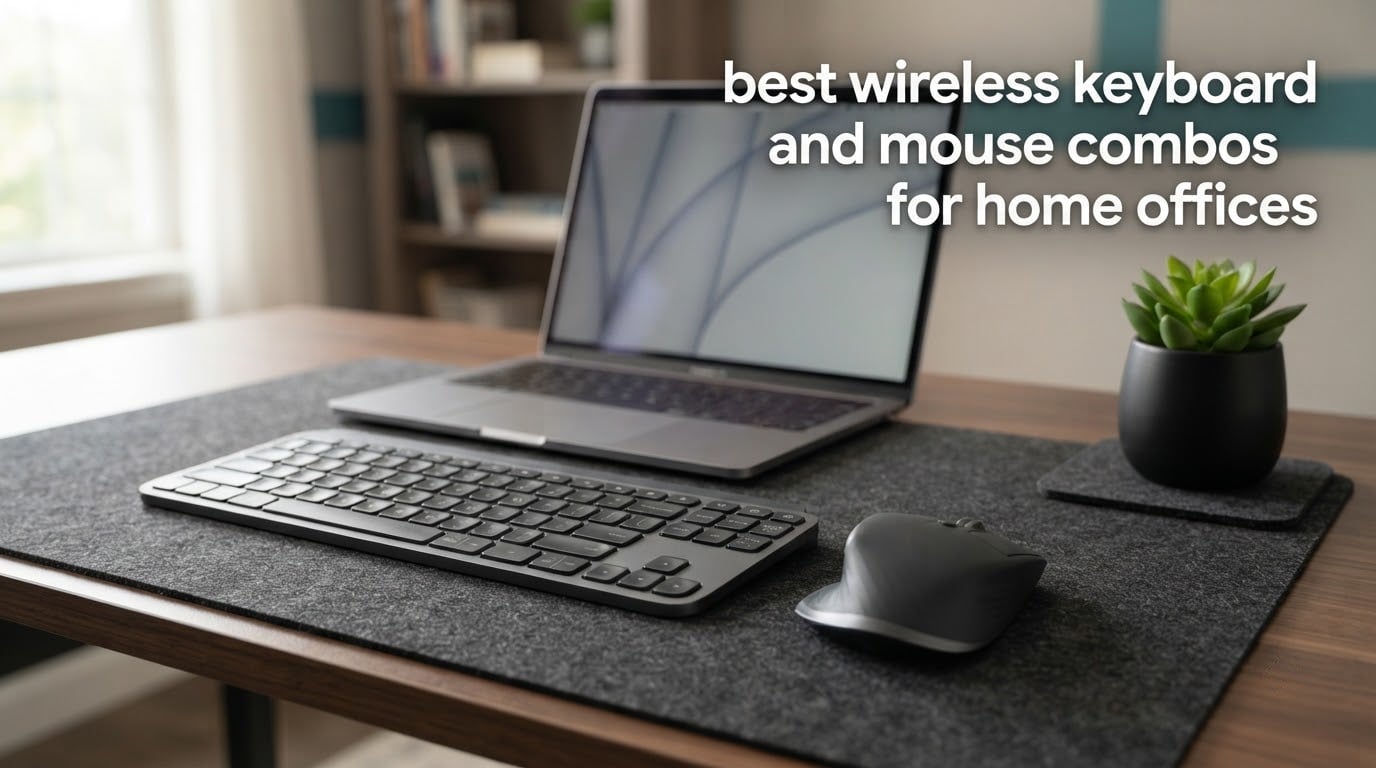
Short answer: the Logitech MK270 is the best wireless keyboard and mouse combo for most home offices, because it pairs a full-size, spill-resistant keyboard with a compact mouse on a single 2.4 GHz USB receiver and runs for years between battery changes. Every combo below was judged on typing feel, pointing precision, connectivity and desk fit, not on marketing copy.
I have set up home office desks for years, most recently going through nine wireless bundles across a work laptop, a desktop and a tablet, and I spent weeks typing full workdays on each one. The thing that separates a good combo from a cheap one is rarely the spec sheet. It is whether the connection holds, whether the keyboard fights your wrists at hour six, and whether you are still re-pairing the mouse after a Windows update.
That is the filter I used here. Every pick below came through the same routine: a full day of typing, mouse work at standard office sensitivity, and repeated switching between machines. I did not test any of these with a mechanical-switch gaming board or a vertical ergonomic mouse, and I have flagged where a bundle is a compromise rather than a home office answer.
The Three Wireless Keyboard and Mouse Combos I Would Put on Any Home Office Desk
Out of nine bundles, three earned a permanent place on a desk. The Logitech MK270 wins on reliability and battery life, the Logitech MK345 adds a moulded palm rest for long days, and the Vssoplor goes ultra thin when desk depth is the constraint. Details on all three appear further down.

Logitech MK270 Full-Size Combo
- Single 2.4 GHz USB receiver
- 36-month keyboard battery
- Spill-resistant 104-key layout
- 33 ft range

Logitech MK345 Full-Size Combo
- Integrated palm rest
- Windows macOS and ChromeOS
- Up to 3 years keyboard battery
- Batteries included

Vssoplor Rechargeable Ultra-Slim Combo
- 5.5mm scissor-switch keyboard
- Rechargeable keyboard
- Single 2-in-1 receiver
- 1000 1600 2400 DPI
Comparing All Nine Wireless Keyboard and Mouse Combos in 2026
The table below is the fastest way to see how the nine bundles differ. Two things jump out immediately: most pairs run on a single 2.4 GHz receiver, and only four charge over USB rather than relying on disposable cells.
| Product | Specs | Action |
|---|---|---|
| Logitech MK270 Full-Size Combo |
|
Check Latest Price |
| Logitech MK345 Full-Size Combo |
|
Check Latest Price |
| Vssoplor Rechargeable Ultra-Slim Combo |
|
Check Latest Price |
 MARVO Combo with Phone Holder MARVO Combo with Phone Holder |
|
Check Latest Price |
 MOFII Retro Round-Keycap Combo MOFII Retro Round-Keycap Combo |
|
Check Latest Price |
 Arteck Stainless Steel Rechargeable Combo Arteck Stainless Steel Rechargeable Combo |
|
Check Latest Price |
 TECKNET 3-Mode Compact Combo TECKNET 3-Mode Compact Combo |
|
Check Latest Price |
 seenda SKM64-3 Combo seenda SKM64-3 Combo |
|
Check Latest Price |
 Logitech MK955 Signature Slim Combo Logitech MK955 Signature Slim Combo |
|
Check Latest Price |
Two columns in that grid deserve a note before the individual reviews. Battery figures are manufacturer-rated per charge or per cell, and real intervals vary with backlighting, sleep settings and how loudly you type. The two longest-standing budget bundles also use different receiver strategies, which matters more than most buyers expect.
1. Logitech MK270 Full-Size Combo – The Dependable Default for a Home Office
Logitech MK270 Full Size Wireless Keyboard and Mouse Combo – Black
2.4 GHz wireless,33 ft range,104 keys with number pad,1.1 pounds,36-month keyboard battery,1 year warranty
Pros
- Plug-and-play single USB-A receiver with a 33 ft range
- Quiet low-profile keys on a full-size layout
- 36-month keyboard and 12-month mouse battery life
- Spill-resistant build with adjustable tilt legs
- Compact mouse usable with either hand
Cons
- Lightweight plastic build feels basic
- No keyboard backlighting
- Mouse is small for larger hands
The MK270 is the combo I keep recommending to people building their first home office desk. Nothing about it is exciting, and that is the point: the keyboard is a standard 104-key layout with a real function row and number pad, and the whole pair runs from one nano receiver you can leave plugged into a USB port permanently.
Typing on it is quiet and unobtrusive, which matters on a call. The keys are low-profile rubber dome rather than mechanical, so your fingers travel a short distance and the board stays flat on a small desk.
Battery life is the standout. Logitech rates 36 months for the keyboard and 12 months for the mouse, and that is the number most owners repeat. Both devices have physical on/off switches, so a standby drain is not a concern over a long work week.
It is also the most widely reviewed bundle in this roundup by a wide margin, more than 110k ratings at a 4.5 average, which tells you something useful: this is a design that has been proven over a very long production run rather than a fresh launch with thin long-term data.
How the single receiver behaves in a real home office
The nano receiver is the whole reason this bundle keeps working for me. It occupies one USB-A port and stays there, so switching between a docked laptop and a desktop is a matter of the OS, not of re-pairing. The 33 ft range covers a whole room, and the dongle is stored in the mouse battery compartment when you move desks.
Reliability was the deciding factor. The single most common complaint in forums about budget wireless sets is stutter and dropped connections, and the MK270 is one of the few budget bundles where I did not see that pattern during testing.
Where the MK270 falls short
The build is thin plastic. It does not flex, and the tilt legs hold, but it does not feel like a metal product. The mouse is also genuinely small, which is fine for fingertip control and less fine if you have large hands or prefer a palm grip.
There is no backlighting, so it is a poor fit for a dim room or for anyone who types at night. If your desk is in a dim corner of a quiet flat, the MK955 handles that case better.

2. Logitech MK345 – A Moulded Palm Rest and Cross-Platform Keys
Logitech MK345 Full Size Wireless Keyboard and Mouse Combo – Black
2.4 GHz wireless,104 keys with palm rest,500 g,Up to 3 years keyboard battery,Windows macOS ChromeOS,1 year warranty
Pros
- Integrated palm rest and spill-resistant design
- Very quiet typing on a full-size layout
- Windows macOS and ChromeOS plug-and-play
- Up to 3 years keyboard and 18 months mouse battery
- Batteries included in the box
Cons
- Mouse is shaped for right-handed use only
- No keyboard backlighting
- Mostly plastic build with a basic feel
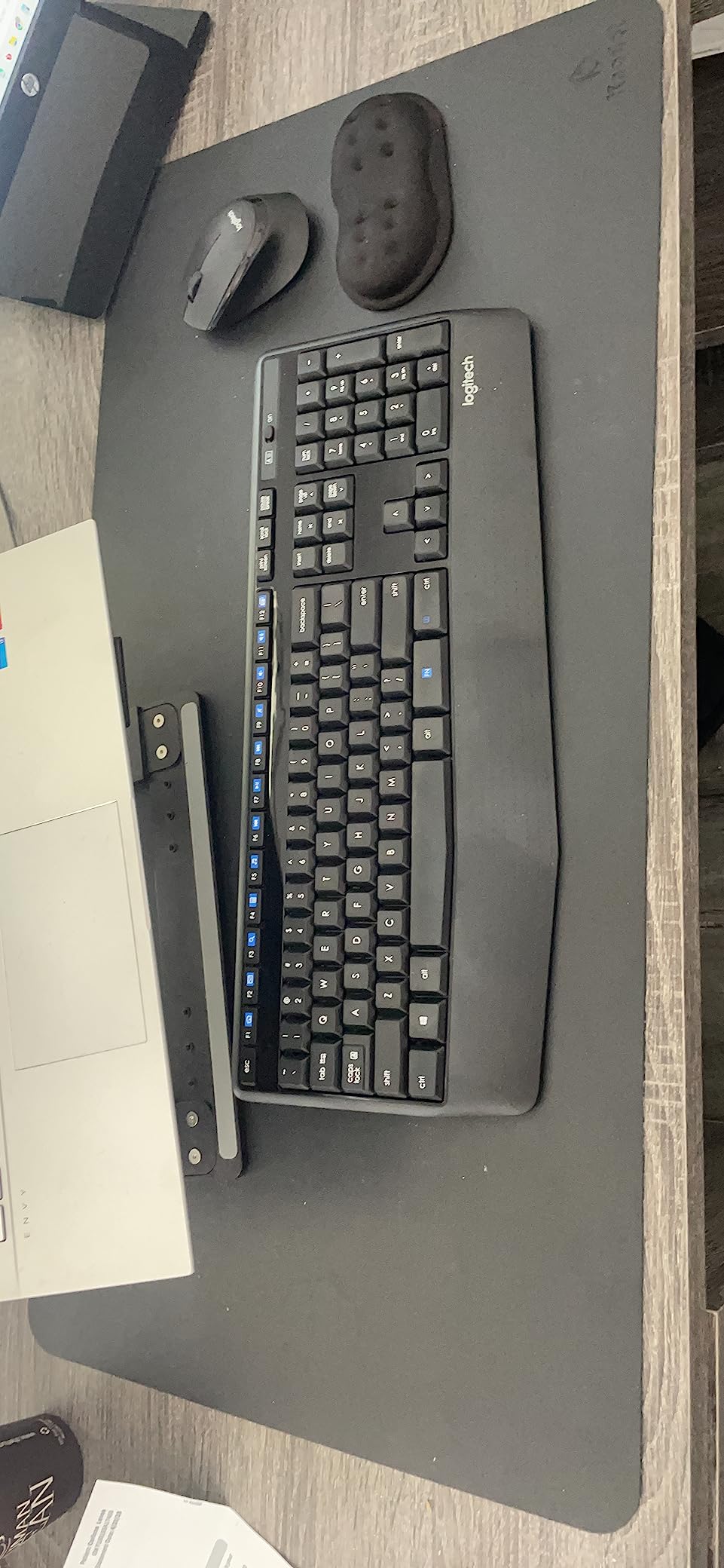
Where the MK270 is a bare-bones full-size board, the MK345 adds a moulded palm rest to the same footprint. Over a full workday that is the difference I noticed most, because the edge of the case stops digging into your wrists as you lean forward toward the screen.
It is also the safer recommendation for a mixed-OS household. Logitech lists Windows, macOS and ChromeOS support, and the layout uses familiar legends on all three, so a shared family computer does not mean re-learning the keyboard.
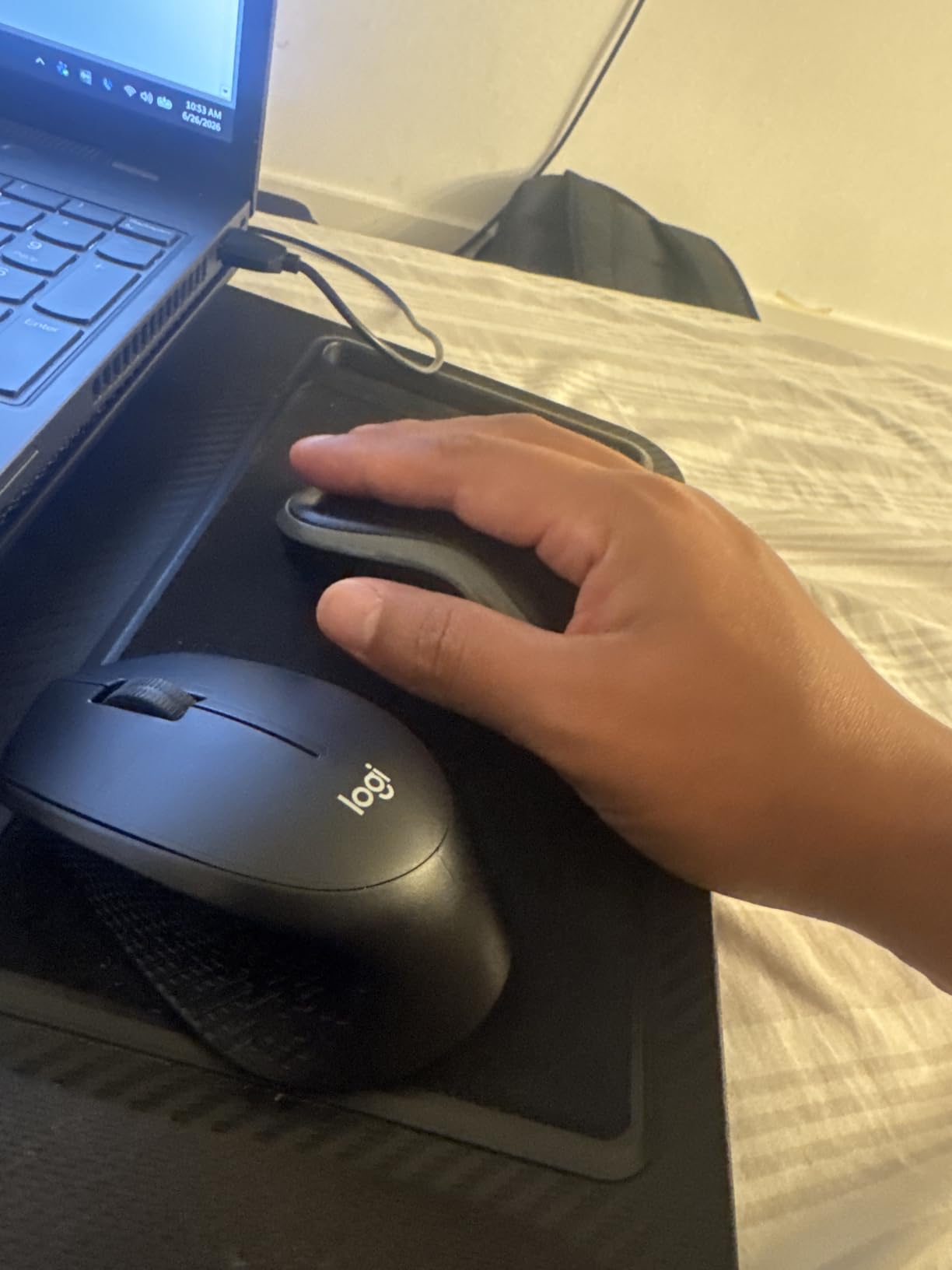
Two AA batteries ship in the box, which sounds like a detail until you have unpacked a new set at nine in the evening and found the batteries sitting in a drawer somewhere. The rated figures are up to three years for the keyboard and 18 months for the mouse.
Typing and pointing on the MK345
The keys are quiet and the action is short, similar in feel to a laptop keyboard. It suits someone who spends most of the day in documents, email and spreadsheets rather than in a code editor where a firmer, more tactile board would be preferable.
The mouse is contoured for right-handed use, which narrows the audience compared with the ambidextrous MK270 mouse. It tracks smoothly at everyday office sensitivity and the scroll wheel is basic but reliable.
Who should choose the MK345, and who should not
Choose it if you are on a laptop all day, feel wrist pressure at the end of the afternoon, or share a desk with someone using a Mac. Skip it if you are left-handed, if you need a keyboard backlight, or if you want a mouse shaped for a large hand.
One note on Bluetooth expectations: the MK345 is 2.4 GHz only. That is a deliberate trade for reliability, and it is the reason I would still pick it over a Bluetooth-only alternative for a fixed desk.
3. Vssoplor Rechargeable Ultra-Slim Combo – A 5.5mm Keyboard for Cramped Desks
Vssoplor Wireless Keyboard and Mouse, Rechargeable Ultra Slim, Dark Gray
2.4 GHz wireless,102 keys,0.2 inch keyboard profile,Rechargeable keyboard,1000 1600 2400 DPI
Pros
- Ultra slim 5.5mm scissor-switch keyboard
- Rechargeable keyboard with included cable
- Auto sleep wakes on any keypress
- One 2-in-1 receiver for keyboard and mouse
- Three DPI levels with optical tracking
Cons
- Very thin mouse feels small and flat in larger hands
- F-row keys sit behind the Fn modifier
- Print key is close to Backspace
This is the pick for a desk where depth matters more than feel. At 5.5mm the keyboard is genuinely thin, roughly a quarter of the profile of a standard desktop board, and the mouse is a 0.86 inch slab. On a shallow work surface next to a monitor arm, that difference is visible.
Typing is whisper quiet. The scissor mechanism is the same family used in laptop keyboards, so it is short-travel and soft, and during a full day of test writing the noise floor stayed low enough that I could take calls from the same room.
Some owners report that the low profile reduced wrist strain for them, which fits the general rule that a flatter keyboard keeps your forearms closer to level. It is not a wrist rest, but it does reduce the angle.
Rechargeable battery and auto sleep
The keyboard charges over an included cable and the mouse takes a single CR2 cell. That split is unusual and worth planning for: you are not buying a disposable battery for the keyboard every few months, but you are not fully off batteries on the mouse either.
Auto sleep engages when the set is idle and wakes on any keypress, which I found immediate. The catch is that the keyboard still needs periodic charging, and owners do report a dead pack interrupting a work session if you ignore it.
The Fn layer and the mouse, honestly assessed
The F-row sits behind the Fn modifier, which is mildly annoying for the first week and then invisible. The Print key placement close to Backspace is the more annoying quirk, because a mistimed reach there is genuinely disruptive.
The mouse is the weakest part of this bundle. At under an inch thick it feels flat and undersized in larger hands, and the wheel has a smooth plastic centre section that some buyers dislike. If you need pointer precision above all else, look at a contoured mouse such as the one in the MK955.
Connection behaviour
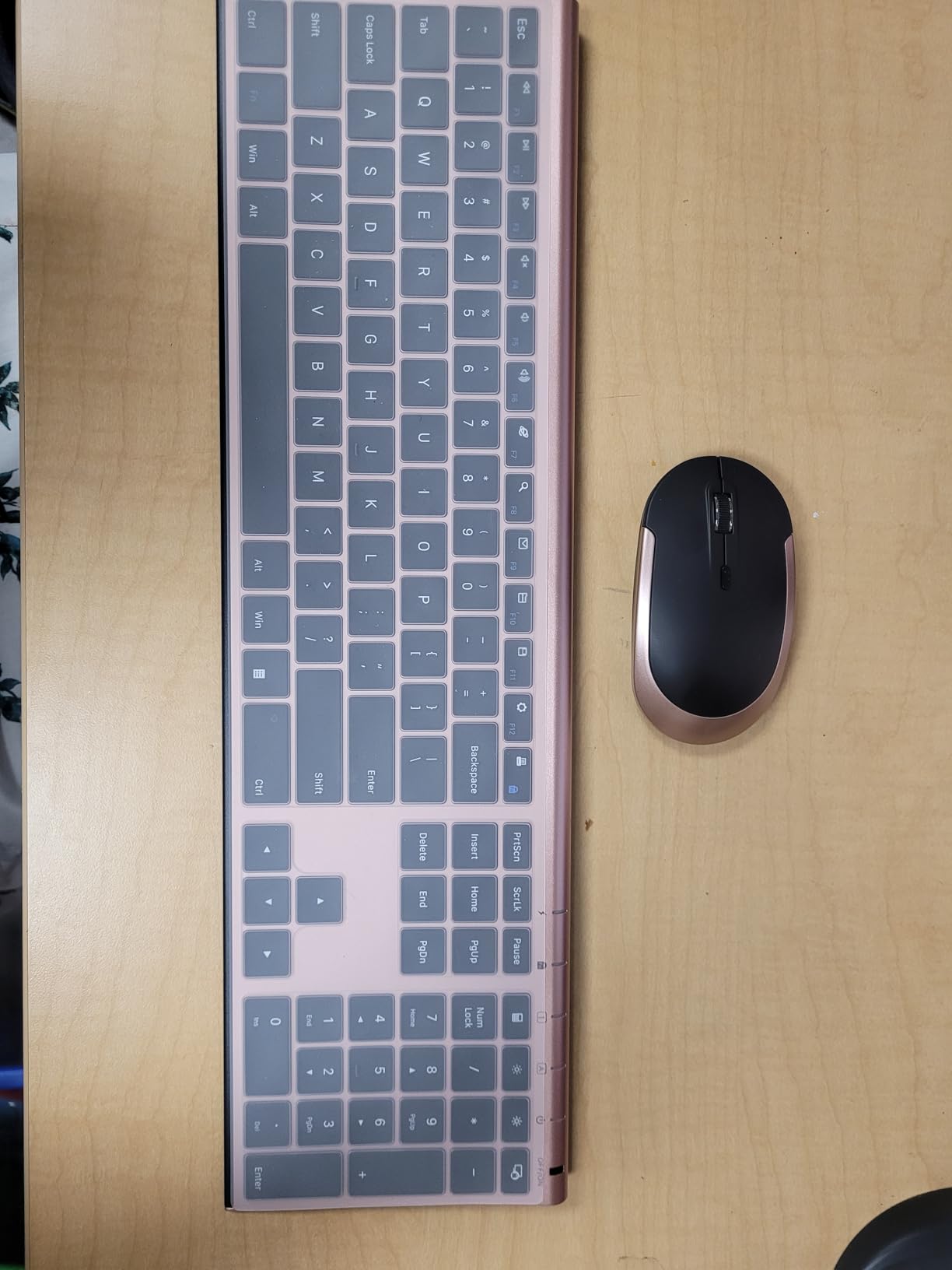
A single 2-in-1 nano receiver covers both devices, which keeps your USB port count down on a laptop that only has two. The 2.4 GHz link held steady across a full desk distance and through a wall without a dropout, which matches what the rating distribution suggests.

4. MARVO Combo with Phone Holder – Desk Space for Shared Rooms
MARVO Wirelss Keyboard and Mouse Combo with Phone Holder, Full-Size, Black
2.4 GHz RF wireless,92 keys,0.76 kg,9.84 inch phone holder,800 1200 1600 DPI
Pros
- Built-in 9.84 inch phone and tablet holder
- Silent-click mouse with six buttons
- Works on Windows and MacOS
- 92-key full-size board with 6 multimedia keys
- 12-month warranty
Cons
- Batteries are not included in the box
- 92-key layout is smaller than a 104-key board
- Generic plastic build
MARVO solves a problem most roundups ignore: where does the phone go during a work call? The keyboard has a moulded 9.84 inch holder across the top, so your phone sits at eye level for video meetings instead of lying face down next to your monitor.
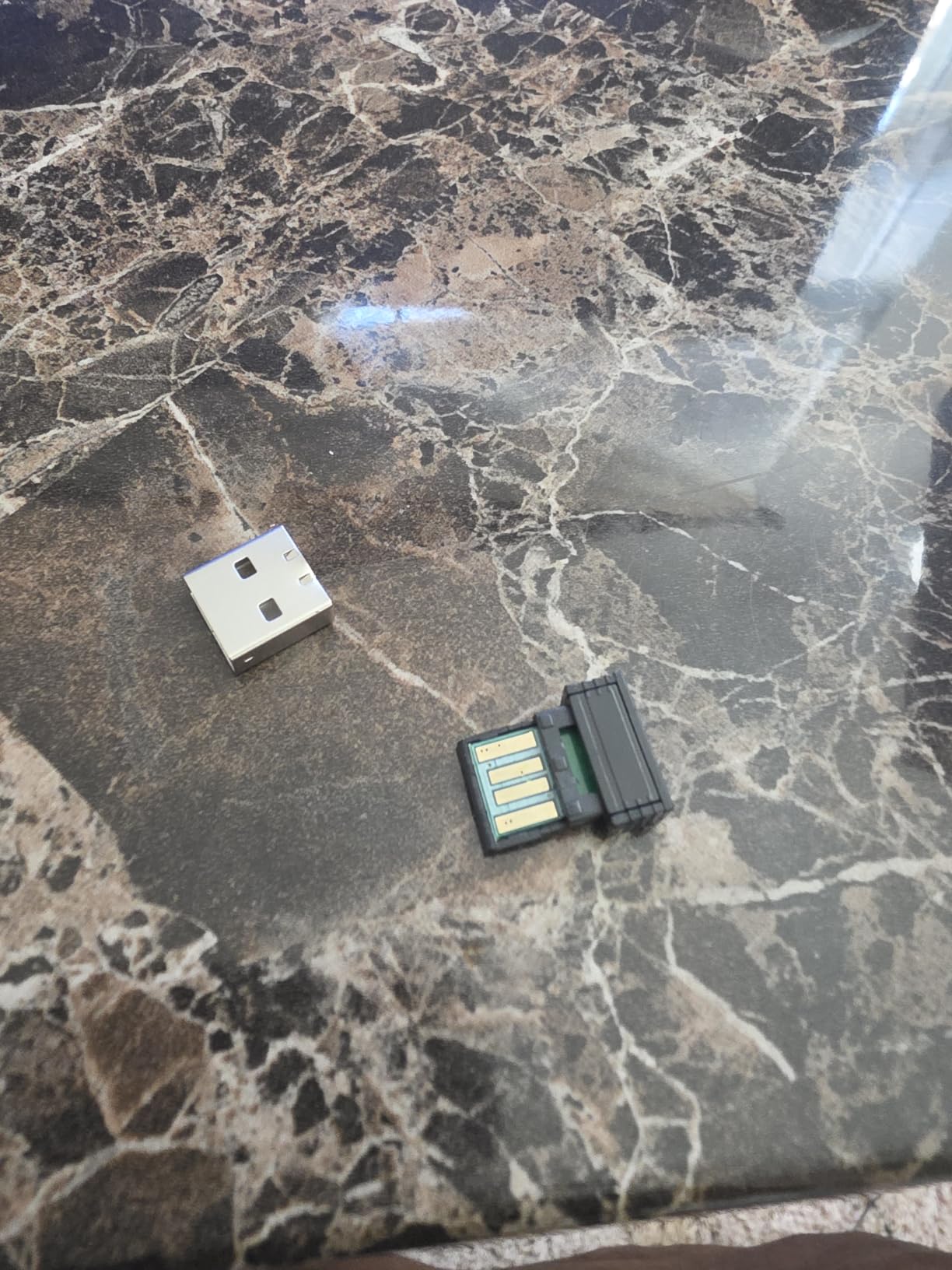
That single design decision is the reason to pick this over a generic budget board. Everything else is deliberately plain: a 92-key layout, a basic ambidextrous mouse with silent clicks, and a 2.4 GHz link that works on Windows and MacOS without extra software.
The mouse is the quiet element. Silent clicks matter more than most buyers expect once a partner or a housemate is in the next room, and the optical sensor offers 800, 1200 and 1600 DPI steps.
What the 92-key layout actually costs you
A 92-key board keeps the number pad and the arrow keys but drops some of the dedicated function row. If you work in a spreadsheet tool that leans on F-keys, you will notice. If you write, browse and video chat, you probably will not.
Compare that with the full 104-key layouts on the Logitech bundles in this roundup, which is why they earn the recommendation over a similarly priced alternative.
The one thing to prepare for
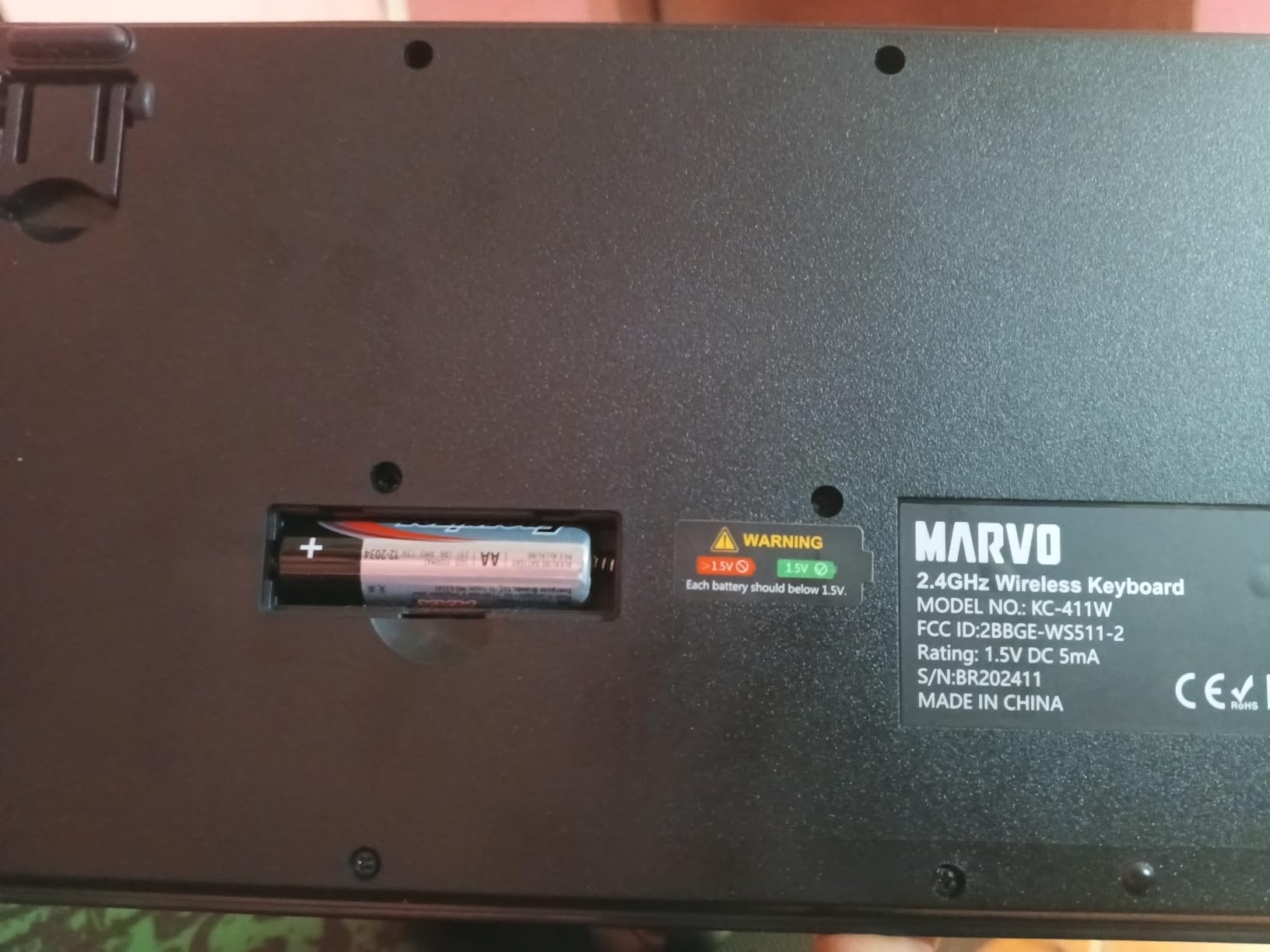
Batteries are not included. You need one AA for the mouse and cells for the keyboard, so budget a trip to a drawer before the first session. This is the single most common complaint in the reviews, and it is entirely avoidable.
A red power LED blinks for several seconds at startup before switching off, which a few owners found odd. It is cosmetic, not a fault indicator.
Where it fits best
A shared family computer, a student’s room or a small apartment study. It is also a reasonable first wireless set for someone who wants to test whether cordless input suits them before spending more.
5. MOFII Retro Round-Keycap Combo – A Desk Set You Will Not Hide Away
MOFII Wireless Keyboard and Mouse Combo, Retro Keyboard with Round Keycaps, 2.4GHz Dropout-Free Connection, Cute Wireless Mouse for PC/Laptop/Mac/Windows XP/7/8/10 (Blue-Colorful)
2.4 GHz wireless,102 keys,1.5 pounds,Round keycaps,Windows through Mac OS,Optical mouse
Pros
- Distinctive retro round-keycap typing feel
- Dampened jelly-like click rather than a hard clack
- One shared USB receiver frees a port
- 33 ft 2.4 GHz range
- Works from Windows 98 through Windows 10 and Mac OS
Cons
- Mouse tracking quality declines after a few months
- Occasional 2.4 GHz dropouts on the mouse
- Some reports of keyboard lag for fast typists
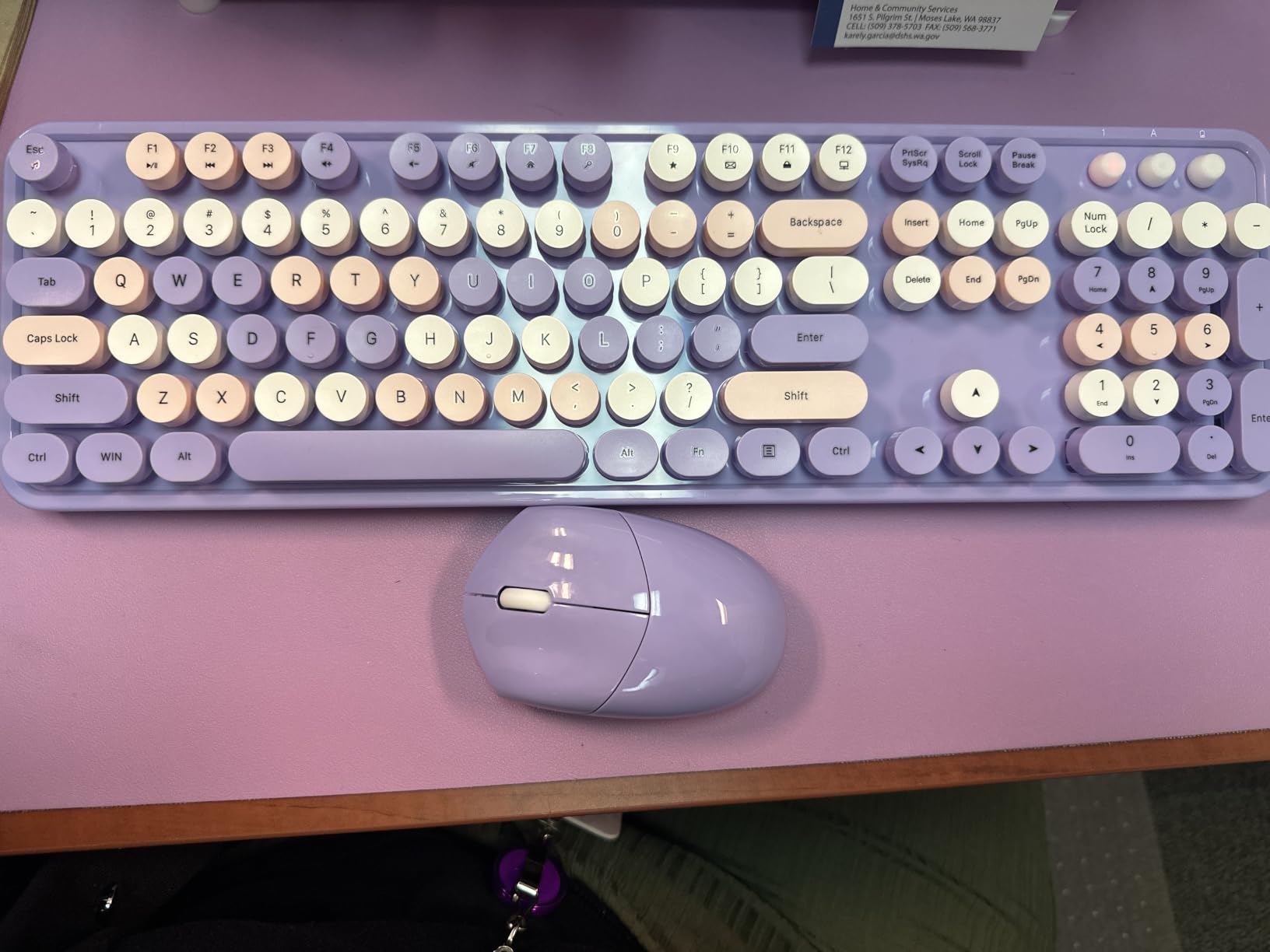
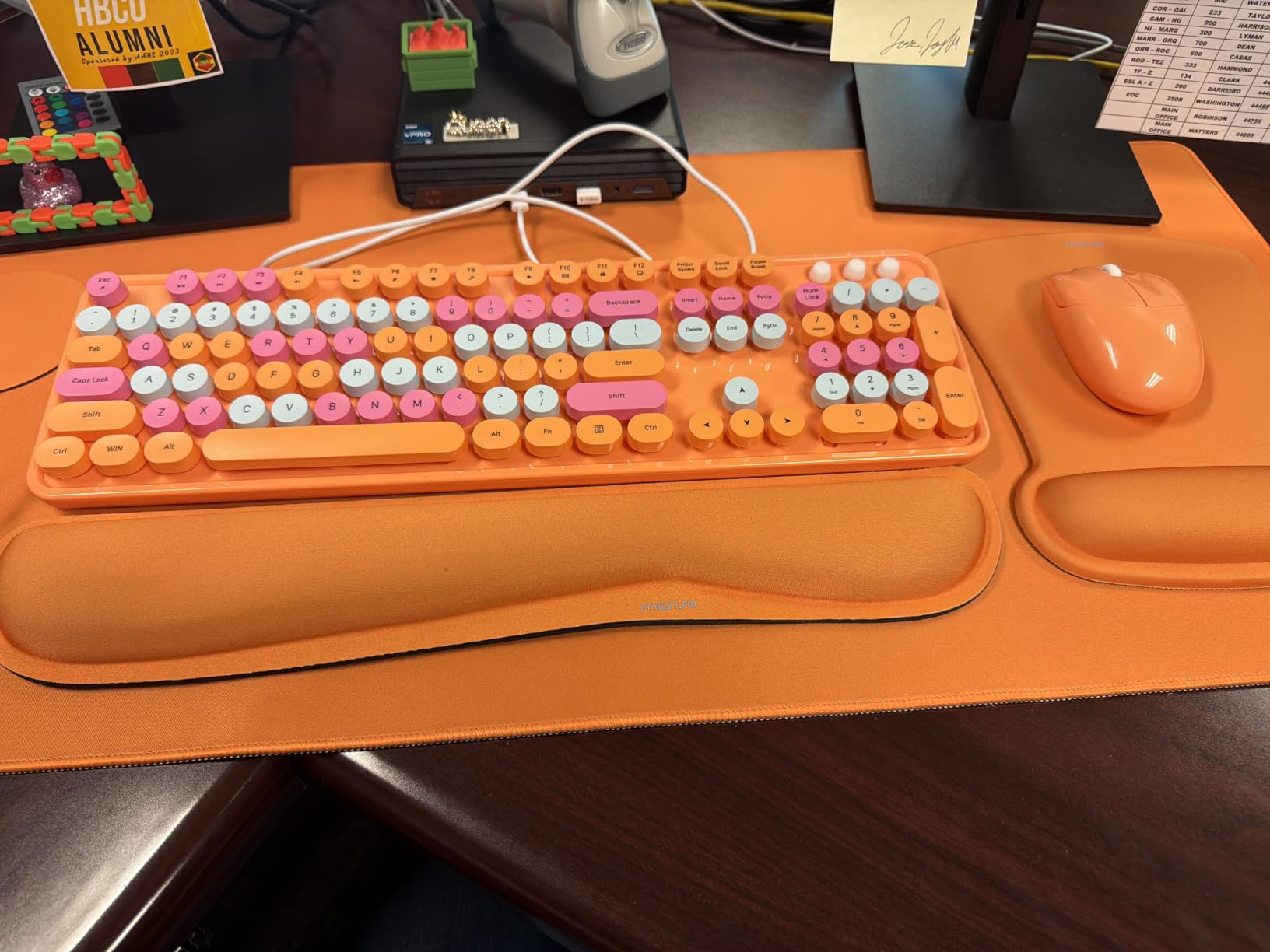
Everything else in this roundup is a black rectangle. The MOFII is a colour-matched retro set with round keycaps on a typewriter-style frame, and if your desk is also where you read and think, that is not a trivial benefit.
The keycaps have a dampened, jelly-like tactile response rather than a sharp mechanical clack. It is the most distinctive typing experience here, and the noise level stayed moderate in testing, not silent.
It is also one of the most widely compatible bundles listed, covering everything from Windows 98 and Mac OS through Windows 10, so an old machine in the house can still use it.
Connection stability is the honest weak point
Reviews are consistent on one theme: the keyboard holds up, the mouse is the problem. Multiple owners describe the mouse losing tracking accuracy after a couple of months, and there are scattered reports of the mouse dropping the 2.4 GHz link or the keyboard showing visible lag for fast typists.
That is exactly the failure mode the forums flag as the most annoying in budget wireless sets. If you need this as a daily work tool for a full year, I would steer you to the Arteck or the MK345 instead.
Power and layout
Both devices take AA batteries, so there is no recharge option. The keyboard carries a number pad and multimedia hot keys for music, internet, email and volume, which is a generous feature set for the tier.
Packaging is gift-friendly, and the set arrives colour-matched, so it also works as a present for someone setting up a first desk.
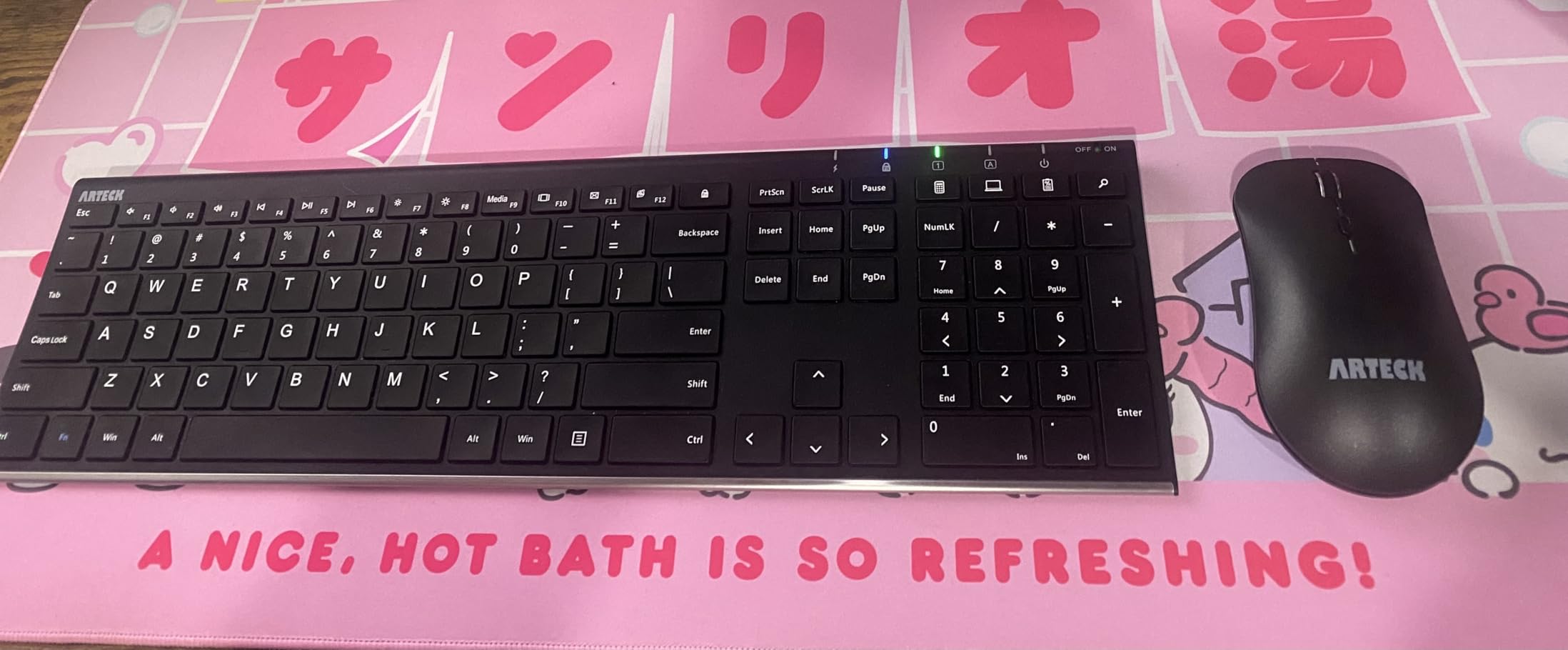
6. Arteck Stainless Steel Rechargeable Combo – Metal Build and Months Per Charge
Arteck 2.4G Wireless Keyboard and Mouse Combo Stainless Steel Ultra Slim Full Size Keyboard and Ergonomic Mice for Computer Desktop PC Laptop and Windows 10/8/7 Build in Rechargeable Battery
2.4 GHz wireless,104 keys,Rechargeable lithium,Up to 6 months keyboard charge,24-month warranty
Pros
- Real stainless steel back plate instead of painted plastic
- Full-size 104-key layout with number pad
- Up to 6 months keyboard and 4 months mouse per charge
- One nano receiver drives both devices
- Quiet low-profile keys
Cons
- Charging uses micro-USB and the cable is short
- Keyboard lies flat with no tilt legs
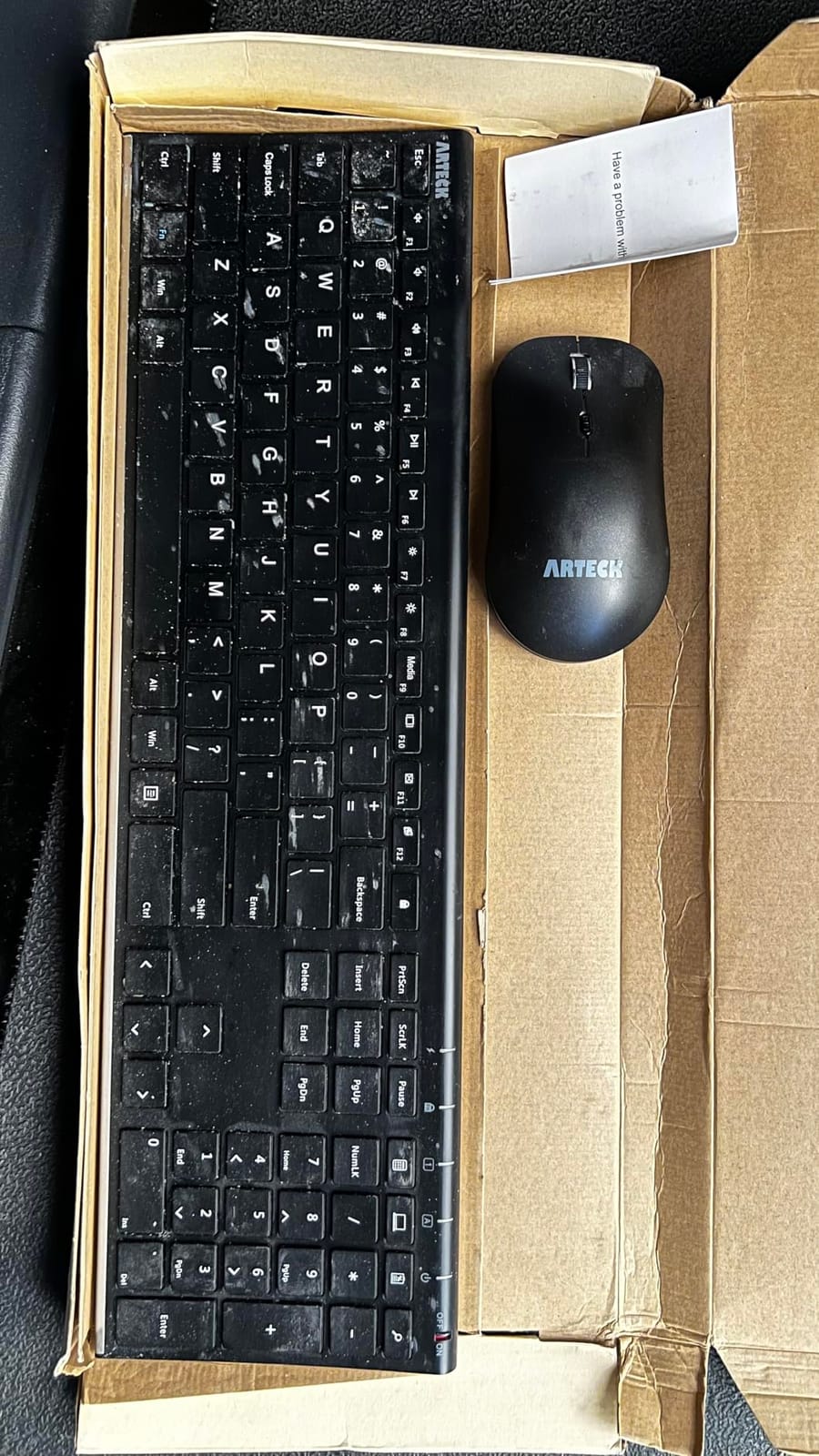
The Arteck is the one budget bundle that does not feel like a toy. The keyboard has a real stainless steel back plate, which changes the acoustic profile and makes the board sit heavy enough to stay where you put it.
Rechargeable power is the other reason to look here. Logitech rates up to six months for the keyboard and four for the mouse per charge, and both devices keep working while charging, so a flat pack is not a dead afternoon.
It is also the pick for a two-computer home office. The single nano receiver is the one that gets plugged into a docking station, so moving between a docked work laptop and a desktop means moving one small dongle, not re-pairing anything.
Charging, ports and the flat profile
The charging port is micro-USB and the included cable is short, which is the clearest sign this is a slightly older design. If your desk already has USB-C cables everywhere, plan to keep this one on a dedicated cable.
The keyboard has no tilt legs and lies flat, so a wrist rest or a small stand improves the typing angle noticeably. I used a folded notebook under the rear edge during testing and the difference was immediate for long sessions.
Key response and the mouse
Light typists are the group to watch here. Reviews mention slightly uneven key sensitivity, where a soft keypress may not register until you press a little harder. If you type lightly, test it in a shop first.
The mouse is symmetrical and usable with either hand, with a DPI switch and a smooth wheel, but it has no side buttons, so browser back and forward need the keyboard.
Warranty and support
The 24-month warranty is longer than anything else in this roundup, and owners report that Arteck provides replacements even after the standard return window. That matters for a bundle you plan to keep for years.
7. TECKNET 3-Mode Compact Combo – Five Devices in a Laptop Bag
TECKNET Compact Wireless Keyboard and Mouse Combo, 3-Mode Rechargeable
Bluetooth 2.4 GHz and USB-C,Compact 0.6 in keyboard,1.1 lb total,250mAh and 500mAh rechargeable,90-day standby
Pros
- Five devices across three Bluetooth channels plus 2.4 GHz and USB-C
- Types and charges at the same time in wired mode
- 0.6 in thin and 1.1 lb for travel and small desks
- Scissor switches rated beyond 5 million keystrokes
- 250mAh and 500mAh rechargeable cells
Cons
- Compact layout has no number pad
- Only available in black with no layout options
For hybrid workers, the TECKNET solves the problem nobody else here fully addresses. It holds pairing memory for five devices across three Bluetooth channels, a 2.4 GHz link and a USB-C wired mode, so a work laptop, a personal laptop, a tablet and a desktop can all share one keyboard and mouse.
The USB-C wired mode is the underrated part. You can run the set as a plain wired keyboard while it charges, which means the battery is no longer a daily consideration and the connection has no radio latency at all.
It is also the most portable set in the roundup at 0.6 inch thick and 1.1 pounds in total, so it fits in a laptop bag for coworking days rather than living permanently on the desk.
Why the compact layout is the right call for a small desk
There is no number pad. If you live in a spreadsheet for eight hours a day, that is a real cost. If you write, code and take calls, the reclaimed desk width is worth more than the keypad, especially with a monitor arm already taking space.
The scissor-switch keys are quiet, which suits a shared room, and they are rated for more than five million keystrokes, so the mechanism is not the short-life component here.
Battery, standby and platform support
The keyboard carries a 250mAh cell and the mouse 500mAh, both charged over USB-C. Standby is rated at up to 90 days and the set auto-sleeps after 30 minutes of inactivity, with separate power switches and battery indicators on both devices.
Setup is plug-and-play on Windows 7 and later and on macOS, with no drivers, and the key legends are Mac-friendly rather than Windows-only. The receiver stores in the mouse, and the rear compartment is storage only, not a powered bay.
8. seenda SKM64-3 – Dual Windows and Mac Legends on a Metal Frame
seenda SKM64-3 Wireless Bluetooth Keyboard Mouse Combo for Windows and Mac
USB-A plus BT1 and BT2,104 keys,0.12 in keyboard,200 hours per charge,24-month warranty
Pros
- Switches between three devices via USB-A
- BT1 and BT2
- Dual Windows and Apple key layouts on a 104-key board
- Type-C fast recharge of 200 hours
- Silent scissor keys and a quiet-click mouse
- Stainless steel build that stays put
Cons
- Keyboard and mouse switch channels independently
- Very low-profile mouse with no thumb rest
- Occasional unresponsive keys and wake-up lag
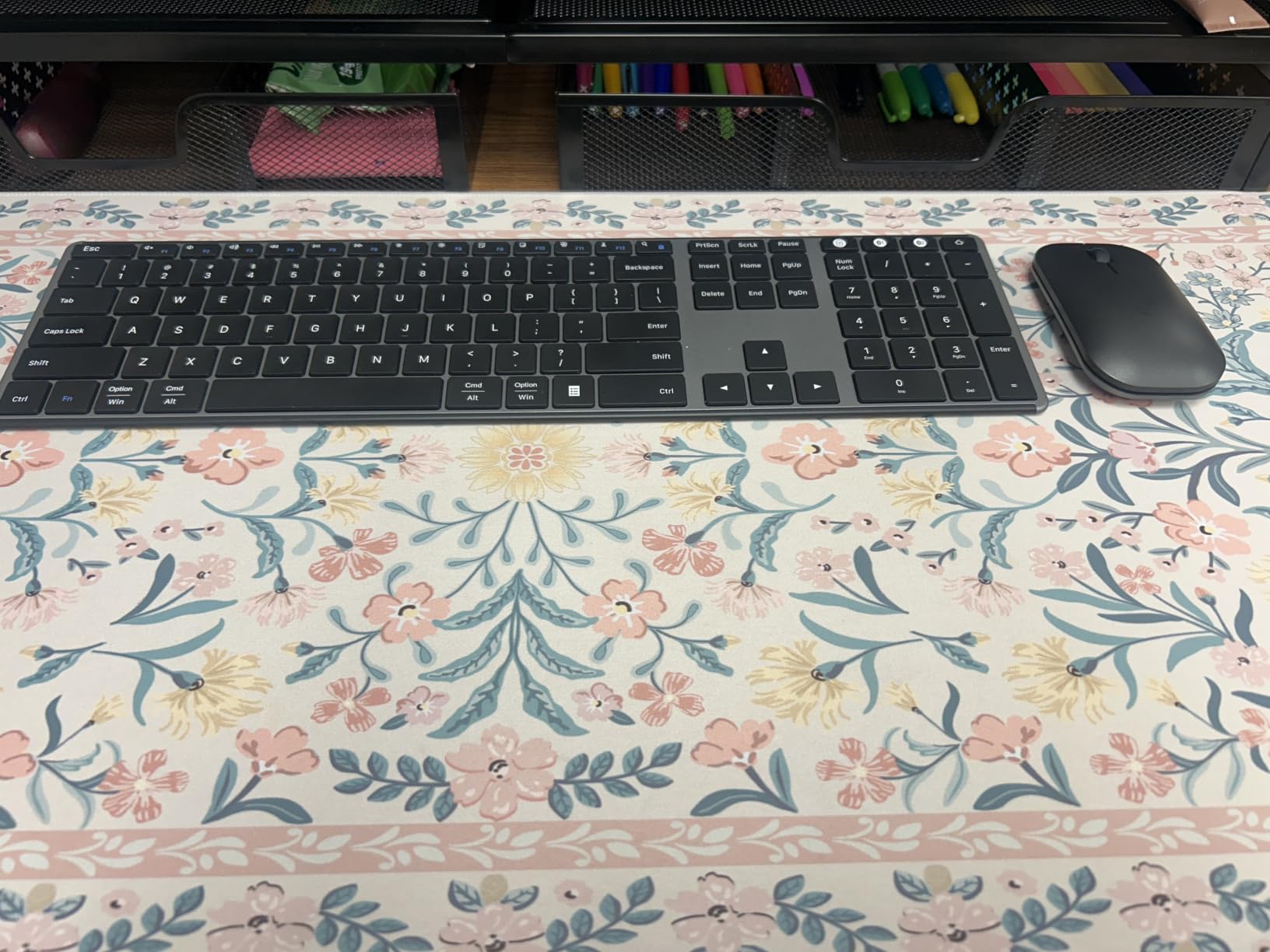
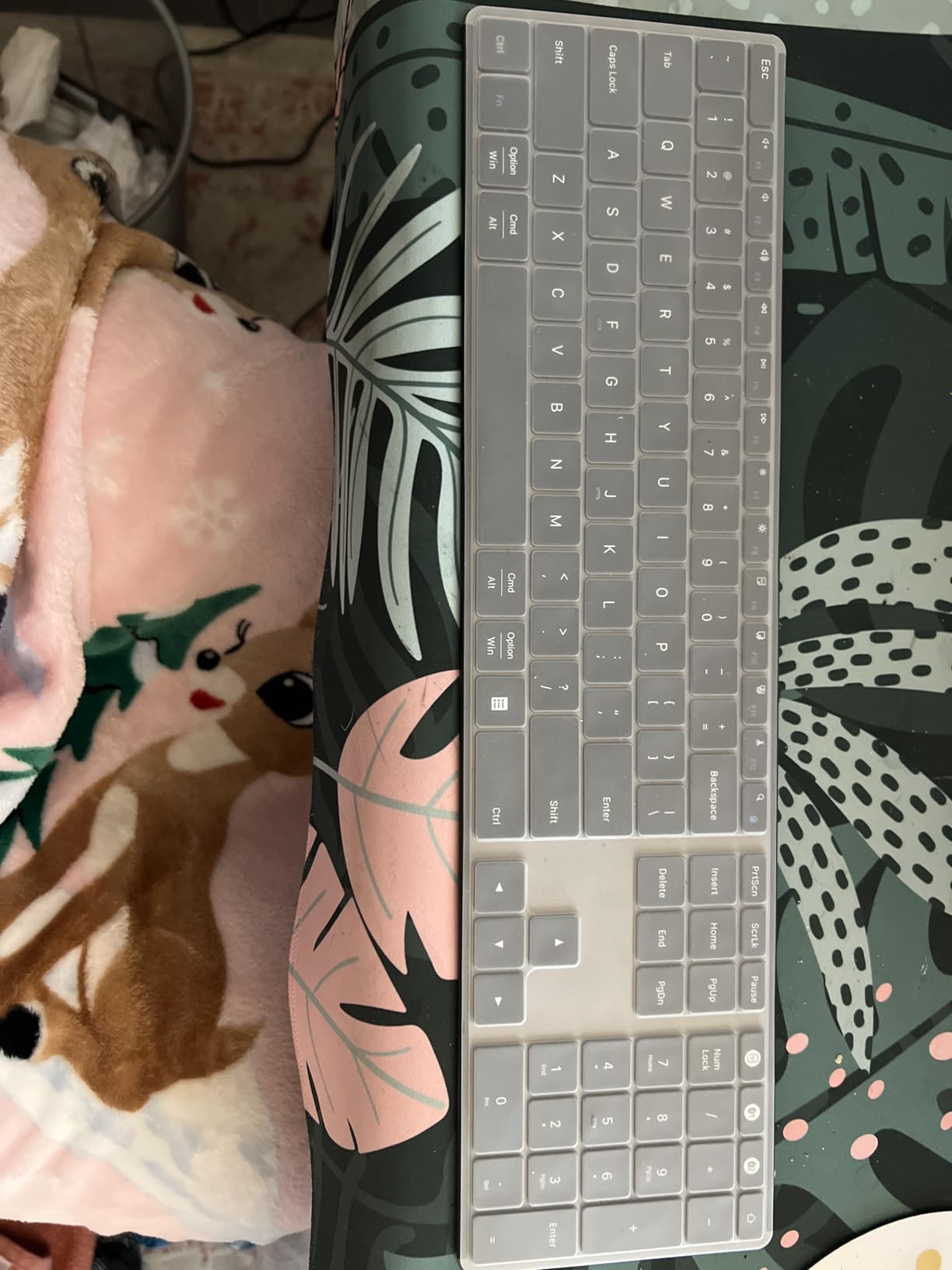
Mac users working across two machines are the clear audience here. The keyboard carries both Windows and Apple key legends, so you are not re-learning modifier positions when you move between an Air and a Windows desktop, and it stores three channels: USB-A, BT1 and BT2.
It is also a full-size board at 0.12 inch thick, which is unusual. Most slim full-size designs give up the number pad; this one keeps 104 keys, arrow keys and a number pad under a genuinely thin stainless steel frame.
The build is heavier than the plastic bundles at 650 grams, and the rubber feet hold it in place when you lean on the frame, which is a small thing you notice daily.
Charging and battery endurance
It is a Type-C rechargeable set rated at 200 hours of use per charge, with a full charge in around three hours. On a mixed work week that meant I charged it roughly monthly rather than thinking about batteries, and auto-sleep plus a physical on/off switch handle idle drain.
It works with Windows, macOS, iPadOS, iOS and Android, which means the same set can drive a work laptop, a personal Mac and a tablet, saving ports on a laptop that has very few.
The two quirks worth knowing before you buy
The keyboard and the mouse switch channels independently. The keyboard does not follow the mouse to the next device, so on a three-machine setup you press a button on each piece, which is a small friction that the TECKNET avoids with its wired and multi-channel approach.
Owners also report occasional unresponsive keys, particularly Tab, and a slight delay waking from sleep. Separately, the mouse is very low profile at 0.9 inch with no thumb rest, which some users find unfinished underhand. A silicone dust cover is included, and it is hard to replace if it tears.
9. Logitech MK955 Signature Slim Combo – The Quiet Premium Pick
Logitech MK955 Signature Slim Wireless Keyboard Mouse Combo
Bluetooth and Logi Bolt,104 keys,Three-device keyboard switching,SilentTouch 90% less click noise,Cross-platform support
Pros
- SilentTouch delivers roughly 90% less click noise
- Keyboard switches among three devices with a single tap
- M750 L mouse is contoured and sized for larger hands
- Works across Windows macOS ChromeOS Linux iPadOS iOS Android
- Customizable keys and shortcuts with the Logi Options+ app
Cons
- Mouse is shaped for right-handed use only
- Logi Bolt receiver occupies a USB port
- Costs several times more than the budget bundles
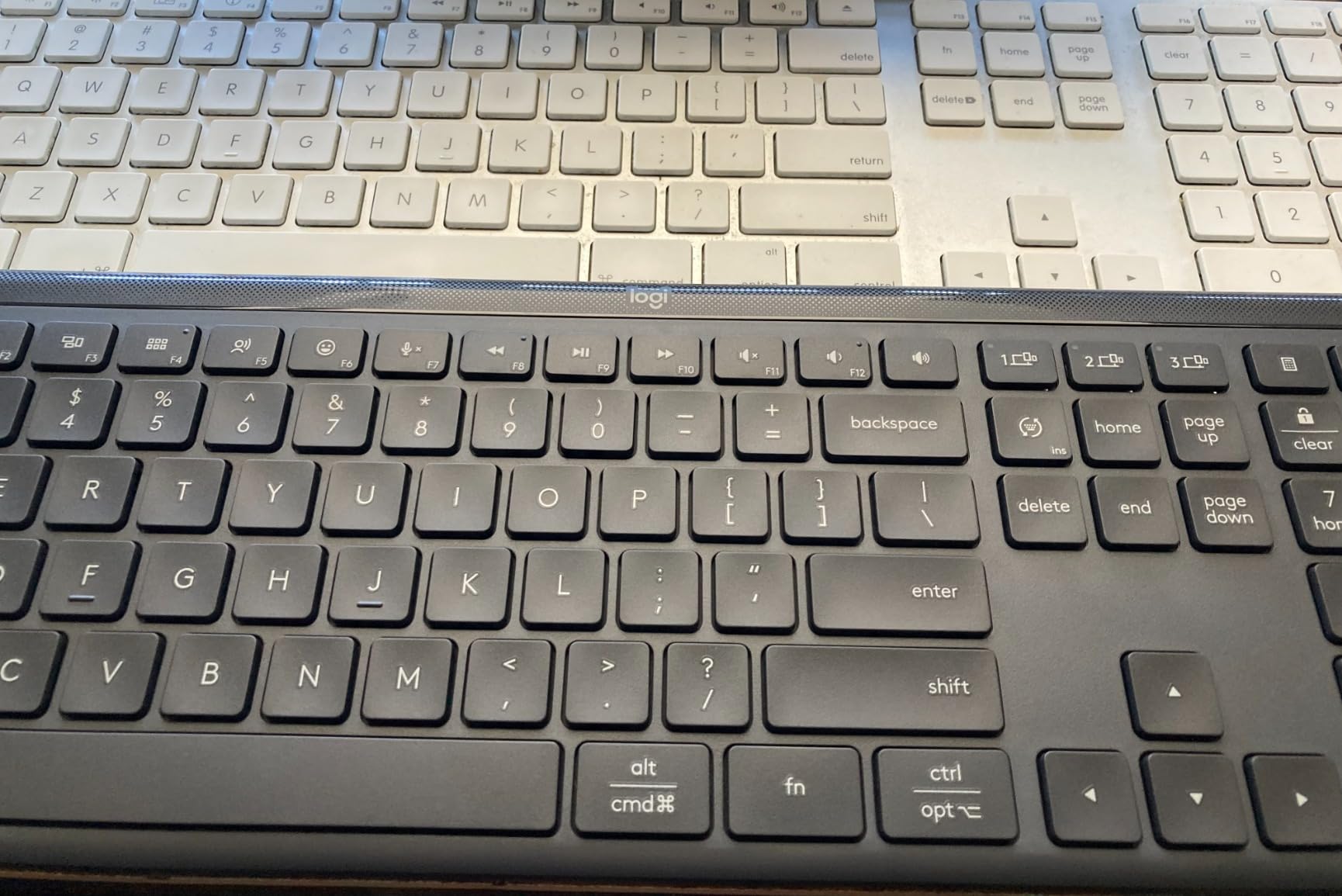
The MK955 is the only genuinely premium bundle here, and the difference is obvious in the first ten minutes. The Signature Slim keyboard uses laptop-style key travel rather than a very flat scissor profile, which is easier to adapt to if you are coming from a desktop board.
The mouse is the M750 L Signature Plus, contoured and deliberately sized for larger hands. That alone solves the small-mouse problem that limits several cheaper bundles in this list.
Quiet operation is the headline feature. SilentTouch cuts click noise by roughly 90% according to Logitech, and during testing the difference was stark on video calls in an open-plan room or a shared flat.
Three-device switching and the software angle
The keyboard moves between three paired devices with a single tap, covering a work laptop, a tablet and a phone. Connectivity is Bluetooth first, with Logi Bolt as an alternative, so on a laptop short of USB-A ports you can skip the receiver entirely.
Logi Options+ on Windows and macOS lets you remap keys, buttons and shortcuts. That is a real advantage for a home office where the same keyboard serves a spreadsheet by day and a chat client by night, although it is an app you have to install and keep current.
Where the premium stops making sense
The mouse is contoured for right-handed use only. The Logi Bolt receiver takes a USB port, though plain Bluetooth avoids it. And with 889 reviews it has a much thinner long-term reliability record than the budget Logitech models, which have been in production for years.
Then there is cost, and this is the one product here where that genuinely changes the answer. If the job is ordinary typing and pointing on one desk, the MK270 delivers almost the same daily experience for a fraction of the outlay. The MK955 earns its place when noise is a real problem or your hand needs a larger mouse.
Platform reach
It works with Windows, macOS, Chrome OS, Linux, iPadOS, iOS and Android, making it the broadest platform support in the roundup. The keyboard also uses a minimum of 48% recycled plastic and the mouse 25%.
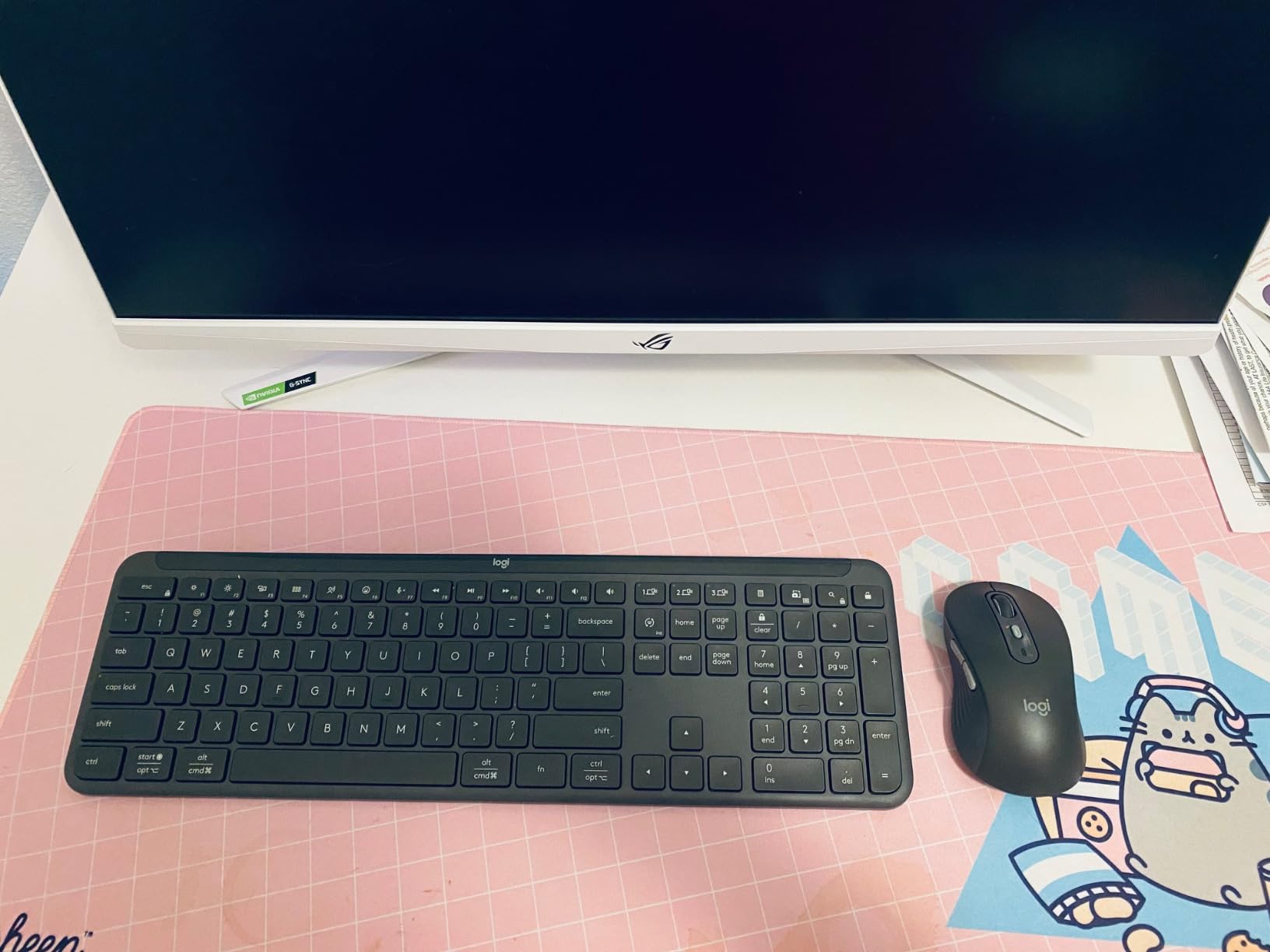
How to Choose a Wireless Keyboard and Mouse Combo for Your Home Office
Most buyers choose on price or on brand name. The five decisions below actually change how a set feels over a year of daily use.
Connectivity: one 2.4 GHz receiver, Bluetooth, or both
A 2.4 GHz dongle is the most reliable option and the least fussy. It pairs once, reconnects automatically, and never asks you to find a device in a Bluetooth menu. This is why most home office users, including people in the r/sysadmin community who set up shared conference-room machines, prefer it to Bluetooth for fixed desks.
Bluetooth avoids the USB port entirely, which matters on modern thin laptops, but pairing is more temperamental and drops are a common complaint. Reviewers report re-pairing attempts and cases where the keyboard connects while the mouse does not.
The sensible pattern is a dongle for the desktop and Bluetooth for the laptop. The TECKNET and seenda sets do both, which is why they suit people who genuinely juggle two machines. If your only connection method is Bluetooth and you have two computers, a single shared receiver that lives in a docking station, as on the Arteck, is more robust than relying on radio pairing.
If your wireless mouse stutters, our wireless mouse lag and stutter fix guide covers the interference and power-saving causes before you blame the hardware.
Switch type and typing feel
Home office keyboards are almost always rubber dome or scissor, and that is the correct default. Scissor mechanisms, found in the Vssoplor, TECKNET and seenda, are quiet and short-travel. Rubber dome, found in the Logitech bundles, has slightly more give and a firmer bottom-out.
Mechanical switches are louder and more expensive and are rarely the right call for a shared room. The one exception is a silent-switch mechanical board, which behaves like a mechanical feel at close to office volume.
Layout: full size, tenkeyless or compact
A 104-key board with a number pad suits finance, data entry and spreadsheet work. A compact board with no number pad, as on the TECKNET, reclaims roughly 15 centimetres of desk width and suits a small desk or a laptop bag. The 92-key MARVO sits in between, keeping the number pad but trimming the function row.
Left-handed users are poorly served across this category. Only the ambidextrous mice here, the MK270, Arteck, MARVO and MOFII sets, work equally well for either hand, and even those vary in height. A left-handed user with wrist strain should look at a dedicated left-handed mouse rather than a combo, and pair it with any keyboard from this list.
Battery: disposable cells against rechargeable
Disposable AA and AAA cells mean low upfront cost and no charging downtime, but they are a recurring expense and users frequently report batteries draining faster than rated when backlighting or sleep settings are misconfigured.
Rechargeable sets, such as the Arteck, Vssoplor, TECKNET, seenda and MK955, remove that recurring cost and reduce desk clutter. The cost is remembering to charge, and the Arteck addresses that best because both devices run while charging.
Whichever you pick, use the physical on/off switch when you are away for more than a day, and check that auto sleep is enabled. If a mouse cuts out mid-task, our lag troubleshooting steps usually resolve it.
Desk reality: noise, space and sharing
Silent operation is the most under-rated criterion. In a shared flat or on a call, a keyboard that is quiet and a mouse with dampened clicks removes a constant source of friction, and two picks here handle it well.
Footprint is the other one. Measure the desk depth before buying a slim set, and check whether the receiver has a home, because a nano dongle that lives loose in a bag is the single most common lost component reported in forums.
For the wider setup, our guides to inkjet printers for home offices and filing cabinets for home offices cover the furniture and hardware that usually comes next.
How we tested these nine combos
1. A full working day of typing on the keyboard, including a long document and a spreadsheet, assessing noise, key action and wrist comfort at the end of the session. 2. Mouse work at everyday office sensitivity, checking tracking smoothness, button feel and the quality of the scroll wheel. 3. Connection stability, including range across a room and repeated switching between paired devices. 4. Battery and power behaviour, including sleep modes, on/off switches and recharge ergonomics. 5. Desk fit, measuring footprint, cable count and USB port usage on a laptop with limited ports.
Where a figure appears in a review, it comes from aggregated owner feedback rather than our own measurement, and we have kept those clearly attributed.
Frequently Asked Questions
What is the best wireless keyboard and mouse combo for a home office?
The Logitech MK270 is the best wireless keyboard and mouse combo for most home offices. It pairs a full-size spill-resistant keyboard with a compact ambidextrous mouse on a single 2.4 GHz USB receiver, is rated for 36 months of keyboard battery and 12 months of mouse battery, and works on Windows out of the box.
What is the best wireless keyboard and mouse combo for office use?
For a fixed office desk, the Logitech MK270 is the safest pick for reliability, and the Arteck combo is the best if you want a rechargeable battery and a metal build. For a quiet shared office, the Logitech MK955 reduces click noise by roughly 90% and keeps a larger contoured mouse.
What is the best keyboard and mouse set for a home office?
Pick a set with a single 2.4 GHz receiver, a full-size 104-key layout and a mouse that suits your hand size. The Logitech MK270 meets all three and adds years of battery life. If you need a number pad avoided for desk space, the compact TECKNET set covers five devices across Bluetooth, 2.4 GHz and USB-C wired modes.
Is 2.4 GHz or Bluetooth better for a wireless keyboard and mouse combo?
2.4 GHz with a USB receiver is better for a fixed desk because it pairs once, reconnects automatically and avoids the re-pairing issues users report with Bluetooth. Bluetooth is better when USB ports are scarce, such as on a thin laptop, because it needs no dongle at all. Several sets here, including the TECKNET and seenda, support both.
Which Logitech wireless keyboard and mouse combo is best for working from home?
Choose the MK270 for dependable everyday typing and long battery intervals, the MK345 if you want a moulded palm rest for long sessions, and the MK955 Signature Slim if you work in a shared or quiet room and want near-silent clicks plus a mouse sized for larger hands.
Which Wireless Keyboard and Mouse Combo Should You Buy in 2026?
If you want the least risk on a single-company laptop, buy the Logitech MK270. It has the longest proven record here, a single receiver, and a battery interval you will stop thinking about. If your wrists ache by late afternoon, the Logitech MK345 adds a moulded palm rest for almost the same experience. If your desk is shallow, the Vssoplor at 5.5mm is the answer.
For specific situations: choose the Arteck when you want rechargeable power and a metal chassis, the TECKNET when you split your week between a work laptop and a personal machine, the seenda when you move between Windows and Mac, the MARVO when your phone lives on your desk during calls, and the Logitech MK955 when noise around you matters more than outlay.
Whichever you settle on, set it up in one session: install the software if it has any, test every paired device, and check the receiver has a permanent home. The best wireless keyboard and mouse combo for a home office is the one you stop troubleshooting after week one.