
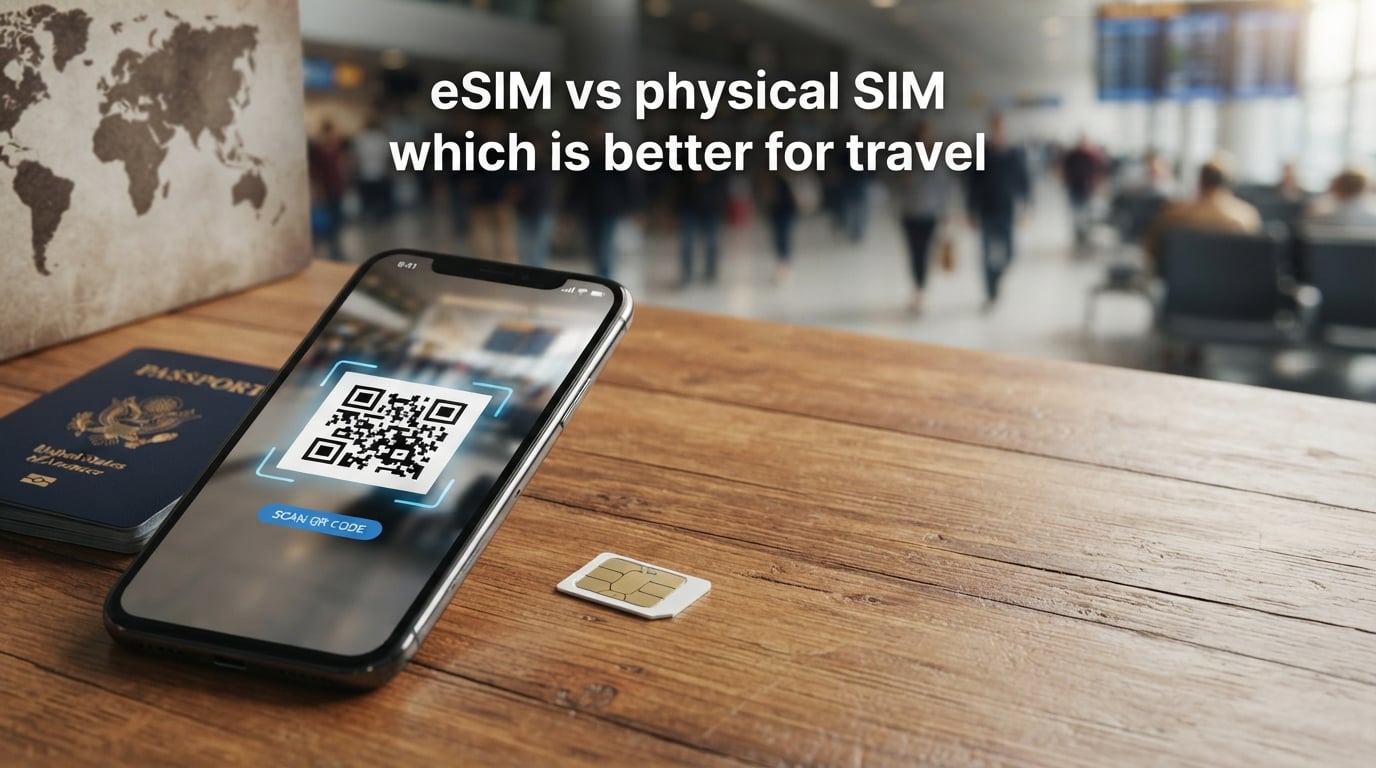
Figuring out the eSIM vs physical SIM which is better for travel question used to take me hours of research before every international trip. I would scroll through Reddit threads, compare carrier roaming fees, and second-guess myself at airport SIM kiosks. After testing both options across multiple countries and trip lengths, I can tell you the answer is not one-size-fits-all. Your best choice depends on how long you are traveling, how many countries you are visiting, and what type of phone you carry.
In this guide, our team breaks down everything you need to decide between an eSIM and a physical SIM for your next trip. You will get a side-by-side comparison, real cost breakdowns by trip type, a dual SIM setup walkthrough, and answers to the most common questions travelers ask. By the end, you will know exactly which option fits your travel style in 2026.
Let us settle the eSIM vs physical SIM debate for travel once and for all.
What Is an eSIM?
An eSIM is an embedded SIM chip built directly into your phone. There is no removable card to insert. Instead, you download a digital SIM profile to your device, usually by scanning a QR code or tapping an activation link from an eSIM provider.
The eSIM stores your carrier information on a small secure chip inside the phone, sometimes called the eUICC. When you buy a travel eSIM plan, the provider sends you a QR code that provisions the profile remotely. Your phone treats it exactly like a physical SIM for connectivity, signal strength, and data speeds.
Most modern iPhones (iPhone XS and later) and many Android flagships support eSIM. Some devices, like the US versions of the iPhone 14 and later, ship without a physical SIM tray at all. That makes understanding eSIM activation essential for travelers in 2026.
What Is a Physical SIM Card?
A physical SIM card is the traditional removable chip you insert into your phone’s SIM tray. It stores your carrier profile on a tiny embedded circuit. You can pop it out, swap it between phones, and buy prepaid versions at airports, convenience stores, and carrier shops worldwide.
For travel, a physical SIM usually means buying a local prepaid SIM at your destination. You walk into a shop, show your passport, pay in local currency, and walk out with a working local number and data plan. In many countries, these local rates are significantly cheaper than international roaming or even travel eSIMs.
The downside is the friction. You have to find a shop, deal with language barriers, and in some countries complete biometric or passport registration before the SIM activates. Physical SIM cards also wear out over time. Forum users on r/eSIMs report that cards can stop working after roughly four years of use.
eSIM vs Physical SIM: Side-by-Side Comparison
Here is a feature-by-feature breakdown so you can see how eSIM vs physical SIM stack up for travel at a glance.
Activation time: eSIM activates in 2 to 10 minutes via QR code scan, often before you even land. Physical SIM requires visiting a shop, which can take 20 minutes to an hour depending on queues and registration requirements.
Cost structure: Travel eSIMs typically charge per gigabyte or offer fixed data packages. Local physical SIMs often include a local phone number and generous bundled data at lower per-GB rates, especially in Southeast Asia, India, and Brazil.
Convenience: eSIM wins for convenience because you can buy and install it from your couch before departure. Physical SIM wins when you need a local number for calls, SMS, or services that require domestic registration.
Compatibility: Physical SIM works in virtually every phone ever made. eSIM requires a compatible device and an unlocked carrier. Some budget Android phones still lack eSIM support entirely.
Security: eSIM is harder to physically steal since it is embedded in the phone. It is also more resistant to SIM-swap attacks when paired with strong carrier authentication. Physical SIM can be removed and used in another device if your phone is stolen, but this also means a thief cannot easily clone it remotely.
Multi-country flexibility: Regional eSIM plans cover groups of countries (like all of Europe) on one profile with no SIM swapping. Physical SIM means buying a new card every time you cross a border unless your local carrier offers roaming.
Phone number: Most travel eSIMs are data-only. Physical SIMs include a local phone number, which you may need for local delivery apps, bank verification, or booking services in certain countries.
Signal strength and speed: eSIM and physical SIM deliver identical signal strength and data speeds when connected to the same carrier network. The connection type does not affect performance.
When eSIM Wins for Travel?
For the majority of short-to-medium trips, eSIM is the clear winner. Here is where it shines.
Short vacations (under 30 days). You buy the plan online, scan a QR code, and land with data already working. No airport SIM shop hunting, no passport queues, no language confusion. Reddit travelers consistently call this the single biggest advantage of eSIM for trips of one to three weeks.
Multi-country trips. If you are backpacking through Europe or hopping between countries in Southeast Asia, a regional eSIM plan covers multiple destinations on one profile. You do not need to buy and swap physical SIMs at every border crossing.
Last-minute departures. Your flight is tomorrow and you forgot to arrange connectivity. With eSIM, you can purchase and activate a plan in minutes from your phone. A physical SIM requires you to wait until you arrive and find a store.
Keeping your home number active. With an eSIM travel plan, your physical SIM slot stays free for your home carrier. That means you keep receiving calls and SMS on your home number, which is critical for two-factor authentication codes from your bank, email, and social accounts.
Late-night arrivals. Airport SIM shops are not always open. If you land at 1 AM, a physical SIM may not be available until morning. An eSIM installed before departure works the moment you turn on your phone.
Avoiding passport registration hassle. Countries like Indonesia, India, and Turkey require biometric or passport registration to activate a local physical SIM. This process can take 30 to 60 minutes. Many travel eSIMs bypass this requirement entirely.
When Physical SIM Wins for Travel?
Physical SIM still has real advantages in specific situations. Here is where it beats eSIM.
Long-term stays (1 month or more). If you are staying in one country for an extended period, a local prepaid SIM is almost always cheaper. Forum users report that in Brazil, Thailand, and Vietnam, local monthly plans cost a fraction of what travel eSIM providers charge for comparable data.
You need a local phone number. Most travel eSIMs are data-only. If you need to make local calls, receive SMS from local services, register for a local delivery app, or verify a local bank account, a physical SIM with a real local number is the way to go.
Your phone does not support eSIM. Many budget and mid-range Android phones still lack eSIM hardware. If your device is not on the eSIM compatible phones list, a physical SIM is your only option.
Areas with spotty eSIM provider coverage. Some remote regions have limited eSIM provider partnerships. A local physical SIM connects directly to the domestic carrier with the best tower coverage in that area.
Predicting data costs on a tight budget. Local carriers in many countries offer unlimited or high-data plans for very low prices. If you are a heavy data user, the per-gigabyte savings of a physical SIM can be significant.
Cost Comparison by Trip Type
Cost is where the eSIM vs physical SIM debate gets practical. Here is how the numbers break down based on trip length and destination.
Short trip (7 to 14 days, single country). A travel eSIM with 5 to 10 GB typically costs between $8 and $25 depending on the country. A local physical SIM with similar data might cost $5 to $15 but requires time to purchase and activate. The savings of a physical SIM are often under $10, making the convenience of eSIM worth the small premium for most travelers.
Multi-country Europe trip (14 days, 4 countries). A regional Europe eSIM plan with 10 to 20 GB runs about $20 to $40 and works across all four countries without any swapping. Buying four separate physical SIMs would cost more and eat hours of your trip. This is where eSIM dominates.
Long stay (1 to 3 months, single country). A local physical SIM almost always wins here. In countries like Thailand or Brazil, a monthly local plan with 30 to 50 GB can cost $6 to $12. A comparable travel eSIM for two months could run $60 to $100. The longer you stay, the more the physical SIM savings compound.
Carrier daily roaming pass comparison. Major carriers charge $10 to $12 per day for international roaming add-ons. For a 10-day trip, that is $100 to $120. Both eSIM and physical SIM options typically beat roaming by 70 to 90 percent.
Dual SIM Setup: The Best of Both Worlds
If your phone supports dual SIM (one physical SIM plus one eSIM, or two eSIMs), you do not have to choose. This is the setup most experienced travelers I know use.
Here is how it works. You keep your home carrier physical SIM (or eSIM) in one slot for receiving calls and SMS on your regular number. Then you install a travel eSIM as your secondary line for data. Your phone uses the travel eSIM for internet while your home line stays active for incoming messages and two-factor authentication codes.
On iPhone, you go to Settings, then Cellular, then tap Add eSIM or Add Cellular Plan. Scan the QR code from your eSIM provider, then label the plans (for example, Home and Travel Data). Set the travel eSIM as your data line and turn data roaming on for that line only. Keep data roaming off for your home line to avoid surprise charges.
This dual SIM approach solves the biggest pain point travelers mention on forums: losing access to 2FA codes and home number services while using travel data. You get cheap travel data without sacrificing your home connectivity.
One important note: do not forget to turn off data roaming on your primary SIM. Several Reddit users on r/digitalnomad have reported unexpected roaming charges because both lines had roaming enabled.
Device Compatibility Checklist
Before you commit to eSIM for travel, verify your phone supports it. Here is a quick checklist.
iPhone: iPhone XS, XR, and later support eSIM. iPhone 13 and later support two active eSIMs simultaneously. US models of iPhone 14 and later are eSIM-only with no physical SIM tray.
Google Pixel: Pixel 3 and later support eSIM. Pixel 7 and later support dual eSIM.
Samsung Galaxy: Galaxy S20 and later, Galaxy Note 20 and later, and Galaxy Z Fold series support eSIM. Some carrier-locked versions may disable eSIM.
Budget Android phones: Many TCL, Motorola, and Xiaomi budget models do not support eSIM. Always check your specific model number before relying on eSIM for a trip.
Carrier unlock requirement: Your phone must be carrier-unlocked to use a travel eSIM from a different provider. If you are still paying off your phone or it is locked to your home carrier, contact them to request an unlock before you travel.
Battery Life, Security, and Environmental Impact
These are the topics most competitors skip, but they matter for travelers making an informed choice.
Battery life: Neither eSIM nor physical SIM has a measurable impact on battery drain. The power consumption comes from your cellular radio and data usage, not the SIM format. What does affect battery is signal searching. If your travel SIM connects to a weak network, your phone works harder and drains faster. The fix is choosing a provider with strong local network partnerships, regardless of SIM type.
Security: eSIM offers better physical security because it cannot be removed and transferred to another device. If your phone is stolen, the thief cannot pop out your SIM and use it elsewhere. However, eSIM introduces a different risk: remote provisioning attacks. Always buy eSIM plans from reputable providers and avoid QR codes from unverified sources. Physical SIM users should enable a SIM PIN to protect against unauthorized use if the card is removed.
Environmental impact: This is an angle no major competitor covers. Physical SIM cards are made of plastic and metal and come in packaging that generates waste. Billions of SIM cards are produced annually. eSIM eliminates the need for physical production, shipping, and packaging. If sustainability matters to you, eSIM is the greener choice for travel connectivity.
Frequently Asked Questions
Is it better to get an eSIM or physical SIM when travelling?
For trips under 30 days, an eSIM is usually better because you can activate it before departure, avoid airport SIM shops, and keep your home number active. For long stays of one month or more, a local physical SIM is typically cheaper and includes a local phone number.
What is the downside of eSIM?
The main downsides of eSIM are limited device compatibility (many budget Android phones lack support), most travel eSIMs are data-only without a local phone number, and activation can occasionally fail requiring a replacement QR code. You also need an unlocked phone to use a third-party eSIM provider.
Should I turn off roaming if I have an eSIM?
You should turn off data roaming on your primary home SIM to avoid carrier roaming charges, but keep data roaming enabled on your travel eSIM line. In a dual SIM setup, only the travel eSIM should have data roaming turned on.
Do you turn off your primary SIM when using an eSIM?
You do not need to turn off your primary SIM. In a dual SIM setup, keep your primary line active for calls and SMS (including two-factor authentication codes), but set your travel eSIM as the data line and disable data roaming on the primary SIM.
Is there a downside to using eSIM?
Yes. eSIM downsides include no physical card to swap between phones, limited compatibility with budget devices, data-only limitations on most travel plans, dependence on QR code activation that can occasionally fail, and the requirement for an unlocked device.
Which eSIM is good for international travel?
Popular and reliable eSIM providers for international travel include Airalo, Saily, Holafly, Nomad, BNESIM, and GigSky. Look for providers offering regional or global plans that cover multiple countries on one profile, competitive per-gigabyte pricing, and responsive customer support.
Can I use both eSIM and physical SIM at once?
Yes. Most modern iPhones and Android flagships support dual SIM, meaning you can use one physical SIM and one eSIM simultaneously. Your home line stays active for calls and texts while the travel eSIM handles data. Some newer phones even support two active eSIMs at the same time.
Do I need an unlocked phone for eSIM?
Yes. Your phone must be carrier-unlocked to install and activate an eSIM profile from a travel provider. If your phone is locked to your home carrier, contact them to request an unlock before your trip. Most carriers will unlock paid-off phones within a few days.
Conclusion
The eSIM vs physical SIM which is better for travel question comes down to your trip type, budget, and phone. For short trips, multi-country itineraries, and anyone who values convenience, eSIM is the clear winner. For long stays, budget-heavy travelers, and those who need a local phone number, a physical SIM still holds strong advantages.
Our recommendation for most travelers in 2026: use a dual SIM setup. Keep your home line on the physical SIM (or home eSIM) for calls and 2FA codes, and install a travel eSIM for affordable data. This gives you the best of both options without compromise.
Before your next trip, check that your phone is unlocked and eSIM-compatible, compare a few travel eSIM providers for your destination, and set up your dual SIM configuration at home so everything works the moment you land.