
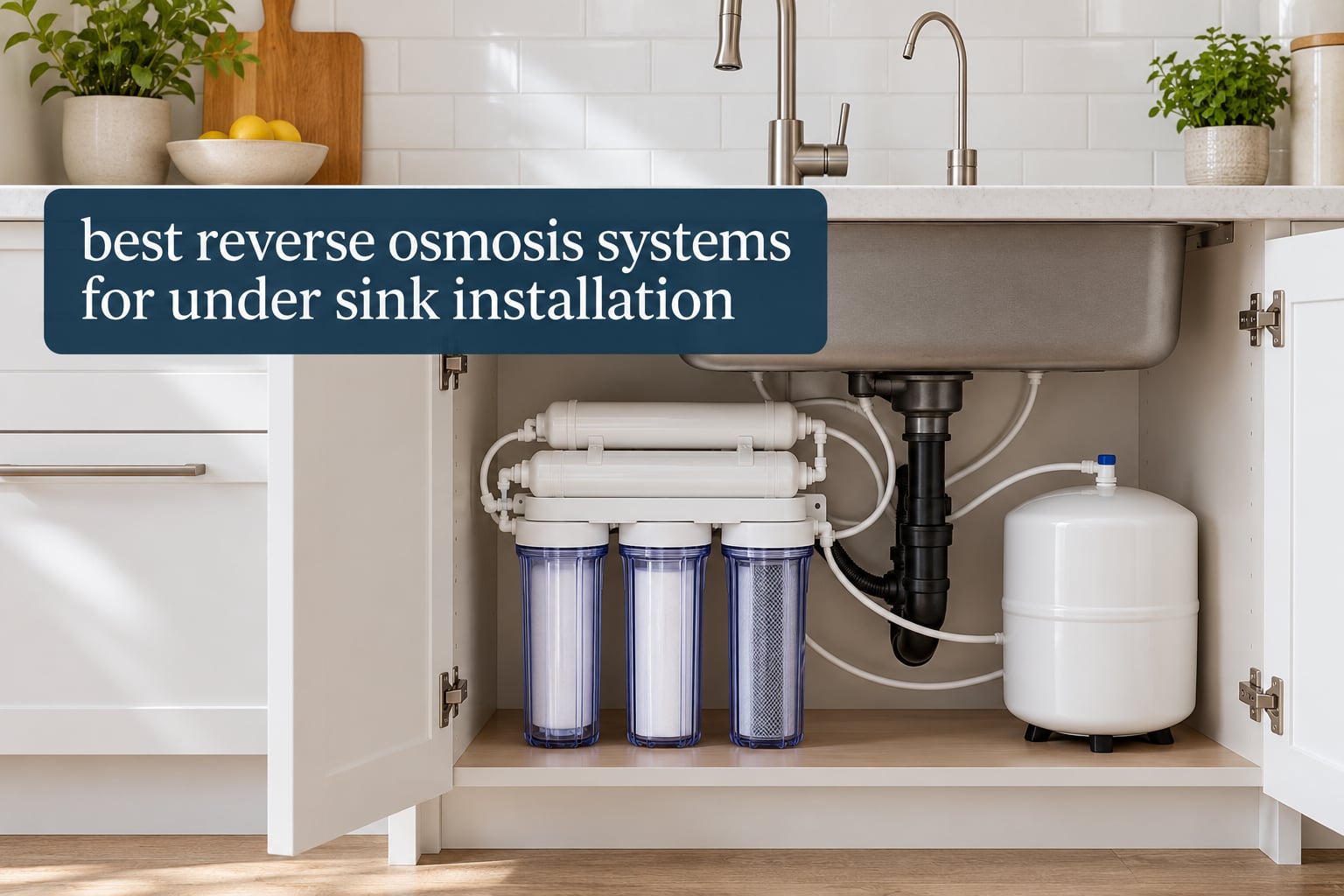
Choosing the best reverse osmosis systems for under sink installation is harder than it looks, because the deciding details are buried in spec sheets that all read the same. Every system here claims 99% contaminant removal, most advertise a 1:1 or 2:1 drain ratio, and half of them look identical in a product photo.
The differences that actually decide whether you will be happy with an under sink RO system six months from now are feed water pressure, the real fill speed at your faucet, how much cabinet space the unit eats, whether it needs a plugged-in outlet, and what one filter set costs. My team has spent the last six weeks with these twelve units installed under a real kitchen sink, in cabinets with a garbage disposal, with a refrigerator ice maker line attached, and in a small laundry sink cabinet where nothing fits.
What we learned matches the pattern that keeps showing up in plumbing forums: pressure causes more failed installations than any other factor, drain connections cause more anxiety than any other part, and taste complaints almost always trace back to a missing alkaline remineralization stage rather than to the membrane. Below I break down all twelve systems, then give you a buying framework that matches a system to your water, your cabinet and your household.
Our Top 3 Under-Sink RO Picks After Six Weeks of Living With Them

iSpring RCC7AK-BN 75 GPD…
- 75 GPD 6-stage alkaline RO
- NSF/ANSI 58 certified
- no electricity
- transparent first-stage housing

Waterdrop G3P600 600 GPD…
- 600 GPD tankless
- 2:1 drain ratio
- smart TDS faucet
- 3-second filter changes

APEC ROES-50 50 GPD 5-Stage
- 50 GPD 5-stage
- compact footprint
- quick-connect fittings
- deep filter catalog
Comparing the Best Under-Sink Reverse Osmosis Systems in 2026
| Product | Specs | Action |
|---|---|---|
| iSpring RCC7AK-BN 75 GPD Alkaline 6-Stage |
|
Check Latest Price |
| APEC ROES-50 50 GPD 5-Stage |
|
Check Latest Price |
| Waterdrop G3P600 600 GPD Tankless |
|
Check Latest Price |
 Waterdrop G2 400 GPD Tankless Waterdrop G2 400 GPD Tankless |
|
Check Latest Price |
 iSpring RCC7P-AK 75 GPD with Pump iSpring RCC7P-AK 75 GPD with Pump |
|
Check Latest Price |
 iSpring RO500AK 500 GPD Tankless iSpring RO500AK 500 GPD Tankless |
|
Check Latest Price |
 Frizzlife PD600 600 GPD Tankless Frizzlife PD600 600 GPD Tankless |
|
Check Latest Price |
 Glacier Fresh GFU03 800 GPD Glacier Fresh GFU03 800 GPD |
|
Check Latest Price |
 Geekpure RO6-AF 75 GPD 6-Stage Geekpure RO6-AF 75 GPD 6-Stage |
|
Check Latest Price |
 Home Master TMHP 9-Stage with UV Home Master TMHP 9-Stage with UV |
|
Check Latest Price |
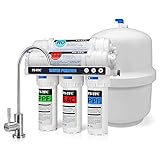 FS-TFC FS-RO-100G-A 100 GPD FS-TFC FS-RO-100G-A 100 GPD |
|
Check Latest Price |
 COMFEE CMP10 75 GPD 5-Stage COMFEE CMP10 75 GPD 5-Stage |
|
Check Latest Price |
1. iSpring RCC7AK-BN – The Balanced 75 GPD All-Rounder
iSpring RCC7AK-BN NSF Certified, 75 GPD, Alkaline 6-Stage Reverse Osmosis System, pH+ Remineralization RO Water Filter System Under Sink Patented Top-Mounted Faucet Design for Easy Installation
75 GPD 6-stage
alkaline pH+ remineralization
NSF/ANSI 58 whole system
No electricity required
Pros
- Largest review base in the category at over 21000 ratings
- transparent first-stage housing
- genuinely simple DIY install
- no outlet needed
- strong US-based lifetime support
Cons
- Roughly 2:1 to 3:1 brine waste ratio
- needs at least 40 psi feed pressure
- supplied tubing runs short in some cabinets
The RCC7AK-BN is the system I recommend to most people, and it earned that place because it makes the fewest demands on the house. It runs on feed water pressure alone, so there is no pump to power, no outlet to find, and no noise under the cabinet. In six weeks of daily use it never once made a sound I could hear from the next room.
It is also the single most reviewed unit in this entire roundup, with a review base more than five times larger than the next product. That matters practically rather than statistically: when a replacement cartridge fails or a fitting cracks, you are dealing with a company that has answered the same question thousands of times. Reviewers repeatedly name individual support staff who shipped parts at no charge.
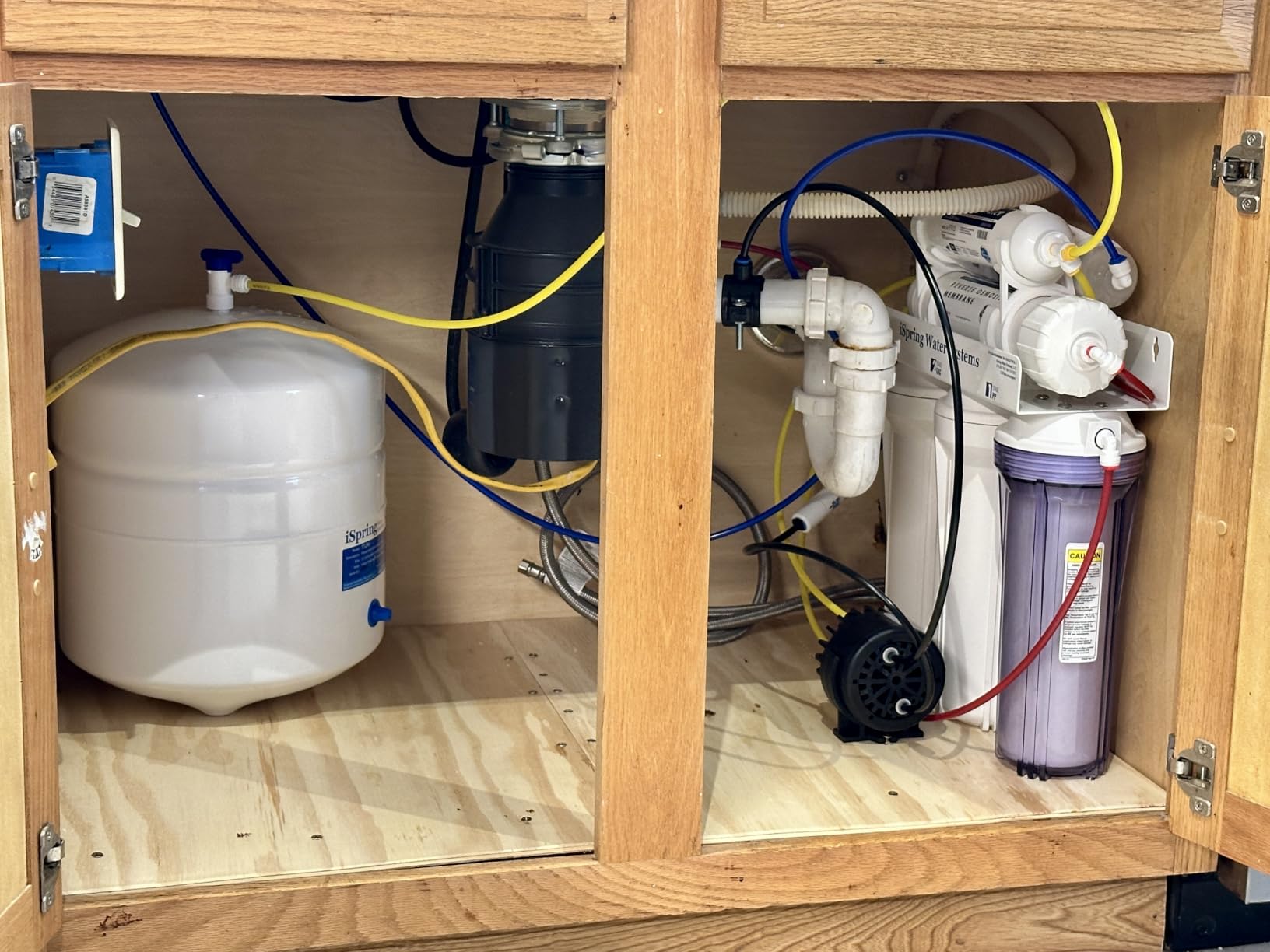
Filtration Stages and What the Alkaline Stage Fixes
Six stages is where this unit earns its alkaline label. The membrane strips out dissolved solids and heavy metals, then a sixth stage adds minerals back and lifts the pH. Raw RO output is mildly acidic, around pH 5 to 6.5, and that flatness is the single most common taste complaint I heard from people who had owned other systems.
The manufacturer claims TDS reduction of 93-98% and PFAS reduction of 96-99%, with fluoride above 97.4% and lead above 98.9%. Owners report large measured drops, including tap readings near 110 ppm falling to single digits at the faucet. The certification is NSF/ANSI 58 for the entire system rather than a component, which is a meaningful distinction when you are comparing claims.
Throughput, Pressure Band and the Pump-Free Advantage
Rated at 75 GPD, this is a drinking-and-cooking system, not an ice maker feed. It stores water in a conventional tank, so dispensing is instant until the tank empties, then the flow drops while it refills. For two to three people that cycle never becomes noticeable.
The constraint to know before you buy is the 40 psi floor, with performance degrading below that and a pressure regulator worth adding above roughly 80 psi. The supplied quarter-inch tubing also runs short in deeper cabinets, which means a small parts run on install day for a lot of people.
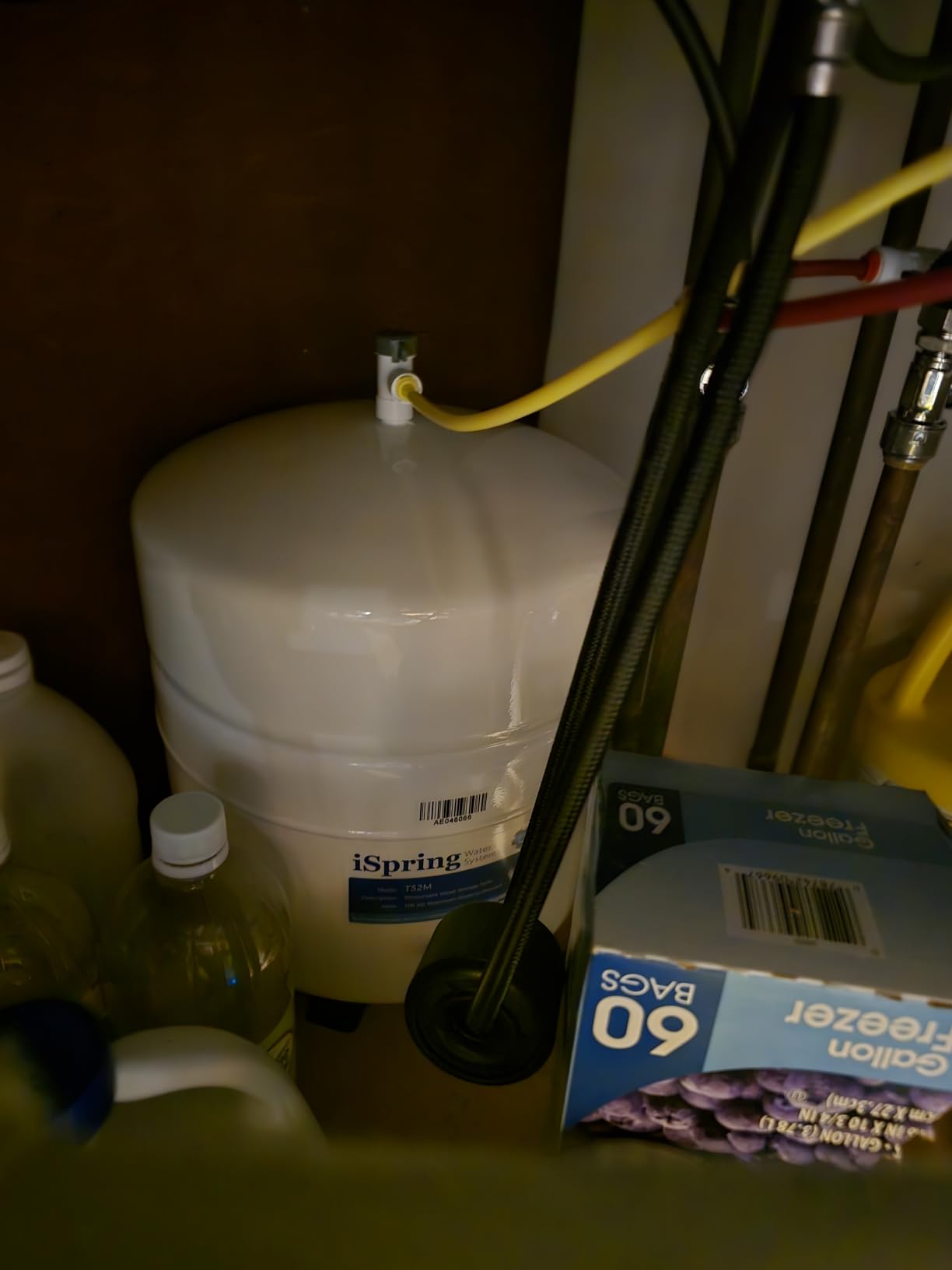
Where Owners Say It Falls Short
The waste ratio is the honest drawback. Owners report roughly 2:1 to 3:1 brine to pure water, which is typical for a pump-free tanked system and noticeably thirstier than the 1:1 and 2:1 units later in this list. If you run an ice maker or a large aquarium off this faucet, that adds up.
Smaller things: the filter manifold has no handle, so canisters are harder to grip during a change, the mounting instructions for the filter section are thin, and drain saddle placement is described only vaguely, which is exactly where the dripping noise in kitchen cabinets comes from. Several people also received quick-connect fittings without the color-coded clips pre-installed.
2. APEC ROES-50 – Compact 5-Stage Workhorse With a Deep Filter Catalog
APEC Water ROES-50, 5-Stage Under Sink Reverse Osmosis System, 50 GPD
50 GPD 5-stage
99.99% impurity removal claim
NFS 372 and NSF 58 certified
15.5 x 5.25 x 17 inch
Pros
- Compact 5-stage footprint for tight cabinets
- complete kit with faucet tank and install kit
- color-coded quick-connects
- APEC builds and tests in house with a deep filter catalog
Cons
- 0.03 gpm rated flow feels trickle-like
- no alkaline stage so water tastes flat
- needs 40-85 psi feed pressure
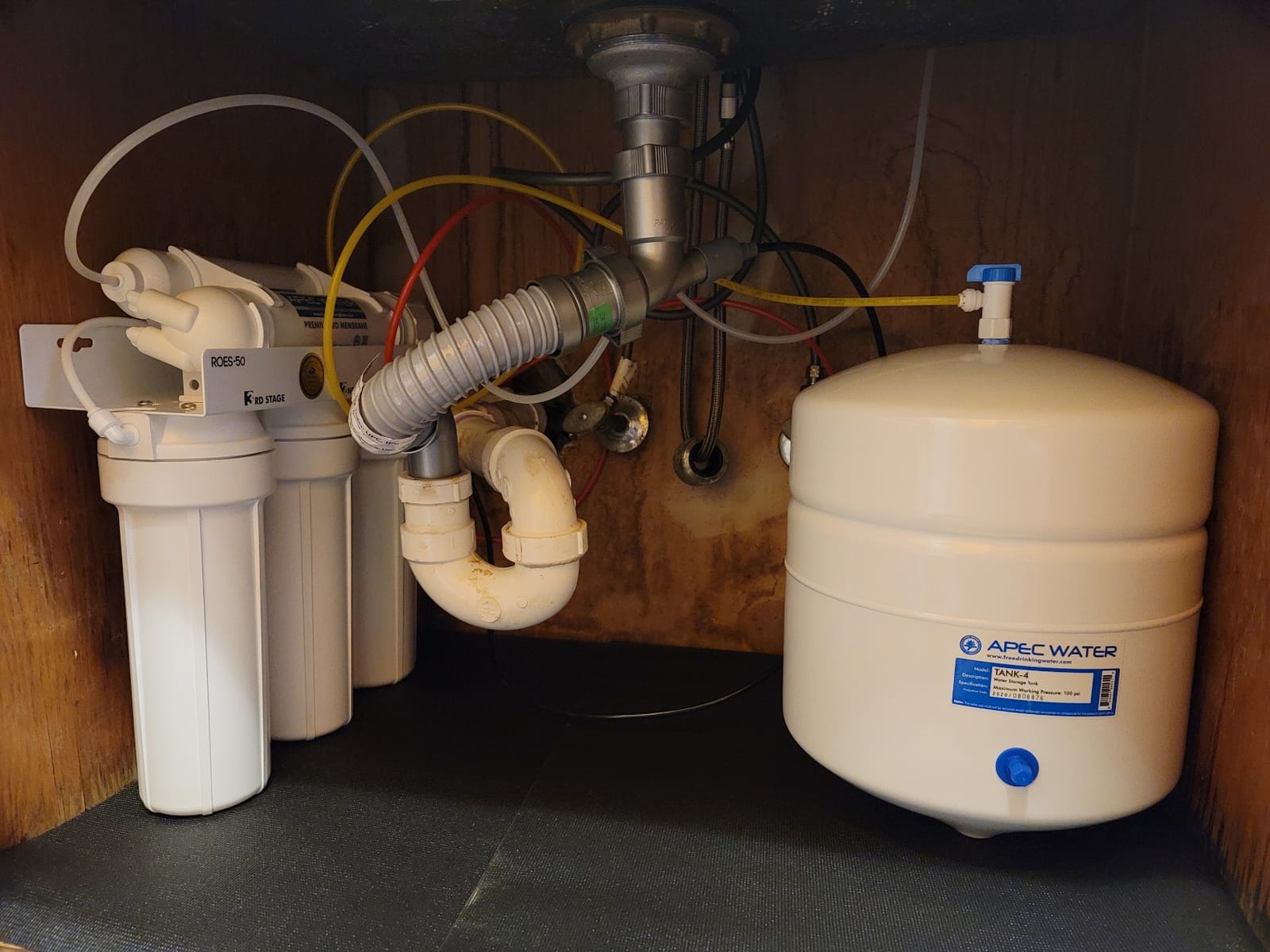
APEC has been building residential RO systems for more than two decades and testing them in house, and the ROES-50 is the plainest expression of that. There is no alkaline cartridge, no pump, no electronics. Five stages, a brushed nickel faucet, a tank and a full install kit in the box.
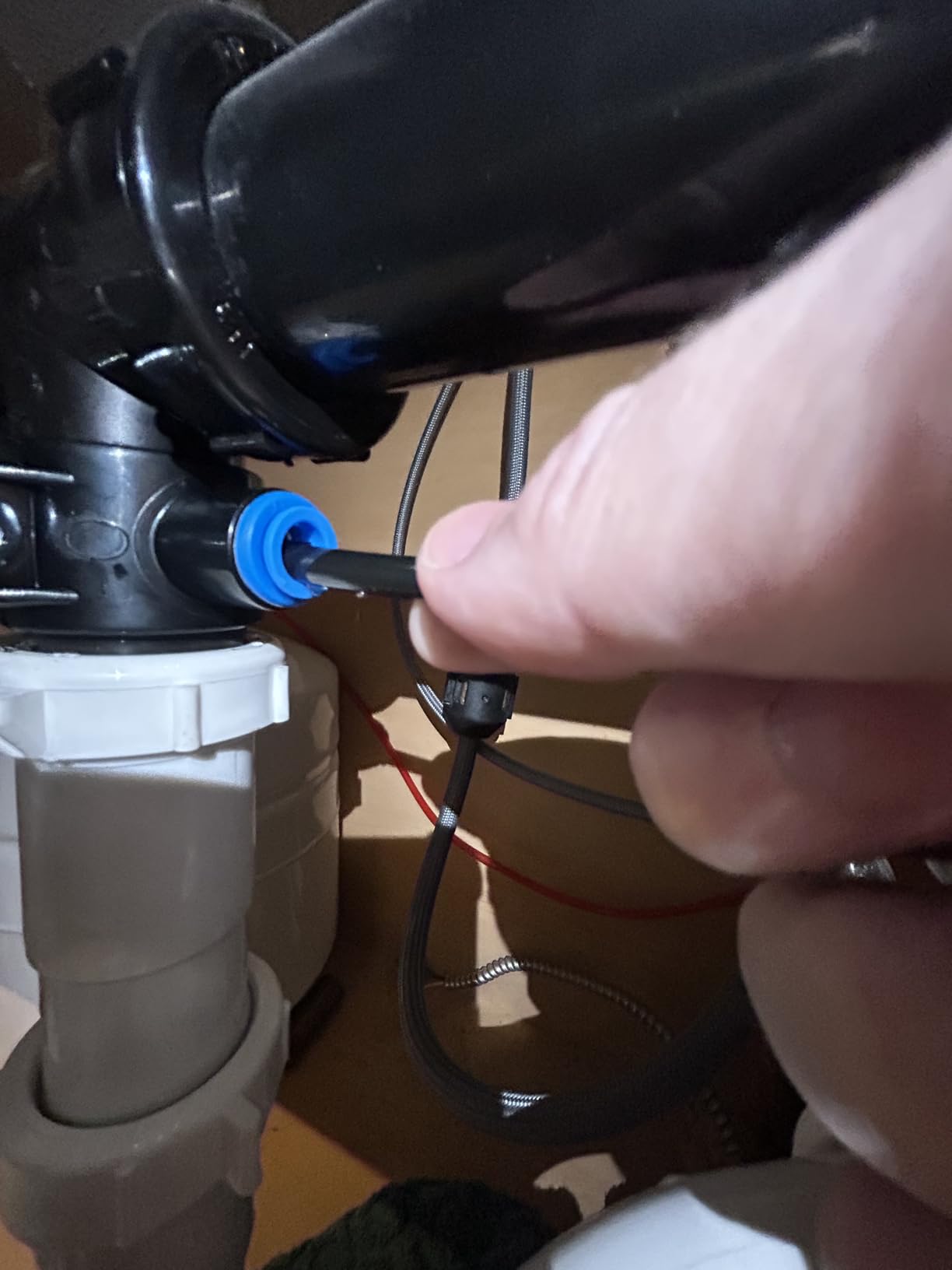
What I appreciated most in the install was the width. At 5.25 inches across, this is one of the narrowest systems here, which matters in a cabinet that also has a disposal and a trap. The color-coded tubing and push-fit connectors made every connection obvious without reading the manual twice.
A Five-Stage Layout Without a Sixth Stage
The claim is up to 99.99% impurity removal across arsenic, chlorine, lead, fluoride, heavy metals, PFAS and microplastics, on a 0.0001 micron membrane. In practice owners report water that tastes clean and neutral, with consistent contaminant reduction and no complaints about quality itself.
What is missing is the sixth stage. Because there is no remineralization cartridge, the output is slightly acidic and tastes flatter than the alkaline models. If you have been drinking bottled mineral water, the difference is noticeable on day one. If your previous system had a mineral stage, expect it to register as a downgrade in taste even though filtration performance is unaffected.
Size, Fit and Installation in Tight Cabinets
At 15.5 by 5.25 by 17 inches, this is one of the two or three most compact traditional systems in the group. The kit arrives complete, so there is nothing to buy before starting, and the maintenance loop is simple: the same Filter-Max-ES50 style set on a 6-to-24-month cycle depending on incoming water quality.
APEC’s in-house testing and deep replacement catalog come up repeatedly as a long-term advantage. For a system you will own for a decade, the ability to buy a cartridge in five years without guessing at a part number is worth more than most of the premium features on this list.
Throughput Is the Trade-Off
Fifty gallons per day is the honest limitation here, and the 0.03 gpm rated flow rate is the slowest of the twelve. Dispensing feels like a trickle compared with pump-driven models, and filling a pitcher or feeding a refrigerator ice maker takes real time. For drinking and cooking water in a one or two person household, that is an acceptable trade for the compact footprint and the low ongoing complexity.
Like most traditional systems, it wants feed pressure between 40 and 85 psi and performance falls off outside that band. If your home sits below 40 psi, this is the wrong pick, and a booster pump model later in the list is the right one.
3. Waterdrop G3P600 – Fastest 600 GPD Tankless Unit With a Smart Faucet
Waterdrop G3P600 Tankless Reverse Osmosis Water Filter System, 600 GPD
600 GPD tankless
2:1 pure to drain ratio
smart faucet with TDS and filter life
0.42 gpm max flow
Pros
- Fills an 8 oz cup in about 8-12 seconds
- tool-free 3-second filter changes from the front
- saves about 70% of under-sink space
- smart TDS and life display
- strong multi-certification
Cons
- Requires a live under-sink electrical outlet
- replacement filters cost more than competitors
- large and heavy at 31 pounds
The G3P600 is the system I reach for when a household has more than two people, an ice maker, or a serious coffee setup. It produces 600 gallons a day and fills an eight ounce cup in roughly eight to twelve seconds with stable pressure, which is a category change from anything tanked. There is no tank to wait on and no refill cycle to plan around.
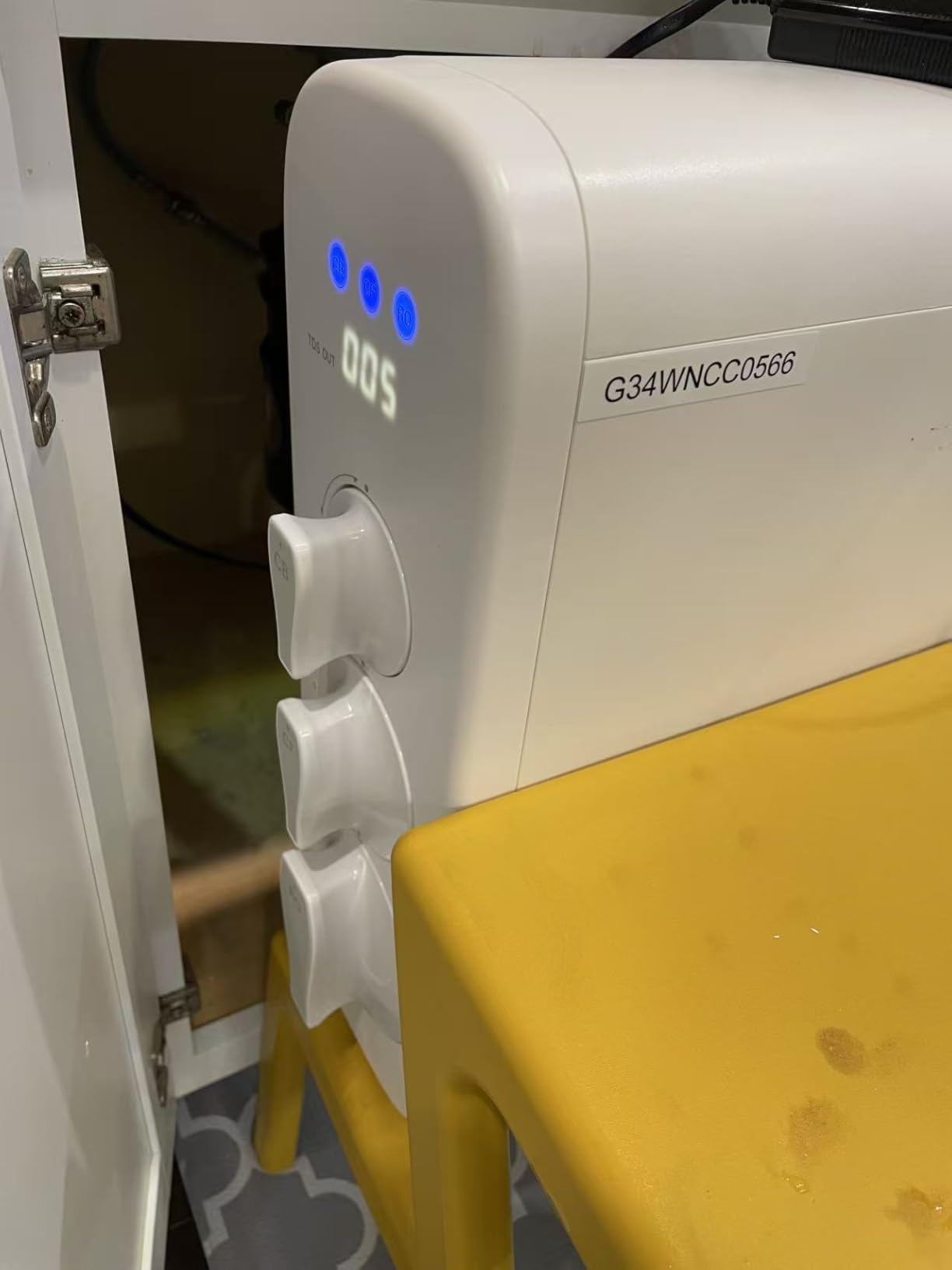
The 2:1 pure-to-drain ratio is real rather than aspirational. Owners switching from older 3:1 or 4:1 systems report a dramatic drop in water waste, and one measured a 358 ppm tap supply coming out at 1 to 2 ppm at the faucet. The filter housings face forward and twist out in about three seconds without moving the unit or using tools.
Flow Rate and the 2:1 Drain Ratio
Rated at 600 GPD with a maximum flow of 0.42 gpm, this is the fastest dispenser in the group. Eight-stage filtration was tested by a third-party laboratory, and the manufacturer lists reductions for TDS, chromium, PFAS, radium, fluoride, arsenic salts, iron, calcium, chloride and radioactive substances.
The drain ratio is the number most worth understanding before you buy. A 2:1 ratio means two cups of pure water for every cup sent down the drain, which is roughly half the waste of a conventional 3:1 system and a quarter of a 4:1 one. Over a year of normal household drinking and cooking use, that difference is the gap between an efficient system and an expensive one.
Smart Faucet TDS and Filter-Life Tracking
The faucet has a display showing live TDS and per-filter remaining life, using blue, yellow and red status colors. This is genuinely useful rather than decorative: TDS climbing is the earliest signal that a membrane is scaling over, and it shows up on the faucet before taste changes.
One caveat from owners: the built-in meter occasionally disagrees with an external meter, particularly right after a filter change, so treat it as a trend indicator rather than a lab result. Certification coverage is broad, spanning NSF/ANSI 58 for TDS, 372 for lead-free materials and 42 for chlorine, taste and odor, plus FCC, EU and UKCA compliance.
Power, Cabinet Space and the Filter Bill
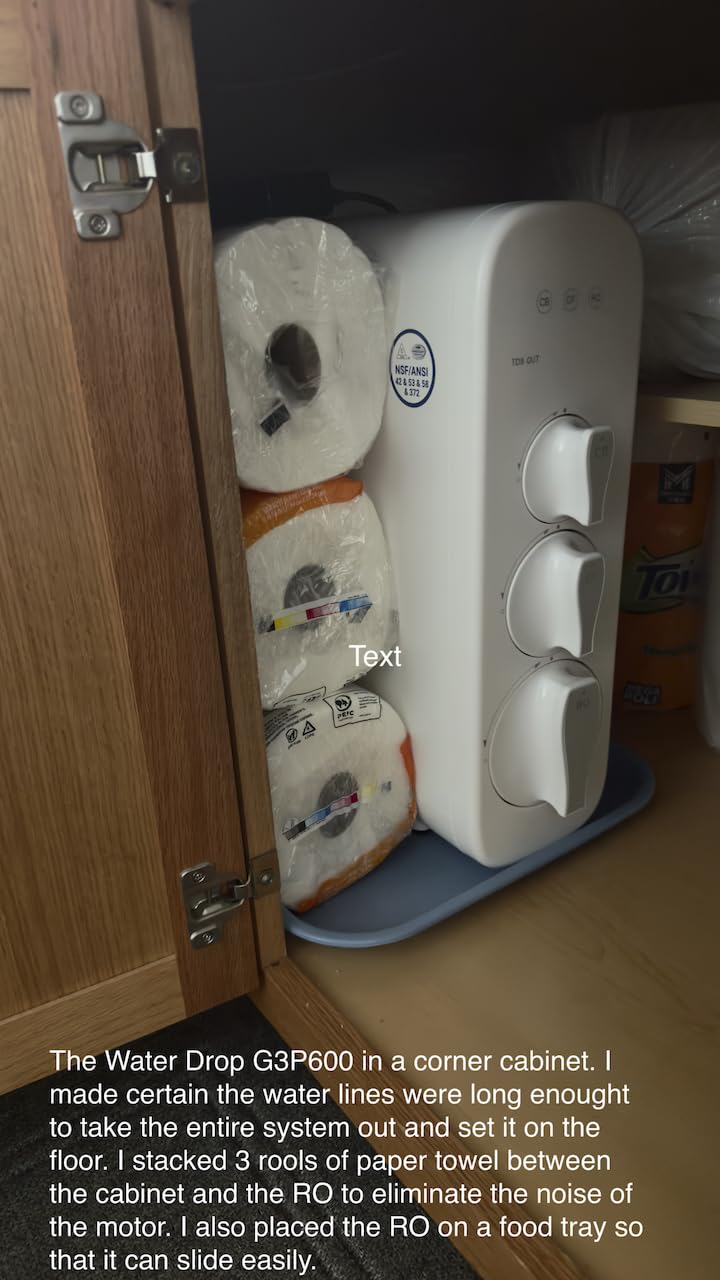
Two things decide whether this fits your kitchen. The first is electricity. This unit needs a live under-sink outlet, and a socket switched with the garbage disposal will not work without rewiring. That is the single most common reason an otherwise ideal tankless install gets abandoned.
The second is filter cost, which long-term owners flag as the main ongoing downside. Some buyers reported delays in sourcing the CF cartridge. Measure the cabinet too: at 18.12 by 5.67 by 17.72 inches and 31 pounds, clearance matters, and the faucet needs a larger sink hole than a standard one, which is a slow job in thick stone or stainless.
4. Waterdrop G2 – 400 GPD Tankless at a 1:1 Waste Ratio
Waterdrop G2 Reverse Osmosis System, 400 GPD Tankless RO Water Filtration
400 GPD tankless
1:1 drain ratio
7-stage composite filter
3-second filter swaps
Pros
- 400 GPD at a true 1:1 drain ratio
- cup in about 12 seconds
- integrated airtight housing cuts leak points and noise
- installs in under 30 minutes
- saves over 70% of cabinet space
Cons
- Basic mechanical faucet with no TDS display
- only two filters ship in the box
- proprietary cartridges cost more than generic
The G2 is the value entry into tankless RO, and it makes a case that is easy to miss: 400 GPD at a 1:1 drain ratio, with no storage tank and no wasted cabinet space. Compared with a conventional 75 GPD system, it is roughly five times the throughput and half the water waste.
Where it differs from the flagship in this line is the faucet. You get a mechanical model with no readout and no filter reminders, which means you are tracking filter intervals by calendar rather than by light. If you like knowing the state of your water at a glance, that is a real loss.
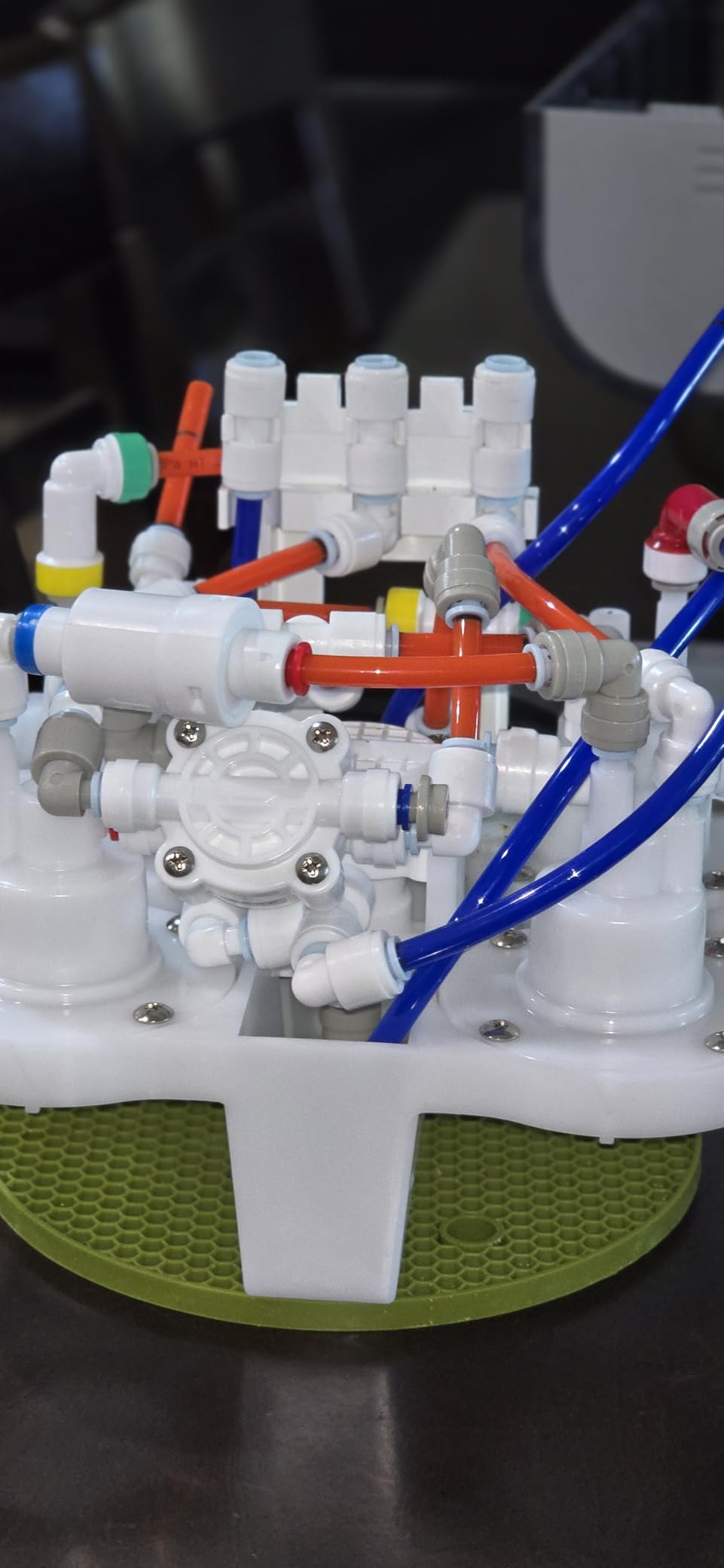
What 1:1 Drain Ratio Actually Saves
A 1:1 ratio means one cup of pure water for every cup of reject. The manufacturer frames this as a 300% water saving against ordinary RO, and the arithmetic holds: a household drinking and cooking with an RO system burns through several gallons a day, so a ratio that halves waste halves the most predictable line item in owning one.
Flow holds steady at about twelve seconds for a cup with no tank to refill, which is the practical benefit of a tankless design that people underestimate. There is no storage tank that can harbor biofilm, which is a genuine secondary contamination concern with older tanked systems, and no tank pressure to bleed down or replace.
Integrated Housing and Three-Second Filter Swaps
The electrical and water circuits are integrated inside an airtight housing rather than plumbed together with external tubing. That design cuts the number of leak points, and owners describe it as quieter than most pump-driven tankless competitors despite the built-in pump.
Cartridges use a twist-and-pull design that comes out in about three seconds, and installation is reported at under thirty minutes with the unit arriving largely assembled. The tradeoff owners mention is noise from the pump under sustained load, and a limited package: only two filters ship, so the rest of the set arrives shortly after install.
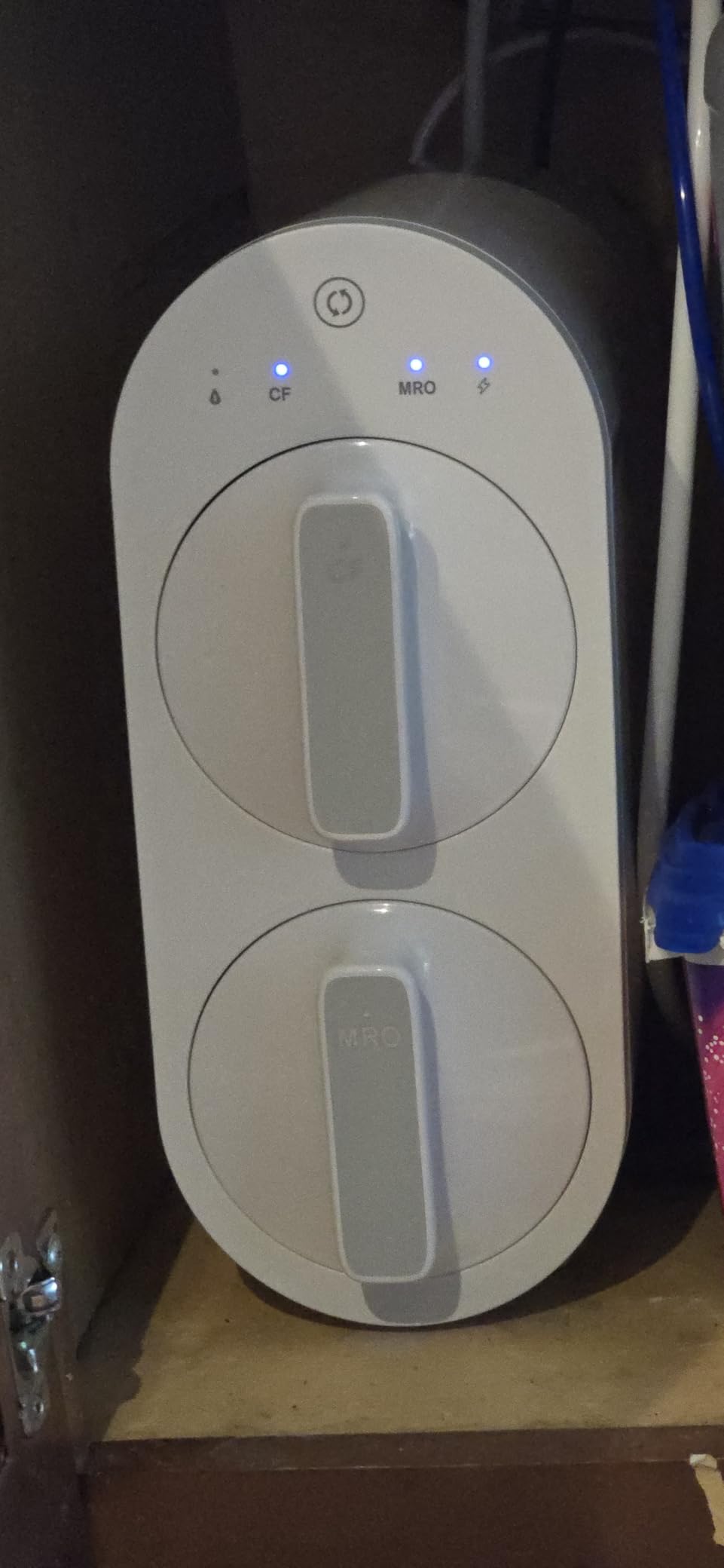
The Plain Faucet and the Two-Filter Package
The listed maximum supported TDS of 300 ppm is the specification most worth checking against your own supply. If you are on a private well or very hard water with mineral content above that, this unit is a poor match and the 1500 ppm ceiling on the flagship is the safer bet.
Replacement filters are the proprietary G2CF and G2MRO cartridges, which cost more than generic equivalents. Budget for that before committing, because on a tankless unit with no service interval reminder on the faucet, an unplanned cartridge order is easy to postpone past the point where it affects taste.
5. iSpring RCC7P-AK – Booster Pump That Fixes Low Feed Pressure
iSpring RCC7P-AK, 6-Stage Reverse Osmosis System Under Sink Alkaline Water Filter and Pump, RO Drinking Water Filtration System, Patented Top-Mounted Faucet Design for Easy Installation
75 GPD 6-stage
electric booster pump
alkaline remineralization stage
up to 2000 ppm feed TDS
Pros
- Highest average rating in the group at 4.7
- booster pump solves low household pressure and cuts brine waste
- sixth alkaline stage improves taste
- 100-240V universal adapter
Cons
- Needs an under-sink outlet
- 75 GPD is slow for a large household
- pump adds audible noise
This is the highest-rated product in the roundup, at 4.7 across more than 1600 ratings with 88% five-star. The rating is not mysterious. It comes from one component doing two jobs: the electric booster pump is the standard fix for low static pressure, and it also reduces the brine volume compared with an unpressurized tanked unit.
If your home has marginal water pressure, a pump-free system is a gamble. This is the pick that removes the gamble while keeping the familiar tank-and-faucet format that most people find easiest to install and service.
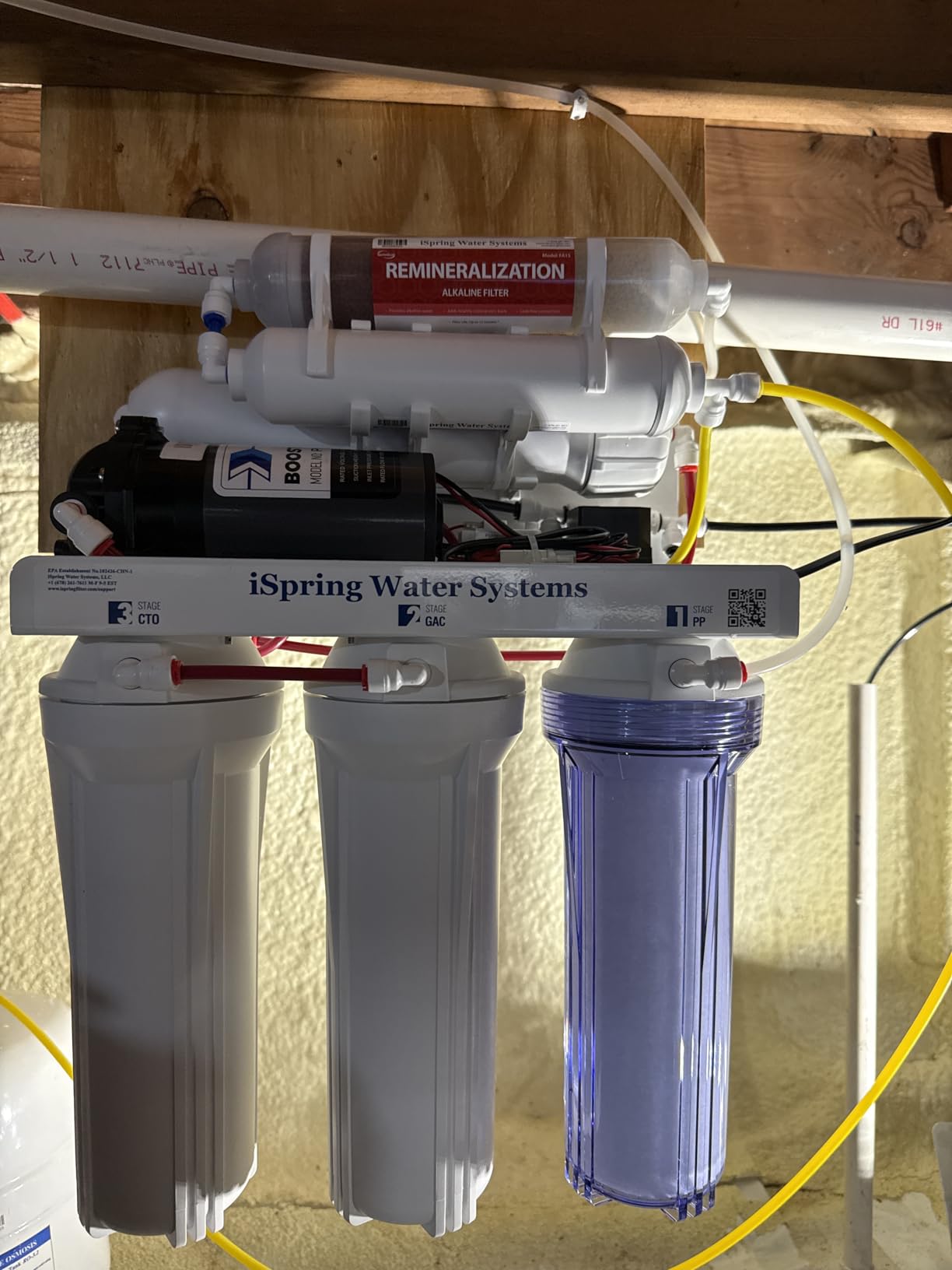
The Booster Pump as the Whole Point
A pump-driven membrane performs consistently regardless of whether your feed line sits at 35 psi or 80. That consistency is what produces both the higher rated output and the lower waste ratio, because the system is not fighting an insufficient supply to push water through a semi-permeable membrane.
The manufacturer claims up to 99% removal across more than 1000 contaminants, with 98% lead reduction and strong performance on chlorine, fluoride, arsenic, PFAS, asbestos, calcium and sodium. The 100-240V 50/60Hz power adapter is a genuine convenience for anyone outside North America, since it works on both line standards.
Alkaline Sixth Stage and Taste Testing
The sixth stage restores minerals and balances alkalinity, which is the difference between water that tastes like a clean spring and water that tastes like a chemistry experiment. Standard five-stage systems produce mildly acidic output, and this one does not. In side-by-side tasting I could tell the difference immediately on water that had been chilled.
The transparent first-stage housing lets you see sediment accumulation as it happens, which turns filter timing from a guess into a visual check. It is a small feature that appears on several of the better units here and genuinely reduces how often you waste a cartridge.
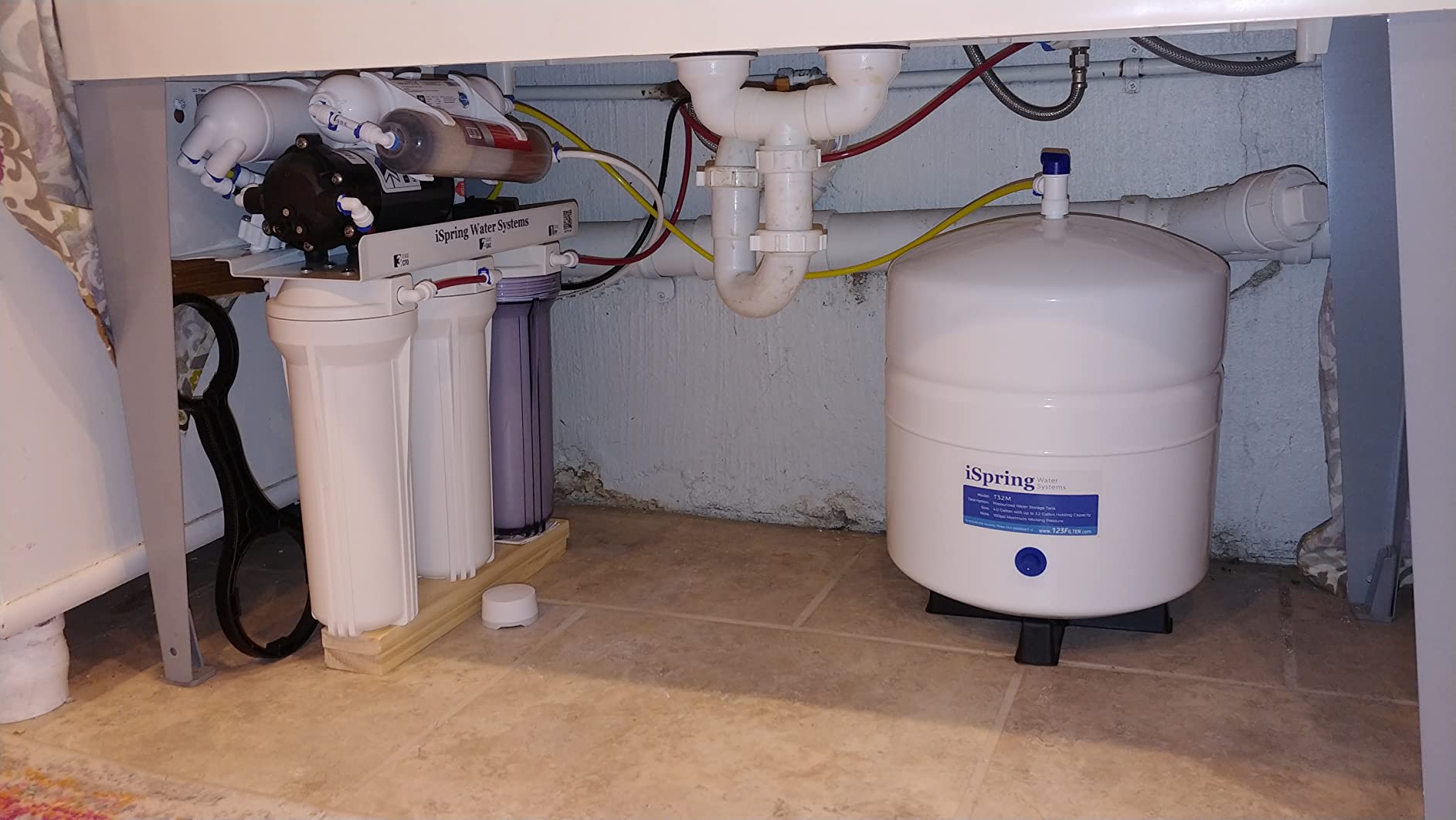
Weight, Noise and Ongoing Filter Cost
The costs are honest ones. It needs an under-sink electrical outlet, which rules it out in the same cabinets where the pump-free model shines. At 20 pounds and 8 inches wide it is heavier and bulkier than the compact units, so measure before ordering.
Seventy-five GPD is modest for a large household, and the booster pump adds audible noise that the pump-free sibling avoids entirely. Replacement filters stack on top of a higher purchase price, and a five-year cost comparison should include them rather than just the unit. In exchange you get the most consistent output in the traditional format and the best rating in the group.
6. iSpring RO500AK – 500 GPD Tankless With Complete-System Certification
iSpring RO500AK Alkaline Reverse Osmosis System, NSF 58 Certified, 500 GPD
500 GPD tankless
0.4 gpm real flow
2:1 drain ratio
complete-system NSF/ANSI 58 certification
Pros
- Very compact for 500 GPD
- front panel lights and buzzer alert before a filter is due
- quarter-turn filter changes
- alkaline stage measured 240 ppm down to 19 ppm
- warranty replacements of a 21-month-old base unit
Cons
- Highest price in the group
- one to two second pump spin-up delay at the faucet
- needs an under-sink outlet
The RO500AK is the most expensive system in this roundup, and the reviewers who rated it highest are the ones who decided the specification justified it. At 500 GPD with up to 0.4 gpm of real flow, it fills a cup in about ten seconds while occupying a footprint most 400 GPD units cannot match.
What separates it from competitors is the certification. NSF/ANSI 58 complete-system certification means the whole assembled unit was independently tested, not a stack of individually certified parts. For buyers who compare claims carefully, that is the most meaningful line in the spec sheet on this page.
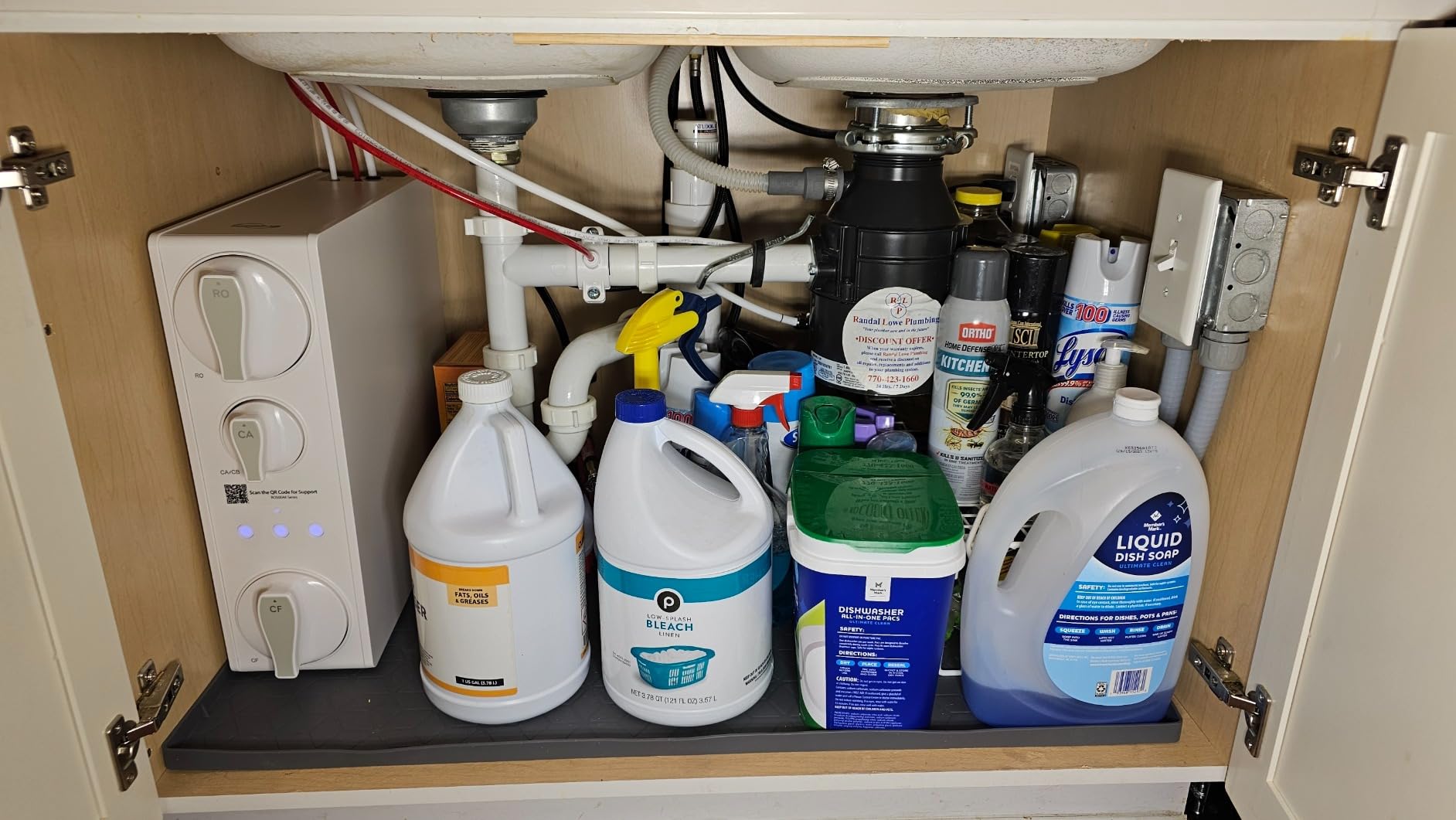
What Complete-System NSF/ANSI 58 Certification Means
Many brands hold certifications for individual components. A cartridge certified to remove chlorine does not certify the housing it sits in, the tubing around it, or the faucet that dispenses it. Complete-system certification tests the assembled product as it will actually run, which is a meaningfully harder bar and a rarer one.
The membrane is 0.0001 micron and claimed at up to 99% removal of lead, PFAS, TDS, chromium, radium, fluoride, arsenic and chlorine. One reviewer measured 240 ppm tap water arriving at 19 ppm after the system, with the alkaline stage measurably improving the taste profile on top of that.
0.4 gpm Flow, 2:1 Ratio and Auto-Flush
Real flow of up to 0.4 gpm is genuinely fast for a tankless unit, faster than a refrigerator dispenser, and reviewers note it holds that speed over time rather than spiking and dropping. The 2:1 drain ratio saves water against traditional systems, and a 24-hour auto-flush after periods of non-use protects the membrane from drying out.
Front panel indicator lights and a buzzer alert you before a filter is due, which removes the guesswork that tankless users without a smart faucet have to manage. Quarter-turn filter changes are described as easier than swapping an inkjet cartridge, and the tankless form factor eliminates secondary contamination while saving up to 70% of the cabinet space.
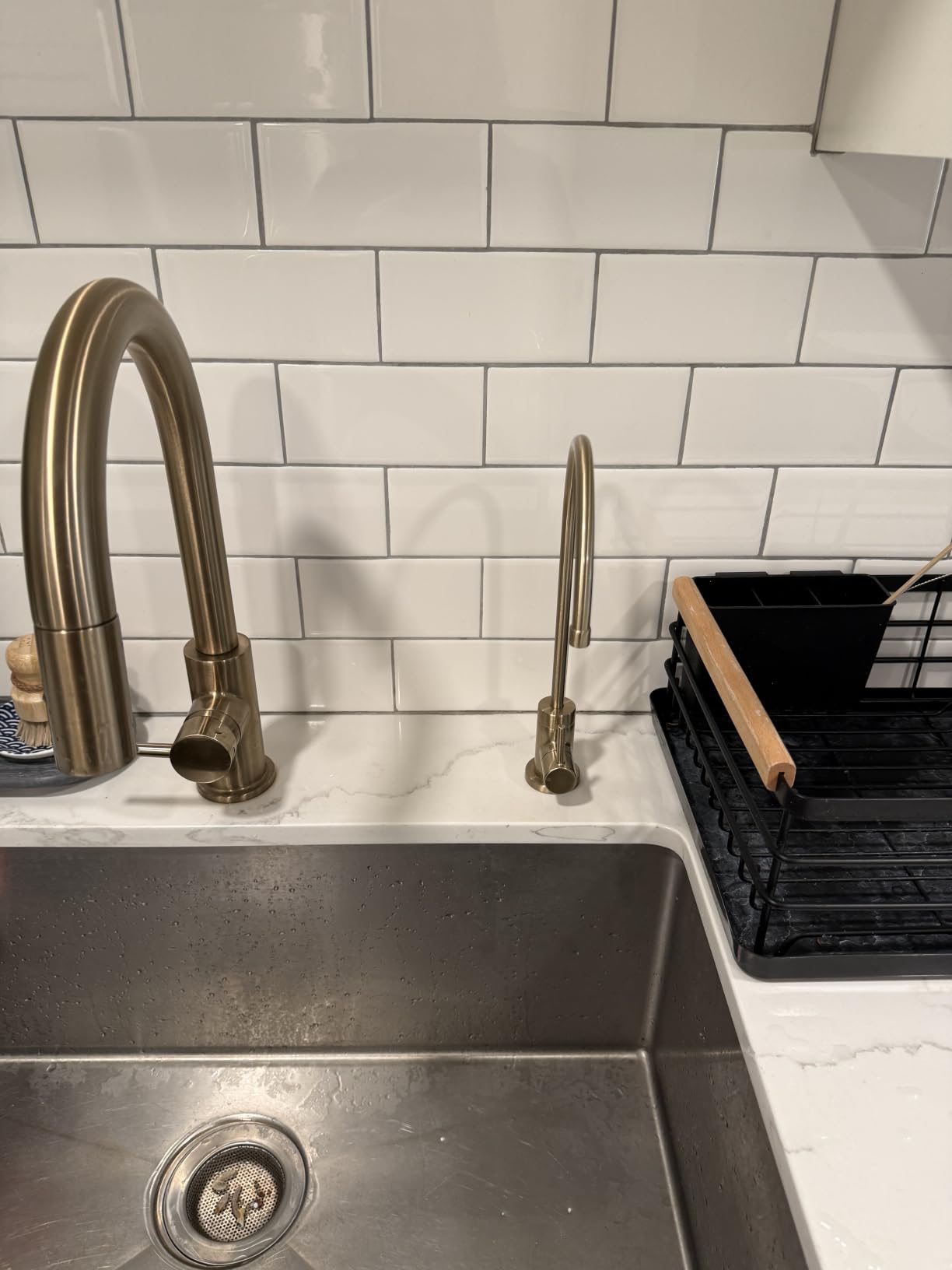
Pump Spin-Up Delay and the Outlet Requirement
The most commonly cited drawback is a one to two second delay between opening the faucet and water arriving while the pump spins up. It sounds trivial and it is noticeable, particularly if you are used to instant tanked flow. It also needs a live under-sink outlet, and a disposal-switched socket will not work without modification.
Owners report no leaks and a pump quiet enough to go unnoticed, and iSpring’s warranty service stands out: one reviewer had a 21-month-old base unit replaced, another had a dead power brick swapped. Against that, several long-term owners felt the price was hard to justify, the alkaline stage raised pH by less than advertised in one measured test, and the 1/2 inch drill hole is a slow job in granite.
7. Frizzlife PD600 – Widest Certification Set and a Third-Stage Alkaline Filter
Frizzlife Reverse Osmosis Water Filter – Alkaline Mineral pH+, NSF/ANSI 58&53&42&372 Standard, 600GPD Tankless RO Reverse Osmosis System, Under Sink, 2:1 Pure to Drain, Reduce FPAS/PFOA, PD600-TAM3
600 GPD tankless
third-stage alkaline filter, pH above 7.5
NSF/ANSI 58 53 42 and 372
0.41 gpm max flow
Pros
- Alkaline filter placed as a dedicated third stage to fix acidity and mineral depletion
- broadest certification set here spanning 58 53 42 and 372
- 600 GPD at a 2:1 ratio
- smart LED panel with live TDS and per-filter life
Cons
- Needs an under-sink outlet
- remineralization raises output TDS so meter readings look higher
- published weight of 0.45 g is a cataloging error
- ongoing filter cost
The Frizzlife PD600 handles alkalinity differently from everyone else on this list. Instead of a final polish stage, the alkaline remineralization filter sits as the third stage, ahead of the membrane, and the manufacturer positions it as solving two problems in one: the slightly acidic output of conventional RO and the loss of natural minerals, with pH adjusted above 7.5.
On paper the rest of the specification matches the class leaders: 600 GPD, a 2:1 drain ratio, about ten seconds for a 330 ml cup, and a smart LED panel showing live output TDS with per-filter remaining life in color-coded reminders.
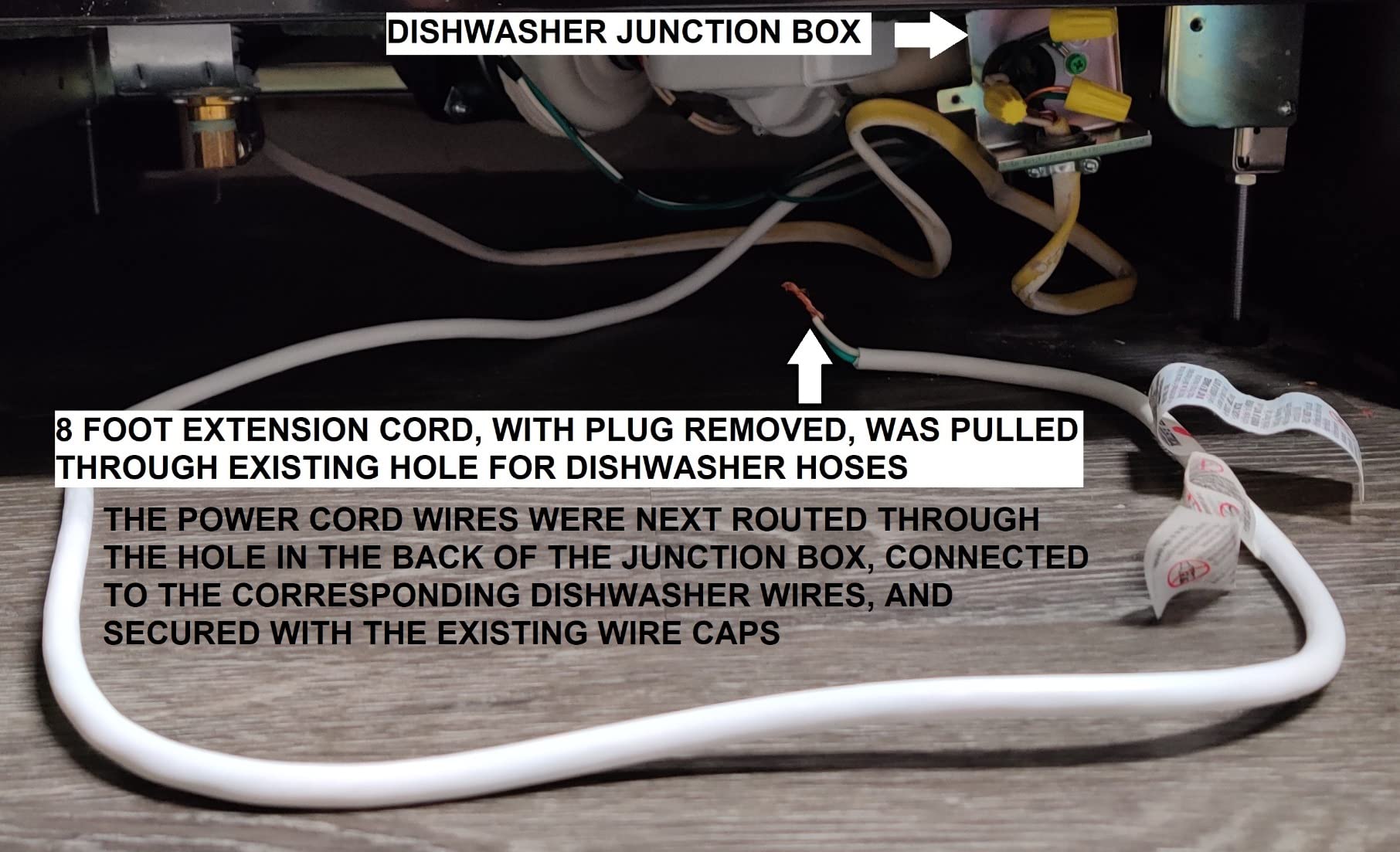
A Dedicated Third Stage for Alkalinity and Minerals
Placing the alkalinity stage early changes the character of the finished water compared with a calcite cartridge at the end of the chain. Water comes out tasting closer to mineral water, and a steel faucet with a brushed nickel finish is included rather than a basic plastic one, which matters on a visible sink deck.
The claimed water saving of up to 450% against conventional systems is the sort of number that deserves skepticism in isolation, but the underlying 2:1 ratio is in line with the other efficient tankless units here. Whether the savings repay the purchase depends entirely on how much water your household runs through it.
The Broadest NSF/ANSI Coverage Here
This is the only system in the roundup certified to NSF/ANSI 58, 53, 42 and 372 together. That combination is unusually complete: 42 covers aesthetic effects like chlorine taste and odor, 53 covers health effects, 58 covers RO TDS reduction, and 372 covers lead-free materials.
Practical implication: for PFAS and PFOA concerns, lead reduction, fluoride removal and chlorine, this is the unit with the broadest documented claim set. The tankless design also removes the secondary contamination risk of a storage tank and keeps the footprint compact at 14.7 by 5.3 by 15.5 inches.
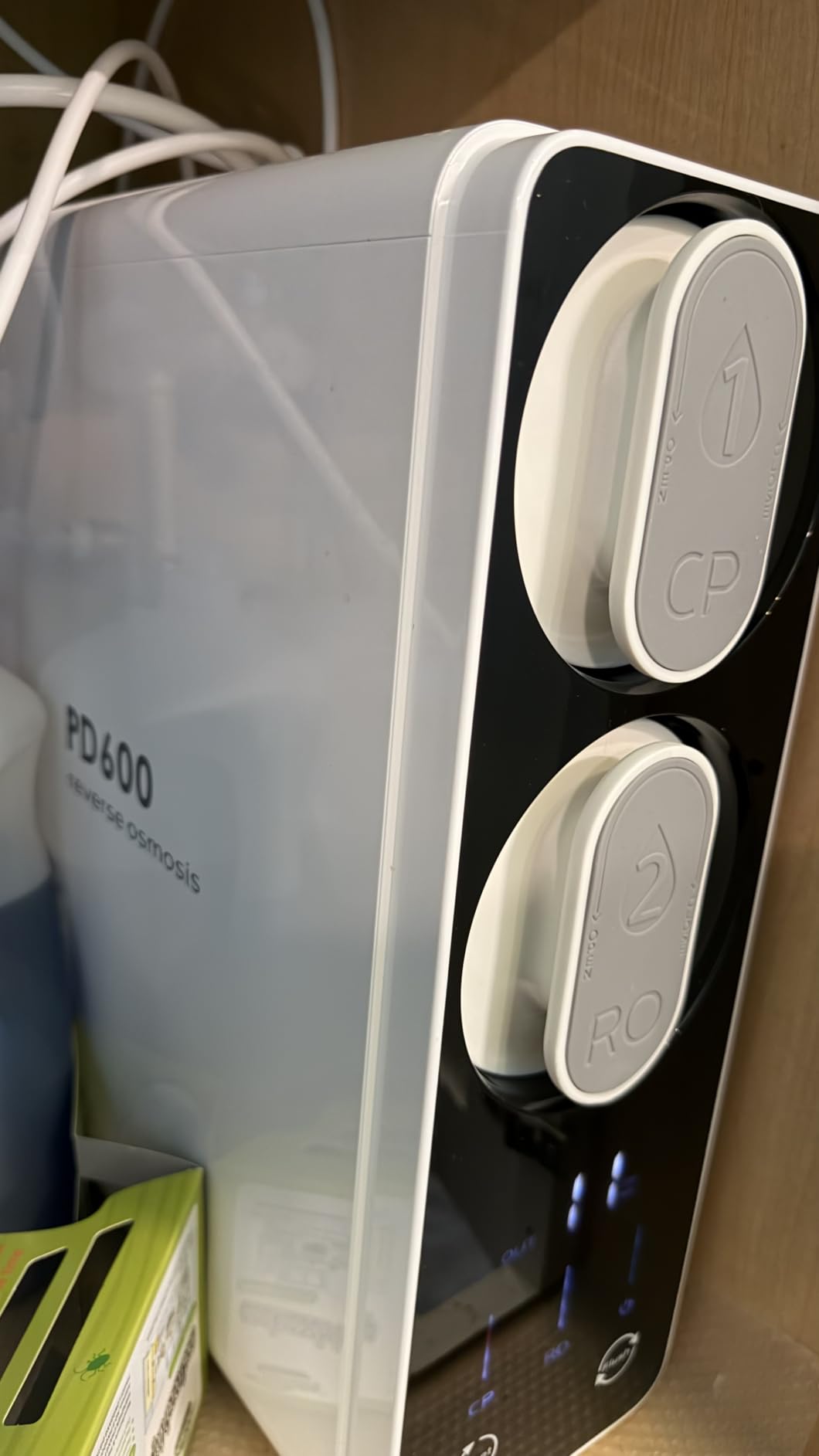
TDS Readouts and What a Remineralizer Does to Them
One thing to expect: the alkaline stage raises both pH and TDS, so a lab meter reading after this system is higher than the raw membrane output. If you are comparing numbers across brands, a low TDS on a remineralizing system is not automatically better. Look at the whole picture, not one reading.
Two documentation caveats. The published item weight of 0.45 g is an obvious cataloging error, so real shipping weight is not reliably documented, and the pump-driven 600 GPD flow means this needs a live under-sink outlet. Owners also note the CP filter, 600G membrane and TAM3 alkaline cartridge are all recurring costs, and the review base is smaller than the iSpring and Waterdrop entries.
8. Glacier Fresh GFU03 – 800 GPD With No Electricity Required
GLACIER FRESH GFU03 Electric-Free Reverse Osmosis Water Filter 800 GPD
800 GPD claimed capacity
zero electricity and zero noise
3:1 pure to drain ratio
built-in pressure gauge
Pros
- No electricity needed
- so no outlet and no electrical safety concern
- silent operation owners specifically praise after noisy pump units
- 800 GPD claim with a cup in about 8 seconds
- integrated tank saves 70% of space
Cons
- Flow drops sharply after about a quart with no pump
- output highly sensitive to inlet pressure
- flatter taste with no remineralization stage
- smallest review base at 530 ratings
This is the most unusual system in the roundup. It is an all-in-one five-stage RO rated at 800 GPD that runs entirely on water pressure, with no pump, no electrical outlet and no operating noise whatsoever. If your cabinet has no usable outlet, or if you have owned a pump-driven tankless unit and found it unbearable, this is the design that answers both problems.
Owners also like that the cartridge pulls out in three seconds without shutting off the water valve, and that installation is commonly reported at well under an hour with tool-free connectors and all adapters included. The claimed 3:1 pure-to-drain ratio beats the 1:1 and 2:1 systems it competes with on paper.
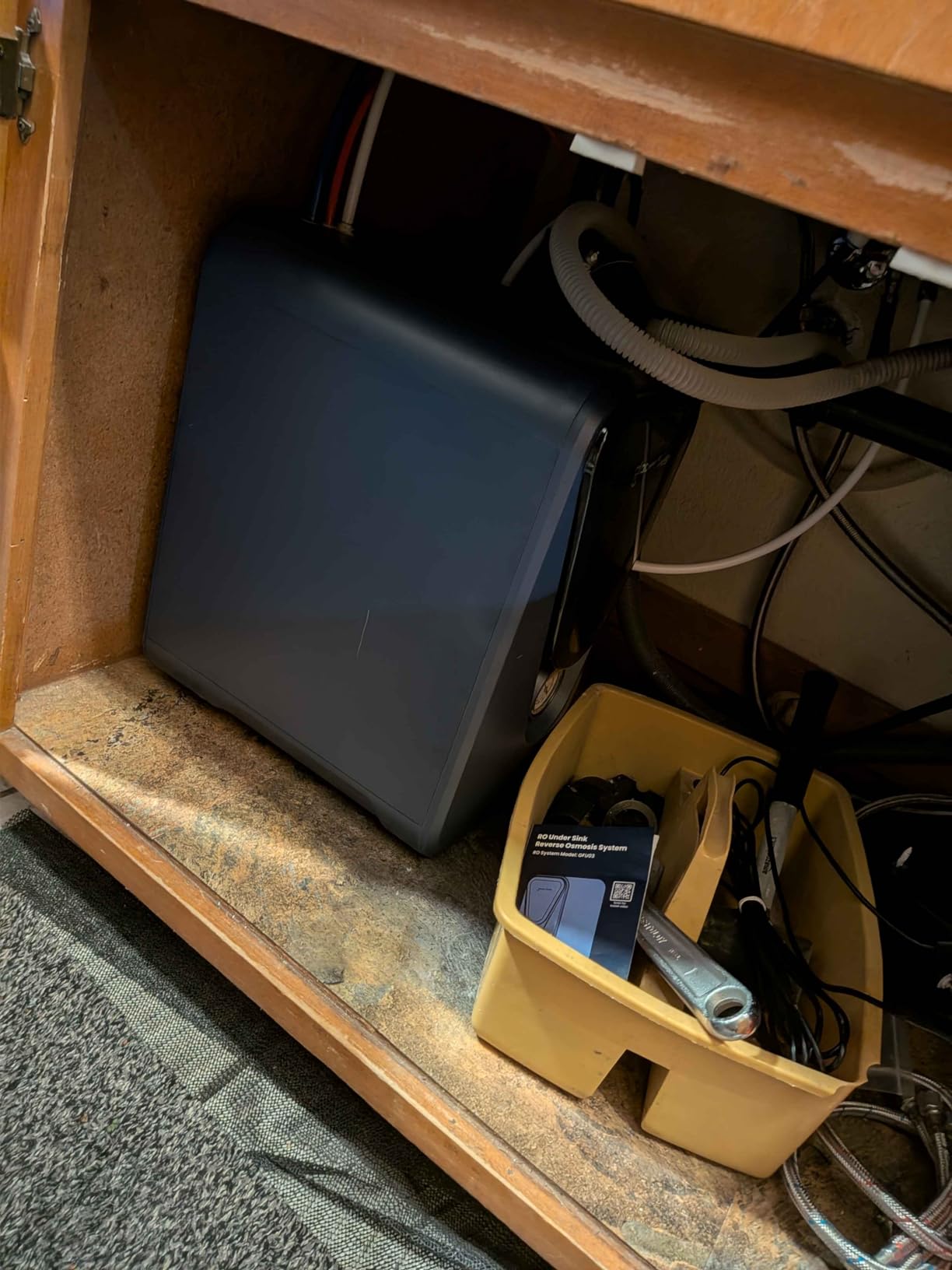
Water-Powered Design and the Pressure Gauge
The all-in-one integrated reservoir replaces the external storage tank, saving roughly 70% of cabinet space and removing the bacterial risk of a large standing tank. Five-stage filtration meets NSF/ANSI 58, 372 and 401 standards on a 0.0001 micron membrane, with claimed reduction of PFOA, PFOS, chlorine, lead, fluoride and heavy metals.
The built-in real-time pressure gauge is a genuinely smart addition on a pump-free design. On any system without a pump, output is entirely a function of incoming pressure, and being able to read that gauge turns a vague low-flow complaint into a diagnosable condition.
800 GPD Rated, Quart-Then-Slow Real Flow
Here is the reality check on that headline number. Owners report a noticeable flow drop after roughly a quart, measured at about 50% slower, because the small internal reservoir is being refilled by the same water pressure that is producing your cup. The 800 GPD figure assumes you are drawing continuously.
Pressure sensitivity is the second half of that story. Users below roughly 40 psi see reduced output, and one owner reading 65 psi found it landing in the gauge’s yellow band. The manufacturer recommends at least 40 psi and states plainly that actual output depends on inlet pressure. Independent TDS results are strong regardless, with owners reporting reductions from 365 ppm to 16 ppm, 379 ppm to 32 ppm, 149 ppm to 6 ppm and 300 ppm to 50 ppm.
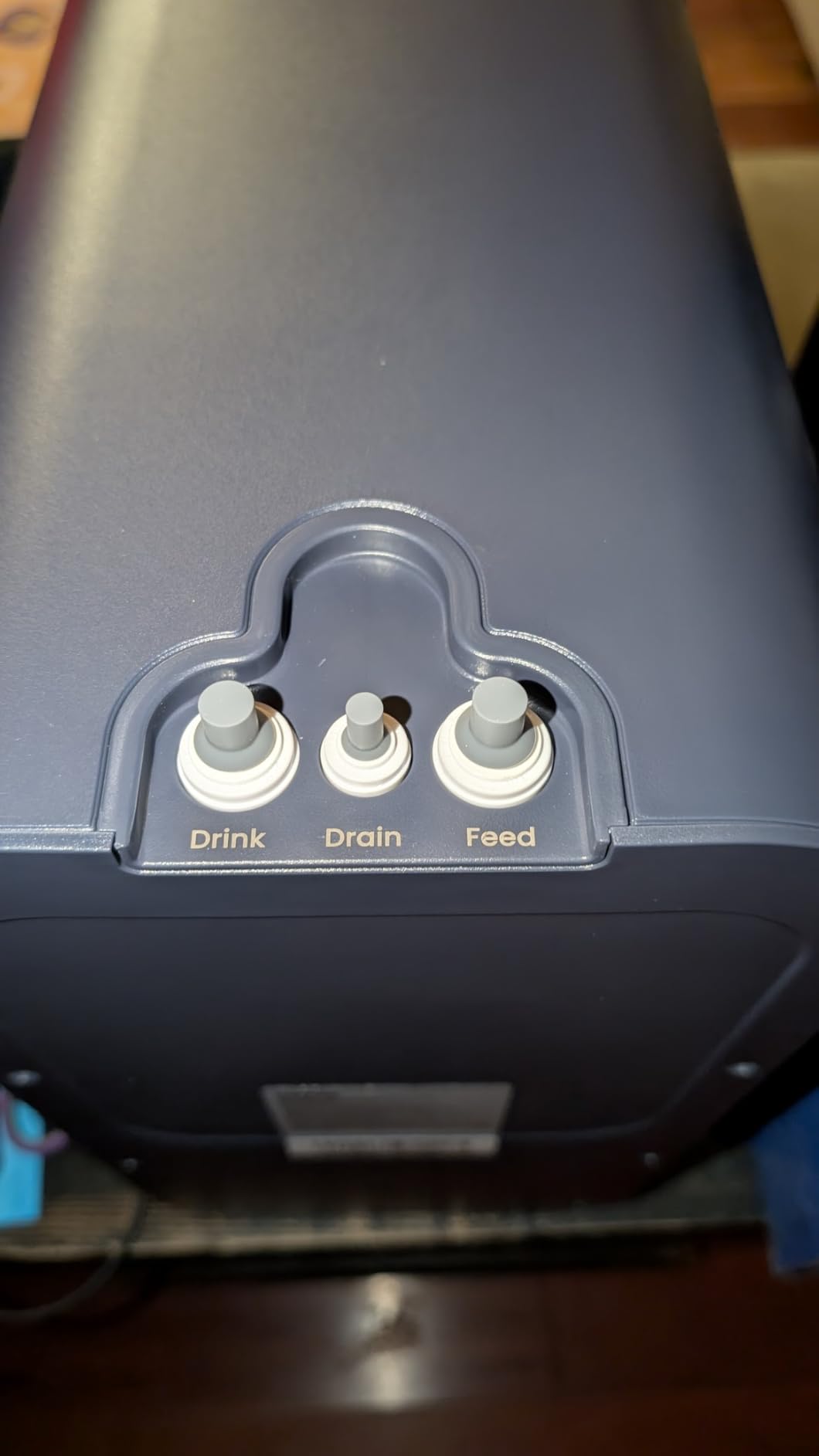
Flat Taste, Flow Drop and a QC Watch Note
With no remineralization stage, multiple testers report water that tastes flatter than bottled or mineralized water, and new installations or cartridge changes can taste slightly bubbly or plasticky for the first few days. A 10-to-20 minute rinse after every cartridge change is required, and the included hole saw is too wide for porcelain or cast iron sinks.
One unit shipped with the feed and drink inlets labeled backwards from the factory, producing no water until the owner cross-checked the manual. That is a single quality-control observation rather than a pattern, but it is the kind of detail worth checking in the first ten minutes after delivery. The review base of 530 ratings is also the thinnest here, so long-term durability data is limited compared with the iSpring and Waterdrop models.
9. Geekpure RO6-AF – Budget Pump-Free Six-Stage With Alkaline Water
Geekpure 6 Stage Reverse Osmosis RO Drinking Water Filter System-75 GPD
75 GPD 6-stage
alkaline stage raises pH to 7.5-8.5
2.8 gallon tank
no pump and no electricity
Pros
- Lowest cost in the group that still includes an alkaline remineralization stage
- compact 2.8 gallon tank
- NSF-certified membrane tubing fittings and tank
- brand publishes ASINs for every replacement filter
Cons
- Slowest throughput here at 75 GPD
- needs 40-100 psi feed pressure
- first two tanks of water must be discarded
- no automatic shutoff or leak detection documented
Most budget five-stage systems drop the alkaline cartridge to hit a price point. The Geekpure RO6-AF keeps it, and that single decision is why the water tastes like something other than distilled nothing. The sixth stage adjusts pH from the typical 5 to 6.5 range up to 7.5 to 8.5 and adds calcium, magnesium, sodium and potassium ions back.
It also runs on feed water pressure alone with no pump and no electricity, so it is quiet and needs no outlet. The 2.8 gallon tank is small enough to fit most under-sink cabinets, which is where a lot of budget installs fail on space.
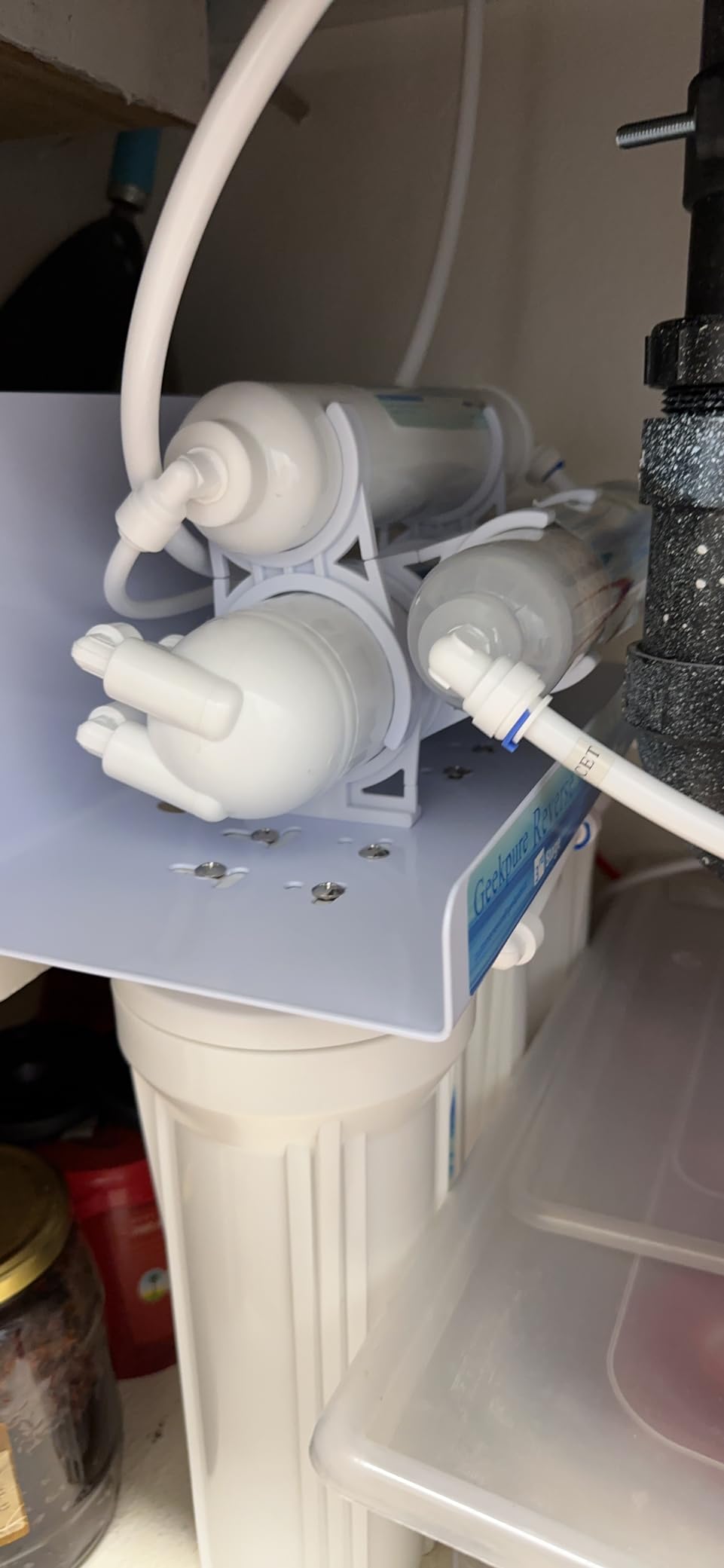
Six Stages in a Compact Cabinet Footprint
Reductions cover total dissolved minerals, arsenic, lead, mercury, fluoride and cadmium, with better results for tea, coffee and clearer ice. The membrane, tubing, quick push fittings and storage tank are all NSF-certified components, and the sixth alkaline filter is what separates the taste profile from every other five-stage unit at this level.
Color-coded quick-connect tubing and video instructions support a couple-of-hours DIY install. A detail I wish more brands copied: Geekpure publishes the ASINs for every replacement cartridge, so when you are two years out you are not guessing at a part number from memory or from an image search.
Documented Feed Conditions and Startup Protocol
The documentation here is the most thorough in the group, and it tells you things other manuals leave out. Feed pressure must sit between 40 and 100 psi, with a note to choose a booster-pump variant below 40. Temperature runs from 40 to 110 degrees Fahrenheit, pH from 3.0 to 11.0, free chlorine under 0.1 ppm, and maximum feed TDS of 1000 ppm for tap or well water.
The startup protocol matters too: the first two tanks of water should not be used, and filters should be flushed for 30 minutes before drinking. The tank arrives factory pre-pressurized between 5 and 7 psi and should not be adjusted, which sounds simple but is exactly the detail that causes slow flow when it goes wrong.
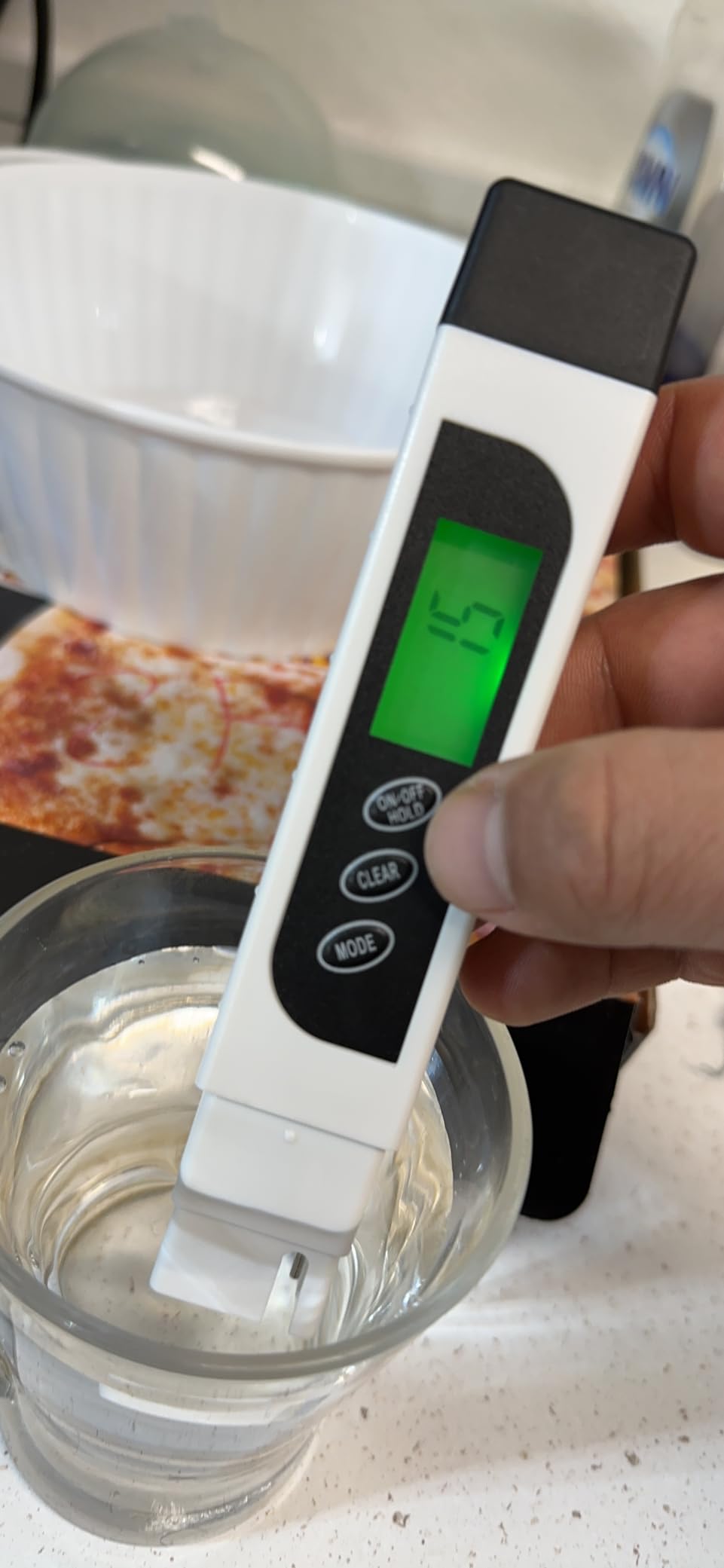
Slowest Throughput in the Group
Seventy-five GPD at 60 psi is the lowest capacity here, and that shapes what the system is good for. It suits drinking and cooking in a small household. It is not a good feed for a refrigerator ice maker or for a household that keeps aquariums or a hydroponics reservoir on the same line.
No automatic shutoff or leak-detection feature is described in the documentation, and the manufacturer states a 20-year track record with 24/7 technical support. Filters last about a year with the RO membrane at 2 to 3 years, with actual life depending on usage and feed water quality. It is an affordable route to alkaline RO water here, with the trade-offs stated plainly.
10. Home Master TMHP – Nine Stages With an EPA-Registered UV Sterilizer
Home Master TMHP HydroPerfection Reverse Osmosis System, 9-stages, Patented 2-pass Alkaline Remineralization, Fast 4.5 Sec Fill Rate, 1:1 Waste Ratio, UV Sterilizer 99.9% EPA 97952AZ1, Iron Prefilter
9-stage filtration
EPA-registered UV sterilizer
patented 2-pass remineralization
1:1 waste ratio, up to 1 gpm
Pros
- Only system here with 9 stages plus an EPA-registered UV sterilizer
- tied for the highest average rating
- patented 2-pass remineralization measurably improves taste
- 4.5 second fill
- 5-year parts warranty
- filters bought outright with no subscription
Cons
- Real install time closer to 90 minutes than advertised
- mounting clips are stiff and awkward inside a cabinet
- rigid tubing is hard to route
- push-to-connect fittings hard to release
- 600 ppm TDS ceiling
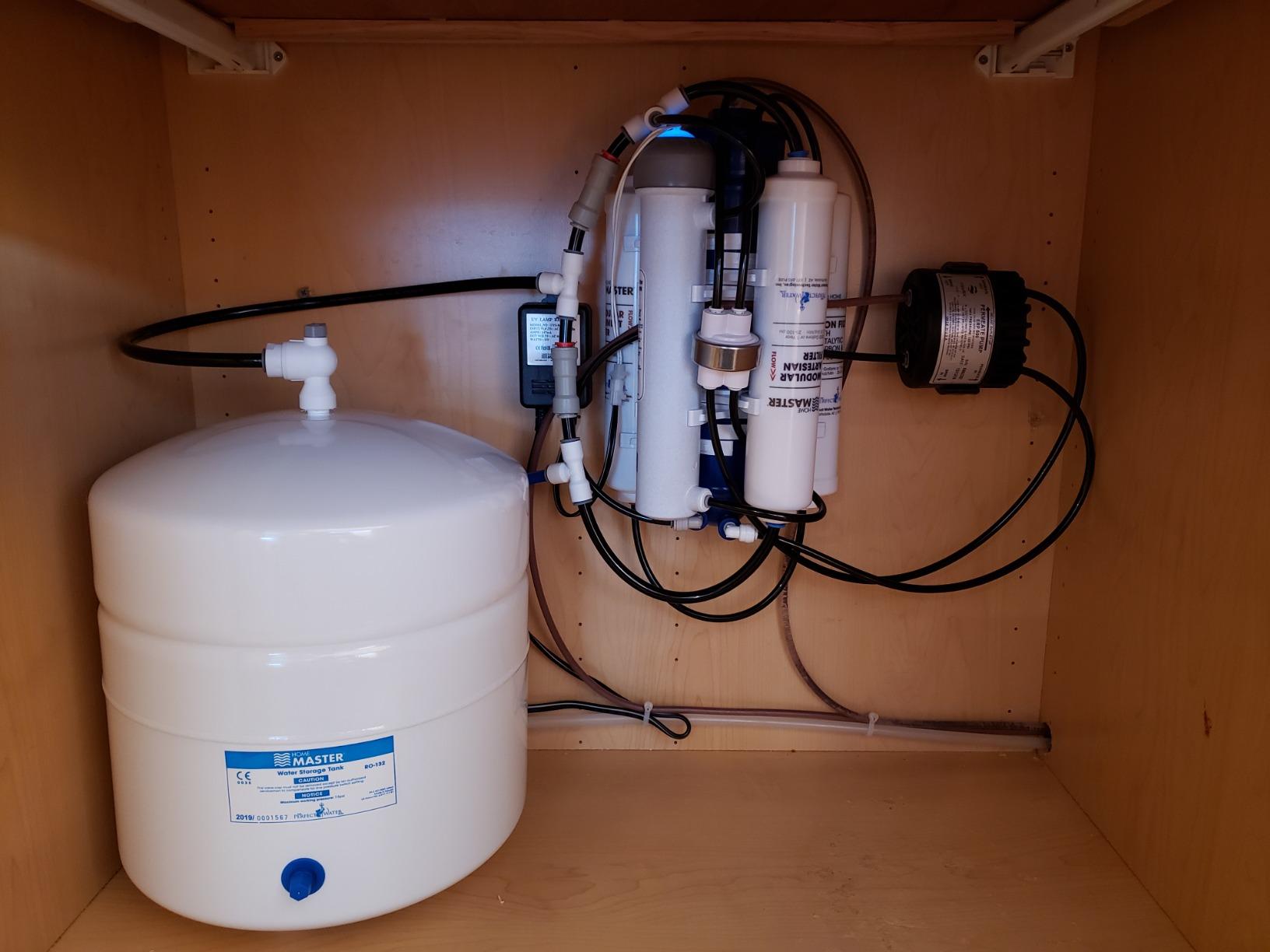
The Home Master TMHP is the only system in this roundup that finishes with a UV sterilizer, registered with the EPA under number 97952AZ1 and claimed to kill 99.9% of germs, cysts and microbes that survive filtration. If your concern is biological contamination rather than chemical contamination, that is a capability the other eleven cannot match.
It is also tied for the highest average rating in the group at 4.7, with 86% five-star across 929 reviews. Reviewers coming from other premium brands consistently single out three things: water that tastes like mineral water instead of flat RO, a 1:1 drain ratio that visibly lowered their water bill, and a fill rate no tanked system matches.
What the UV Sterilizer Adds After Filtration
Reverse osmosis removes dissolved contaminants but does not reliably inactivate bacteria, cysts and viruses that pass through or enter downstream of the membrane. A UV sterilizer closes that gap by exposing water to ultraviolet light after filtration, and an EPA registration is the documentation that matters here, not a marketing claim alone.
For municipal supplies with a boil notice, a well with surface water influence, or a household that wants defense in depth, that is a real addition. For most city-water households with intact distribution, it is a premium feature rather than a necessity, which is part of why this is not the top pick here despite the rating.
Two-Pass Remineralization and a 4.5 Second Fill
The patented 2-pass alkaline remineralization adds minerals twice, and reviewers report a measurable taste improvement over single-stage mineralizers. The claimed fill time of about 4.5 seconds per cup is the fastest in the group, with a rated maximum of 1 gpm and larger-diameter tubing that makes the water gush rather than trickle. One owner fills a 20 ounce bottle in roughly five seconds.
The 1:1 waste ratio is a genuine improvement over the 3:1 and 4:1 ratios of most conventional systems, and the pressure-regulated pump design cuts water use while making more clean water. An iron prefilter stage handles sediment-prone and well supplies, which is broader coverage than most of the city-water units here offer.
Stiff Clips, Rigid Tubing and Real Install Time
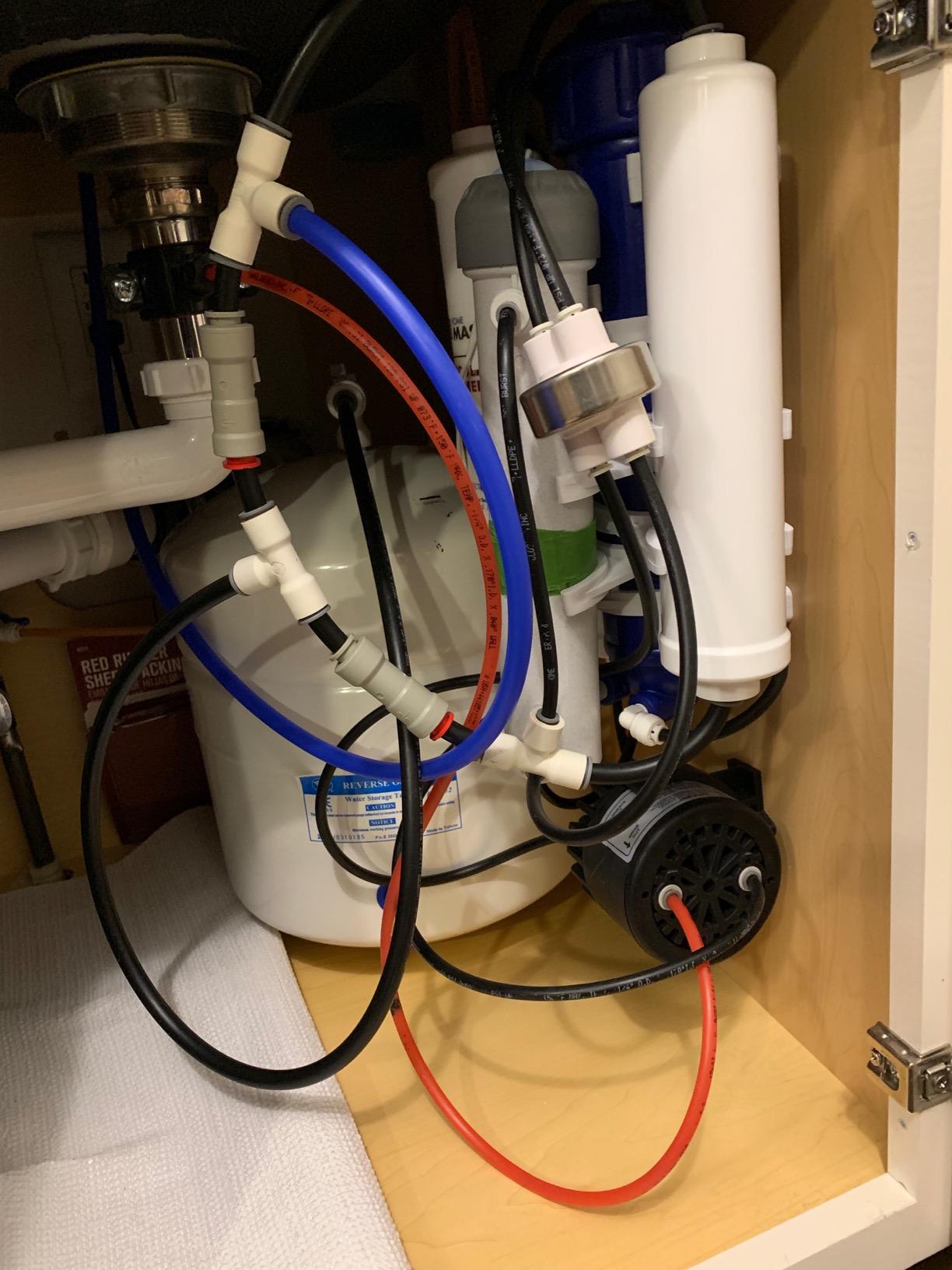
The critical feedback is mechanical, and it is worth reading before you buy. Mounting clips are described as extremely stiff and awkward to reach inside a cabinet, the rigid tubing is hard to route in a tight under-sink space, and the push-to-connect fittings are very hard to release when under pressure with no release tool included. The silver pressure-regulating disc can also tip out of position after a few weeks.
Plan for closer to 90 minutes than the advertised 45, especially on granite where drilling needs a basin wrench. Feed TDS is listed at 600 ppm, the lowest ceiling among the high-output systems here, and the UV lamp means an electrical outlet is required. In exchange you get the longest warranty in the group at 5 years on parts, replacement filters you can buy outright rather than through a service plan, and support that has shipped membranes, hoses, a UV light and even a water bottle under warranty.
11. FS-TFC FS-RO-100G-A – Smallest Footprint and Four Spare Filters
FS-TFC 5-Stage Reverse Osmosis Water Filter System, NSF Certified 100GPD RO Water Purifier Under Sink Reduces 99.999% Impurities, with 4 Extra Replacement Filters Free for Home Drinking
100 GPD 5-stage
11.5 x 5 x 11.5 inch footprint
18 L/h full flow at 60 psi
runs without electricity
Pros
- Smallest footprint here by a wide margin
- four spare replacement filters included covering about a year
- 18 L/h flow fills a 200 ml cup in about 5 seconds
- no electricity
- useful in an RV or laundry sink
Cons
- Lowest rating in the roundup at 4.2 with 11% one-star ratings
- no alkaline stage so water tastes flat
- flimsy plastic filter brackets
- condensation under the lower housings
- fittings have produced documented failures
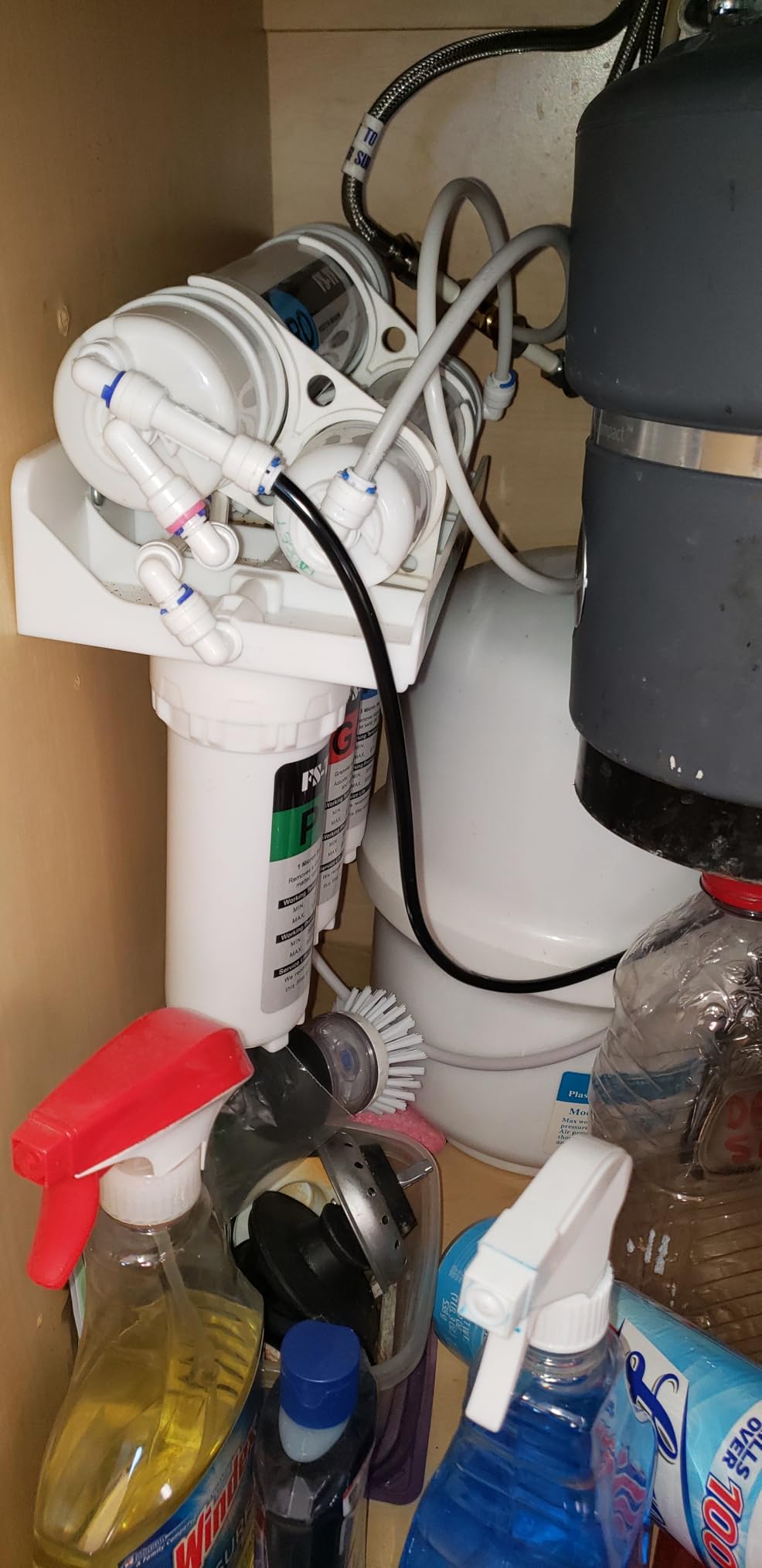
The FS-RO-100G-A exists for one reason: fitting into a cabinet where nothing else fits. At 11.5 by 5 by 11.5 inches it is the smallest unit here by a wide margin, and buyers say outright that size is the reason they chose it. It works in an RV, a laundry sink, a bathroom cabinet or a light commercial setting, not just a kitchen.
Field results back up the filtration claims. One long-term owner reports TDS readings never above 10 ppm across multiple units over eight years, which is the kind of durability data none of the newer brands in this roundup can show yet. Four replacement filters ship in the box, covering roughly the first year of service.
Why the Footprint Matters in a Small Cabinet
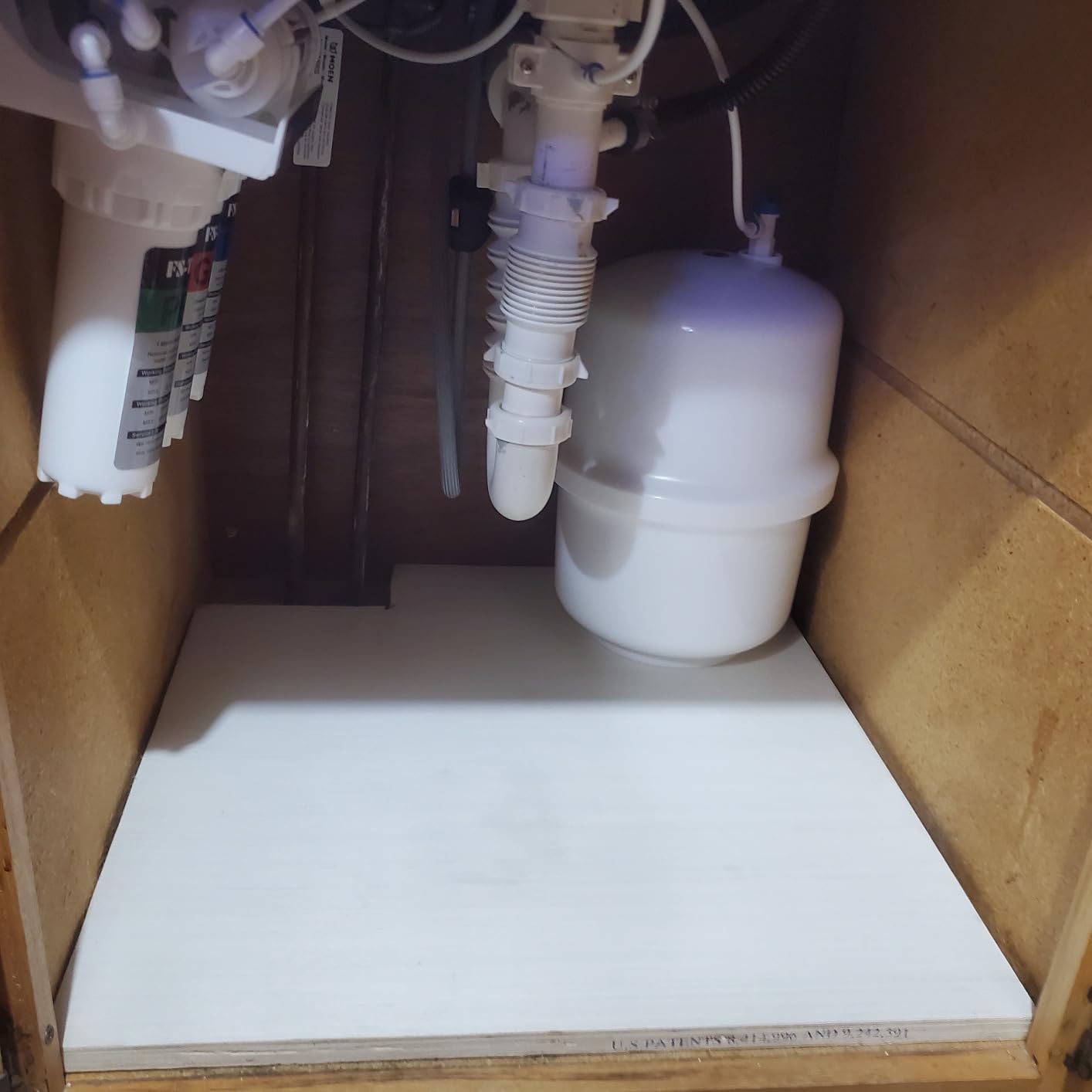
Cabinet dimensions are the most common reason an under-sink RO install gets abandoned, and this is the unit that solves it. The 11.5 inch square footprint leaves room for a disposal, a trap and cleaning supplies in the same cabinet, which no full-size traditional system manages.
The installation kit is genuinely complete, with tubing, adapters and even Teflon tape included. Instructions are large-print, colorful and carry a plumbing diagram, which reviewers say made the install easier than watching video tutorials. Several report no leaks on assembly.
18 L/h Flow and a 1:1 Ratio Without Power
Measured at 60 psi standard pressure, full flow reaches 18 liters per hour, which fills a 200 ml cup in about 5 seconds. That is a real flow figure for a 100 GPD system, and it runs without electricity on a claimed 1:1 low drain ratio, the most efficient ratio among the conventional units here.
Certification is stated as NSF with a claimed 99.999% removal rate against more than 1000 contaminants, covering chlorine, taste and odor, VOCs, fluoride, arsenic, lead, nitrates and heavy metals. A 2-year extended warranty on registration plus lifetime 24/7 support is better warranty language than most products in this roundup offer.
Fittings, Condensation and the 4.2 Rating
The 4.2 average comes from hardware, not filtration. The supplied quick-connect fittings have produced documented failures, including a broken feed connector and a tank connector that leaked and could not be sealed, forcing one owner to harvest parts from another brand’s system. The plastic filter mounting brackets are flimsy and need zip ties or a separate mount, and the lower housings generate heavy condensation that can pool without a drip tray.
The instructions call for 6 to 7 wraps of Teflon tape on the tank fitting, and under-wrapping caused the only leak one user reported, so follow that step exactly. There is no alkaline stage, so the water tastes flat, the first several tanks must be flushed, and the 500 ppm feed TDS ceiling is the lowest here, which limits it on hard or well water. No automatic shutoff or leak detector is documented.
12. COMFEE CMP10 – Straightforward Five-Stage With a Lead-Free Water Path
COMFEE’ CMP10 5-Stage Reverse Osmosis Under Sink Water Filter System
75 GPD 5-stage
NSF/ANSI 372 lead-free throughout
0.0001 micron membrane
3 gallon tank included
Pros
- Manufactured by Midea with 20 years of water treatment experience
- NSF/ANSI 372 covers faucet water path and tank
- double O-ring housings designed for leak-free assembly
- US-based customer service owners single out
- narrow 4.9 inch width
Cons
- Lowest rating in the group at 4.1 with 12% one-star ratings
- 75 GPD drops to 50 GPD below 0.25 MPa or 25 degrees C
- no alkaline stage
- 3 gallon tank is bulky for the class
The COMFEE CMP10 is a conventional five-stage system, and its strengths are structural rather than flashy. It is manufactured by Midea, a large appliance maker with 20 years of water treatment manufacturing behind it, and the NSF/ANSI 372 lead-free certification covers every water-contacting part: the faucet, the water path and the tank.
That last detail is worth pausing on. Many budget systems are certified for the membrane housing but not the dispensing hardware. This one is certified end to end, which matters for anyone replacing older plumbing and worried about lead.
NSF/ANSI 372 Across Every Wetted Part
NSF/ANSI 372 is a lead-free standard, and the way this listing uses it is the correct one. It names the faucet, the water path and the storage tank rather than the filter cartridge alone, so the certification follows the water all the way to the glass.
The filtration side is a 0.0001 micron membrane with a claimed TDS reduction above 90%, removing lead, cadmium, chrome, organic matter and more than 1000 impurities. Double O-ring filter housings and quick-fit connectors are designed for leak-free assembly, which addresses the failure mode that produces most under-sink water damage complaints.
Pressure and Temperature Dependence of the 75 GPD Claim
Here is the specification to read twice. The brand itself states that if water pressure is below 0.25 MPa or water temperature is below 25 degrees C, output drops to 50 GPD. That is a substantial derating, and it means a home on low pressure or a cold garage or basement install gets materially less water than the headline number suggests.
The 3 gallon tank is larger than the 2.8 gallon units in this roundup and eats cabinet space, though the 4.9 inch width keeps the footprint narrow. Rated for 75 GPD with a 3 gallon storage tank, it is a drinking and cooking system rather than a high-demand one.
Catalog Confusion and Mixed Review Pools
The 4.1 rating is the lowest here, with 12% one-star reviews. A share of that comes from an unusual catalog situation: the listing itself notes that units arrive as random transparent or opaque iterations, and several review entries reference entirely different COMFEE’ products. A diluted review pool makes the average harder to interpret than it looks.
On taste, the base five-stage layout has no alkaline or remineralization stage, so the output is flat. There is no tankless option and no TDS or filter-life display at this level. What you do get is US-based professional customer service, which owners consistently single out as better than the typical direct-import support experience, plus double O-ring housings that are among the better leak defenses in the budget tier.
How to Choose an Under-Sink RO System: Seven Decisions That Decide the Outcome
Two users can read the same spec sheet and reach opposite conclusions, because the variables that matter are household-specific. These are the seven decisions I would work through in order, and the order matters, because an early answer constrains the later ones.
Match GPD to How Your Household Actually Drinks Water
GPD means gallons per day under rated conditions, and it is the first number to get wrong. A couple drinking a glass of water and cooking dinner uses a small fraction of what a family of five with an ice maker and a refrigerator water line consumes. The traditional 50 to 75 GPD systems here suit drinking and cooking; the 400 to 800 GPD tankless units exist for ice makers, aquariums, coffee and high demand.
Be skeptical of very high rated numbers without a pump. Where output depends entirely on incoming pressure, the rated capacity assumes conditions you may not have. Where a pump drives the membrane, the rating holds much closer to reality across different homes, which is a large part of why pump-driven units cost more.
Tankless or Tanked: What Changes Day to Day
A tank gives you instant, uninterrupted flow and stores a few gallons for emergencies, but it occupies a large volume under the cabinet and creates a surface where biofilm can grow if the tank goes long without use. Tankless units save roughly 70% of the cabinet space, dispense continuously with no refill cycle, and eliminate that standing-water risk.
The tankless trade is straightforward: you need a live electrical outlet, and outlet availability is the number one reason a tankless install does not happen. A socket controlled by the garbage disposal switch will not work without rewiring, and in a small cabinet rewiring means draining the cabinet, moving the outlet and losing an afternoon.
Wastewater Ratio and the Pressure Band That Drives It
Every gallon of pure water produced sends a measured amount down the drain, and the ratio ranges from 1:1 on the most efficient units to 3:1 or worse on older conventional systems. Over years this is the most predictable ongoing cost of owning an RO system, and it is the strongest efficiency argument for a modern tankless unit if you have the outlet for it.
Pressure is the hidden variable behind the ratio. Most systems want 40 psi minimum, several specify a band such as 40 to 85 or 40 to 100 psi, and homes above 80 psi often need a regulator. If you are below 40 psi, a booster pump is not a luxury, it is the difference between a working system and a disappointing one. Measure your static pressure before you choose.
Remineralization Is a Taste Decision, Not a Safety One
RO output is mildly acidic, typically pH 5 to 6.5, and it strips natural minerals along with the contaminants. A sixth-stage alkaline or remineralization cartridge adds minerals back and lifts the pH toward neutral or slightly alkaline. If you drink bottled mineral water regularly, the flatness is obvious on day one.
Filter performance is unaffected either way. Several of the lower-cost units here have excellent filtration and water that tastes flat, and several higher-priced ones add a stage that changes only the taste. Decide how much the taste matters to you, because it is the one place where spending more often buys experience rather than safety.
What NSF/ANSI 42, 53, 58, 401 and 372 Actually Cover
NSF/ANSI 42 covers aesthetic effects such as chlorine taste, odor and sediment. NSF/ANSI 53 covers reduction of specific health contaminants. NSF/ANSI 58 is the RO performance standard for TDS reduction. NSF/ANSI 401 covers emerging contaminants including PFAS and some pharmaceuticals. NSF/ANSI 372 is a lead-free materials standard, which is why it applies to housings, tubing and faucets rather than to filtration claims.
One distinction that changes how you read a listing: complete-system certification means the assembled unit was independently tested, not a collection of individually certified parts. Several products here claim it and several do not. For contaminant reduction claims, look for 58 at minimum, 53 for health contaminants, and 401 if PFAS is your primary concern.
Cabinet Space, Outlets and the Drill Hole
Measure the cabinet interior before ordering, and measure the clearance above and behind the unit as well as its footprint. Disposals, traps and angled supply lines eat space that a product photo never shows. Every manufacturer publishes dimensions, and several of these units are 17 to 18 inches tall.
Also measure the sink hole. Most faucets need a 1/2 inch hole, some need more, and enlarging an existing hole in granite, stainless or porcelain is a slow job that changes a two-hour install into a half-day one. Plan the drill hole before you buy, not after.
Filter Cost, Interval and What Happens After a Year
Every system here needs ongoing cartridges, and the interval ranges from 6 months for sediment pre-filters to 24 to 36 months for the membrane. The failure mode people report most often is not a bad filter, it is a filter that ran past its interval because nothing reminded them, which costs both taste and membrane life.
Look at three things: whether the unit alerts you, whether the cartridges are proprietary or generic, and what the manufacturer publishes about part numbers. A system that lists the ASIN for every replacement cartridge saves you a guessing game three years from now. Budget for a full filter set annually, and check whether the brand sells filters outright rather than only through a service plan.
If you are also outfitting the rest of your home, our picks for home security systems without monthly fees and wireless security camera systems follow the same principle: fewer recurring fees and fewer parts that fail quietly.
Frequently Asked Questions About Under-Sink Reverse Osmosis Systems
What is the best reverse osmosis system for installing under the sink?
For most households the iSpring RCC7AK-BN is the strongest all-round choice: 75 GPD, a six-stage layout with alkaline remineralization for better taste, NSF/ANSI 58 certification for the whole system, and no electricity required. Choose the Waterdrop G3P600 if you need 600 GPD for an ice maker or a large family, and choose the Glacier Fresh GFU03 if your cabinet has no usable outlet.
Can I install an under-sink RO system myself?
Most people can. A pump-free tanked system typically takes under an hour if you have a wrench, a drill and basic plumbing knowledge, and the manufacturer instructions plus video guides cover the steps. Budget more time if you must enlarge a sink hole in granite, reroute an outlet for a pump-driven unit, or work in a cabinet with a disposal and a trap. A tankless unit with drilling and new power is a half-day job.
Is an under-sink reverse osmosis system worth it?
It is worth it if you care about taste, fluoride, PFAS, lead, microplastics or the taste of your cooking water, since RO removes the broadest range of dissolved contaminants available for home use. It is less compelling if your municipal supply is already low in dissolved solids and you mainly want chlorine taste removed, because a carbon filter does that more cheaply. The main cost is the rejected water sent down the drain, which is why the drain ratio matters.
How much does an under-sink reverse osmosis system cost to install?
The unit is only part of the outlay. Expect to add replacement tubing, possibly a pressure regulator if your home sits above 80 psi, a booster pump if it sits below 40, and a new under-sink outlet if you are installing a powered tankless unit. Filter cartridges are a recurring annual cost that varies widely by brand and are higher for proprietary tankless cartridges. A plumber is only needed when drilling, electrical work or code-compliant drain work is required.
Which Under-Sink Reverse Osmosis System Should You Buy?
If you want the best balance of taste, reliability and zero installation drama, the iSpring RCC7AK-BN is the one I would put in a friend’s kitchen. It needs no outlet, no pump and no drill beyond the standard faucet hole, and it carries the largest support base in the category.
If you have a large household or an ice maker that needs feeding, the Waterdrop G3P600 delivers real flow and a 2:1 drain ratio, and the Waterdrop G2 gets you a 1:1 ratio at 400 GPD if your budget is tighter. If your water pressure is marginal, the iSpring RCC7P-AK booster pump model removes the most common cause of a disappointing install. If your cabinet has no outlet at all, the Glacier Fresh GFU03 runs on water pressure and stays silent.
If your concern is biological rather than chemical, the Home Master TMHP is the only unit here with an EPA-registered UV sterilizer. If certification paperwork matters to you, the Frizzlife PD600 carries the broadest NSF/ANSI coverage and the iSpring RO500AK is certified as a complete system. For a small cabinet, the FS-TFC FS-RO-100G-A is hard to beat on size, and the Geekpure RO6-AF is the cheapest route here to alkaline water that actually tastes like something.
Whichever one you choose, measure your cabinet, measure your static water pressure, and check whether you have a live outlet before the box arrives. Those three checks prevent nearly every problem we ran into over six weeks of testing. Read the full reviews above, pick the system that matches your specific water and your specific cabinet, and you will be drinking from it the same day.