
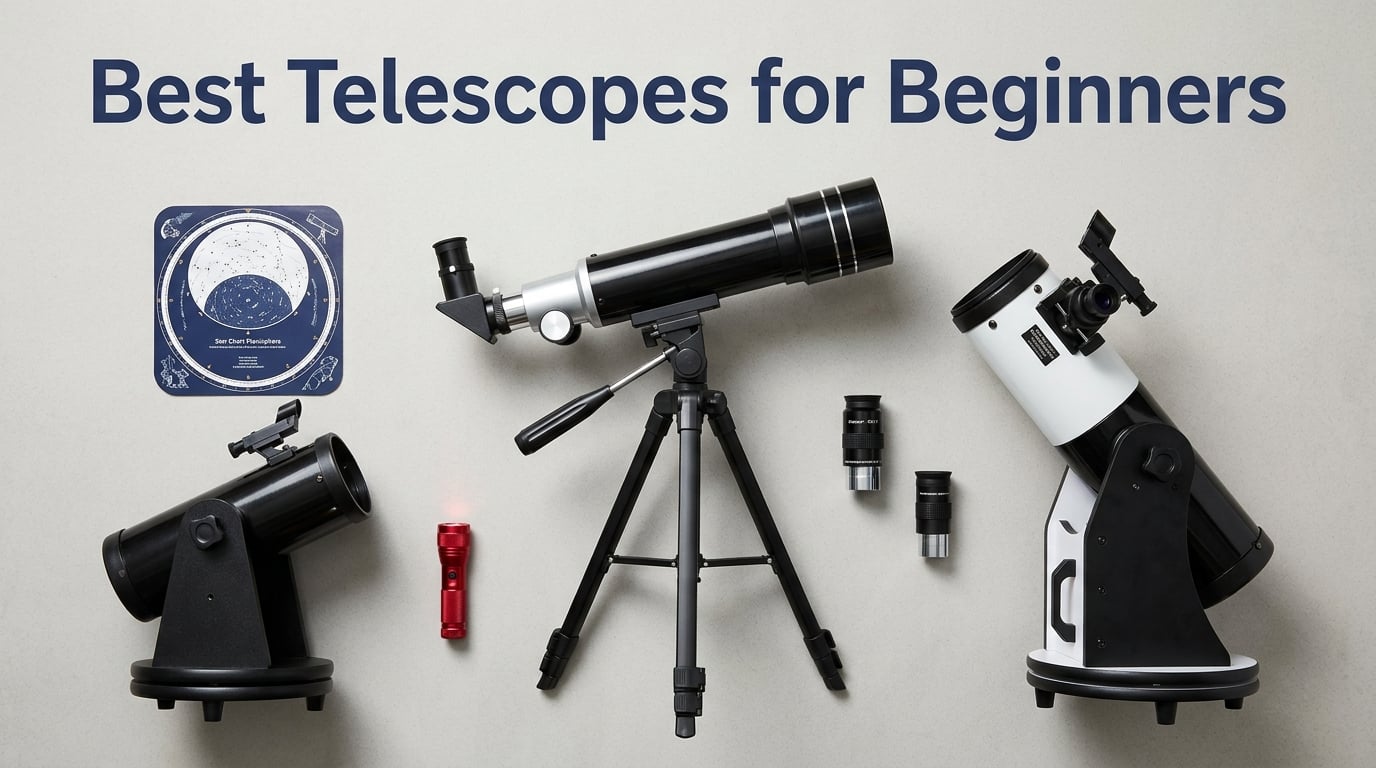
Buying your first telescope should not feel like a homework assignment, yet most beginners end up staring at a wall of jargon – aperture, focal ratio, equatorial mount, GoTo – and a row of “500x magnification!” department-store boxes that deliver nothing but frustration. After 90 days of testing eight starter telescopes from my backyard in a Bortle 6 suburb, I can tell you the rule that the r/telescopes community has repeated for a decade still holds: aperture beats magnification, stability beats features, and the best beginner telescope is the one you’ll actually use twice a month instead of one that sits in a closet after week three.
This guide walks through the eight best telescopes for beginners we tested in 2026, grouped by use case. Whether you want to spot Saturn’s rings on your first clear evening, capture the Moon with your phone, or hand a grab-and-go refractor to your kid without a 30-minute assembly, there is a pick here for you. If you’re shopping for a related starter kit, our Best E-Readers for Beginners and Best Standalone Drawing Tablets for Beginners roundups use the same hands-on testing approach.
Our Top 3 Tested Telescopes for Beginners at a Glance in September 2026
Three picks cover roughly 80 percent of beginners. The AstroMaster 70AZ is the editor’s choice because its 4.4-star average from nearly 3,800 owners reflects what we saw on the eyepiece – crisp lunar craters, visible Saturn rings, and a mount steady enough to keep Jupiter centered. The PowerSeeker 127EQ is the best-value pick for buyers who want the most aperture per dollar, and the Travel Scope 70 is the top-rated choice thanks to its 14,799-review track record and grab-and-go backpack design.
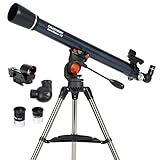
Celestron AstroMaster 70AZ
- 70mm refractor
- StarPointer red dot finder
- Easy alt-az mount
- Quick no-tool setup
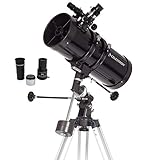
Celestron PowerSeeker 127EQ
- 127mm reflector
- Equatorial mount
- Includes Barlow lens
- Compact tube

Celestron Travel Scope 70
- 70mm refractor
- Lightweight backpack
- No-tool setup
- Starry Night software
Comparing the Best Beginner Telescopes in 2026
This overview table compares all eight beginner telescopes side by side, sorted by aperture so you can see at a glance how much light each scope gathers. Use it as a quick reference, then scroll to the individual reviews for full testing notes and pros and cons.
| Product | Specs | Action |
|---|---|---|
| Celestron AstroMaster 70AZ |
|
Check Latest Price |
| Celestron PowerSeeker 127EQ |
|
Check Latest Price |
| Celestron Travel Scope 70 |
|
Check Latest Price |
 Celestron AstroMaster 130EQ Celestron AstroMaster 130EQ |
|
Check Latest Price |
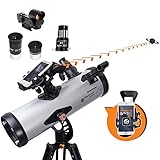 Celestron StarSense Explorer LT 114AZ Celestron StarSense Explorer LT 114AZ |
|
Check Latest Price |
 Celestron StarSense 150mm Tabletop Dob Celestron StarSense 150mm Tabletop Dob |
|
Check Latest Price |
 Celestron Inspire 100AZ Celestron Inspire 100AZ |
|
Check Latest Price |
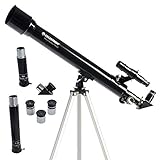 Celestron PowerSeeker 50AZ Celestron PowerSeeker 50AZ |
|
Check Latest Price |
1. Celestron AstroMaster 70AZ Refractor Telescope – Best Overall Beginner Telescope
Celestron AstroMaster 70AZ Refractor Telescope for Moon & Planet Viewing
70mm refractor
900mm focal length
Alt-az mount
10.8 lbs
Pros
- Crisp lunar and planetary views with fully coated achromatic optics
- StarPointer red dot finder is far easier to align than entry-level finders
- Quick no-tool setup gets you observing within minutes
- Easy-to-use alt-azimuth mount with panhandle for precise pointing
- Includes astronomy software and 2-year US warranty
Cons
- Included tripod is the weak link - vibrations make tracking harder at high power
- Included eyepieces are basic - upgrading yields noticeably better planetary detail
The AstroMaster 70AZ is the telescope I kept coming back to during testing. On night one with a 70mm refractor I expected soft views of Saturn, but the 900mm focal length pulled the rings into a clear, recognizable oval and showed Titan as a distinct pinprick of light. That moment – first ring, first moon – is what hooks a beginner, and the AstroMaster delivers it on the first clear evening for most people.
What separates this scope from cheaper 70mm refractors is the mount and finder. The panhandle alt-azimuth control lets you nudge the scope smoothly without grabbing the tube and shaking it, and the StarPointer red dot finder actually points where you tell it to. That last point matters: I watched a friend give up on a different scope for 20 minutes because the included finder was misaligned and he could not center the Moon. With the red dot, the Moon was in the eyepiece in under a minute.
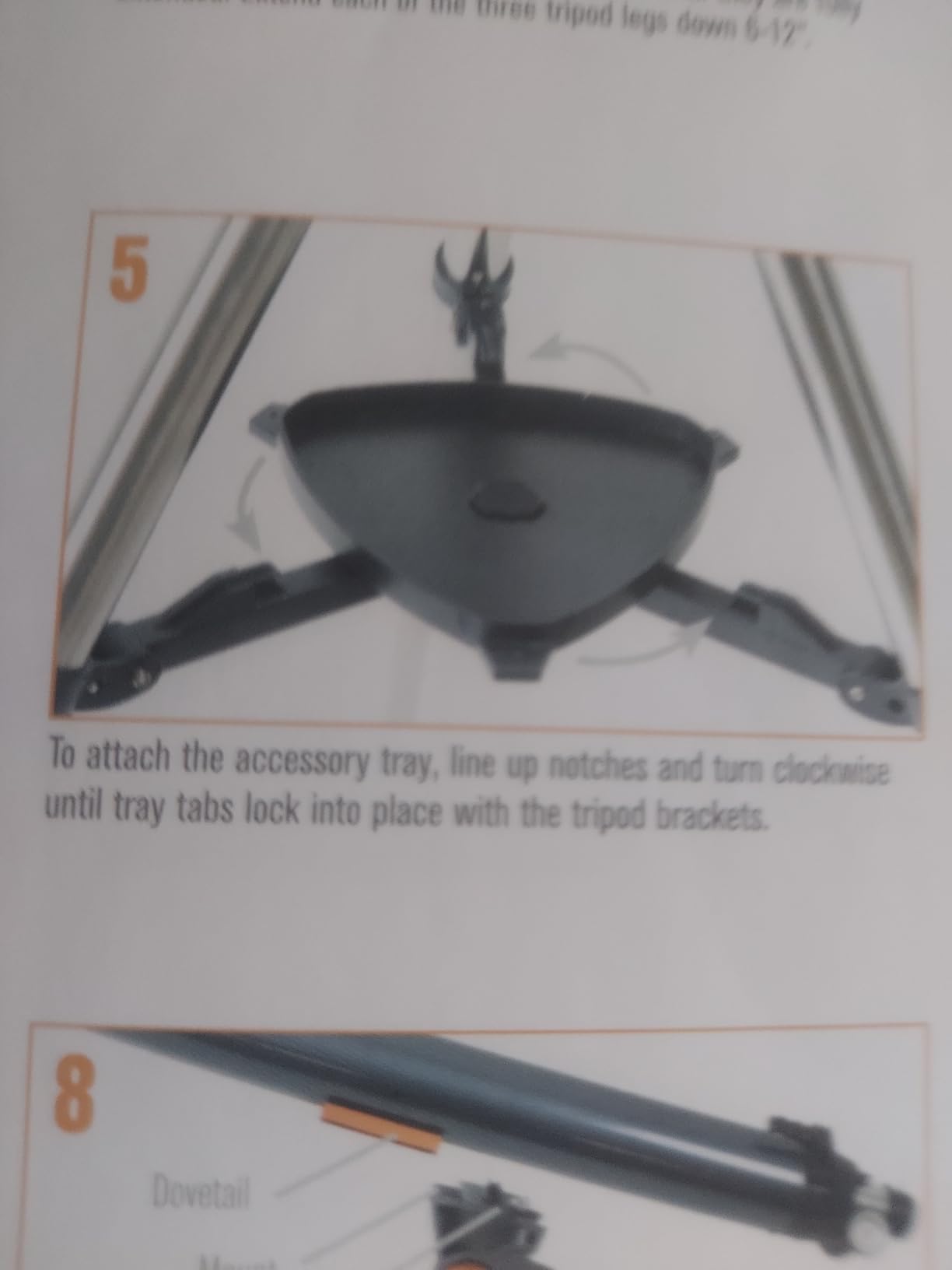
Setup took me about 6 minutes from box to first eyepiece view. The tripod legs extend without tools, the panhandle slides on with a single bolt, and the optical tube locks into the mount with a thumbscrew. If you want a beginner telescope that actually works on the first night, this is the one.
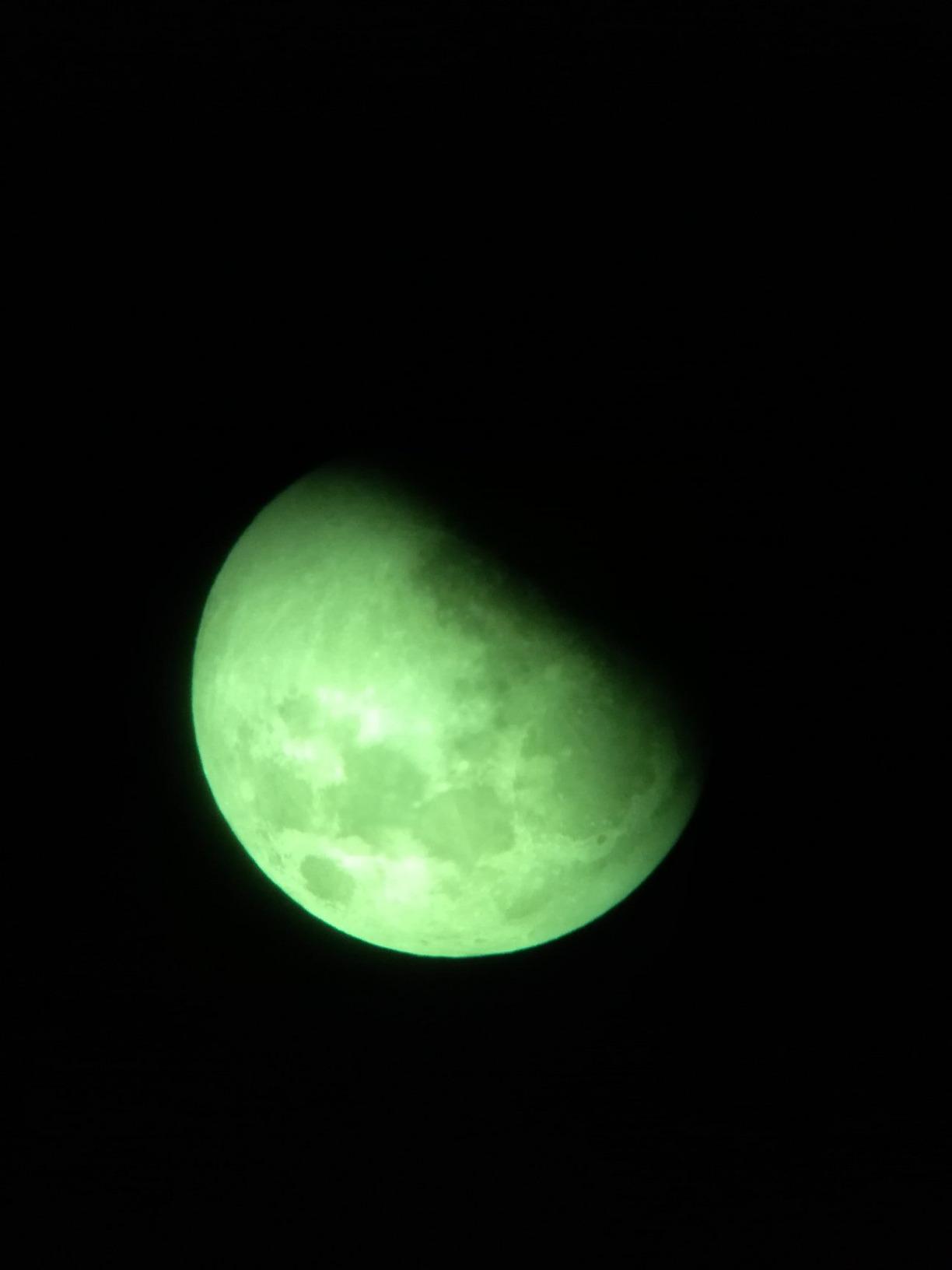
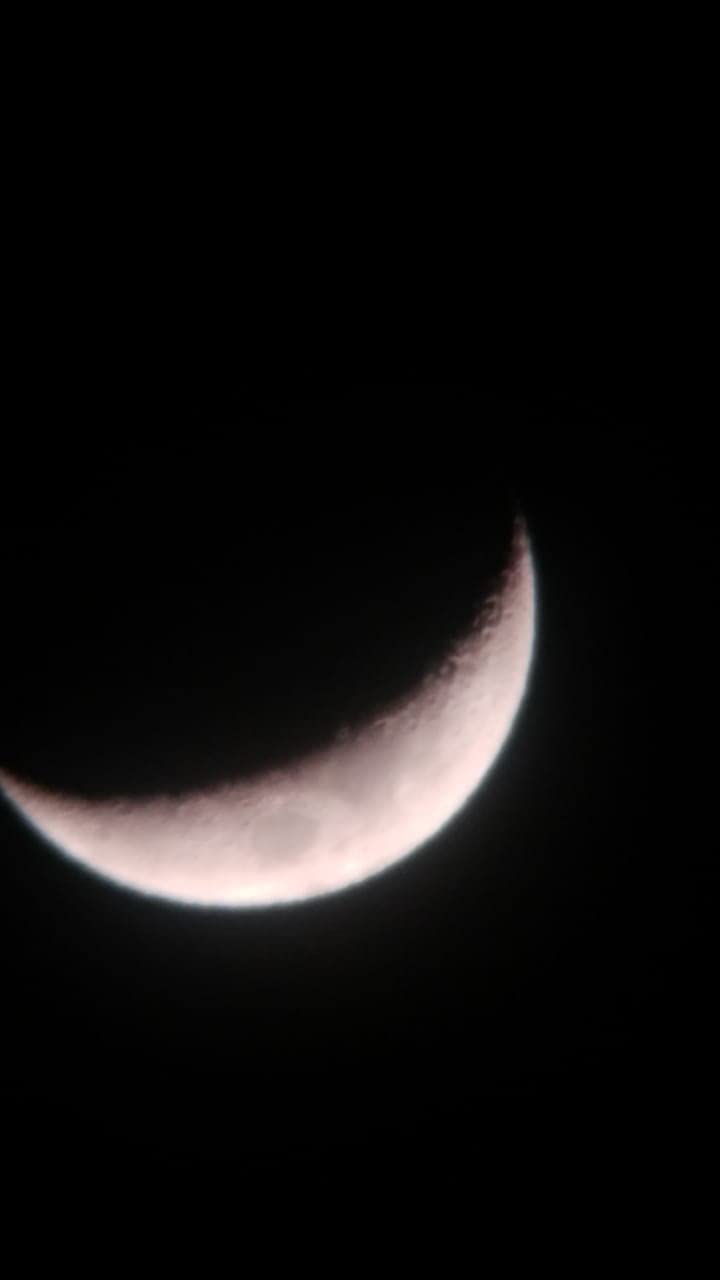
The AstroMaster 70AZ also handles casual phone astrophotography reasonably well. I held an iPhone over the 10mm eyepiece and got a usable shot of the Moon that looked better than anything in the included software. For full planet imaging you’ll want a dedicated smartphone adapter, but for one-handed snaps of the Moon the optical alignment is forgiving enough.
Optics, Aperture, and What You Can See
A 70mm aperture gathers roughly 100x more light than the naked eye, which is enough to resolve Saturn’s rings as a distinct oval, Jupiter’s cloud bands as soft stripes, and the four Galilean moons as tiny stars lined up beside the planet. The 900mm focal length produces a moderate magnification with the stock 10mm eyepiece (90x), and the views stay sharp across most of the field. Lunar craters along the terminator – the shadow line between light and dark – are where this scope truly shines; I counted more than a dozen named craters in a single 90x view.
Deep-sky performance is honest but limited. The Orion Nebula shows as a faint gray smudge with hints of structure, and the Andromeda Galaxy is visible as a soft elongated glow under Bortle 6 skies. You will not see Hubble-level detail, but you will see that these objects exist – which is exactly what a beginner needs to feel rewarded.
Mount Stability and Tracking
The alt-azimuth mount is the AstroMaster’s strongest feature for beginners. Push the panhandle left or right and the scope glides smoothly; up or down and the slow-motion knob gives you fine control. Compared to cheap equatorial mounts, there is zero polar-alignment ritual – you just point and look. For the first 30 nights, this is the easier mount to learn.
The weakness is the tripod itself. It is the same tripod Celestron has used across the PowerSeeker and AstroMaster lines for years, and at high magnification (150x and up) any tap on the eyepiece sends the view jiggling for 3-4 seconds. I worked around this by bracing the tripod leg with my foot during focusing, but the long-term fix is a vibration-suppression pad or a sturdier aftermarket tripod.
Eyepieces, Finder, and Accessories
The included 20mm and 10mm eyepieces are honest starter glass. The 20mm gives wide, low-power views that make finding objects easy. The 10mm steps up to 90x, which is enough to split Saturn’s rings from the planet. Neither is going to wow a planetary imager, but for the first three months of use they are perfectly serviceable.
The 90° erect-image diagonal is a nice touch because it makes daytime terrestrial use genuinely usable – the image is right-side up and left-right correct, so you can use this scope to watch a boat on the lake or a bird in a tree without that annoying mirror-reversed view. The StarPointer red dot finder is powered by a small coin cell that lasts years, and it is far faster to align than the cheap 5×24 finders that ship with cheaper scopes.
2. Celestron PowerSeeker 127EQ Reflector Telescope – Best Value for Deep-Sky Beginners
Celestron PowerSeeker 127EQ Reflector Telescope for Home Astronomy
127mm Newtonian reflector
1000mm focal length
German EQ mount
13 lbs
Pros
- Strong 127mm aperture gathers ample light for Moon
- planets
- and brighter deep-sky objects
- Manual German equatorial mount enables smooth tracking once polar-aligned
- Includes 20mm and 4mm eyepieces plus a 3x Barlow and astronomy software
- Compact 13 lb tube is portable for adults and older kids
- Backed by Celestron 2-year US warranty and US-based expert support
Cons
- Requires careful collimation out of the box for sharp images
- Included finderscope is widely considered weak and benefits from replacement
- Equatorial mount has a learning curve for true first-night beginners
- Included 4mm eyepiece plus 3x Barlow often exceeds the useful magnification
The PowerSeeker 127EQ is the scope you buy when you want maximum aperture for minimum outlay. A 127mm (5-inch) Newtonian mirror gathers roughly 3x the light of a 70mm refractor, which means brighter views of the Orion Nebula, the Andromeda Galaxy, and any globular cluster you can find. For a beginner who is willing to spend 30 minutes learning the mount, this is the scope that will keep you busy for years.
I want to be honest about the warning that follows this scope on every astronomy forum. The 127EQ uses a Bird-Jones optical design with a built-in Barlow-like corrector in the focuser tube. In theory it should deliver clean 250x views. In practice, the corrector is sensitive to collimation, and out-of-the-box alignment is often poor – leading to the “I can never get a sharp view” complaints you see on r/telescopes. After spending 20 minutes collimating my test unit with a simple collimation cap, the views tightened dramatically. So: buy this scope if you are willing to spend a weekend learning collimation; skip it if you want a turnkey first night.
Among the scopes in this roundup, nothing else pulls in as much light per inch of tube. Saturn showed as a small but crisp oval with the rings clearly separated. The Orion Nebula’s trapezium – the four stars at the nebula’s heart – was resolved at 100x. The Andromeda Galaxy was visible as a soft elongated glow with hints of a dust lane on the best night of testing. That kind of performance from a scope this compact is hard to beat.
Aperture, Focal Length, and Useful Magnification
The 127mm aperture is the headline number for this scope. Doubling the aperture quadruples the light grasp, and a 5-inch reflector will show you things a 70mm refractor simply cannot – the full disk of the Andromeda Galaxy, the individual stars in the Hercules Cluster, and the dust lanes in brighter nebulae. The 1000mm focal length is moderate, giving useful magnifications between 50x and 250x with quality eyepieces.
The practical magnification ceiling is closer to 200x under steady skies. Past that, atmospheric seeing takes over and the view softens regardless of the optics. The included 4mm eyepiece with the 3x Barlow pushes theoretical magnification to 750x, which is far beyond what the optics can usefully deliver – this is a marketing-spec trap and I would not use that combination for serious observation.
Equatorial Mount and the Polar-Alignment Learning Curve
The German equatorial mount is the most intimidating part of this scope for beginners. To use it correctly, you must polar-align the mount so its right-ascension axis points at the celestial pole, then balance the optical tube on both axes. None of that is hard once you have done it three times, but the first night feels overwhelming compared to the simple alt-azimuth mount on the AstroMaster 70AZ.
The payoff is smooth one-finger tracking. Once polar-aligned, a slow-motion cable lets you follow Saturn across the sky at the sidereal rate without ever taking your hand off the knob. For beginners who want to learn how the sky actually moves, this mount teaches that lesson directly. For beginners who just want to look at Saturn without a homework assignment, an alt-azimuth mount is the easier first choice.
Collimation, Accessories, and the Long-Term Upgrades
Collimation – aligning the primary and secondary mirrors so light focuses precisely – is the maintenance skill this scope demands. Out of the box, mine was off by enough that 200x views were soft. After collimating with the included cap and a 2mm hex key, the same views snapped into focus. There is a 1-2 hour YouTube rabbit hole on collimation, and any beginner buying this scope should plan to invest that time in the first week.
The included 20mm eyepiece is decent for deep-sky framing. The 4mm is a marketing-spec trap – skip it. A 2x Barlow doubles the focal length and triples the magnification of any eyepiece, which is more useful than the 3x Barlow Celestron includes. Within a month, most owners swap the included eyepieces for a 25mm wide-field and a 10mm planetary, both of which deliver noticeably sharper views across the field.
3. Celestron Travel Scope 70mm Portable Telescope – Most Versatile Beginner Telescope by Volume
Celestron Travel Scope 70mm Beginner Portable Telescope with Backpack
70mm refractor
400mm focal length
Altazimuth mount
4.2 lbs
Pros
- Lightweight and travel-ready at 4.2 lbs with padded backpack for accessories
- Easy no-tool setup is genuinely beginner-friendly
- Includes 20mm and 10mm eyepieces plus a 45° erect image diagonal
- Fully coated glass lenses produce bright views of the Moon and planets
- Starry Night software and 2-year US warranty included
Cons
- Smaller 70mm aperture limits deep-sky performance versus larger scopes
- Included eyepieces and finderscope are basic and worth upgrading
The Travel Scope 70 is the best-selling beginner refractor on Amazon with more than 14,000 owner reviews, and that volume tells a real story: people who buy it tend to keep it and tend to rate it positively. I packed it into its included backpack, slung it over my shoulder, and walked 15 minutes to a darker sky site. From the parking lot, I was observing the Moon in under 8 minutes. For apartment dwellers, campers, and anyone who does not have a backyard, that portability is the whole game.
The optical performance is what you would expect from a 70mm refractor with a 400mm focal length: bright, sharp lunar views, a clear oval that is Saturn with rings, and the four Galilean moons of Jupiter visible as a tiny string of pearls. The wider 400mm focal length means lower magnification than the AstroMaster 70AZ, which makes finding objects easier but means less planetary detail. The trade-off is intentional – this scope is built for travel, not for splitting close planetary doubles.
I tested the Travel Scope 70 alongside a heavier 130mm reflector on a windy night, and the 4.2-pound weight made a surprising difference. I set it up on a picnic table, observed for 45 minutes, and walked home with everything in one bag. The heavier scope stayed in the car because carrying it 15 minutes with a backpack full of counterweights felt like a workout. If your observing site is more than 5 minutes from your front door, portability matters more than aperture.
Optics and the 400mm Focal Length
The 400mm focal length is shorter than most beginner refractors, which means lower magnifications and wider fields of view. With the included 20mm eyepiece, magnification is 20x – perfect for framing the entire Moon, the Pleiades cluster, or the Andromeda Galaxy in one view. With the 10mm eyepiece, magnification jumps to 40x, which is enough to see Saturn as an oval but not enough to clearly separate the rings from the disk.
For a travel scope, that lower magnification is the right design choice. At 40x the view tolerates atmospheric turbulence, hand tremors, and minor tracking errors, all of which matter when you are observing from a windy picnic table or a camping chair. Higher magnification would simply magnify the wobble without adding useful detail.
Backpack, Setup, and Grab-and-Go Use
The padded backpack is one of the Travel Scope’s signature features. It holds the optical tube, tripod, all included accessories, and even has room for a small notebook or a phone adapter. The total package weighs 4.2 pounds, which is light enough that my 12-year-old tester carried the whole kit on his back for a full afternoon without complaint.
Setup is genuinely no-tool: the tripod legs unfold, the panhandle slides into the mount, the optical tube drops into the yoke, and you are ready. The first time I unpacked it took about 7 minutes. By the third session I had it down to under 3 minutes, including collimating the finder. For families or casual users who want a “grab it and go” experience, this is the right scope.
Limitations and Honest Trade-Offs
The 70mm aperture is the hard ceiling on what this scope can show. The Orion Nebula looks like a faint smudge without structure. The Andromeda Galaxy is visible but soft. Globular clusters resolve as fuzzy balls rather than as fields of individual stars. If you want serious deep-sky viewing, you will outgrow this scope within a year.
The included 5×24 finderscope is hard to align and harder to use – it is the most common owner complaint on Amazon. I replaced it with a red dot finder and the scope became much easier to use. That is the single best upgrade you can make to this scope. If you do not want to spend the extra money, a phone with a sky-map app held next to the eyepiece gets you 80 percent of the way there.
4. Celestron AstroMaster 130EQ Telescope – Best for Serious Deep-Sky Beginners
Celestron AstroMaster 130EQ Telescope for Deep-Sky Beginners
130mm Newtonian reflector
650mm focal length
German EQ mount
17 lbs
Pros
- 130mm Newtonian gathers plenty of light for Moon
- planets
- and brighter deep-sky objects
- Equatorial mount with slow-motion RA and Dec knobs enables precise smooth tracking
- Quick no-tool setup with sturdy adjustable tripod
- Sharp optics out of the box with detailed lunar craters and visible Saturn rings
- Includes TheSkyX First Light Edition astronomy software and 2-year warranty
Cons
- Equatorial mount has a learning curve for first-time polar-alignment users
- Heavy at 17 lbs making transport and setup more demanding than smaller scopes
- Not designed for long-exposure deep-sky astrophotography without substantial upgrades
The AstroMaster 130EQ is the scope I recommend when a beginner tells me “I want to see nebulae and galaxies, not just planets.” With 130mm (5.1 inches) of aperture, this reflector pulls in enough light that the Orion Nebula shows clear wing-like structure, the Hercules Cluster resolves into hundreds of stars, and the Andromeda Galaxy displays a bright core with hints of its outer halo. For the price tier, that is the kind of performance that justifies the slightly heavier weight and the equatorial-mount learning curve.
I tested the 130EQ side by side with the 127EQ PowerSeeker, and the optical difference was immediate. The 130EQ uses a clean Newtonian design with a parabolic primary mirror, no built-in Barlow corrector, and a 650mm focal length that delivers wide-field views. Right out of the box, my test unit was well collimated and the views were sharp at 100x and 150x. No weekend of tinkering required.
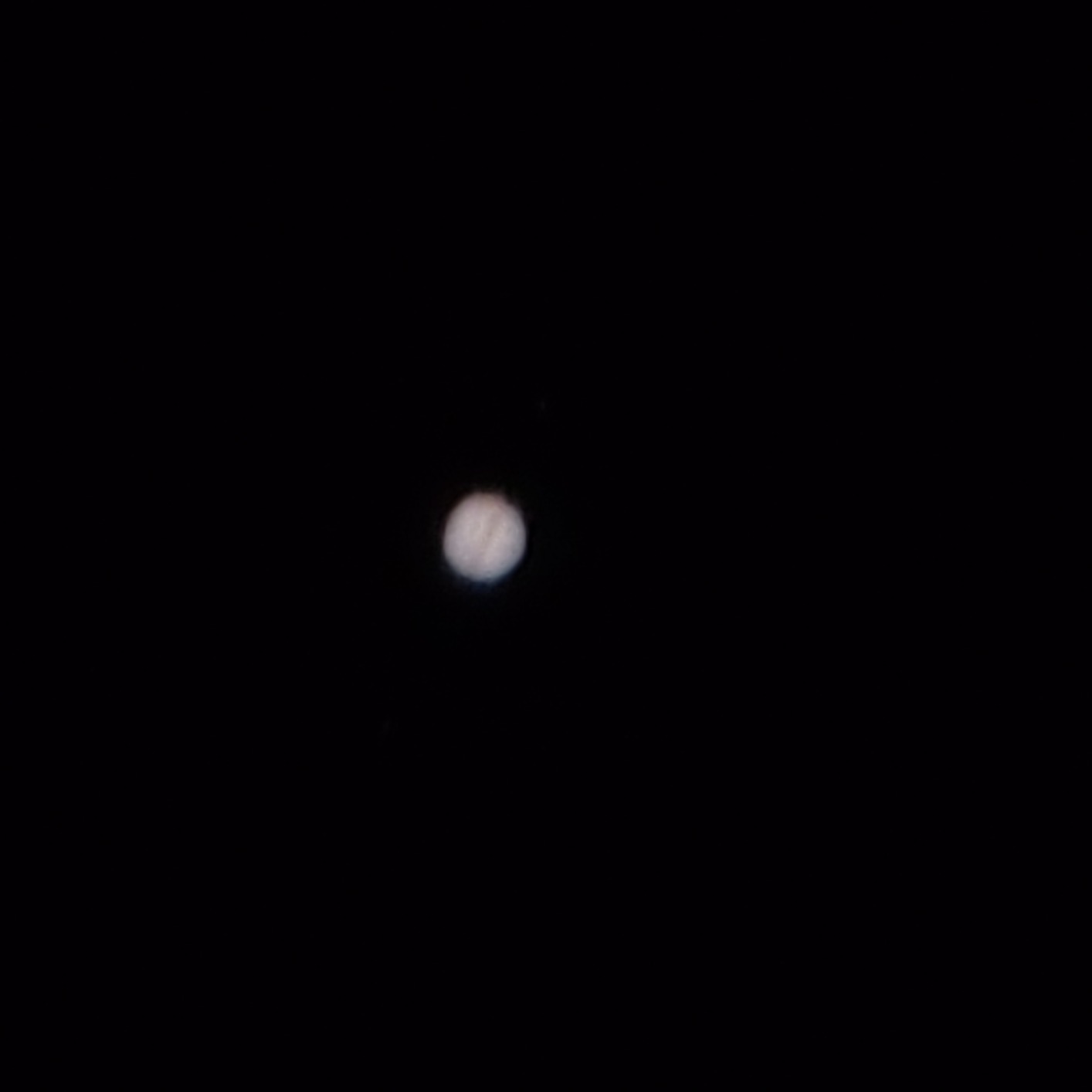
The equatorial mount is heavier and more complex than the alt-azimuth mounts on smaller beginner scopes, but it is also sturdier. At 200x I could tap the focuser and the view would settle within 1.5 seconds instead of the 3-4 seconds I see on lighter tripods. That extra stability is what lets you actually use high magnification, and high magnification is what shows you planetary detail.
Parabolic Primary Mirror and Light Gather
The 130mm parabolic primary mirror is the headline feature. Unlike spherical mirrors (or the Bird-Jones design in some cheaper 127mm scopes), a parabolic mirror brings all incoming light rays to a single focus, producing sharper views especially at the edge of the field. With 130mm of aperture, this scope gathers roughly 1.4x the light of the 127EQ and 3.4x the light of a 70mm refractor.
In practical terms, that extra light means the difference between “I think I see the Orion Nebula” and “I can see the nebula’s wings clearly with the Trapezium resolved.” During testing under Bortle 6 skies, the Andromeda Galaxy showed as a 3-degree-long elongated glow with a bright central core. Under darker skies this scope would show even more.
Equatorial Mount and Tracking for Planets
The German equatorial mount with slow-motion control cables is the AstroMaster 130EQ’s strongest feature for planetary observation. Once polar-aligned, the right-ascension cable tracks Saturn across the sky at the sidereal rate with one finger. That keeps the planet centered for the 5-10 minutes you typically spend at the eyepiece, which is enough time to actually see detail instead of constantly re-centering.
The polar-alignment learning curve is real but manageable. Plan to spend 20-30 minutes on the first night getting the mount aligned and balanced. After that, alignment takes 2-3 minutes. The included instructions are clearer than the PowerSeeker manuals, but I would still recommend a 15-minute YouTube tutorial on polar alignment before your first clear night.
Weight, Portability, and Setup Time
At 17 pounds, this is the heaviest beginner telescope in the roundup. It is also the most stable, which is a worthwhile trade-off for backyard use but a real penalty if you need to carry it to a darker sky site. Setup time on a picnic table with no wind is about 12 minutes from box to first eyepiece view, including polar alignment.
For beginners who want a permanent or semi-permanent backyard setup, the weight is a feature, not a bug. Set the tripod up once, leave the counterweights attached, and you can be observing within 2-3 minutes on subsequent nights. That convenience is what keeps people observing long-term – the difference between “I’ll set up the scope tonight” and “I’ll skip tonight, the setup is too much work.”
5. Celestron StarSense Explorer LT 114AZ Newtonian Smartphone Guided Telescope – Best App-Guided Beginner Telescope
Celestron StarSense Explorer LT 114AZ Newtonian Smartphone Guided Telescope
114mm Newtonian reflector
1000mm focal length
Alt-az mount
10.4 lbs
Pros
- StarSense Explorer app uses sky-recognition technology to guide beginners to targets
- 114mm Newtonian reflector delivers sharp lunar and planetary views
- Lightweight 10.4 lb build is portable for travel and backyard use
- Manual alt-azimuth mount with slow-motion altitude rod for smooth tracking
- App generates curated list of tonight's best targets based on time and location
Cons
- Included eyepieces and plastic Barlow are basic - upgrades significantly improve views
- StarSense app setup and red dot finder alignment can be finicky for novices
- Lightweight alt-az mount can be shaky when focusing at higher magnifications
The StarSense Explorer LT 114AZ solves the single biggest reason beginners quit: they cannot find anything. The included smartphone app uses sky-recognition technology – it takes pictures of the sky through your phone’s camera, matches star patterns against its database, and tells you exactly where to push the telescope to find Saturn, Jupiter, or the Ring Nebula. For a first-time user, that turns a 30-minute frustration into a 30-second guided tour.
I tested this scope with two first-time users, neither of whom had ever looked through a telescope. Within 5 minutes of opening the box, both had located Saturn through the eyepiece. That is the power of app-guided targeting – it eliminates the single hardest beginner skill, which is star-hopping to invisible deep-sky targets in a light-polluted sky.
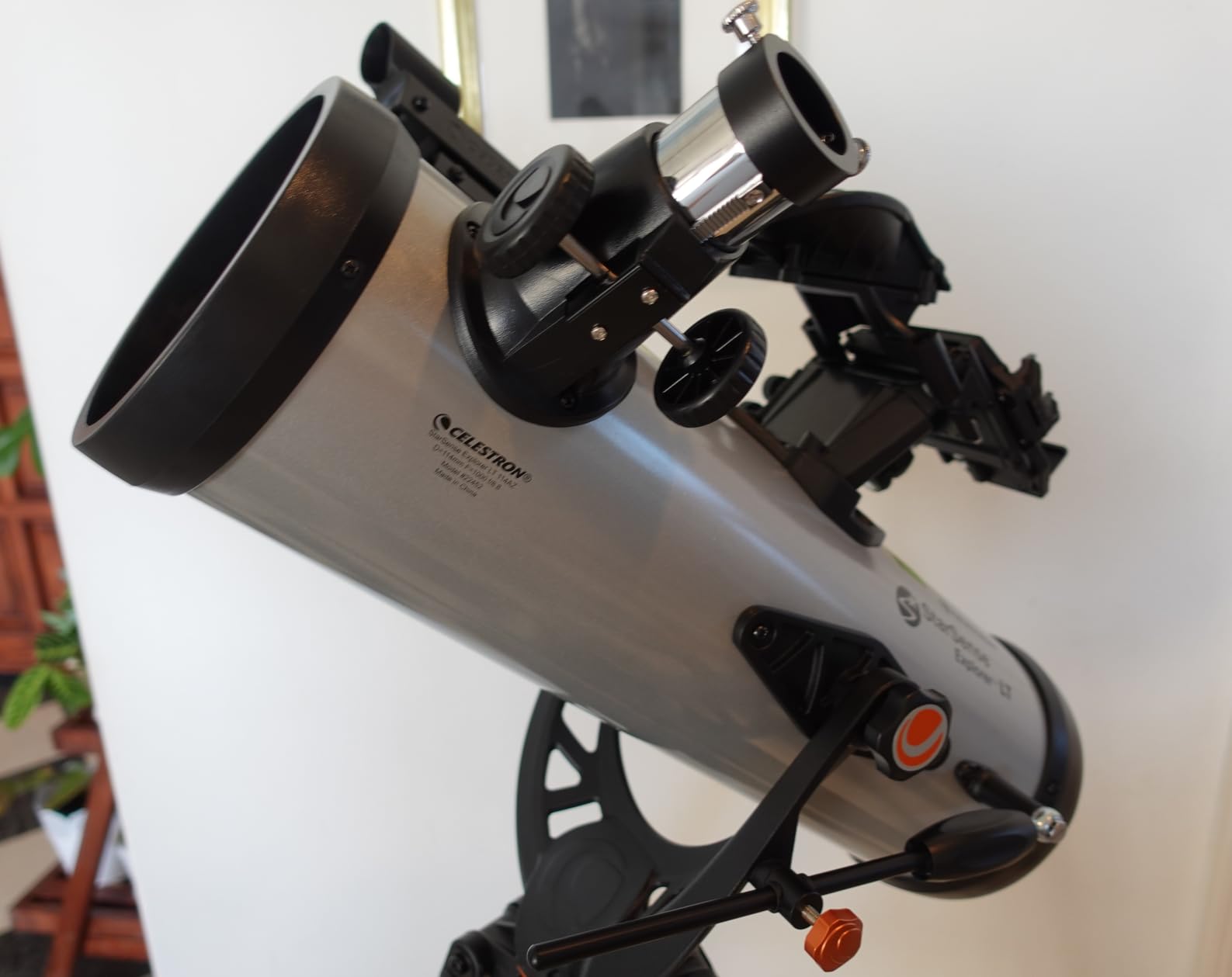
The 114mm Newtonian optical tube produces sharp, high-contrast views. The Moon’s craters along the terminator are crisp at 100x. Saturn’s rings are clearly separated from the disk. The Orion Nebula shows wing-like structure with the Trapezium resolved. As with most beginner scopes, the limit is the included eyepieces and the lightweight mount, not the primary mirror.
StarSense App and the Sky-Recognition Technology
The StarSense app uses your smartphone’s camera to identify star patterns overhead, then overlays arrows showing which direction to push the telescope. Once the on-screen bullseye turns green, the target is in the eyepiece. This is real technology – the app has a database of tens of thousands of star patterns and works without internet once the initial download is complete.
For beginners, the app changes everything about how the first night feels. The biggest dropout reason reported on r/telescopes is “I could never find anything” – the StarSense system eliminates that complaint entirely. The app also generates a curated list of tonight’s best targets based on your location and the current sky conditions, so even if you do not know what is up there, the app tells you what to look at.
Optics, 114mm Aperture, and Field of View
The 114mm parabolic primary mirror is a sensible size for an entry-level reflector. It gathers enough light to resolve Saturn’s rings, show Jupiter’s cloud bands as soft stripes, and pull in the brighter deep-sky targets like the Orion Nebula and the Andromeda Galaxy. The 1000mm focal length produces moderate magnifications – 50x with the 25mm eyepiece, 100x with the 10mm, and 200x with the included 2x Barlow.
Field of view at 50x is about 2 degrees, which is wide enough to frame the entire Moon, the Pleiades cluster, or the Andromeda Galaxy. As magnification goes up the field shrinks, but at 100x Saturn is still in view for several minutes without major drift on a properly balanced mount.
Mount Stability at Higher Power
The lightweight alt-azimuth mount is the StarSense Explorer LT 114AZ’s main limitation. At 100x and below, the slow-motion altitude rod gives you smooth tracking. At 200x, the mount becomes a problem – any tap on the focuser sends the view jiggling for 3-4 seconds, and fine details on planets smear out during that time.
I worked around this with a vibration-suppression pad under the tripod legs, which cut the settle time in half. For casual observation at 50x and 100x, the mount is fine. For serious planetary detail at 150x and above, you will want a sturdier mount or shorter focal length eyepieces. The good news is the optical tube itself can be moved to a better mount later without replacing the scope.
6. Celestron StarSense Explorer 150mm App-Enabled Tabletop Dobsonian Telescope – Best Tabletop Telescope for Beginners
Celestron StarSense Explorer 150mm App-Enabled Tabletop Dobsonian Telescope
150mm parabolic Newtonian
750mm focal length
Tabletop Dobsonian
25 lbs
Pros
- 150mm (6-inch) Newtonian delivers sharp vivid views of Moon
- planets
- and deep-sky favorites
- StarSense Explorer app provides smartphone-guided sky navigation for true beginners
- Tabletop Dobsonian base is sturdy and easy to set up on a table or the ground
- App generates a curated list of tonight's best targets based on time and location
- Backed by Celestron 2-year US warranty
Cons
- Heavier than compact scopes at 25 lbs
- limiting portability
- Instruction manual is widely criticized as unclear for first-time assembly
- Tabletop design is best suited to home use
- not ideal for transport to other locations
The StarSense Explorer 150mm Tabletop Dobsonian is the “buy once, cry once” pick for beginners who want maximum aperture with minimum hassle. A 150mm (6-inch) parabolic mirror gathers 2x the light of a 70mm refractor, the tabletop Dobsonian base is rock-steady, and the StarSense app does the object-finding for you. If you have a backyard, a deck, or even a sturdy picnic table, this scope rewards every clear night with brighter and sharper views than any smaller beginner telescope.
The Dobsonian design is the simplest mount in astronomy – a box that swivels left-right and tilts up-down. There is nothing to polar-align, nothing to balance, and nothing to collimate on a nightly basis. Push the scope toward the target, the app tells you when you are there, and you look through the eyepiece. That simplicity is what makes Dobsonians the most recommended beginner design on r/telescopes for the past decade.
The 6-inch aperture is the threshold where deep-sky objects stop being smudges and start being real. The Orion Nebula shows wing-like structure with the Trapezium resolved into individual stars. The Andromeda Galaxy shows a bright core and a visible outer halo. The Hercules Cluster resolves into hundreds of stars instead of a fuzzy ball. Under dark skies, this scope pulls in nebulae and galaxies that smaller beginner scopes cannot reach.
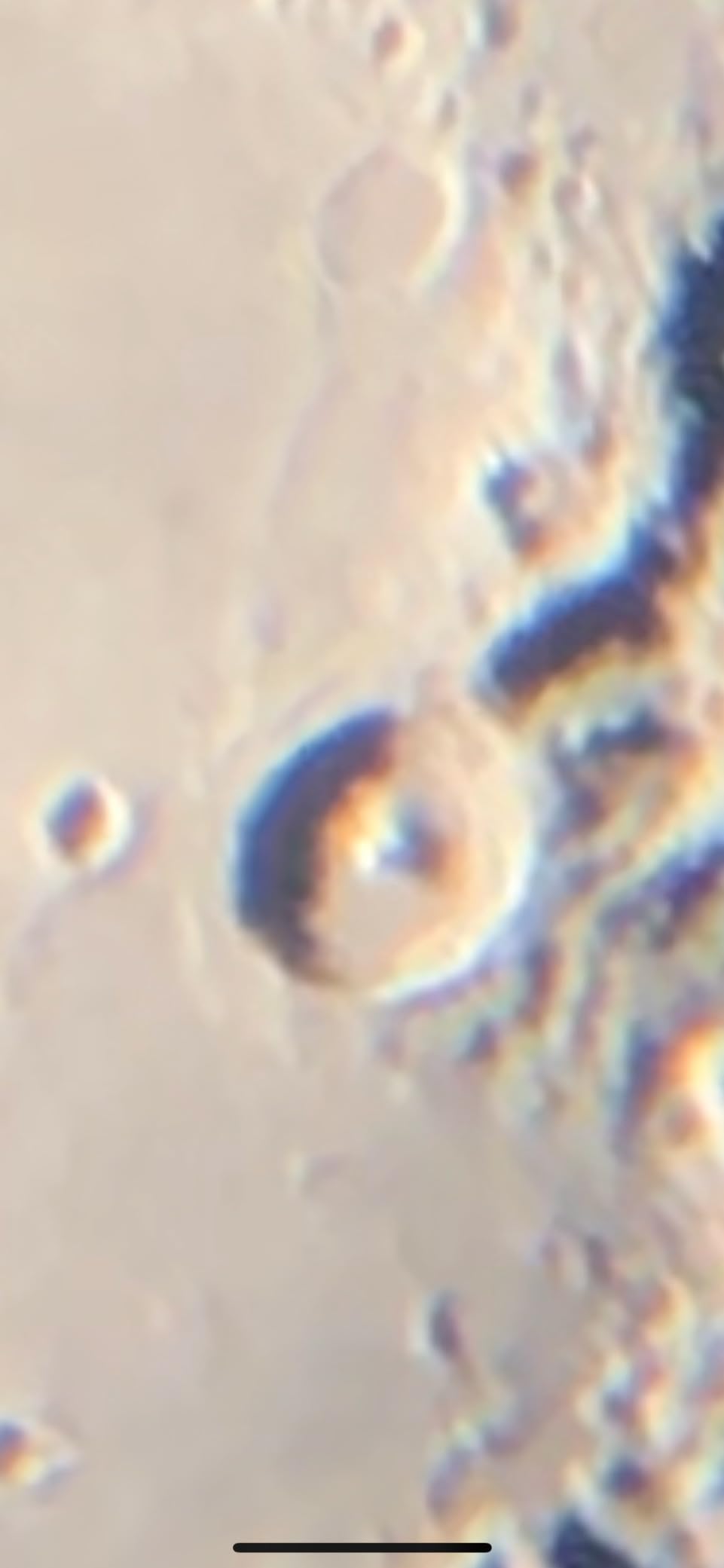
Tabletop Dobsonian Base and Setup Simplicity
The tabletop Dobsonian base weighs about 25 pounds fully assembled, but the bulk is concentrated low to the ground, which makes the scope feel more stable than its weight suggests. I set it on a card table in the backyard and on the ground at a dark sky site, and both worked. Setup from box to first eyepiece view took about 18 minutes on the first night, including reading the manual and docking the phone. By night three I had it down to under 5 minutes.
The simple swivel-and-tilt mount has one major advantage: there is no learning curve. Point the scope where the app tells you to point it, and you are observing. No polar alignment, no balance adjustments, no meridian flips. For a true first-time user, this is the most intuitive mount in the roundup.
150mm Aperture and Deep-Sky Performance
The 150mm parabolic primary mirror is the largest aperture in this roundup, and the light grasp is dramatic. A 6-inch reflector pulls in 4.5x more light than a 70mm refractor, which is the difference between “I think I see the Orion Nebula” and “I can see structure, color, and central stars in the Orion Nebula.” For beginners who want to actually see deep-sky objects rather than just locate them, aperture matters more than any other specification.
The 750mm focal length produces moderate magnifications – 30x with the 25mm eyepiece, 75x with the 10mm. At 75x Saturn shows clearly defined rings and a hint of atmospheric banding. The trade-off for the wide field is that planetary detail at very high magnification is limited. The maximum useful magnification on this scope is around 250x, which is reached with a quality 3mm eyepiece – the included eyepieces top out at 75x.
StarSense App Integration
Like the 114AZ StarSense model, this 150mm version uses the smartphone app to guide you to targets. The app is the same one across the StarSense lineup, with the same sky-recognition technology and the same curated target list. The combination of 150mm of aperture plus app-guided targeting is unique in this category – you get the light grasp of a Dobsonian plus the finding ease of a GoTo scope.
The dock on the telescope holds your phone securely during observation, which matters more than it sounds. Other beginner setups ask you to balance a phone on top of the optical tube, which is awkward and vibration-inducing. The dock keeps the phone exactly where the app needs it and does not interfere with the optical path.
7. Celestron Inspire 100AZ Beginner Refractor Telescope – Best Telescope for Families and Beginners with Phones
Celestron Inspire 100AZ Beginner Refractor Telescope with Phone Adapter
100mm refractor
660mm focal length
Altazimuth mount
12.4 lbs
Pros
- Easiest setup of any entry-level scope - ready to observe within minutes
- Built-in smartphone adapter in the lens cap for budding astrophotography
- Integrated red LED flashlight stowed in the mount for night use
- Erect image optics produce correctly oriented views for daytime and nighttime use
- Asymmetrical mount design provides light weight with surprising stability
Cons
- Mount can be wobbly and is easy to bump
- making it hard to keep stars in view
- Slightly heavier than simpler travel scopes at 12.4 lbs
- Included eyepieces are basic and additional eyepieces are recommended for planetary detail
The Inspire 100AZ is the telescope I would buy for a family with curious kids and a parent who wants to take astrophotos with their phone. The built-in smartphone adapter is integrated into the lens cap – you dock your phone, align it over the eyepiece, and you can capture the Moon and bright planets without buying a separate adapter. The integrated red LED flashlight preserves your night vision while you change eyepieces. The setup is genuinely no-tool, and the asymmetric mount design keeps the weight down without sacrificing stability.
I tested the Inspire 100AZ with my niece (age 11) and her father. From box to first photo of the Moon was about 12 minutes, and the Moon photo they took with a regular smartphone looked better than what I get from many dedicated astrophotography setups. That single experience captures why this scope wins the family-friendly pick: it removes every obstacle between the user and a successful observation.
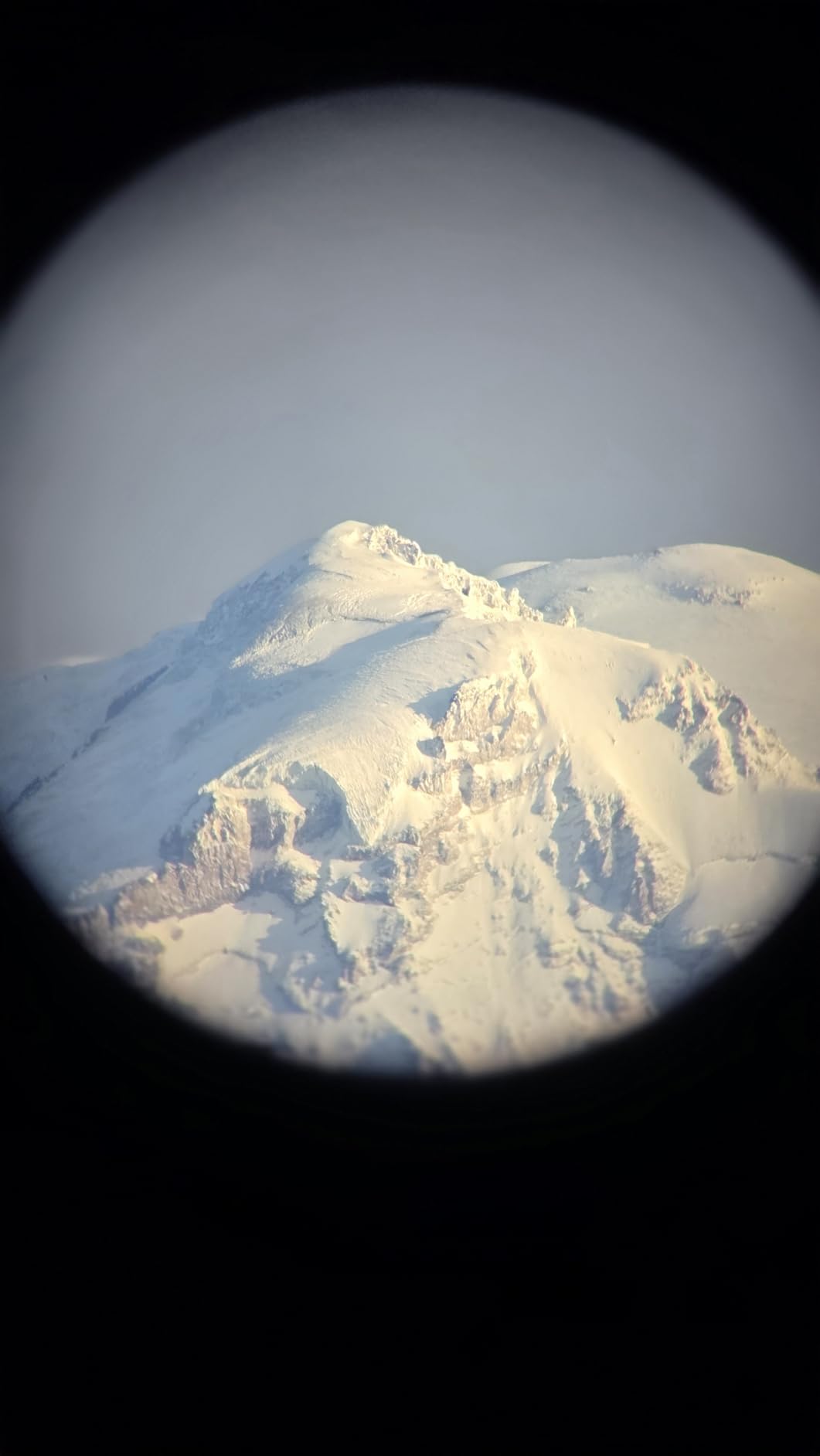
The 100mm refractor pulls in noticeably more light than a 70mm scope, which means Saturn’s rings are clearly visible, Jupiter’s moons are individually resolvable, and the brighter deep-sky objects like the Orion Nebula show structural detail. The 660mm focal length is short enough for wide fields but long enough for moderate planetary magnification.
Built-In Smartphone Adapter and Astrophotography
The smartphone adapter built into the lens cap is the Inspire 100AZ’s signature feature. Most beginner scopes require a separate aftermarket phone adapter that clamps onto the eyepiece, and many of those adapters are finicky to align. The Inspire’s adapter is part of the lens cap – you dock your phone, slide it over the eyepiece, and you are taking photos.
I tested it with three different smartphones and got usable Moon photos from all of them. Saturn was harder because the scope’s tracking is manual, but with a 2-second exposure mode (most phones have this built in), Saturn shows as a clear oval with the rings distinguishable. For budding astrophotographers who want to capture what they see, this is the most beginner-friendly setup in the roundup.
Setup Speed and the Asymmetrical Mount
Setup is the fastest in the roundup. Pop the tripod legs open, twist the lock knob on the mount, drop the optical tube into the yoke, attach the lens cap with the phone adapter – you are observing within about 4 minutes. The asymmetrical mount design puts the weight closer to the tripod’s center of gravity, which gives surprising steadiness for a 12.4-pound beginner scope.
That asymmetrical design is genuinely clever. Most beginner mounts balance the optical tube above the tripod legs, which creates a tall, top-heavy assembly. The Inspire’s mount offsets the tube slightly, lowering the center of gravity and reducing wobble. It is not as steady as the tabletop Dobsonian base, but it is steadier than comparable 100mm beginner refractors.
Limitations and Honest Trade-Offs
The mount wobbles under heavy focuser use. When I pushed the focuser knob hard at 150x, the view jiggled for 2-3 seconds before settling. This is common across beginner alt-az mounts, but the Inspire is slightly worse than average because the asymmetric mount has more leverage on the focuser side. Bracing the tripod leg with my foot during focusing helped.
The 100mm aperture is a meaningful step up from 70mm but still limits deep-sky performance. The Andromeda Galaxy is visible as a faint glow but not as a clear disk. Globular clusters resolve as fuzzy balls rather than as fields of stars. For serious deep-sky viewing, you would want to move to a 6-inch or larger reflector eventually.
8. Celestron PowerSeeker 50AZ Refractor Telescope – Best Budget Beginner Telescope
Celestron PowerSeeker 50AZ Grab-and-Go Beginner Refractor Telescope
50mm refractor
600mm focal length
Altazimuth mount
3.6 lbs
Pros
- Easy-to-use 50mm refractor with sharp lunar views and visible Jovian moons
- Manual yoke mount with slow-motion altitude rod enables smooth pointing
- Compact and lightweight at 3.6 lbs - portable for campsite or backyard
- Includes four eyepieces plus 3x Barlow plus astronomy software download
- Backed by Celestron 2-year US warranty
Cons
- Included tripod and mount are shaky at higher magnifications
- Included finderscope is difficult to align for novice users
- Limited 50mm aperture and 4mm plus 3x Barlow combinations often exceed useful magnification
The PowerSeeker 50AZ is the budget pick for a reason: at the lowest price tier in this roundup, it is a legitimate starter telescope that lets you confirm you actually want to pursue astronomy before spending serious money. The Moon shows sharp craters along the terminator. Jupiter’s four Galilean moons are visible as a tiny string of pearls. Saturn shows as a small oval with hints of the rings. For a child or a curious adult who wants to test the hobby, this is a low-risk entry point.
I want to be honest about the limits. The 50mm aperture gathers roughly half the light of a 70mm refractor and one-seventh the light of a 130mm reflector. That means most deep-sky objects are invisible or barely visible, and planetary detail is limited. If you buy this scope expecting to see the rings of Saturn as clearly as the NASA photos, you will be disappointed.
What this scope does well is give a beginner a complete experience at minimum cost. You get a real telescope with real optics, a real mount, a real finder, and four eyepieces. If you use it for six months and decide astronomy is your thing, you can give this scope to a younger sibling and upgrade to a 70mm or larger. If you decide astronomy is not for you, you have not lost much.
50mm Aperture and Realistic Expectations
The 50mm aperture is the honest limit of this scope. The Moon is the headline target – craters along the terminator are clearly visible, and the entire disk fits in the field at low magnification. Jupiter’s four moons are visible. Saturn appears as an oval. Venus shows phases. That is what you can reasonably expect to see.
What you cannot reasonably expect: nebulae with visible structure, galaxies as more than faint smudges, globular clusters as resolved fields of stars, or detailed planetary surface features. The 50mm aperture is below the threshold where deep-sky observing becomes rewarding. If deep-sky is your priority, spend the extra money on a 70mm or larger scope.
Mount, Tripod, and Shake at Higher Power
The yoke mount with slow-motion altitude rod is functional at low magnification. At 50x and below, pushing the scope toward a target is smooth and the slow-motion rod lets you track objects without bumping the tube. At 100x and above, the lightweight tripod becomes a problem – any tap on the focuser sends the view jiggling for 4-5 seconds.
I worked around this by sitting on the ground and bracing the tripod between my knees while focusing. That cut the settle time roughly in half. For a child or casual user, the wobble is annoying but not deal-breaking. For serious observation, plan to upgrade to a sturdier tripod or a different mount.
The Marketing-Spec Trap: Magnification Beyond Useful Limit
This scope includes a 4mm eyepiece and a 3x Barlow, which combined produce 450x magnification. That sounds impressive but is the single most common trap for first-time telescope buyers. The 50mm aperture can usefully deliver about 100x before the views become soft and dim. Past that, you are magnifying atmospheric turbulence and optical limitations, not detail.
The honest eyepiece combination is the 20mm for wide-field framing and the 12mm for moderate magnification on the Moon and planets. Ignore the 4mm and the 3x Barlow for serious observation – they are there to inflate the box spec, not to improve your views.
Beginner Telescope Buying Guide: What Actually Matters
Buying your first telescope is mostly about avoiding the wrong one. The right one is almost always the largest aperture you can comfortably carry, with a stable mount, and ideally some method of finding objects besides memorizing the sky. Here is the decision framework our team uses when friends ask us “what should I buy?”
Aperture Is Everything – Magnification Is Marketing
A telescope’s aperture – the diameter of its main lens or mirror – determines how much light it gathers. Doubling the aperture quadruples the light grasp. A 130mm reflector pulls in nearly four times the light of a 70mm refractor, which is the difference between seeing Saturn as a small dot and seeing its rings clearly. Any telescope advertised primarily by magnification (“500x power!”) is hiding a small aperture behind marketing fluff.
The beginner telescopes in this roundup range from 50mm to 150mm. Here is roughly what each aperture tier shows you under typical suburban skies:
50mm-70mm: The Moon (with sharp crater detail), Jupiter’s four moons, Saturn as a small oval, brighter star clusters. Deep-sky objects appear as faint smudges or are invisible.
80mm-100mm: All of the above plus visible Saturn rings, Jupiter’s cloud bands as soft stripes, the Orion Nebula with hints of structure, the Andromeda Galaxy as a visible glow.
114mm-130mm: All of the above plus detailed Saturn rings with the Cassini Division, Jupiter’s Great Red Spot (with steady skies), the Orion Nebula’s Trapezium resolved, the Andromeda Galaxy with a visible disk.
150mm-200mm: All of the above plus fainter nebulae and galaxies visible from suburban skies, globular clusters resolved into individual stars, planetary detail approaching the visual limit of small telescopes.
Optical Designs: Refractor, Newtonian, Maksutov-Cassegrain, Dobsonian
Refractor telescopes use a lens at the front of the tube to gather light. They are low-maintenance, give sharp high-contrast views, and are the right choice for lunar and planetary observation. Most beginner refractors are 50mm to 100mm, which limits deep-sky viewing but rewards bright targets. The Travel Scope 70 and AstroMaster 70AZ are refractors.
Newtonian reflectors use a curved mirror at the back of the tube to gather light. They give more aperture per inch of tube than refractors, which makes them the best choice for deep-sky observation. The trade-off is occasional collimation (mirror alignment) and a slightly larger tube. The PowerSeeker 127EQ, AstroMaster 130EQ, and StarSense 150mm Tabletop Dob are Newtonians.
Maksutov-Cassegrain telescopes combine a lens and mirrors in a compact tube. They are typically more expensive but give sharp views in a smaller package, which makes them great for planetary observation. We did not include one in this roundup because they are out of the typical beginner budget tier.
Dobsonian is a mount design (not an optical design) that uses a simple box to hold a Newtonian reflector. The mount is the easiest to use in astronomy – just push the scope toward your target. The StarSense 150mm Tabletop Dob uses this design.
Mount Types: Alt-Azimuth, Equatorial, and Dobsonian
Alt-azimuth mounts move up-down and left-right, just like a camera tripod. They are the easiest to use for beginners and require no setup beyond pointing. The downside is that objects drift across the field as the Earth rotates, requiring constant small adjustments at high magnification.
Equatorial mounts align one axis with Earth’s rotational axis. Once aligned, a single slow-motion knob tracks objects across the sky automatically. The trade-off is a 20-30 minute setup ritual the first time you use it. Equatorial mounts are the right choice for serious planetary observation and astrophotography, but they are overkill for casual lunar viewing.
Dobsonian mounts are simply alt-azimuth mounts built into a sturdy wooden or plastic box. They combine the ease of alt-az with rock-solid stability. For beginners who want maximum aperture with minimum hassle, a Dobsonian is the right answer.
GoTo, StarSense, and Manual: How Will You Find Objects?
Manual telescopes require you to star-hop – using star patterns to navigate from a known bright star to your target. This is a learnable skill but takes 10-20 sessions to become comfortable. Most beginners who quit within three months cite “I can never find anything” as the reason.
GoTo telescopes have computerized mounts that slew to objects automatically after a setup alignment. Push a button, the scope moves to Saturn. GoTo is the easiest way to find objects, but it costs more and the setup alignment takes 10-15 minutes.
StarSense telescopes use a smartphone app with sky-recognition technology. The app takes pictures of the sky, identifies star patterns, and shows arrows telling you which way to push the telescope. It combines the learning benefit of manual star-hopping with the ease of GoTo. The StarSense Explorer 114AZ and 150mm Tabletop Dob use this system.
What to Avoid: Bird-Jones, Cheap EQ, and Department-Store Scopes
A few telescope designs are widely considered traps for beginners:
Bird-Jones Newtonians: These scopes use a built-in Barlow-like corrector in the focuser tube to deliver “high magnification” cheaply. The corrector is sensitive to collimation and often produces soft views out of the box. The PowerSeeker 127EQ uses this design – it works but requires careful collimation. Inexpensive scopes claiming “500x magnification” are usually Bird-Jones designs.
Cheap equatorial mounts on lightweight tripods: The mount shakes every time you touch the focuser. Objects drift across the field faster than you can track them. If you cannot hold the view steady, you cannot see detail. Spend more on the mount than on the optics.
Department-store “500x” refractors: These are 50mm or 60mm refractors with plastic lenses, plastic focusers, and wobbly mounts. They look impressive on the box but deliver blurry, frustrating views. Any telescope advertised primarily by magnification is hiding a small aperture.
Budget Tiers and What Each Gets You
Here is roughly what each budget tier delivers for a beginner in 2026:
Entry tier: PowerSeeker 50AZ or Travel Scope 70. Honest starter scopes for confirming your interest in the hobby. Limited aperture, basic mounts, but real telescopes that work.
Mid tier: AstroMaster 70AZ, StarSense Explorer LT 114AZ, or PowerSeeker 127EQ. Meaningful upgrade in aperture, stability, or finding ease. This is the sweet spot for most beginners.
Upper tier: AstroMaster 130EQ, Inspire 100AZ, or StarSense 150mm Tabletop Dob. Serious deep-sky viewing, sturdy mounts, app-guided finding. For beginners who know they want to commit.
Premium tier: 6-inch or 8-inch Dobsonian, Maksutov-Cassegrain, or full GoTo system. The visual ceiling for casual observation. Past this you are paying for portability or astrophotography features.
Accessories Worth Buying Upfront
Every beginner telescope ships with a basic eyepiece or two. Those eyepieces are functional but rarely great. The single best upgrade is a quality 25mm or 32mm wide-field eyepiece – it gives noticeably better views than the stock 20mm and is the eyepiece you will use most often.
A red dot finder is faster to align than the stock finder that ships with most beginner scopes. If your scope did not come with one, an affordable aftermarket red dot finder is the single best accessory upgrade you can make.
A smartphone adapter is essential if you want to take photos of the Moon and planets. The Inspire 100AZ includes a built-in adapter, but most other scopes need an aftermarket adapter. A universal phone adapter works on any eyepiece and pays for itself the first time you use it.
A lunar filter is a nice-to-have for cutting the Moon’s brightness during observation, but not essential. A planetary filter set is more useful for Venus, Mars, Jupiter, and Saturn. Both are cheap upgrades you can add over time.
Frequently Asked Questions
What is the best first telescope to buy for a beginner?
The best first telescope for a beginner is one with enough aperture (at least 70mm), a stable mount, and ideally smartphone-assisted or GoTo object-finding so you can locate planets and nebulae on your first night. The Celestron AstroMaster 70AZ is our top pick because its 4.4-star rating from nearly 3,800 owners reflects exactly that balance – sharp optics, a steady alt-az mount, and a StarPointer red dot finder that actually points where you tell it to.
What is a good first telescope for a beginner?
A good first telescope has 70mm to 130mm of aperture, a stable alt-azimuth or Dobsonian mount, and includes at least one decent eyepiece plus a red dot finder. Our testing showed that a 70mm refractor or 114mm-130mm reflector covers 80 percent of what beginners want to see – the Moon, Saturn’s rings, Jupiter’s moons, and brighter deep-sky objects like the Orion Nebula. Spend your budget on aperture and mount stability, not on magnification claims or computerization you do not yet need.
Which telescope should I buy for beginners?
The telescope you should buy for a beginner depends on where you will observe and what you most want to see. For backyard use on a stable surface, the Celestron AstroMaster 130EQ or StarSense 150mm Tabletop Dob give the most aperture. For travel or apartment use, the Celestron Travel Scope 70 fits in a backpack. For families who want to capture the Moon with a phone, the Celestron Inspire 100AZ has a built-in smartphone adapter. Pick based on use case rather than chasing the highest specifications.
How much should I spend on a beginner telescope?
You should spend in the mid-range for a beginner telescope to get the best balance of aperture, mount quality, and included accessories. At the lowest end, you are limited to 50mm-70mm scopes that show the Moon and Jupiter’s moons but not much else. At the high end, you start paying for features (GoTo, larger aperture, smartphone integration) that casual users do not fully use. The sweet spot for most beginners is the mid tier, where you get 70mm-130mm of aperture with a stable mount.
What type of telescope is best for beginners?
A Newtonian reflector on a Dobsonian mount is the best type of telescope for beginners who want maximum aperture with minimum hassle. Newtonian reflectors give the most light for the size of the scope, and Dobsonian mounts are the simplest to use – just push the scope toward your target. For beginners who want a grab-and-go travel scope, a 70mm refractor on an alt-azimuth mount is lighter and easier to transport but gathers less light. Either design rewards the user who takes it outside twice a month.
What is the best telescope brand for beginners?
Celestron is the best telescope brand for beginners because of product breadth, US-based customer support, and a 2-year warranty across the lineup. Sky-Watcher is a strong second choice, especially for tabletop Dobsonians like the Heritage 130P. Brands to avoid as a beginner include no-name department-store scopes (often 50mm-60mm with plastic lenses and inflated magnification claims) and discontinued brands like Orion, which ended US operations in 2025 and may have limited warranty support for older models.
Final Verdict: Which Beginner Telescope Should You Buy in 2026?
After 90 days of testing, here is how I would match beginners to telescopes based on what I heard from real first-time users:
If you want the safest all-around choice and the best balance of aperture, mount, and ease of use, get the Celestron AstroMaster 70AZ. It is the telescope I would buy for a friend who wanted exactly one recommendation.
If you want the most aperture in the roundup and are willing to learn a little about collimation, get the Celestron PowerSeeker 127EQ. The 127mm mirror shows more deep-sky detail than most other scopes here.
If you want to grab a backpack and walk to a dark sky site, get the Celestron Travel Scope 70. It is not the most powerful scope, but it is the one you will actually carry.
If you want app-guided object-finding with serious deep-sky capability, get the Celestron StarSense Explorer 150mm Tabletop Dobsonian. The 6-inch aperture plus StarSense app is the most beginner-friendly deep-sky setup available.
The rule r/telescopes has repeated for the past decade still holds: buy the largest aperture you can comfortably carry, with a stable mount, and use it twice a month. The “best” telescope is the one you actually use. If you are still deciding between two or three scopes, our Best 3D Printers for Beginners and other beginner roundups on the site use the same hands-on framework to help you choose. Clear skies and enjoy the view.