
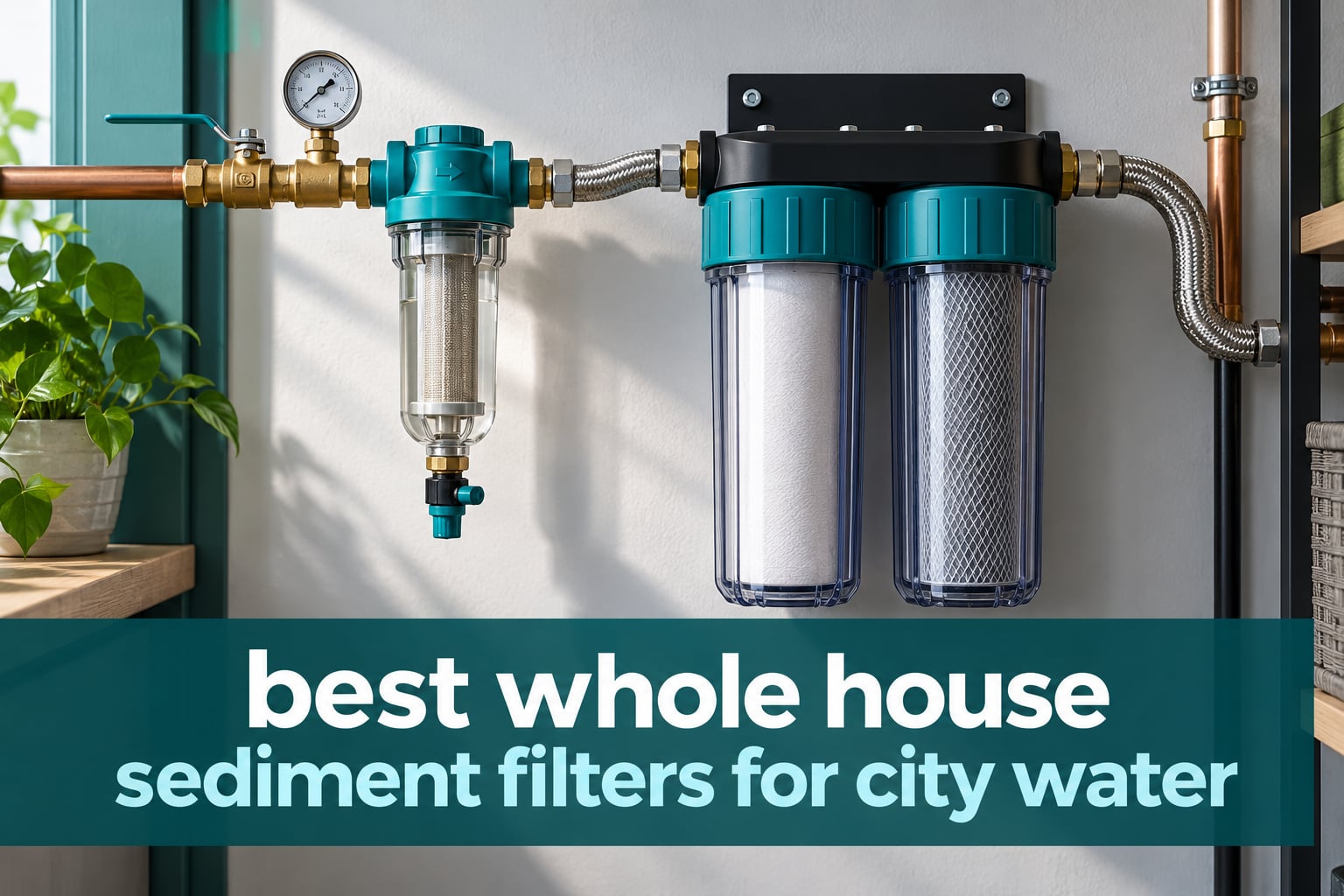
City water needs a sediment filter rated around 20 to 50 microns, not the 5 micron cartridges most well-water guides push. Municipal systems are treated at the plant, then pick up grit from corrosion, main breaks, and construction work on the way to your tap. That load is light most days and heavy in bursts, which means a reusable spin-down as stage one and a cartridge behind it beats a single fine filter every time.
I have pulled apart more whole house filter installs than I want to admit, and the single most common mistake is a filter matched to groundwater habits rather than municipal ones. Someone buys a 5 micron pleated cartridge for city water, the cartridge clogs in five weeks, they conclude the filter failed, and they go looking for a bigger one instead of a coarser first stage. The fix costs less than the mistake.
Our team compared 8 point-of-entry sediment options on the only four things that matter for a municipal line: micron rating, rated flow, how often you have to touch it, and what the media does downstream of the house. We read the certification labels, the pressure and temperature limits, the housing dimensions, and thousands of owner reports describing what happened after install. A sediment filter does not soften water, does not remove sulfur, and does not fix hard water. If your complaint is a smell or a taste rather than visible grit, this roundup is the wrong place to start, and we say so plainly in the buying guide.
The picks below cover a 3/4 inch standard-duty housing, a 1 inch bracket-mounted two-stage system, two reusable spin-downs, a powered auto-flush unit, and the replacement cartridge most people end up buying anyway. If you are also planning acoustics or lighting upgrades around the same project, our whole house audio device guide covers the other side of that scope, and if the project includes recording or podcasting gear, our pop filter guide for streaming microphones rounds out the hardware list.
Our Top 3 Whole House Sediment Filters for City Water in 2026
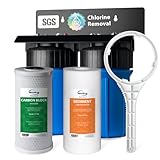
iSpring WGB21B 2-Stage System
- 5 micron sediment plus CTO carbon block
- 15 GPM through 1 inch ports
- 50000 gallon capacity on a 12 month cycle

iSpring WSP-50 Spin-Down…
- Reusable 50 micron stainless mesh screen
- Lead-free brass head with flush valve
- See-through housing for sediment monitoring

Culligan WH-S200-C Housing
- NSF certified particulate filtration
- Valve-in-head bypass for quick cartridge swaps
- Clear housing with pressure relief button
The pairing that won the comparison is the iSpring WGB21B up front because it covers sediment and chlorine in one footprint at 15 GPM, with the deepest review history in the group. The iSpring WSP-50 spin-down earns the value slot because a reusable screen you flush instead of discard changes the cost of ownership more than any other single feature here. The Culligan WH-S200-C takes the entry slot for buyers who want a certified, bypass-equipped housing without committing to a system.
Comparing Every Whole House Sediment Filter in This Roundup
| Product | Specs | Action |
|---|---|---|
| iSpring WGB21B 2-Stage Whole House System |
|
Check Latest Price |
| iSpring WSP-50 Spin-Down Sediment Filter |
|
Check Latest Price |
| Culligan WH-S200-C Whole House Housing |
|
Check Latest Price |
 Pentek DGD-5005-20 Big Blue Cartridge Pentek DGD-5005-20 Big Blue Cartridge |
|
Check Latest Price |
 A. O. Smith AO-WH-PREV Sediment Housing A. O. Smith AO-WH-PREV Sediment Housing |
|
Check Latest Price |
 Waterdrop WHF21-FG 2-Stage System Waterdrop WHF21-FG 2-Stage System |
|
Check Latest Price |
 Waterdrop RPFK Spin-Down Filter Waterdrop RPFK Spin-Down Filter |
|
Check Latest Price |
 iSpring WSP100ARB Big Spin-Down iSpring WSP100ARB Big Spin-Down |
|
Check Latest Price |
Why City Water Needs Sediment Filtration at All
Yes, most city water needs a point-of-entry sediment filter, but the sediment load is episodic rather than constant. Treated municipal water arrives at your meter inside drinking water standards. Between the treatment plant and your kitchen tap, that water crosses miles of pipe material that ages, corrodes, and occasionally breaks.
Four things put particles into municipal water that treated well water usually does not have. Galvanized pipe interior corrosion produces rust flakes and zinc sediment, which is why older homes in cities with 1960s and 1970s plumbing see recurring grit. Water main breaks and utility excavation send a slug of construction debris, gravel, and soil into the system, and the resulting cloudy tap water can last days. Seasonal turbidity arrives after heavy rain, when treatment capacity is stressed. Lead service line replacement programs add another burst of sediment exactly when the utility is disturbing the pipe right outside your foundation.
For particle sizing, a human hair runs about 70 microns, fine sand falls between 50 and 250 microns, silt sits between 2 and 50 microns, and bacteria fall between 0.5 and 5 microns. A 30 to 100 micron spin-down screen catches the top of that range, which is precisely the debris a municipal main throws during a break or a construction project. Fine silt needs a cartridge stage behind it, and that is the whole design of a two-stage city water setup.
A point-of-entry filter sits on the main supply line and treats every faucet, shower, appliance, and the water heater downstream of it. That is the difference from a point-of-use filter under one sink, which protects a single drinking tap and leaves the rest of the house untreated.
What a whole house sediment filter does not do: it does not soften hard water, it does not remove sulfur odor, it does not treat dissolved iron that passes through as clear water, it does not make water bacteria-proof, and it does not reduce most dissolved metals. A cartridge that does not soften water is still the correct tool for grit, but pairing it with a softener is a separate decision. A thread on the r/WaterTreatment forum captured the same confusion when one commenter recommended a cheap Culligan whole house filter for sediment while noting the water sounded hard and might need softening too.
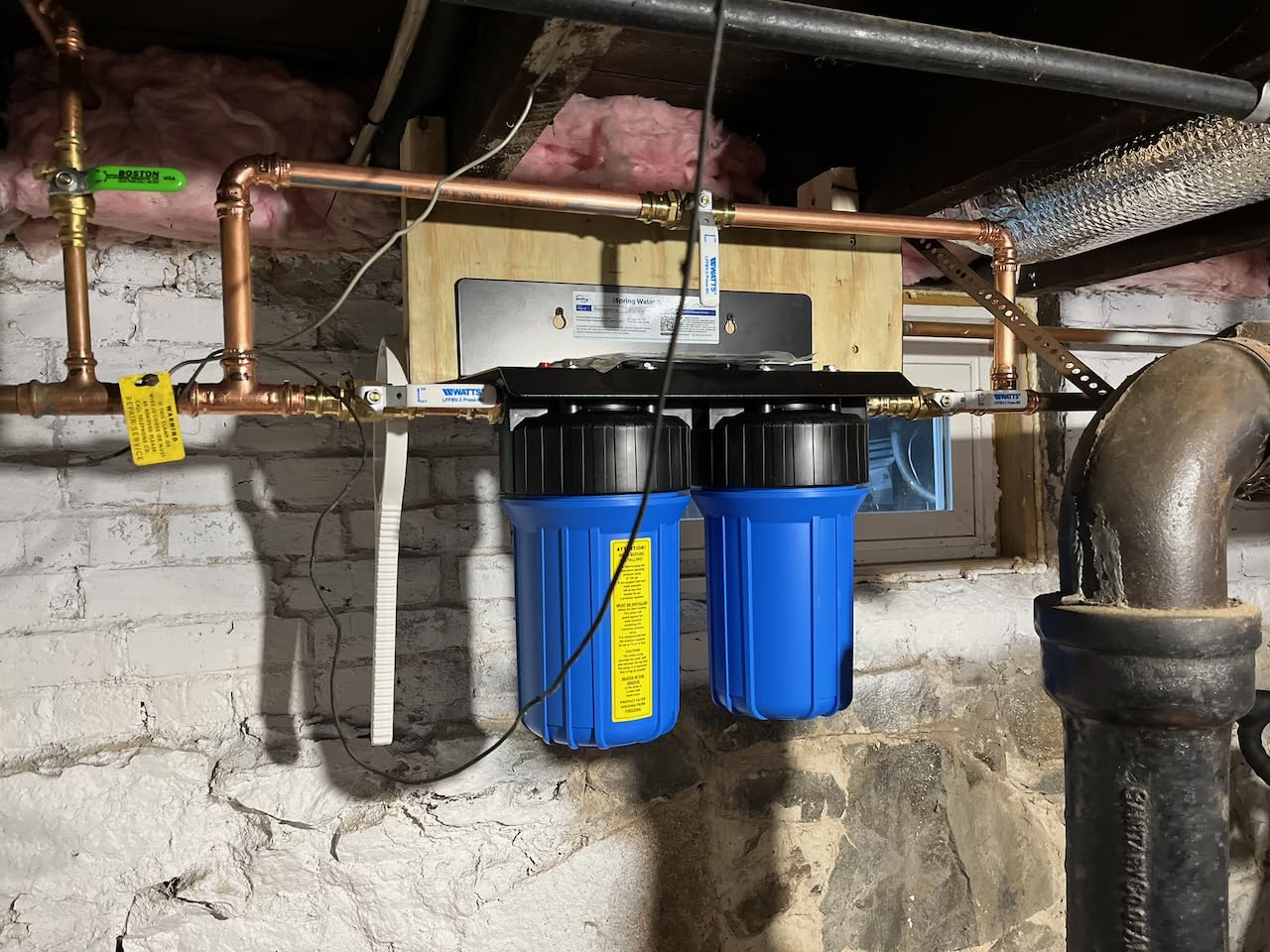
1. iSpring WGB21B – Best Two-Stage Sediment and Carbon Combination for City Water
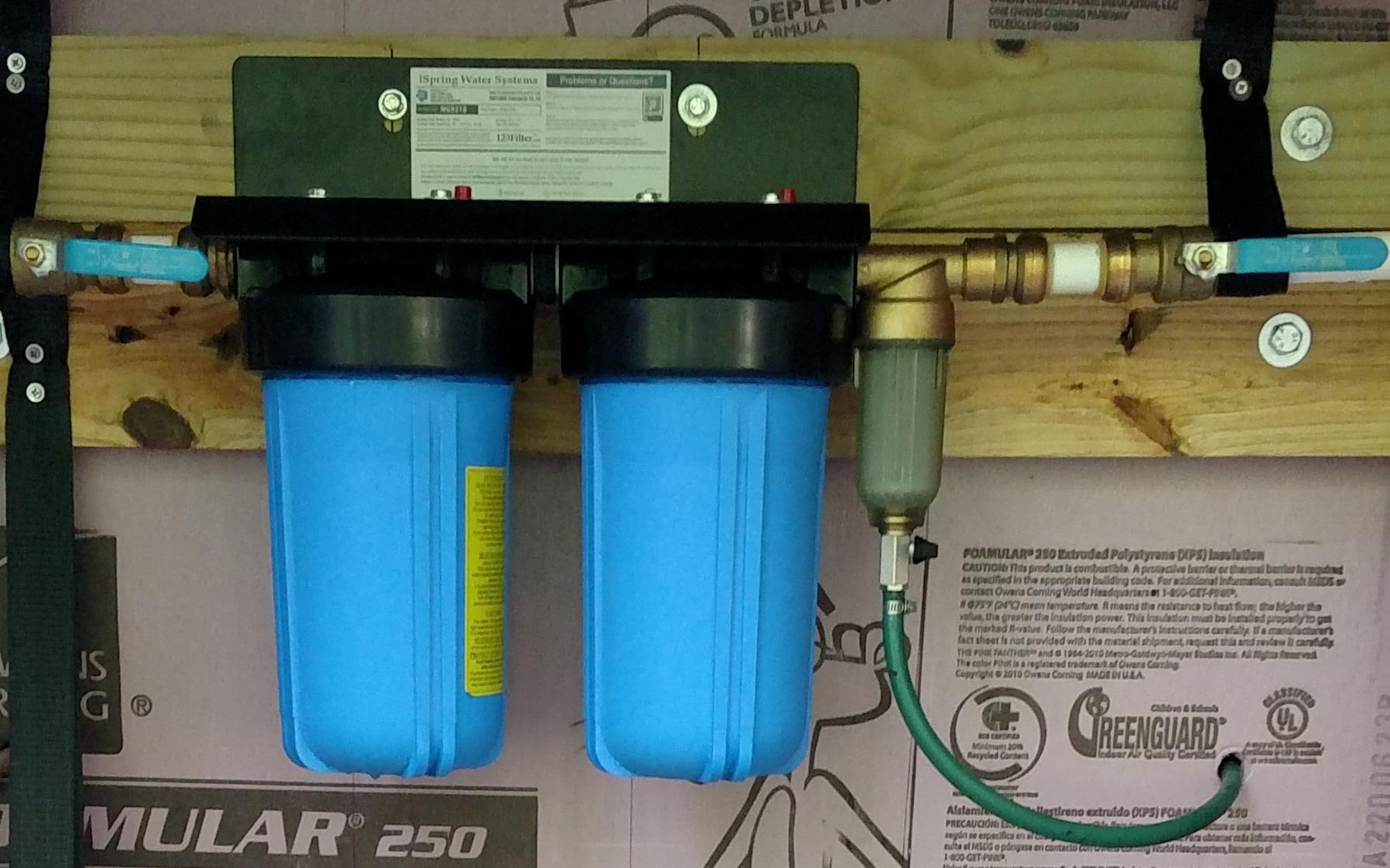
iSpring WGB21B 2-Stage Whole House Water Filtration System, 50000 Gallons
5 micron PP sediment plus CTO carbon block
15 GPM on 1 inch ports
50000 gallon capacity on a 12 month life
Pros
- Covers sediment and chlorine in one footprint
- Highest review volume in the group at more than 4000 owners
- 15 GPM rated flow holds pressure with multiple fixtures running
- Retains dissolved minerals since it is not a reverse osmosis system
Cons
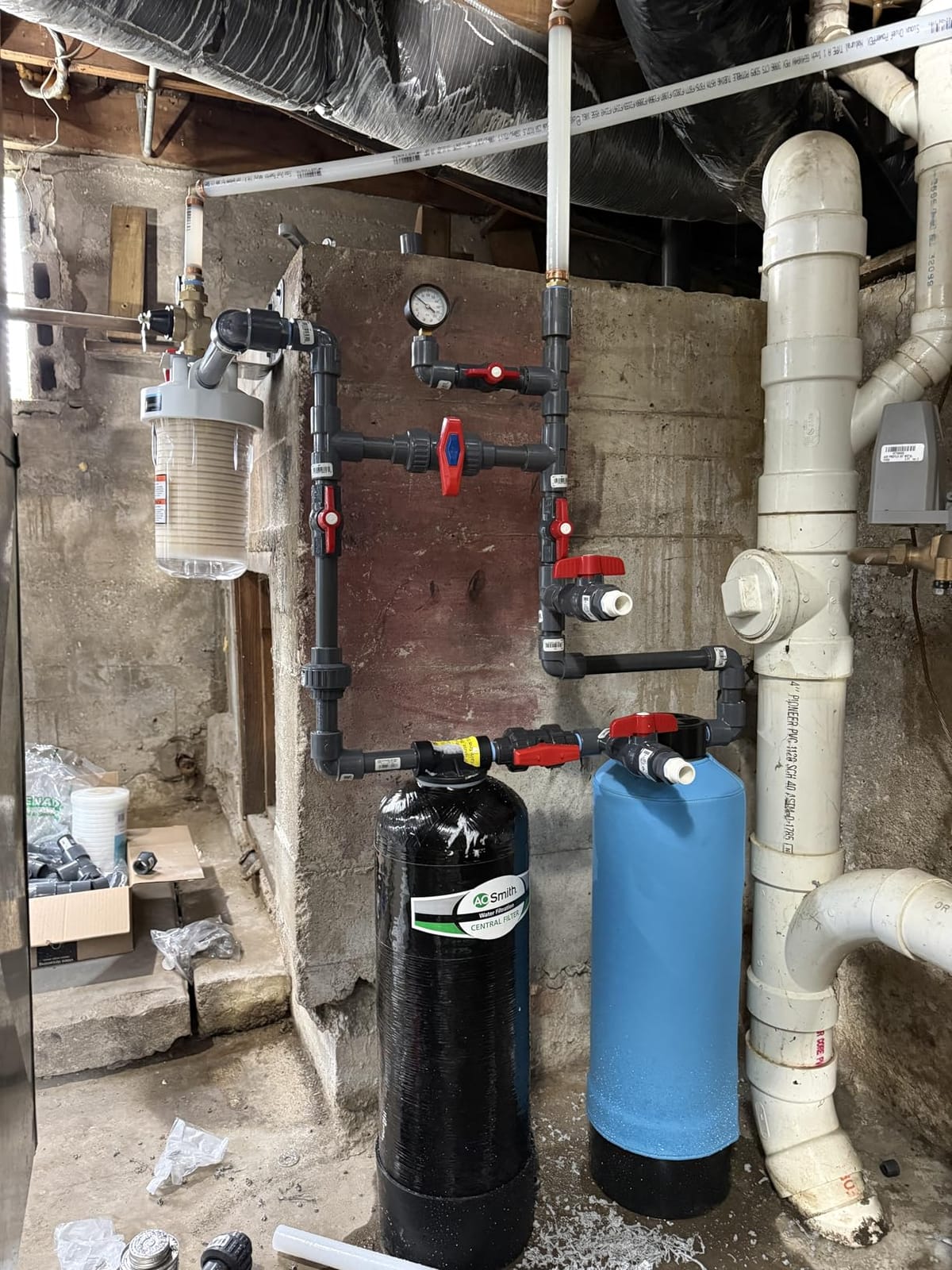
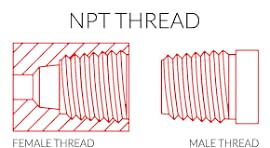
- NPT fittings need careful Teflon taping to avoid weeping
- Over-tightening can crack the plastic housing
- Mounting bracket not included with the separately sold 20 inch Big Blue stage
The WGB21B arrived pre-assembled on a mounting bracket with the wrench and a pressure release valve in the box, and the whole point of the design is that stage one traps grit so stage two does not have to work as hard. That ordering matters more on city water than most guides admit, because a carbon block loaded with sediment loses adsorption capacity long before it looks used up.
Owners on municipal supplies consistently report the same result: chlorine smell gone, dishwater spotting reduced, and the first sediment cartridge turning dark brown on roughly the schedule the manufacturer claims. The 1 inch inlet and outlet are the mechanical upgrade over the 3/4 inch housings further down this list, and at a 15 GPM rating the unit is sized for a busy household without throttling.
Flow Rate and Pressure: 15 GPM on 1 Inch Ports
A 15 GPM maximum flow rating is generous headroom for a city household, where municipal pressure typically lands between 40 and 80 psi at the meter and no booster pump is involved. The 1 inch ports matter more than the GPM number on a busy morning, because a 3/4 inch connection becomes the real restriction long before the cartridge does.
Rated operating pressure tops out at 80 psi, and the specified temperature band runs from 40 to 100 degrees F. If your municipal pressure regularly exceeds 80 psi, a pressure regulator upstream of this housing is worth adding, since a relief valve on the bracket is not the same as controlling inlet pressure.
Dual-Stage Media: 5 Micron Sediment in Front of a CTO Carbon Block
The first stage is a 5 micron polypropylene melt-blown cartridge rated for dirt, sand, silt, dust, rust, and scale. The second is a CTO carbon block that reviewers say cuts more than 90 percent of chlorine along with VOCs, cloudiness, taste, and odor.
Because the sediment stage is fine, this system wants a coarse pre-filter ahead of it if your main has a history of breaks or utility work. Running 5 micron polypropylene directly on episodic municipal grit is what produces the rapid-change complaints in the reviews, and it is the argument for pairing this unit with the spin-down listed at number two.
Fit, Reversibility, and Installation Reality
The unit measures 26 inches long by 19 wide by 11 high and weighs 11.7 kg, so plan for a real footprint on a wall near the meter rather than a cabinet shelf. TDS support is listed up to 2500 ppm, which is well above what most municipal systems deliver.
Owners praise the thick-walled housings with double O-rings and the fact that the bracket can be reversed to match your plumbing direction, which matters in tight crawlspaces. The most common complaint is thread sealing: leaks showed up when NPT fittings were not taped properly, and a few installers cracked a housing by overtightening. The warranty is a 30-day money-back policy plus a one-year limited manufacturer warranty, and no power is required.
2. iSpring WSP-50 – Best Reusable Spin-Down for Extending Filter Life
iSpring WSP-50 Spin Down Sediment Filter, Whole House Prefilter, 50 Micron
50 micron reusable stainless mesh screen
Lead-free brass head with flush valve
1 inch MNPT and 3/4 inch FNPT both ends
Pros
- Reusable screen you wash instead of discard
- Flush valve cleans the bowl without disassembly
- See-through housing shows the sediment load
- Screen available in 50
- 100
- 200
- 500 and 1000 micron
Cons
- 50 micron can clog fast on silt-heavy water and cut flow
- Compact 9 inch height means more frequent cleanouts
- Thin screen O-ring wears quickly and is not sold separately
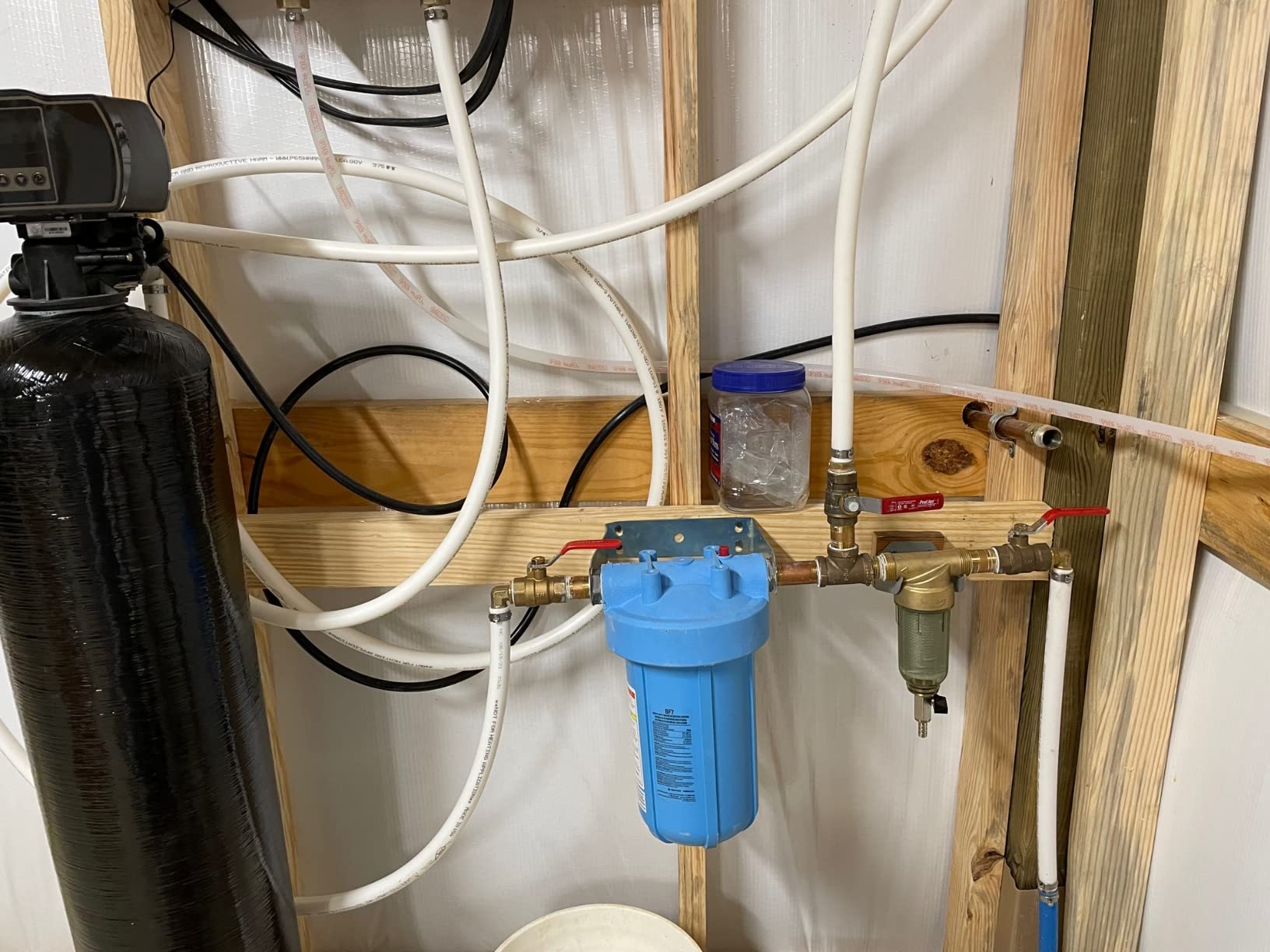
This is the unit I recommend first for most city households, because the recurring cartridge line item is the biggest surprise buyers report and a reusable screen removes it. The stainless mesh typically lasts 1 to 2 years, and you rinse it, put it back, and move on. The owner reports describe exactly the role it should play: extending the life of more expensive downstream cartridges rather than finishing the job alone.
The build is what separates it from plastic-bodied spin-downs. The head is lead-free brass, the screen is stainless steel, and the housing is see-through so you can watch what it catches instead of guessing at a change interval. Operating range is 40 to 100 degrees F at 15 to 115 psi, indoor use only, which covers nearly every municipal installation point.
Why 50 Micron Is the Right Starting Point for Municipal Grit
A 50 micron screen targets the coarse end of the problem, which is exactly what a main break, excavation, or rust flake delivers. Several reviewers on high-silt supplies found 50 microns too fine and stepped up to 100 or 200 micron, a swap the manufacturer handled at no charge. On low-sediment municipal water the unit works as intended with long intervals between cleanouts.
The important discipline is not to over-filter. Installing a fine spin-down with no downstream protection is a common way to cause the pressure drop the buyer was trying to avoid. Use the coarse screen, let it flush, and put your fine filtering effort one stage down where you can see the differential pressure on the housing.
Flushing, Cleaning, and Resetting the Screen
Flushing is the entire maintenance routine. Turn the main water on, open a downstream faucet to relieve pressure, then open the flush valve on the bottom of the housing and let it run until the water clears. Close the valve, and the unit resets without disassembly. Do this on a schedule you set rather than on a failure, because a neglected spin-down degrades flow before anyone notices.
The recurring mechanical complaints are small but real. The 9 inch housing is short, so more frequent cleanouts than taller models, and the screen O-ring is thin and wears faster than the mesh itself. Threads run tight against a filter housing, so this unit needs more Teflon tape than the fitting size suggests. The flush valve takes a garden hose barb, and the package includes a wrench and manual.
Connection Flexibility and Where It Fits
Both ends offer double threading, 1 inch MNPT and 3/4 inch FNPT, which makes it the least fussy unit to plumb into an existing 1 inch main. Dimensions are 3.5 inch diameter by 3.5 wide by 9 high at 16 ounces, so it drops into a small wall bracket next to the meter without stealing space from a water heater.
One limitation to plan for is the drain. A spin-down needs somewhere to discharge the flush water, and if your install point has nowhere to drain, add a hose bib or a bucket route. The unit is rated for indoor use only, so in an unheated garage in a climate that freezes, treat it like any other exposed plumbing and protect it.
3. Culligan WH-S200-C – Best NSF-Certified Housing for an Existing Main Line
Culligan WH-S200-C Whole House Water Filter Housing – 3/4″ Inlet/Outlet, Standard Duty, Sediment Filtration System, Clear Housing, Pressure Relief Valve, NSF Certified
NSF certified sediment filtration
Valve-in-head bypass shut-off
4 GPM flow on 3/4 inch connections
Pros
- NSF certified for particulate reduction
- Valve-in-head bypass makes cartridge swaps painless
- Clear housing shows loading before flow drops
- Works with Culligan P5
- CW-F
- CW-MF and S1A-D cartridges
Cons
- 4 GPM rating is the tightest flow in the group
- Wall mounting bracket not included
- Bypass handle is stiff and can weep at the top when not seated
The WH-S200-C is the housing to buy when the goal is a simple certified canister on an existing main without a full bracket-mounted system. It is a clear canister with a valve-in-head bypass, and that bypass is the feature that decides whether cartridge changes are a five-minute job or a plumber visit. Owners with mineral-heavy supply report visible rust and iron collecting in the bowl within weeks.
Specifications put it at 16000 gallon capacity, a 4 GPM maximum flow, 3/4 inch inlet and outlet, a 30 to 100 psi operating range, and a 40 to 100 degree F temperature band. It is compatible with Culligan P5, CW-F, CW-MF, and S1A-D cartridges, which matters because a proprietary cartridge you cannot find later turns a cheap housing into an expensive commitment.
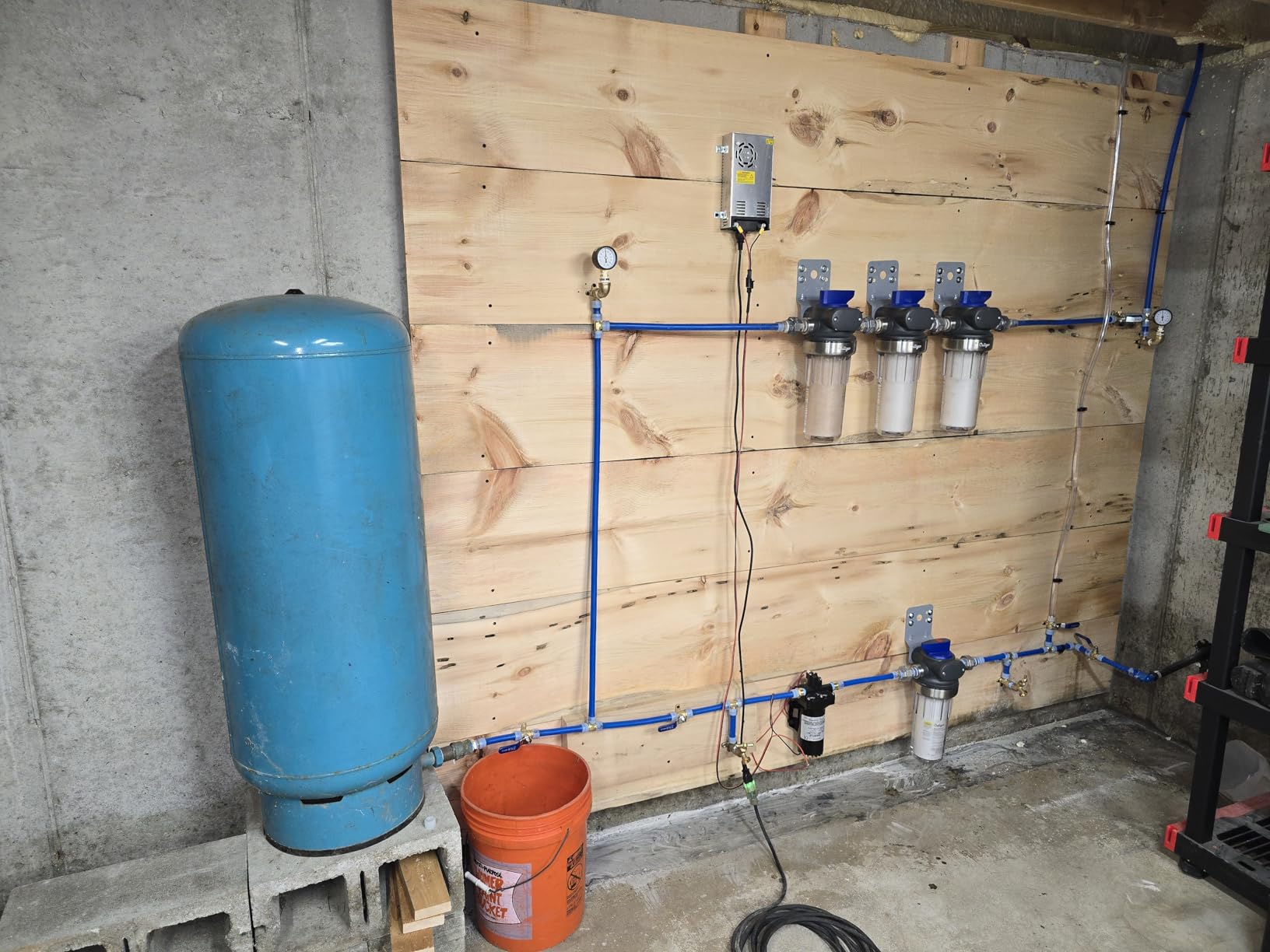
Is 4 GPM Enough for a City Household?
For a two to three person household on municipal water, 4 GPM is workable, and it is the tightest rating in this roundup. A single shower, a dishwasher, and a laundry cycle running together can push past that number, and once a cartridge starts to load you notice the shortfall at the worst possible moment.
Owners do report delivering two to four months of service per cartridge even on mineral-heavy well water, so the flow rating is not the first thing that limits you. The 3/4 inch connections, however, do throttle more than the cartridge does, and a few installers reported reducer threads going in slanted or hitting a cracked housing wall at the outlet connection. Check the run before you commit to this size.
The Valve-in-Head Bypass and the Pressure Relief Button
The built-in bypass shuts off supply to the cartridge without shutting off the house, which turns a filter change into a five-minute job with a bucket. The pressure relief button bleeds pressure before you crack the housing, which protects threads and reduces the weeping that shows up on poorly seated fittings.
The mechanical complaints cluster around that valve. The handle is stiff to turn, and owners report a small weep at the top when it is not seated exactly right. It is not a defect that stops filtration, but budget a few minutes of troubleshooting the first time you use it rather than assuming the housing failed.
Clear Housing and Cartridge Compatibility
The clear body is a monitoring tool, not a styling choice. You can see the sediment accumulating at the bottom of the canister and change the cartridge on condition rather than on a calendar, which is how you avoid paying for capacity you never used and how you avoid a fully loaded cartridge choking flow.
Budget for the housing and the cartridges separately, and confirm the cartridge model you want is one of the four listed compatible types. A 6.57 by 6.18 by 15.94 inch profile at 3 pounds fits most standard utility spaces, and the unit carries an NSF certification for particulate reduction rather than a bare contaminant claim.
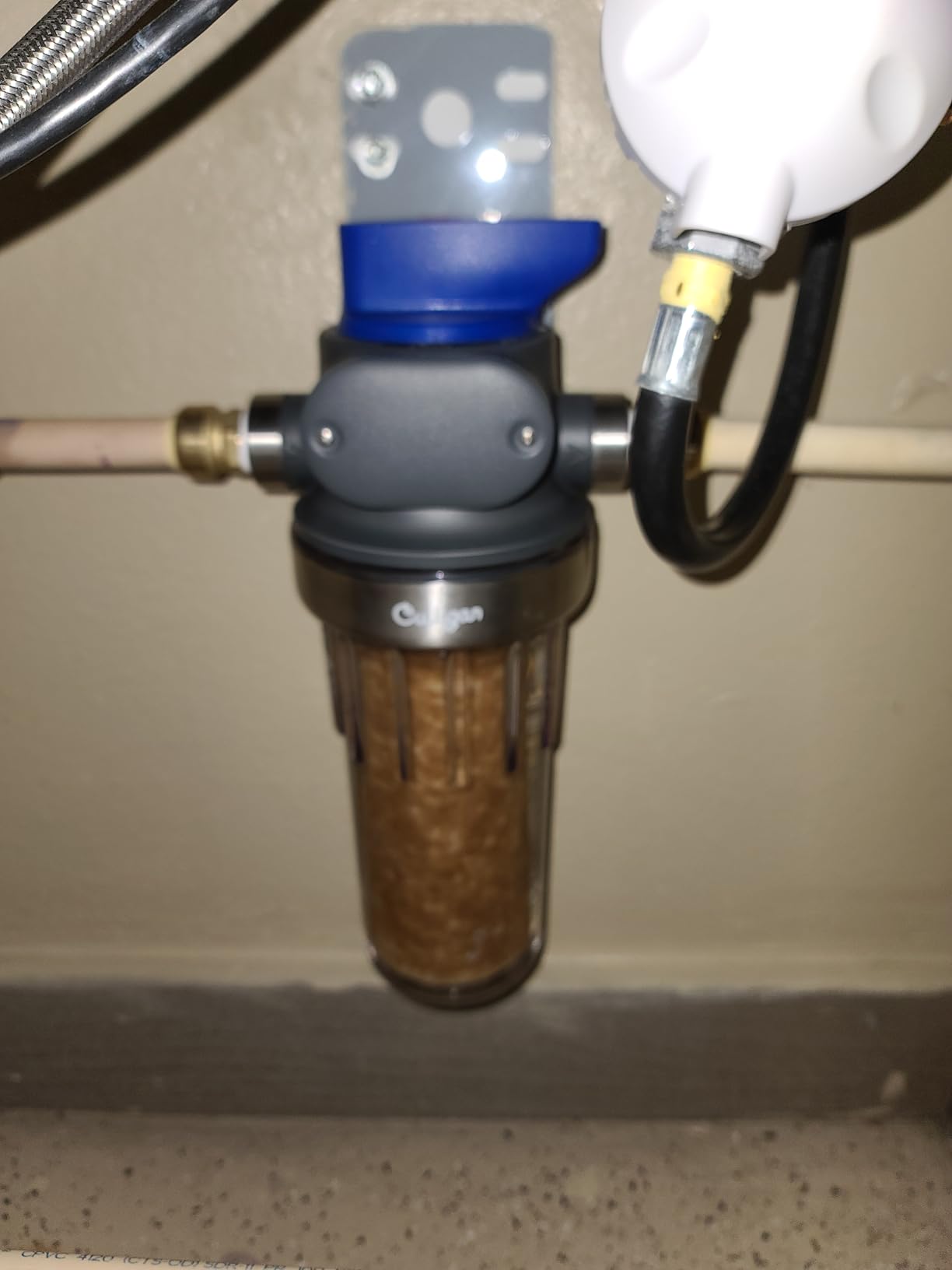
4. Pentek DGD-5005-20 – Best Dirt-Holding Cartridge for Big Blue Housings
Pentair Pentek DGD-5005-20 Big Blue Water Filter, 20-Inch Whole House Sediment Filter Cartridge Replacement, Dual-Gradient Density Spun Polypropylene, 20″ x 4.5″, 5 Micron, Pack of 1, White
5 micron nominal dual-gradient density media
NSF ANSI 42 certified
Under 1 psi pressure drop at 20 gpm
Pros
- Highest satisfaction rating in the group
- Up to 3x the dirt-holding capacity of same-size cartridges
- Under 1 psi pressure drop at 20 gpm
- Fits any 20 by 4.5 inch housing
Cons
- Cartridge only
- housing sold separately
- Replacement roughly every 6 months under load
This is a cartridge, not a system, and that framing matters before anything else. If you already own a 20 inch Big Blue housing, this is the upgrade path. If you do not, you need the housing from number three or number five before this cartridge has anywhere to go, and that changes the total cost of the decision.
What earns the highest rating in the roundup is the media construction. The dual-gradient density design increases filter density from the outer surface toward the core, and Pentair rates it at up to 3 times the dirt-holding capacity of similar-size sediment cartridges with 233 percent greater effective filter depth. Owners upgrading from a standard spun cartridge report exactly that behavior change.

Dual-Gradient Density and Why Pressure Drop Stays Low
Spun polypropylene cartridges of the same nominal micron rating often have wildly different capacity depending on how evenly the media was packed. The gradient construction places the coarsest material on the outside where the heaviest particles land and the finest material deeper in, which is why the pressure drop figure is under 1 psi at 20 gpm on a clean cartridge.
That low clean-side drop is what lets a fine 5 micron stage sit behind a spin-down without eating your pressure. A coarse pre-filter absorbs the burst load from a main break or a utility project, and the fine cartridge downstream handles the slow background silt that the spin-down lets through.
Fit, Certification, and the Six-Month Interval
The cartridge measures 4.5 inch diameter by 20 high, weighs 15.84 ounces, and is 100 percent pure polypropylene that will not impart taste, odor, or color. It fits all 20 inch Big Blue and other heavy-duty housings, which means the format is not an obsolescence risk the way proprietary cartridges can be.
Certification is NSF/ANSI Standard 42 for particulate reduction, a material-requirements certification rather than a contaminant claim, and that distinction is worth understanding before you compare it to carbon stages. The stated replacement interval is approximately every 6 months, sooner when pressure or water quality drops. Manufacturer part number is 155358-43, and the listing is a single pack, so multi-packs are the more practical buy if you plan ahead.
Cartridge Economics Over Five Years
This is the recurring-cost line that surprises buyers, and it is the reason we put a spin-down ahead of a fine cartridge whenever possible. A cartridge-only strategy means buying two of these every year indefinitely, while a spin-down-first strategy turns a large share of those replacements into occasional screen washes.
Owners who paired a coarse pre-filter with this cartridge report longer intervals than the six-month figure suggests, which is the practical argument for staging your whole house system rather than treating fine filtration as the only line of defense.
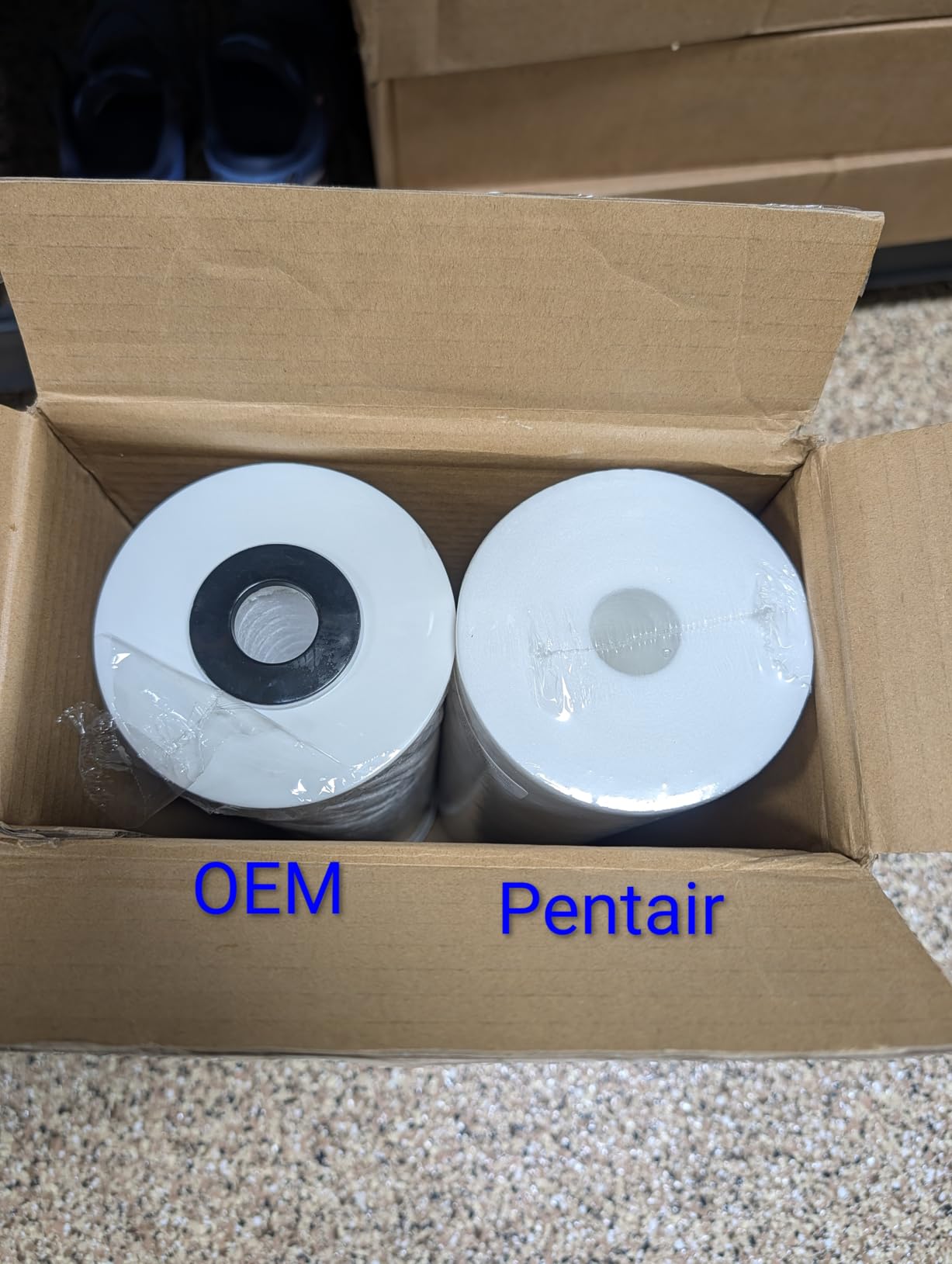
5. A. O. Smith AO-WH-PREV – Best Compact Housing for Tight Utility Spaces
A. O. Smith Whole House Sediment Filter | Valve-in-Head | AO-WH-PREV
Low profile 15 by 6 by 5 inch housing
6 GPM flow on 3/4 inch connections
NSF ANSI 42 certified
Pros
- Compact profile fits where full size systems cannot
- Includes housing
- first cartridge and wrench
- Valve-in-head bypass and pressure release button
- Runs on water pressure with no power required
Cons
- Clear housing cracks at the threaded collar over time
- Threads on the housing nipple can drip
- Lowest customer rating in this group at 4.3
At 15 inches long, 6 wide, and 5 high, this is the housing to consider when the space behind the meter will not take a bracket-mounted system. It is also a passive unit, so it keeps working during a power outage, and the box includes the housing, the first sediment cartridge, and a wrench.
Owners use it in two roles: as a standalone sediment stage on moderately hard city water, and as a pre-filter in front of a carbon or softening system where you want to see rust and sediment load up on a small clear canister. In the second role it earns its keep by keeping downstream media cleaner.
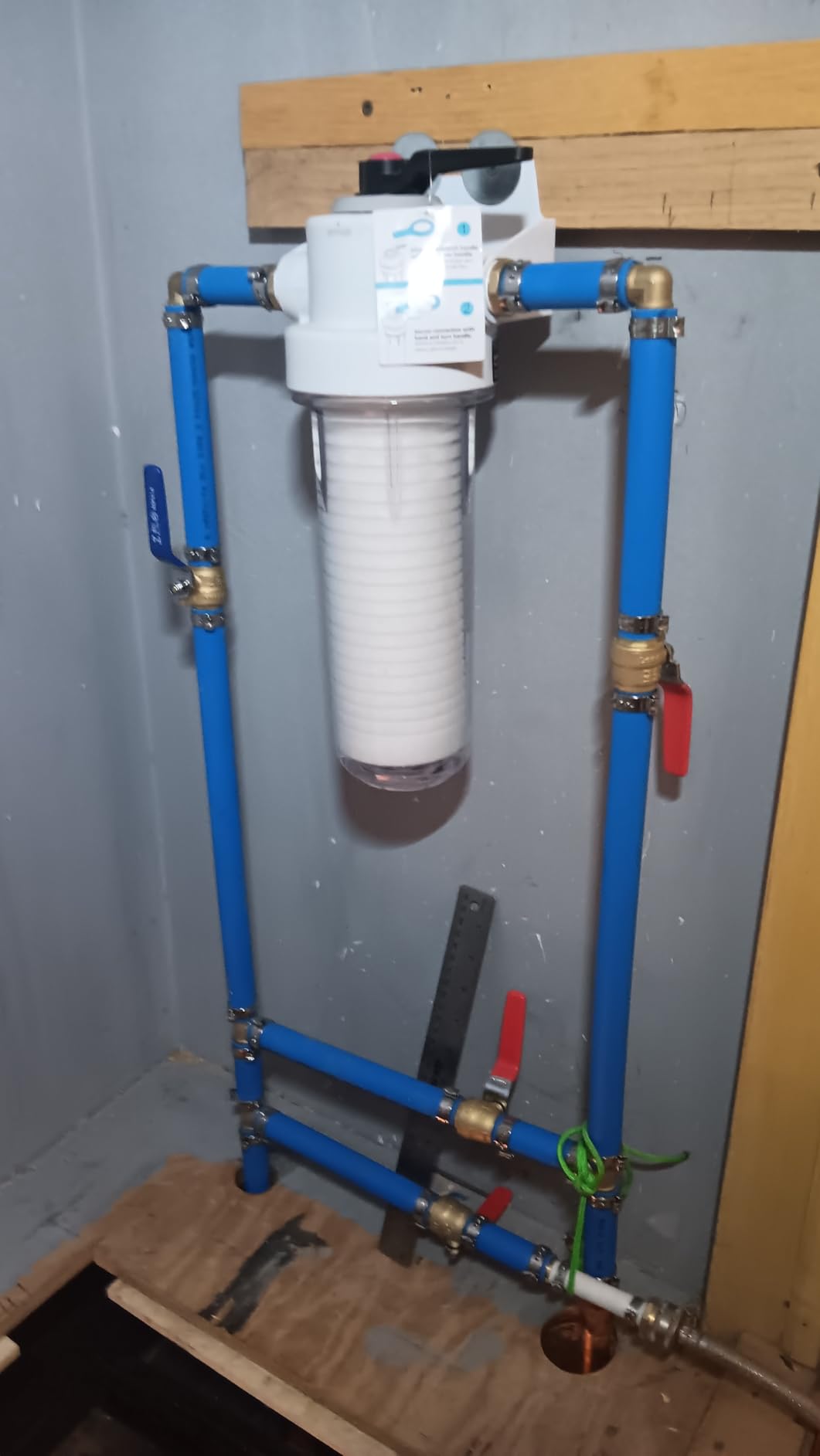
Capacity, Flow, and Where 6 GPM Sits
Specifications list 24000 gallons of capacity, a 6 GPM maximum flow, 25 to 100 psi operating pressure, and a 40 to 100 degree F range. TDS support is listed at 500 ppm, which is below what some municipal systems deliver, so verify your utility number before committing if you live in an area with high total dissolved solids.
At 6 GPM this sits between the 4 GPM Culligan and the 15 GPM bracket systems, which is a reasonable middle for a two to four person home. The connection size is the more practical constraint, and reviews note that the port sizing cuts throughput compared with a full 3/4 inch or 1 inch setup, so plan your install point with that in mind.
Certification and Filter Life
The unit is NSF Certified to Standard 42 for particulate reduction, which is the certification that actually applies to a sediment filter, and the stated filter life cycle is 6 months. The warranty is a 1-year limited warranty, shorter than the support some competitors offer, so factor that into the value calculation if you are buying on service life.
Practically, the six-month figure assumes a steady load. On light city sediment the canister stays clear longer, and on a main break or a lead service line project the same cartridge can load in days. Change it on pressure and appearance rather than on the calendar.
Durability Concerns and Install Details
The recurring complaint is housing longevity. Owners report the clear plastic cracking at the threaded collar within a year or two, and because that part is not sold separately, the fix is replacing the whole unit. The threads on the housing nipple are also described as hard to seal and prone to dripping, and the supplied bracket is weak enough that several installers reinforced it with oversized washers.
One practical warning from the reviews: if you are gluing PVC, let the primer fully cure or an acetone smell carries into your water. That is a cure-time issue, not a filter fault, but it is the kind of thing that gets blamed on the new equipment.
6. Waterdrop WHF21-FG – Best Two-Stage Pairing for Iron and Manganese
Waterdrop WHF21-FG 2-Stage Whole House Water Filter System, 5 Micron
Iron and manganese stage plus coconut GAC
15 GPM on 1 inch NPT
50000 gallons combined over 6 months
Pros
- Two complementary stages in one 10 by 4.5 inch footprint
- 15 GPM flow holds up with multiple fixtures
- Reinforced brass threads and dual O-rings resist leaks and water hammer
- Cartridges and bracket arrive pre-installed
Cons
- Both cartridges need replacement about every 6 months
- NPT threads still need careful taping
- Iron and manganese figures come from third-party testing rather than broad certification
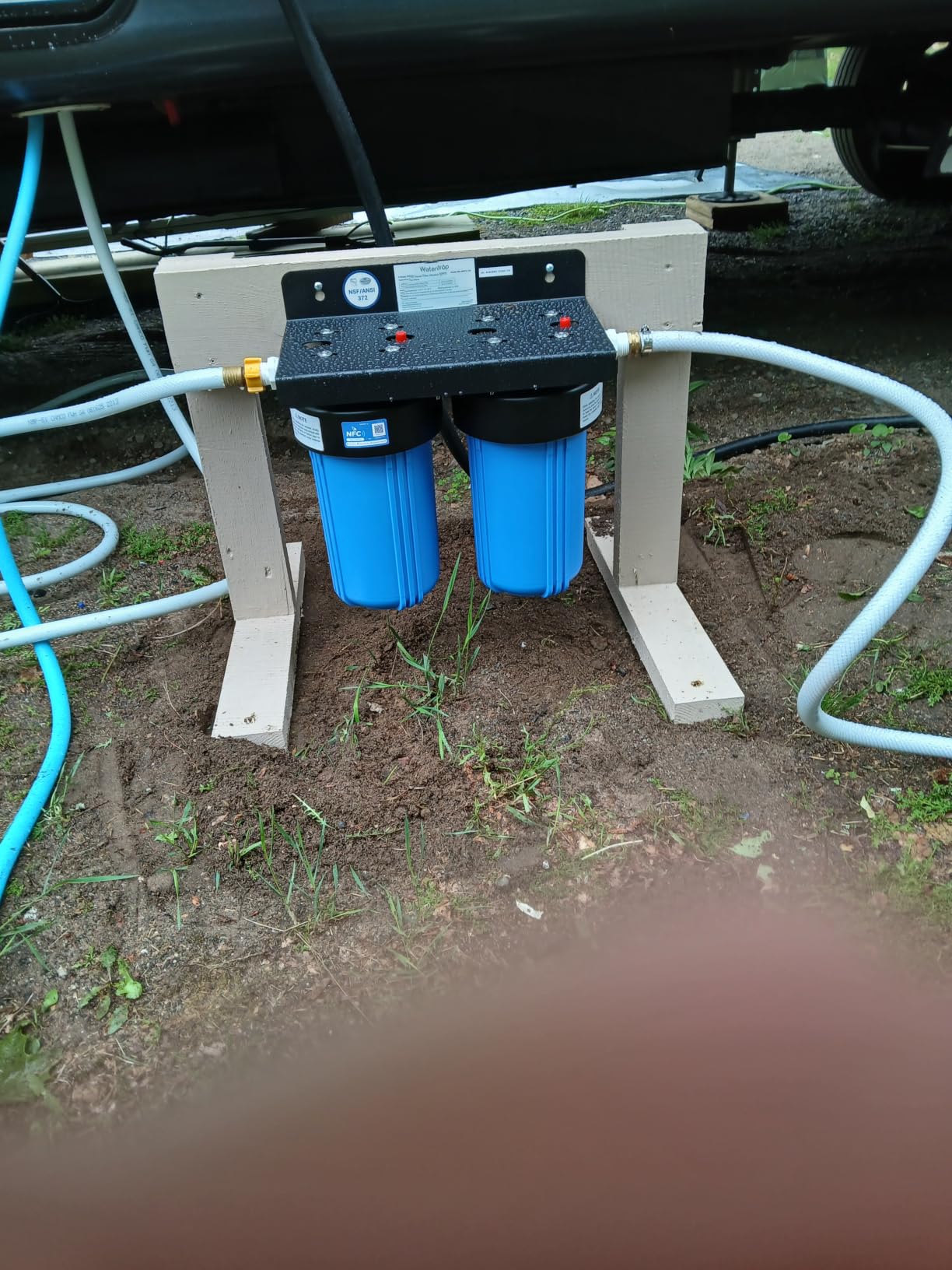
The WHF21-FG is the pick for a household where the complaint is not only grit but orange staining and metallic taste. It pairs a 10 by 4.5 inch iron and manganese reduction cartridge with a coconut shell granular activated carbon stage, and both sit on 1 inch NPT connections rated to 15 GPM.
Third-party testing cited for this system shows reduction of up to 96.4 percent iron, 98.2 percent manganese, and 95.63 percent chlorine, along with mercury, lead, cadmium, chromium, and copper. The important caveat is that those figures are test results rather than a broad contaminant-reduction certification, and the cartridges carry NSF/ANSI 372 lead-free compliance instead.
Sediment Plus Carbon in Two 10 x 4.5 Inch Stages
Two 10 by 4.5 inch cartridges give you roughly the media area of one larger housing at half the height, and the dimension is 14.37 by 7.48 by 15.55 inches at 10.1 pounds. That footprint fits on a utility wall where a 20 inch Big Blue would not, which is why it appears in utility rooms in older homes.
Owners like that the filters and bracket arrive pre-installed, so the install is closer to attaching a bracket and connecting two ports than to assembling a housing. Reinforced brass threads and dual high-sealing O-rings were tested through more than 100000 water hammer and pressure cycles, which addresses the leak complaints that plague plastic NPT connections in this category.
Certification Limits and What That Means for You
Read the certification carefully before you compare this to an NSF/ANSI 42 particulate filter. NSF/ANSI 372 is a lead-free material standard, not a performance claim, so the particulate filtration here is less formally certified than the Culligan or A. O. Smith housings in this roundup.
If your priority is verified sediment reduction, the certified housings win. If your priority is iron staining and metallic taste on hard municipal water, the combination treatment here is the reason to look past the certification label.
Maintenance and Total Footprint
Two cartridges at a six-month interval is a real recurring cost, and it is the most common reservation in the reviews. TDS support is listed at 1000 ppm and the upper temperature rating is 100.4 degrees F, which are unremarkable for municipal supply.
For a household already running a softener, this system can sit upstream as sediment and iron protection, and the reviews note it suits both municipal and well sources. Ordering matters: put sediment protection ahead of the softener so resin beds are not loaded with grit.
7. Waterdrop RPFK – Best Spin-Down for Moderate-Pressure Supply Lines
Waterdrop RPFK Spin Down Sediment Filter, 40-50 Micron, BPA Free
50 micron 316L stainless screen
BPA-free PA12 housing rated above 600 psi
Up to 20 GPM with four fitting types
Pros
- Brass and 316L stainless construction with a heavy duty feel
- Backwash flush cleans the screen without disassembly
- BPA-free lead-free materials with NSF ANSI 372 certification
- Four fitting types make almost any hookup straightforward
Cons
- Operating window of 14.5 to 72 psi is narrow
- 50 micron screen needs frequent flushing on sediment-heavy water
- TDS support listed at 300 ppm
- below most competitors
The RPFK is a spin-down with the same job as the iSpring WSP-50 and a different engineering budget, so the decision comes down to your supply pressure and materials. It is brass and 316L food-grade stainless steel, and the housing is a German-made PA12 shell described as BPA-free and tested to burst pressures above 600 psi.
Reviewers note the backwash function flushes trapped sediment from the screen without disassembly, and four fitting types are included, covering 1 inch MNPT, 3/4 inch MNPT, 3/4 inch FNPT, and 3/4 inch push-fit. That flexibility is genuinely useful when you are splicing into an existing main and do not want to match thread standards exactly.
The Pressure Window Is the Deciding Spec
The operating range is 14.5 to 72 psi, and that ceiling sits below what some municipal systems deliver at the meter. Before you buy, check your static pressure with a gauge. If your supply regularly runs above 72 psi, add a regulator upstream rather than running this unit at its limit, because the failure mode is a housing problem you did not need.
Flow is rated up to 20 GPM, which is ample for city use. The catch is that a high flow rating on a coarse screen does not protect the screen from loading, and 50 micron still needs regular flushing on sediment-heavy mains. Reviewers with sand or silt-heavy supplies report the largest share of routine flushing complaints in this group, which is a reflection of the water, not a defect.
TDS Rating and Material Certification
Maximum supported TDS is listed at 300 ppm, the lowest ceiling among the housings here, and the upper temperature rating is 100 degrees F. On a typical municipal line this is fine, but in areas with higher total dissolved solids, confirm the number before committing.
Materials carry NSF/ANSI 372 certification and are lead-free, and the housing is BPA-free, which owners cite as a point of interest for households with small children. The fittings are copper with a corrosion-resistant blue nano-coating.
When to Choose This Over the iSpring Spin-Down
Pick this unit when your static pressure is comfortably inside 72 psi, when you want push-fit options, and when BPA-free materials matter to you. Pick the iSpring WSP-50 instead when you want a wider 15 to 115 psi range, a longer service interval on light sediment, or a head with more replaceable parts.
Both are reusable coarse screens, and neither is a complete solution on its own. Whichever you choose, the next stage downstream should be a certified particulate cartridge if you want the fine silt removed.
8. iSpring WSP100ARB – Best Hands-Free Maintenance for High-Volume Homes
iSpring WSP100ARB Big Spin Down Sediment Filter, Auto Flushing, 100 Micron
100 micron mesh with integrated auto-flush module
Built-in scraper plus HD touch screen
Dual power supply with adapter and AA backup
Pros
- Automated flushing removes the manual cleanout routine
- Built-in scraper helps clear heavier debris
- Owners report downstream cartridge life extending from monthly to 3 months or more
- Rotatable head fits awkward layouts without welding
Cons
- Powered auto-flush module is vulnerable to moisture ingress
- Auto-flush shaft can be misassembled and fail to engage the valve
- Fine mesh outpaces auto-flush on heavy clay or sand
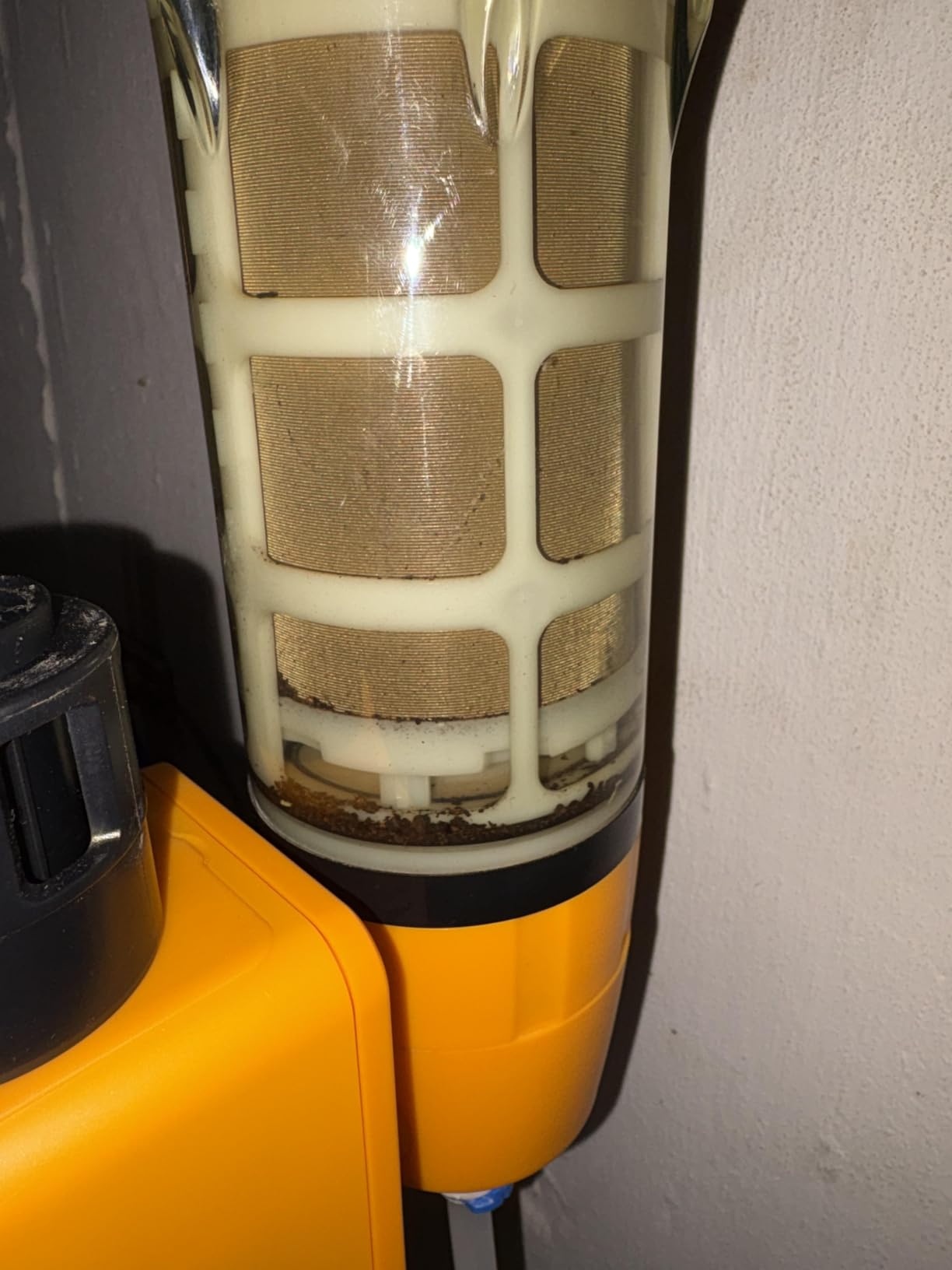
This is the only unit in the roundup with a powered flush module, and the entire value argument sits in that. An HD touch screen schedules automatic, semi-automatic, or manual flush cycles, a built-in scraper helps clear heavier debris, and dual power supply from an adapter plus three AA batteries keeps the routine running through an outage.
Owners running high-load supplies report the most striking effect anywhere in these reviews: adding this as a pre-filter cut downstream cartridge replacements from monthly to three months or longer. The 360-degree rotatable head connection also removes the need to weld or glue when you are fitting it into copper, PEX, or CPVC, which cuts install difficulty noticeably.
100 Micron, 25 to 35 GPM, and a Wide Housing
The screen is 100 micron food-grade stainless steel on a lead-free brass head, rated for up to 25 to 35 GPM, and the housing is described as explosion-proof transparent. Dimensions are 20 inches long by 10 wide by 6 high, so this is the largest spin-down in the group and needs real wall space next to the meter.
Connections are 1 inch MNPT and 3/4 inch FNPT on both ends, and the operating pressure rating is listed at 20 bar. Maximum supported TDS is 1000 ppm and the temperature range is 40 to 100 degrees F, which covers a typical municipal supply.
The Electronics Are the Weak Point
Moisture ingress is the documented failure mode, and multiple reviews describe water in a damp basement killing the control board. Install this where the housing stays dry, or the automation that justifies the design becomes a repair.
Other reported problems are mechanical: an auto-flush shaft assembled short of its housing that never engaged the flush valve, and a cycle that would not fully close after flushing. In each case iSpring support replaced the module at no cost, which is why the rating holds at 4.5 despite the hardware failures.
Where the Scraper Falls Short
The built-in scraper is sized for heavier debris, and owners on fine clay report the gap is too large to help. On fine sediment the auto-flush cycle also runs out of ability faster than the machine can clear, so this unit does not replace a downstream fine cartridge.
Treat it as stage one that buys you time and money downstream. The package includes the system, power adapter, three AA batteries, manual, wrench, bracket, and plumber’s tape.
How to Choose a Whole House Sediment Filter for City Water
Choosing well comes down to four decisions in this order: filter type, micron rating, flow rate, and housing size. Get the first one right and the rest follow without much drama. The most expensive mistakes in this category come from ordering a fine cartridge when the actual problem is episodic coarse grit, and that is a type decision, not a shopping decision.
Spin-Down vs. Cartridge vs. Multi-Stage: Pick the Type First
A spin-down uses centrifugal separation to push particles to the bowl of a clear housing where you flush them out, and the screen is reusable. A cartridge filter forces water through disposable media rated in microns. A multi-stage system chains both so the coarse stage protects the fine one.
For city water the staged approach wins almost every time, because municipal sediment arrives in bursts rather than as a constant trickle. A coarse spin-down absorbs the burst and gets washed back into service, and the fine cartridge downstream handles background silt on its own schedule. Pure cartridge setups work, but they absorb the burst load too, which is why fine-only city installations change media on a punishing cycle.
Nominal vs. Absolute Micron Rating Changes Everything
A nominal rating describes the particle size at which a cartridge captures a stated percentage, and an absolute rating is a tighter specification with a higher capture percentage at a finer size. The two are not comparable, and a 5 micron nominal cartridge and a 5 micron absolute cartridge are very different products with very different service lives.
Here is the practical version of the sizing decision. Coarse rust flakes and construction grit are roughly 30 to 100 microns, so a spin-down screen handles them. Fine sand runs 50 to 250 microns, silt runs 2 to 50 microns, and bacteria fall between 0.5 and 5 microns, so anything below 20 microns belongs in a cartridge stage behind a pre-filter. A 5 micron stage is right for silt, and it is wrong as your only defense on a main that has broken once.
Flow Rate: Municipal Pressure Is Not Well Pressure
City households typically see 40 to 80 psi at the meter with no booster pump involved, so flow capacity is a sizing question rather than a pressure-recovery problem. A 3 to 4 person home is usually served by 6 to 10 GPM of realistic simultaneous demand, and matching a 15 GPM rated unit to that household leaves headroom for cartridge loading as it fills.
For a 5 micron cartridge specifically, the practical ceiling is around 4 to 5 GPM through a 3/4 inch connection before you notice pressure loss at the shower. If a household wants more, the answer is a larger housing and 1 inch plumbing, not a finer cartridge. Practitioners on the Terry Love plumbing forum actively question published flow ratings, and one user described running a 1 micron nominal cartridge in a standard clear housing at 0.5 GPM actual flow, which is a good reminder that rated GPM is a clean-media number.
Housing Size Cheat Sheet
A 10 by 4.5 inch slim housing gives you roughly 4 to 5 GPM and is for point-of-use or small apartments. A 20 by 4.5 inch Big Blue housing gives you 15 to 20 GPM and is the whole house default. Spin-down housings sit in between, with coarse capture and a 20 to 50 micron range rather than fine filtration.
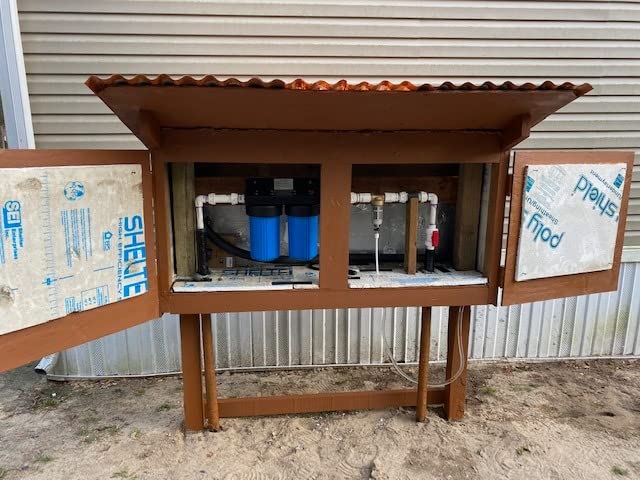
Check two dimensions before buying: the wall space you actually have, and the diameter of your main. Bigger housings with 1 inch ports flow better but need clearance, and a spin-down needs a drain nearby for flushing that many people forget until the day they need it.
Where the Filter Goes on the Main Line
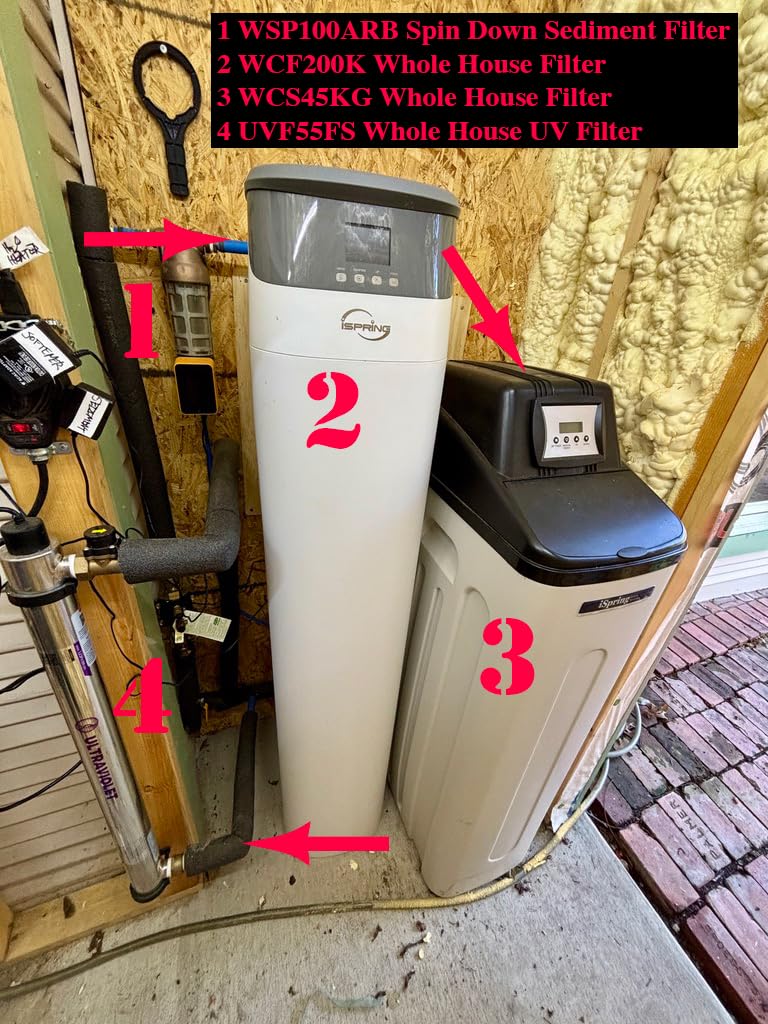
Install sediment filtration ahead of any water softener. Grit that reaches a softener resin bed fouls the resin and shortens regeneration performance, so the sediment filter takes the first hit on the main line and the softener follows downstream.
Mount it near the meter or in the garage wall if the space near the meter is tight, but protect it from freezing if that area is unheated. Every cartridge housing should have a bypass valve so a filter change does not require shutting off water to the house, and spin-downs additionally need a flush discharge point.
How to Flush a Spin-Down and Change a Cartridge
To flush a spin-down, turn on the main supply, open a cold faucet downstream to relieve pressure, then open the flush valve at the bottom of the housing and run it until the water runs clear. Close the valve and you are back in service without disassembly. A monthly habit is enough on light city sediment, and every few weeks on a main with recent utility work.
To change a cartridge, close the house supply, then close the valve-in-head bypass. Open the pressure relief button to bleed the canister, unscrew the housing with the supplied wrench, swap the element, seat the O-ring, and close everything back up before opening the bypass. Do not over-tighten plastic housings, and do tape every NPT thread properly, since weeping fittings are the most common install complaint across this whole roundup.
When a Sediment Filter Is the Wrong Answer
Skip this roundup entirely if your problem is hardness, sulfur odor, or bacteria, because a sediment filter will not address any of them. Hard water needs a softener, sulfur needs an oxidation or sulfur media stage, and bacterial concerns need disinfection. A second commenter on the r/WaterTreatment thread made the same point in different words, recommending a softener plus a chlorine carbon filter rather than a sediment-only setup.
A 2017 Houzz thread on city water reached a similar conclusion, pairing a softener with a carbon filter and warning against generic combo units. That advice is still sound, and it is the single most common buyer mismatch we saw across homeowner discussions of this category.
If you want a broader look at point-of-use versus point-of-entry hardware for the rest of the house, our city driving essentials guide covers a different kind of whole-system planning. For the audio side of a combined renovation, our pop filter guide for streaming lists the smaller hardware most people overlook.
Frequently Asked Questions
How many microns should a whole house sediment filter be?
For city water, 20 to 50 microns is the right starting point for a first-stage spin-down, and 5 to 10 microns for a fine cartridge stage behind it. City sediment is usually coarse and episodic: rust flakes and construction debris run roughly 30 to 100 microns, while fine silt runs 2 to 50 microns. Filtering everything at 5 microns with no pre-filter is what causes rapid clogging.
What is the recommended flow rate for a whole house water filter?
For a 2 to 4 person household on municipal water, target 6 to 10 GPM of usable flow and buy a housing rated above that. Key rules: match 1 inch plumbing to 1 inch housing ports, stay at or below the housing maximum flow rating, and expect a clean 5 micron cartridge to sit near 4 to 5 GPM through a 3/4 inch connection before pressure loss shows up at the shower.
Is a 5 micron filter better than a 20 micron filter for city water?
A 5 micron filter catches finer particles and shorter replacement intervals; a 20 micron filter catches coarser grit and lasts longer with less pressure drop. For city water, the 5 micron stage is the right second stage, while 20 to 50 microns is the right first stage. Running 5 micron with no upstream pre-filter is the most common reason city cartridges clog fast.
Do I need a whole house filter for city water?
You need one if you see grit, rust-colored particles, or cloudy water, if faucet aerators clog repeatedly, or if you want to protect a new water heater, dishwasher, or washing machine. City water is treated at the plant but can pick up sediment from corrosion, main breaks, and utility construction. If your only complaint is taste and odor, you need a carbon stage rather than more sediment filtration.
Can I install a whole house sediment filter myself?
Yes, if you are comfortable with copper, PEX, or CPVC and working on the main shutoff. You need a drill, a tubing cutter, Teflon tape, and a way to drain a spin-down flush. Buy a housing with a bypass valve so you are not shutting off the house for changes, avoid overtightening plastic housings, and call a plumber if your main is older galvanized pipe or the space is tight.
Which Whole House Sediment Filter Fits Your City Water
If you want one system that covers sediment and chlorine without staging anything else, the iSpring WGB21B is our top pick for 2026, and its 15 GPM rating and two-stage media cover the two problems municipal water actually produces. Pair it behind a coarse spin-down if your main has broken before.
If your budget is the deciding factor and you want the lowest ongoing cost, the iSpring WSP-50 spin-down as stage one with a certified 20 by 4.5 inch cartridge behind it will outlast any fine-only setup. The Culligan WH-S200-C covers the certified-housing route for buyers who want a bypass and a brand name without a full system.
If you are chasing orange staining and metallic taste rather than grit, the Waterdrop WHF21-FG covers iron and manganese in a compact two-stage footprint. If you are in a tight utility space or a high-load home, the A. O. Smith AO-WH-PREV and the iSpring WSP100ARB respectively solve for footprint and for never having to remember a flush.
Start by reading your utility’s Consumer Confidence Report, then run a clear-jug test and a faucet aerator check before you buy anything. Ten minutes of homework tells you whether you need coarse grit protection, fine silt filtration, or a carbon stage you do not yet have.