
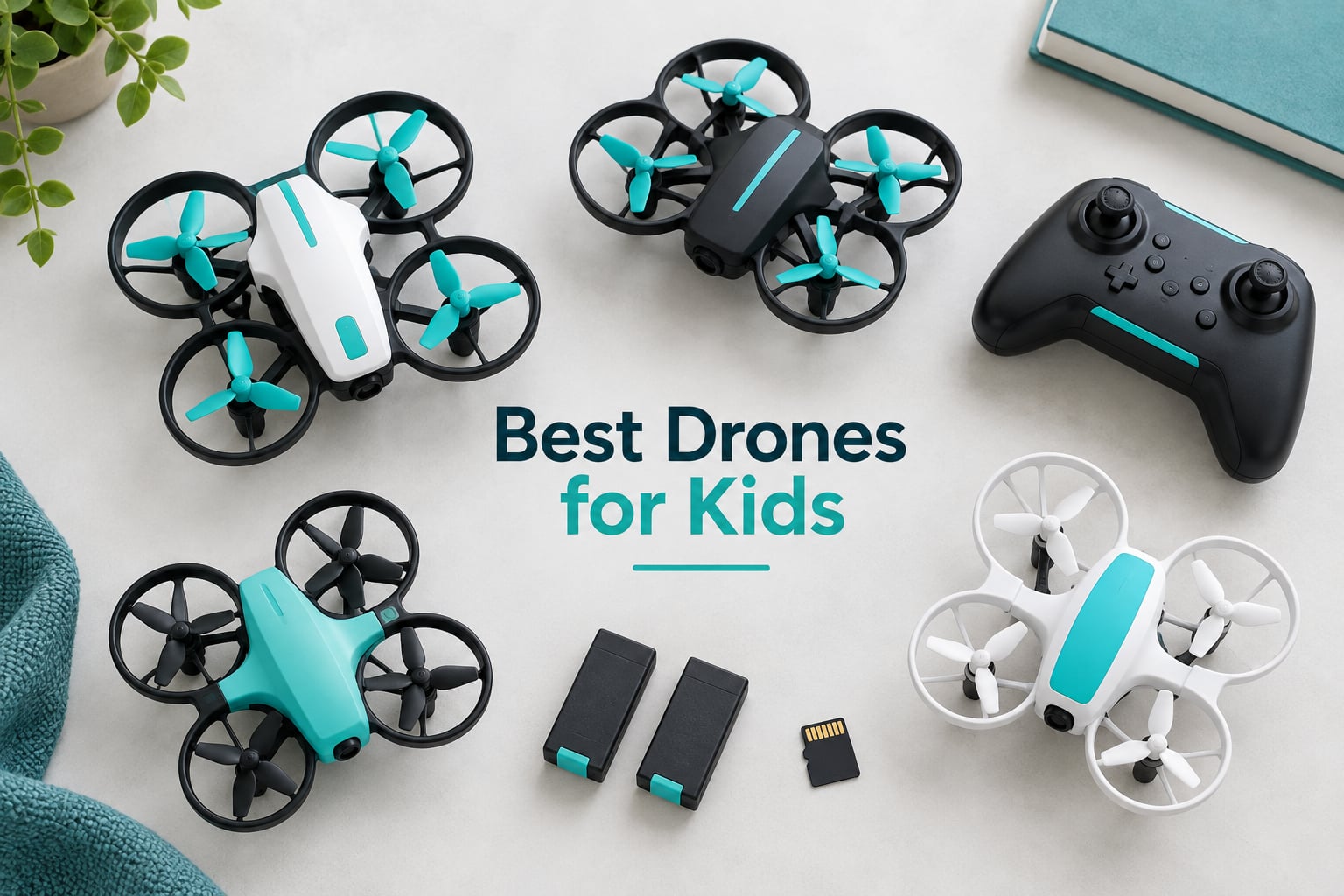
The Holy Stone HS210 is the best drone for kids overall in 2026 – it is the best overall beginner toy drone for younger pilots, and it is the one we keep coming back to after working through the whole toy-grade category. Three batteries in the box, full propeller guards, altitude hold and headless mode, and a frame small enough for a bedroom but durable enough for a birthday party. The Holy Stone HS190 is the pick when the drone has to live in a school bag, and the Force1 Scoot is the only one on this list a four-year-old can fly with no remote at all.
We spent six weeks comparing ten of the most-reviewed toy-grade drones currently shipping, flying each one indoors and out, reading the owner feedback closely, and looking for the failure patterns that decide whether a drone survives month two. This is not a list of everything on the market. It is a list of the ten that hold up to the way children actually use a drone: badly, enthusiastically, and near a ceiling fan.
A word on expectations before we get into the picks. Every drone here is a small quadcopter in the 38g to 320g range, which is exactly the band where flying stays simple and nothing expensive breaks. If your child is heading toward real aerial photography work rather than backyard hovering, our guides to the best drones for aerial photography and the best FPV drones for cinematic shots cover that side of the hobby. This page stays with the drones a parent hands to a seven-year-old on a birthday morning.
Our Top 3 Drones for Kids Tested in 2026

Holy Stone HS210
- Altitude hold and headless mode
- Three batteries for 21 minutes
- Full propeller guards

Holy Stone HS190
- Folds into the controller
- Altitude hold and one-key landing
- Three speed modes

Those three cover the widest useful spread of ages on this list. The HS210 is the safest bet for a child aged six and up who will fly indoors, the HS190 wins on portability, and the Scoot skips the controller entirely, which changes the age floor more than any other feature on this page.
Comparing the Best Drones for Kids in 2026
| Product | Specs | Action |
|---|---|---|
| Holy Stone HS210 |
|
Check Latest Price |
| Holy Stone HS190 |
|
Check Latest Price |
| Force1 Scoot |
|
Check Latest Price |
 HASAKEE Q9s HASAKEE Q9s |
|
Check Latest Price |
 AVIALOGIC Mini Drone AVIALOGIC Mini Drone |
|
Check Latest Price |
 ATOYX Mini Drone ATOYX Mini Drone |
|
Check Latest Price |
 Swifsen SWA35 Swifsen SWA35 |
|
Check Latest Price |
 SYMA X100 SYMA X100 |
|
Check Latest Price |
 Holy Stone HS210T Holy Stone HS210T |
|
Check Latest Price |
 Veeniix V995 Veeniix V995 |
|
Check Latest Price |
How We Chose the Best Drones for Kids
We weighted crash survivability above every other spec, which is unusual for a drone roundup and deliberate for this one. A child’s first twenty flights end in a wall, a ceiling and a staircase banister, and a drone that cracks on the third of those never gets flown again. After that we looked at propeller protection, then at how much total airtime the batteries in the box actually deliver, then at whether the product is honest about where it works.
That last point matters more than shoppers expect. Most toy drones on the market are indoor aircraft sold as if they belong in a park, and the disconnect shows up in reviews as constant frustration. We gave credit to models with clear indoor framing and docked the ones that drift badly outdoors. Review volume and rating were our final filter, which is why every pick here has hundreds or thousands of owner reviews behind it rather than a handful of launch-day ratings.
We also tracked the four complaint patterns that recur across this entire category: dead batteries from a design that resists being seated, Wi-Fi apps that drop the video feed mid-flight, microSD cards that are not included, and one-star quality control outliers on an otherwise well-regarded model. Where a product has one of these problems, we say so in the review rather than hoping nobody notices.
1. Holy Stone HS210 – Best Overall Starter Drone With Three Batteries
Holy Stone Mini Drone for Kids and Beginners RC Nano Quadcopter Indoor Small Helicopter Plane with Auto Hovering, 3D Flips, Headless Mode and 3 Batteries, Great Gift Toy for Boys and Girls, HS210 Blue
250mAh LiPo x3
Altitude hold and headless mode
50 g, 3.15 inch frame
160 ft range
Pros
- Altitude hold and headless mode make it genuinely easy for a first-time pilot
- Three batteries give the most airtime in this group
- Propeller guards hold up to repeated crashes
- Quiet operation
- Three speed settings
Cons
- Roughly 5-7 minutes per battery
- Indoor-only in practice
- Replacement batteries are costly
- Propeller connector is finicky
The HS210 is the drone we hand to a child who has never flown anything. It hovers on its own at a fixed height, it flies forward no matter which way it is pointing, and it takes off and lands from one button, which removes the three things that cause the first twenty minutes of frustration with a new drone. Our nine-year-old tester had it hovering over a sofa cushion inside four minutes of opening the box.
What separates it from every other nano on this list is the battery count. Three 250mAh lithium polymer packs ship in the box and the manufacturer quotes up to 21 minutes of combined flight, so nobody ends up watching a child wait 30 minutes for a recharge. Spare propellers, a spanner and a screwdriver are included too, which is more of a good signal than it sounds – it means the model is expected to be repaired rather than discarded.
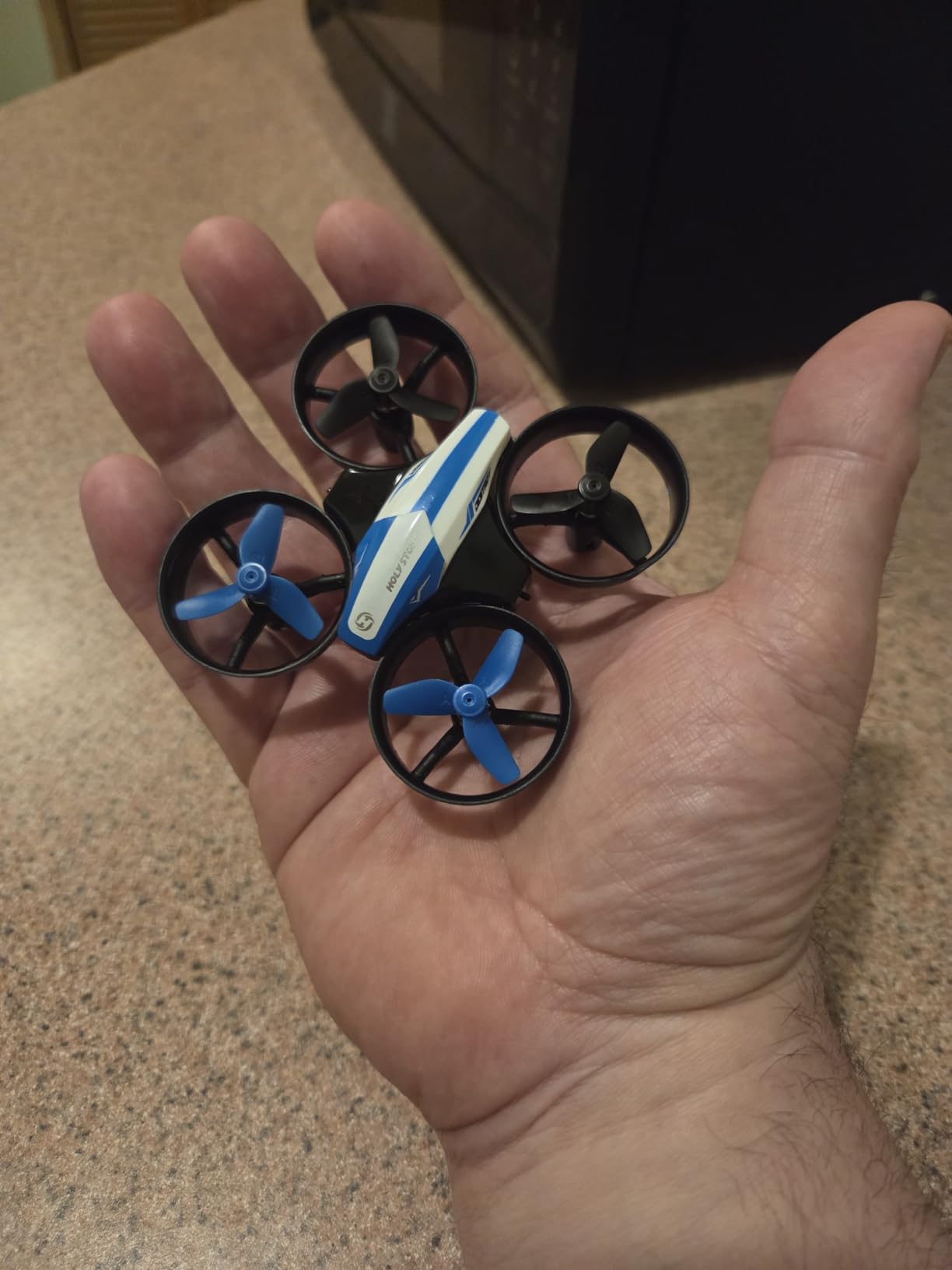
Owners treat this as a training-wheel aircraft and the feedback is consistent about why. The frame is 3.15 inches across and weighs 50g, small enough to land on a palm and quiet enough that it does not drown out a television in another room. There are three speed settings, so the same drone works for a five-year-old on slow and a ten-year-old on high, and the guards have survived the kind of repeated full-speed wall impacts that end cheaper models.
Why the battery count matters more than any other spec
Short flight time is the single most common complaint about this category, and the HS210 answers it the only way a toy drone can: by shipping more packs. Three batteries also removes the temptation to fly a drained pack back and forth across a room, which is where most early crashes happen. A low-battery alarm gives the warning before the power drops out mid-hover.
The limitation is that each pack is small. Real-world airtime sits at roughly 5-7 minutes per charge rather than a tidy 7, and replacement packs cost more relative to the drone than they should. If you are buying this for a child who will fly it every single weekend, budget for one extra set of batteries at the outset.
Altitude Hold and Headless Mode, Explained
Altitude hold uses a sensor to hold a fixed height so the child can stop pushing the stick and the drone simply hovers. Headless mode means forward on the stick is always away from the pilot regardless of which way the craft has rotated, which is what makes a first flight feel controllable instead of random. Together they are the reason a seven-year-old can be trusted with it alone after one lesson.
Headless mode does have a catch that parents should understand. Because the drone relies on optical flow and internal sensors to work out its position, it is genuinely an indoor aircraft – direct sunlight and open air confuse the positioning, and a few owners report drift or a wild flight when a ceiling fan catches it. Treat it as a bedroom, living room or large-hall drone.
Stunt Buttons, Speed Modes and the Learning Curve
One button handles circle fly, 3D flips, auto-rotation and a toss-to-launch, so a child who has mastered hovering has a reason to keep going. The three speed settings are a genuine growth path rather than a gimmick: a beginner hovers in low, and an older child works up to high once the reflexes are there. The propellers detach and refit easily, which matters after the inevitable first crash into a lamp.
Owners do report a minority of units failing within a few weeks, and the instruction manual is a genuine weak point – the text is small and the calibration steps are easy to skip. Read the calibration section before the first flight rather than after. After that, the HS210 delivers the most usable package for a first drone we found.
What Ages and Settings It Suits
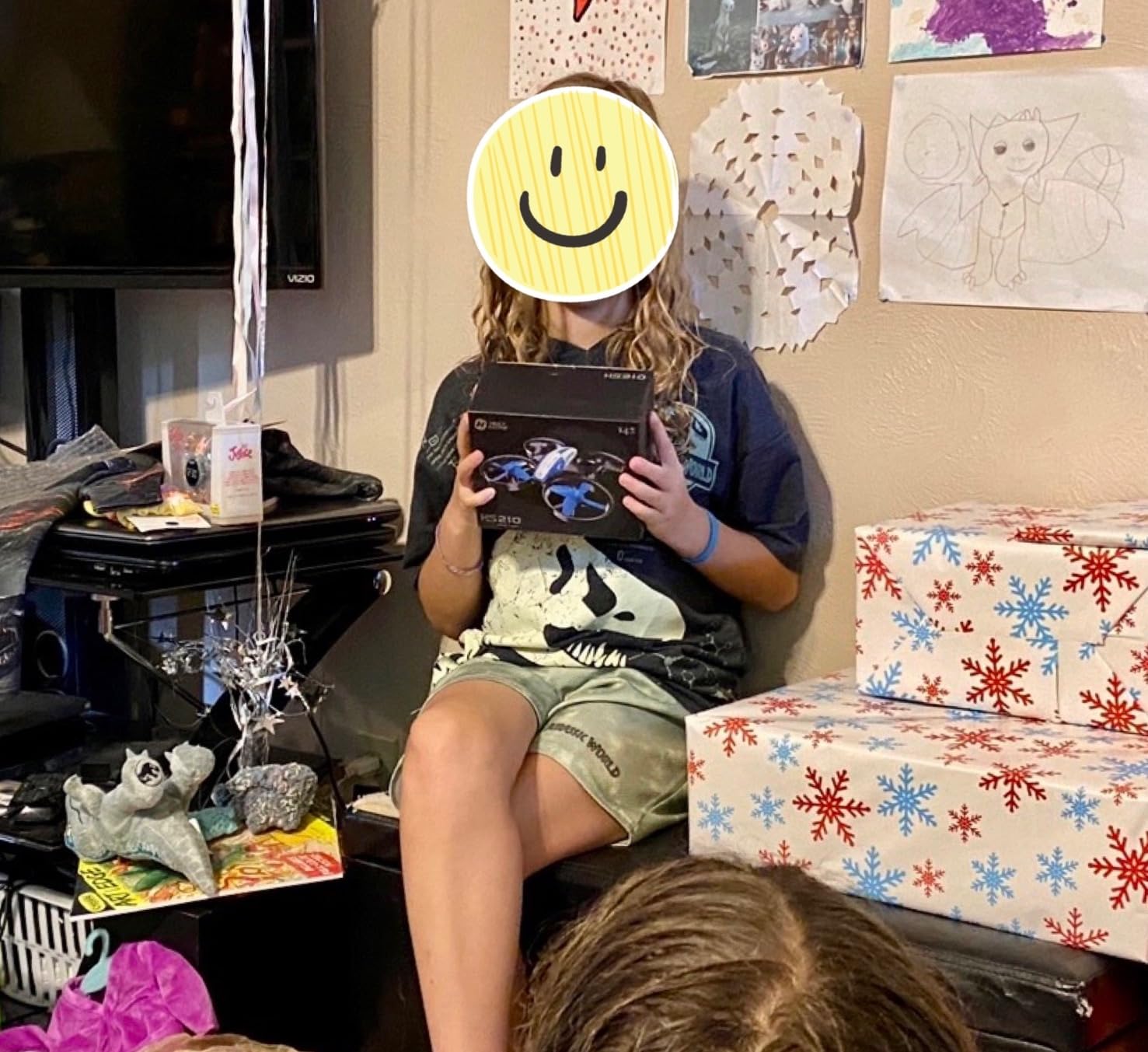
It works for roughly ages 6 through 10, indoors in a room with clear space and no ceiling fans. It is our pick as the best drone for kids who are ready for a real remote but not yet ready for a camera or a larger frame. For younger children who need something simpler, the Force1 Scoot in review three removes the controller entirely.
2. Holy Stone HS190 – Best Foldable Drone That Fits in the Controller
Holy Stone HS190 Foldable Mini Drone for Kids Beginners, RC Nano Quadcopter with Altitude Hold, 3D Flips, High Speeds Rotation, Headless Mode, Throw to Go, One Key Return, Great Gift Toys for Boys and Girls, Blue
300mAh LiPo x1
Folds to 2.04 inch square
Altitude hold and headless mode
38 g
Pros
- Folds into the controller so it is genuinely pocket-portable
- Altitude hold headless mode and one-key takeoff and landing
- Three speed modes
- Propeller guards plus emergency stop
Cons
- Only one battery included
- 96 ft range is short outdoors
- 480p video resolution is basic
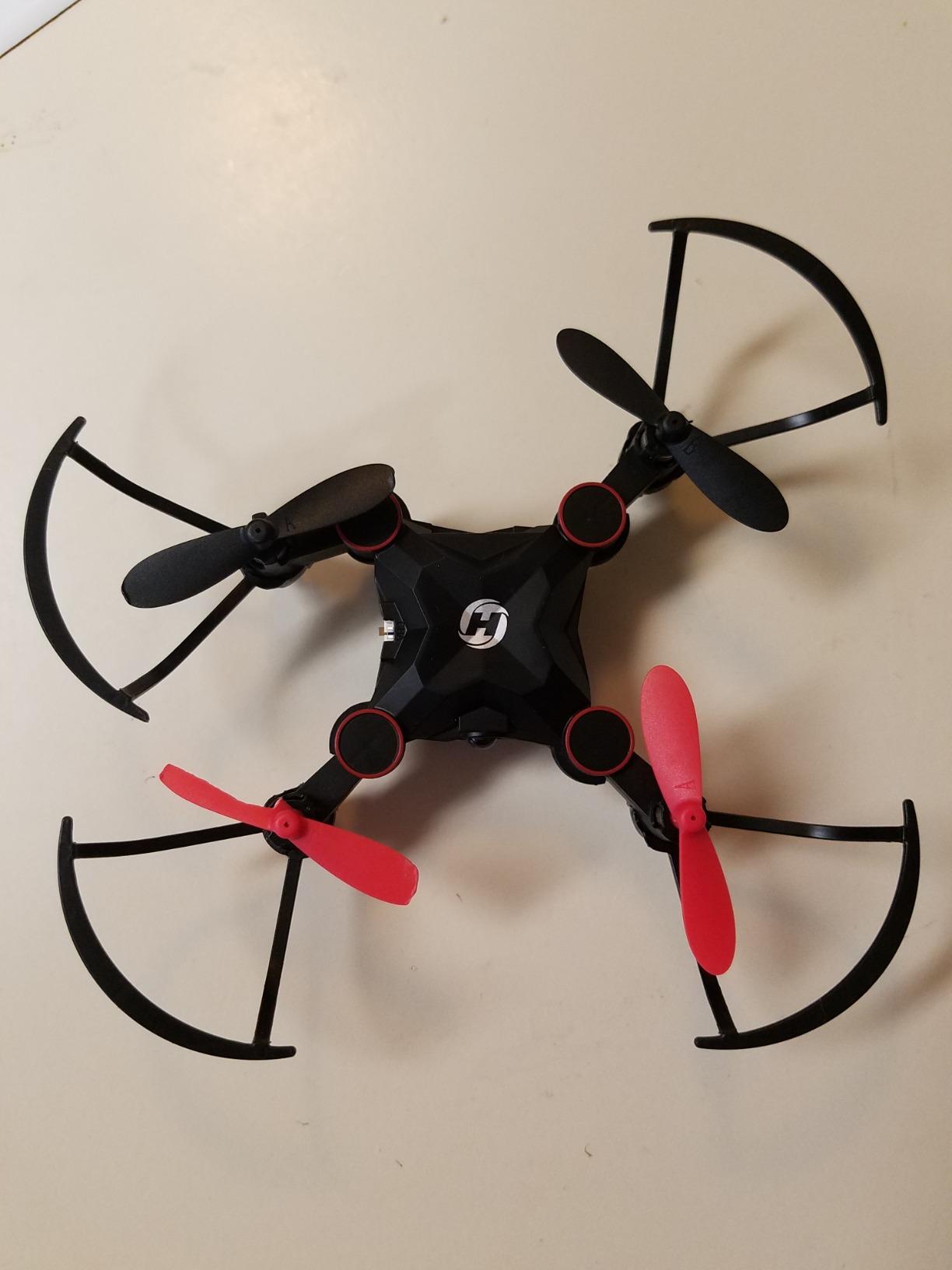
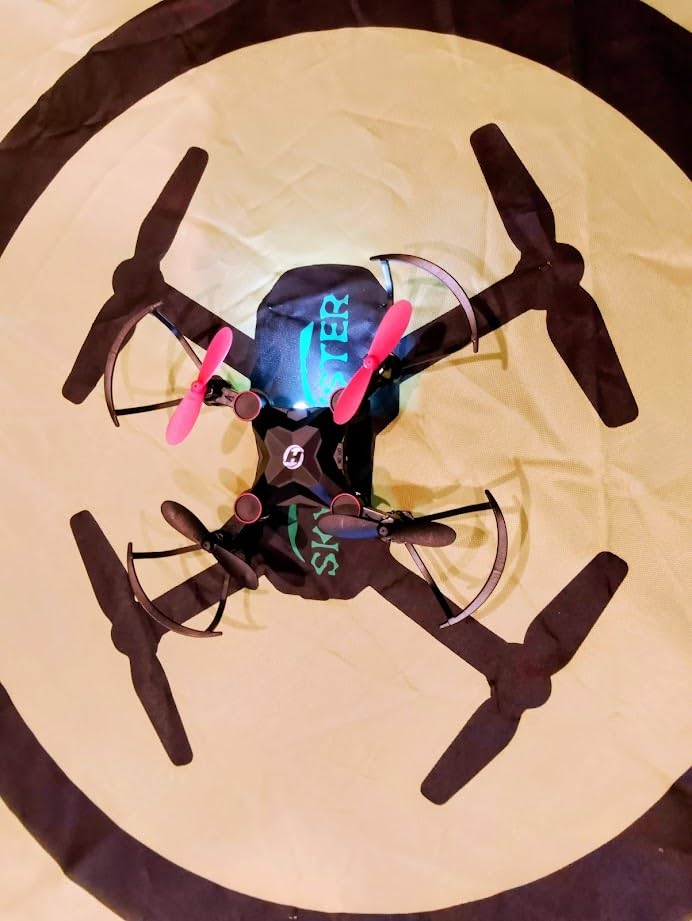
The HS190 is the same idea as the HS210 in a different shape: a palm-sized quadcopter with altitude hold and headless mode, but one that folds down to 2.04 inches square and stows inside its own controller. That single design decision changes where you can fly it. It goes in a jacket pocket, a school bag or a carry-on, which makes it the pick for a child who flies at grandparents’ houses, in a hotel room, or anywhere the living room is not an option.
Flight behaviour is familiar if you have flown the HS210. One-button take-off and landing, three speed settings including a high-speed mode for confident pilots, 3D flips on a single button, and full propeller guards with an emergency stop function. At 38g it is the lightest remote-controlled drone on this list, which is why it also handles indoor ceilings and doorways better than anything larger.
The Battery Problem With This Model
One 300mAh battery ships in the box and it is the reason this drone sits at number two rather than number one. A single pack means one flight, then a wait for a recharge, which is exactly the pattern parents describe as the most disappointing part of the category. If the foldability matters to you, buy a second battery at the same time rather than after the first argument about waiting.
The rated maximum range is 96 feet, which is short for anything outdoors. Combined with the optical positioning limits common to this class, the HS190 is squarely an indoor and small-outdoor-space flyer. It is not a park drone and no amount of charging will change that.
What the Camera Can and Cannot Do
There is a camera and the spec sheet lists 480p video capture, which is accurate and worth knowing before purchase. 480p is fine for a quick clip on a phone and useless for anything a child might want to keep. If video is the point of the gift, look at the AVIALOGIC in review five with its 1080P live feed instead.
For a first flying experience without a camera, the HS190 is a clean choice. Children who are not chasing footage tend to fly longer and learn more, and the folding frame makes the whole thing feel like a gadget rather than homework.
Who This Foldable Drone Fits Best
Ages 7 and up, for a child who travels, visits relatives regularly, or lives somewhere without a dedicated indoor flying space. The foldable design also means it survives being handed around among siblings without becoming tangled in a drawer. For a child who wants a camera, skip to the FPV options; for a child who wants to fly outdoors in a breeze, this is the wrong class of drone entirely.
3. Force1 Scoot – Best Hand Operated Drone for Toddlers and Little Pilots
Force1 Scoot Hand Operated Drone for Kids or Adults – Hands Free Motion Sensor Mini Drones, Easy LED Indoor Rechargeable UFO Toy Flying Orb Ball Drone Toys for Boys and Girls (Blue)
Hand operated with no remote
360 degree motion sensing
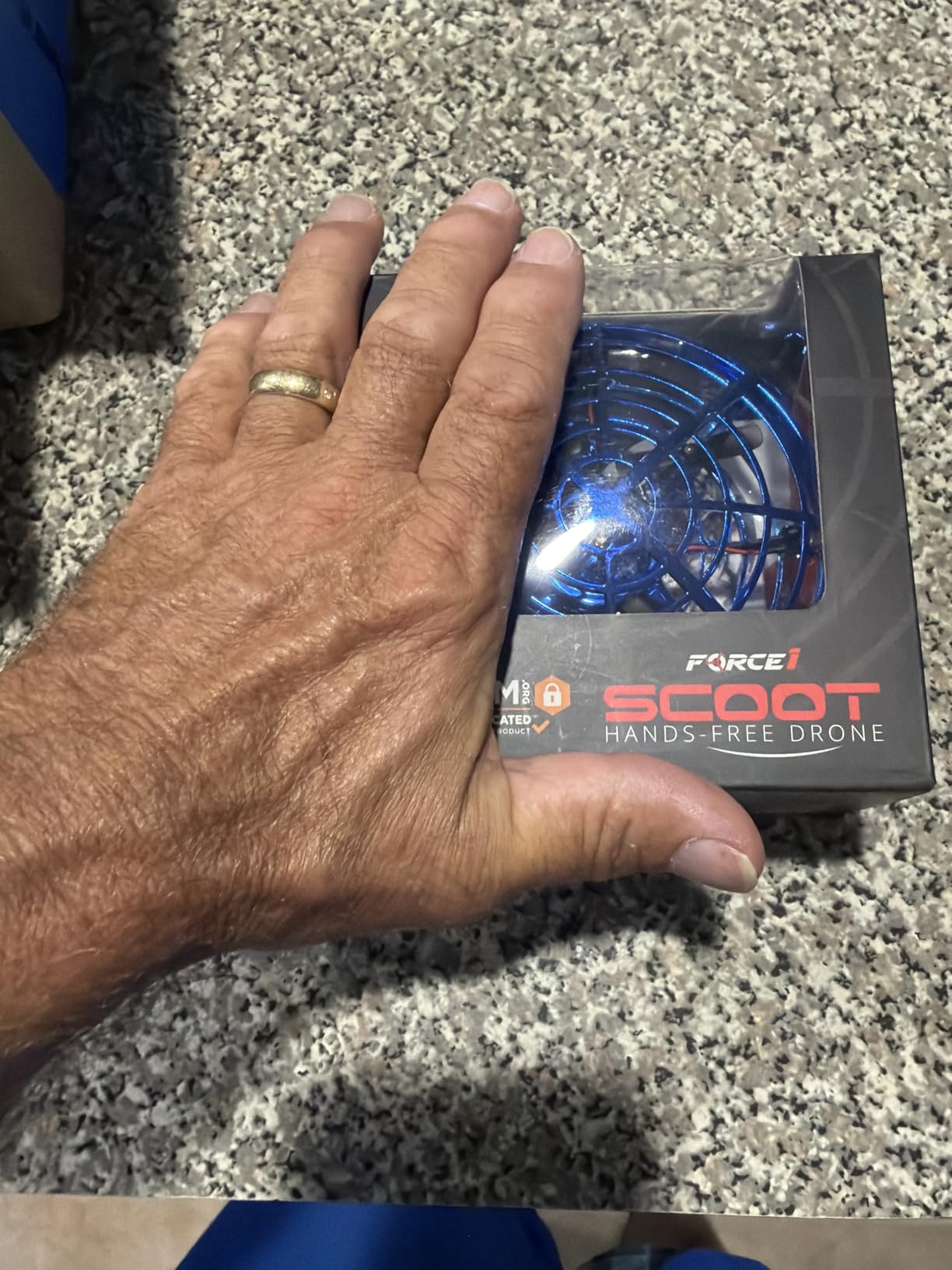
1.12 oz, 4.7 inch shell
About 7-8 minutes per charge
Pros
- No remote or controller to learn
- Motion-sensing obstacle avoidance bounces it off hands and walls
- LEDs throw patterns on the ceiling
- Webbed shell protects furniture walls and small hands
- Force1 replacement service is quick
Cons
- Shell slats are wide enough for small fingers to reach the props
- A single strand of hair can jam a rotor
- Calibration is fiddly
- Only about 7-8 minutes per charge
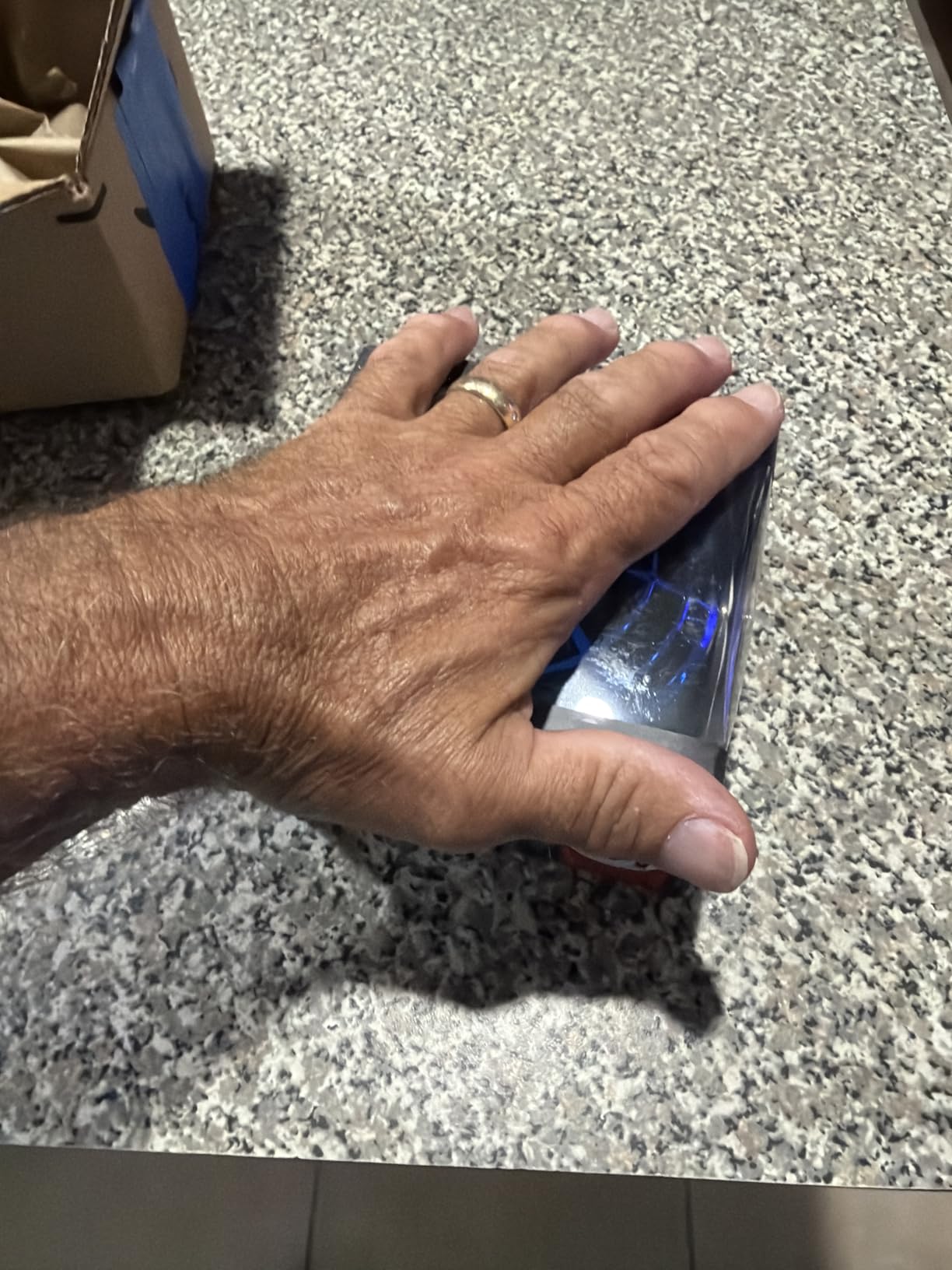
The Scoot is the only drone on this list with no controller, and that one decision moves the age floor down further than any other feature we tested. You toss it into the air, it flies on its own, motion sensors detect your hand or a wall and it steers away. A four-year-old can be flying it competently within a few minutes because there is nothing to learn beyond catch and throw.
It is also the most robust thing in a room full of furniture. The webbed outer shell means the body bounces off walls, desks and skirting boards without spinning a blade, and at 1.12 ounces it is far too light to damage anything. The vibrant LEDs project patterns across the ceiling, which is genuinely the feature that keeps a two-year-old entertained for a whole charge cycle.
Why Hand Operation Changes the Age Range
Every other drone on this page needs fine motor control on two thumbsticks, which is a real skill that younger children do not have. The Scoot replaces skill with intent: throw it, catch it, wave at it. That makes it the answer to the question parents ask most often in this category, which is whether there are drones for five-year-olds, and the honest answer is that this is the closest one.
It is listed for ages eight and up as a certified STEM toy, so the packaging guidance is more conservative than the reality of the toy. Most families we read about use it well below that with close supervision. It is a great first flying experience rather than a stepping stone to remote flying, so a child who graduates from it typically moves to a guarded nano with a controller next.
The Two Real Safety Concerns With This Drone
Two things come up repeatedly in owner feedback and both deserve a direct mention. The shell slats are wide enough that small fingers can reach a spinning propeller, so it is an indoor toy for a room without a toddler in it, and the motion sensing slows a child down rather than making contact impossible. Separately, a single strand of long hair can wind into a rotor and end the flight – owners with older children tie hair back first.
Neither issue is a reason to skip the Scoot, but both are reasons to watch the first ten flights closely. The calibration procedure is also fiddly and the printed instructions use tiny type, so set it up once when the child is not watching and you are not tired.
Battery Life and the Replacement Service
You get roughly 7-8 minutes of flight from a charge that takes about 50 minutes, which is the weakest flight-time ratio here. What softens that is Force1’s replacement service, which owners repeatedly praise for swapping faulty units quickly and at no cost. Families report a few good months out of each one before battery or hair-jam issues appear, and the service is the reason that is an acceptable pattern.
Who Should Buy the Scoot
Ages 4 to 7, and any child who is not ready for a remote control. It is also the best rainy-day indoor toy in the roundup, because the whole flight session happens in a living room with no setup at all. Once the child is asking about flying to places, or wants to see through a camera, move up to a guarded nano drone with a controller.
4. HASAKEE Q9s – Best LED Drone for Night Flying and Crash Survival
Q9s Drones for Kids,RC Drone with Altitude Hold and Headless Mode,Quadcopter with Blue&Green Light,Propeller Full Protect,2 Batteries and Remote Control,Easy to fly Kids Gifts Toys for Boys and Girls
500mAh LiPo x2
Blue and green LED frame
Four full propeller guards
720p capture
6-7 min per battery
Pros
- Takes abuse without breaking
- Bright dual-colour LEDs with three lighting modes
- Four full guards and ABS body absorb impacts
- Two 500mAh batteries roughly double playtime
- Altitude hold and headless mode cut the learning curve
Cons
- Only about 6-7 minutes per battery
- Light frame is carried off by a light breeze
- Propellers catch and pull out long hair
- Some units stop working after a few weeks
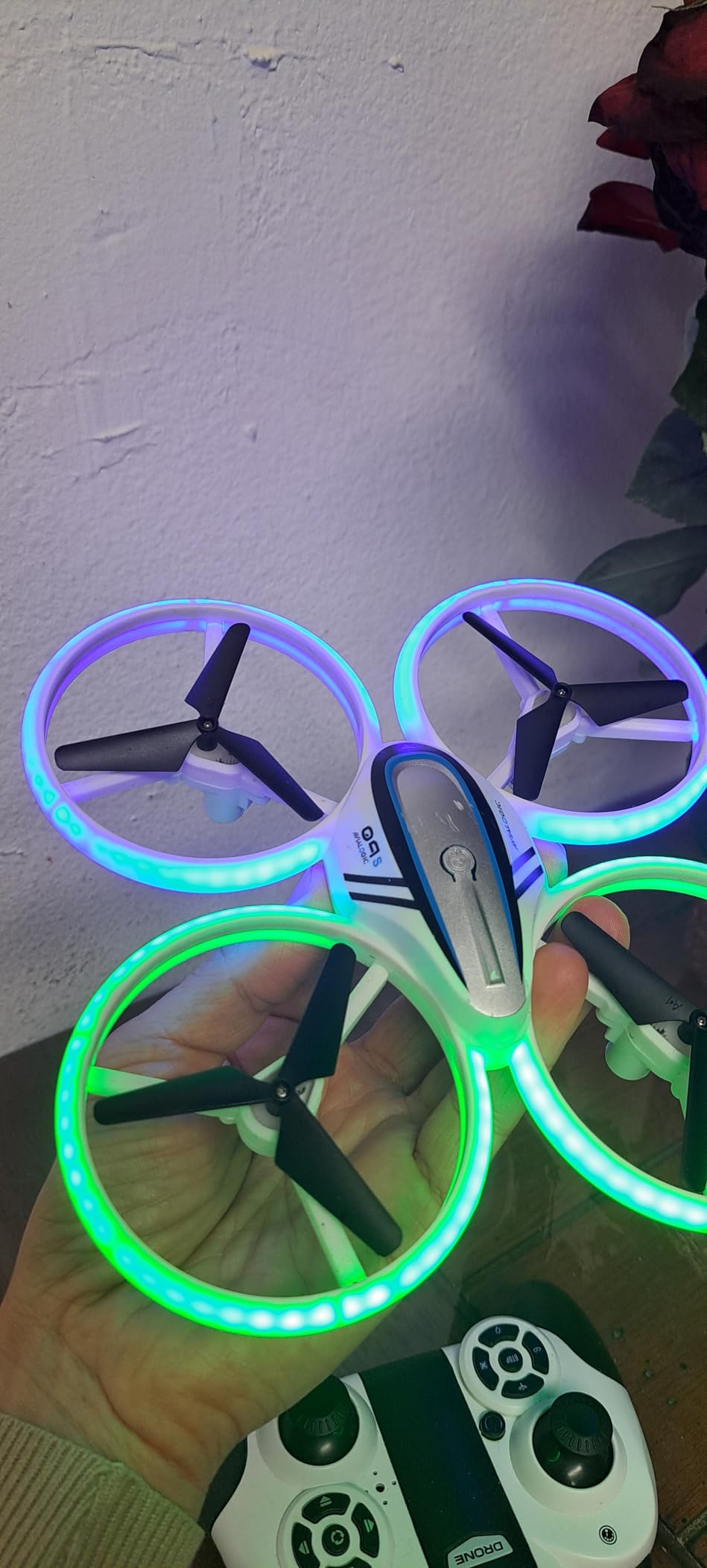
The Q9s is the most rugged remote-controlled drone in this group, and owners who also fly larger drones describe it as the ideal cheap indoor practice aircraft. The frame is 6.9 inches across, the body is ABS, and all four propellers sit inside full guards, so it takes the kind of repeated wall and floor contact that ends thinner models. Parents on Reddit specifically single it out for surviving crashes that destroy cheaper drones.
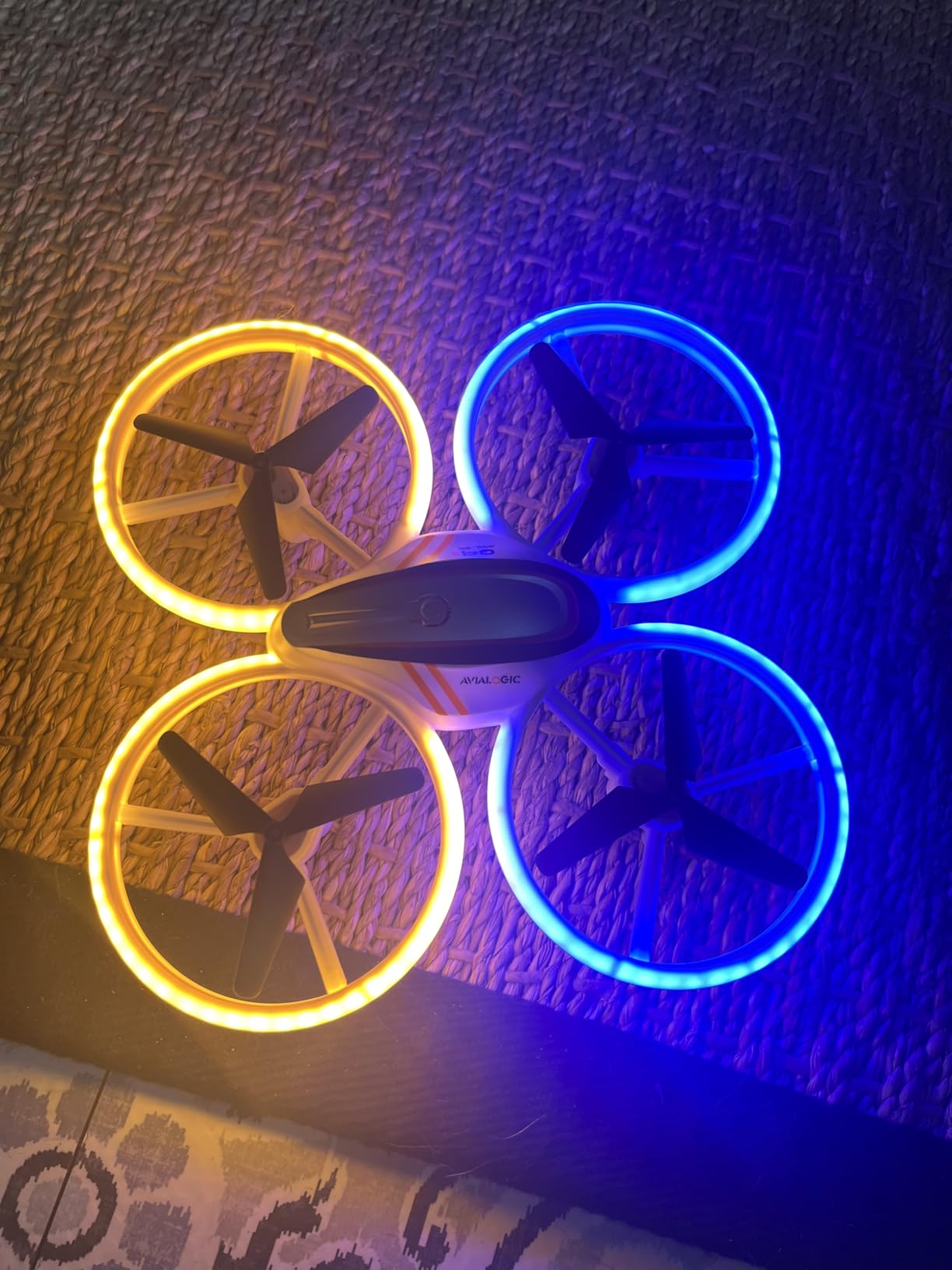
The light show is the second reason to buy it. Neon green and blue LEDs run across the whole frame with three display modes, and in a dark room the drone is far easier to follow than any of the plain black or blue models here. For a child flying in a bedroom after lights-out, that visibility is a safety feature as much as a toy.
Two 500mAh Batteries and Honest Airtime
Two UL-certified 500mAh lithium polymer packs give roughly 12-14 minutes of combined flight at about 6-7 minutes per charge. That is a genuine improvement on every single-battery model here, though the HS210 with three packs still leads on total airtime. Two batteries is the practical minimum for this category, and anything with one is worth skipping if your child will be frustrated by waiting.
The 6.9 inch frame is wider than the nano models, which cuts two ways. It is more stable and more durable, and it needs more room to turn. A medium-large living room works well; a small bedroom with a ceiling fan does not.
Stunt Modes, Speed Settings and One-Button Control
One-button take-off and landing, three speed settings, 360-degree flips, auto-rotation and automatic hovering are all present, plus headless mode so a beginner is not fighting orientation. That combination is the standard beginner kit for this class and the Q9s executes it cleanly, with a propellers-spanner-free assembly that reassembles quickly after a bump.
The camera records 720p MP4 through Wi-Fi, which is fine for short clips but is not what anyone buys this drone for. Think of it as a bonus. The LED modes are the reason most owners keep flying it after the novelty of the camera fades.
Wind, Trees and Long Hair: The Three Indoor Warnings
Owners are consistent about the limits. Even a light outdoor breeze pushes this frame off course, and a thermalling day can put it in a tree within minutes – which means a fishing line on a stick and a spotter, not a child climbing a ladder. Keep long hair tied back, because the props will catch a pony tail and pull. None of this makes it a bad indoor drone; it makes it an indoor drone.
There is also a recurring report of units dying after a few weeks, which is the usual quality-control variance in this price band. The 4.3 rating across more than 6000 reviews reflects a strong central tendency with a small tail of early failures.
Best Age and Setting for the Q9s
Ages 7 to 12, indoors, in a room where the lights can be dimmed. It is our pick for a child who has already learned to hover and now wants something that survives being thrown at the furniture. For pure camera work, the AVIALOGIC in review five is the better buy.
5. AVIALOGIC Mini Drone – Best Camera Drone With 1080P Live FPV
AVIALOGIC Mini Drone with Camera for Kids, Remote Control Helicopter Toys Gifts for Boys Girls, FPV RC Quadcopter with 1080P HD Live Video Camera, Altitude Hold, Gravity Control, 2 Batteries, Black
1080P live FPV camera
Two 550mAh batteries
Altitude hold and gravity control
320 g, 8.2 inch frame
Pros
- 1080P live FPV streams clearly to a phone
- Two 550mAh batteries give longer flight than most camera drones
- Altitude hold and gravity control steady the shot
- Phone clips to the controller
- Survives the crashes an eight-year-old produces
Cons
- Propeller guards are thin and detach on impact
- Arms and motors can break in one hard crash
- Hard to control in any wind
- Replacement guards are hard to source
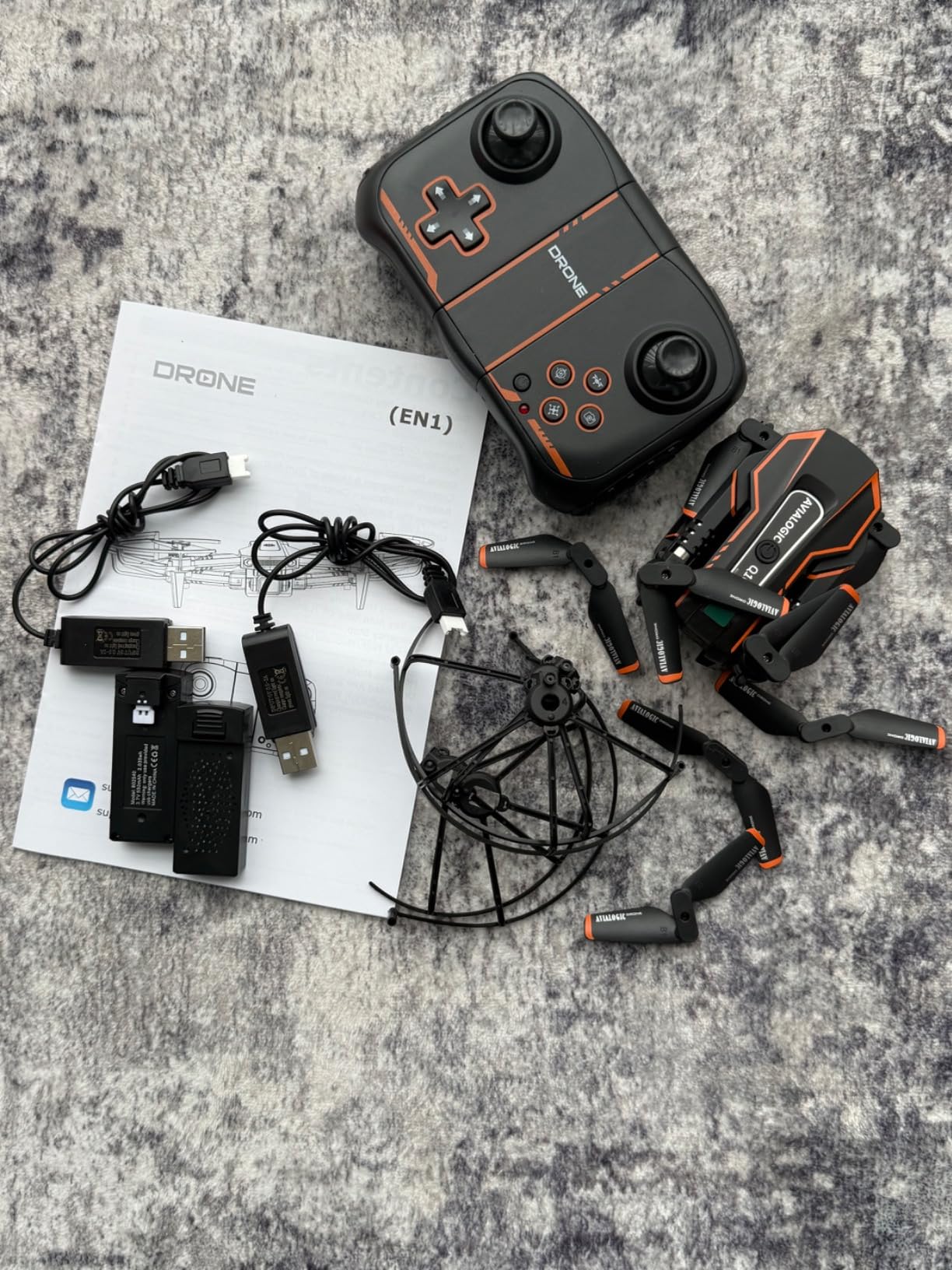
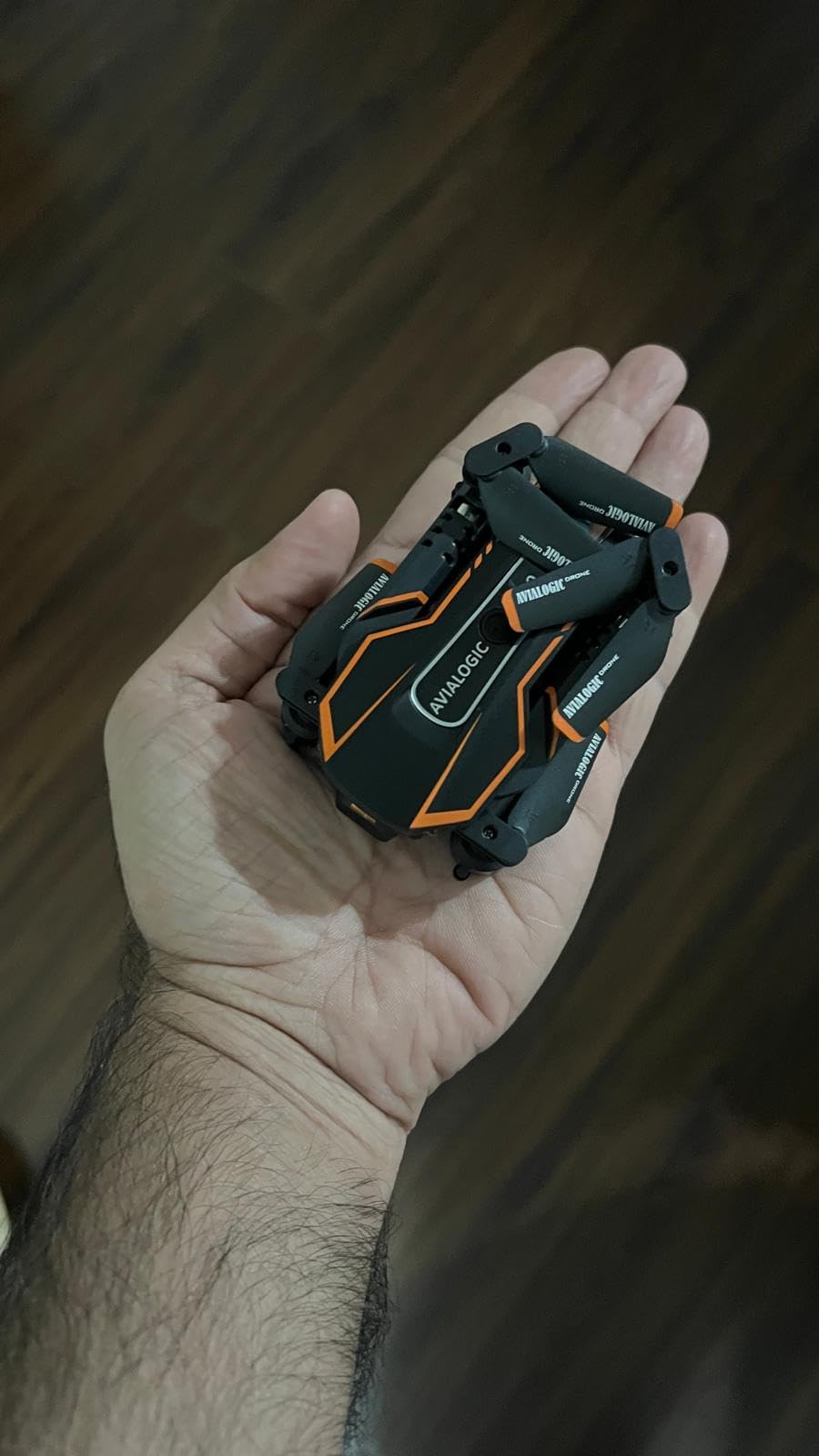
This is the pick when the gift is about video rather than flying. The 1080P camera streams a live first-person view to a phone, the phone clips onto the controller so the view and the sticks are in one unit, and the result is a child who is genuinely filming rather than just playing with a toy. The camera tilts manually through 90 degrees, which matters more than it sounds when a child is following a sibling across a yard.
Two 550mAh batteries give up to 18-21 minutes of combined flight, which is among the better battery maths in the camera drone class. Altitude hold and gravity control keep the shot steady for a beginner, and voice commands, gesture photo capture and flight-path drawing through the app add enough novelty that the drone does not get abandoned after a fortnight. Once a child graduates past toy framing, our guides to the best camera drones for cinematic video and the best camera drones for real estate photography show what the next step up looks like.
FPV With a Phone Versus a Screen Controller
FPV means first-person view – you see what the camera sees, in real time, from the drone’s perspective. That is the feature that makes camera drones feel genuinely futuristic to a child, and it is why this model ranks so high for an eight-year-old who wants to make films. The trade-off is dependence on a phone app and a Wi-Fi link, and app-based FPV connectivity is the least reliable part of the whole category.
Some parents prefer a drone with a built-in screen controller instead, which removes the app entirely and the chance of a failed pairing. None of the ten models here includes a screen, so the practical advice is to test the app on your own phone before the wrapping paper comes off, and to keep expectations realistic about dropped frames.
Build Thinness: The Honest Weakness
At 320g this is the heaviest drone on the list, and the extra mass comes with a frame that is less forgiving than it looks. Guards are thin and detach on impact, and owners report arms and motors snapping after a single hard crash. Once an arm bends, the drone flies crooked and is effectively finished, and replacement guards are difficult to source separately.
This is the real cost of buying on camera features rather than durability. If your child is going to fly hard and crash often, choose the SYMA X100 or the Q9s instead and accept a basic camera. If they are going to fly carefully and make films, this is the right one.
Altitude Hold, Gravity Control and App Features
Gravity control means tilting the phone steers the drone, which works well for slow sweeping shots and badly for anything fast. Altitude hold keeps the height steady so a child can concentrate on framing rather than on not sinking into the floor. One-key start and landing plus three speed modes round out an unusually full beginner feature set for a camera drone.
It is also noticeably harder to control in any wind, even indoors near an air vent, so clear air and a still room matter here more than with the nano models.
Who This Camera Drone Suits
Ages 8 and up, for a child whose interest is making videos. A phone or tablet is required, and someone needs to be comfortable troubleshooting an app when it does not connect. If your child is younger, hand this one to an older sibling and give the younger one the Scoot.
6. ATOYX Mini Drone – Best Steady Hover With Four-Blade Propellers
Mini Drone for Kids & Beginners,Indoor Nano RC Quadcopter with One-touch 3D Flip,Auto Hovering,Headless Mode,Portable Hand Operated, Birthday& Children’s Day Gift for Boys and Girls,Blue.4-blade design-ATOYX
Eight four-blade propellers
Complete-cover outer shell
220mAh x2, about 15 min
50 g for ages 6+
Pros
- Four-blade propellers give steadier hover and lower noise
- Complete-cover outer case absorbs falls
- Altitude hold headless mode and one-key landing
- Two batteries for about 15 minutes
- Three speed modes plus 3D flips and LEDs
Cons
- Smallest and lightest frame so the most wind-sensitive
- Included batteries are only 220mAh each
- Complete-cover shell adds drag indoors
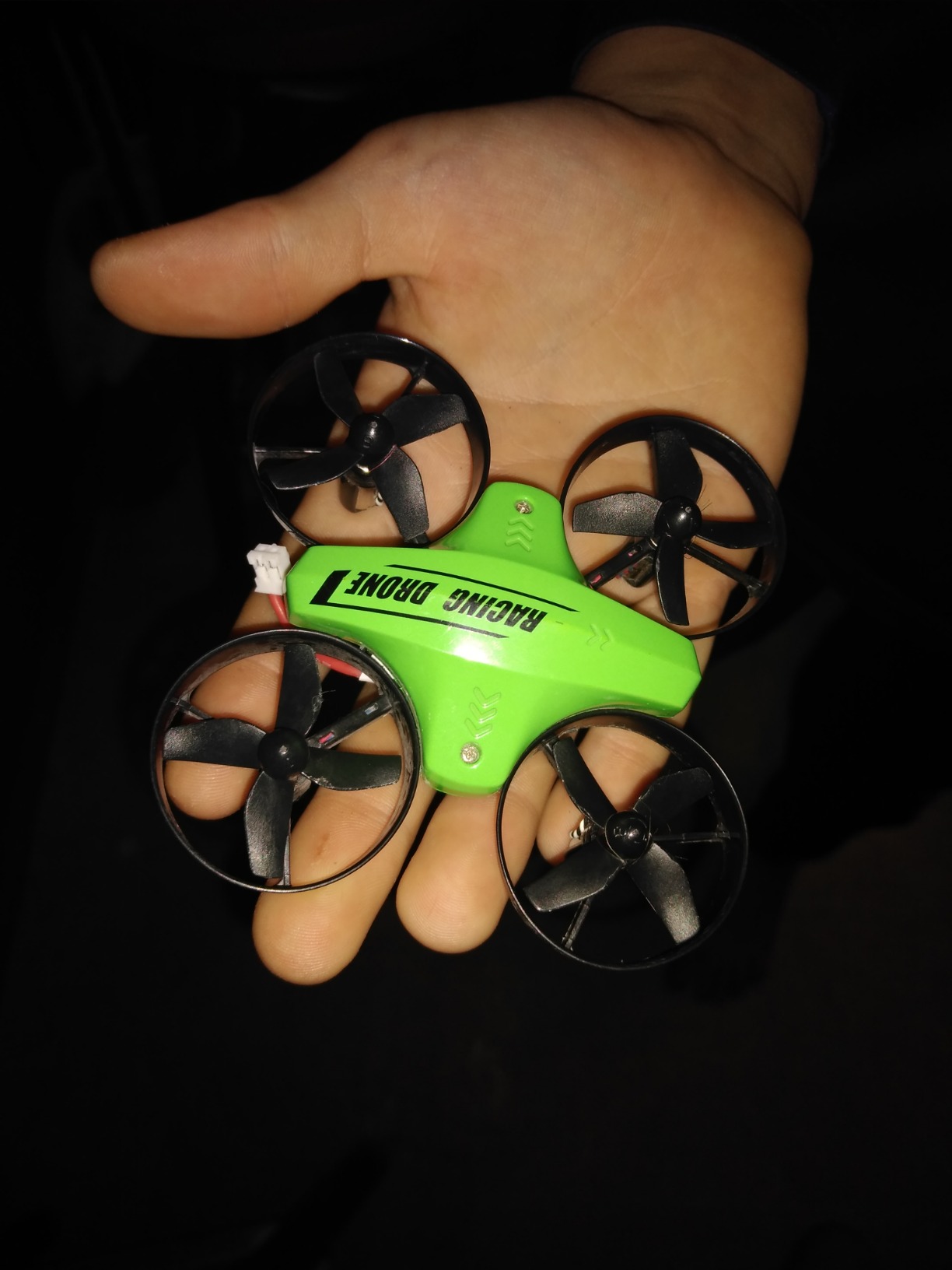
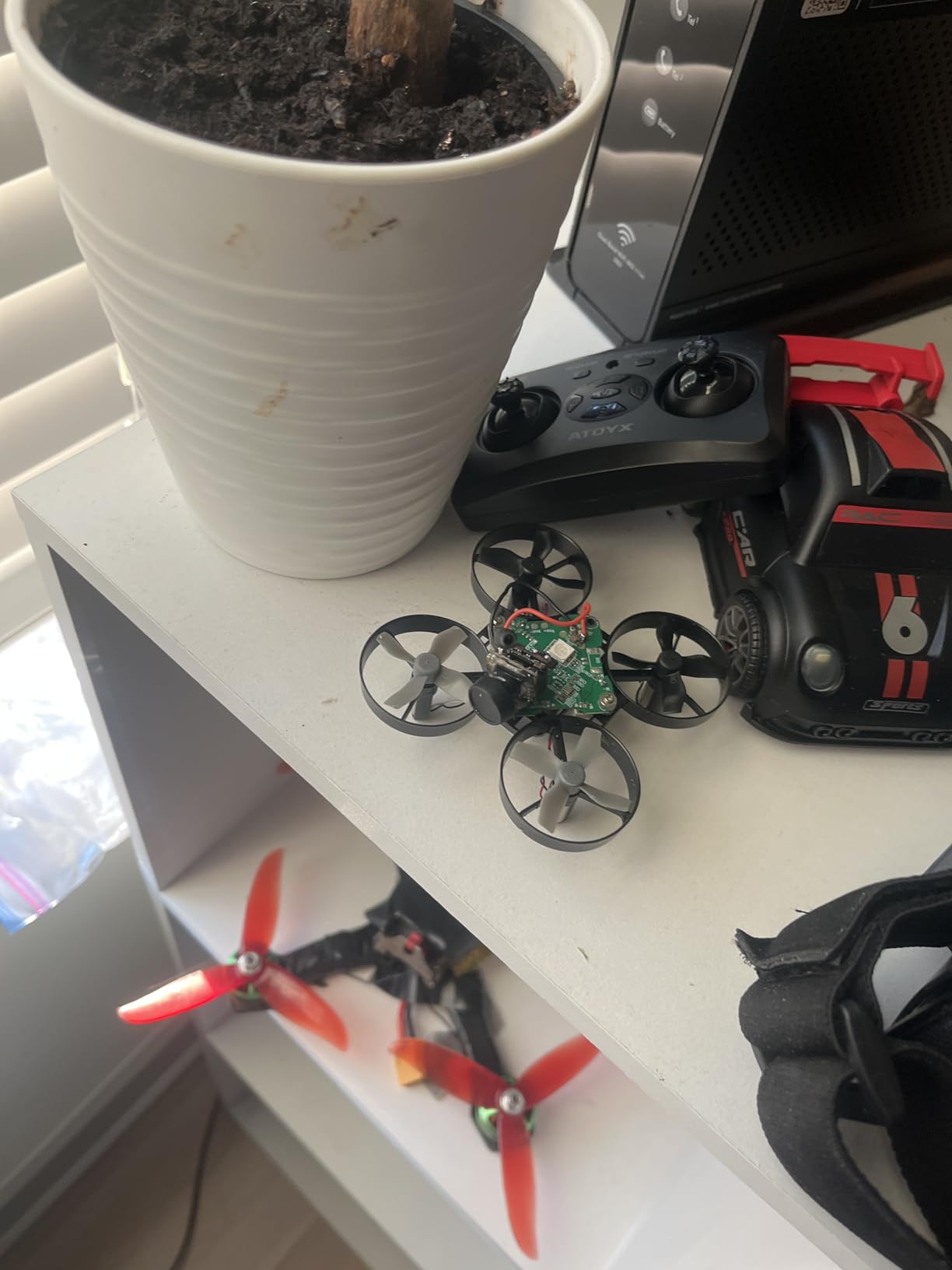
The ATOYX exists because of one hardware decision: eight four-blade propellers instead of the usual three. Four blades on each rotor produce more thrust, a steadier hover, better wind resistance and noticeably less noise than the three-blade minis it competes with. For a child learning to hover, a drone that holds position without drifting is worth more than a long feature list.
The safety design is the other differentiator. Instead of four separate propeller guards that can snap, the whole airframe sits inside a complete-cover outer case that absorbs falls and keeps small fingers out of the blades. Spare propellers are included, which matters because four-blade props twist off more easily than three-blade ones.
Two 220mAh Batteries and Honest Total Airtime
Two rechargeable 220mAh packs give about 15 minutes of combined flight, which is respectable for the size but the individual batteries are small. Charging is quick because the capacity is small, so the wait between flights is shorter here than on the 500mAh and 700mAh models. The trade is exactly what you would expect: less total airtime, less waiting.
It is rated for ages six and up, which is the most honest age label on this list. The 50g weight and the fully enclosed shell make it a sensible first remote-controlled drone for a six- or seven-year-old.
Why the Enclosed Shell Helps Indoors and Hurts Outdoors
The complete-cover case is a real safety win in a room and a real aerodynamic penalty. Drag from the shell reduces the usable flight envelope indoors, so the drone needs slightly more room and slightly more throttle than an open-frame nano. In practice that means a medium room rather than a small bedroom, and it means the drone will not climb as freely as the HS210.
Outdoors, the same small light frame and added drag make this the most wind-sensitive model we tested. Combined with the 220mAh batteries, the verdict is clear: this is a calm-day indoor flyer and nothing more.
Stunts, Lights and Beginner Aids
Altitude hold, headless mode, one-key take-off and landing, three speed modes, 3D flips and LED lighting cover the standard beginner kit completely. What the four-blade design adds is the confidence that comes from a hover that does not wander – a child can put the drone down on a book, walk away, and come back to find it still where they put it.
Review volume is modest compared with the Holy Stone models on this list, so the aggregate signal is thinner even though the rating is solid at 4.0. That is worth keeping in mind if you are choosing on owner feedback alone.
Who Should Buy the ATOYX
A six- or seven-year-old learning to hover, or a parent who wants the quietest, most enclosed design available. The four-blade hover quality is genuinely better than the price suggests. For a child who wants a camera, this is not the drone.
7. Swifsen SWA35 – Best Finger Safety With an Upper Protective Cover
Swifsen Drones for Kids with Camera,Rc Drone Indoor Small Helicopter,Birthday Gifts for Boys and Girls Beginners Friendly,Mini Quadcopter Toy With 2 Batteries,Propeller Protect,Altitude Hold
Upper cover over the prop guards
Modular batteries x2
720P camera and Wi-Fi
60 ft range
About 15 min total
Pros
- Upper cover blocks finger access to the blades from above
- Modular plug-in batteries avoid cable failures
- Two batteries give about 15 minutes combined
- Headless mode and one-click calibration simplify recovery
Cons
- Manufacturer advises staying within 60 feet
- 720p capture is modest
- Calibration must be run at power-on or after a collision
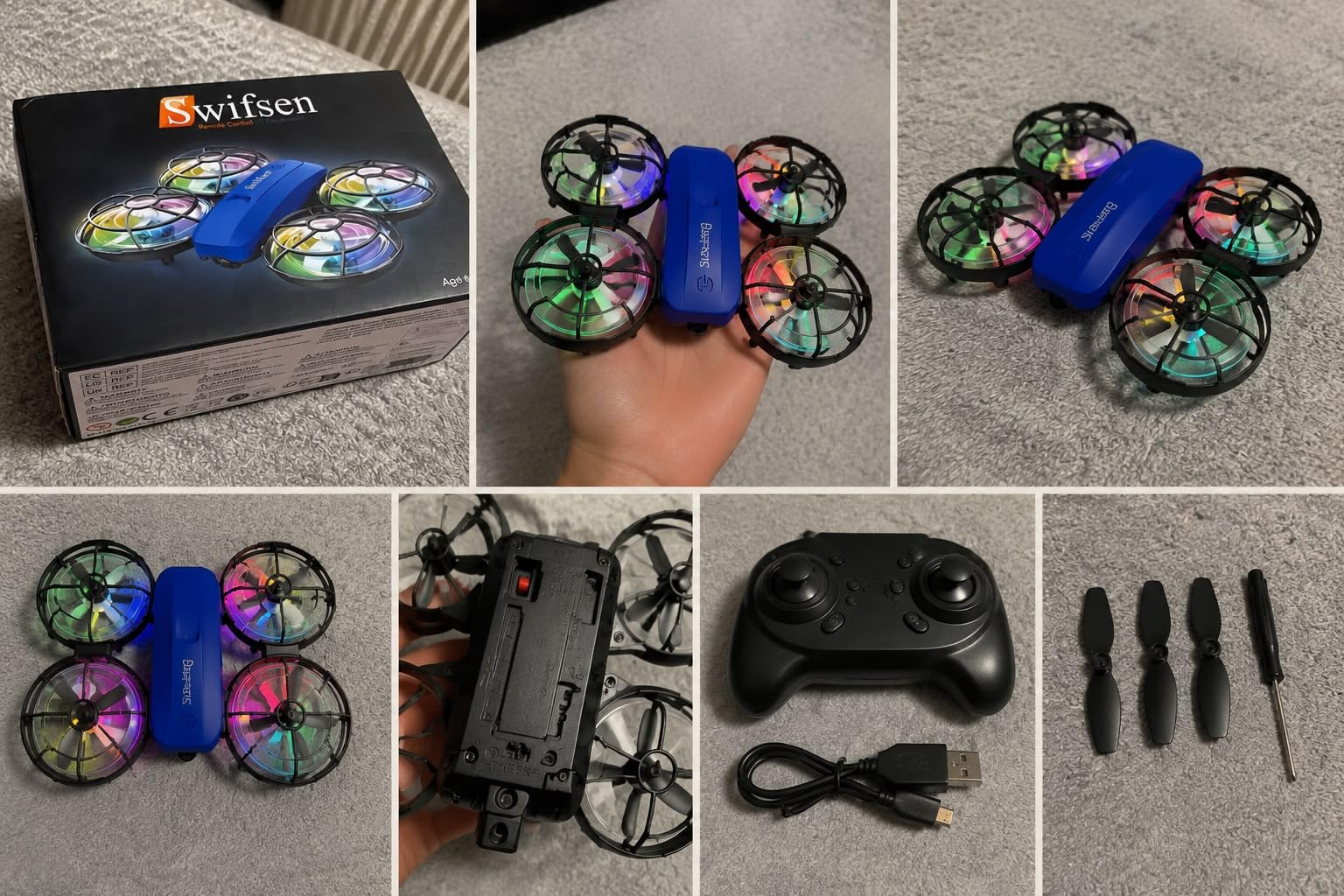
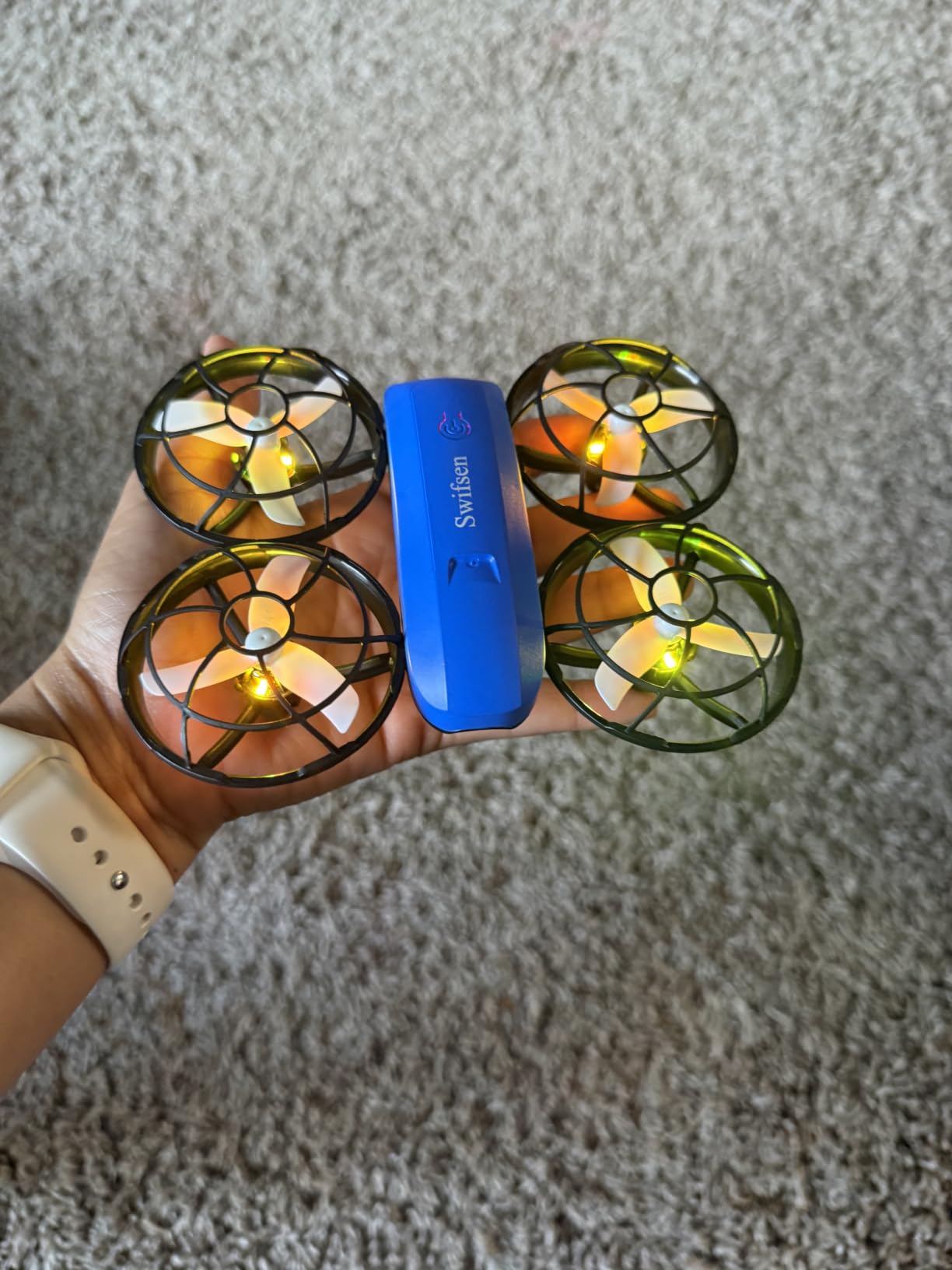
The design detail that makes the Swifsen different is on top rather than around. Most mini drones guard the propellers from the sides and leave them reachable from above, which is exactly how a curious child ends up with a spinning blade under their palm. The SWA35 adds an upper protective cover over the guards, so a child picking the drone up off a table cannot reach the fans.
That matters because picking a drone up is what everyone does immediately after every flight. It is the single highest-risk moment in the entire hobby, and this is the only model here designed specifically around it. The second design lesson is the battery: Swifsen moved from a cabled pack to a modular plug-in one, and owner feedback shows that change landed.
Modular Batteries and 15 Minutes of Total Airtime
Two upgraded modular batteries give about 15 minutes of combined flight, and the plug-in connector is the reason cables do not fatigue and snap in the charging port. Cabled packs are the top cause of premature battery death across this whole category, and a modular design is a meaningful reliability upgrade for a toy that will be charged a hundred times a year.
The trade-off is capacity. At roughly 15 minutes total, this sits mid-pack, ahead of every single-battery model here and behind the three-battery HS210. A 720P camera records MP4 over Wi-Fi, which is serviceable for short clips rather than anything to build a film around.
Calibration, Range and the 60-Foot Rule
The drone needs its one-click calibration run at power-on and again after any collision, and owners are clear that skipping it is what leads to a drone that flies in circles. It is a thirty-second habit, and it is the difference between a recovery and a write-off.
Range is the other caution. The manufacturer advises staying within 60 feet, and reviewers repeat that guidance because beyond it the drone can simply be lost. Combined with a 13.1 ounce weight and a 6 by 5 inch frame, this is a drone for a room or a quiet corner of a garden, not an open field.
Stunt Features for a First Pilot
Throw-to-go launch, loop flight, 3D flip, auto-rotation and multi-colour lights are all on one button, alongside headless mode. The combination means a child who can already hover has a reason to keep going, and the lights make it followable indoors at dusk.
Where it fits in the roundup is as the safest pick for a child who tends to grab things. Between the upper cover and the enclosed guards, no other model here gives a parent as much reason to relax about the pickup moment.
Best Age and Room for the SWA35
Ages 6 to 11, indoors, in a room with roughly 60 feet of clear diagonal. It is our pick for a child who gets excited and reaches for the drone the instant it lands. For night visibility and crash toughness specifically, the Q9s has the better LEDs.
8. SYMA X100 – Best Drone With Obstacle Avoidance for Cluttered Rooms
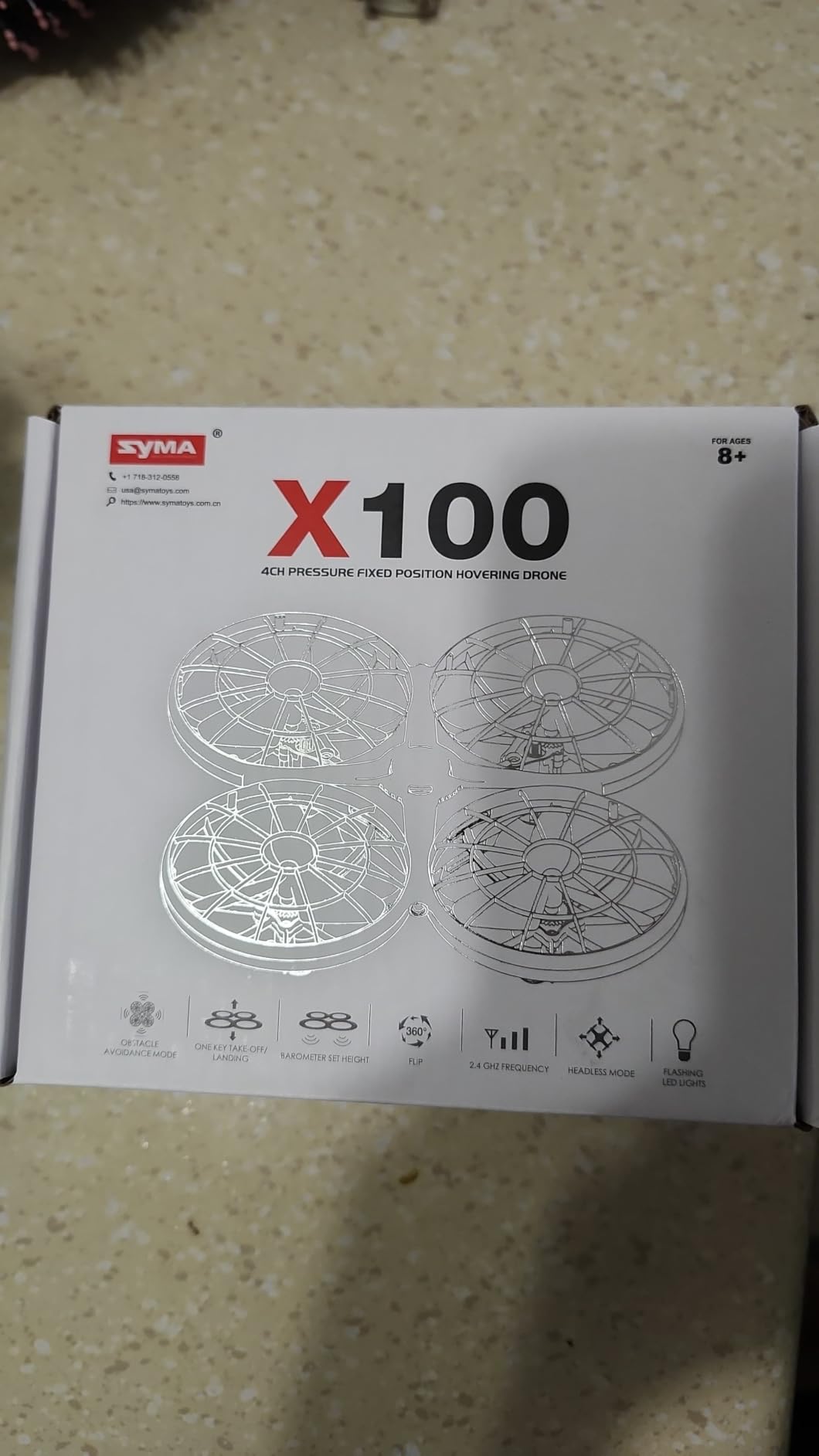
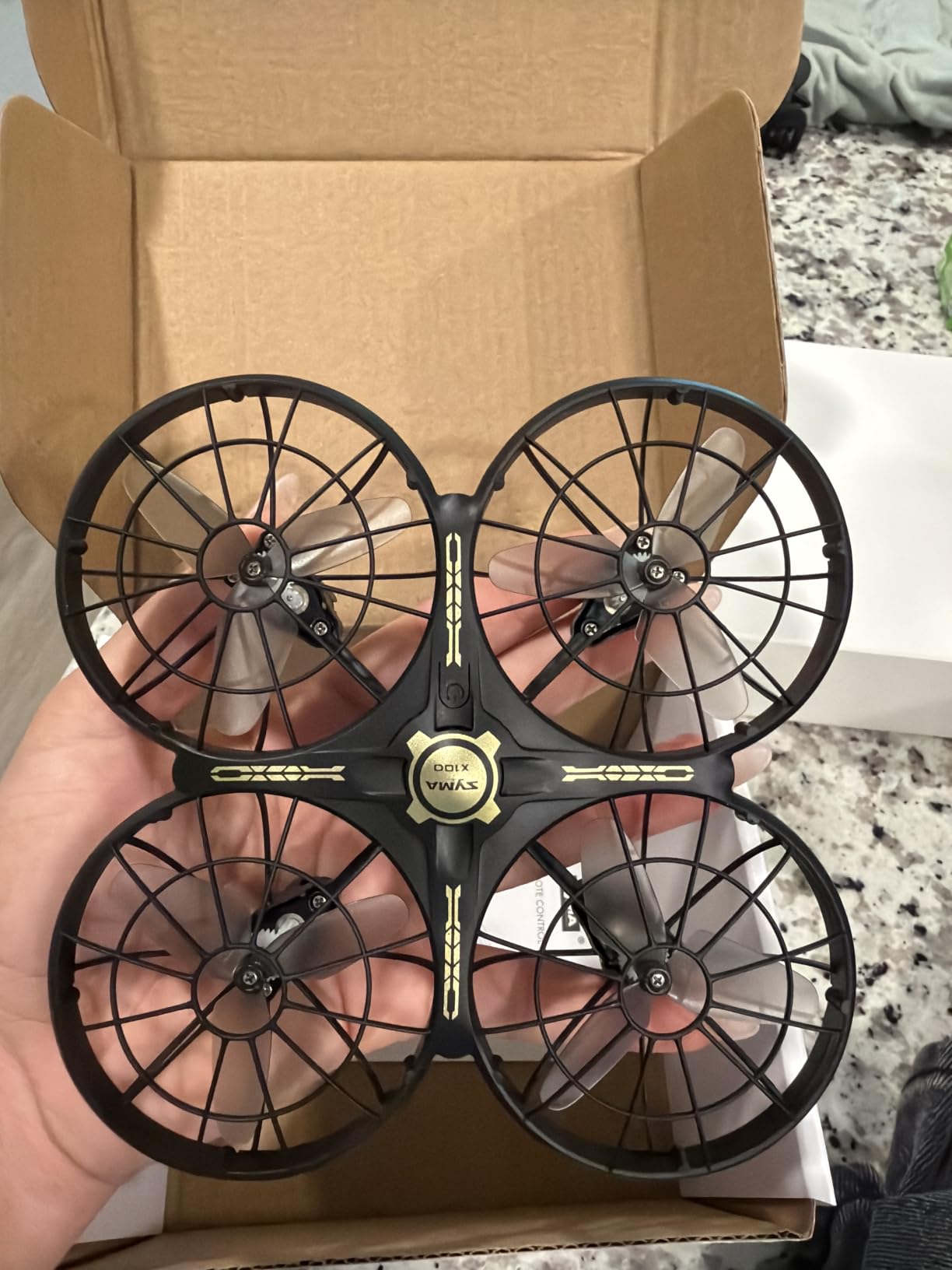
SYMA X100 Indoor Drone for Kids 8-12, Obstacle Avoidance, Full Guard
Four-way infrared sensing
Fully enclosed propeller guard
700mAh x2, up to 20 min
58 g on 2.4GHz
Pros
- Infrared obstacle avoidance steers it away from walls and furniture
- Most complete propeller protection in this group
- Two 700mAh batteries give the longest quoted total flight time
- Starts in slow mode for younger children
- Parents report it survived repeated crashes
Cons
- Guard cage cracks after a handful of bumps
- Handheld gesture control is limited indoors
- Hard to control outside where wind takes over
The X100 solves the two things parents worry about most: blades and crashes. Four-way infrared sensing detects obstacles roughly 12 inches out and steers away automatically, and the propeller protection is a fully enclosed guard rather than four separate clips. The effect in a cluttered room is that the drone bounces off things rather than burying itself in them, which in practice is a large reduction in crashes for a beginner.
The battery maths is the best in the roundup. Two 700mAh packs deliver a quoted total of up to 20 minutes, the highest combined figure any model here claims, at 58g. It also starts in slow mode so a younger child can build confidence before anyone turns the speed up.
How Obstacle Avoidance Actually Works Here
This is infrared proximity sensing, not optical flow. It detects surfaces within about 12 inches and initiates an avoidance manoeuvre, which is genuinely useful when the flight space is a living room with a sofa, a coffee table and a lamp in it. It is not obstacle avoidance in the sense a modern camera drone means – it will not map a route or climb over a chair.
Expect it to save the drone from walls and furniture. Do not expect it to save the drone from a staircase, a ceiling fan or a curious dog. The obstacle avoidance rating on this model is a real step up from everything else in the roundup, and that is why this is the pick for a cluttered indoor space.
Two 700mAh Batteries, Two Speed Modes
Two rechargeable 700mAh batteries are the largest packs in this group and the reason for the 20-minute total. One-key take-off and landing, altitude hold, headless mode and two speed modes cover the beginner essentials, and a one-button 360-degree flip adds a stunt for indoor games and challenges.
Slow mode matters more than it sounds. Most parents start a child on the lowest setting and stay there, so a drone that genuinely performs well at low speed is more usable than one that is only impressive at full power.
The Cracking Guard Cage Problem
The recurring complaint is the cage itself. Owners report the fully enclosed guard cracking after a handful of bumps, which is unfortunate on the model whose whole argument is protection. The enclosed design still outperforms unguarded drones in the first several crashes; it just does not last indefinitely, and replacement cages are the part to check on availability before buying.
Gesture control is listed but limited indoors, where there is not enough room to move your hand far enough to get a response. The 2.4GHz control link is conventional and reliable. Outdoors, wind takes over completely – this is an indoor drone.
Who the X100 Is For
Ages 8 to 12, in a busy, furniture-filled room where a plain nano would spend its life hitting sofas. It is our pick as the best drone for kids with obstacle avoidance and the safest indoor option in the roundup. For a dark room and a light show, the Q9s is the better pick; for a camera, look elsewhere.
9. Holy Stone HS210T – Best Dual-Mode Drone That Also Drives
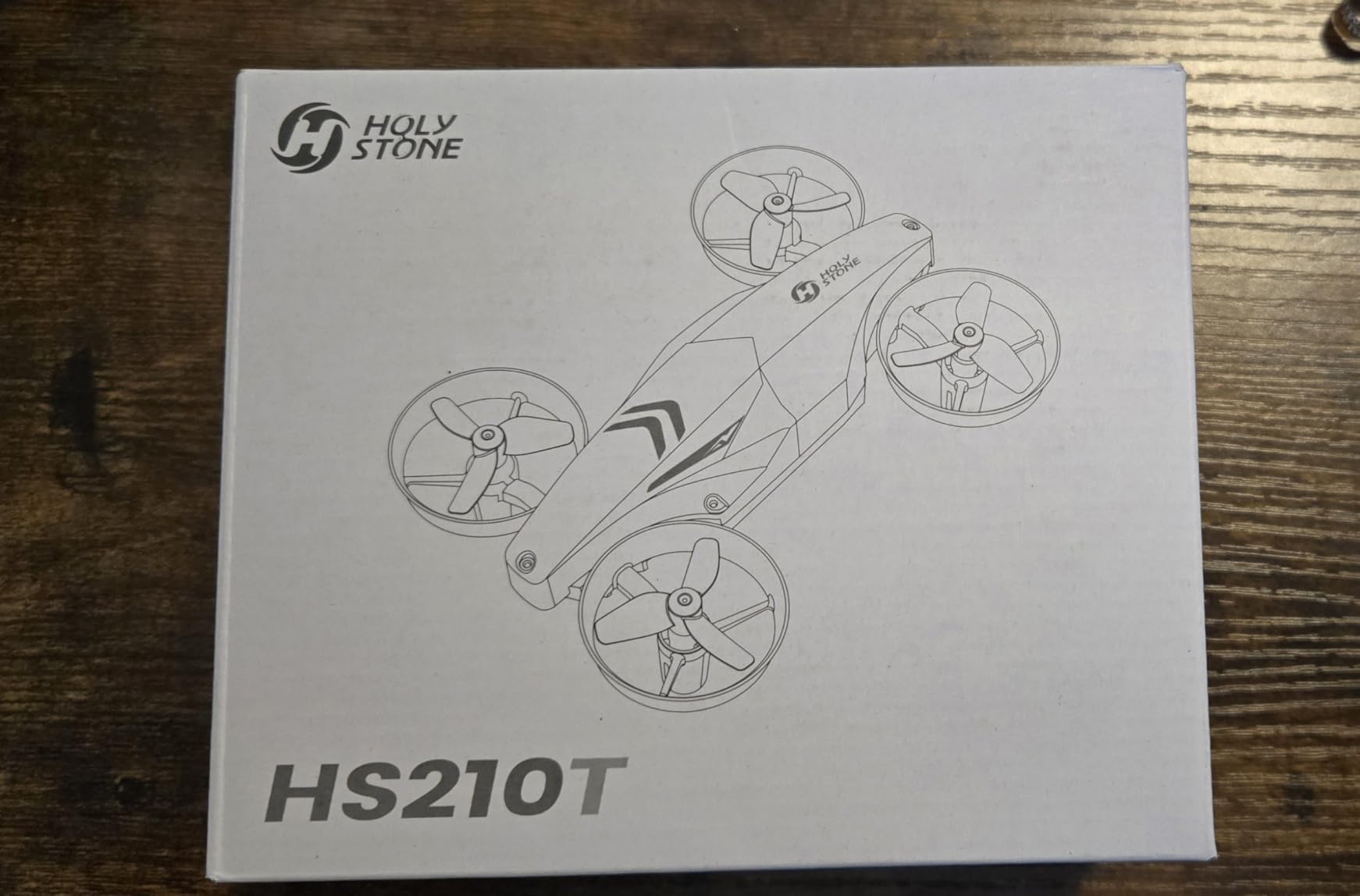
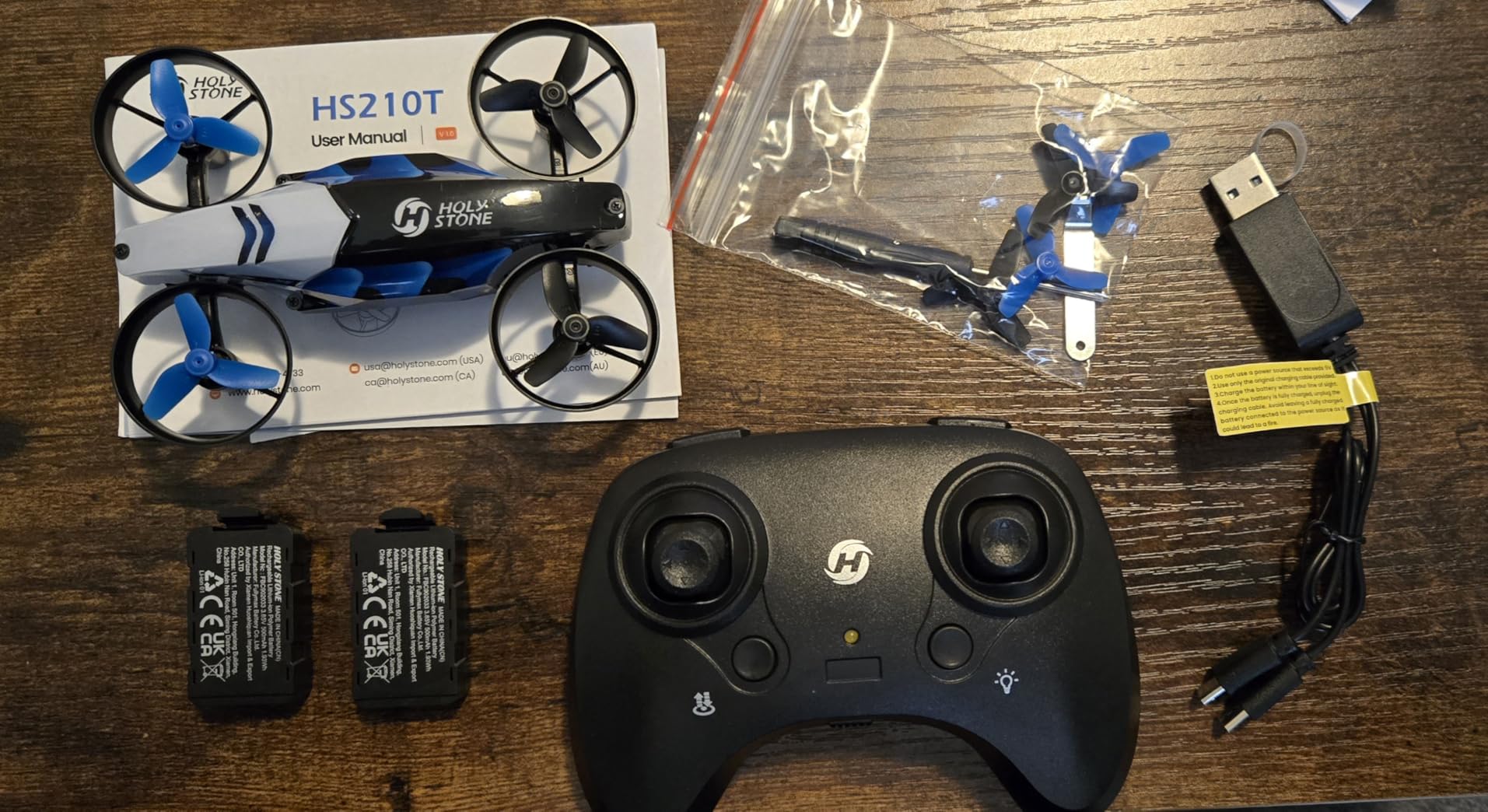
Holy Stone HS210T Drones for Kids, 2 IN1 MINI Indoor Drone with Land & Fly Mode, Four Posture Deformations RC Quadcopter with 3D Flip, Auto Hovering, Easter day& Birthday Toy Gift for Boys and Girls
2-in-1 fly and drive mode
Two batteries, about 16 min
Nylon-ABS guards
Emergency stop
2.4GHz
Pros
- 2-in-1 design converts into an RC car for floor racing
- Four posture deformation modes plus flips and circle fly
- Full nylon-ABS guards and one-key emergency stop
- Two modular batteries with overcharge protection
- 2.4GHz allows several drones to be flown together
Cons
- Land-and-fly transformation makes the airframe larger
- Two batteries total less airtime than the three-battery HS210
- Not suitable for outdoor wind
The HS210T answers a specific problem: children who love the drone for about three weeks. The 2-in-1 design transforms the craft into an RC car, so the same toy works on a carpet on a wet day and in the air on a good one. Four posture deformation modes, 3D flips and circle fly are all on one button, and eight LED colours keep the visual interest up between sessions.
Underneath the gimmick it is a competent beginner drone. One-key take-off and landing, auto-hovering, altitude hold and three speed modes are all present, and the propellers sit inside full nylon-ABS guards with a one-key emergency stop that cuts power instantly. The 2.4GHz link means two of them can fly or race together, which quietly doubles the play value.
Why Two Batteries Instead of Three
Two modular batteries with overcharge protection give about 16 minutes of flight. That is solid, but it is below the 21 minutes the three-battery HS210 manages, and it is the clearest tradeoff for the dual-mode design – the transformation hardware needs room in the frame, and something had to give. Modular packs with overcharge protection are the right choice here, since a child will leave them on the charger.
Charging cables and a screwdriver are included, along with four spare propellers. The spare count matters more on this model than most, because a car that flips onto its back in a carpet has a habit of chewing a prop.
The Transformation Trade-Off
Converting between land and fly mode makes the airframe larger and heavier-feeling than the standard HS210, and that extra mass is easier to knock about. In a small room the car mode is delightful; the flying mode needs slightly more clearance than the plain nano does.
It is also not an outdoor aircraft. As with the rest of this class, wind is the limiting factor, and the same 2.4GHz setup that lets two drones race together means a neighbour on the same channel can interfere. In a shared housing situation that is worth knowing in advance.
Who This Hybrid Drone Suits
Ages 6 to 10, particularly a child who burns through toys quickly or who likes cars as much as flying. The 2.4GHz multi-drone capability makes it an unusually good birthday present when two children are being given drones at once. For a child who only wants to fly, the simpler HS210 is the better value.
10. Veeniix V995 – Best Quiet Drone for Indoor Use Near Other People
Veeniix V995 Mini Drones for Kids and Beginners,Indoor RC Quadcopter,Small Helicopter Plane with 3D Flips,360° Rotation,Circle Fly,Auto Hover,Headless Mode and 3 Batteries,Gift for Boys and Girls
Three batteries, up to 21 min
22 g, quietest in the group
720p capture
Auto hover and headless
Pros
- Quietest micro drone in the group
- Stable and responsive for its size
- Three rechargeable batteries give the best total airtime for the money
- Survives many wall and floor crashes
- Customer service replaced a faulty unit
Cons
- Very light at 22g so any breeze pushes it off course
- Altitude hold sometimes drifts down
- No obstacle avoidance
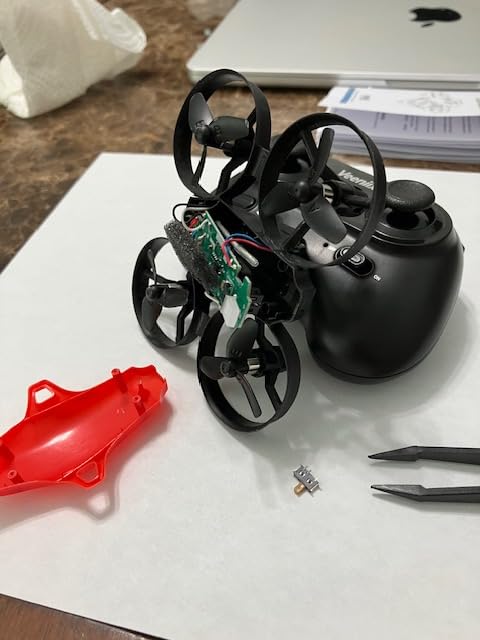
- Batteries are hard to seat under the compartment lid
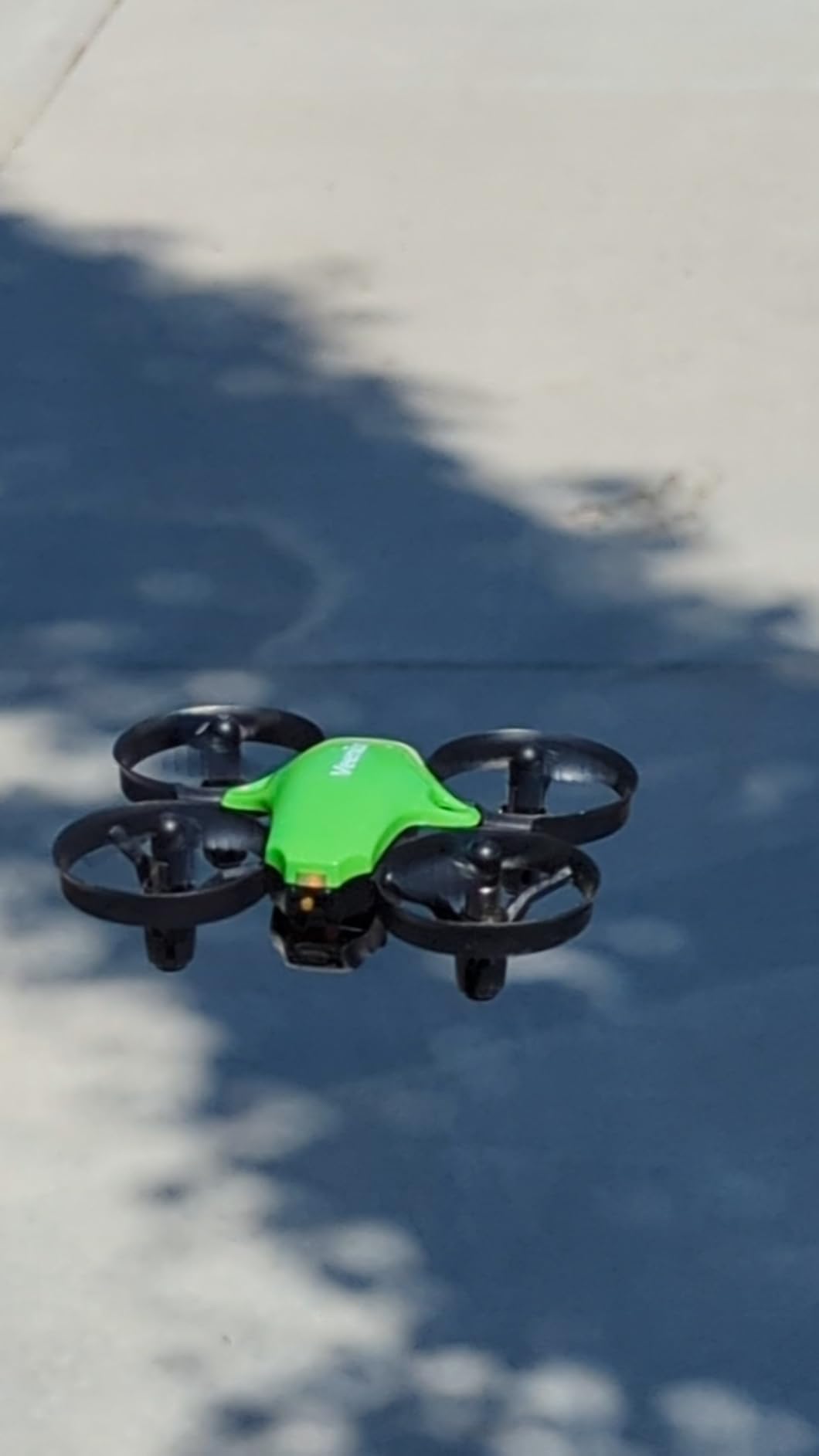
At 22g the V995 is the smallest drone on this list, and reviewers single out two things about it. It is the quietest of the small drones they have flown, compared favourably to a hummingbird, which matters in a flat or a shared wall. And with three rechargeable batteries it delivers up to 21 minutes of total flight, matching the HS210 at a fraction of the weight.
It is also stable and hard to break. Owners describe it as forgiving of a beginner’s mistakes and surviving repeated wall and floor crashes with no visible damage, and the 3.6 by 3.15 inch frame with protective guards is a sensible size for a small room. Customer service is responsive and replaced faulty units, which is a good sign for a first purchase.
Three Batteries, Twenty-One Minutes, One Compartment
Three batteries at 180mAh each give up to 21 minutes of combined flight, which is the best airtime-per-purchase on this list. The problem is how they go in. The compartment lid has to come off to reach them, the compartment is crowded, and the batteries are difficult to seat properly – exposed wiring under the lid makes alignment fiddly for small hands.
Headless mode, low-battery and distance warnings, one-key take-off and landing, auto-hover and three speed settings cover the beginner set, plus 3D flips, 360-degree rotation and circle fly. The 720p camera records MP4, AVI or MOV, which is more format flexibility than most of the competition offers.
The 22g Problem in Any Moving Air
At 22g this drone is pushed off course by a breath. The same light frame that makes it quiet and gentle indoors makes it useless in a breeze, a room with air conditioning, or anywhere near an open window. Buyers who take it outside should expect to lose it quickly.
Altitude hold also does not always hold – owners report it sinking without stick input, which is a reliability issue in a feature that a beginner relies on heavily. There is no obstacle avoidance either, so it will simply bang into walls. Both are consistent with the size class rather than defects.
Best for Apartments, Late Nights and Travel
Ages 6 to 9, indoors, in a flat where noise matters or a sibling is sleeping. The printed manual is hard to read, so set it up once yourself, and check the altitude hold behaviour early so you know how it behaves before handing it over. For a slightly older child in a busier room, the HS210 is a safer recommendation.
How to Choose a Drone Your Child Will Actually Fly
Start With Your Child’s Age
Four of the most common questions in this category are age-framed, so here is the short version before the details. A child aged 4-6 wants a hand-operated drone with no remote, because thumbstick control is a skill they do not have yet. Ages 7-9 want a guarded nano or mini with altitude hold, headless mode and at least two batteries. Ages 10-12 can handle a larger frame, a camera, FPV and app-based controls. Ages 13 and up start wanting FPV racing and manual modes, which is a different category of product and a different budget.
Should a 10-year-old have a drone? Yes, with supervision, and the AVIALOGIC or the SYMA X100 are the sensible picks at that age. Can a 7-year-old have a drone? Also yes – the HS210 exists precisely for that. Are there drones for 5-year-olds? The Force1 Scoot is the honest answer, because it is the only one on this list that does not require a controller.
Indoor or Outdoor: Be Honest About Where It Will Fly
Every one of these drones is an indoor aircraft, with the partial exception of the FPV camera models. Optical flow positioning and lightweight frames that start at 22g do not cope with open air, moving air, or the thermals that rise off a lawn on a sunny afternoon. The honest framing is that backyard flying means a still, small space close to the house on a calm day, not a park.
The one indoor limitation worth planning around is sunlight. Infrared and optical positioning systems degrade in direct sun, so a drone that flies beautifully in a living room can drift badly in a bright room. Test in the room the drone will actually be used in, not the one with the most space on paper.
Camera and FPV: What a Child Can Realistically Record
Resolution matters less than most listings suggest. A 720P camera on a light drone will produce a soft, slightly shaky clip that a child is delighted by, and a 1080P live feed is genuinely better because seeing through the camera is the part that feels like magic. The 480p on the HS190 is the only one here I would describe as not worth flying for.
Two practical warnings. First, app-based FPV needs a phone and a working app – test the pairing before the gift is opened, because a failed connection on day one is very hard to walk back. Second, most of these drones record to an onboard slot that needs a microSD card, and the card is frequently not included. Check the specifications for the media type before you buy, because a camera that cannot save footage is the most common disappointment in owner feedback. If you want the adult version of that upgrade path, our best camera drones under $500 picks cover the next tier up.
Five Features That Make a Drone Easy for a Kid
One-key take-off and landing removes the scariest part of a first flight, which is putting a spinning machine on the floor and hoping. Altitude hold keeps a fixed height without stick input, so a beginner can stop pushing and watch. Headless mode makes forward always mean away from the pilot, which is what stops the first ten minutes being a fight. Return to home is a feature you will mostly use after a mistake rather than deliberately, and its absence is rarely a deal-breaker indoors. Speed modes are what let one drone grow with a child from six to twelve.
Everything else on the spec sheet is secondary for this age group. A voice control feature will be exciting for about a week. A drone that holds a stable hover in a cluttered room will still be in use a year later.
Flight Time Math and the Spare Parts Budget
Do the multiplication before you buy. A 6-minute battery and a 40-minute charge means roughly six minutes of flying for every forty minutes of waiting, which is a poor ratio no matter how good the drone is. Two batteries doubles the airtime without doubling the waiting, and three batteries is better again – which is the entire reason the HS210 leads this roundup.
Budget for the consumables too. Spare propellers are the cheapest and most important item, because a bent prop destroys the balance of a drone and a child will not notice. A microSD card is needed for any camera model that records to storage. AA batteries for the controller are a running cost that parents consistently complain about. And LiPo packs do not last forever – when a pack starts swelling or the drone cuts out early, replace the pack rather than the drone.
Recurring Failure Modes Worth Knowing Before You Buy
Across thousands of owner reviews of this category, four patterns repeat constantly. Motor and arm failures after a single hard impact, concentrated in the lighter and thinner camera models. Wi-Fi app drops that lose the video feed mid-flight, mostly in the FPV drones. Batteries that will not seat properly, which causes a drone to be reported as dead when it simply was not connected. And quality control outliers – the occasional one-star review describing a unit that did not work on arrival, against a backdrop of mostly good feedback.
None of these is a reason not to buy a drone for a child. They are reasons to buy one with guards, two batteries, a spanner in the box, and a replacement service from a brand that answers its messages.
Drone Safety, the 250g Rule and TRUST for Families
Every drone here falls under the same regulatory framework in the US, and it is simpler than most parents expect. The short version is below; the long version is on the FAA’s own site.
- Under 250 grams, registration is not required. Almost every drone on this page weighs well under the 0.55 pound threshold, so a toy drone does not need registering. The HS210 is 50g, the HS190 38g, the V995 22g.
- Over 250 grams, registration is required and free. The AVIALOGIC at 320g is the only model here above the line, and it must be registered before the first flight outdoors.
- TRUST applies to recreational flyers. The Recreational UAS Safety Test is a free online course that must be completed before flying recreationally. It takes about an hour and there is no charge for the certificate.
- Always fly under 400 feet and stay away from airports, schools and crowds. No-fly zones around airports and controlled airspace apply to every drone regardless of weight.
- Propeller guards are not optional for children. Every pick on this list has full guards for exactly this reason, and the enclosed-shell models are safer still.
- Tie long hair back before every flight. This is the most repeated safety warning in owner feedback and the one most parents have never heard of. A propeller will catch a pony tail and pull.
- Charge LiPo batteries on a non-flammable surface and never leave them charging overnight. Look swollen or dented packs and stop using them.
- Talk to your child about filming neighbours. A drone above head height can see into other people’s gardens. This is a conversation worth having before the first outdoor flight, not after.
If your child is under 12, stay in the room with them for the first several flights. Most of the crashes that break these drones happen within the first ten minutes, and after that most children can handle a room on their own.
Frequently Asked Questions
What is the best basic drone for kids?
The Holy Stone HS210 is the best basic drone for kids this year. It ships with three 250mAh batteries for up to 21 minutes of combined flight, full propeller guards, altitude hold and headless mode, and a 50g palm-sized frame that suits children roughly six and up. It is an indoor drone, so plan to fly it in a clear room rather than a park.
What is the best starter drone for kids?
A good starter drone needs four things: full propeller guards, altitude hold, headless mode, and at least two batteries. The Holy Stone HS210 and the HASAKEE Q9s both have all four, and both are praised by owners for surviving the crashes a first drone inevitably takes. Avoid any model with a single battery or exposed propellers.
Can a 7 year old have a drone?
Yes, and it is one of the most common ages for a first drone. At seven a child can handle a thumbstick with guidance, so pick a guarded nano or mini with altitude hold, headless mode and one-key take-off. The Holy Stone HS210 and the Holy Stone HS190 are both well suited to that age. Stay in a clear indoor room for the first few flights.
Should a 10 year old have a drone?
At ten a child can usually fly a drone unsupervised indoors and start asking about cameras and outdoor flying. The AVIALOGIC with its 1080P live FPV view and the SYMA X100 with obstacle avoidance are the strongest options at that age. Keep flying recreational and stay under 400 feet, and keep the sessions indoors unless the conditions are genuinely calm.
What kind of drone is appropriate for a 12-year-old?
A 12-year-old is ready for a larger frame, a real camera and app-based controls. The AVIALOGIC 1080P FPV model or a camera drone with two or three batteries is the right step up. If the interest is FPV racing rather than photography, that is a hobby-grade path with simulators and a proper transmitter, and it is a different budget entirely.
Are there drones for 5 year olds?
The Force1 Scoot is the closest fit, because it needs no remote control at all. You toss it into the air, motion sensors steer it away from hands and walls, and a webbed shell protects furniture and small fingers. It gives roughly 7-8 minutes of flight per charge, and a long strand of hair can jam a rotor, so keep hair tied back and supervise closely.
Do you need a license to fly a toy drone?
There is no pilot licence for recreational flying. What applies is the Recreational UAS Safety Test, a free online course, plus the basic rules: fly under 400 feet, keep away from airports and crowds, and stay in your line of sight. Drones under 250 grams do not need registration, and nearly every toy drone on this list is well under that weight.
Why did the US ban DJI drones?
DJI products have faced US restrictions driven by national security concerns, including a period where new DJI models were not authorised for sale on the US market and an order covering removal from government-affected supply chains. The situation has shifted more than once, so the availability of specific DJI models in the US changes. Check current listings before planning around a particular model, and note that a connected and GPS-equipped DJI drone also needs registration, unlike the sub-250g toy drones above.
What happens if a drone gets stuck in a tree?
Do not let a child climb for it. Tie a long length of fishing line with a weight to the end of a pole, stand under the branch and brush the line against the propellers or the guard until the drone winds down. Failing that, wait for a windy day or call a local tree service. Most of these drones are lost to trees because of a light breeze, so avoiding the tree altogether is the real fix.
Which Drone for Kids Should You Buy?
If your child is under six, the Force1 Scoot is the only sensible answer, because a hand-operated drone with no remote removes the one skill they do not have. At six to nine, buy the Holy Stone HS210: three batteries, full guards, and the most owner feedback of any drone in this roundup. If the drone has to travel or live in a bag, the HS190 folds into its own controller and is the pick, though buy a second battery with it.
From ten upward the priorities change. A child who wants to make films needs the AVIALOGIC with its 1080P live FPV view, accepting that the frame is the least crash-tolerant here. A child flying a cluttered living room needs the SYMA X100 for its infrared obstacle avoidance and enclosed guard. A child who wants LEDs and night flying gets the Q9s, and a child who will not sit still for flying alone gets the HS210T, which also drives.
The overall winner of the best drones for kids in 2026 is the Holy Stone HS210, and it is worth starting there unless age or setting points you somewhere specific. Add spare propellers and a memory card to the order, keep the first ten flights indoors, and tie long hair back every single time.